CE3013 - ADVANCED CONSTRUCTION TECHNIQUES
Prepared By: Er. A A Kumar, M.E (STRUCT).,
(Ph.D).,
COURSE OBJECTIVE:
To study and understand the latest construction techniques applied to
engineering construction for sub structure, super structure, special
structures, rehabilitation and strengthening techniques and demolition
techniques.
Credit
SYLLABUS
2
 UNIT V DEMOLITION 9
Demolition Techniques, Demolition by Machines, Demolition by
Explosives, Advanced techniques using Robotic Machines, Demolition
Sequence, Dismantling Techniques, Safety precaution in Demolition and
Dismantling.
Unit 1 – Demolition
3
 INTRODUCTION
Demolition techniques refer to the various methods and processes
used to dismantle, destroy, or remove structures, buildings, or
infrastructure. Demolition is typically undertaken to make way for new
construction projects, renovation or remodeling purposes, or to remove
unsafe or obsolete structures. It requires careful planning, engineering
expertise, and adherence to safety protocols to ensure the efficient and
controlled dismantling of the targeted structure.
Demolition techniques can vary depending on the size, type, and
complexity of the structure, as well as the surrounding environment and
site conditions. The choice of technique is influenced by factors such as
the materials used in the structure, the presence of hazardous substances,
the proximity of neighboring structures, and the desired outcome of the
demolition process.
Unit 5 – Demolition
COMMON DEMOLITION TECHNIQUES
4
Implosion
• used for tall buildings or structures where there is limited space for the
structure to collapse outward.
• requires precise engineering calculations and meticulous planning to ensure
the safety of surrounding structures and minimize the impact of the collapse.
High Reach
Arm/Excavator
• utilizes specialized high-reach excavators equipped with extended booms
and attachments.
• The excavator's arm can reach significant heights, allowing for the controlled
dismantling of structures from the top down.
Selective
Demolition
• Selective demolition involves the targeted removal of specific components or
sections of a structure while preserving the integrity of surrounding areas.
• This technique is often used when renovating or repurposing existing
structures.
Unit 5 – Demolition
COMMON DEMOLITION TECHNIQUES
5
Mechanical
Demolition
• Mechanical demolition involves the use of heavy machinery such as
excavators, cranes, wrecking balls, or hydraulic shears to mechanically
dismantle structures.
• This technique is suitable for structures made of materials like concrete,
steel, or wood.
Deconstruction
• Deconstruction is a method that focuses on salvaging and recycling
materials from the structure being demolished.
• It involves the careful disassembly of a building to recover reusable
materials such as bricks, timber, metals, and fixtures.
• Deconstruction aims to minimize waste, reduce environmental impact, and
promote sustainability by repurposing or recycling materials instead of
sending them to landfills.
Unit 5 – Demolition
COMMON DEMOLITION TECHNIQUES
6 Unit 5 – Demolition
BUILDING DEMOLITION METHODS
7 Unit 5 – Demolition
Divided into two categories
1. Non-explosive method
demolition technique that uses hand tools and machinery. It
is best used to dismantle smaller- to medium-sized
structures like homes or other establishments.
2. Implosive method
Implosive method is a type of demolition technique that
uses explosives to destroy the structural supports of the
building and make it collapse. It is best used to dismantle a
building or structure with significant height.
DEMOLITION PROCESS
8 Unit 5 – Demolition
Survey the
building
Remove
hazardous
materials
Prepare
the
demolition
plan
Implement
safety
measures
DEMOLITION BY MACHINES
9 Unit 5 – Demolition
 Demolition by machines refers to the use of heavy machinery
and equipment to dismantle structures or buildings.
 This method involves the use of specialized machinery such as
excavators, bulldozers, cranes, hydraulic breakers, and shears to
perform the demolition tasks.
 It offers several advantages over manual demolition methods. It
is faster, more efficient, and safer, as it reduces the need for
manual labor in hazardous environments.
 The use of powerful machinery allows for precise and
controlled demolition, targeting specific areas or components of
a structure while minimizing damage to adjacent structures.
DEMOLITION BY MACHINES - Types
10 Unit 5 – Demolition
 Excavators: Excavators are versatile machines widely used in
demolition. They have a hydraulic arm with a bucket or
attachment at the end, allowing them to dig, lift, and move
materials. Excavators can be equipped with different
attachments, such as hydraulic breakers, shears, or grapples, to
break down or cut through structures.
DEMOLITION BY MACHINES - Types
11 Unit 5 – Demolition
 Bulldozers: Bulldozers are heavy machines with a wide blade
at the front. They are commonly used for pushing and clearing
debris during the demolition process. Bulldozers are
particularly useful for leveling the site and removing large
amounts of rubble.
DEMOLITION BY MACHINES - Types
12 Unit 5 – Demolition
 Cranes: Cranes are used in demolition projects to lift and
move heavy objects or materials. They can be equipped
with wrecking balls or other specialized attachments to
bring down structures. Cranes are often employed in high-
reach demolition, where tall structures need to be
dismantled from the top down.
DEMOLITION BY MACHINES - Types
13 Unit 5 – Demolition
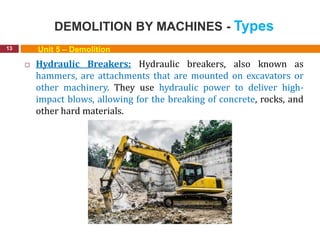
 Hydraulic Breakers: Hydraulic breakers, also known as
hammers, are attachments that are mounted on excavators or
other machinery. They use hydraulic power to deliver high-
impact blows, allowing for the breaking of concrete, rocks, and
other hard materials.
DEMOLITION BY MACHINES - Types
14 Unit 5 – Demolition
 Shears: Shears are attachments that can be fitted onto
excavators or other machinery. They are designed to cut
through metal structures such as beams, columns, or steel
frames during demolition. Shears are commonly used in
selective demolition where precise cutting is required.
DEMOLITION BY MACHINES - Types
15 Unit 5 – Demolition
 Grapples: Grapples are large claw-like attachments that can be
attached to excavators or cranes. They are used to grab and
handle debris, making it easier to remove and clear the site.
DEMOLITION BY MACHINES – Advantages &
Benefits
16 Unit 5 – Demolition
• Efficiency
• Precision
• Safety
• Structural
Integrity
• Dust and Noise
Control
• Waste
Management
• Cost-
Effectiveness
Advantages
& Benefits
DEMOLITION BY EXPLOSIVES
17 Unit 5 – Demolition
 Demolition by explosives, also known as controlled demolition,
is a method used to dismantle structures using carefully placed
explosives.
 It involves strategically placing explosives at key structural
points within a building to induce a rapid and controlled
collapse.
 This technique is employed when traditional methods, such as
manual or mechanical demolition, are impractical or time-
consuming.
 By using explosives, structures can be brought down quickly,
saving time and reducing labor costs.
DEMOLITION BY EXPLOSIVES
18 Unit 5 – Demolition
DEMOLITION BY EXPLOSIVES - Types
19 Unit 5 – Demolition
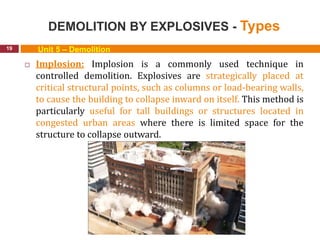
 Implosion: Implosion is a commonly used technique in
controlled demolition. Explosives are strategically placed at
critical structural points, such as columns or load-bearing walls,
to cause the building to collapse inward on itself. This method is
particularly useful for tall buildings or structures located in
congested urban areas where there is limited space for the
structure to collapse outward.
DEMOLITION BY EXPLOSIVES - Types
20 Unit 5 – Demolition
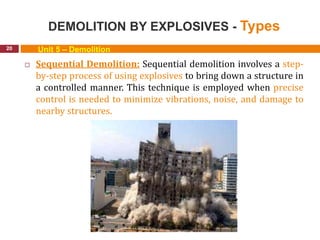
 Sequential Demolition: Sequential demolition involves a step-
by-step process of using explosives to bring down a structure in
a controlled manner. This technique is employed when precise
control is needed to minimize vibrations, noise, and damage to
nearby structures.
DEMOLITION BY EXPLOSIVES - Types
21 Unit 5 – Demolition
 Pre-weakening: In pre-weakening, explosives are used to
weaken specific structural elements of a building before the
main demolition. This technique is useful when there is a need
to preserve certain portions of the structure or when the
structure has complex geometry that requires careful planning.
By strategically weakening specific components, the controlled
demolition process becomes more predictable and manageable.
DEMOLITION BY EXPLOSIVES - Advantages
22 Unit 5 – Demolition
Adva
ntage
s
Speed
and
Efficiency
Precision
Safety
Cost-
Effective
ness
Reduced
Environm
ental
Impact
DEMOLITION BY EXPLOSIVES
23 Unit 5 – Demolition
Point to be consider the before demolition by explosives
 Structural Assessment
 Permits and Regulations
 Safety Planning
 Hazardous Materials Identification
 Site Preparation
 Public Safety
 Expertise and Training
 Environmental Considerations
 Monitoring and Contingency Plans
Advanced Demolition Techniques
24 Unit 5 – Demolition
Robotic Machines
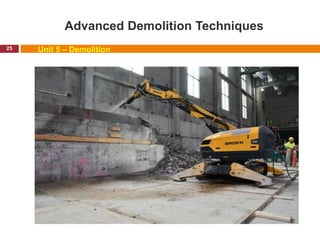
 These techniques involve the use of specialized robotic
equipment, such as excavators, robots, drones, and wire cutting
machines, to carry out demolition tasks.
 Robotic machines are designed to operate remotely or
autonomously, allowing them to access hazardous or hard-to-
reach areas that may be challenging or unsafe for human
workers.
 They are equipped with various attachments, such as hydraulic
hammers, crushers, shears, cutting tools, and wire saws,
enabling them to break down, dismantle, and selectively remove
components of structures.
Advanced Demolition Techniques
25 Unit 5 – Demolition
Advanced Demolition Techniques - Examples
26 Unit 5 – Demolition
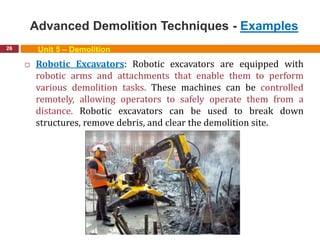
 Robotic Excavators: Robotic excavators are equipped with
robotic arms and attachments that enable them to perform
various demolition tasks. These machines can be controlled
remotely, allowing operators to safely operate them from a
distance. Robotic excavators can be used to break down
structures, remove debris, and clear the demolition site.
Advanced Demolition Techniques - Examples
27 Unit 5 – Demolition
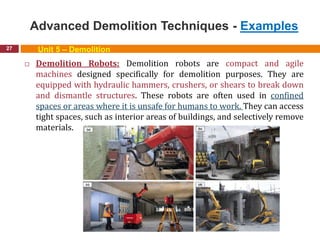
 Demolition Robots: Demolition robots are compact and agile
machines designed specifically for demolition purposes. They are
equipped with hydraulic hammers, crushers, or shears to break down
and dismantle structures. These robots are often used in confined
spaces or areas where it is unsafe for humans to work. They can access
tight spaces, such as interior areas of buildings, and selectively remove
materials.
Advanced Demolition Techniques - Examples
28 Unit 5 – Demolition
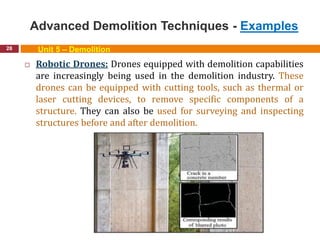
 Robotic Drones: Drones equipped with demolition capabilities
are increasingly being used in the demolition industry. These
drones can be equipped with cutting tools, such as thermal or
laser cutting devices, to remove specific components of a
structure. They can also be used for surveying and inspecting
structures before and after demolition.
Advanced Demolition Techniques - Examples
29 Unit 5 – Demolition
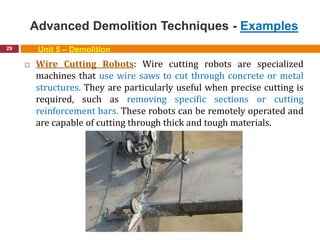
 Wire Cutting Robots: Wire cutting robots are specialized
machines that use wire saws to cut through concrete or metal
structures. They are particularly useful when precise cutting is
required, such as removing specific sections or cutting
reinforcement bars. These robots can be remotely operated and
are capable of cutting through thick and tough materials.
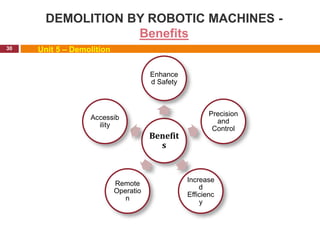
DEMOLITION BY ROBOTIC MACHINES -
Benefits
30 Unit 5 – Demolition
Benefit
s
Enhance
d Safety
Precision
and
Control
Increase
d
Efficienc
y
Remote
Operatio
n
Accessib
ility
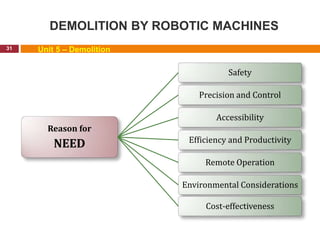
DEMOLITION BY ROBOTIC MACHINES
31 Unit 5 – Demolition
Reason for
NEED
Safety
Precision and Control
Accessibility
Efficiency and Productivity
Remote Operation
Environmental Considerations
Cost-effectiveness
DEMOLITION SEQUENCE
32 Unit 5 – Demolition
DISMANTLING TECHNIQUES
33 Unit 5 – Demolition
Dismantling techniques refer to methods used to carefully and
systematically remove structures or components without causing
damage or disruption to the surrounding environment. These
techniques are often employed when demolition is not feasible or
when preservation or salvage of certain elements is desired.
DISMANTLING TECHNIQUES
34 Unit 5 – Demolition
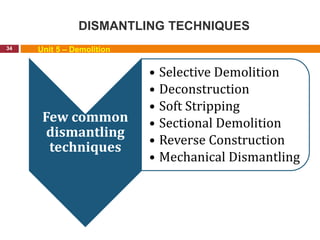
Few common
dismantling
techniques
• Selective Demolition
• Deconstruction
• Soft Stripping
• Sectional Demolition
• Reverse Construction
• Mechanical Dismantling
SAFETY PRECAUTION IN DEMOLITION AND
DISMANTLING
35 Unit 5 – Demolition
Demolition involves the complete or partial removal of structures,
while dismantling focuses on the careful disassembly of
components or elements. These activities require careful planning,
skilled labor, and adherence to safety protocols to ensure the safety
of workers, protect the environment, and prevent damage to
adjacent structures.
The main objective of demolition and dismantling is to safely and
efficiently remove structures or components to make way for new
construction, renovations, or repurposing of land. These processes
involve the use of various techniques, such as mechanical methods,
explosives, robotic machines, or manual dismantling, depending on
the nature and size of the project.
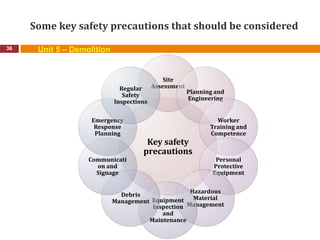
Some key safety precautions that should be considered
36 Unit 5 – Demolition
Key safety
precautions
Site
Assessment
Planning and
Engineering
Worker
Training and
Competence
Personal
Protective
Equipment
Hazardous
Material
Management
Equipment
Inspection
and
Maintenance
Debris
Management
Communicati
on and
Signage
Emergency
Response
Planning
Regular
Safety
Inspections