Industrial Pharmacy-I
Course Code:BP502T
B.Pharm 5th Semester
Unit- I BCS Classification
BY
Rajat Saxena
Assistant Professor
IFTM University, Moradabad
The Biopharmaceutics Classification System
(BCS) is a system to differentiate drugs on
the basis of their solubility and
permeability
BCS (Biopharmaceutical
Classification System)
“The Biopharmaceutical Classification System is a
scientific framework for classifying a drug
substance based on its aqueous solubility &
intestinal permeability & dissolution rate”.
To saved time fast screening is required so drug
substances are classified on basis of solubility
and permeability. This classification is called
Biopharmaceutical Classification System.
The Biopharmaceutical Classification System has
been developed to provide a scientific approach
to allow for to prediction in-vivo
pharmacokinetics of oral immediate release(IR)
drug product by classifying drug compound
based on their,
 1.SOLUBILITY
 2.PERMEABILITY
 3.DISSOLUTION
FACTOR AFFECTING ON BCS
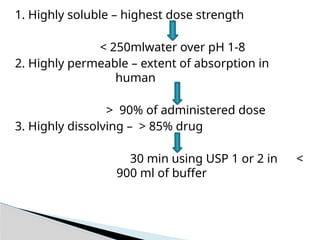
1. Highly soluble – highest dose strength
< 250mlwater over pH 1-8
2. Highly permeable – extent of absorption in
human
> 90% of administered dose
3. Highly dissolving – > 85% drug
30 min using USP 1 or 2 in <
900 ml of buffer
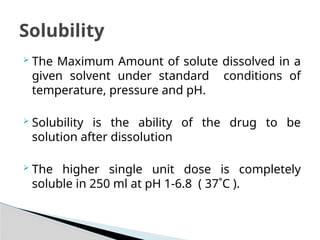
 The Maximum Amount of solute dissolved in a
given solvent under standard conditions of
temperature, pressure and pH.
 Solubility is the ability of the drug to be
solution after dissolution
 The higher single unit dose is completely
soluble in 250 ml at pH 1-6.8 ( 37˚C ).
Solubility
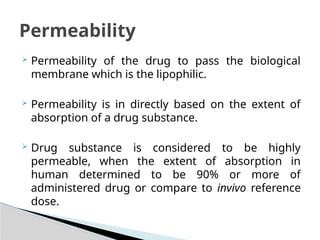
 Permeability of the drug to pass the biological
membrane which is the lipophilic.
 Permeability is in directly based on the extent of
absorption of a drug substance.
 Drug substance is considered to be highly
permeable, when the extent of absorption in
human determined to be 90% or more of
administered drug or compare to invivo reference
dose.
Permeability
 It is process in which solid substance solubilises in given
solvent i.e mass transfer from solid surface to liquid
phase.
 Using USP apparatus I at 100 rpm or USP apparatus II at
50 rpm.
 Dissolution Media [900ml],
1. 1.0.1 N HCl or simulated gastric fluid (pH 1.2) without
enzyme.
2. 2.pH 4.5 buffer & pH 6.8 buffer.
3. 3.Simulated intestinal fluid without enzyme.
Dissolution
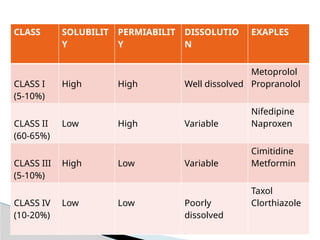
CLASS SOLUBILIT
Y
PERMIABILIT
Y
DISSOLUTIO
N
EXAPLES
CLASS I
(5-10%)
High High Well dissolved
Metoprolol
Propranolol
CLASS II
(60-65%)
Low High Variable
Nifedipine
Naproxen
CLASS III
(5-10%)
High Low Variable
Cimitidine
Metformin
CLASS IV
(10-20%)
Low Low Poorly
dissolved
Taxol
Clorthiazole
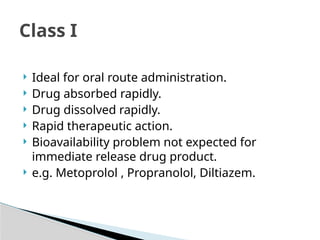
 Ideal for oral route administration.
 Drug absorbed rapidly.
 Drug dissolved rapidly.
 Rapid therapeutic action.
 Bioavailability problem not expected for
immediate release drug product.
 e.g. Metoprolol , Propranolol, Diltiazem.
Class I
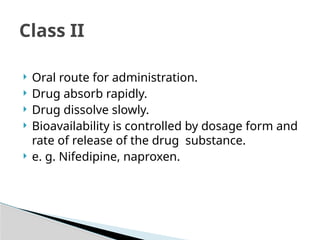
 Oral route for administration.
 Drug absorb rapidly.
 Drug dissolve slowly.
 Bioavailability is controlled by dosage form and
rate of release of the drug substance.
 e. g. Nifedipine, naproxen.
Class II
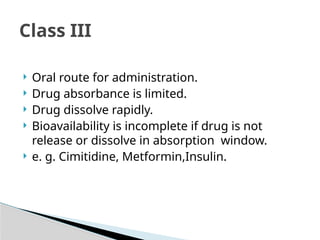
 Oral route for administration.
 Drug absorbance is limited.
 Drug dissolve rapidly.
 Bioavailability is incomplete if drug is not
release or dissolve in absorption window.
 e. g. Cimitidine, Metformin,Insulin.
Class III
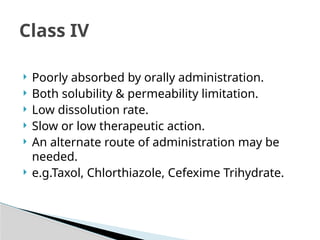
 Poorly absorbed by orally administration.
 Both solubility & permeability limitation.
 Low dissolution rate.
 Slow or low therapeutic action.
 An alternate route of administration may be
needed.
 e.g.Taxol, Chlorthiazole, Cefexime Trihydrate.
Class IV
 To predict in vivo performance of drug product
using solubility and permeability
measurements.
 Aid in earliest stages of drug development
research.
 Help in deciding drug delivery technology.
 For use to bio waiver consideration.
Application
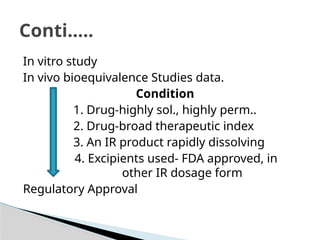
In vitro study
In vivo bioequivalence Studies data.
Condition
1. Drug-highly sol., highly perm..
2. Drug-broad therapeutic index
3. An IR product rapidly dissolving
4. Excipients used- FDA approved, in
other IR dosage form
Regulatory Approval
Conti…..
THANK YOU

Industrial Pharmacy , unit-I BCS Classification

  • 1.
    Industrial Pharmacy-I Course Code:BP502T B.Pharm5th Semester Unit- I BCS Classification BY Rajat Saxena Assistant Professor IFTM University, Moradabad
  • 2.
    The Biopharmaceutics ClassificationSystem (BCS) is a system to differentiate drugs on the basis of their solubility and permeability BCS (Biopharmaceutical Classification System)
  • 3.
    “The Biopharmaceutical ClassificationSystem is a scientific framework for classifying a drug substance based on its aqueous solubility & intestinal permeability & dissolution rate”. To saved time fast screening is required so drug substances are classified on basis of solubility and permeability. This classification is called Biopharmaceutical Classification System.
  • 4.
    The Biopharmaceutical ClassificationSystem has been developed to provide a scientific approach to allow for to prediction in-vivo pharmacokinetics of oral immediate release(IR) drug product by classifying drug compound based on their,  1.SOLUBILITY  2.PERMEABILITY  3.DISSOLUTION FACTOR AFFECTING ON BCS
  • 5.
    1. Highly soluble– highest dose strength < 250mlwater over pH 1-8 2. Highly permeable – extent of absorption in human > 90% of administered dose 3. Highly dissolving – > 85% drug 30 min using USP 1 or 2 in < 900 ml of buffer
  • 6.
     The MaximumAmount of solute dissolved in a given solvent under standard conditions of temperature, pressure and pH.  Solubility is the ability of the drug to be solution after dissolution  The higher single unit dose is completely soluble in 250 ml at pH 1-6.8 ( 37˚C ). Solubility
  • 7.
     Permeability ofthe drug to pass the biological membrane which is the lipophilic.  Permeability is in directly based on the extent of absorption of a drug substance.  Drug substance is considered to be highly permeable, when the extent of absorption in human determined to be 90% or more of administered drug or compare to invivo reference dose. Permeability
  • 8.
     It isprocess in which solid substance solubilises in given solvent i.e mass transfer from solid surface to liquid phase.  Using USP apparatus I at 100 rpm or USP apparatus II at 50 rpm.  Dissolution Media [900ml], 1. 1.0.1 N HCl or simulated gastric fluid (pH 1.2) without enzyme. 2. 2.pH 4.5 buffer & pH 6.8 buffer. 3. 3.Simulated intestinal fluid without enzyme. Dissolution
  • 9.
    CLASS SOLUBILIT Y PERMIABILIT Y DISSOLUTIO N EXAPLES CLASS I (5-10%) HighHigh Well dissolved Metoprolol Propranolol CLASS II (60-65%) Low High Variable Nifedipine Naproxen CLASS III (5-10%) High Low Variable Cimitidine Metformin CLASS IV (10-20%) Low Low Poorly dissolved Taxol Clorthiazole
  • 10.
     Ideal fororal route administration.  Drug absorbed rapidly.  Drug dissolved rapidly.  Rapid therapeutic action.  Bioavailability problem not expected for immediate release drug product.  e.g. Metoprolol , Propranolol, Diltiazem. Class I
  • 11.
     Oral routefor administration.  Drug absorb rapidly.  Drug dissolve slowly.  Bioavailability is controlled by dosage form and rate of release of the drug substance.  e. g. Nifedipine, naproxen. Class II
  • 12.
     Oral routefor administration.  Drug absorbance is limited.  Drug dissolve rapidly.  Bioavailability is incomplete if drug is not release or dissolve in absorption window.  e. g. Cimitidine, Metformin,Insulin. Class III
  • 13.
     Poorly absorbedby orally administration.  Both solubility & permeability limitation.  Low dissolution rate.  Slow or low therapeutic action.  An alternate route of administration may be needed.  e.g.Taxol, Chlorthiazole, Cefexime Trihydrate. Class IV
  • 14.
     To predictin vivo performance of drug product using solubility and permeability measurements.  Aid in earliest stages of drug development research.  Help in deciding drug delivery technology.  For use to bio waiver consideration. Application
  • 15.
    In vitro study Invivo bioequivalence Studies data. Condition 1. Drug-highly sol., highly perm.. 2. Drug-broad therapeutic index 3. An IR product rapidly dissolving 4. Excipients used- FDA approved, in other IR dosage form Regulatory Approval Conti…..
  • 16.