Biopharmaceutical Classification
System [BCS]
By Dr. Manoj Kumar
BIOPHARMACEUTICAL CLASSIFICATION SYSTEM
• The Biopharmaceutical Classification System was first developed by in 1995, by
Amidon et al & his colleagues.
• Definition:
• “The Biopharmaceutical Classification System is a scientific framework for
classifying a drug substance based on its
AQUEOUS SOLUBILITY
INTESTINAL PERMEABILITY
DISSOLUTION RATE
It is a system in which drug is classified on the basis of
SOLUBILITY AND PERMEABILITY
SOLUBILITY
• The Maximum Amount of solute dissolved in a given solvent under standard
conditions of temperature, pressure and pH.
Solubility is the ability of the drug to be solution after dissolution
The higher single unit dose is completely soluble in 250 ml at pH 1- 6.8 ( 37˚C ).
Solubility of drug is seen in the condition that mimics Gastric Juices and
temperature
PERMEABILITY
Permeability of the drug to pass the biological membrane which is the lipophilic.
 Permeability is indirectly based on the extent of absorption of a drug substance
 Drug substance is considered to be highly permeable, when the extent of
absorption in human determined to be 90% or more of administered drug or
compare to in vivo reference dose.
DISSOLUTION
• It is process in which solid substance solubilises in given solvent i.e mass transfer
from solid surface to liquid phase.
.
Dissolution Media [900 ml],
1. 0.1 N HCl or simulated gastric fluid (pH 1.2) without enzyme.
pH 4.5 buffer & pH 6.8 buffer,
Simulated intestinal fluid without enzyme.
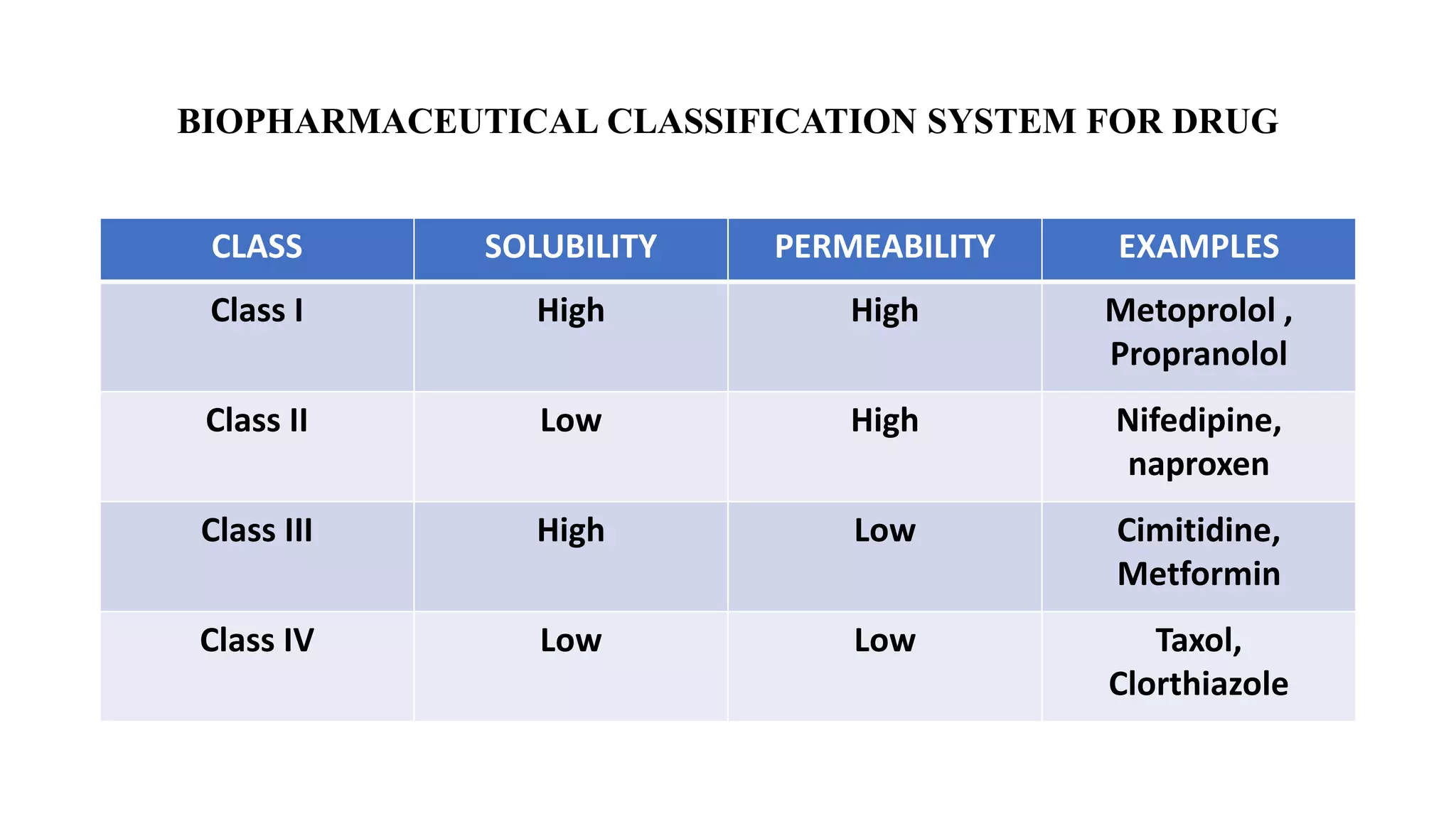
BIOPHARMACEUTICAL CLASSIFICATION SYSTEM FOR DRUG
CLASS SOLUBILITY PERMEABILITY EXAMPLES
Class I High High Metoprolol ,
Propranolol
Class II Low High Nifedipine,
naproxen
Class III High Low Cimitidine,
Metformin
Class IV Low Low Taxol,
Clorthiazole
Class I Drugs
• Ideal for oral route administration.
•  Drug absorbed rapidly.
•  Drug dissolved rapidly.
•  Rapid therapeutic action.
•  Bioavailability problem not expected for immediate release drug product.
•  e.g. Metoprolol , Propranolol, Diltiazem.
Class II Drugs
• Oral route for administration.
•  Drug absorb rapidly.
•  Drug dissolve slowly.
•  Bioavailability is controlled by dosage form and rate of release of the drug
• substance.
•  e. g. Nifedipine, naproxen.
Class III
• Oral route for administration.
•  Drug absorbance is limited.
•  Drug dissolve rapidly.
•  Bioavailability is incomplete if drug is not release or dissolve in absorption
• window.
•  e. g. Cimitidine, Metformin,Insulin.
Class IV Drugs
• Poorly absorbed by orally administration.
•  Both solubility & permeability limitation.
•  Low dissolution rate.
•  Slow or low therapeutic action.
•  An alternate route of administration may be needed.
•  e. g. Taxol, Chlorthiazole, Cefexime Trihydrate.
APPLICATION
• To predict in vivo performance of drug product using solubility and permeability
• measurements.
•  Aid in earliest stages of drug discovery research.
•  To use in biowaiver considerations.
•  For research scientist to decide upon which drug delivery technology to follow or
• develop.
•  Also for the regulation of bioequivalence of the drug product during scale up and
• post approval.
BIOWAIVER
• in vitro instead of in vivo bioequivalence testing”
•  Definition:
It is an exemption from conducting human bioequivalence studies when the active ingredients
meet certain solubility and permeability criteria in vitro and when the dissolution profile of the
dosage form meets the requirements for an IR dosage form.
CRITERIA OF BIOWAIVER
• Rapid and similar dissolution
•  High solubility
•  High permeability
•  Wide therapeutic window
•  Excipient used in dosage form are same as those present in approved drug product
CONCLUSION
• Biopharmaceutical classification system aims to provide regulatory tools for
• replacing certain bio-equivalence studies by accurate in vivo dissolution tests.
•  The in vivo pharmacokinetics of drug depends largely on the solubility and
• permeability.
•  Many laboratories are engaged to find better means to estimates in vivo behavior
• of the drug after oral administration by using simple in vitro dissolution tests.
THANK YOU

Bcs classification of drug

  • 1.
  • 2.
    BIOPHARMACEUTICAL CLASSIFICATION SYSTEM •The Biopharmaceutical Classification System was first developed by in 1995, by Amidon et al & his colleagues. • Definition: • “The Biopharmaceutical Classification System is a scientific framework for classifying a drug substance based on its AQUEOUS SOLUBILITY INTESTINAL PERMEABILITY DISSOLUTION RATE It is a system in which drug is classified on the basis of SOLUBILITY AND PERMEABILITY
  • 3.
    SOLUBILITY • The MaximumAmount of solute dissolved in a given solvent under standard conditions of temperature, pressure and pH. Solubility is the ability of the drug to be solution after dissolution The higher single unit dose is completely soluble in 250 ml at pH 1- 6.8 ( 37˚C ). Solubility of drug is seen in the condition that mimics Gastric Juices and temperature
  • 4.
    PERMEABILITY Permeability of thedrug to pass the biological membrane which is the lipophilic.  Permeability is indirectly based on the extent of absorption of a drug substance  Drug substance is considered to be highly permeable, when the extent of absorption in human determined to be 90% or more of administered drug or compare to in vivo reference dose.
  • 5.
    DISSOLUTION • It isprocess in which solid substance solubilises in given solvent i.e mass transfer from solid surface to liquid phase. . Dissolution Media [900 ml], 1. 0.1 N HCl or simulated gastric fluid (pH 1.2) without enzyme. pH 4.5 buffer & pH 6.8 buffer, Simulated intestinal fluid without enzyme.
  • 6.
    BIOPHARMACEUTICAL CLASSIFICATION SYSTEMFOR DRUG CLASS SOLUBILITY PERMEABILITY EXAMPLES Class I High High Metoprolol , Propranolol Class II Low High Nifedipine, naproxen Class III High Low Cimitidine, Metformin Class IV Low Low Taxol, Clorthiazole
  • 7.
    Class I Drugs •Ideal for oral route administration. •  Drug absorbed rapidly. •  Drug dissolved rapidly. •  Rapid therapeutic action. •  Bioavailability problem not expected for immediate release drug product. •  e.g. Metoprolol , Propranolol, Diltiazem.
  • 8.
    Class II Drugs •Oral route for administration. •  Drug absorb rapidly. •  Drug dissolve slowly. •  Bioavailability is controlled by dosage form and rate of release of the drug • substance. •  e. g. Nifedipine, naproxen.
  • 9.
    Class III • Oralroute for administration. •  Drug absorbance is limited. •  Drug dissolve rapidly. •  Bioavailability is incomplete if drug is not release or dissolve in absorption • window. •  e. g. Cimitidine, Metformin,Insulin.
  • 10.
    Class IV Drugs •Poorly absorbed by orally administration. •  Both solubility & permeability limitation. •  Low dissolution rate. •  Slow or low therapeutic action. •  An alternate route of administration may be needed. •  e. g. Taxol, Chlorthiazole, Cefexime Trihydrate.
  • 11.
    APPLICATION • To predictin vivo performance of drug product using solubility and permeability • measurements. •  Aid in earliest stages of drug discovery research. •  To use in biowaiver considerations. •  For research scientist to decide upon which drug delivery technology to follow or • develop. •  Also for the regulation of bioequivalence of the drug product during scale up and • post approval.
  • 12.
    BIOWAIVER • in vitroinstead of in vivo bioequivalence testing” •  Definition: It is an exemption from conducting human bioequivalence studies when the active ingredients meet certain solubility and permeability criteria in vitro and when the dissolution profile of the dosage form meets the requirements for an IR dosage form.
  • 13.
    CRITERIA OF BIOWAIVER •Rapid and similar dissolution •  High solubility •  High permeability •  Wide therapeutic window •  Excipient used in dosage form are same as those present in approved drug product
  • 14.
    CONCLUSION • Biopharmaceutical classificationsystem aims to provide regulatory tools for • replacing certain bio-equivalence studies by accurate in vivo dissolution tests. •  The in vivo pharmacokinetics of drug depends largely on the solubility and • permeability. •  Many laboratories are engaged to find better means to estimates in vivo behavior • of the drug after oral administration by using simple in vitro dissolution tests.
  • 15.