DOSAGE FORMS
Reshma Fathima K
Assistant Professor
Introduction to dosage forms
Dosage forms are the means by which drug molecules/APIs are delivered to sites of action within the body to produce
optimum desired effects and minimum adverse effect.
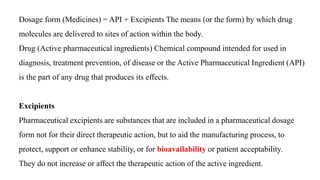
Dosage form (Medicines) = API + Excipients The means (or the form) by which drug
molecules are delivered to sites of action within the body.
Drug (Active pharmaceutical ingredients) Chemical compound intended for used in
diagnosis, treatment prevention, of disease or the Active Pharmaceutical Ingredient (API)
is the part of any drug that produces its effects.
Excipients
Pharmaceutical excipients are substances that are included in a pharmaceutical dosage
form not for their direct therapeutic action, but to aid the manufacturing process, to
protect, support or enhance stability, or for bioavailability or patient acceptability.
They do not increase or affect the therapeutic action of the active ingredient.
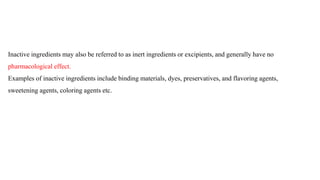
Inactive ingredients may also be referred to as inert ingredients or excipients, and generally have no
pharmacological effect.
Examples of inactive ingredients include binding materials, dyes, preservatives, and flavoring agents,
sweetening agents, coloring agents etc.
Need of Dosage forms
Provide safe and convenient delivery of accurate dosage. Example – Tablets, capsules, syrups
Protection of a drug substances from atmospheric oxygen or moisture. Example – Coated capsules, sealed ampules
Protection of a drug substances from gastric acid after oral administration. Example – Enteric coated tablets
Conceal bitter taste, or odor of a drug substances. Example – Capsules, coated tablets, flavored syrups
Provide liquid preparation of drug that insoluble or unstable in the desired vehicle. Example – Suspension
Provide liquid dosage forms of substances soluble in desired vehicle. Example – Solution.
Provide optional drug action from topical administration sites. Example – Ointment, cream, ear and nasal preparations.
Provide for insertion of a drug into one of the body’s orifices. Example – Rectal and vaginal suppositories.
Provide extended drug action through controlled release mechanisms. Example – Controlled release tablets, capsules,
suspensions.
Provide for the placement of drugs within body tissues. Example – Implants. Provide for the optimal drug action
through inhalation therapy. Example – Inhalants.
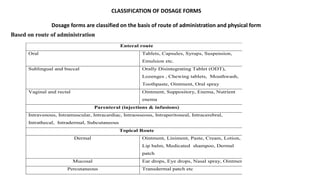
CLASSIFICATION OF DOSAGE FORMS
Dosage forms are classified on the basis of route of administration and physical form
Based on route of administration
Enteral route
Oral Tablets, Capsules, Syrups, Suspension,
Emulsion etc.
Sublingual and buccal Orally Disintegrating Tablet (ODT),
Lozenges , Chewing tablets, Mouthwash,
Toothpaste, Ointment, Oral spray
Vaginal and rectal Ointment, Suppository, Enema, Nutrient
enema
Parenteral (injections & infusions)
Intravenous, Intramuscular, Intracardiac, Intraosseous, Intraperitoneal, Intracerebral,
Intrathecal, Intradermal, Subcutaneous
Topical Route
Dermal Ointment, Liniment, Paste, Cream, Lotion,
Lip balm, Medicated shampoo, Dermal
patch
Mucosal Ear drops, Eye drops, Nasal spray, Ointment
Percutaneous Transdermal patch etc
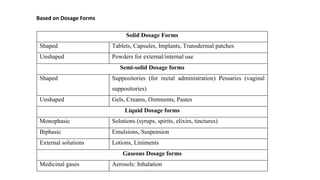
Solid Dosage Forms
Shaped Tablets, Capsules, Implants, Transdermal patches
Unshaped Powders for external/internal use
Semi-solid Dosage forms
Shaped Suppositories (for rectal administration) Pessaries (vaginal
suppositories)
Unshaped Gels, Creams, Ointments, Pastes
Liquid Dosage forms
Monophasic Solutions (syrups, spirits, elixirs, tinctures)
Biphasic Emulsions, Suspension
External solutions Lotions, Liniments
Gaseous Dosage forms
Medicinal gases Aerosols: Inhalation
Based on Dosage Forms
Solid Dosage forms
Tablets
Tablets may be defined as the solid unit dosage form of medicament or medicaments with suitable
excipients. It comprises a mixture of active substances and excipients, usually in powder form,
compressed or compacted from a powder into a solid dose
Buccal and Sublingual tablets
Buccal tablets placing between the gum and the cheek.
Sublingual tablets placing under the tongue.
Medicaments of both systems rapidly dissolve in mouth and absorbed through the mucous
membrane of mouth.
Drug reaches in systemic circulation without affecting by gastric juices and metabolizing
enzymes of the liver.
EFFERVESCENT TABLETS
• Effervescent tablets are uncoated and generally contain acid substances (citric
and tartaric acids) and carbonates or bicarbonates , which react rapidly in
presence of water and release carbon dioxide.
• They are intended to be dissolved or dispersed in water before use, it provide
• Tablet immediately dissolve or dispersed
• Pleasant taste of carbonated drink
• CHEWABLE TABLET
They are tablets that chewed prior to swallowing.
They are designed for administration to children e.g. vitamin products.
CAPSULES
Solid unit dosage form that contain a solid, semi-solid, and liquid fill and a gelatin shell.
They are mainly two types are :
• Hard gelatin capsules used for dry powder ingredients.
• Soft gelatin capsules used for semi-solid and for active ingredients that are dissolved or
suspended in oil.
LOZENGES
• It is a solid preparation that used to medicate the mouth and throat for the slow
administration of indigestion or cough remedies.
• It consisting of sugar and gum, the latter giving strength and cohesiveness to the
lozenge and facilitating slow release of the medicament.
PILLS
• It is a solid oral dosage form which consists of spherical masses prepared from
one or more APIs with inert excipients.
• Pills are now rarely used.
ORAL GRANULES
• They are consisting of solid, dry aggregates of powder particles with irregular
shape often supplied in single-dose sachets.
• Some granules are placed under the tongue and swallowed with water and other
are intended to be dissolved in water before taking.
• Effervescent granules evolve carbon dioxide when added to water
ORAL POWDER
• Bulk Powders are multi dose preparations consisting of solid, loose, dry
particles of varying degrees of fineness.
• Contain one or more active ingredients, with or without excipients and, if
necessary, coloring matter and flavoring substances.
• Usually contain non-potent medicaments such as antacids since the patient
measures a dose by volume using a 5 ml medicine spoon.
ORAL SOLUTION
Oral solutions are clear Liquid preparations for oral use containing one or more active ingredients dissolved in a suitable vehicle.
ORAL EMULSION
• Emulsion is a biphasic liquid preparation, containing two immiscible liquids, one of which is dispersed as minute globules into the
other. The liquid which is converted into minute globules is called as dispersed phase. The liquid in which the globules are
dispersed is called continuous phase.
• o/w
• w/o
LIQUID DOSAGE FORMS
• ORAL SUSPENSION
• Suspensions are the biphasic liquid dosage forms of medicament, in
which the finely divided solid particles ranging from 0.5 to 5.0 micron
are dispersed in a liquid or semisolid vehicle. The solid particles act as
a dispersed phase. Where as the liquid vehicle act as the continuous
phase
SYRUP
It is a concentrated aqueous solution of a sugar, usually sucrose to
which medicaments are added.
Flavored syrups are a convenient form of masking disagreeable tastes.
ELIXIR
It is pleasantly flavored clear liquid oral preparation of potent or
nauseous drugs.
The vehicle may contain a high proportion of ethanol or sucrose
together with antimicrobial preservatives which confers the stability of
the preparation.
MOUTHWASHES
These are similar to gargles but are used for oral hygiene and to treat
infections of the mouth.
LINCTUSES
• It is viscous, liquid oral preparations that are usually prescribed for
the relief of cough. It contain high proportion of syrup and glycerol
which have a demulcent effect on the membranes of the throat.
• The dose volume is small (5ml) and, to prolong the demulcent action,
they should be taken undiluted.
ORAL DROPS
• Oral drops are liquid preparations for oral use that are intended to be
administered in small volumes with the aid of a suitable measuring
device.
• They may be solutions, suspensions or emulsions.
GARGLES
• They are prepared in a concentrated solution with directions for the
patient to dilute with warm water before use.
• They are aqueous solutions used in the prevention or treatment of
throat infections.
LOTIONS
It is mono-phasic liquid preparations (aqueous) for external application
without friction either dabbed on the skin or applied on a suitable
dressing and covered with a water proof dressing to reduce
evaporation.
NASAL DROPS & SPRAYS
Drugs in aqueous solution may be instilled into the nose from a
dropper or from a plastic squeeze bottle.
Used for local effect, e.g. antihistamine, decongestant.
• PAINTS
• Paints are mono-phasic liquids for application to the skin or mucous
membranes.
• Skin paints contain volatile solvent that evaporates quickly to leave a
dry resinous film of medicament.
• Throat paints are more viscous due to a high content of glycerol that
designed to prolong contact of the medicament with the affected site.
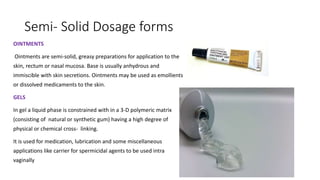
Semi- Solid Dosage forms
OINTMENTS
Ointments are semi-solid, greasy preparations for application to the
skin, rectum or nasal mucosa. Base is usually anhydrous and
immiscible with skin secretions. Ointments may be used as emollients
or dissolved medicaments to the skin.
GELS
In gel a liquid phase is constrained with in a 3-D polymeric matrix
(consisting of natural or synthetic gum) having a high degree of
physical or chemical cross- linking.
It is used for medication, lubrication and some miscellaneous
applications like carrier for spermicidal agents to be used intra
vaginally
CREAMS
• Oil-in-water (O/W)
It composed of small droplets of oil dispersed in a continuous aqueous
phase.
Less greasy and more easily washed off using water.
• Water-in-oil (W/O)
It composed of small droplets of water dispersed in a continuous oily
phase.
• More difficult to handle but used for hydrophobic drug preparation.
PASTES
• Pastes are basically ointments into which a high percentage of
insoluble solid has been added.
• The extra ordinary amount of particulate matter stiffens the system.
• It provide less heating and penetration than ointment.
• It make good protective barrier when placed on the skin, the solid
they contain can absorb and thereby neutralize certain noxious
chemicals before they ever reach the skin.
SUPPOSITORY
It is a semi solid medicated mass, usually cone shaped, that is inserted
either into the rectum, vagina where it melts at body temperature.
ENEMA
An enema is the procedure of introducing liquids into the rectum and
colon via the anus.

Dosage forms

  • 1.
    DOSAGE FORMS Reshma FathimaK Assistant Professor
  • 2.
    Introduction to dosageforms Dosage forms are the means by which drug molecules/APIs are delivered to sites of action within the body to produce optimum desired effects and minimum adverse effect.
  • 3.
    Dosage form (Medicines)= API + Excipients The means (or the form) by which drug molecules are delivered to sites of action within the body. Drug (Active pharmaceutical ingredients) Chemical compound intended for used in diagnosis, treatment prevention, of disease or the Active Pharmaceutical Ingredient (API) is the part of any drug that produces its effects. Excipients Pharmaceutical excipients are substances that are included in a pharmaceutical dosage form not for their direct therapeutic action, but to aid the manufacturing process, to protect, support or enhance stability, or for bioavailability or patient acceptability. They do not increase or affect the therapeutic action of the active ingredient.
  • 4.
    Inactive ingredients mayalso be referred to as inert ingredients or excipients, and generally have no pharmacological effect. Examples of inactive ingredients include binding materials, dyes, preservatives, and flavoring agents, sweetening agents, coloring agents etc.
  • 5.
    Need of Dosageforms Provide safe and convenient delivery of accurate dosage. Example – Tablets, capsules, syrups Protection of a drug substances from atmospheric oxygen or moisture. Example – Coated capsules, sealed ampules Protection of a drug substances from gastric acid after oral administration. Example – Enteric coated tablets Conceal bitter taste, or odor of a drug substances. Example – Capsules, coated tablets, flavored syrups Provide liquid preparation of drug that insoluble or unstable in the desired vehicle. Example – Suspension Provide liquid dosage forms of substances soluble in desired vehicle. Example – Solution. Provide optional drug action from topical administration sites. Example – Ointment, cream, ear and nasal preparations. Provide for insertion of a drug into one of the body’s orifices. Example – Rectal and vaginal suppositories. Provide extended drug action through controlled release mechanisms. Example – Controlled release tablets, capsules, suspensions. Provide for the placement of drugs within body tissues. Example – Implants. Provide for the optimal drug action through inhalation therapy. Example – Inhalants.
  • 7.
    CLASSIFICATION OF DOSAGEFORMS Dosage forms are classified on the basis of route of administration and physical form Based on route of administration Enteral route Oral Tablets, Capsules, Syrups, Suspension, Emulsion etc. Sublingual and buccal Orally Disintegrating Tablet (ODT), Lozenges , Chewing tablets, Mouthwash, Toothpaste, Ointment, Oral spray Vaginal and rectal Ointment, Suppository, Enema, Nutrient enema Parenteral (injections & infusions) Intravenous, Intramuscular, Intracardiac, Intraosseous, Intraperitoneal, Intracerebral, Intrathecal, Intradermal, Subcutaneous Topical Route Dermal Ointment, Liniment, Paste, Cream, Lotion, Lip balm, Medicated shampoo, Dermal patch Mucosal Ear drops, Eye drops, Nasal spray, Ointment Percutaneous Transdermal patch etc
  • 8.
    Solid Dosage Forms ShapedTablets, Capsules, Implants, Transdermal patches Unshaped Powders for external/internal use Semi-solid Dosage forms Shaped Suppositories (for rectal administration) Pessaries (vaginal suppositories) Unshaped Gels, Creams, Ointments, Pastes Liquid Dosage forms Monophasic Solutions (syrups, spirits, elixirs, tinctures) Biphasic Emulsions, Suspension External solutions Lotions, Liniments Gaseous Dosage forms Medicinal gases Aerosols: Inhalation Based on Dosage Forms
  • 10.
    Solid Dosage forms Tablets Tabletsmay be defined as the solid unit dosage form of medicament or medicaments with suitable excipients. It comprises a mixture of active substances and excipients, usually in powder form, compressed or compacted from a powder into a solid dose Buccal and Sublingual tablets Buccal tablets placing between the gum and the cheek. Sublingual tablets placing under the tongue. Medicaments of both systems rapidly dissolve in mouth and absorbed through the mucous membrane of mouth. Drug reaches in systemic circulation without affecting by gastric juices and metabolizing enzymes of the liver.
  • 11.
    EFFERVESCENT TABLETS • Effervescenttablets are uncoated and generally contain acid substances (citric and tartaric acids) and carbonates or bicarbonates , which react rapidly in presence of water and release carbon dioxide. • They are intended to be dissolved or dispersed in water before use, it provide • Tablet immediately dissolve or dispersed • Pleasant taste of carbonated drink
  • 12.
    • CHEWABLE TABLET Theyare tablets that chewed prior to swallowing. They are designed for administration to children e.g. vitamin products. CAPSULES Solid unit dosage form that contain a solid, semi-solid, and liquid fill and a gelatin shell. They are mainly two types are : • Hard gelatin capsules used for dry powder ingredients. • Soft gelatin capsules used for semi-solid and for active ingredients that are dissolved or suspended in oil.
  • 13.
    LOZENGES • It isa solid preparation that used to medicate the mouth and throat for the slow administration of indigestion or cough remedies. • It consisting of sugar and gum, the latter giving strength and cohesiveness to the lozenge and facilitating slow release of the medicament. PILLS • It is a solid oral dosage form which consists of spherical masses prepared from one or more APIs with inert excipients. • Pills are now rarely used.
  • 14.
    ORAL GRANULES • Theyare consisting of solid, dry aggregates of powder particles with irregular shape often supplied in single-dose sachets. • Some granules are placed under the tongue and swallowed with water and other are intended to be dissolved in water before taking. • Effervescent granules evolve carbon dioxide when added to water
  • 15.
    ORAL POWDER • BulkPowders are multi dose preparations consisting of solid, loose, dry particles of varying degrees of fineness. • Contain one or more active ingredients, with or without excipients and, if necessary, coloring matter and flavoring substances. • Usually contain non-potent medicaments such as antacids since the patient measures a dose by volume using a 5 ml medicine spoon.
  • 16.
    ORAL SOLUTION Oral solutionsare clear Liquid preparations for oral use containing one or more active ingredients dissolved in a suitable vehicle. ORAL EMULSION • Emulsion is a biphasic liquid preparation, containing two immiscible liquids, one of which is dispersed as minute globules into the other. The liquid which is converted into minute globules is called as dispersed phase. The liquid in which the globules are dispersed is called continuous phase. • o/w • w/o LIQUID DOSAGE FORMS
  • 17.
    • ORAL SUSPENSION •Suspensions are the biphasic liquid dosage forms of medicament, in which the finely divided solid particles ranging from 0.5 to 5.0 micron are dispersed in a liquid or semisolid vehicle. The solid particles act as a dispersed phase. Where as the liquid vehicle act as the continuous phase
  • 18.
    SYRUP It is aconcentrated aqueous solution of a sugar, usually sucrose to which medicaments are added. Flavored syrups are a convenient form of masking disagreeable tastes. ELIXIR It is pleasantly flavored clear liquid oral preparation of potent or nauseous drugs. The vehicle may contain a high proportion of ethanol or sucrose together with antimicrobial preservatives which confers the stability of the preparation.
  • 19.
    MOUTHWASHES These are similarto gargles but are used for oral hygiene and to treat infections of the mouth. LINCTUSES • It is viscous, liquid oral preparations that are usually prescribed for the relief of cough. It contain high proportion of syrup and glycerol which have a demulcent effect on the membranes of the throat. • The dose volume is small (5ml) and, to prolong the demulcent action, they should be taken undiluted.
  • 20.
    ORAL DROPS • Oraldrops are liquid preparations for oral use that are intended to be administered in small volumes with the aid of a suitable measuring device. • They may be solutions, suspensions or emulsions. GARGLES • They are prepared in a concentrated solution with directions for the patient to dilute with warm water before use. • They are aqueous solutions used in the prevention or treatment of throat infections.
  • 21.
    LOTIONS It is mono-phasicliquid preparations (aqueous) for external application without friction either dabbed on the skin or applied on a suitable dressing and covered with a water proof dressing to reduce evaporation. NASAL DROPS & SPRAYS Drugs in aqueous solution may be instilled into the nose from a dropper or from a plastic squeeze bottle. Used for local effect, e.g. antihistamine, decongestant.
  • 22.
    • PAINTS • Paintsare mono-phasic liquids for application to the skin or mucous membranes. • Skin paints contain volatile solvent that evaporates quickly to leave a dry resinous film of medicament. • Throat paints are more viscous due to a high content of glycerol that designed to prolong contact of the medicament with the affected site.
  • 24.
    Semi- Solid Dosageforms OINTMENTS Ointments are semi-solid, greasy preparations for application to the skin, rectum or nasal mucosa. Base is usually anhydrous and immiscible with skin secretions. Ointments may be used as emollients or dissolved medicaments to the skin. GELS In gel a liquid phase is constrained with in a 3-D polymeric matrix (consisting of natural or synthetic gum) having a high degree of physical or chemical cross- linking. It is used for medication, lubrication and some miscellaneous applications like carrier for spermicidal agents to be used intra vaginally
  • 25.
    CREAMS • Oil-in-water (O/W) Itcomposed of small droplets of oil dispersed in a continuous aqueous phase. Less greasy and more easily washed off using water. • Water-in-oil (W/O) It composed of small droplets of water dispersed in a continuous oily phase. • More difficult to handle but used for hydrophobic drug preparation.
  • 26.
    PASTES • Pastes arebasically ointments into which a high percentage of insoluble solid has been added. • The extra ordinary amount of particulate matter stiffens the system. • It provide less heating and penetration than ointment. • It make good protective barrier when placed on the skin, the solid they contain can absorb and thereby neutralize certain noxious chemicals before they ever reach the skin.
  • 27.
    SUPPOSITORY It is asemi solid medicated mass, usually cone shaped, that is inserted either into the rectum, vagina where it melts at body temperature. ENEMA An enema is the procedure of introducing liquids into the rectum and colon via the anus.