DMS
PRESENTATIO
N
PRESENTED TO DR. B. MANOHAR
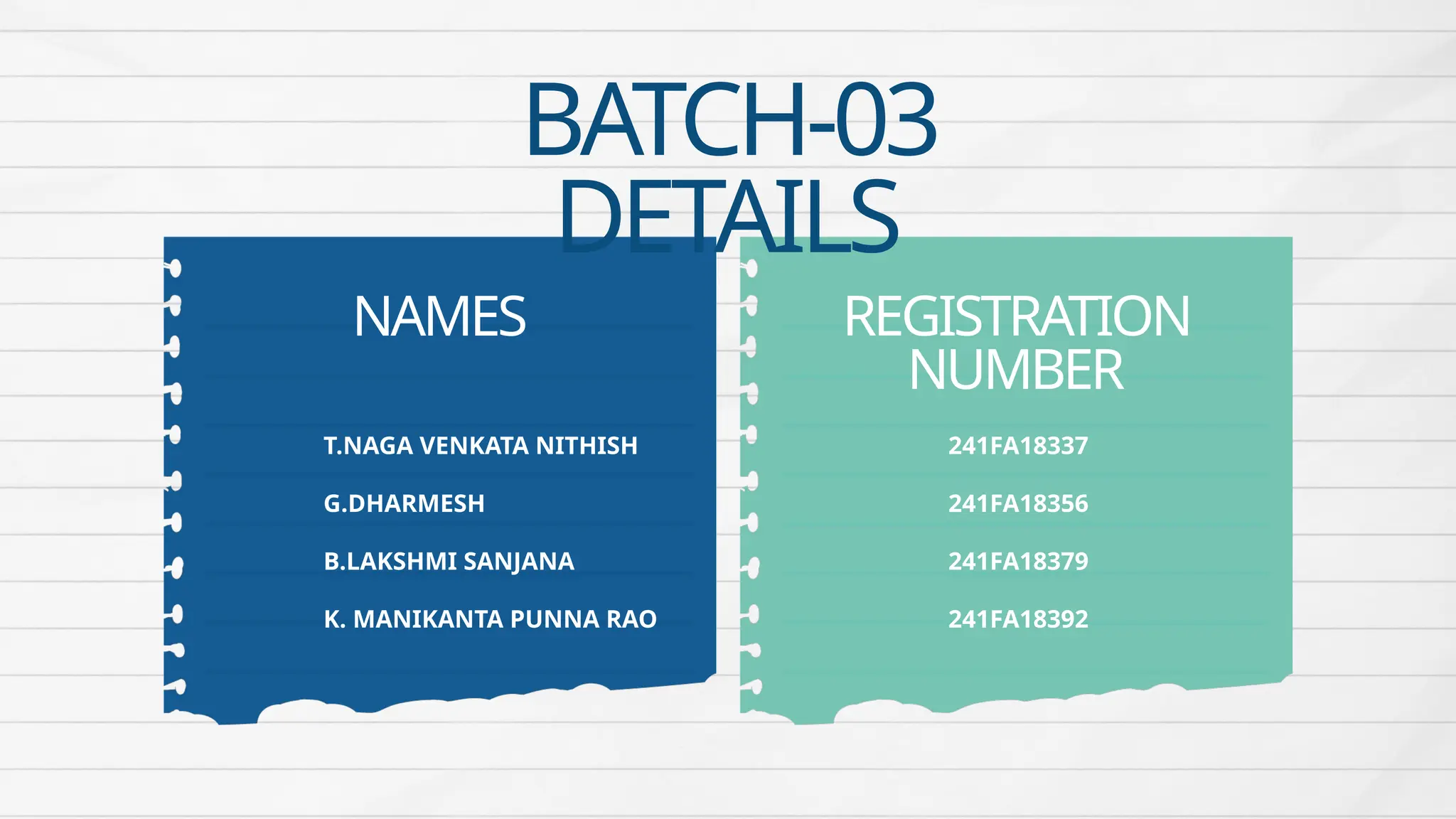
BATCH-03
DETAILS
NAMES
T.NAGA VENKATA NITHISH
G.DHARMESH
B.LAKSHMI SANJANA
K. MANIKANTA PUNNA RAO
REGISTRATION
NUMBER
241FA18337
241FA18356
241FA18379
241FA18392
INTRODUCTIO
N:
•Digital Signal Processing (DSP) relies on
mathematical structures to represent and manipulate
signals.
•A field in discrete mathematics is a set where
addition, subtraction, multiplication, and division
(except by zero) are always possible.
•These properties ensure that DSP operations like
convolution, Fourier transforms, filtering, and
coding are mathematically consistent and reversible.
•Fields such as Real numbers (ℝ), Rational numbers
(Q), and Finite fields (GF(p)) form the backbone of
modern DSP applications in audio, image,
communication, and data storage systems.
QUESTIONS:
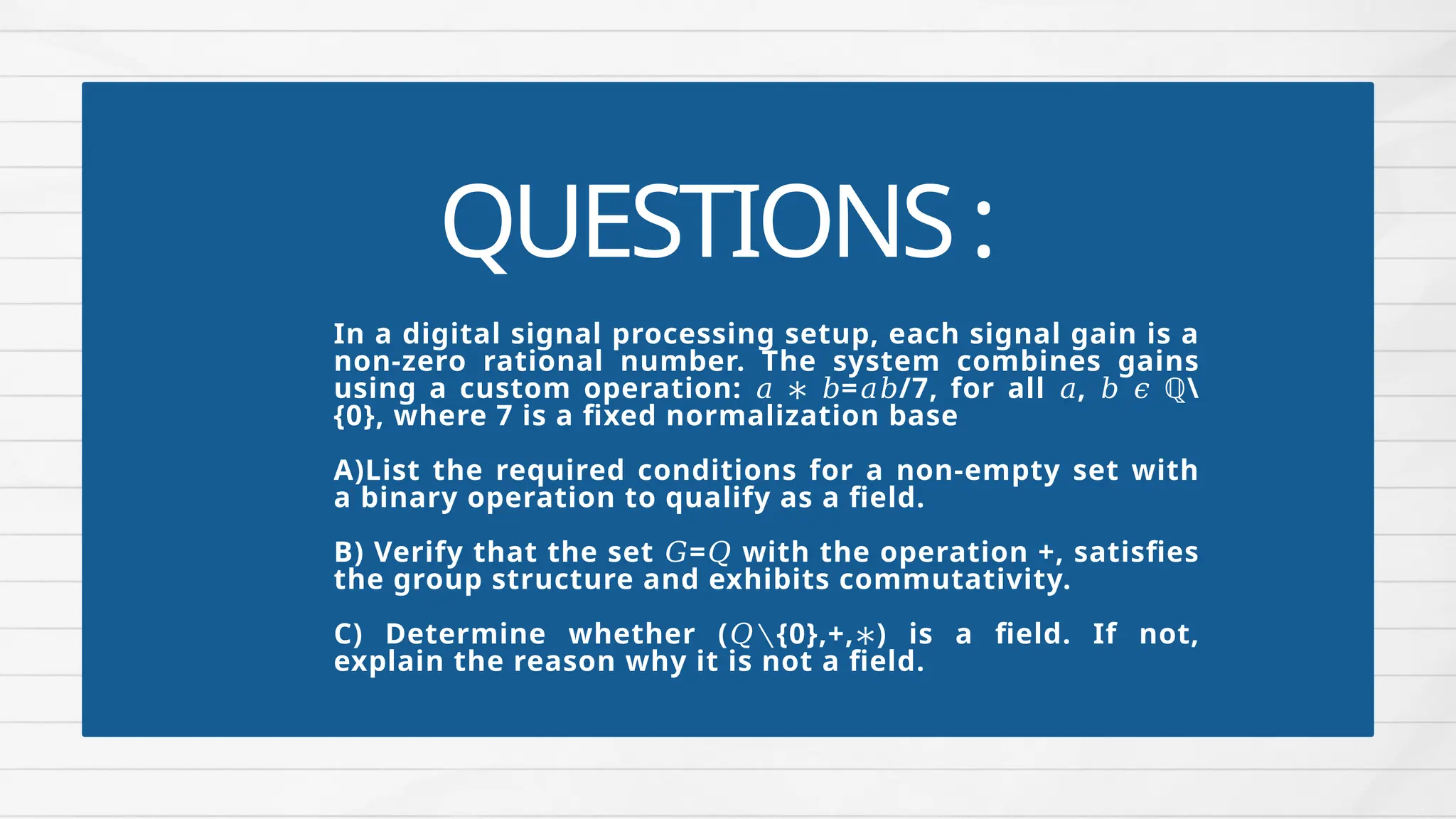
In a digital signal processing setup, each signal gain is a
non-zero rational number. The system combines gains
using a custom operation: = /7, for all , ℚ
𝑎 ∗ 𝑏 𝑎𝑏 𝑎 𝑏 𝜖
{0}, where 7 is a fixed normalization base
A)List the required conditions for a non-empty set with
a binary operation to qualify as a field.
B) Verify that the set = with the operation +, satisfies
𝐺 𝑄
the group structure and exhibits commutativity.
C) Determine whether ( {0},+, ) is a field. If not,
𝑄∖ ∗
explain the reason why it is not a field.
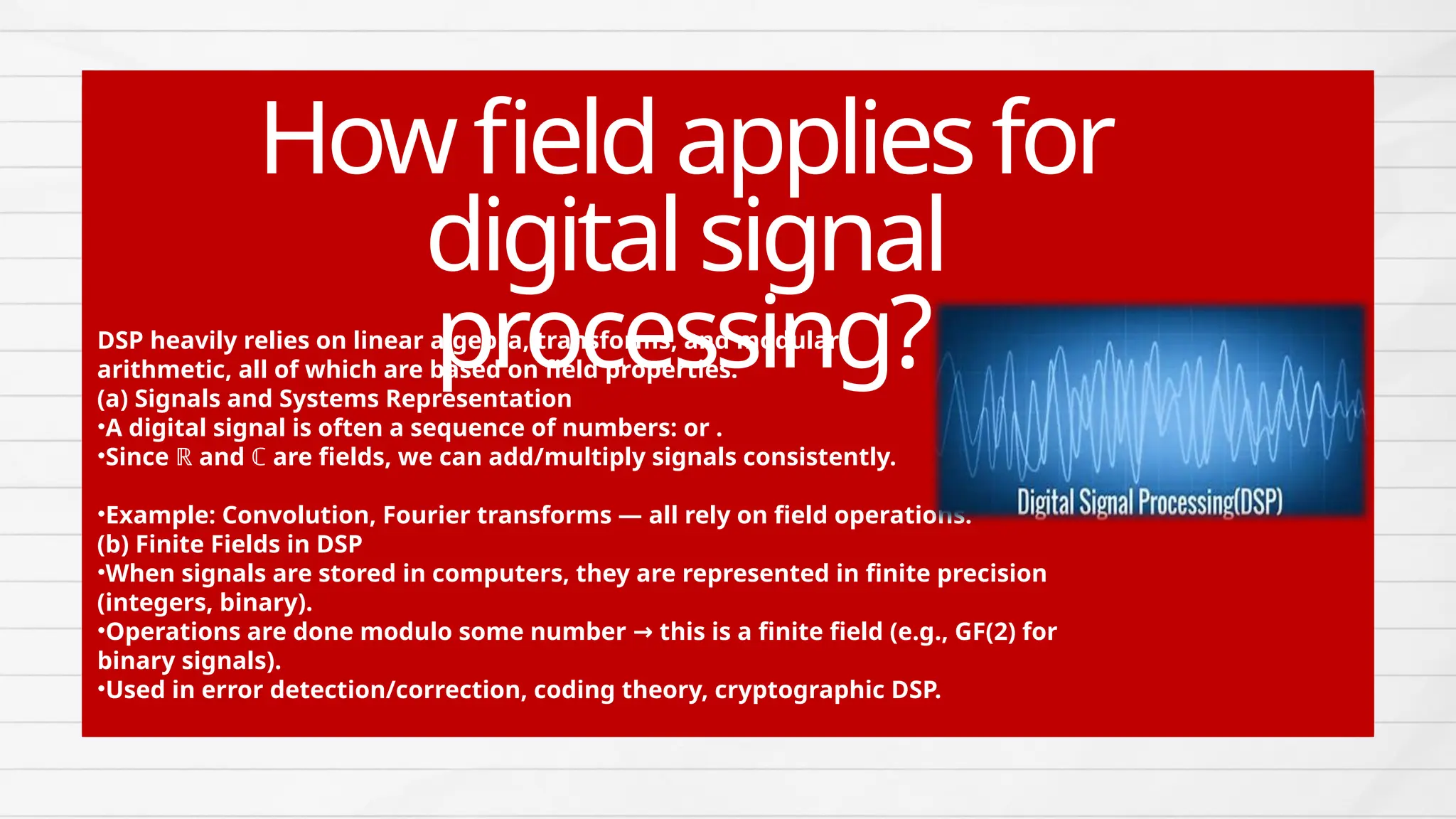
DSP heavily relies on linear algebra, transforms, and modular
arithmetic, all of which are based on field properties.
(a) Signals and Systems Representation
•A digital signal is often a sequence of numbers: or .
•Since ℝ and ℂ are fields, we can add/multiply signals consistently.
•Example: Convolution, Fourier transforms — all rely on field operations.
(b) Finite Fields in DSP
•When signals are stored in computers, they are represented in finite precision
(integers, binary).
•Operations are done modulo some number this is a finite field (e.g., GF(2) for
→
binary signals).
•Used in error detection/correction, coding theory, cryptographic DSP.
Howfieldappliesfor
digitalsignal
processing?
SOMEOF
APPLICATIONS
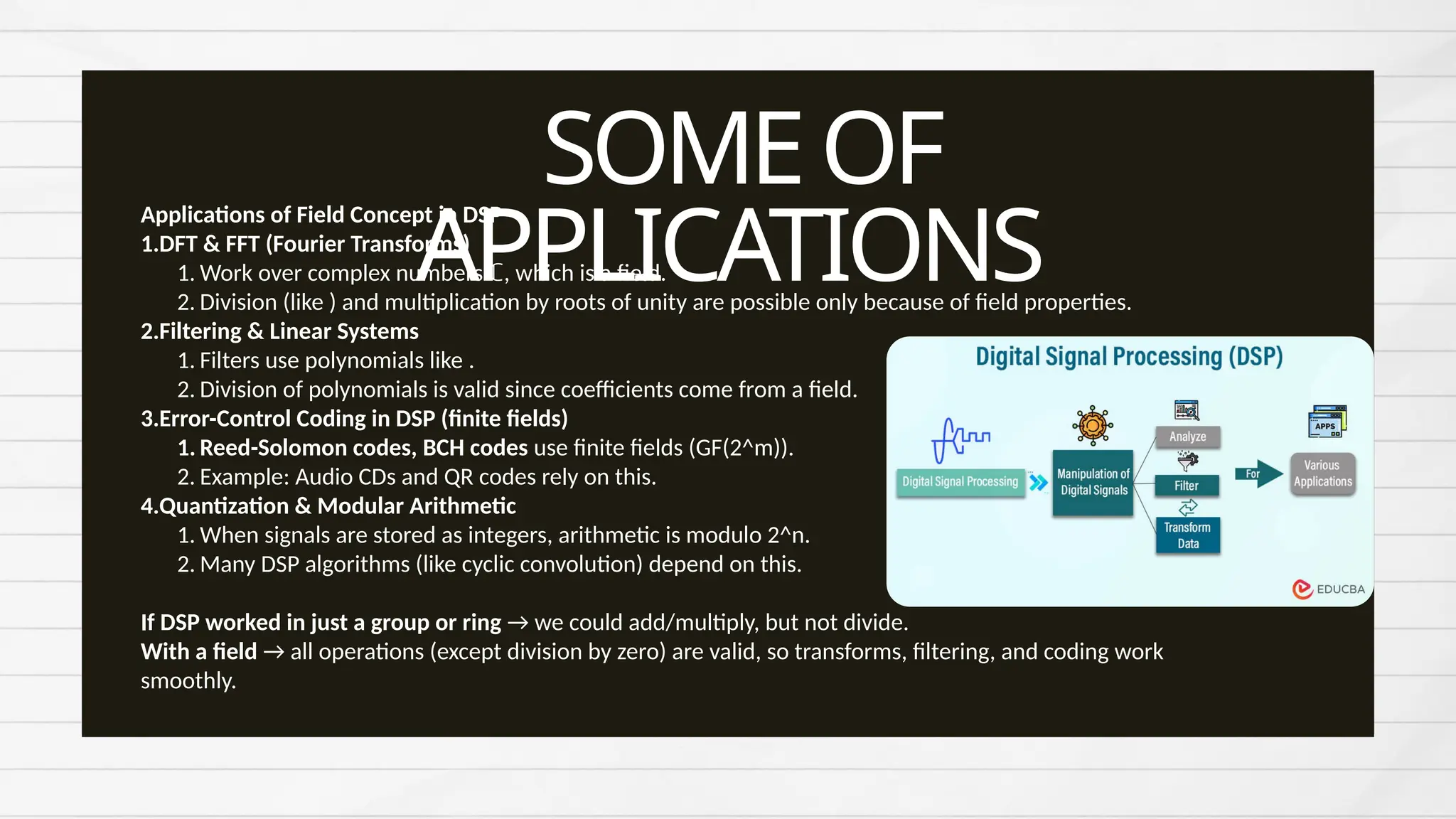
Applications of Field Concept in DSP
1.DFT & FFT (Fourier Transforms)
1. Work over complex numbers ℂ, which is a field.
2. Division (like ) and multiplication by roots of unity are possible only because of field properties.
2.Filtering & Linear Systems
1. Filters use polynomials like .
2. Division of polynomials is valid since coefficients come from a field.
3.Error-Control Coding in DSP (finite fields)
1. Reed-Solomon codes, BCH codes use finite fields (GF(2^m)).
2. Example: Audio CDs and QR codes rely on this.
4.Quantization & Modular Arithmetic
1. When signals are stored as integers, arithmetic is modulo 2^n.
2. Many DSP algorithms (like cyclic convolution) depend on this.
If DSP worked in just a group or ring → we could add/multiply, but not divide.
With a field → all operations (except division by zero) are valid, so transforms, filtering, and coding work
smoothly.
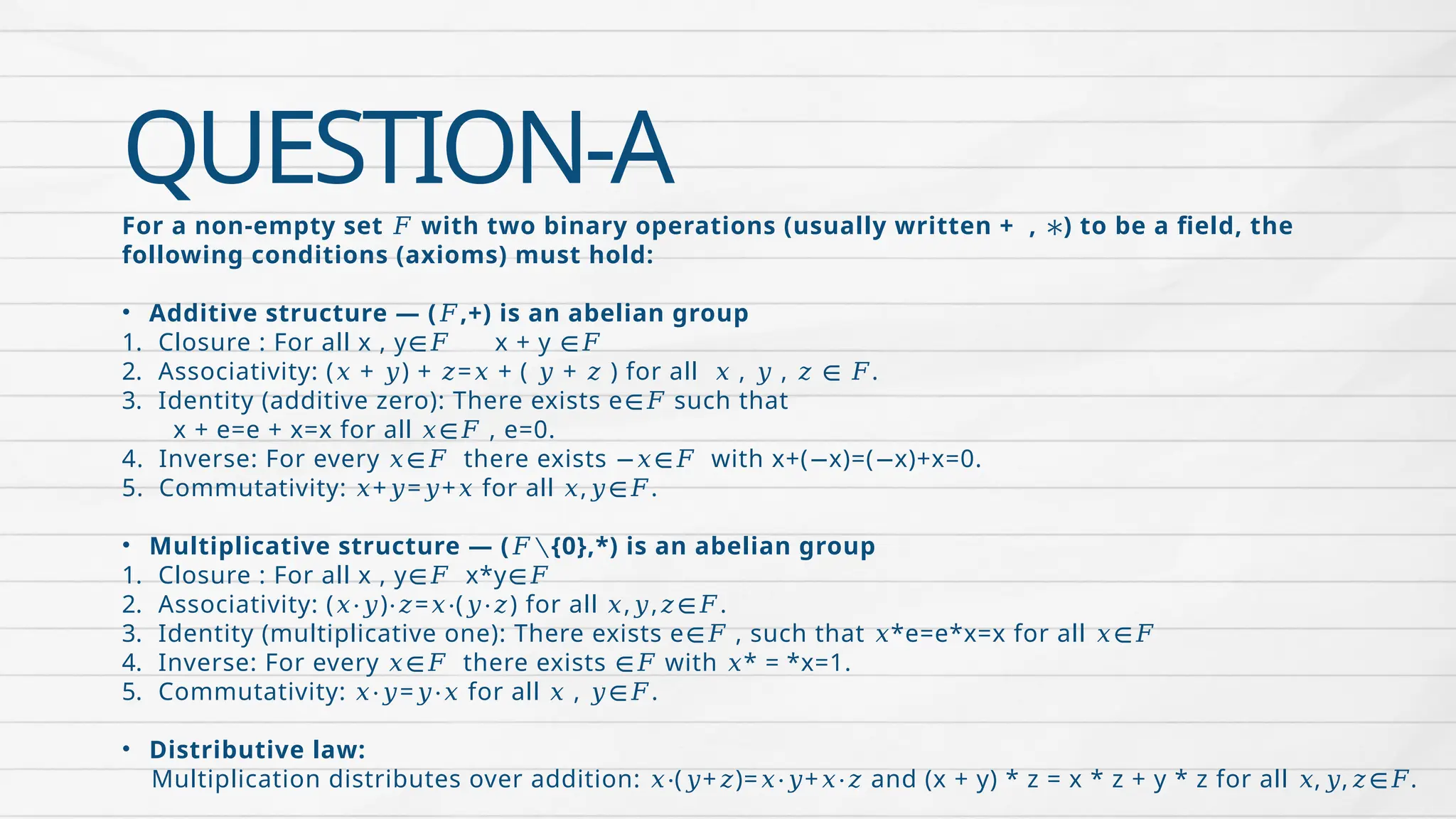
QUESTION-A
For a non-empty set with two binary operations (usually written + , ) to be a field, the
𝐹 ∗
following conditions (axioms) must hold:
• Additive structure — ( ,+) is an abelian group
𝐹
1. Closure : For all x , y x + y
∈𝐹 ∈𝐹
2. Associativity: ( + ) + = + ( + ) for all , , .
𝑥 𝑦 𝑧 𝑥 𝑦 𝑧 𝑥 𝑦 𝑧 ∈ 𝐹
3. Identity (additive zero): There exists e such that
∈𝐹
x + e=e + x=x for all , e=0.
𝑥∈𝐹
4. Inverse: For every there exists with x+( x)=( x)+x=0.
𝑥∈𝐹 −𝑥∈𝐹 − −
5. Commutativity: + = + for all , .
𝑥 𝑦 𝑦 𝑥 𝑥 𝑦∈𝐹
• Multiplicative structure — ( {0},*) is an abelian group
𝐹∖
1. Closure : For all x , y x*y
∈𝐹 ∈𝐹
2. Associativity: ( ) = ( ) for all , , .
𝑥⋅𝑦 ⋅𝑧 𝑥⋅ 𝑦⋅𝑧 𝑥 𝑦 𝑧∈𝐹
3. Identity (multiplicative one): There exists e , such that *e=e*x=x for all
∈𝐹 𝑥 𝑥∈𝐹
4. Inverse: For every there exists with *
𝑥∈𝐹 ∈𝐹 𝑥 = *x=1.
5. Commutativity: = for all , .
𝑥⋅𝑦 𝑦⋅𝑥 𝑥 𝑦∈𝐹
• Distributive law:
Multiplication distributes over addition: ( + )= + and (x + y) * z = x * z + y * z for all , , .
𝑥⋅ 𝑦 𝑧 𝑥⋅𝑦 𝑥⋅𝑧 𝑥 𝑦 𝑧∈𝐹
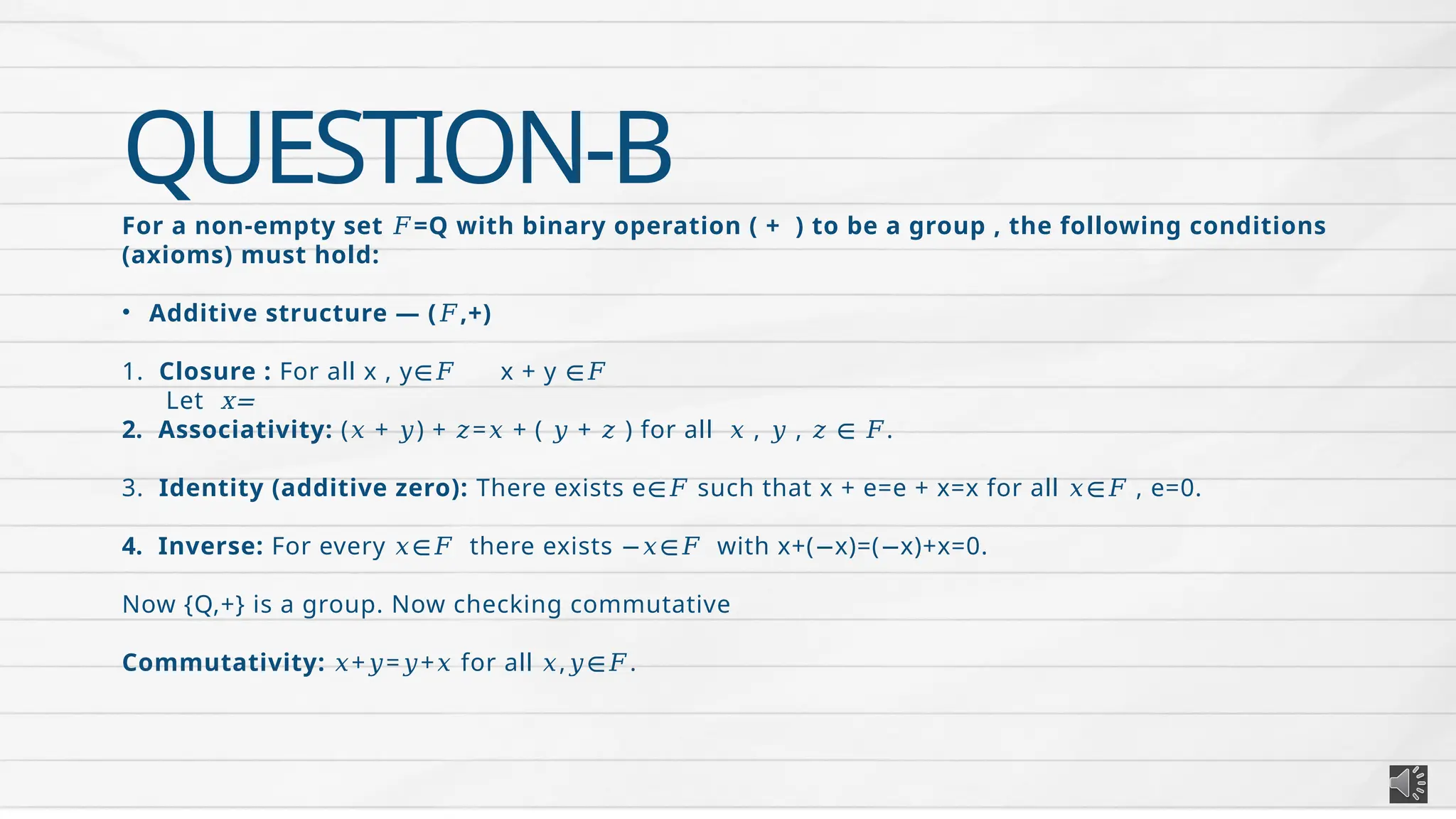
QUESTION-B
For a non-empty set =Q with binary operation ( + ) to be a group , the following conditions
𝐹
(axioms) must hold:
• Additive structure — ( ,+)
𝐹
1. Closure : For all x , y x + y
∈𝐹 ∈𝐹
Let x=
2. Associativity: ( + ) + = + ( + ) for all , , .
𝑥 𝑦 𝑧 𝑥 𝑦 𝑧 𝑥 𝑦 𝑧 ∈ 𝐹
3. Identity (additive zero): There exists e such that x + e=e + x=x for all , e=0.
∈𝐹 𝑥∈𝐹
4. Inverse: For every there exists with x+( x)=( x)+x=0.
𝑥∈𝐹 −𝑥∈𝐹 − −
Now {Q,+} is a group. Now checking commutative
Commutativity: + = + for all , .
𝑥 𝑦 𝑦 𝑥 𝑥 𝑦∈𝐹
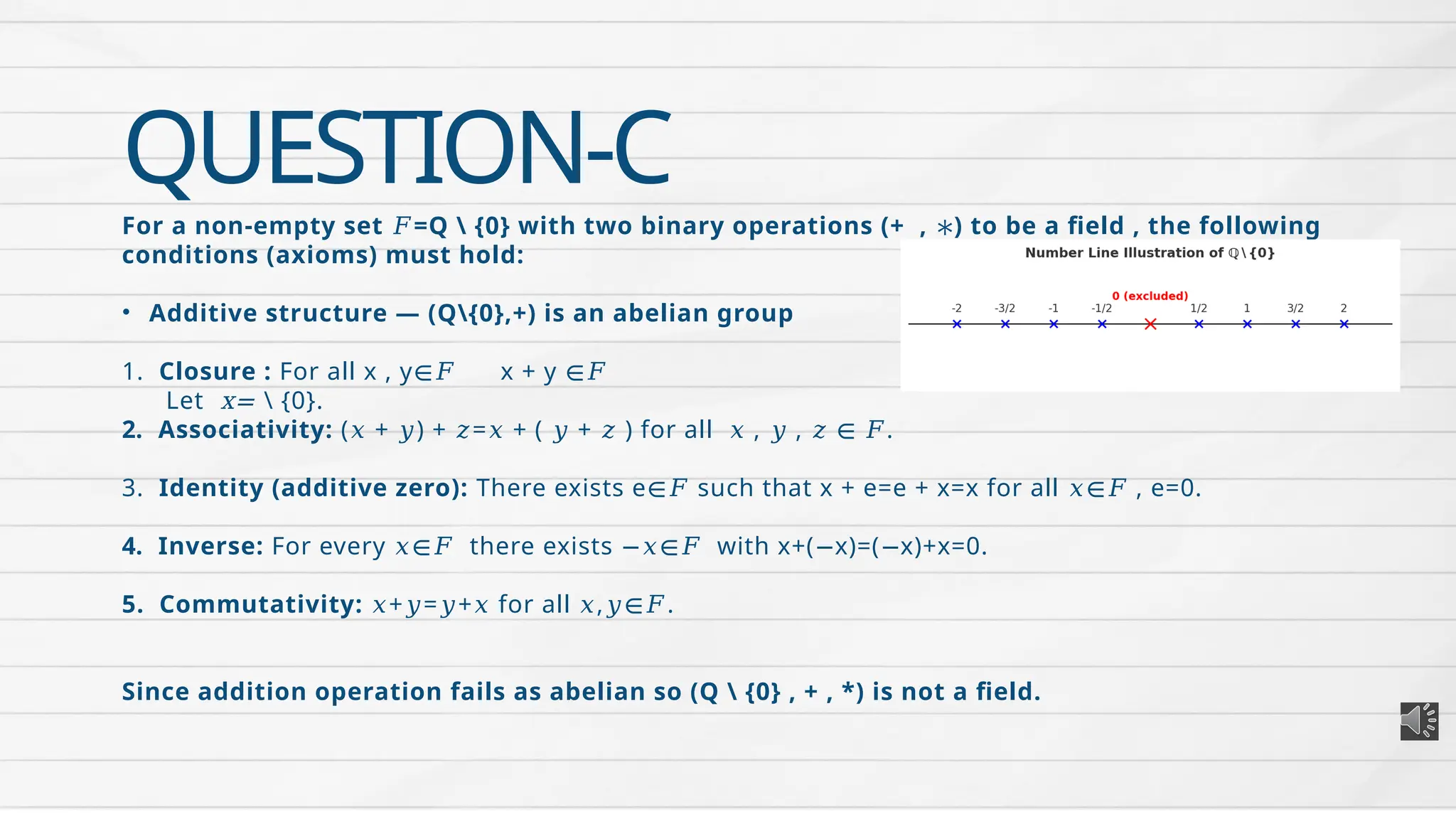
QUESTION-C
For a non-empty set =Q  {0} with two binary operations (+ , ) to be a field , the following
𝐹 ∗
conditions (axioms) must hold:
• Additive structure — (Q{0},+) is an abelian group
1. Closure : For all x , y x + y
∈𝐹 ∈𝐹
Let x=  {0}.
2. Associativity: ( + ) + = + ( + ) for all , , .
𝑥 𝑦 𝑧 𝑥 𝑦 𝑧 𝑥 𝑦 𝑧 ∈ 𝐹
3. Identity (additive zero): There exists e such that x + e=e + x=x for all , e=0.
∈𝐹 𝑥∈𝐹
4. Inverse: For every there exists with x+( x)=( x)+x=0.
𝑥∈𝐹 −𝑥∈𝐹 − −
5. Commutativity: + = + for all , .
𝑥 𝑦 𝑦 𝑥 𝑥 𝑦∈𝐹
Since addition operation fails as abelian so (Q  {0} , + , *) is not a field.
• The field structure provides the algebraic
foundation for all DSP operations.
• Real & Complex fields (ℝ, ℂ): Enable transforms
(DFT/FFT), filtering, and signal analysis.
• Finite fields (GF(p)): Power error detection,
correction, and secure digital communication.
• Without field properties (closure, inverses,
division), many DSP algorithms would not be
consistent or reversible.
• Thus, fields bridge mathematics and real-world
digital signal applications like audio, image,
communication, and data storage.
CONCLUSION
THANK
YOU
VERY
MUCH!

BATCH-03 DMS PPT[1][1] based on performance....pptx

  • 1.
  • 2.
    BATCH-03 DETAILS NAMES T.NAGA VENKATA NITHISH G.DHARMESH B.LAKSHMISANJANA K. MANIKANTA PUNNA RAO REGISTRATION NUMBER 241FA18337 241FA18356 241FA18379 241FA18392
  • 3.
    INTRODUCTIO N: •Digital Signal Processing(DSP) relies on mathematical structures to represent and manipulate signals. •A field in discrete mathematics is a set where addition, subtraction, multiplication, and division (except by zero) are always possible. •These properties ensure that DSP operations like convolution, Fourier transforms, filtering, and coding are mathematically consistent and reversible. •Fields such as Real numbers (ℝ), Rational numbers (Q), and Finite fields (GF(p)) form the backbone of modern DSP applications in audio, image, communication, and data storage systems.
  • 4.
    QUESTIONS: In a digitalsignal processing setup, each signal gain is a non-zero rational number. The system combines gains using a custom operation: = /7, for all , ℚ 𝑎 ∗ 𝑏 𝑎𝑏 𝑎 𝑏 𝜖 {0}, where 7 is a fixed normalization base A)List the required conditions for a non-empty set with a binary operation to qualify as a field. B) Verify that the set = with the operation +, satisfies 𝐺 𝑄 the group structure and exhibits commutativity. C) Determine whether ( {0},+, ) is a field. If not, 𝑄∖ ∗ explain the reason why it is not a field.
  • 5.
    DSP heavily relieson linear algebra, transforms, and modular arithmetic, all of which are based on field properties. (a) Signals and Systems Representation •A digital signal is often a sequence of numbers: or . •Since ℝ and ℂ are fields, we can add/multiply signals consistently. •Example: Convolution, Fourier transforms — all rely on field operations. (b) Finite Fields in DSP •When signals are stored in computers, they are represented in finite precision (integers, binary). •Operations are done modulo some number this is a finite field (e.g., GF(2) for → binary signals). •Used in error detection/correction, coding theory, cryptographic DSP. Howfieldappliesfor digitalsignal processing?
  • 6.
    SOMEOF APPLICATIONS Applications of FieldConcept in DSP 1.DFT & FFT (Fourier Transforms) 1. Work over complex numbers ℂ, which is a field. 2. Division (like ) and multiplication by roots of unity are possible only because of field properties. 2.Filtering & Linear Systems 1. Filters use polynomials like . 2. Division of polynomials is valid since coefficients come from a field. 3.Error-Control Coding in DSP (finite fields) 1. Reed-Solomon codes, BCH codes use finite fields (GF(2^m)). 2. Example: Audio CDs and QR codes rely on this. 4.Quantization & Modular Arithmetic 1. When signals are stored as integers, arithmetic is modulo 2^n. 2. Many DSP algorithms (like cyclic convolution) depend on this. If DSP worked in just a group or ring → we could add/multiply, but not divide. With a field → all operations (except division by zero) are valid, so transforms, filtering, and coding work smoothly.
  • 7.
    QUESTION-A For a non-emptyset with two binary operations (usually written + , ) to be a field, the 𝐹 ∗ following conditions (axioms) must hold: • Additive structure — ( ,+) is an abelian group 𝐹 1. Closure : For all x , y x + y ∈𝐹 ∈𝐹 2. Associativity: ( + ) + = + ( + ) for all , , . 𝑥 𝑦 𝑧 𝑥 𝑦 𝑧 𝑥 𝑦 𝑧 ∈ 𝐹 3. Identity (additive zero): There exists e such that ∈𝐹 x + e=e + x=x for all , e=0. 𝑥∈𝐹 4. Inverse: For every there exists with x+( x)=( x)+x=0. 𝑥∈𝐹 −𝑥∈𝐹 − − 5. Commutativity: + = + for all , . 𝑥 𝑦 𝑦 𝑥 𝑥 𝑦∈𝐹 • Multiplicative structure — ( {0},*) is an abelian group 𝐹∖ 1. Closure : For all x , y x*y ∈𝐹 ∈𝐹 2. Associativity: ( ) = ( ) for all , , . 𝑥⋅𝑦 ⋅𝑧 𝑥⋅ 𝑦⋅𝑧 𝑥 𝑦 𝑧∈𝐹 3. Identity (multiplicative one): There exists e , such that *e=e*x=x for all ∈𝐹 𝑥 𝑥∈𝐹 4. Inverse: For every there exists with * 𝑥∈𝐹 ∈𝐹 𝑥 = *x=1. 5. Commutativity: = for all , . 𝑥⋅𝑦 𝑦⋅𝑥 𝑥 𝑦∈𝐹 • Distributive law: Multiplication distributes over addition: ( + )= + and (x + y) * z = x * z + y * z for all , , . 𝑥⋅ 𝑦 𝑧 𝑥⋅𝑦 𝑥⋅𝑧 𝑥 𝑦 𝑧∈𝐹
  • 8.
    QUESTION-B For a non-emptyset =Q with binary operation ( + ) to be a group , the following conditions 𝐹 (axioms) must hold: • Additive structure — ( ,+) 𝐹 1. Closure : For all x , y x + y ∈𝐹 ∈𝐹 Let x= 2. Associativity: ( + ) + = + ( + ) for all , , . 𝑥 𝑦 𝑧 𝑥 𝑦 𝑧 𝑥 𝑦 𝑧 ∈ 𝐹 3. Identity (additive zero): There exists e such that x + e=e + x=x for all , e=0. ∈𝐹 𝑥∈𝐹 4. Inverse: For every there exists with x+( x)=( x)+x=0. 𝑥∈𝐹 −𝑥∈𝐹 − − Now {Q,+} is a group. Now checking commutative Commutativity: + = + for all , . 𝑥 𝑦 𝑦 𝑥 𝑥 𝑦∈𝐹
  • 9.
    QUESTION-C For a non-emptyset =Q {0} with two binary operations (+ , ) to be a field , the following 𝐹 ∗ conditions (axioms) must hold: • Additive structure — (Q{0},+) is an abelian group 1. Closure : For all x , y x + y ∈𝐹 ∈𝐹 Let x= {0}. 2. Associativity: ( + ) + = + ( + ) for all , , . 𝑥 𝑦 𝑧 𝑥 𝑦 𝑧 𝑥 𝑦 𝑧 ∈ 𝐹 3. Identity (additive zero): There exists e such that x + e=e + x=x for all , e=0. ∈𝐹 𝑥∈𝐹 4. Inverse: For every there exists with x+( x)=( x)+x=0. 𝑥∈𝐹 −𝑥∈𝐹 − − 5. Commutativity: + = + for all , . 𝑥 𝑦 𝑦 𝑥 𝑥 𝑦∈𝐹 Since addition operation fails as abelian so (Q {0} , + , *) is not a field.
  • 10.
    • The fieldstructure provides the algebraic foundation for all DSP operations. • Real & Complex fields (ℝ, ℂ): Enable transforms (DFT/FFT), filtering, and signal analysis. • Finite fields (GF(p)): Power error detection, correction, and secure digital communication. • Without field properties (closure, inverses, division), many DSP algorithms would not be consistent or reversible. • Thus, fields bridge mathematics and real-world digital signal applications like audio, image, communication, and data storage. CONCLUSION
  • 11.