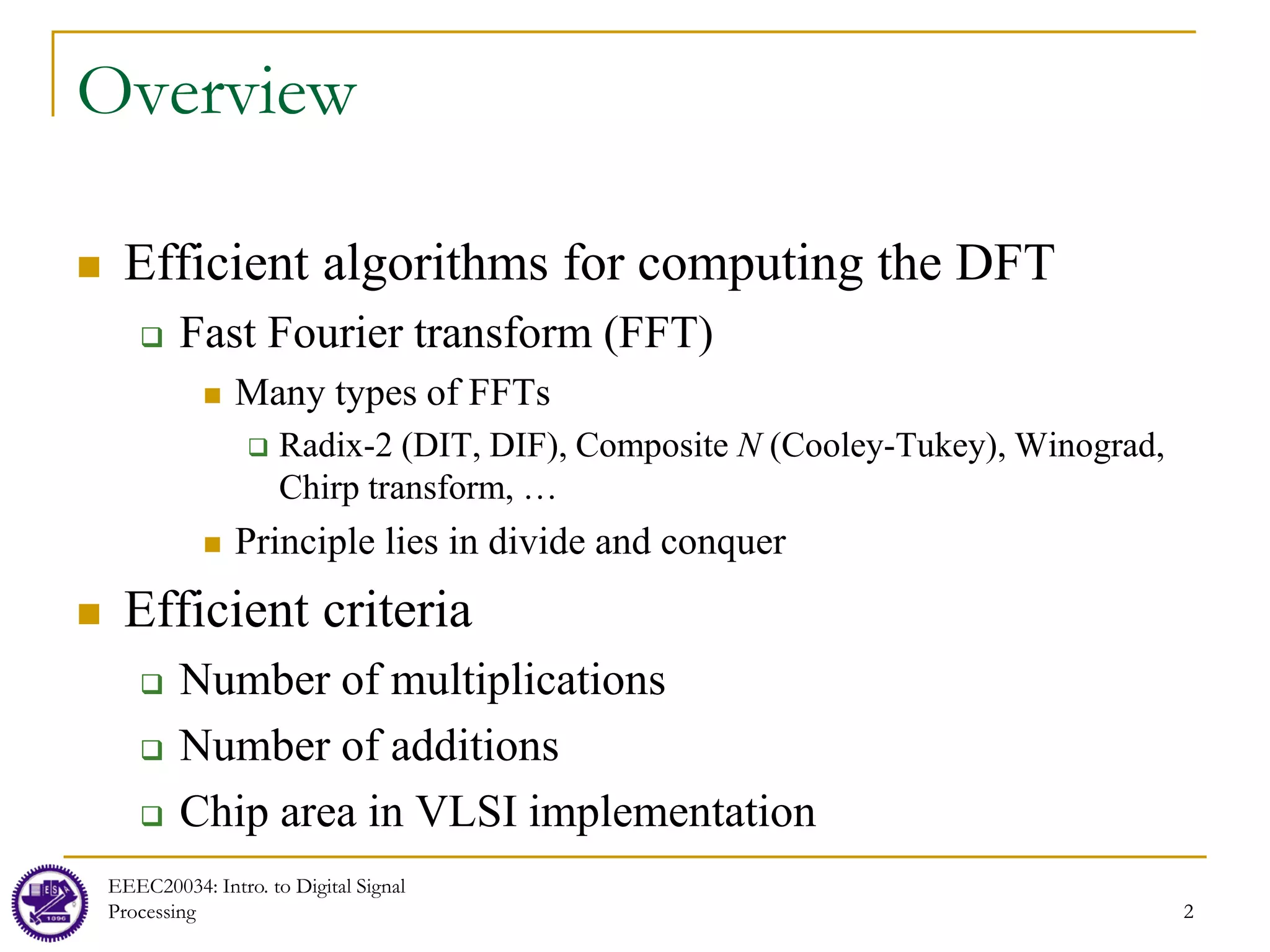
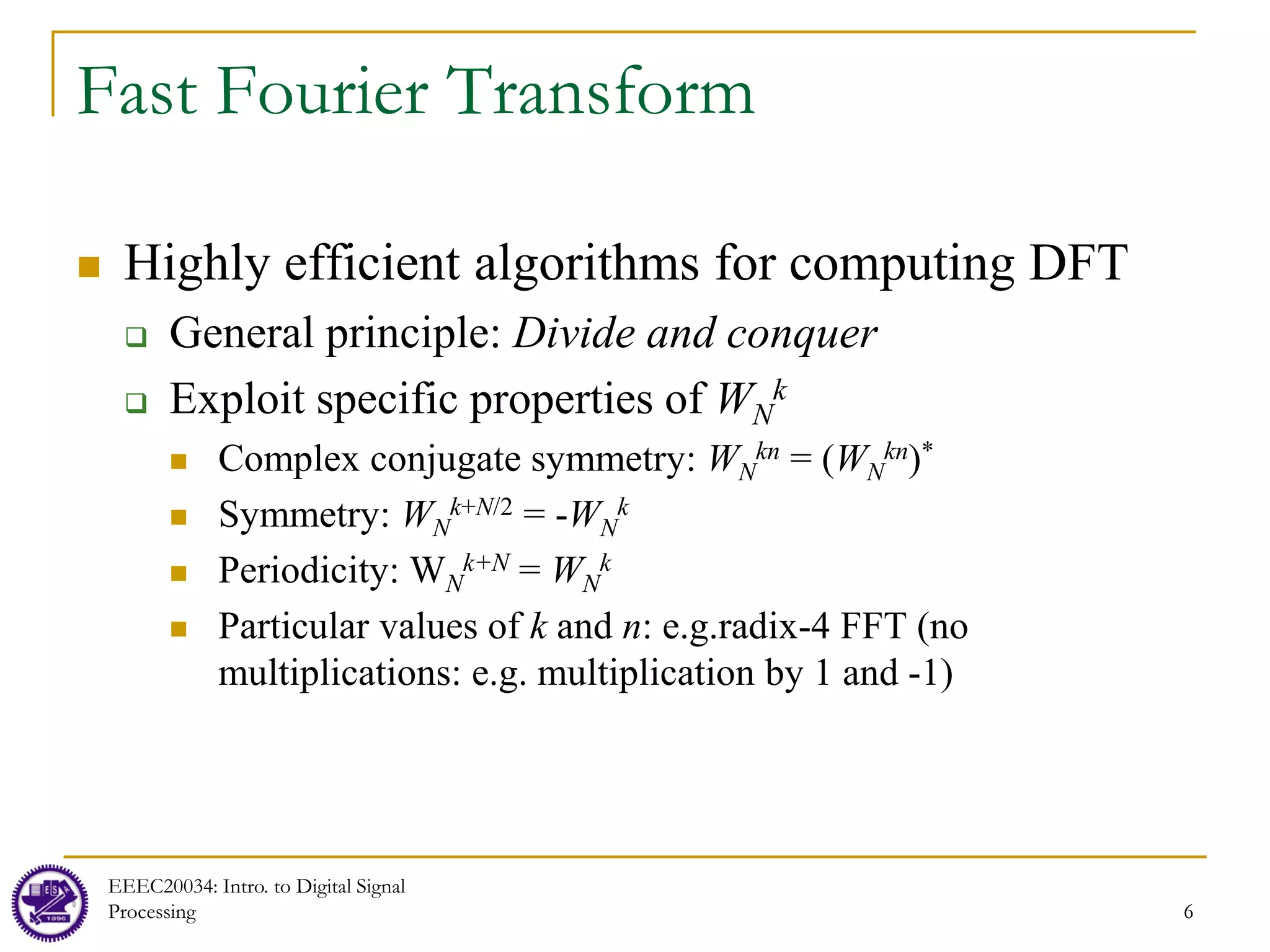
The document discusses computation of the discrete Fourier transform (DFT) and efficient algorithms for computing the DFT, specifically the fast Fourier transform (FFT). It provides an overview of FFTs and notes they are based on a divide and conquer principle. The DFT is described as a linear transformation that can be represented by matrices. Efficient FFT algorithms like the radix-2 algorithm are then presented, showing how an N-point DFT can be broken down into smaller DFTs like N/2-point and N/4-point DFTs, reducing the computational complexity from O(N^2) to O(NlogN).
![3
DFT as a Linear Transformation
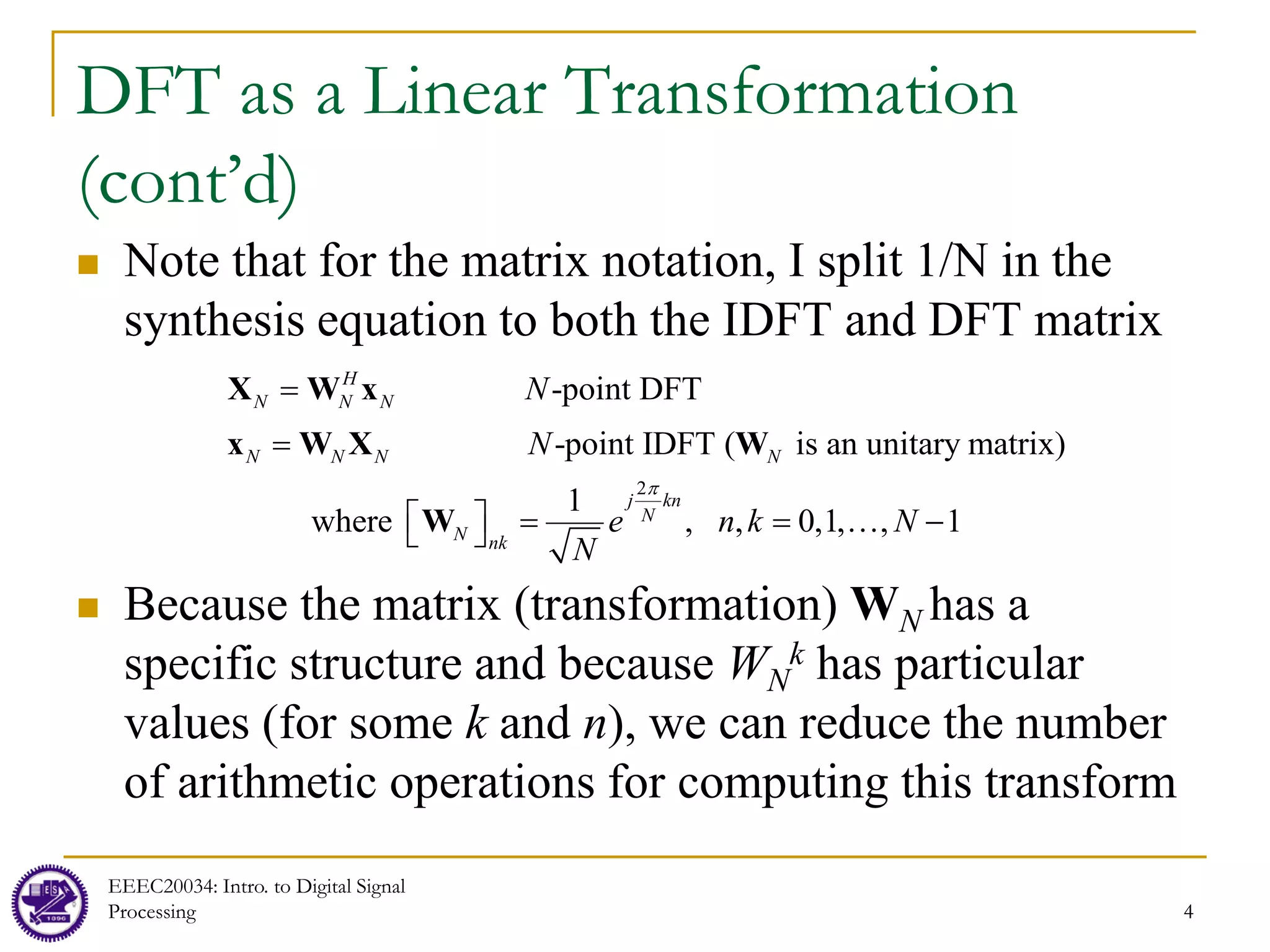
Recall that the DFT can be regarded as linear transformation
Can be computed using matrices
DFT:
Let
and
EEEC20034: Intro. to Digital Signal
Processing 3
[ ] [ ]
[ ] [ ]
1
0
1
0
, 0,1, , 1
1
, 0,1, , 1
N
kn
N
n
N
kn
N
k
k n
n
X x W k N
x X W n N
N
k
−
=
−
−
=
= = −
= = −
∑
∑
,
)
1
(
)
1
(
)
0
(
,
)
1
(
)
1
(
)
0
(
−
=
−
=
N
X
X
X
N
x
x
x
N
N
X
x
( )
1
2
2 4 2( 1)
( 1) 2( 1) ( 1)( 1)
1 1 1 1
1
IDFT matrix: , for , 0,1
1
1
1
, 1
N
N N N
nk N
N N N N
N N N N
N N N
W W W
k n N
W W W
W W
N
W
−
−
− − − −
= = −
W
](https://image.slidesharecdn.com/lec08computationofdft-230606124625-691907bf/75/lec08_computation_of_DFT-pdf-3-2048.jpg)
![5
Example
Let
Compute the 4-point DFT
DFT matrix
Thus
Note that to compute each X[k] value, assuming x[n] is complex-valued, it
requires us to perform N complex-valued multiplications and N-1 complex-
valued additions. To compute all N values of the FFT, it requires N2
complex-valued multiplications and N(N-1) additions
EEEC20034: Intro. to Digital Signal
Processing 5
[ ]
0 1 2 3
T
=
x
0 0 0 0
4 4 4 4
0 1 2 3
4 4 4 4
0 2 4 6
0 2
4 4 4 4
4 4
0 3 6 9
2 2 2
1 2 3
4 4 4
2 2 2
4 2 4 6
4 4 4
2 2 2
3 6 9
4 4 4
4 4 4 4
3 2 1
4 4 4
1 1 1 1
1 1 1 1
1 1 1
1 2
1
1 1 1
2 2
j j j
H
j j j
j j j
W W W W
e e e j
W W W W
W W W W e e W e W
W W W W
e W e W e W
π π π
π π π
π π π
− ⋅ − ⋅ − ⋅
− ⋅ − ⋅ − ⋅
− ⋅ − ⋅ − ⋅
− −
= = =
= =
= = =
W
1 1 1 1
1 1
j
j j
− −
− −
4 4
4
3
1
1
1
H j
j
− +
= =
−
− −
X W x](https://image.slidesharecdn.com/lec08computationofdft-230606124625-691907bf/75/lec08_computation_of_DFT-pdf-5-2048.jpg)
![7
FFT
Direct computation of DFT
For 1 complex multiplication: x[n]WN
kn requires
4 real-valued multiplications, 2 real-valued additions
For each complex-valued addition
2 real-valued additions
So, for each k, since we need N complex multiplications and N-1 complex additions
N complex-valued multiplications = 4N real-valued multiplications and 2N real-valued
additions
N-1 complex-valued additions = 2(N-1) real-valued additions
Therefore, 4N real-valued multiplications and 2N+2(N-1) = 4N-2 real-valued additions
Therefore, to compute all N values of the DFT, we need 4N2 real-valued
multiplications and N(4N-2) real-valued additions.
EEEC20034: Intro. to Digital Signal
Processing 7
( ) ( ) ( ) ( )
[ ]
( ) ( ) ( ) ( )
[ ]
∑
∑
−
=
−
=
+
⋅
+
⋅
−
⋅
=
−
=
⋅
=
1
0
1
0
Re
]
[
Im
Im
]
[
Re
Im
]
[
Im
Re
]
[
Re
1
,
,
1
,
0
,
]
[
]
[
N
n
kn
N
kn
N
kn
N
kn
N
N
n
kn
N
W
n
x
W
n
x
j
W
n
x
W
n
x
N
k
W
n
x
k
X ](https://image.slidesharecdn.com/lec08computationofdft-230606124625-691907bf/75/lec08_computation_of_DFT-pdf-7-2048.jpg)
![8
Radix-2: Decimation-in-Time
Algorithms
Idea: N-point DFT N/2-point DFT N/4-point DFT
N/4-point DFT
N/2-point DFT N/4-point DFT
N/4-point DFT
Sequence: x[0] x[1] x[2] x[3] … x[n/2] … x[N-1]
Even index: x[0] x[2] … x[N-2]
Odd index: x[1] x[3] … x[N-1]
EEEC20034: Intro. to Digital Signal
Processing 8](https://image.slidesharecdn.com/lec08computationofdft-230606124625-691907bf/75/lec08_computation_of_DFT-pdf-8-2048.jpg)
![9
Radix-2: Decimation-in-Time
Algorithms (cont’d)
EEEC20034: Intro. to Digital Signal
Processing 9
1
0
even odd
2 2 1
1 1
2 2
2 (2 1)
0 0
2
2 2
2 /2
/2
[ ] [ ] , 0,1, , 1
[ ] [ ]
[2 ] [2 1]
Since
N
kn
N
n
kn kn
N N
n n
n r n r
N N
rk r k
N N
r r
j j
N N
N N
X k x n W k N
x n W x n W
x r W x r W
W e e W
π π
−
=
= = +
− −
+
= =
− −
= = −
= +
= + +
= = =
∑
∑ ∑
∑ ∑
]
[
]
[
]
1
2
[
]
2
[
]
[
point DFT
-
2
1
2
0
2
/
point DFT
-
2
1
2
0
2
/
k
H
W
k
G
W
r
x
W
W
r
x
k
X
k
N
N
N
r
rk
N
k
N
N
N
r
rk
N
+
=
+
+
= ∑
∑
−
=
−
=
](https://image.slidesharecdn.com/lec08computationofdft-230606124625-691907bf/75/lec08_computation_of_DFT-pdf-9-2048.jpg)
![10
Radix-2: Decimation-in-Time Algorithms
(cont’d)
Note that G[k] and H[k] are periodic in k with a
period of N/2. Therefore for N = 8
Similar relationship can be exploited to obtain
X[5], X[6], and X[7]
EEEC20034: Intro. to Digital Signal
Processing 10
[ ] [ ] [ ]
[ ] [ ]
4
4
4
4
4 4 4
0 0
X G W H
G W H
= +
= +](https://image.slidesharecdn.com/lec08computationofdft-230606124625-691907bf/75/lec08_computation_of_DFT-pdf-10-2048.jpg)
![11
Comparison
Direct computation of N-point DFT (N frequency samples)
N2 complex-valued multiplications and ~N2 (it’s actually N(N-1), but we shall assume N is large)
complex-valued additions
Direct computation of N/2-point DFT
We need to perform 2(N/2)-point DFTs, each one will require (N/2)2 complex-valued
multiplications and approximately (N/2)2 complex-valued additions. Therefore, we need to
perform 2(N/2)2 complex-valued multiplications and 2(N/2)2 complex-valued additions
Combining the 2(N/2)-point DFTs also requires
an additional N complex-valued multiplications (because we need to multiply the WN
k terms)
an additional N complex-valued additions (combining the G[k] and H[k] terms)
Adding everything together, we have:
N + 2(N/2)2 = N + N2/2 complex-valued multiplications
N + 2(N/2)2 = N + N2/2 complex-valued additions
For N>2, N+N2/2 < N2, therefore, this divide-and-conquer approach does decrease the amount of
computations
log2N-stage FFT
Since N=2v, we can further break N/2-point DFT into two N/4-point DFT and so on
EEEC20034: Intro. to Digital Signal
Processing 11](https://image.slidesharecdn.com/lec08computationofdft-230606124625-691907bf/75/lec08_computation_of_DFT-pdf-11-2048.jpg)
![12
(N/4)-point DFT: G[k]
EEEC20034: Intro. to Digital Signal
Processing 12
[ ] [ ]
[ ] [ ] ( )
[ ] [ ]
/2 1
/2
0
/4 1 /4 1
2 1
2
/2 /2
0 0
/4 1 /4 1
/4 /2 /4
0 0
2 2 1
2 2 1
N
rk
N
r
N N
k
k
N N
N N
k k k
N N N
G k g r W
g W g W
g W W g W
−
=
− −
+
= =
− −
=
=
= + +
= + +
∑
∑ ∑
∑ ∑
](https://image.slidesharecdn.com/lec08computationofdft-230606124625-691907bf/75/lec08_computation_of_DFT-pdf-12-2048.jpg)
![13
(N/4)-point DFT: H[k]
EEEC20034: Intro. to Digital Signal
Processing 13
[ ] [ ]
[ ] [ ] ( )
[ ] [ ]
/2 1
/2
0
/4 1 /4 1
2 1
2
/2 /2
0 0
/4 1 /4 1
/4 /2 /4
0 0
2 2 1
2 2 1
N
rk
N
r
N N
k
k
N N
N N
k k k
N N N
H k h r W
h W h W
h W W h W
−
=
− −
+
= =
− −
=
=
= + +
= + +
∑
∑ ∑
∑ ∑
N/4-point
DFT
N/4-point
DFT
x[1]
x[5]
x[3]
x[7]
WN/2
0
WN/2
1
WN/2
2
WN/2
3
H[0]
H[1]
H[2]
H[3]](https://image.slidesharecdn.com/lec08computationofdft-230606124625-691907bf/75/lec08_computation_of_DFT-pdf-13-2048.jpg)
![14
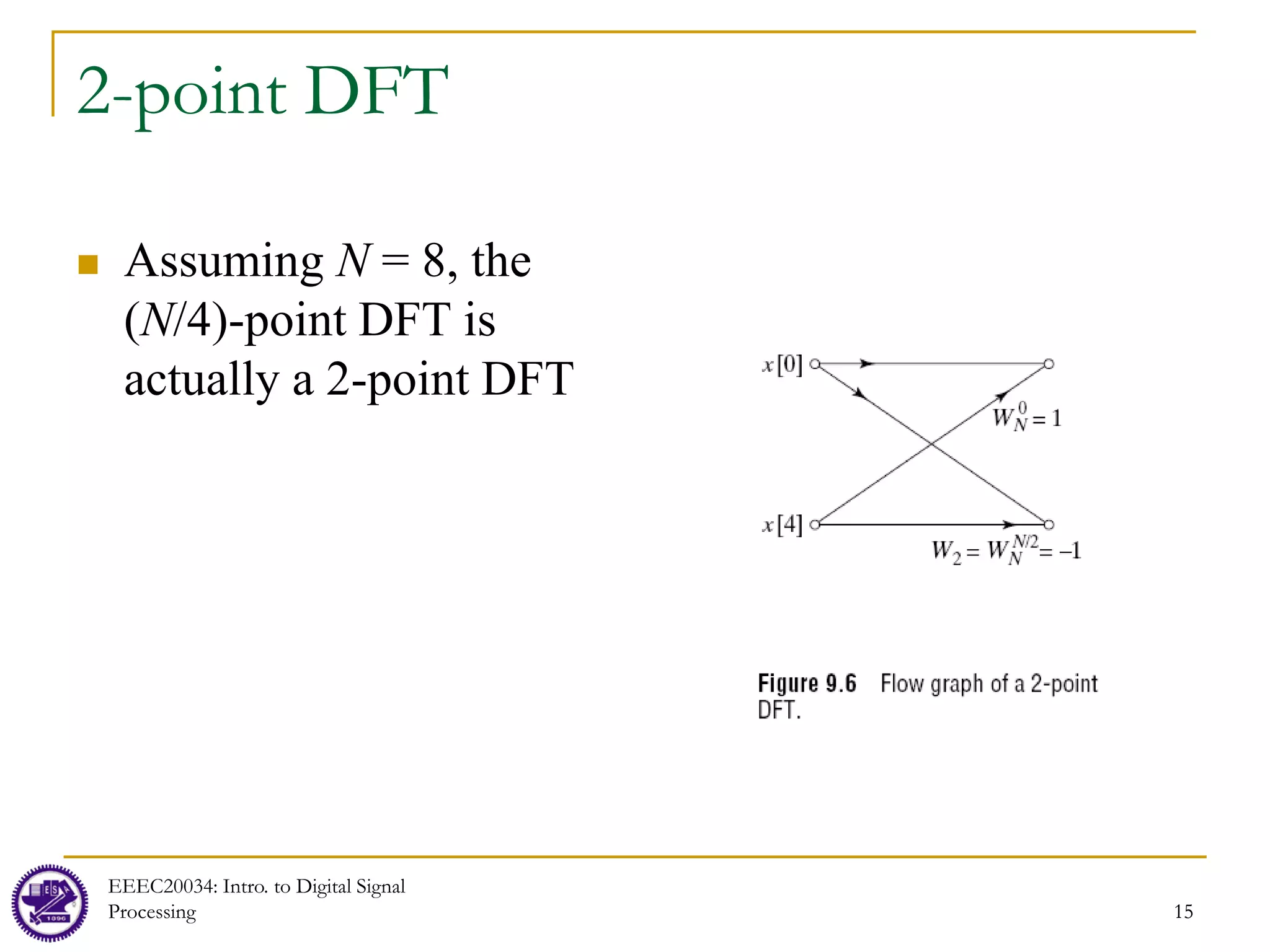
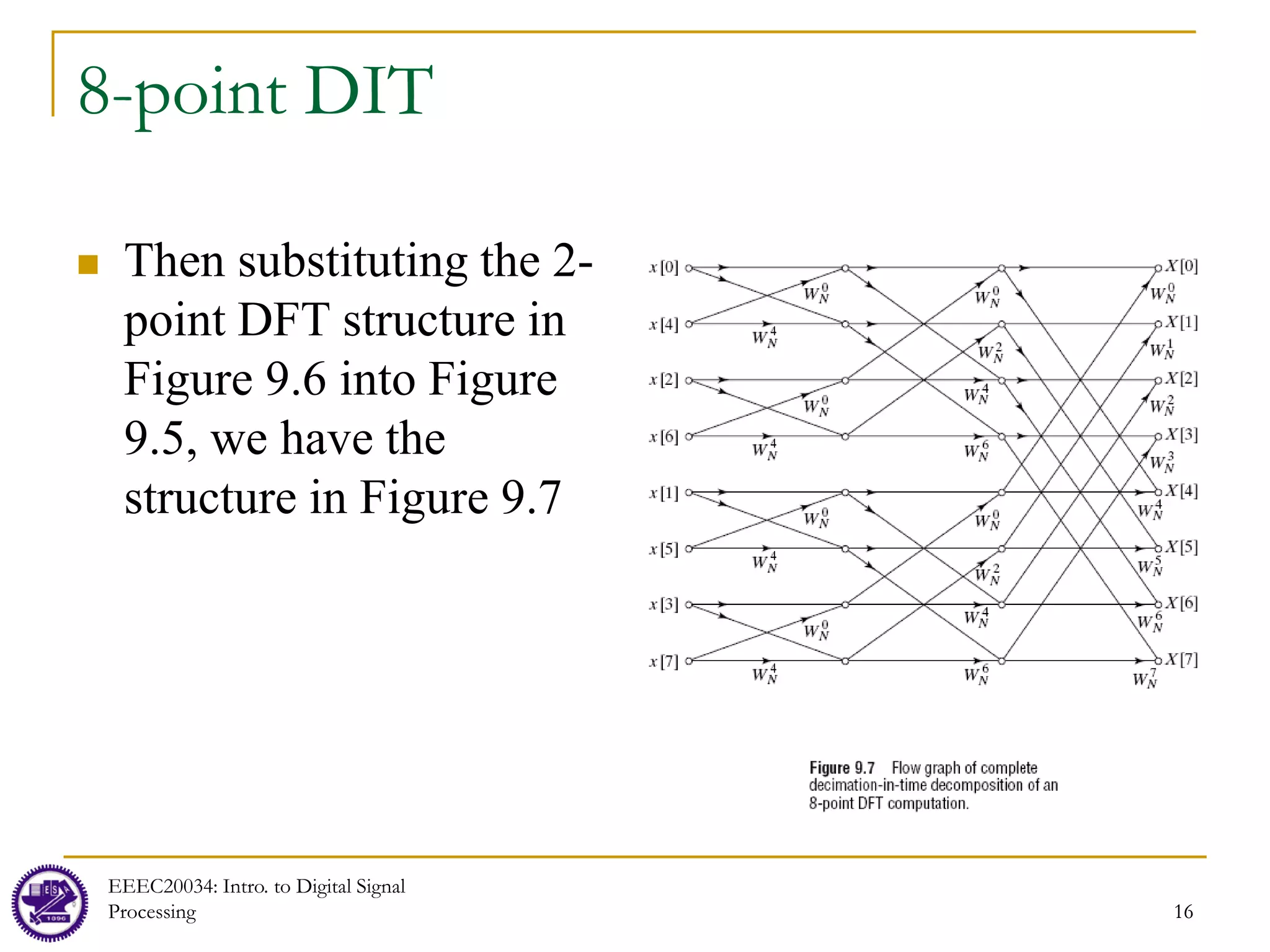
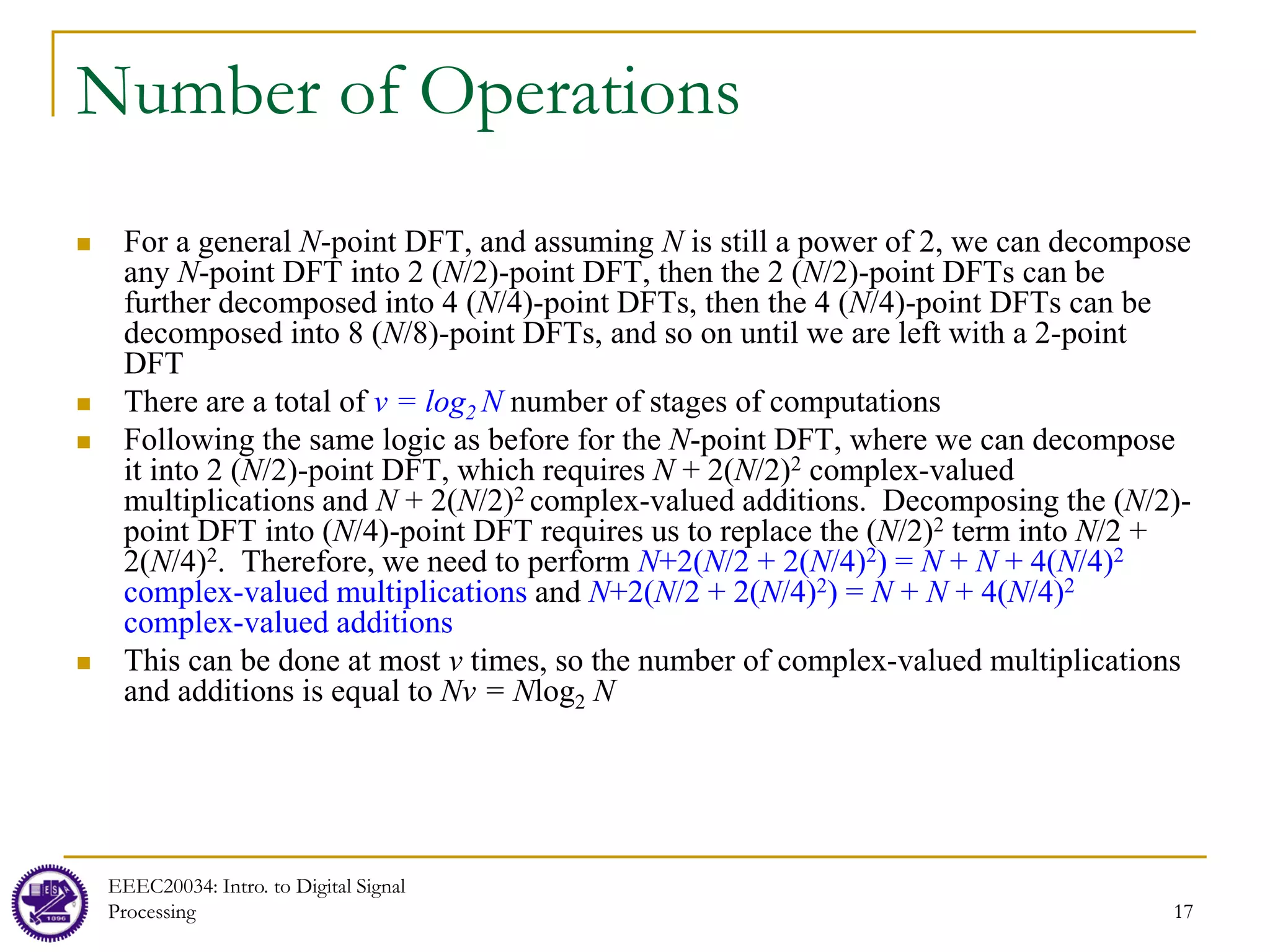
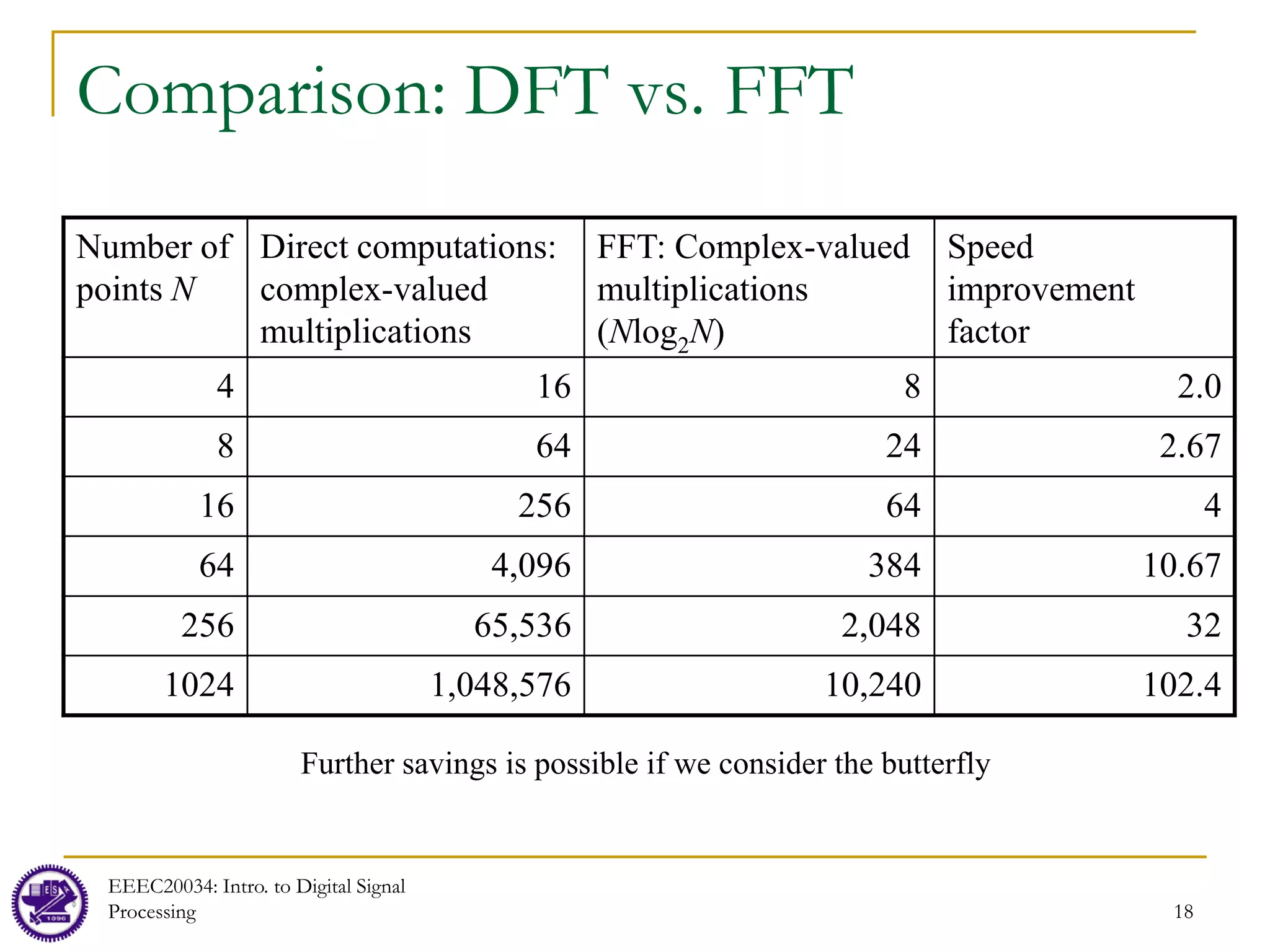
Combining G[k] and H[k]
Combining the two
figures above and
realizing that WN/2
k =
WN
2k, we can obtain
Figure 9.5
EEEC20034: Intro. to Digital Signal
Processing 14](https://image.slidesharecdn.com/lec08computationofdft-230606124625-691907bf/75/lec08_computation_of_DFT-pdf-14-2048.jpg)
![FFT in Matrix Form: 4-point FFT
EEEC20034: Intro. to Digital Signal
Processing 19
2
4
Consider the 4-point DFT matrix and consider decimation-in-time in which the inputs are
permuted (bit
1 1 1 1 1 1 1 1
1 1 1
1 1 1 1 1 1
1 1
-reversed) becomes
1
1 1
1
1
H j j
j j
j
j j
−
= =
− − −
− −
− −
W
2
1
1
1
1
j
Even-odd
permutation
x[0]
x[2]
x[1]
x[3]
X[0]
X[1]
X[2]
X[3]
1
4
W j
= −
0
4 1
W =
2
4 1
W = −
3
4
W j
=
x[0]
x[1]
x[2]
x[3]
0
2 1
W =
1
2 1
W = −
2
2 1
W =
3
2 1
W = −](https://image.slidesharecdn.com/lec08computationofdft-230606124625-691907bf/75/lec08_computation_of_DFT-pdf-19-2048.jpg)
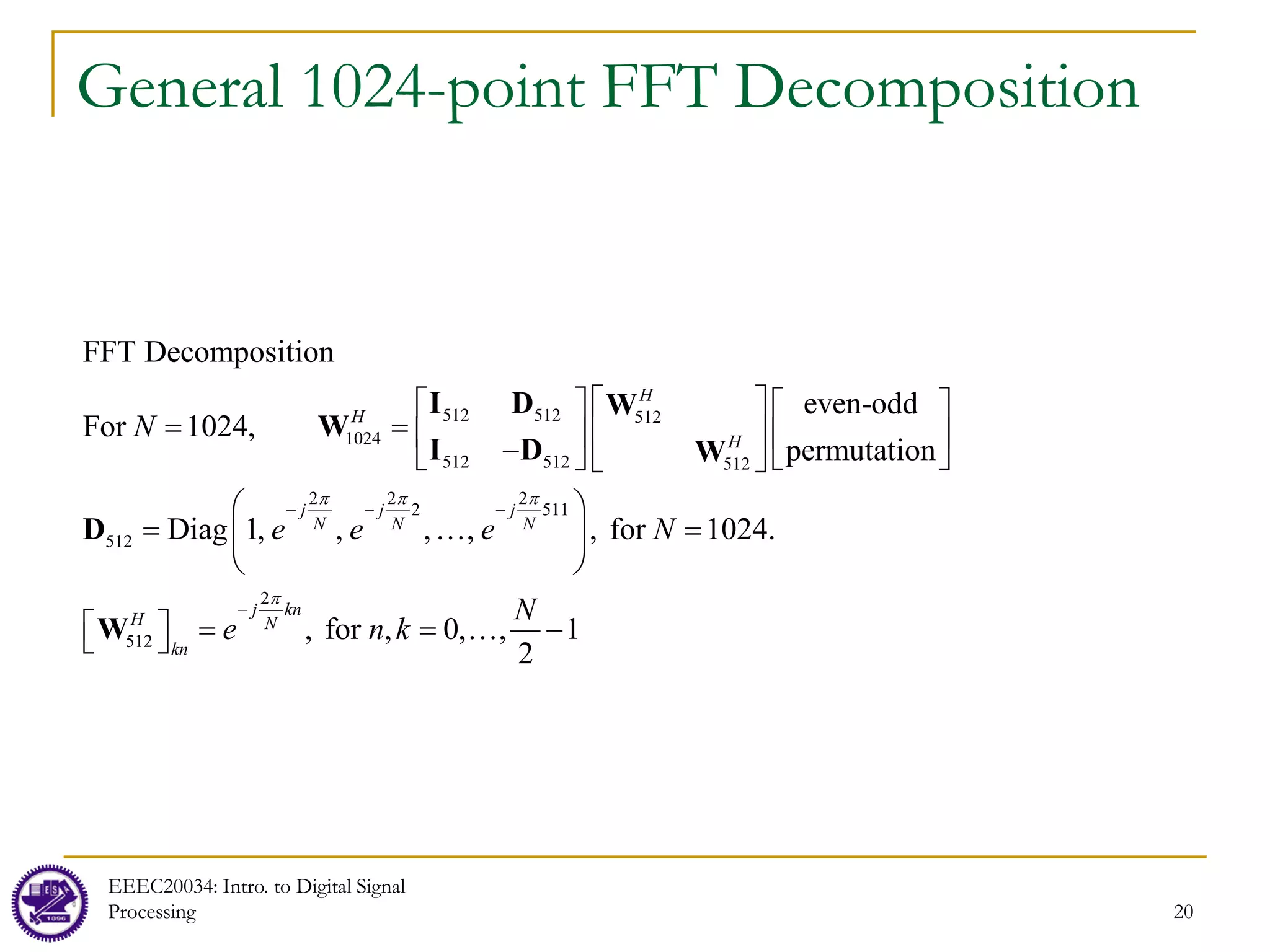
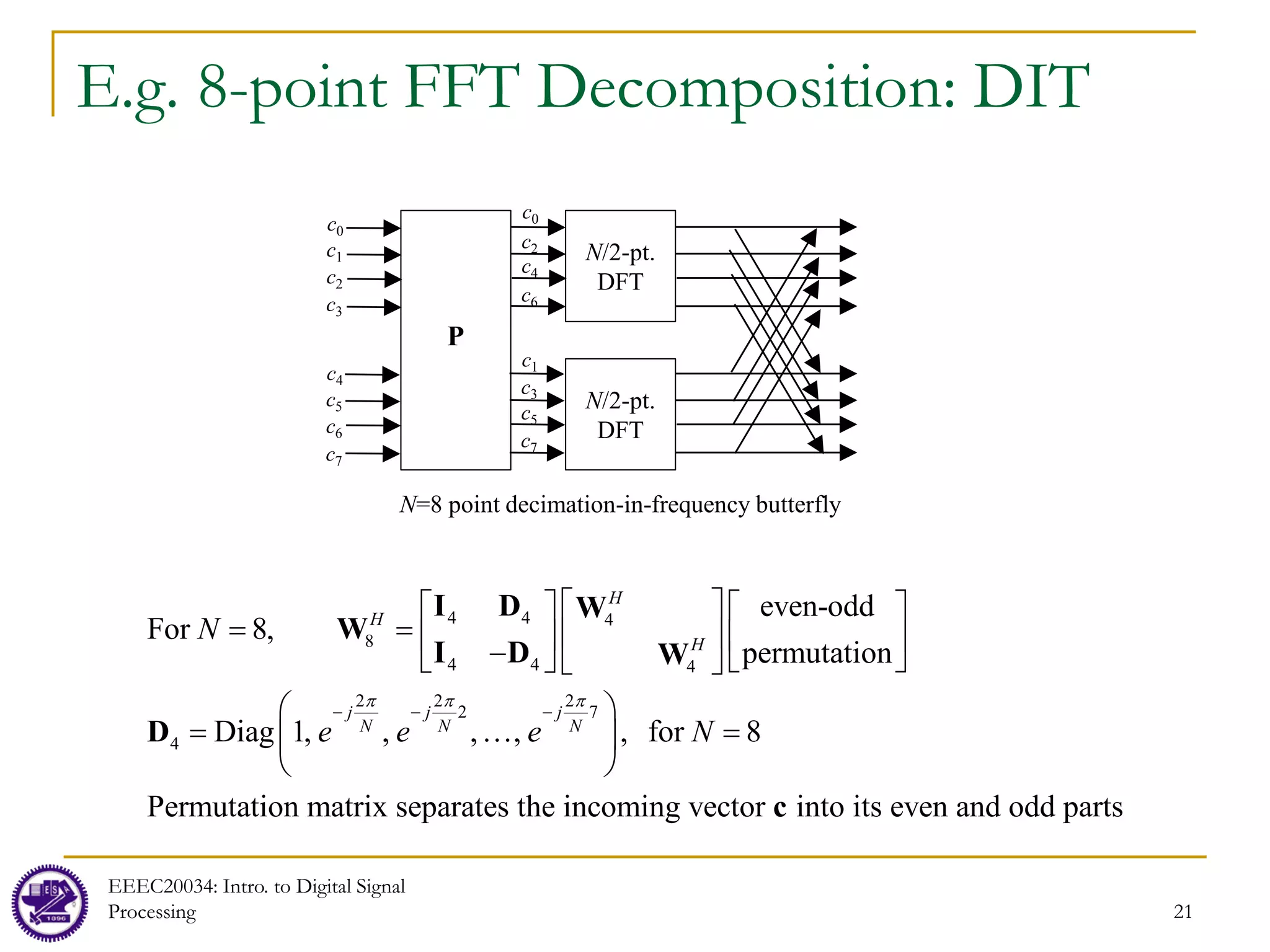
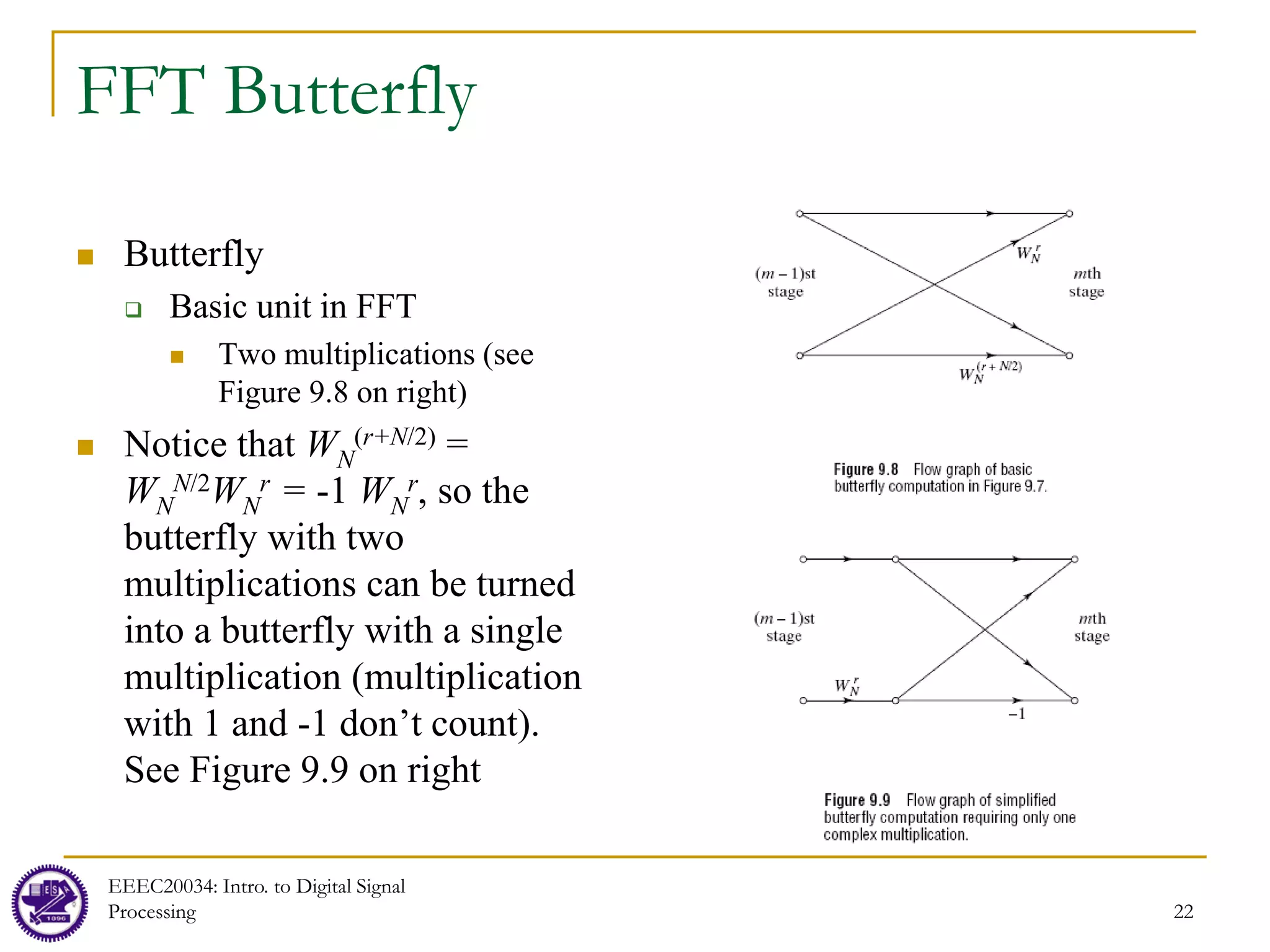
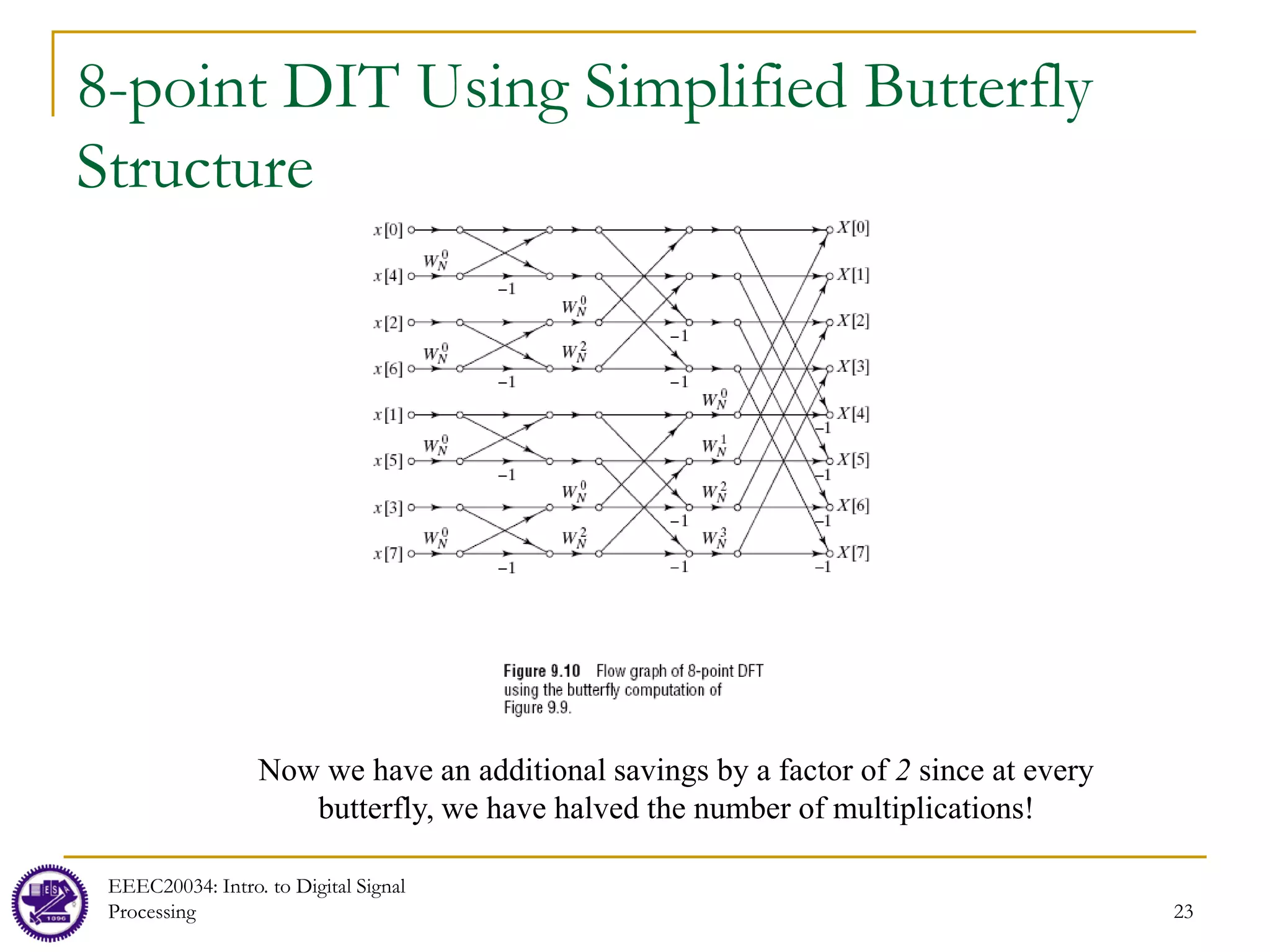
![24
In-Place Computations
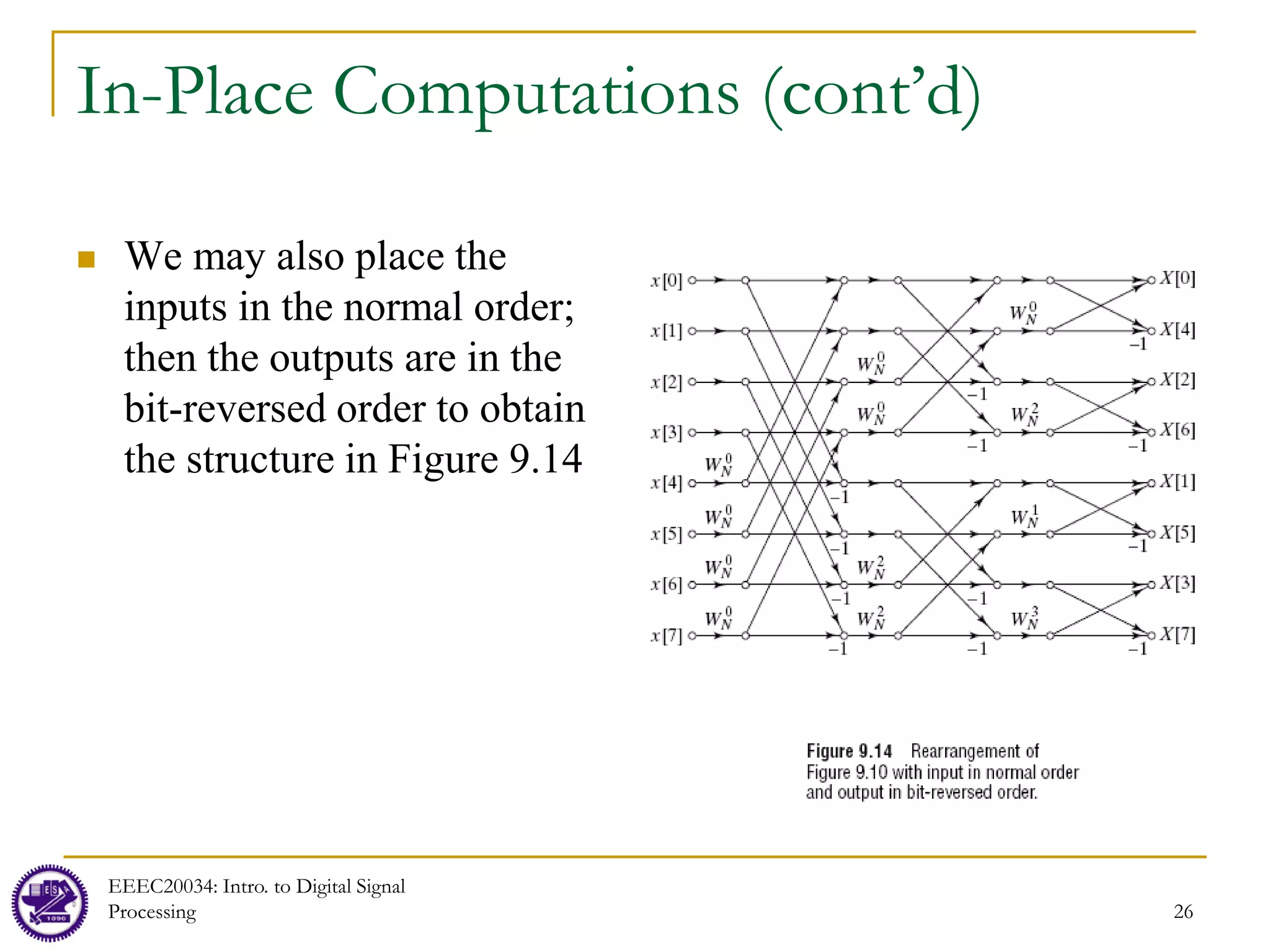
Besides efficient computation of the DFT, the structure in Figure 9.10 also offers an efficient
way to storage the original data and the results of the computations in the intermediate stages
Each stage of the FFT process has N inputs and N outputs, so we need exactly N storage
locations at any one point in the calculations
It is possible to reuse the same storage locations at each stage to reduce memory overhead
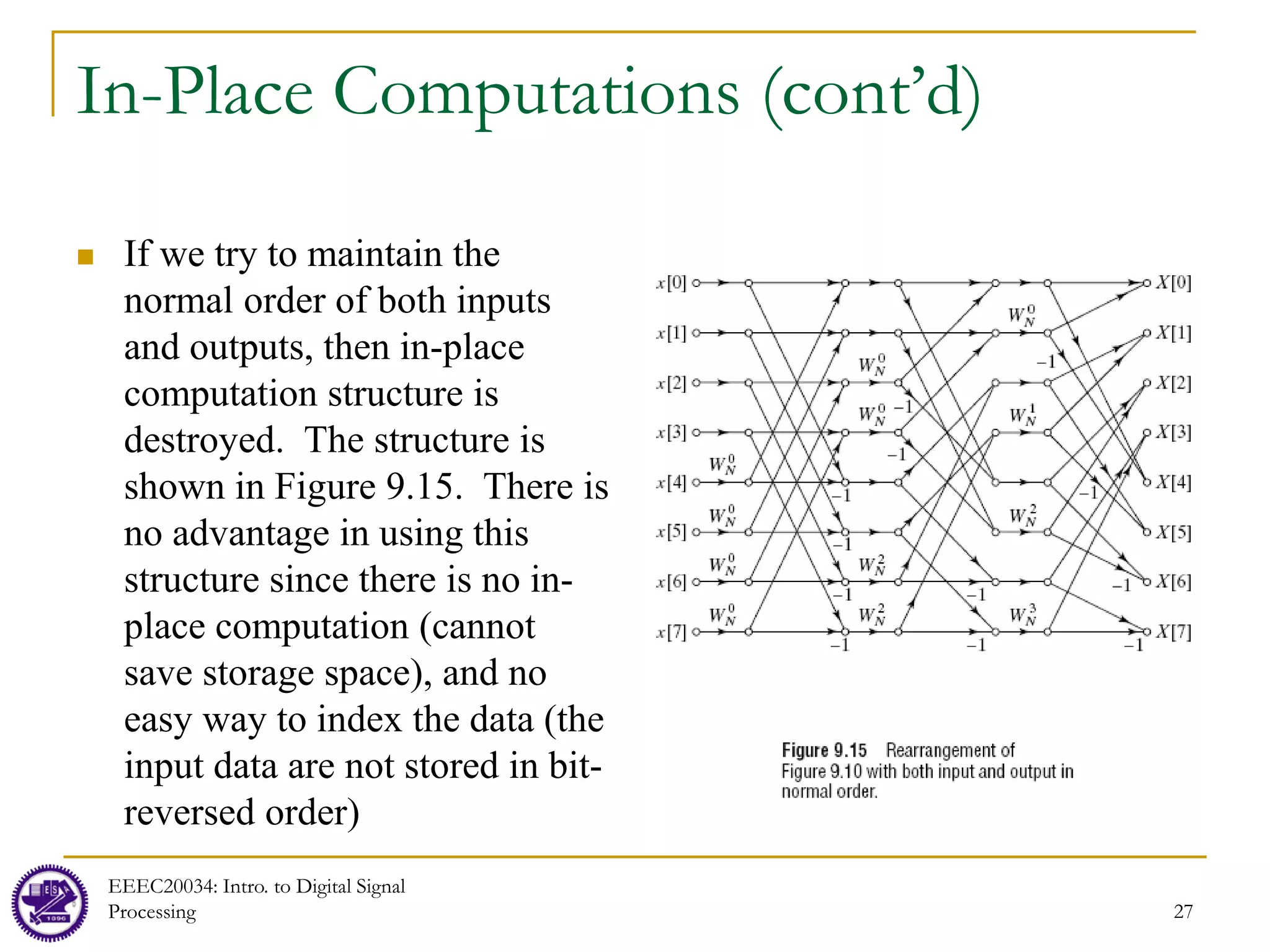
Any algorithm which uses the same memory to store successive iterations of a calculation is called an
“in-place” algorithm
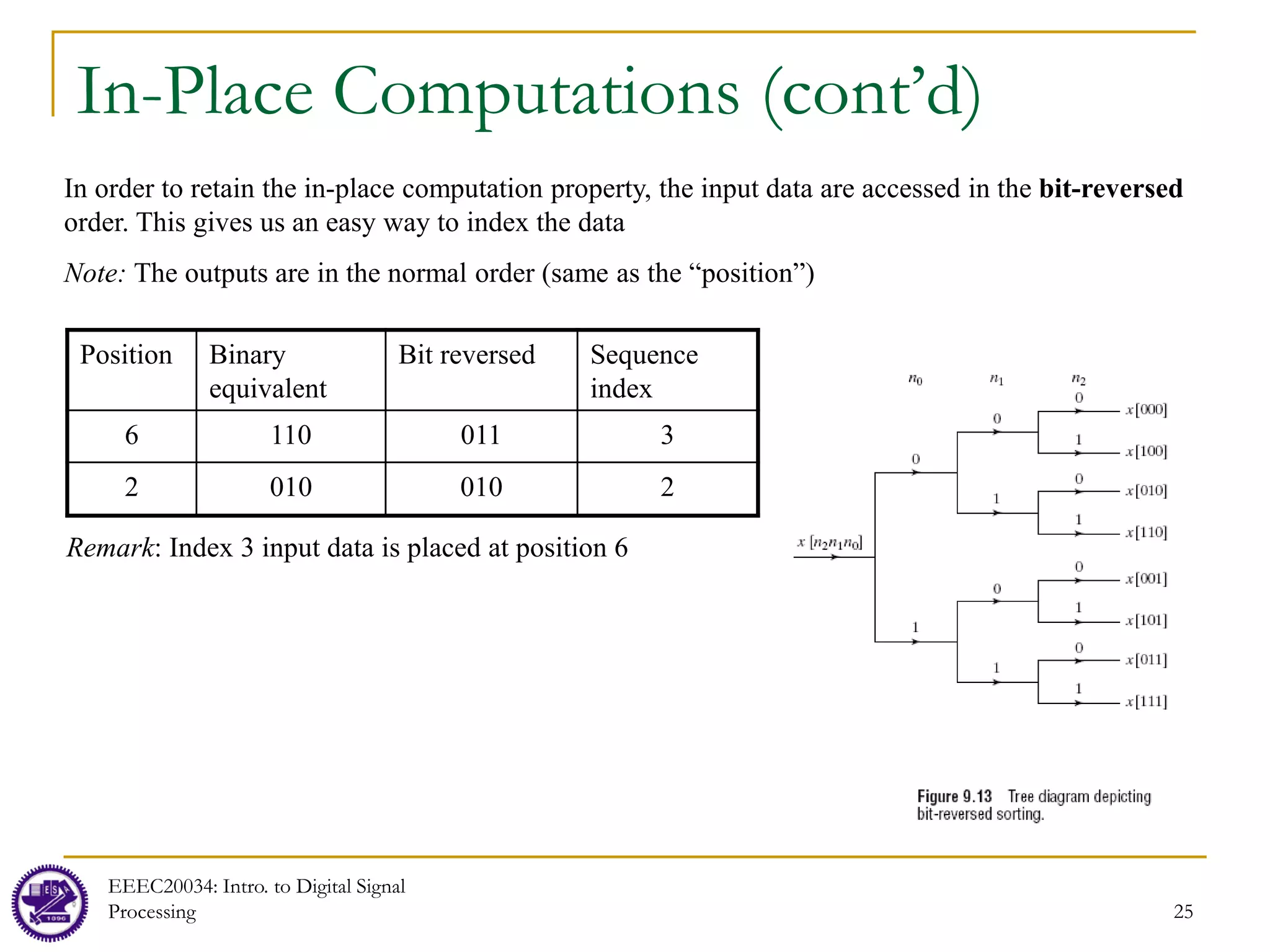
Computation must be done in a specific order
Let Xm[p] and Xm[q] denote the results from the mth stage of computations and Xm-1[p] and Xm-
1[q] denote the results from the (m-1)th stage of computations. Then the relationship between
the input and output of the butterfly can be written as (see Figure 9.11)
Only two registers are needed for computing a butterfly unit because Xm[p] and Xm[q] are
stored in the same storage registers as Xm-1[p] and Xm-1[q], respectively. This is because once
Xm[p] and Xm[q] are produced from Xm-1[p] and Xm-1[q], there is no need to store Xm-1[p] and
Xm-1[q] anymore, so we can place the new results, Xm[p] and Xm[q], into the storage location of
Xm-1[p] and Xm-1[q]
]
[
]
[
]
[
]
[
]
[
]
[
1
1
1
1
q
X
W
p
X
q
X
q
X
W
p
X
p
X
m
r
N
m
m
m
r
N
m
m
−
−
−
−
−
=
+
=
EEEC20034: Intro. to Digital Signal
Processing](https://image.slidesharecdn.com/lec08computationofdft-230606124625-691907bf/75/lec08_computation_of_DFT-pdf-24-2048.jpg)
![28
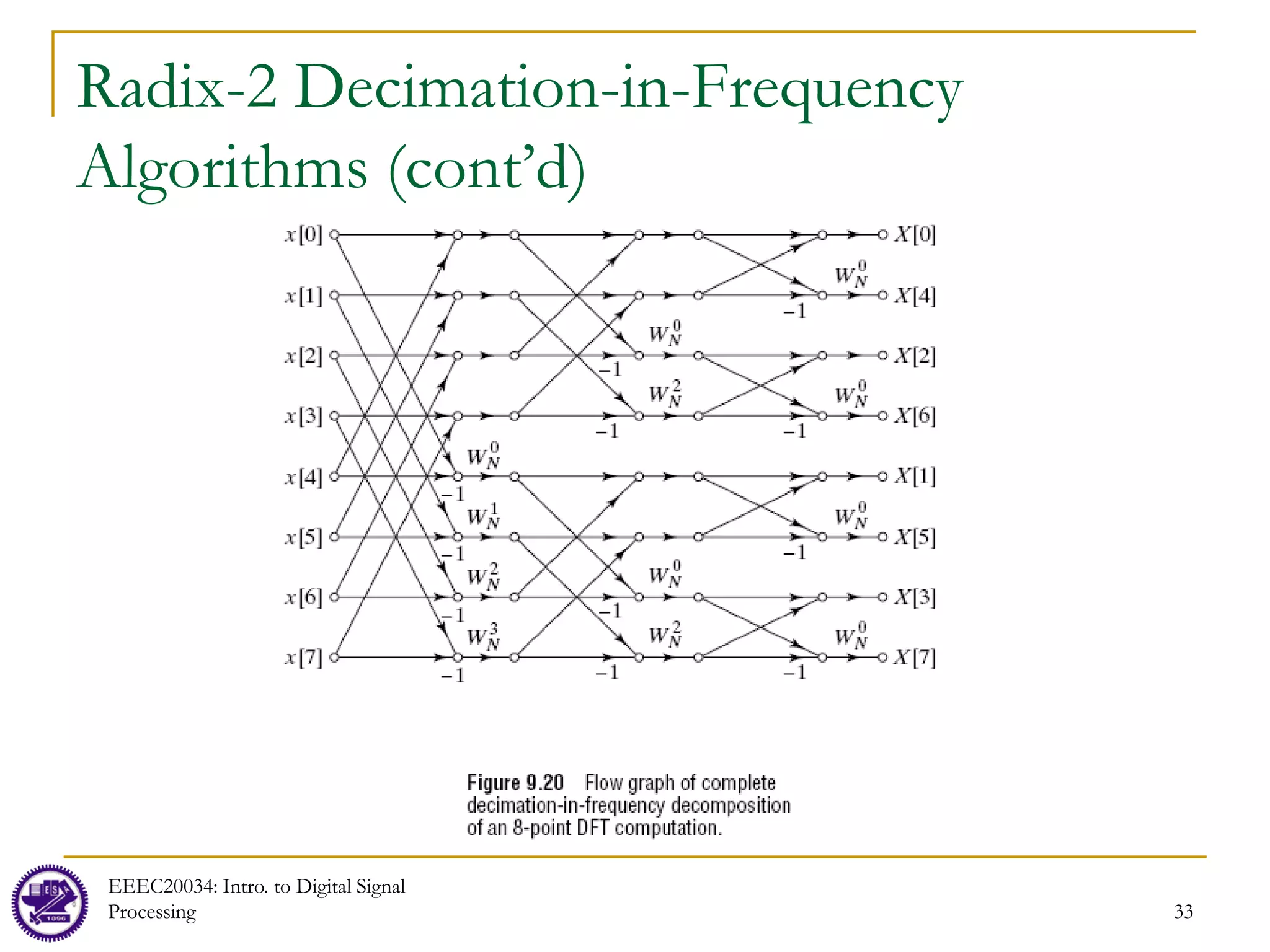
Radix-2 Decimation-in-Frequency
Algorithms
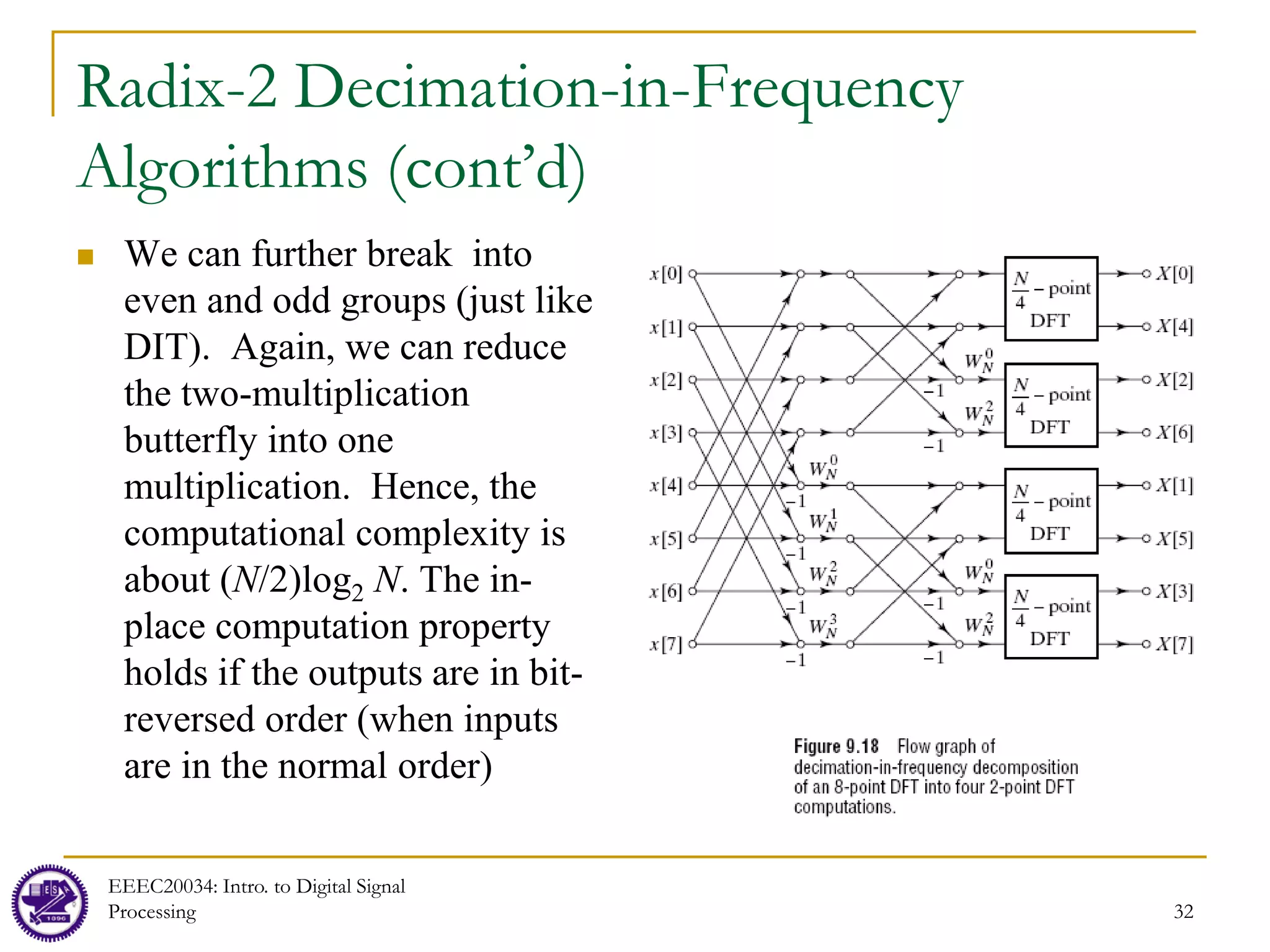
Dividing the output sequence X[k] into smaller pieces
[ ] [ ]
1
0
, 0,1, , 1
N
kn
N
n
X k x n W k N
−
=
= = −
∑
Assuming N = 2v, where v is an integer. If k is even, i.e. k = 2r, then
1
0
1
1
2
2 2
0
2
1 1
2 2 2
2 2
0 0
2 [ ] 2 2
2
[2 ] [ ] , 0,1, , 1
2
[ ] [ ] ( ) in second term
2
[ ]
2
[ ]
2
N
kn
N
n
N
N
nr nr
N N
N
n n
N N
N
r n
nr
N N
n n
N
r n rn rN rn
N N N N
N
X r x n W r
N
x n W x n W n n
N
x n W x n W
W W W W
N
x n x n
−
=
−
−
= =
− −
+
= =
+
= = −
= + ← +
= + + ⋅
= =
= + +
∑
∑ ∑
∑ ∑
1
2
2
0
1
2
2
0
[ ]
2
N
nr
N
n
N
nr
N
n
W
N
x n x n W
−
=
−
=
⋅
= + + ⋅
∑
∑
EEEC20034: Intro. to Digital Signal
Processing](https://image.slidesharecdn.com/lec08computationofdft-230606124625-691907bf/75/lec08_computation_of_DFT-pdf-28-2048.jpg)
![Radix-2 Decimation-in-Frequency
Algorithms
EEEC20034: Intro. to Digital Signal
Processing 29
[ ] [ ] ( )
[ ] ( )
[ ] ( )
[ ] ( ) ( )
1
2 1
0
1
1
2
2 1 2 1
0
2
1
1 2 2 1
2 1 2
0
2
2 1, 0,1, , 1
2
2 1
Let ,
For
then
2 2
N
n r
N
n
N
N
n r n r
N N
N
n n
N
N
N n r
n r
N N
N n
n
N
k r r
X r x n W
x n W x n W
N N
n n x n W x n W
−
+
=
−
−
+ +
= =
−
− + +
+
=
=
= + = … −
+ =
= +
→ + = +
∑
∑ ∑
∑ ∑
( ) ( )
1
2
2 1
2 1
2
0 2
N
N
r
n r
N N
n
N
W x n W
−
+
+
=
= +
∑](https://image.slidesharecdn.com/lec08computationofdft-230606124625-691907bf/75/lec08_computation_of_DFT-pdf-29-2048.jpg)
![Radix-2 Decimation-in-Frequency
Algorithms
EEEC20034: Intro. to Digital Signal
Processing 30
( )
[ ] ( ) ( )
[ ] [ ] ( ) ( )
2 1 2
2 2 2
1
1 2
2 1 2 1
0
2
1
2
2 1 2 1
0 0
Note 1. Therefore
2
So
2 1
2
1
N N N
r r
N N N
N
N
n r n r
N N
N n
n
N
n r n r
N N
n n
W W
N
x n W x n W
N
X r
W
x n W x n W
+
−
−
+ +
=
=
−
+ +
= =
⋅−
=
− +
+
= − +
=
=
∑ ∑
∑
[ ] ( )
[ ]
1
2
1 1
2 2
2 1
/2
0 0
2 2
N
N N
n r n nr
N N N
n n
N N
x n x n W x n x n W
W
−
− −
+
=
= − + = − +
∑
∑ ∑
[ ] [ ] ( ) ( ) ( )
1 1
2 2
2 1
2 1 2 1
2
0 0
2 1
2
N N
N
r
n r n r
N N N
n n
N
X r x n W W x n W
− −
+
+ +
= =
+
= + +
∑ ∑
2
/2
nr nr
N N
W
W =](https://image.slidesharecdn.com/lec08computationofdft-230606124625-691907bf/75/lec08_computation_of_DFT-pdf-30-2048.jpg)
![31
Radix-2 Decimation-in-Frequency
Algorithms (cont’d)
[ ] [ ]
1
2
0
0
2
1
2
/
2
2 1
[ ] [ ]
2
2
2
N
n nr
N N
n
N
nr
N
n
N
X r x n x n W
W
N
X r x n x n W
−
=
−
=
+ =
= + + ⋅
− +
∑
∑
+
−
=
+
+
=
2
]
[
]
[
2
]
[
]
[
N
n
x
n
x
n
h
N
n
x
n
x
n
g
EEEC20034: Intro. to Digital Signal
Processing
/2 is refers to
the /2-point DFT
nr
N
N
W](https://image.slidesharecdn.com/lec08computationofdft-230606124625-691907bf/75/lec08_computation_of_DFT-pdf-31-2048.jpg)
![34
FFT for Composite N
When N is not a power of 2, but a product of 2 or more
integers, FFT algorithms still exist to compute the DFT
If N is a prime number, we can simply pad zeros to make
N into an composite integer
Cooley-Tukey Algorithm: N = N1N2
DIT and DIF are special cases of Composite N algorithm
where N = 2(N/2) = (N/2)2
For composite N FFT, we can divide x[n] and X[k] into a
two-dimensional array
EEEC20034: Intro. to Digital Signal
Processing](https://image.slidesharecdn.com/lec08computationofdft-230606124625-691907bf/75/lec08_computation_of_DFT-pdf-34-2048.jpg)
![35
Example
For x[n] in this case, n1 is the column index and n2 is the
row index. There will be N2 elements in each column (i.e.
N2 number of rows) of the two-dimensional array which
stores x[n].
For X[k], k1 is the column index and k2 is the row index.
There will be N1 elements in each row (i.e. N1 number of
columns) of the two-dimensional array which stores X[k]
1 1
1 1 2
2 2
1
2 1 2
1
2 1 2
2 2
1 1 2
0 1
Time index: or
0 1
0 1
Freq. index: or
0 1
n N n n
k k
n N
n n N n
n N
k N
k N k k
k N
N k
≤ ≤ −
= +
≤ ≤ −
≤ ≤ −
= +
≤ ≤ −
= +
= +
EEEC20034: Intro. to Digital Signal
Processing](https://image.slidesharecdn.com/lec08computationofdft-230606124625-691907bf/75/lec08_computation_of_DFT-pdf-35-2048.jpg)
![36
Example (cont’d)
For example: N1 = 2, N2 = N/N1 = N/2, then the input signal x[n] can be arranged
into a 2-dimensional array as
n1
n2
0 1
0 x[0] x[N/2]
1 x[1] x[N/2+1]
.
.
.
.
.
.
N2-1 x[N/2-1] x[N-1]
EEEC20034: Intro. to Digital Signal
Processing](https://image.slidesharecdn.com/lec08computationofdft-230606124625-691907bf/75/lec08_computation_of_DFT-pdf-36-2048.jpg)
![37
Decomposition
Goal: Decompose N-point DFT into two stages: let n = N2n1 + n2 and k=k1 + N1k2
N1-point DFT⊗N2-point DFT
( )( )
2 1
1 1 2 2 1 2
2 1
2 1
2 1 1 1 2 2 1 2 1 2 2 1
2 1 1 1 2 2
1 2
1
1
0
1 1 2
1 1
2 1 2
0 0
1 1
2 1 2
0 0
1
2 1 2
[ ] [ ] , 0 1
[ ]
[ ]
[ ]
[ ]
k n k n
N N
N
kn
N
n
N N
k N k N n n
N
n n
N N
N k n k n k N n N N k n
N N N N
n n
W W
k
N
X k x n W k N
X k N k
x N n n W
x N n n W W W W
x N n n W
−
=
− −
+ +
= =
− −
= =
= ≤ ≤ −
= +
= + ⋅
= + ⋅ ⋅ ⋅ ⋅
= + ⋅
∑
∑ ∑
∑ ∑
2 1
1 1 1 2 2 2
2
2 1
1
2
1 1
0 0 twiddle
factor
-point
-point
N N
n k n k n
N N
n n
N
N
W W
− −
= =
⋅ ⋅
∑ ∑
EEEC20034: Intro. to Digital Signal
Processing](https://image.slidesharecdn.com/lec08computationofdft-230606124625-691907bf/75/lec08_computation_of_DFT-pdf-37-2048.jpg)
![38
Procedure
1
1 1
1
1
1 2
1
1 1
2 1 2 1 2
0 2 2
(1) Compute -point DFT of all rows: (row transform)
0 1
[ , ] [ ] ,
0 1
(2) Each row DFTs are multiplied by twiddle factors:
N
k n
N
n
N N
k N
G n k x N n n W
n N
−
=
≤ ≤ −
= + ⋅
≤ ≤ −
∑
1 2
2
2 2
2
2
1 1
2 1 2 1
2 2
2
1
1 1 2 2 1
0
0 1
[ , ] [ , ],
0 1
(3) Compute -point DFT: (column transform)
[ ] [ , ]
k n
N
N
k n
N
n
k N
G n k W G n k
n N
N
X k N k G n k W
−
=
≤ ≤ −
= ⋅
≤ ≤ −
+ = ⋅
∑
EEEC20034: Intro. to Digital Signal
Processing](https://image.slidesharecdn.com/lec08computationofdft-230606124625-691907bf/75/lec08_computation_of_DFT-pdf-38-2048.jpg)
![39
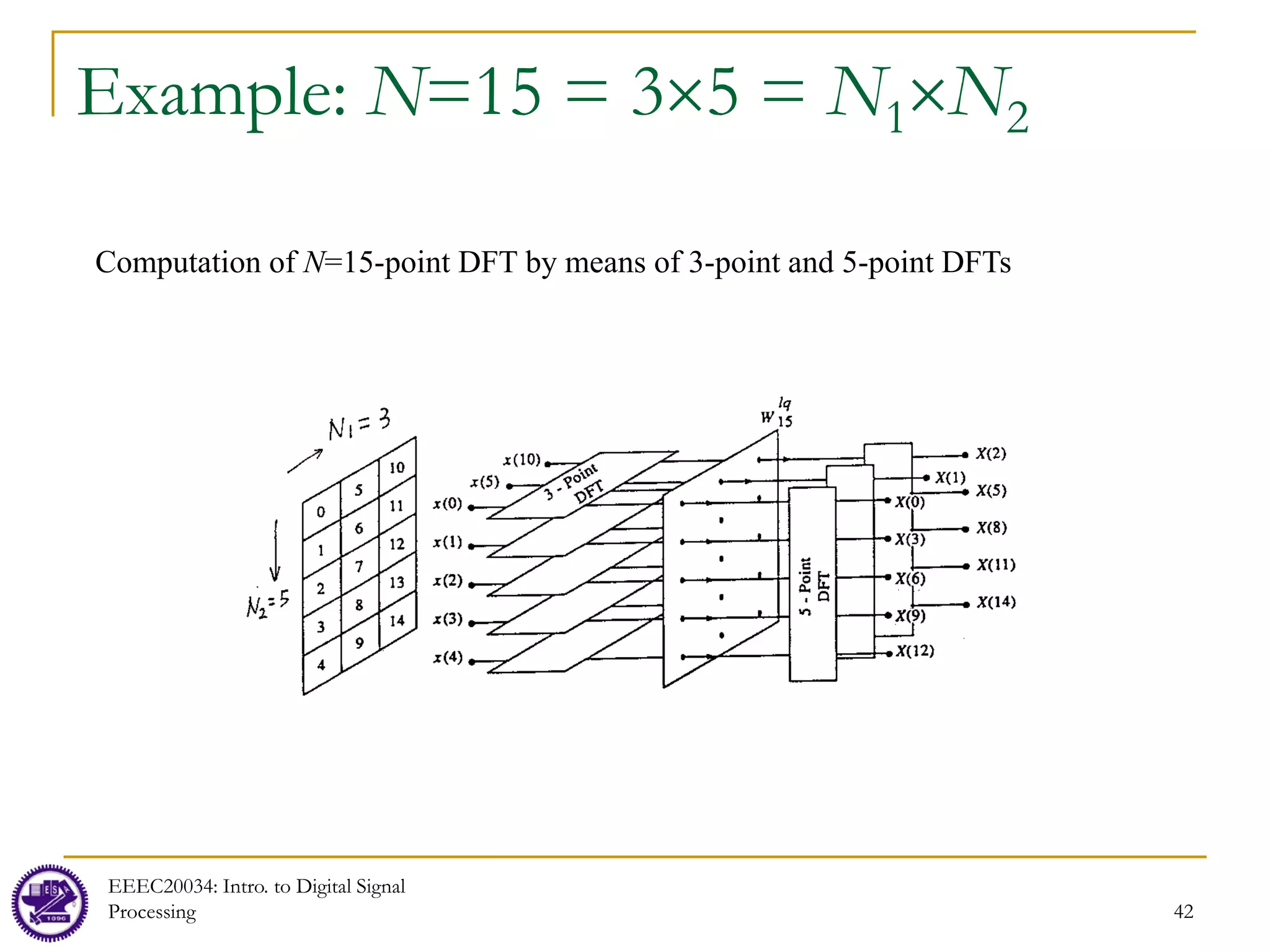
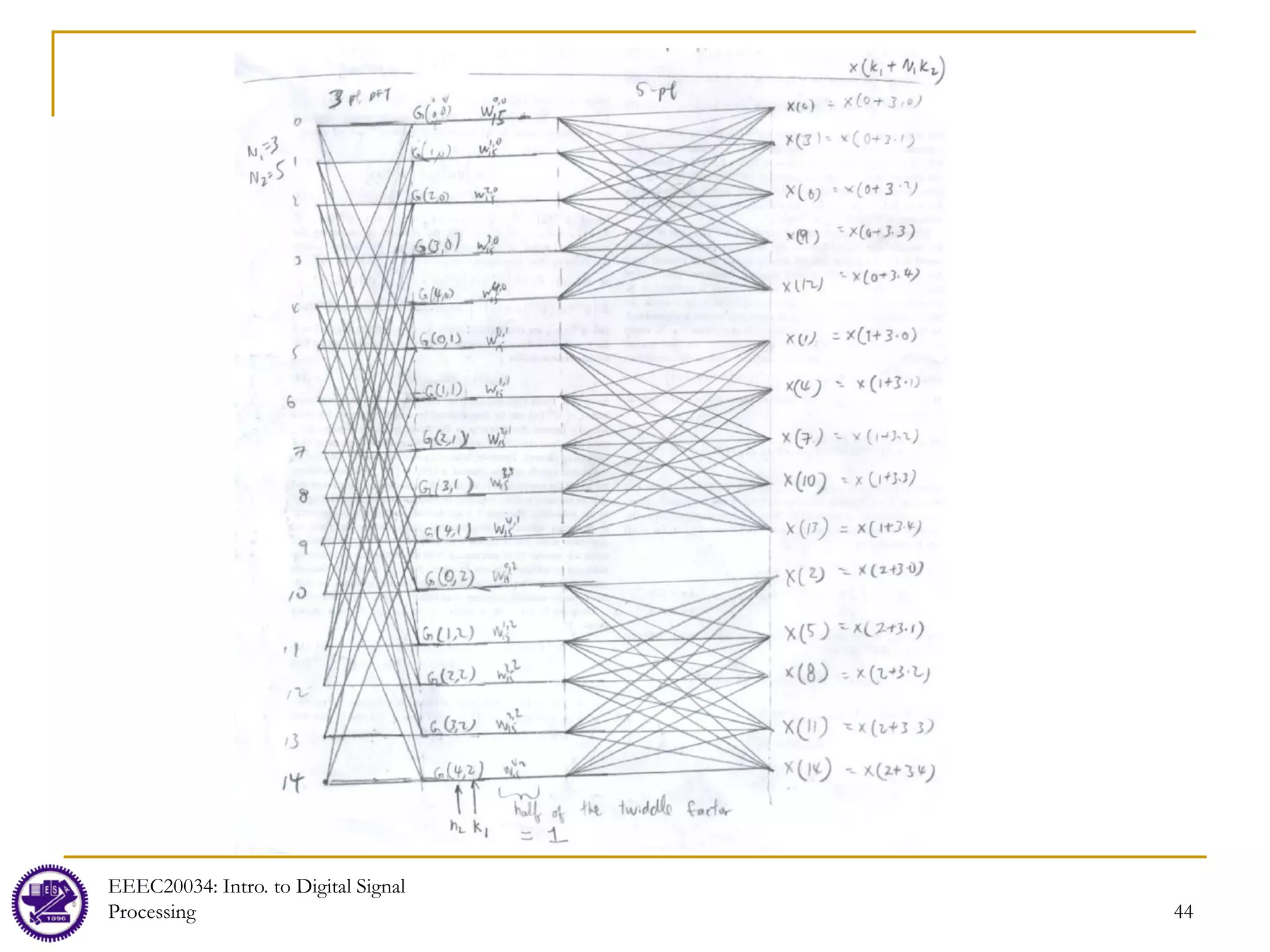
Example: N=15 = 3×5 = N1×N2
Row 1 x[0,0] = x[0] x[0,1] = x[5] x[0,2] = x[10] G[0,k1]
Row 2 x[1,0] = x[1] x[1,1] = x[6] x[1,2] = x[11] G[1,k1]
Row 3 x[2,0] = x[2] x[2,1] = x[7] x[2,2] = x[12] G[2,k1]
Row 4 x[3,0] = x[3] x[3,1] = x[8] x[3,2] = x[13] G[3,k1]
Row 5 x[4,0] = x[4] x[4,1] = x[9] x[4,2] = x[14] G[4,k1]
First, perform a 3-point DFT for each of the five rows (Notations: x[n2,n1], G[n2,k1]):
EEEC20034: Intro. to Digital Signal
Processing](https://image.slidesharecdn.com/lec08computationofdft-230606124625-691907bf/75/lec08_computation_of_DFT-pdf-39-2048.jpg)
![40
Example: N=15 = 3×5 = N1×N2
Multiply by 1 2
k n
N
W
Column 1 Column 2 Column 3
[ ]
0,0
G
[ ]
1,0
G
[ ]
2,0
G
[ ]
3,0
G
[ ]
4,0
G
[ ]
0,1
G
[ ]
1,1
G
[ ]
2,1
G
[ ]
3,1
G
[ ]
4,1
G
[ ]
0,2
G
[ ]
1,2
G
[ ]
2,2
G
[ ]
3,2
G
[ ]
4,2
G
EEEC20034: Intro. to Digital Signal
Processing](https://image.slidesharecdn.com/lec08computationofdft-230606124625-691907bf/75/lec08_computation_of_DFT-pdf-40-2048.jpg)
![41
Example: N=15 = 3×5 = N1×N2
Compute the 5-point DFT for each of the three columns
X[0,0] = X[0] X[0,1] = X[1] X[0,2] = X[2]
X[1,0] = X[3] X[1,1] = X[4] X[1,2] = X[5]
X[2,0] = X[6] X[2,1] = X[7] X[2,2] = X[8]
X[3,0] = X[9] X[3,1] = X[10] X[3,2] = X[11]
X[4,0] = X[12] X[4,1] = X[13] X[4,2] = X[14]
EEEC20034: Intro. to Digital Signal
Processing](https://image.slidesharecdn.com/lec08computationofdft-230606124625-691907bf/75/lec08_computation_of_DFT-pdf-41-2048.jpg)
![46
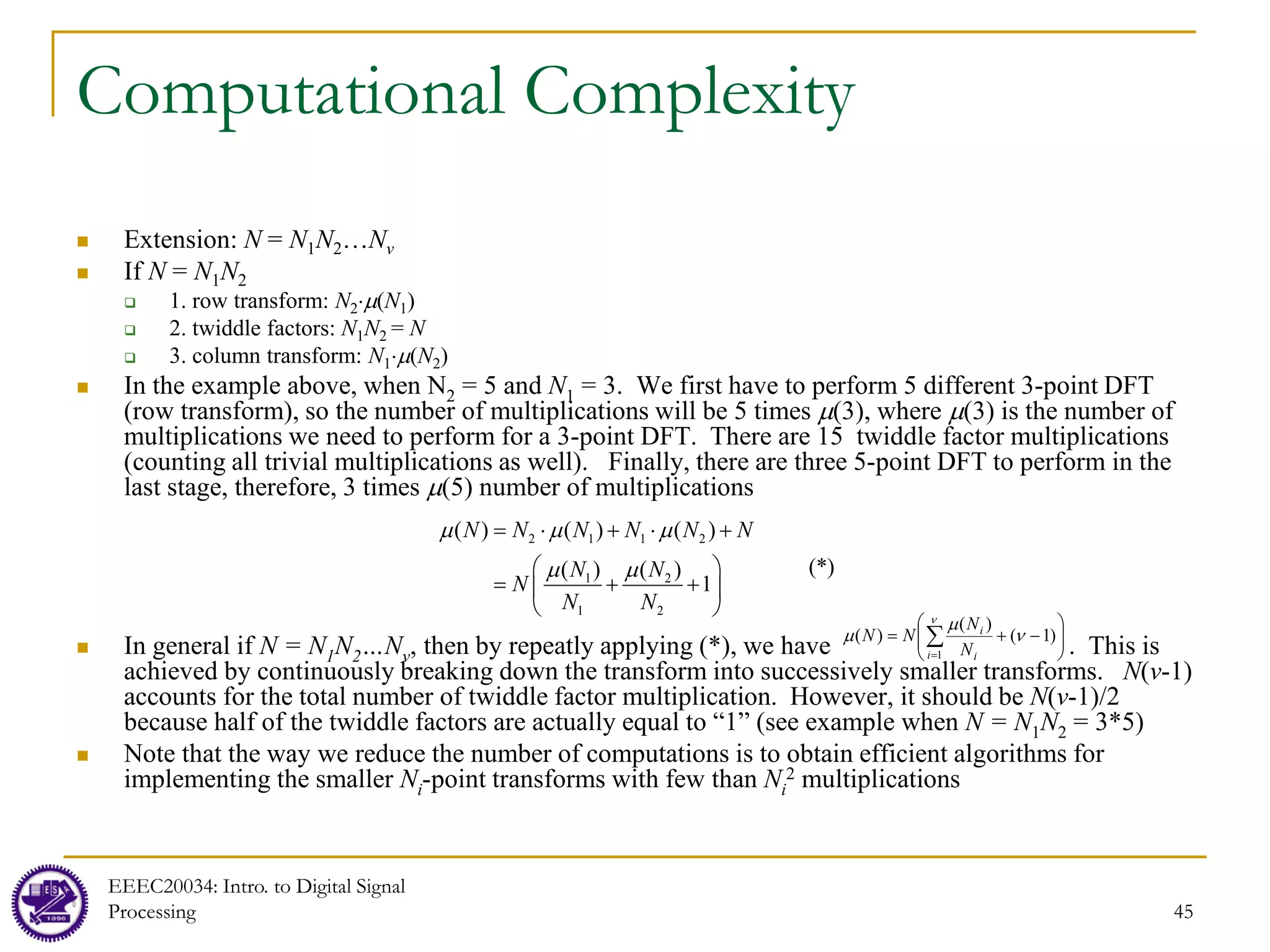
Special Case: N1 = N2 = … = Nv = 2
( )
( )
( )
( )
1 2 2
1 2 4
Radix-2: 2 and log
1
( ) multiplications because 2 requires no multiplications
2
Radix-4: 4 and log
1
( ) multiplications because 4
2
N N N v N
N v
N
N N N v N
N v
N
ν
ν
µ µ
µ µ
= = = = =
−
=
= = = = =
−
=
requires no multiplications
(multiplications by and - can be achieved by interchanging the real and
imaginary parts). This FFT has few stages than Radix-2 fewer mult
j j
⇒
0 0 0 0
4 4 4 4
1 2 3
0 1 2 3
4 4 4
4 4 4 4
4 2 0 2
0 2 4 6
4 4 4
4 4 4 4
3 2 1
0 3 6 9
4 4 4
4 4 4 4
1 2
2
s
1 1 1 1 1 1 1 1
1 1 1
1 1 1 1 1
1 1 1
For example, let 16 4*4
,
W W W W
W W W j j
W W W W
W W W
W W W W
W W W j j
W W W W
N N N
G n k
− −
= = =
− −
− −
= = =
W
[ ] [ ] ( ) ( ) ( ) ( ) ( ) ( )
1 1 1
1 2 2 2 2
1 2
/ 4 1 / 2 3 / 4 ,
for 0,1,2,3; 0,1, ( / 4) 1
k k k
x n j x N n x N n j x N n
k n N
= + − + + − + + +
= = −
EEEC20034: Intro. to Digital Signal
Processing](https://image.slidesharecdn.com/lec08computationofdft-230606124625-691907bf/75/lec08_computation_of_DFT-pdf-46-2048.jpg)
![48
Implementation of Inverse FFT Using
FFT
( )
[ ]
1
0
1
0
*
1
*
0
1
*
0
*
1
IDFT: [ ] [ ] (*)
DFT: [ ] [ ]
Hence, take the conjugate of (*)
1
[ ] [ ]
1
[ ]
1
DFT
N
kn
N
k
N
nk
N
n
N
kn
N
k
N
kn
N
k
x n X k W
N
X k x n W
x n X k W
N
X k W
N
X k
N
−
−
=
−
=
−
−
=
−
=
= ⋅
= ⋅
= ⋅
= ⋅
=
∑
∑
∑
∑
[ ]
[ ]
( )
[ ]
( )
*
*
*
*
*
Then take the conjugate of
1
[ ] DFT
1
FFT
Thus, we can use the FFT algorithm
to compute the inverse DFT
x n
x n X k
N
X k
N
=
=
EEEC20034: Intro. to Digital Signal
Processing](https://image.slidesharecdn.com/lec08computationofdft-230606124625-691907bf/75/lec08_computation_of_DFT-pdf-48-2048.jpg)


