MOLECULAR
FARMING
AND ITS APPLICATIONS IN
AGRICULTURE
PRESENTED BY
AYUSH JAIN
PALB7286
Jr. MSc(PLANT BIOTECHNOLOGY)
CONTENTS
What is Molecular Farming ??
Brief History of Molecular Farming
Why Molecular Farming ??
How to do Molecular Farming??
What are its Applications in Agriculture??
What are the Drawbacks of Molecular pharming??
03/01/2018TECHNIQUES IN MOLECULAR BIOLOGY I (PBT 505) 2
What is Molecular Farming ??
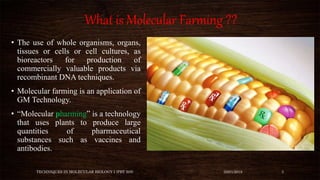
• The use of whole organisms, organs,
tissues or cells or cell cultures, as
bioreactors for production of
commercially valuable products via
recombinant DNA techniques.
• Molecular farming is an application of
GM Technology.
• “Molecular pharming” is a technology
that uses plants to produce large
quantities of pharmaceutical
substances such as vaccines and
antibodies.
03/01/2018TECHNIQUES IN MOLECULAR BIOLOGY I (PBT 505) 3
HISTORY OF MOLECULAR FARMING
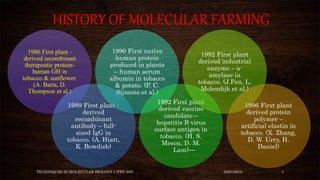
1986 First plant -
derived recombinant
therapeutic protein-
human GH in
tobacco & sunflower.
(A. Barta, D.
Thompson et al.)
1989 First plant -
derived
recombinant
antibody – full-
sized IgG in
tobacco. (A. Hiatt,
K. Bowdish)
1990 First native
human protein
produced in plants
– human serum
albumin in tobacco
& potato. (P. C.
Sijmons et al.)
1992 First plant
derived vaccine
candidate –
hepatitis B virus
surface antigen in
tobacco. (H. S.
Meson, D. M.
Lam)—
1992 First plant
derived industrial
enzyme – α-
amylase in
tobacco. (J.Pen, L.
Molendijk et al.)
1996 First plant
derived protein
polymer –
artificial elastin in
tobacco. (X. Zhang,
D. W. Urry, H.
Daniel)
TECHNIQUES IN MOLECULAR BIOLOGY I (PBT 505) 03/01/2018 4
TECHNIQUES IN MOLECULAR BIOLOGY I (PBT 505) 03/01/2018 5
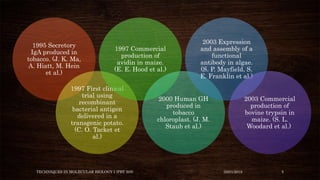
1995 Secretory
IgA produced in
tobacco. (J. K. Ma,
A. Hiatt, M. Hein
et al.)
1997 First clinical
trial using
recombinant
bacterial antigen
delivered in a
transgenic potato.
(C. O. Tacket et
al.)
1997 Commercial
production of
avidin in maize.
(E. E. Hood et al.)
2000 Human GH
produced in
tobacco
chloroplast. (J. M.
Staub et al.)
2003 Expression
and assembly of a
functional
antibody in algae.
(S. P. Mayfield, S.
E. Franklin et al.)
2003 Commercial
production of
bovine trypsin in
maize. (S. L.
Woodard et al.)
TECHNIQUES IN MOLECULAR BIOLOGY I (PBT 505) 03/01/2018 6
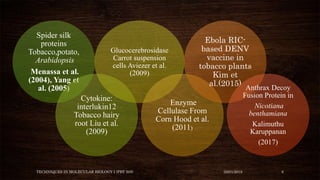
Spider silk
proteins
Tobacco,potato,
Arabidopsis
Menassa et al.
(2004), Yang et
al. (2005)
Cytokine:
interlukin12
Tobacco hairy
root Liu et al.
(2009)
Glucocerebrosidase
Carrot suspension
cells Aviezer et al.
(2009)
Enzyme
Cellulase From
Corn Hood et al.
(2011)
Ebola RIC-
based DENV
vaccine in
tobacco plants
Kim et
al.(2015) Anthrax Decoy
Fusion Protein in
Nicotiana
benthamiana
Kalimuthu
Karuppanan
(2017)
WHY
MOLECULAR
PHARMING??
03/01/2018TECHNIQUES IN MOLECULAR BIOLOGY I (PBT 505) 7
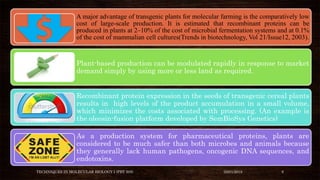
A major advantage of transgenic plants for molecular farming is the comparatively low
cost of large-scale production. It is estimated that recombinant proteins can be
produced in plants at 2–10% of the cost of microbial fermentation systems and at 0.1%
of the cost of mammalian cell cultures(Trends in biotechnology, Vol 21/Issue12, 2003).
Plant-based production can be modulated rapidly in response to market
demand simply by using more or less land as required.
Recombinant protein expression in the seeds of transgenic cereal plants
results in high levels of the product accumulation in a small volume,
which minimizes the costs associated with processing. (An example is
the oleosin-fusion platform developed by SemBioSys Genetics)
As a production system for pharmaceutical proteins, plants are
considered to be much safer than both microbes and animals because
they generally lack human pathogens, oncogenic DNA sequences, and
endotoxins.
TECHNIQUES IN MOLECULAR BIOLOGY I (PBT 505) 03/01/2018 8
Another advantages of molecular pharming is the well-established
technology for gene transfer and expression, high biomass yield, prolific
seed production and the existence of a large-scale processing infrastructure.
Plant as a Bioreactor is easy to store the products like storage in
seeds for longer durations. Another fundamental advantage of
plants has always been the range and diversity of recombinant
molecules that they can potentially produce
Easy to purify proteins and sometimes several types of recombinant
protein can be used in unprocessed or partially processed material,
therefore removing many of the downstream costs (can be consumed
directly).
As a production system for pharmaceutical proteins, plants are
considered to be much safer than both microbes and animals
because they generally lack human pathogens, oncogenic DNA
sequences, and endotoxins.
TECHNIQUES IN MOLECULAR BIOLOGY I (PBT 505) 03/01/2018 9
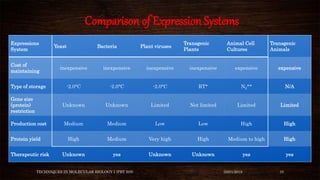
Comparison of Expression Systems
TECHNIQUES IN MOLECULAR BIOLOGY I (PBT 505) 03/01/2018 10
Expressions
System
Yeast Bacteria Plant viruses
Transgenic
Plants
Animal Cell
Cultures
Transgenic
Animals
Cost of
maintaining
inexpensive inexpensive inexpensive inexpensive expensive expensive
Type of storage -2.0°C -2.0°C -2.0°C RT* N2** N/A
Gene size
(protein)
restriction
Unknown Unknown Limited Not limited Limited Limited
Production cost Medium Medium Low Low High High
Protein yield High Medium Very high High Medium to high High
Therapeutic risk Unknown yes Unknown Unknown yes yes
HOW TO DO
MOLECULAR
PHARMING??
03/01/2018TECHNIQUES IN MOLECULAR BIOLOGY I (PBT 505) 11
TECHNIQUES IN MOLECULAR BIOLOGY I (PBT 505) 03/01/2018 12
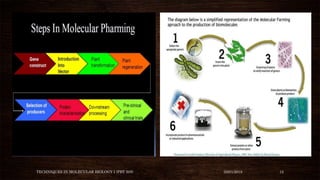
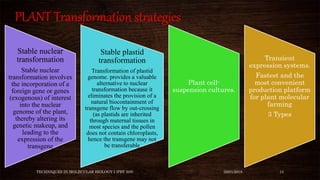
PLANT Transformation strategies
Stable nuclear
transformation
Stable nuclear
transformation involves
the incorporation of a
foreign gene or genes
(exogenous) of interest
into the nuclear
genome of the plant,
thereby altering its
genetic makeup, and
leading to the
expression of the
transgene
Stable plastid
transformation
Transformation of plastid
genome. provides a valuable
alternative to nuclear
transformation because it
eliminates the provision of a
natural biocontainment of
transgene flow by out-crossing
(as plastids are inherited
through maternal tissues in
most species and the pollen
does not contain chloroplasts,
hence the transgene may not
be transferable
Plant cell-
suspension cultures.
Transient
expression systems.
Fastest and the
most convenient
production platform
for plant molecular
farming
3 Types
TECHNIQUES IN MOLECULAR BIOLOGY I (PBT 505) 03/01/2018 13
TECHNIQUES IN MOLECULAR BIOLOGY I (PBT 505) 03/01/2018 14
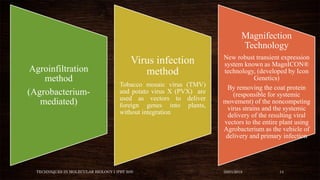
Agroinfiltration
method
(Agrobacterium-
mediated)
Virus infection
method
Tobacco mosaic virus (TMV)
and potato virus X (PVX) are
used as vectors to deliver
foreign genes into plants,
without integration
Magnifection
Technology
New robust transient expression
system known as MagnICON®
technology, (developed by Icon
Genetics)
By removing the coat protein
(responsible for systemic
movement) of the noncompeting
virus strains and the systemic
delivery of the resulting viral
vectors to the entire plant using
Agrobacterium as the vehicle of
delivery and primary infection
WHAT ARE ITS
APPLICATIONS IN
AGRICULTURE ??
03/01/2018TECHNIQUES IN MOLECULAR BIOLOGY I (PBT 505) 15
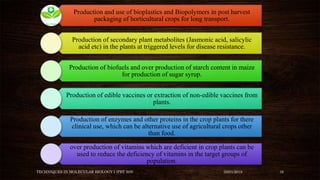
Production and use of bioplastics and Biopolymers in post harvest
packaging of horticultural crops for long transport.
Production of secondary plant metabolites (Jasmonic acid, salicylic
acid etc) in the plants at triggered levels for disease resistance.
Production of biofuels and over production of starch content in maize
for production of sugar syrup.
Production of edible vaccines or extraction of non-edible vaccines from
plants.
Production of enzymes and other proteins in the crop plants for there
clinical use, which can be alternative use of agricultural crops other
than food.
over production of vitamins which are deficient in crop plants can be
used to reduce the deficiency of vitamins in the target groups of
population.
TECHNIQUES IN MOLECULAR BIOLOGY I (PBT 505) 03/01/2018 16
What are the
Drawbacks of
Molecular pharming??
03/01/2018TECHNIQUES IN MOLECULAR BIOLOGY I (PBT 505) 17
• Biosafety concerns
1. horizontal transfer
2. Vertical gene transfer (Pollen mediated)
3. transformed plants can be eaten up by animals
• Ethical issues
• If consumed inadvertently, it could lead to desensitization of
vaccines(direct consumption)
• Production problems (low productivity and complex production
process)
• Time requirement (Require time for initial batch production
when compared to microbial systems)
TECHNIQUES IN MOLECULAR BIOLOGY I (PBT 505) 03/01/2018 18
BIBLIOGRAPHY
• Molecular farming in plants: host systems and expression technology Author Richard
M.Twyman, EvaStoger, StefanSchillberg, PaulChristou, RainerFischer
Journal Trends in Biotechnology Volume 21, Issue 12, December 2003, Pages 570-578
• Plant Molecular Farming: Opportunities and Challenges Pervin Basaran &Emilio Rodríguez-
Cerezo JournalCritical Reviews in Biotechnology Volume 28, 2008 - Issue 3
• Molecular farming for new drugs and vaccines Current
perspectives on the production of pharmaceuticals in transgenic plants
JulianK‐C. Ma, Eugenia Barros, Ralph Bock, Paul Christou, Philip J. Dale, Philip
J. Dix, Rainer Fischer, Judith Irwin, Richard Mahoney, Mario Pezzotti, Stefan Schillberg, Pen
ny Sparrow, Eva Stoger, Richard M. Twyman. EMBO reports (2005) 6, 593-599
• Canadian Food Inspection Agency. “Plant Molecular Farming”. Elbehri, Aziz. “Biopharming
and the Food System: Examining the Potential Benefits and Risks.” AgBioForum, Vol. 8, 2005,
pp. 18-25.Fischer, Rainer, and Neil Emmans. “Molecular farming of pharmaceutical
proteins.” Transgenic Research, Vol. 9, 2000, pp. 279-299.
TECHNIQUES IN MOLECULAR BIOLOGY I (PBT 505) 03/01/2018 19
Thankyou
12/28/2017FUNDAMENTALS OF MOLECULAR BIOLOGY (PBT 502) 20

Molecular farming

  • 1.
    MOLECULAR FARMING AND ITS APPLICATIONSIN AGRICULTURE PRESENTED BY AYUSH JAIN PALB7286 Jr. MSc(PLANT BIOTECHNOLOGY)
  • 2.
    CONTENTS What is MolecularFarming ?? Brief History of Molecular Farming Why Molecular Farming ?? How to do Molecular Farming?? What are its Applications in Agriculture?? What are the Drawbacks of Molecular pharming?? 03/01/2018TECHNIQUES IN MOLECULAR BIOLOGY I (PBT 505) 2
  • 3.
    What is MolecularFarming ?? • The use of whole organisms, organs, tissues or cells or cell cultures, as bioreactors for production of commercially valuable products via recombinant DNA techniques. • Molecular farming is an application of GM Technology. • “Molecular pharming” is a technology that uses plants to produce large quantities of pharmaceutical substances such as vaccines and antibodies. 03/01/2018TECHNIQUES IN MOLECULAR BIOLOGY I (PBT 505) 3
  • 4.
    HISTORY OF MOLECULARFARMING 1986 First plant - derived recombinant therapeutic protein- human GH in tobacco & sunflower. (A. Barta, D. Thompson et al.) 1989 First plant - derived recombinant antibody – full- sized IgG in tobacco. (A. Hiatt, K. Bowdish) 1990 First native human protein produced in plants – human serum albumin in tobacco & potato. (P. C. Sijmons et al.) 1992 First plant derived vaccine candidate – hepatitis B virus surface antigen in tobacco. (H. S. Meson, D. M. Lam)— 1992 First plant derived industrial enzyme – α- amylase in tobacco. (J.Pen, L. Molendijk et al.) 1996 First plant derived protein polymer – artificial elastin in tobacco. (X. Zhang, D. W. Urry, H. Daniel) TECHNIQUES IN MOLECULAR BIOLOGY I (PBT 505) 03/01/2018 4
  • 5.
    TECHNIQUES IN MOLECULARBIOLOGY I (PBT 505) 03/01/2018 5 1995 Secretory IgA produced in tobacco. (J. K. Ma, A. Hiatt, M. Hein et al.) 1997 First clinical trial using recombinant bacterial antigen delivered in a transgenic potato. (C. O. Tacket et al.) 1997 Commercial production of avidin in maize. (E. E. Hood et al.) 2000 Human GH produced in tobacco chloroplast. (J. M. Staub et al.) 2003 Expression and assembly of a functional antibody in algae. (S. P. Mayfield, S. E. Franklin et al.) 2003 Commercial production of bovine trypsin in maize. (S. L. Woodard et al.)
  • 6.
    TECHNIQUES IN MOLECULARBIOLOGY I (PBT 505) 03/01/2018 6 Spider silk proteins Tobacco,potato, Arabidopsis Menassa et al. (2004), Yang et al. (2005) Cytokine: interlukin12 Tobacco hairy root Liu et al. (2009) Glucocerebrosidase Carrot suspension cells Aviezer et al. (2009) Enzyme Cellulase From Corn Hood et al. (2011) Ebola RIC- based DENV vaccine in tobacco plants Kim et al.(2015) Anthrax Decoy Fusion Protein in Nicotiana benthamiana Kalimuthu Karuppanan (2017)
  • 7.
  • 8.
    A major advantageof transgenic plants for molecular farming is the comparatively low cost of large-scale production. It is estimated that recombinant proteins can be produced in plants at 2–10% of the cost of microbial fermentation systems and at 0.1% of the cost of mammalian cell cultures(Trends in biotechnology, Vol 21/Issue12, 2003). Plant-based production can be modulated rapidly in response to market demand simply by using more or less land as required. Recombinant protein expression in the seeds of transgenic cereal plants results in high levels of the product accumulation in a small volume, which minimizes the costs associated with processing. (An example is the oleosin-fusion platform developed by SemBioSys Genetics) As a production system for pharmaceutical proteins, plants are considered to be much safer than both microbes and animals because they generally lack human pathogens, oncogenic DNA sequences, and endotoxins. TECHNIQUES IN MOLECULAR BIOLOGY I (PBT 505) 03/01/2018 8
  • 9.
    Another advantages ofmolecular pharming is the well-established technology for gene transfer and expression, high biomass yield, prolific seed production and the existence of a large-scale processing infrastructure. Plant as a Bioreactor is easy to store the products like storage in seeds for longer durations. Another fundamental advantage of plants has always been the range and diversity of recombinant molecules that they can potentially produce Easy to purify proteins and sometimes several types of recombinant protein can be used in unprocessed or partially processed material, therefore removing many of the downstream costs (can be consumed directly). As a production system for pharmaceutical proteins, plants are considered to be much safer than both microbes and animals because they generally lack human pathogens, oncogenic DNA sequences, and endotoxins. TECHNIQUES IN MOLECULAR BIOLOGY I (PBT 505) 03/01/2018 9
  • 10.
    Comparison of ExpressionSystems TECHNIQUES IN MOLECULAR BIOLOGY I (PBT 505) 03/01/2018 10 Expressions System Yeast Bacteria Plant viruses Transgenic Plants Animal Cell Cultures Transgenic Animals Cost of maintaining inexpensive inexpensive inexpensive inexpensive expensive expensive Type of storage -2.0°C -2.0°C -2.0°C RT* N2** N/A Gene size (protein) restriction Unknown Unknown Limited Not limited Limited Limited Production cost Medium Medium Low Low High High Protein yield High Medium Very high High Medium to high High Therapeutic risk Unknown yes Unknown Unknown yes yes
  • 11.
    HOW TO DO MOLECULAR PHARMING?? 03/01/2018TECHNIQUESIN MOLECULAR BIOLOGY I (PBT 505) 11
  • 12.
    TECHNIQUES IN MOLECULARBIOLOGY I (PBT 505) 03/01/2018 12
  • 13.
    PLANT Transformation strategies Stablenuclear transformation Stable nuclear transformation involves the incorporation of a foreign gene or genes (exogenous) of interest into the nuclear genome of the plant, thereby altering its genetic makeup, and leading to the expression of the transgene Stable plastid transformation Transformation of plastid genome. provides a valuable alternative to nuclear transformation because it eliminates the provision of a natural biocontainment of transgene flow by out-crossing (as plastids are inherited through maternal tissues in most species and the pollen does not contain chloroplasts, hence the transgene may not be transferable Plant cell- suspension cultures. Transient expression systems. Fastest and the most convenient production platform for plant molecular farming 3 Types TECHNIQUES IN MOLECULAR BIOLOGY I (PBT 505) 03/01/2018 13
  • 14.
    TECHNIQUES IN MOLECULARBIOLOGY I (PBT 505) 03/01/2018 14 Agroinfiltration method (Agrobacterium- mediated) Virus infection method Tobacco mosaic virus (TMV) and potato virus X (PVX) are used as vectors to deliver foreign genes into plants, without integration Magnifection Technology New robust transient expression system known as MagnICON® technology, (developed by Icon Genetics) By removing the coat protein (responsible for systemic movement) of the noncompeting virus strains and the systemic delivery of the resulting viral vectors to the entire plant using Agrobacterium as the vehicle of delivery and primary infection
  • 15.
    WHAT ARE ITS APPLICATIONSIN AGRICULTURE ?? 03/01/2018TECHNIQUES IN MOLECULAR BIOLOGY I (PBT 505) 15
  • 16.
    Production and useof bioplastics and Biopolymers in post harvest packaging of horticultural crops for long transport. Production of secondary plant metabolites (Jasmonic acid, salicylic acid etc) in the plants at triggered levels for disease resistance. Production of biofuels and over production of starch content in maize for production of sugar syrup. Production of edible vaccines or extraction of non-edible vaccines from plants. Production of enzymes and other proteins in the crop plants for there clinical use, which can be alternative use of agricultural crops other than food. over production of vitamins which are deficient in crop plants can be used to reduce the deficiency of vitamins in the target groups of population. TECHNIQUES IN MOLECULAR BIOLOGY I (PBT 505) 03/01/2018 16
  • 17.
    What are the Drawbacksof Molecular pharming?? 03/01/2018TECHNIQUES IN MOLECULAR BIOLOGY I (PBT 505) 17
  • 18.
    • Biosafety concerns 1.horizontal transfer 2. Vertical gene transfer (Pollen mediated) 3. transformed plants can be eaten up by animals • Ethical issues • If consumed inadvertently, it could lead to desensitization of vaccines(direct consumption) • Production problems (low productivity and complex production process) • Time requirement (Require time for initial batch production when compared to microbial systems) TECHNIQUES IN MOLECULAR BIOLOGY I (PBT 505) 03/01/2018 18
  • 19.
    BIBLIOGRAPHY • Molecular farmingin plants: host systems and expression technology Author Richard M.Twyman, EvaStoger, StefanSchillberg, PaulChristou, RainerFischer Journal Trends in Biotechnology Volume 21, Issue 12, December 2003, Pages 570-578 • Plant Molecular Farming: Opportunities and Challenges Pervin Basaran &Emilio Rodríguez- Cerezo JournalCritical Reviews in Biotechnology Volume 28, 2008 - Issue 3 • Molecular farming for new drugs and vaccines Current perspectives on the production of pharmaceuticals in transgenic plants JulianK‐C. Ma, Eugenia Barros, Ralph Bock, Paul Christou, Philip J. Dale, Philip J. Dix, Rainer Fischer, Judith Irwin, Richard Mahoney, Mario Pezzotti, Stefan Schillberg, Pen ny Sparrow, Eva Stoger, Richard M. Twyman. EMBO reports (2005) 6, 593-599 • Canadian Food Inspection Agency. “Plant Molecular Farming”. Elbehri, Aziz. “Biopharming and the Food System: Examining the Potential Benefits and Risks.” AgBioForum, Vol. 8, 2005, pp. 18-25.Fischer, Rainer, and Neil Emmans. “Molecular farming of pharmaceutical proteins.” Transgenic Research, Vol. 9, 2000, pp. 279-299. TECHNIQUES IN MOLECULAR BIOLOGY I (PBT 505) 03/01/2018 19
  • 20.