Activation Functions
DEEP LEARNING
By Prateek Sahu
1. SIGMOID
ACTIVATION
FUNCTION
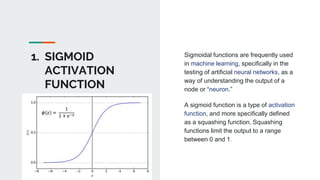
Sigmoidal functions are frequently used
in machine learning, specifically in the
testing of artificial neural networks, as a
way of understanding the output of a
node or “neuron.”
A sigmoid function is a type of activation
function, and more specifically defined
as a squashing function. Squashing
functions limit the output to a range
between 0 and 1.
Pros And Cons of Sigmoid Activation function
Pros
1. The performance of Binary
Classification is very well as compare
to other activation function.
2. Clear predictions, i.e very close to 1 or
0.
Cons
1. The calculation in sigmoid function is
complex.
2. It is not useful in multiclass
classification .
3. For negative values of x-axis gives 0.
4. It become constant and gives 1 for any
high positive values.
5. Function output is not zero-centered
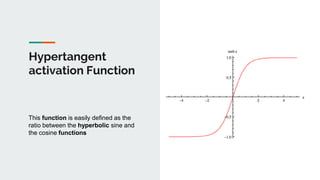
Hypertangent
activation Function
This function is easily defined as the
ratio between the hyperbolic sine and
the cosine functions
Pros And Cons of Tanh Activation function
Pros
1. The gradient is stronger for tanh than
sigmoid ( derivatives are steeper).
2. The output interval of tanh is 1, and the
whole function is 0-centric, which is
better than sigmod
Cons
1. Tanh also has the vanishing gradient
problem.
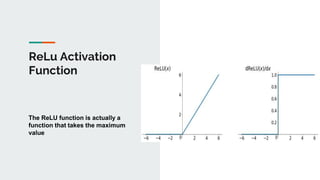
ReLu Activation
Function
The ReLU function is actually a
function that takes the maximum
value
Pros And Cons of ReLu function
Pros
1. When the input is positive, there is no
gradient saturation problem.
2. The calculation speed is much faster.
3. The ReLU function has only a linear
relationship.
4. Whether it is forward or backward, it is
much faster than sigmod and tanh.
Cons
1. When the input is negative, ReLU is
completely inactive, which means that
once a negative number is entered,
ReLU will die
2. We find that the output of the ReLU
function is either 0 or a positive number,
which means that the ReLU function is
not a 0-centric function.
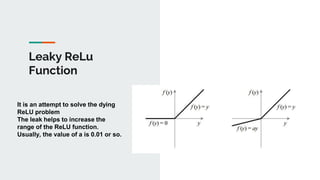
Leaky ReLu
Function
It is an attempt to solve the dying
ReLU problem
The leak helps to increase the
range of the ReLU function.
Usually, the value of a is 0.01 or so.
Pros And Cons of Leaky ReLu Activation
function
Pros
1. There will be no problems with Dead
ReLU.
2. A parameter-based method, Parametric
ReLU : f(x)= max(alpha x,x), which
alpha can be learned from back
propagation.
Cons
1. It has not been fully proved that Leaky
ReLU is always better than ReLU.
ELU (Exponential
Linear Units)
function
ELU is very similiar to RELU except negative inputs.
They are both in identity function form for non-
negative inputs. On the other hand, ELU becomes
smooth slowly until its output equal to -α whereas
RELU sharply smoothes.
Pros And Cons of ELU Activation function
Pros
1. ELU becomes smooth slowly until its
output equal to -α whereas RELU
sharply smoothes.
2. ELU is a strong alternative to ReLU.
3. Unlike to ReLU, ELU can produce
negative outputs.
Cons
1. For x > 0, it can blow up the activation
with the output range of [0, inf].
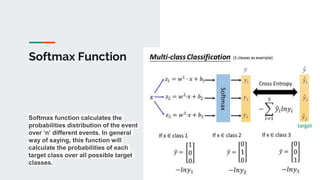
Softmax Function
Softmax function calculates the
probabilities distribution of the event
over ‘n’ different events. In general
way of saying, this function will
calculate the probabilities of each
target class over all possible target
classes.
Pros And Cons of Softmax Activation function
Pros
1. It mimics the one hot encoded labels
better than the absolute values.
2. If we use the absolute (modulus) values
we would lose information, while the
exponential intrinsically takes care of
this.
Cons
1. The softmax function should not be used
for multi-label classification.
2. the sigmoid function (discussed later) is
preferred for multi-label classification.
3. The Softmax function should not be used
for a regression task as well.
Swish Function
Swish's design was inspired by the
use of sigmoid functions for gating
in LSTMs and highway networks. We
use the same value for gating to
simplify the gating mechanism,
which is called self-gating.
Pros And Cons of Swish Activation function
Pros
1. No dying ReLU.
2. Increase in accuracy over ReLU
3. Outperforms ReLU in every batch size.
Cons
1. Slightly more computationally
expensive.
2. More problems with the algorithm will
probably arise given time.
Maxout Function
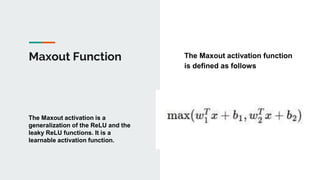
The Maxout activation is a
generalization of the ReLU and the
leaky ReLU functions. It is a
learnable activation function.
The Maxout activation function
is defined as follows
Pros And Cons of Maxout Activation function
Pros
1. It is a learnable activation function.
Cons
1. It doubles the total number of
parameters for each neuron and hence,
a higher total number of parameters
need to be trained.
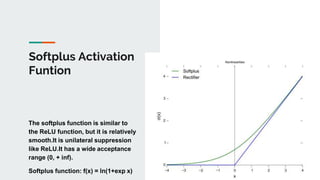
Softplus Activation
Funtion
The softplus function is similar to
the ReLU function, but it is relatively
smooth.It is unilateral suppression
like ReLU.It has a wide acceptance
range (0, + inf).
Softplus function: f(x) = ln(1+exp x)
Pros And Cons of Softplus Activation function
Pros
1. It is relatively smooth.
2. It is unilateral suppression like ReLU.
3. It has a wide acceptance range (0, +
inf).
Cons
1. Leaky ReLU is a piecewise linear
function, just as for ReLU, so quick to
compute. ELU has the advantage over
softmax and ReLU that it's mean output
is closer to zero, which improves
learning.

Activation functions

  • 1.
  • 2.
    1. SIGMOID ACTIVATION FUNCTION Sigmoidal functionsare frequently used in machine learning, specifically in the testing of artificial neural networks, as a way of understanding the output of a node or “neuron.” A sigmoid function is a type of activation function, and more specifically defined as a squashing function. Squashing functions limit the output to a range between 0 and 1.
  • 3.
    Pros And Consof Sigmoid Activation function Pros 1. The performance of Binary Classification is very well as compare to other activation function. 2. Clear predictions, i.e very close to 1 or 0. Cons 1. The calculation in sigmoid function is complex. 2. It is not useful in multiclass classification . 3. For negative values of x-axis gives 0. 4. It become constant and gives 1 for any high positive values. 5. Function output is not zero-centered
  • 4.
    Hypertangent activation Function This functionis easily defined as the ratio between the hyperbolic sine and the cosine functions
  • 5.
    Pros And Consof Tanh Activation function Pros 1. The gradient is stronger for tanh than sigmoid ( derivatives are steeper). 2. The output interval of tanh is 1, and the whole function is 0-centric, which is better than sigmod Cons 1. Tanh also has the vanishing gradient problem.
  • 6.
    ReLu Activation Function The ReLUfunction is actually a function that takes the maximum value
  • 7.
    Pros And Consof ReLu function Pros 1. When the input is positive, there is no gradient saturation problem. 2. The calculation speed is much faster. 3. The ReLU function has only a linear relationship. 4. Whether it is forward or backward, it is much faster than sigmod and tanh. Cons 1. When the input is negative, ReLU is completely inactive, which means that once a negative number is entered, ReLU will die 2. We find that the output of the ReLU function is either 0 or a positive number, which means that the ReLU function is not a 0-centric function.
  • 8.
    Leaky ReLu Function It isan attempt to solve the dying ReLU problem The leak helps to increase the range of the ReLU function. Usually, the value of a is 0.01 or so.
  • 9.
    Pros And Consof Leaky ReLu Activation function Pros 1. There will be no problems with Dead ReLU. 2. A parameter-based method, Parametric ReLU : f(x)= max(alpha x,x), which alpha can be learned from back propagation. Cons 1. It has not been fully proved that Leaky ReLU is always better than ReLU.
  • 10.
    ELU (Exponential Linear Units) function ELUis very similiar to RELU except negative inputs. They are both in identity function form for non- negative inputs. On the other hand, ELU becomes smooth slowly until its output equal to -α whereas RELU sharply smoothes.
  • 11.
    Pros And Consof ELU Activation function Pros 1. ELU becomes smooth slowly until its output equal to -α whereas RELU sharply smoothes. 2. ELU is a strong alternative to ReLU. 3. Unlike to ReLU, ELU can produce negative outputs. Cons 1. For x > 0, it can blow up the activation with the output range of [0, inf].
  • 12.
    Softmax Function Softmax functioncalculates the probabilities distribution of the event over ‘n’ different events. In general way of saying, this function will calculate the probabilities of each target class over all possible target classes.
  • 13.
    Pros And Consof Softmax Activation function Pros 1. It mimics the one hot encoded labels better than the absolute values. 2. If we use the absolute (modulus) values we would lose information, while the exponential intrinsically takes care of this. Cons 1. The softmax function should not be used for multi-label classification. 2. the sigmoid function (discussed later) is preferred for multi-label classification. 3. The Softmax function should not be used for a regression task as well.
  • 14.
    Swish Function Swish's designwas inspired by the use of sigmoid functions for gating in LSTMs and highway networks. We use the same value for gating to simplify the gating mechanism, which is called self-gating.
  • 15.
    Pros And Consof Swish Activation function Pros 1. No dying ReLU. 2. Increase in accuracy over ReLU 3. Outperforms ReLU in every batch size. Cons 1. Slightly more computationally expensive. 2. More problems with the algorithm will probably arise given time.
  • 16.
    Maxout Function The Maxoutactivation is a generalization of the ReLU and the leaky ReLU functions. It is a learnable activation function. The Maxout activation function is defined as follows
  • 17.
    Pros And Consof Maxout Activation function Pros 1. It is a learnable activation function. Cons 1. It doubles the total number of parameters for each neuron and hence, a higher total number of parameters need to be trained.
  • 18.
    Softplus Activation Funtion The softplusfunction is similar to the ReLU function, but it is relatively smooth.It is unilateral suppression like ReLU.It has a wide acceptance range (0, + inf). Softplus function: f(x) = ln(1+exp x)
  • 19.
    Pros And Consof Softplus Activation function Pros 1. It is relatively smooth. 2. It is unilateral suppression like ReLU. 3. It has a wide acceptance range (0, + inf). Cons 1. Leaky ReLU is a piecewise linear function, just as for ReLU, so quick to compute. ELU has the advantage over softmax and ReLU that it's mean output is closer to zero, which improves learning.