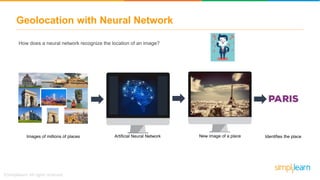
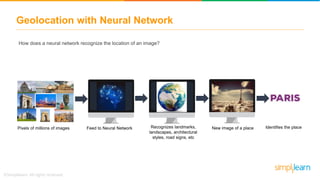



Geolocation with Neural Network
How does a neural network recognize the location of an image?
Artificial Neural Network New image of a placeImages of millions of places Identifies the place
Geolocation with Neural Network
Pixels of millions of images Feed to Neural Network Recognizes landmarks,
landscapes, architectural
styles, road signs, etc
New image of a place Identifies the place
How does a neural network recognize the location of an image?
What’s in it for you?
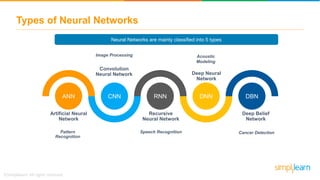
Types of Neural Networks
Applications of Deep Learning
Working of Neural Network
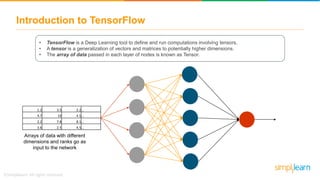
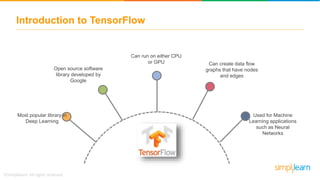
Introduction to TensorFlow
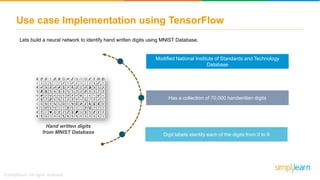
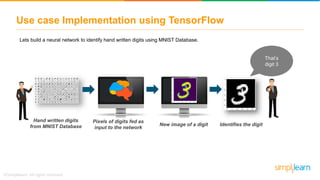
Use case implementation using TensorFlow
What is Deep Learning?
What is a Neural Network?
Implementing Logic Gates using Perceptron
What is a Perceptron?
Why do we need Deep Learning?
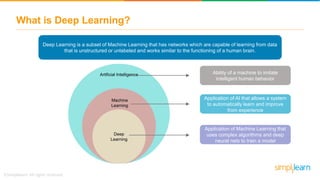
What is Deep Learning?
Deep Learning is a subset of Machine Learning that has networks which are capable of learning from data
that is unstructured or unlabeled and works similar to the functioning of a human brain.
Artificial Intelligence
Machine
Learning
Deep
Learning
Ability of a machine to imitate
intelligent human behavior
Application of AI that allows a system
to automatically learn and improve
from experience
Application of Machine Learning that
uses complex algorithms and deep
neural nets to train a model
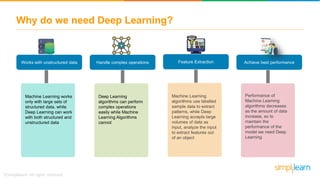
Why do we need Deep Learning?
Machine Learning works
only with large sets of
structured data, while
Deep Learning can work
with both structured and
unstructured data
Deep Learning
algorithms can perform
complex operations
easily while Machine
Learning Algorithms
cannot
Machine Learning
algorithms use labelled
sample data to extract
patterns, while Deep
Learning accepts large
volumes of data as
input, analyze the input
to extract features out
of an object
Performance of
Machine Learning
algorithms decreases
as the amount of data
increase, so to
maintain the
performance of the
model we need Deep
Learning
Works with unstructured data Handle complex operations Feature Extraction Achieve best performance
What is a Neural Network?
Neuron
X1
X2
Xn
Y
Output
w1
w2
w n
Input 1
Input 2
Input n
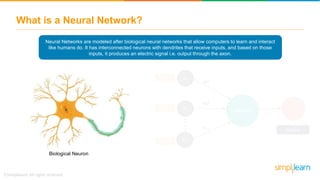
Neural Networks are modeled after biological neural networks that allow computers to learn and interact
like humans do. It has interconnected neurons with dendrites that receive inputs, and based on those
inputs, it produces an electric signal i.e. output through the axon.
Biological Neuron
What is a Neural Network?
Neuron
X1
X2
Xn
Y
Output
w1
w2
w n
Input 1
Input 2
Input n
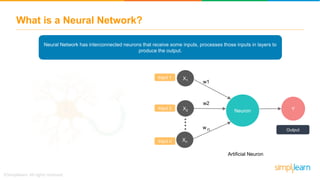
Neural Network has interconnected neurons that receive some inputs, processes those inputs in layers to
produce the output.
Artificial Neuron
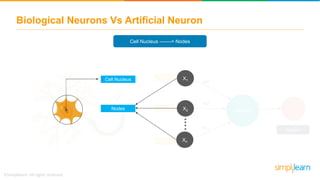
Biological Neurons Vs Artificial Neuron
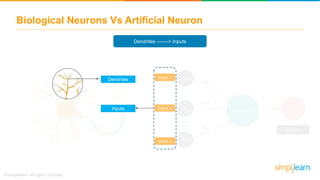
Dendrites -------> Inputs
Neuron
X1
X2
Xn
Y
Output
w1
w2
w n
Dendrites Input 1
Input 2
Input n
Inputs
Biological Neurons Vs Artificial Neuron
Cell Nucleus
Neuron
Input 1
Input 2
Input n
Y
Output
w1
w2
w n
Nodes
X1
X2
Xn
Cell Nucleus -------> Nodes
X1
X2
Xn
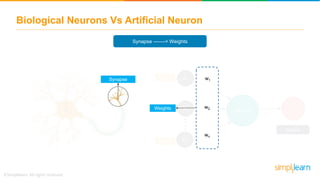
Biological Neurons Vs Artificial Neuron
Synapse
Neuron
Input 1
Input 2
Input n
Y
Output
Weights
w1
w2
wn
Synapse -------> Weights
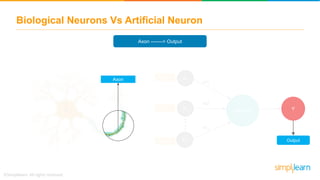
Biological Neurons Vs Artificial Neuron
X1
X2
Xn
Neuron
Input 1
Input 2
Input n
w1
w2
wn
Axon
Axon -------> Output
Y
Output
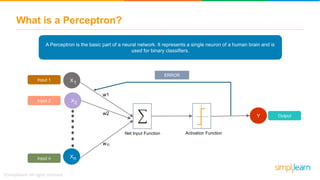
What is a Perceptron?
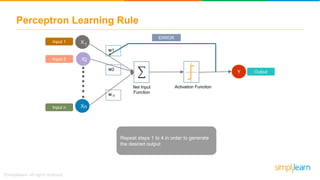
A Perceptron is the basic part of a neural network. It represents a single neuron of a human brain and is
used for binary classifiers.
X1
X2
Xn
Input 1
Input 2
Input n
w1
w2
wn
Y Output
Net Input Function Activation Function
ERROR
Perceptron Learning Rule
w
X1
X2
Xn
Input 1
Input 2
Input n
w2
Y Output
Activation Function
ERROR
w1
n
Net Input
Function
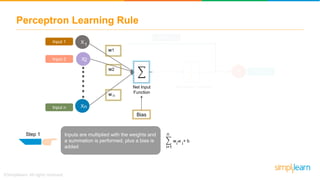
Inputs are multiplied with the weights and
a summation is performed, plus a bias is
added
Bias
i=1
n
w x + b
i i*
Step 1
Perceptron Learning Rule
w
X1
X2
Xn
Input 1
Input 2
Input n
w2
Y Output
Activation Function
ERROR
w1
n
Net Input
Function
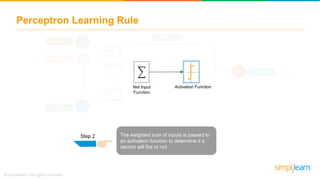
The weighted sum of inputs is passed to
an activation function to determine if a
neuron will fire or not
Step 2
Perceptron Learning Rule
w
X1
X2
Xn
Input 1
Input 2
Input n
w2
Y Output
Activation Function
ERROR
w1
n
Net Input
Function
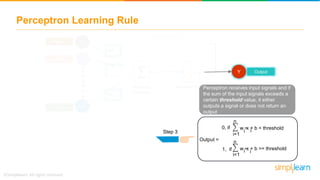
Perceptron receives input signals and if
the sum of the input signals exceeds a
certain threshold value, it either
outputs a signal or does not return an
output
Output =
0, if
i=1
n
w x + b < threshold
i i*
1, if
i=1
n
w x + b >= thresholdi i*
Step 3
Perceptron Learning Rule
w
X1
X2
Xn
Input 1
Input 2
Input n
w2
Y Output
Activation Function
ERROR
w1
n
Net Input
Function
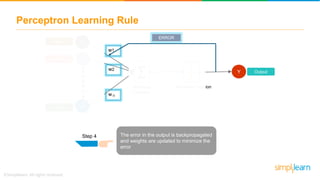
The error in the output is backpropagated
and weights are updated to minimize the
error
Step 4
Perceptron Learning Rule
w
X1
X2
Xn
Input 1
Input 2
Input n
w2
Y Output
Activation Function
ERROR
w1
n
Net Input
Function
Repeat steps 1 to 4 in order to generate
the desired output
Implementing Logic Gates using Perceptron
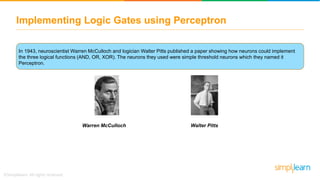
In 1943, neuroscientist Warren McCulloch and logician Walter Pitts published a paper showing how neurons could implement
the three logical functions (AND, OR, XOR). The neurons they used were simple threshold neurons which they named it
Perceptron.
Warren McCulloch Walter Pitts
Implementing Logic Gates using Perceptron
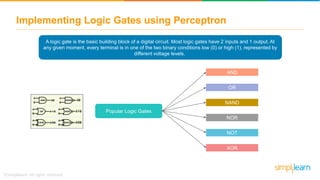
A logic gate is the basic building block of a digital circuit. Most logic gates have 2 inputs and 1 output. At
any given moment, every terminal is in one of the two binary conditions low (0) or high (1), represented by
different voltage levels.
Popular Logic Gates
AND
OR
NAND
NOR
NOT
XOR
Implementing AND Gate
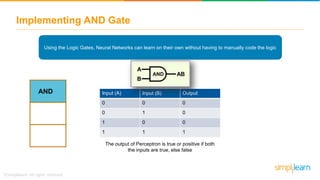
Using the Logic Gates, Neural Networks can learn on their own without having to manually code the logic
Input (A) Input (B) Output
0 0 0
0 1 0
1 0 0
1 1 1
AND
The output of Perceptron is true or positive if both
the inputs are true, else false
Implementing AND Gate
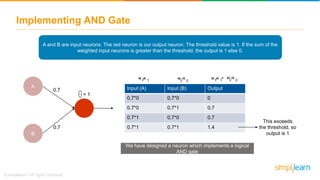
A and B are input neurons. The red neuron is our output neuron. The threshold value is 1. If the sum of the
weighted input neurons is greater than the threshold, the output is 1 else 0.
Input (A) Input (B) Output
0.7*0 0.7*0 0
0.7*0 0.7*1 0.7
0.7*1 0.7*0 0.7
0.7*1 0.7*1 1.4
A
B
0.7
0.7
= 1
This exceeds
the threshold, so
output is 1
We have designed a neuron which implements a logical
AND gate
w x1 1* w x
2 2* w x +1 1* w x
2 2*
Implementing OR Gate
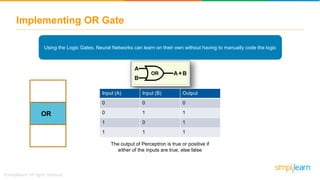
Using the Logic Gates, Neural Networks can learn on their own without having to manually code the logic
Input (A) Input (B) Output
0 0 0
0 1 1
1 0 1
1 1 1
OR
The output of Perceptron is true or positive if
either of the inputs are true, else false
Implementing OR Gate
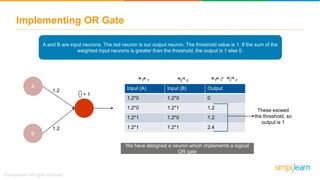
A and B are input neurons. The red neuron is our output neuron. The threshold value is 1. If the sum of the
weighted input neurons is greater than the threshold, the output is 1 else 0.
Input (A) Input (B) Output
1.2*0 1.2*0 0
1.2*0 1.2*1 1.2
1.2*1 1.2*0 1.2
1.2*1 1.2*1 2.4
A
B
1.2
1.2
= 1
These exceed
the threshold, so
output is 1
w x1 1* w x
2 2* w x +1 1* w x
2 2*
We have designed a neuron which implements a logical
OR gate
Implementing XOR Gate
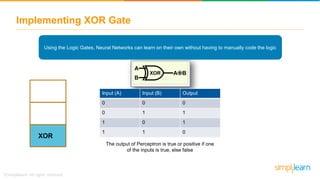
Using the Logic Gates, Neural Networks can learn on their own without having to manually code the logic
Input (A) Input (B) Output
0 0 0
0 1 1
1 0 1
1 1 0
XOR
The output of Perceptron is true or positive if one
of the inputs is true, else false
Implementing XOR Gate
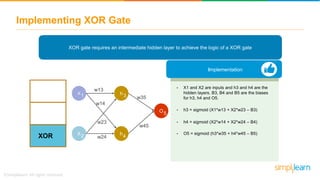
XOR gate requires an intermediate hidden layer to achieve the logic of a XOR gate
XOR
Implementation
5
X
X
h
h
O
1
2
3
4
w13
w14
w23
w24
w45
w35
5
• X1 and X2 are inputs and h3 and h4 are the
hidden layers. B3, B4 and B5 are the biases
for h3, h4 and O5.
• h3 = sigmoid (X1*w13 + X2*w23 – B3)
• h4 = sigmoid (X2*w14 + X2*w24 – B4)
• O5 = sigmoid (h3*w35 + h4*w45 – B5)
Implementing XOR Gate
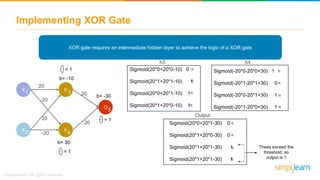
XOR gate requires an intermediate hidden layer to achieve the logic of a XOR gate
5
X
X
h
h
O
1
2
3
4
20
-20
20
-20
20
20
5
Sigmoid(20*0+20*0-10) 0
Sigmoid(20*1+20*1-10) 1
Sigmoid(20*0+20*1-10) 1
Sigmoid(20*1+20*0-10) 1
~~
~~
~~
~~
Sigmoid(-20*0-20*0+30) 1
Sigmoid(-20*1-20*1+30) 0
Sigmoid(-20*0-20*1+30) 1
Sigmoid(-20*1-20*0+30) 1
~~
~~
~~
~~
b= -10
Sigmoid(20*0+20*1-30) 0
Sigmoid(20*1+20*0-30) 0
Sigmoid(20*1+20*1-30) 1
~~
~~
~~
~~
h3 h4
Output
These exceed the
threshold, so
output is 1
b= 30
b= -30
= 1
= 1
= 1
Types of Neural Network
Types of Neural Networks
Pattern
Recognition
ANN CNN RNN DNN DBN
Image Processing Acoustic
Modeling
Recursive
Neural Network
Cancer Detection
Neural Networks are mainly classified into 5 types
Artificial Neural
Network
Convolution
Neural Network
Speech Recognition
Deep Neural
Network
Deep Belief
Network
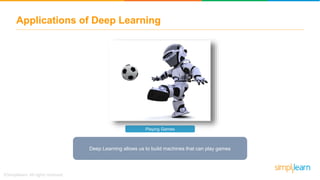
Applications of Deep Learning
Deep Learning allows us to build machines that can play games
Playing Games
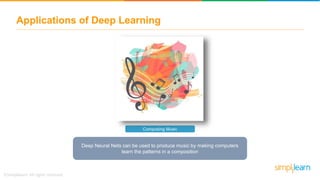
Applications of Deep Learning
Composing Music
Deep Neural Nets can be used to produce music by making computers
learn the patterns in a composition
Applications of Deep Learning
Autonomous Driving Cars
Distinguishes different types of objects, people, road signs and drives
without human intervention
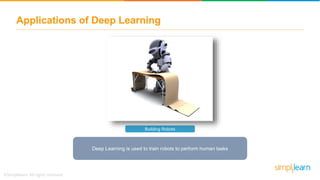
Applications of Deep Learning
Building Robots
Deep Learning is used to train robots to perform human tasks
Applications of Deep Learning
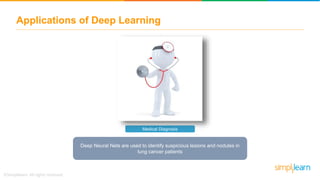
Medical Diagnosis
Deep Neural Nets are used to identify suspicious lesions and nodules in
lung cancer patients
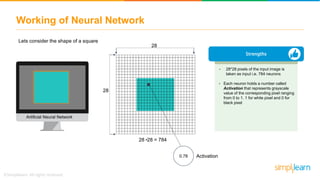
Working of Neural Network
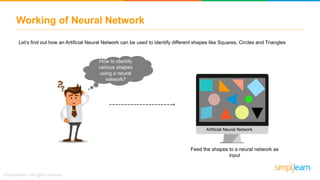
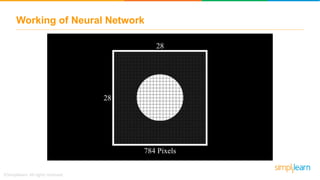
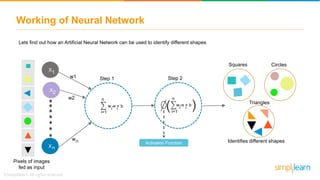
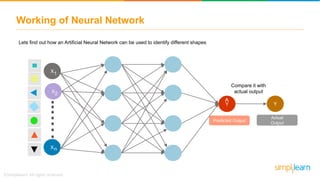
Let’s find out how an Artificial Neural Network can be used to identify different shapes like Squares, Circles and Triangles
How to identify
various shapes
using a neural
network?
Feed the shapes to a neural network as
input
Artificial Neural Network
Working of Neural Network
Artificial Neural Network
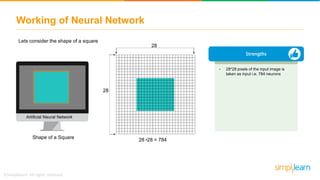
28
28
Strengths
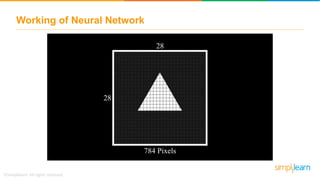
28 28 = 784*
• 28*28 pixels of the input image is
taken as input i.e. 784 neurons
Lets consider the shape of a square
Shape of a Square
Working of Neural Network
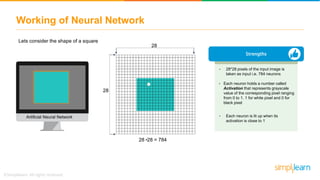
28
28
Strengths
• 28*28 pixels of the input image is
taken as input i.e. 784 neurons
28 28 = 784*
0.78 Activation
• Each neuron holds a number called
Activation that represents grayscale
value of the corresponding pixel ranging
from 0 to 1. 1 for white pixel and 0 for
black pixel
Lets consider the shape of a square
Artificial Neural Network
Working of Neural Network
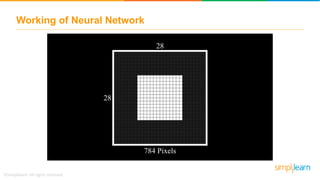
Lets consider the shape of a square
28
28
Strengths
• 28*28 pixels of the input image is
taken as input i.e. 784 neurons
• Each neuron is lit up when its
activation is close to 1
28 28 = 784*
• Each neuron holds a number called
Activation that represents grayscale
value of the corresponding pixel ranging
from 0 to 1. 1 for white pixel and 0 for
black pixel
Artificial Neural Network
Working of Neural Network
X1
X2
Xn
w1
w2
wn
Step 1
i=1
n
w x + b
i i*
Activation Function
Step 2
i=1
n
w x + b
ii*( )
Lets find out how an Artificial Neural Network can be used to identify different shapes
Identifies different shapes
Squares Circles
Triangles
Pixels of images
fed as input
Working of Neural Network
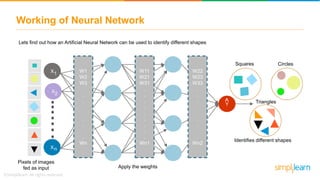
Lets find out how an Artificial Neural Network can be used to identify different shapes
X1
X2
Xn
Y
W1
W2
W3
.
.
.
.
.
.
.
.
.
Wn
W22
W23
W33
.
.
.
.
.
.
.
.
.
Wn2
W11
W21
W31
.
.
.
.
.
.
.
.
.
Wn1
Apply the weights
Identifies different shapes
Squares Circles
Triangles^
Pixels of images
fed as input
Working of Neural Network
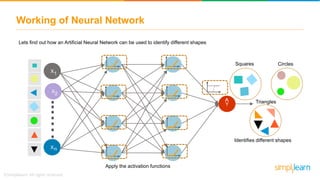
Lets find out how an Artificial Neural Network can be used to identify different shapes
X1
X2
Xn
Y^
Apply the activation functions
Identifies different shapes
Squares Circles
Triangles
Working of Neural Network
Lets find out how an Artificial Neural Network can be used to identify different shapes
X1
X2
Xn
Y^
Compare it with
actual output
Predicted Output
Actual
Output
Y
Working of Neural Network
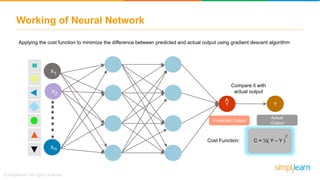
Applying the cost function to minimize the difference between predicted and actual output using gradient descent algorithm
Predicted Output
X1
X2
Xn
Y^
Actual
Output
Compare it with
actual output
Y
Cost Function: C = ½( Y – Y )
2
Working of Neural Network
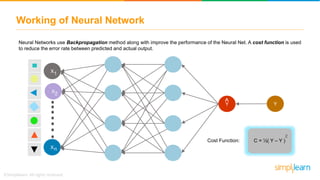
Neural Networks use Backpropagation method along with improve the performance of the Neural Net. A cost function is used
to reduce the error rate between predicted and actual output.
X
X
X
Y^
Cost Function: C = ½( Y – Y )
2
1
2
n
Y
Cost Function
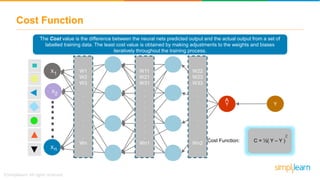
The Cost value is the difference between the neural nets predicted output and the actual output from a set of
labelled training data. The least cost value is obtained by making adjustments to the weights and biases
iteratively throughout the training process.
X
X
Xn
Y Y^
W1
W2
W3
.
.
.
.
.
.
.
.
.
Wn
W22
W23
W33
.
.
.
.
.
.
.
.
.
Wn2
W11
W21
W31
.
.
.
.
.
.
.
.
.
Wn1
1
2
Cost Function: C = ½( Y – Y )
2
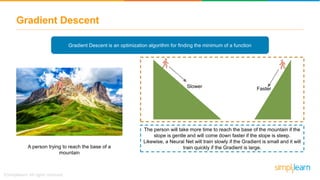
Gradient Descent
Slower Faster
The person will take more time to reach the base of the mountain if the
slope is gentle and will come down faster if the slope is steep.
Likewise, a Neural Net will train slowly if the Gradient is small and it will
train quickly if the Gradient is large.
Gradient Descent is an optimization algorithm for finding the minimum of a function
A person trying to reach the base of a
mountain
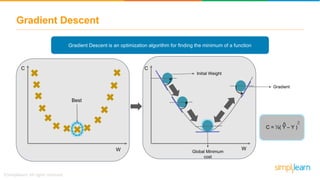
Gradient Descent
Gradient Descent is an optimization algorithm for finding the minimum of a functionGradient Descent is an optimization algorithm for finding the minimum of a function
C = ½( Y – Y )^ 2
C
W
C
W
Best
Gradient
Global Minimum
cost
Initial Weight
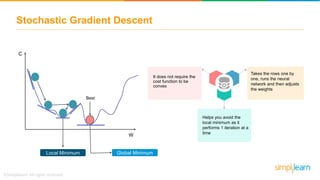
Stochastic Gradient Descent
C
W
Best
Local Minimum Global Minimum
It does not require the
cost function to be
convex
Takes the rows one by
one, runs the neural
network and then adjusts
the weights
Helps you avoid the
local minimum as it
performs 1 iteration at a
time
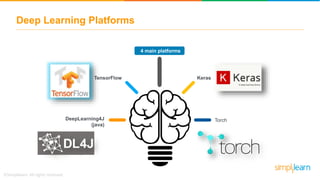
Deep Learning Platforms
Torch
Keras
4 main platforms
TensorFlow
DeepLearning4J
(java)
Introduction to TensorFlow
• TensorFlow is a Deep Learning tool to define and run computations involving tensors.
• A tensor is a generalization of vectors and matrices to potentially higher dimensions.
• The array of data passed in each layer of nodes is known as Tensor.
a
m
k
q
d
2
4
8
1
1
9
3
2
5
4
4
6
6
3
3
7
8
2
9
5
Tensor of Dimensions[5] Tensor of Dimensions[5,4]Tensor of Dimension[3,3,3]
Introduction to TensorFlow
• TensorFlow is a Deep Learning tool to define and run computations involving tensors.
• A tensor is a generalization of vectors and matrices to potentially higher dimensions.
• The array of data passed in each layer of nodes is known as Tensor.
1.2 3.5 2.2…
4.7 10 4.5…
2.2 7.8 8.1…
3.6 2.5 4.5…
Arrays of data with different
dimensions and ranks go as
input to the network
Tensor Ranks
m=V=[1,2,3],[4,5,6]
v=[10,20,30]
t=[[[1],[2],[3]],[[4],[5],[6]],[[7],[8],[9]]]
s= [107]
Tensor of Rank 0 Tensor of Rank 1
Tensor of Rank 2Tensor of Rank 3
Introduction to TensorFlow
Open source software
library developed by
Google
Most popular library in
Deep Learning
Can run on either CPU
or GPU Can create data flow
graphs that have nodes
and edges
Used for Machine
Learning applications
such as Neural
Networks
Use case Implementation using TensorFlow
Lets build a neural network to identify hand written digits using MNIST Database.
Hand written digits
from MNIST Database
Modified National Institute of Standards and Technology
Database
Has a collection of 70,000 handwritten digits
Digit labels identify each of the digits from 0 to 9
Use case Implementation using TensorFlow
Lets build a neural network to identify hand written digits using MNIST Database.
Hand written digits
from MNIST Database
Pixels of digits fed as
input to the network
New image of a digit Identifies the digit
That’s
digit 3
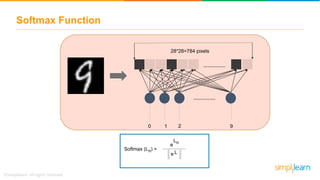
Softmax Function
…………….
0 1 2 9
28*28=784 pixels
…………….
Softmax (Ln) =
Ln
e
e L
Use case Implementation using TensorFlow
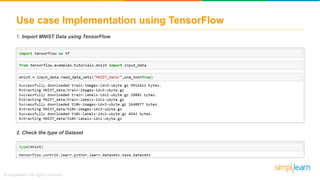
1. Import MNIST Data using TensorFlow
2. Check the type of Dataset
Use case Implementation using TensorFlow
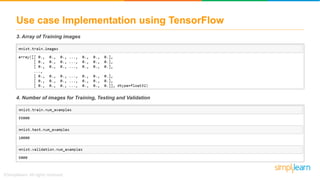
3. Array of Training images
4. Number of images for Training, Testing and Validation
Use case Implementation using TensorFlow
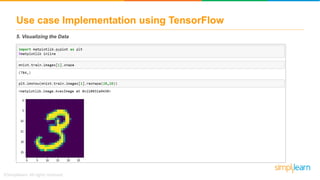
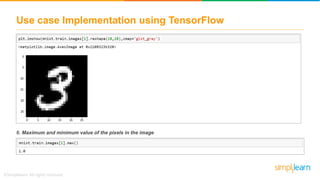
5. Visualizing the Data
Use case Implementation using TensorFlow
6. Maximum and minimum value of the pixels in the image
Use case Implementation using TensorFlow
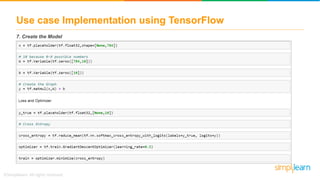
7. Create the Model
Use case Implementation using TensorFlow
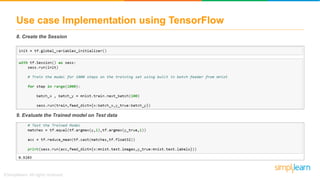
8. Create the Session
9. Evaluate the Trained model on Test data
Deep Learning Tutorial | Deep Learning TensorFlow | Deep Learning With Neural Networks | Simplilearn

Deep Learning Tutorial | Deep Learning TensorFlow | Deep Learning With Neural Networks | Simplilearn

  • 2.
    Geolocation with NeuralNetwork How does a neural network recognize the location of an image? Artificial Neural Network New image of a placeImages of millions of places Identifies the place
  • 3.
    Geolocation with NeuralNetwork Pixels of millions of images Feed to Neural Network Recognizes landmarks, landscapes, architectural styles, road signs, etc New image of a place Identifies the place How does a neural network recognize the location of an image?
  • 4.
    What’s in itfor you? Types of Neural Networks Applications of Deep Learning Working of Neural Network Introduction to TensorFlow Use case implementation using TensorFlow What is Deep Learning? What is a Neural Network? Implementing Logic Gates using Perceptron What is a Perceptron? Why do we need Deep Learning?
  • 5.
    What is DeepLearning?
  • 6.
    What is DeepLearning? Deep Learning is a subset of Machine Learning that has networks which are capable of learning from data that is unstructured or unlabeled and works similar to the functioning of a human brain. Artificial Intelligence Machine Learning Deep Learning Ability of a machine to imitate intelligent human behavior Application of AI that allows a system to automatically learn and improve from experience Application of Machine Learning that uses complex algorithms and deep neural nets to train a model
  • 7.
    Why do weneed Deep Learning? Machine Learning works only with large sets of structured data, while Deep Learning can work with both structured and unstructured data Deep Learning algorithms can perform complex operations easily while Machine Learning Algorithms cannot Machine Learning algorithms use labelled sample data to extract patterns, while Deep Learning accepts large volumes of data as input, analyze the input to extract features out of an object Performance of Machine Learning algorithms decreases as the amount of data increase, so to maintain the performance of the model we need Deep Learning Works with unstructured data Handle complex operations Feature Extraction Achieve best performance
  • 8.
    What is aNeural Network?
  • 9.
    What is aNeural Network? Neuron X1 X2 Xn Y Output w1 w2 w n Input 1 Input 2 Input n Neural Networks are modeled after biological neural networks that allow computers to learn and interact like humans do. It has interconnected neurons with dendrites that receive inputs, and based on those inputs, it produces an electric signal i.e. output through the axon. Biological Neuron
  • 10.
    What is aNeural Network? Neuron X1 X2 Xn Y Output w1 w2 w n Input 1 Input 2 Input n Neural Network has interconnected neurons that receive some inputs, processes those inputs in layers to produce the output. Artificial Neuron
  • 11.
    Biological Neurons VsArtificial Neuron Dendrites -------> Inputs Neuron X1 X2 Xn Y Output w1 w2 w n Dendrites Input 1 Input 2 Input n Inputs
  • 12.
    Biological Neurons VsArtificial Neuron Cell Nucleus Neuron Input 1 Input 2 Input n Y Output w1 w2 w n Nodes X1 X2 Xn Cell Nucleus -------> Nodes
  • 13.
    X1 X2 Xn Biological Neurons VsArtificial Neuron Synapse Neuron Input 1 Input 2 Input n Y Output Weights w1 w2 wn Synapse -------> Weights
  • 14.
    Biological Neurons VsArtificial Neuron X1 X2 Xn Neuron Input 1 Input 2 Input n w1 w2 wn Axon Axon -------> Output Y Output
  • 15.
    What is aPerceptron?
  • 16.
    What is aPerceptron? A Perceptron is the basic part of a neural network. It represents a single neuron of a human brain and is used for binary classifiers. X1 X2 Xn Input 1 Input 2 Input n w1 w2 wn Y Output Net Input Function Activation Function ERROR
  • 17.
    Perceptron Learning Rule w X1 X2 Xn Input1 Input 2 Input n w2 Y Output Activation Function ERROR w1 n Net Input Function Inputs are multiplied with the weights and a summation is performed, plus a bias is added Bias i=1 n w x + b i i* Step 1
  • 18.
    Perceptron Learning Rule w X1 X2 Xn Input1 Input 2 Input n w2 Y Output Activation Function ERROR w1 n Net Input Function The weighted sum of inputs is passed to an activation function to determine if a neuron will fire or not Step 2
  • 19.
    Perceptron Learning Rule w X1 X2 Xn Input1 Input 2 Input n w2 Y Output Activation Function ERROR w1 n Net Input Function Perceptron receives input signals and if the sum of the input signals exceeds a certain threshold value, it either outputs a signal or does not return an output Output = 0, if i=1 n w x + b < threshold i i* 1, if i=1 n w x + b >= thresholdi i* Step 3
  • 20.
    Perceptron Learning Rule w X1 X2 Xn Input1 Input 2 Input n w2 Y Output Activation Function ERROR w1 n Net Input Function The error in the output is backpropagated and weights are updated to minimize the error Step 4
  • 21.
    Perceptron Learning Rule w X1 X2 Xn Input1 Input 2 Input n w2 Y Output Activation Function ERROR w1 n Net Input Function Repeat steps 1 to 4 in order to generate the desired output
  • 22.
    Implementing Logic Gatesusing Perceptron In 1943, neuroscientist Warren McCulloch and logician Walter Pitts published a paper showing how neurons could implement the three logical functions (AND, OR, XOR). The neurons they used were simple threshold neurons which they named it Perceptron. Warren McCulloch Walter Pitts
  • 23.
    Implementing Logic Gatesusing Perceptron A logic gate is the basic building block of a digital circuit. Most logic gates have 2 inputs and 1 output. At any given moment, every terminal is in one of the two binary conditions low (0) or high (1), represented by different voltage levels. Popular Logic Gates AND OR NAND NOR NOT XOR
  • 24.
    Implementing AND Gate Usingthe Logic Gates, Neural Networks can learn on their own without having to manually code the logic Input (A) Input (B) Output 0 0 0 0 1 0 1 0 0 1 1 1 AND The output of Perceptron is true or positive if both the inputs are true, else false
  • 25.
    Implementing AND Gate Aand B are input neurons. The red neuron is our output neuron. The threshold value is 1. If the sum of the weighted input neurons is greater than the threshold, the output is 1 else 0. Input (A) Input (B) Output 0.7*0 0.7*0 0 0.7*0 0.7*1 0.7 0.7*1 0.7*0 0.7 0.7*1 0.7*1 1.4 A B 0.7 0.7 = 1 This exceeds the threshold, so output is 1 We have designed a neuron which implements a logical AND gate w x1 1* w x 2 2* w x +1 1* w x 2 2*
  • 26.
    Implementing OR Gate Usingthe Logic Gates, Neural Networks can learn on their own without having to manually code the logic Input (A) Input (B) Output 0 0 0 0 1 1 1 0 1 1 1 1 OR The output of Perceptron is true or positive if either of the inputs are true, else false
  • 27.
    Implementing OR Gate Aand B are input neurons. The red neuron is our output neuron. The threshold value is 1. If the sum of the weighted input neurons is greater than the threshold, the output is 1 else 0. Input (A) Input (B) Output 1.2*0 1.2*0 0 1.2*0 1.2*1 1.2 1.2*1 1.2*0 1.2 1.2*1 1.2*1 2.4 A B 1.2 1.2 = 1 These exceed the threshold, so output is 1 w x1 1* w x 2 2* w x +1 1* w x 2 2* We have designed a neuron which implements a logical OR gate
  • 28.
    Implementing XOR Gate Usingthe Logic Gates, Neural Networks can learn on their own without having to manually code the logic Input (A) Input (B) Output 0 0 0 0 1 1 1 0 1 1 1 0 XOR The output of Perceptron is true or positive if one of the inputs is true, else false
  • 29.
    Implementing XOR Gate XORgate requires an intermediate hidden layer to achieve the logic of a XOR gate XOR Implementation 5 X X h h O 1 2 3 4 w13 w14 w23 w24 w45 w35 5 • X1 and X2 are inputs and h3 and h4 are the hidden layers. B3, B4 and B5 are the biases for h3, h4 and O5. • h3 = sigmoid (X1*w13 + X2*w23 – B3) • h4 = sigmoid (X2*w14 + X2*w24 – B4) • O5 = sigmoid (h3*w35 + h4*w45 – B5)
  • 30.
    Implementing XOR Gate XORgate requires an intermediate hidden layer to achieve the logic of a XOR gate 5 X X h h O 1 2 3 4 20 -20 20 -20 20 20 5 Sigmoid(20*0+20*0-10) 0 Sigmoid(20*1+20*1-10) 1 Sigmoid(20*0+20*1-10) 1 Sigmoid(20*1+20*0-10) 1 ~~ ~~ ~~ ~~ Sigmoid(-20*0-20*0+30) 1 Sigmoid(-20*1-20*1+30) 0 Sigmoid(-20*0-20*1+30) 1 Sigmoid(-20*1-20*0+30) 1 ~~ ~~ ~~ ~~ b= -10 Sigmoid(20*0+20*1-30) 0 Sigmoid(20*1+20*0-30) 0 Sigmoid(20*1+20*1-30) 1 Sigmoid(20*1+20*1-30) 1 ~~ ~~ ~~ ~~ h3 h4 Output These exceed the threshold, so output is 1 b= 30 b= -30 = 1 = 1 = 1
  • 31.
  • 32.
    Types of NeuralNetworks Pattern Recognition ANN CNN RNN DNN DBN Image Processing Acoustic Modeling Recursive Neural Network Cancer Detection Neural Networks are mainly classified into 5 types Artificial Neural Network Convolution Neural Network Speech Recognition Deep Neural Network Deep Belief Network
  • 33.
  • 34.
    Applications of DeepLearning Deep Learning allows us to build machines that can play games Playing Games
  • 35.
    Applications of DeepLearning Composing Music Deep Neural Nets can be used to produce music by making computers learn the patterns in a composition
  • 36.
    Applications of DeepLearning Autonomous Driving Cars Distinguishes different types of objects, people, road signs and drives without human intervention
  • 37.
    Applications of DeepLearning Building Robots Deep Learning is used to train robots to perform human tasks
  • 38.
    Applications of DeepLearning Medical Diagnosis Deep Neural Nets are used to identify suspicious lesions and nodules in lung cancer patients
  • 39.
  • 40.
    Working of NeuralNetwork Let’s find out how an Artificial Neural Network can be used to identify different shapes like Squares, Circles and Triangles How to identify various shapes using a neural network? Feed the shapes to a neural network as input Artificial Neural Network
  • 41.
    Working of NeuralNetwork Artificial Neural Network 28 28 Strengths 28 28 = 784* • 28*28 pixels of the input image is taken as input i.e. 784 neurons Lets consider the shape of a square Shape of a Square
  • 42.
    Working of NeuralNetwork 28 28 Strengths • 28*28 pixels of the input image is taken as input i.e. 784 neurons 28 28 = 784* 0.78 Activation • Each neuron holds a number called Activation that represents grayscale value of the corresponding pixel ranging from 0 to 1. 1 for white pixel and 0 for black pixel Lets consider the shape of a square Artificial Neural Network
  • 43.
    Working of NeuralNetwork Lets consider the shape of a square 28 28 Strengths • 28*28 pixels of the input image is taken as input i.e. 784 neurons • Each neuron is lit up when its activation is close to 1 28 28 = 784* • Each neuron holds a number called Activation that represents grayscale value of the corresponding pixel ranging from 0 to 1. 1 for white pixel and 0 for black pixel Artificial Neural Network
  • 44.
  • 45.
  • 46.
  • 47.
    Working of NeuralNetwork X1 X2 Xn w1 w2 wn Step 1 i=1 n w x + b i i* Activation Function Step 2 i=1 n w x + b ii*( ) Lets find out how an Artificial Neural Network can be used to identify different shapes Identifies different shapes Squares Circles Triangles Pixels of images fed as input
  • 48.
    Working of NeuralNetwork Lets find out how an Artificial Neural Network can be used to identify different shapes X1 X2 Xn Y W1 W2 W3 . . . . . . . . . Wn W22 W23 W33 . . . . . . . . . Wn2 W11 W21 W31 . . . . . . . . . Wn1 Apply the weights Identifies different shapes Squares Circles Triangles^ Pixels of images fed as input
  • 49.
    Working of NeuralNetwork Lets find out how an Artificial Neural Network can be used to identify different shapes X1 X2 Xn Y^ Apply the activation functions Identifies different shapes Squares Circles Triangles
  • 50.
    Working of NeuralNetwork Lets find out how an Artificial Neural Network can be used to identify different shapes X1 X2 Xn Y^ Compare it with actual output Predicted Output Actual Output Y
  • 51.
    Working of NeuralNetwork Applying the cost function to minimize the difference between predicted and actual output using gradient descent algorithm Predicted Output X1 X2 Xn Y^ Actual Output Compare it with actual output Y Cost Function: C = ½( Y – Y ) 2
  • 52.
    Working of NeuralNetwork Neural Networks use Backpropagation method along with improve the performance of the Neural Net. A cost function is used to reduce the error rate between predicted and actual output. X X X Y^ Cost Function: C = ½( Y – Y ) 2 1 2 n Y
  • 53.
    Cost Function The Costvalue is the difference between the neural nets predicted output and the actual output from a set of labelled training data. The least cost value is obtained by making adjustments to the weights and biases iteratively throughout the training process. X X Xn Y Y^ W1 W2 W3 . . . . . . . . . Wn W22 W23 W33 . . . . . . . . . Wn2 W11 W21 W31 . . . . . . . . . Wn1 1 2 Cost Function: C = ½( Y – Y ) 2
  • 54.
    Gradient Descent Slower Faster Theperson will take more time to reach the base of the mountain if the slope is gentle and will come down faster if the slope is steep. Likewise, a Neural Net will train slowly if the Gradient is small and it will train quickly if the Gradient is large. Gradient Descent is an optimization algorithm for finding the minimum of a function A person trying to reach the base of a mountain
  • 55.
    Gradient Descent Gradient Descentis an optimization algorithm for finding the minimum of a functionGradient Descent is an optimization algorithm for finding the minimum of a function C = ½( Y – Y )^ 2 C W C W Best Gradient Global Minimum cost Initial Weight
  • 56.
    Stochastic Gradient Descent C W Best LocalMinimum Global Minimum It does not require the cost function to be convex Takes the rows one by one, runs the neural network and then adjusts the weights Helps you avoid the local minimum as it performs 1 iteration at a time
  • 57.
    Deep Learning Platforms Torch Keras 4main platforms TensorFlow DeepLearning4J (java)
  • 58.
  • 59.
    Introduction to TensorFlow •TensorFlow is a Deep Learning tool to define and run computations involving tensors. • A tensor is a generalization of vectors and matrices to potentially higher dimensions. • The array of data passed in each layer of nodes is known as Tensor. a m k q d 2 4 8 1 1 9 3 2 5 4 4 6 6 3 3 7 8 2 9 5 Tensor of Dimensions[5] Tensor of Dimensions[5,4]Tensor of Dimension[3,3,3]
  • 60.
    Introduction to TensorFlow •TensorFlow is a Deep Learning tool to define and run computations involving tensors. • A tensor is a generalization of vectors and matrices to potentially higher dimensions. • The array of data passed in each layer of nodes is known as Tensor. 1.2 3.5 2.2… 4.7 10 4.5… 2.2 7.8 8.1… 3.6 2.5 4.5… Arrays of data with different dimensions and ranks go as input to the network
  • 61.
  • 62.
    Introduction to TensorFlow Opensource software library developed by Google Most popular library in Deep Learning Can run on either CPU or GPU Can create data flow graphs that have nodes and edges Used for Machine Learning applications such as Neural Networks
  • 63.
    Use case Implementationusing TensorFlow Lets build a neural network to identify hand written digits using MNIST Database. Hand written digits from MNIST Database Modified National Institute of Standards and Technology Database Has a collection of 70,000 handwritten digits Digit labels identify each of the digits from 0 to 9
  • 64.
    Use case Implementationusing TensorFlow Lets build a neural network to identify hand written digits using MNIST Database. Hand written digits from MNIST Database Pixels of digits fed as input to the network New image of a digit Identifies the digit That’s digit 3
  • 65.
    Softmax Function ……………. 0 12 9 28*28=784 pixels ……………. Softmax (Ln) = Ln e e L
  • 66.
    Use case Implementationusing TensorFlow 1. Import MNIST Data using TensorFlow 2. Check the type of Dataset
  • 67.
    Use case Implementationusing TensorFlow 3. Array of Training images 4. Number of images for Training, Testing and Validation
  • 68.
    Use case Implementationusing TensorFlow 5. Visualizing the Data
  • 69.
    Use case Implementationusing TensorFlow 6. Maximum and minimum value of the pixels in the image
  • 70.
    Use case Implementationusing TensorFlow 7. Create the Model
  • 71.
    Use case Implementationusing TensorFlow 8. Create the Session 9. Evaluate the Trained model on Test data

Editor's Notes