Art of Transfer
Learning
G. Poorna Prudhvi, ML Engineer @ mroads
facebook: Poorna Prudhvi
twitter : @poornaprudhvi
First things first let’s look at different forms
of learning (Explain me like I’m five year old)
Supervised Learning : Labels are specified
Unsupervised Learning : without labels or classes being specified
Reinforcement Learning : goal-directed learning from interaction
Semi Supervised Learning : it is a class of supervised learning tasks and techniques that also
make use of unlabeled data for training – typically a small amount of labeled data with a large
amount of unlabeled data
Artificial Neural Networks
An Artificial Neural Network (ANN) is an information processing paradigm that is inspired by
the way biological nervous systems, such as the brain, process information. The key element of
this paradigm is the novel structure of the information processing system. It is composed of a
large number of highly interconnected processing elements (neurons) working in unison to
solve specific problems. ANNs, like people, learn by example. An ANN is configured for a specific
application, such as pattern recognition or data classification, through a learning process.
Learning in biological systems involves adjustments to the synaptic connections that exist
between the neurones. This is true of ANNs as well.
Perceptron
● Perceptron is a single layer neural network
● Perceptron is a linear classifier (binary)
● Neural Networks works the same way as perceptron
works
● The perceptron consists of 4 parts .
1. Input values or One input layer
2. Weights and Bias
3. Net sum
4. Activation Function
Different types of NN’s
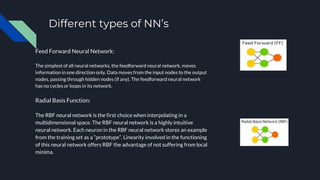
Feed Forward Neural Network:
The simplest of all neural networks, the feedforward neural network, moves
information in one direction only. Data moves from the input nodes to the output
nodes, passing through hidden nodes (if any). The feedforward neural network
has no cycles or loops in its network.
Radial Basis Function:
The RBF neural network is the first choice when interpolating in a
multidimensional space. The RBF neural network is a highly intuitive
neural network. Each neuron in the RBF neural network stores an example
from the training set as a “prototype”. Linearity involved in the functioning
of this neural network offers RBF the advantage of not suffering from local
minima.
Contd..
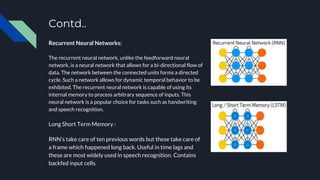
Recurrent Neural Networks:
The recurrent neural network, unlike the feedforward neural
network, is a neural network that allows for a bi-directional flow of
data. The network between the connected units forms a directed
cycle. Such a network allows for dynamic temporal behavior to be
exhibited. The recurrent neural network is capable of using its
internal memory to process arbitrary sequence of inputs. This
neural network is a popular choice for tasks such as handwriting
and speech recognition.
Long Short Term Memory :
RNN’s take care of ten previous words but these take care of
a frame which happened long back. Useful in time lags and
these are most widely used in speech recognition. Contains
backfed input cells.
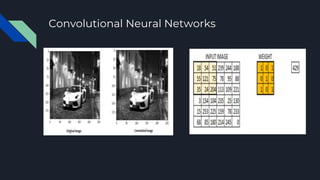
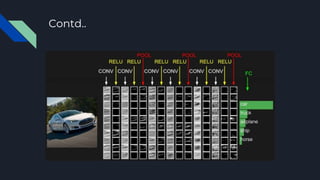
Convolutional Neural Networks
Contd..
Now we have known enough to start with
transfer learning
What do you think is transfer learning?
(Let it be as silly as possible)
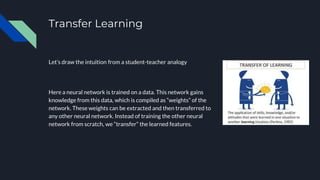
Transfer Learning
Let’s draw the intuition from a student-teacher analogy
Here a neural network is trained on a data. This network gains
knowledge from this data, which is compiled as “weights” of the
network. These weights can be extracted and then transferred to
any other neural network. Instead of training the other neural
network from scratch, we “transfer” the learned features.
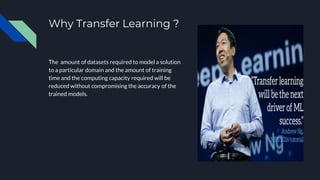
Why Transfer Learning ?
The amount of datasets required to model a solution
to a particular domain and the amount of training
time and the computing capacity required will be
reduced without compromising the accuracy of the
trained models.
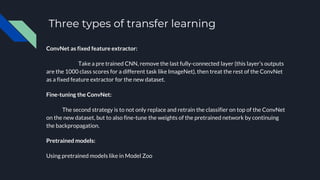
Three types of transfer learning
ConvNet as fixed feature extractor:
Take a pre trained CNN, remove the last fully-connected layer (this layer’s outputs
are the 1000 class scores for a different task like ImageNet), then treat the rest of the ConvNet
as a fixed feature extractor for the new dataset.
Fine-tuning the ConvNet:
The second strategy is to not only replace and retrain the classifier on top of the ConvNet
on the new dataset, but to also fine-tune the weights of the pretrained network by continuing
the backpropagation.
Pretrained models:
Using pretrained models like in Model Zoo
Applications of Transfer Learning
● Learning from simulations (Training using simulated data )
● Adapting to new domains ( Models trained on news data adaption to tweet data)
● Transferring knowledge across languages (Translation model trained on one language
across different languages)
Let’s Walk through the code of a basic
Image classifying CNN and explore the
problems here at malai repo/transfer-
learning
Let’s start our code lab exercise
https://codelabs.developers.google.com/codelabs/tensorflow-for-poets
References
● http://ruder.io/transfer-learning/index.html#applicationsoftransferlearning
● http://cs231n.github.io/convolutional-networks/
● https://www.analyticsvidhya.com/blog/2017/06/transfer-learning-the-art-of-fine-
tuning-a-pre-trained-model/
● Google codelabs
Thank you :)

MaLAI_Hyderabad presentation

  • 1.
    Art of Transfer Learning G.Poorna Prudhvi, ML Engineer @ mroads facebook: Poorna Prudhvi twitter : @poornaprudhvi
  • 2.
    First things firstlet’s look at different forms of learning (Explain me like I’m five year old) Supervised Learning : Labels are specified Unsupervised Learning : without labels or classes being specified Reinforcement Learning : goal-directed learning from interaction Semi Supervised Learning : it is a class of supervised learning tasks and techniques that also make use of unlabeled data for training – typically a small amount of labeled data with a large amount of unlabeled data
  • 3.
    Artificial Neural Networks AnArtificial Neural Network (ANN) is an information processing paradigm that is inspired by the way biological nervous systems, such as the brain, process information. The key element of this paradigm is the novel structure of the information processing system. It is composed of a large number of highly interconnected processing elements (neurons) working in unison to solve specific problems. ANNs, like people, learn by example. An ANN is configured for a specific application, such as pattern recognition or data classification, through a learning process. Learning in biological systems involves adjustments to the synaptic connections that exist between the neurones. This is true of ANNs as well.
  • 4.
    Perceptron ● Perceptron isa single layer neural network ● Perceptron is a linear classifier (binary) ● Neural Networks works the same way as perceptron works ● The perceptron consists of 4 parts . 1. Input values or One input layer 2. Weights and Bias 3. Net sum 4. Activation Function
  • 5.
    Different types ofNN’s Feed Forward Neural Network: The simplest of all neural networks, the feedforward neural network, moves information in one direction only. Data moves from the input nodes to the output nodes, passing through hidden nodes (if any). The feedforward neural network has no cycles or loops in its network. Radial Basis Function: The RBF neural network is the first choice when interpolating in a multidimensional space. The RBF neural network is a highly intuitive neural network. Each neuron in the RBF neural network stores an example from the training set as a “prototype”. Linearity involved in the functioning of this neural network offers RBF the advantage of not suffering from local minima.
  • 6.
    Contd.. Recurrent Neural Networks: Therecurrent neural network, unlike the feedforward neural network, is a neural network that allows for a bi-directional flow of data. The network between the connected units forms a directed cycle. Such a network allows for dynamic temporal behavior to be exhibited. The recurrent neural network is capable of using its internal memory to process arbitrary sequence of inputs. This neural network is a popular choice for tasks such as handwriting and speech recognition. Long Short Term Memory : RNN’s take care of ten previous words but these take care of a frame which happened long back. Useful in time lags and these are most widely used in speech recognition. Contains backfed input cells.
  • 7.
  • 8.
  • 9.
    Now we haveknown enough to start with transfer learning What do you think is transfer learning? (Let it be as silly as possible)
  • 10.
    Transfer Learning Let’s drawthe intuition from a student-teacher analogy Here a neural network is trained on a data. This network gains knowledge from this data, which is compiled as “weights” of the network. These weights can be extracted and then transferred to any other neural network. Instead of training the other neural network from scratch, we “transfer” the learned features.
  • 11.
    Why Transfer Learning? The amount of datasets required to model a solution to a particular domain and the amount of training time and the computing capacity required will be reduced without compromising the accuracy of the trained models.
  • 12.
    Three types oftransfer learning ConvNet as fixed feature extractor: Take a pre trained CNN, remove the last fully-connected layer (this layer’s outputs are the 1000 class scores for a different task like ImageNet), then treat the rest of the ConvNet as a fixed feature extractor for the new dataset. Fine-tuning the ConvNet: The second strategy is to not only replace and retrain the classifier on top of the ConvNet on the new dataset, but to also fine-tune the weights of the pretrained network by continuing the backpropagation. Pretrained models: Using pretrained models like in Model Zoo
  • 14.
    Applications of TransferLearning ● Learning from simulations (Training using simulated data ) ● Adapting to new domains ( Models trained on news data adaption to tweet data) ● Transferring knowledge across languages (Translation model trained on one language across different languages)
  • 15.
    Let’s Walk throughthe code of a basic Image classifying CNN and explore the problems here at malai repo/transfer- learning
  • 16.
    Let’s start ourcode lab exercise https://codelabs.developers.google.com/codelabs/tensorflow-for-poets
  • 17.
    References ● http://ruder.io/transfer-learning/index.html#applicationsoftransferlearning ● http://cs231n.github.io/convolutional-networks/ ●https://www.analyticsvidhya.com/blog/2017/06/transfer-learning-the-art-of-fine- tuning-a-pre-trained-model/ ● Google codelabs
  • 18.