

ARTIFICIAL INTELLIGENCE
(MACHINE LEARNING & DEEP LEARNING )
ANIL KUMAR PRAJAPATI
ASSISTANT PROFESSOR
COMPUTER SCIENCE
WHAT IS AI
• To prepare computer systems in such a way that they are capable of thinking and
understanding like humans. We can call such advanced computer systems artificial
intelligence which are efficient in learning, reasoning, problem-solving, perception,
understanding natural language, and speech recognition.
• The primary goal of artificial intelligence is to create advanced systems that are
capable of making decisions on their own and based on past data and that can
emulate human intelligence and function autonomously.
• Here artificial intelligence can be known as an imitation of the human brain which is
capable of doing all the tasks that a normal person can do.
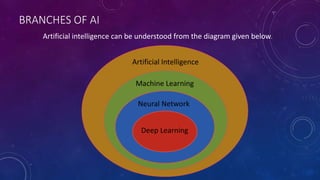
BRANCHES OF AI
Artificial intelligence can be understood from the diagram given below.
Artificial Intelligence
Machine Learning
Neural Network
Deep Learning
MACHINE LEARNING
• Machine learning is a subset of AI, which enables the machine to automatically
learn from data, improve performance from past experience, and make
predictions and/or decisions. Computers can perform tasks without explicit
programming by using algorithms and statistical models. Data and experience
are the primary sources of learning in machine learning.
• There are three types of machine learning techniques.
1. Supervised
2. Unsupervised
3.Reinforcement
SUPERVISED LEARNING
• The supervised learning is based on supervision
• The technique of supervised learning involves training the algorithm on
labeled datasets, which means the input data used to train the algorithm will
include both the input variables and the corresponding output. Supervisory
learning is used to build a mapping between inputs and outputs so that the
algorithm can predict or decide on new, unknown information.
• In this technique the impute is already mapped to the output.
• The supervised learning uses classification and regression to generate the
desired output.
CLASSIFICATION
• Classification is a type of supervised learning in machine learning where the
goal is to predict the categorical class labels of new instances based on past
observations. Various classification algorithms are available, each with its
strengths, weaknesses, and suitable use cases. Here are some commonly
used classification algorithms:
• Logistic Regression
• Decision Trees
• Random Forest
• Support Vector Machines (SVM)
• K-Nearest Neighbors (KNN)
• Naive Bayes
REGRESSION
• Regression is a type of supervised learning in machine learning where the goal is to
predict a continuous output variable based on input features. There are various
regression algorithms, each with its own characteristics and suitability for different
types of data. Here are some commonly used regression algorithms:
Linear Regression:
Ridge Regression (L2 Regularization) and Lasso Regression (L1 Regularization)
Decision Trees for Regression
Random Forest for Regression
Gradient Boosting Algorithms for Regression (e.g., XGBoost, LightGBM)
Support Vector Machines (SVM) for Regression
K-Nearest Neighbors (KNN) for Regression
UNSUPERVISED LEARNING
• Unsupervised machine learning does not require labeled training datasets. in
this type of learning the model trains on the unlabeled datasets and the
model predicts the output without any supervision This means that an
algorithm does not specify what output is to be produced for a given input.
• Unsupervised learning in artificial intelligence is a type of machine learning
that learns from data without human supervision.
• The unsupervised learning uses clustering and association to generate the
desired output.
CLUSTERING & ASSOCIATION
• Clustering: Clustering is a technique used in unsupervised learning to group
similar data points together. The goal is to discover inherent structures within the
data, with the algorithm assigning data points to clusters based on some similarity or
distance metric. Clustering is widely used in various fields, including data analysis,
pattern recognition, image analysis, and more.
• Association: Association rule learning is a type of unsupervised learning that
discovers interesting relationships or associations among variables in large datasets.
The goal is to identify patterns, dependencies, and associations between different
items or features in a dataset. Association rule mining is often used in market basket
analysis, where the objective is to uncover associations between products frequently
purchased together. One of the well-known algorithms for association rule learning is
the A priori algorithm.
REINFORCE LEARNING
• Reinforcement learning works on the feedback-based process, in which an AI
agent automatically explores its surroundings by hitting and trail, taking action
learning from experience, and improving its performance
• The reinforcement learning paradigm (RL) involves training agents to behave
in a particular environment as they perform actions and receive rewards or
penalties for their actions. A learning agent's objective is to learn strategies or
policies that maximize cumulative rewards.
NEURAL NETWORK
• The neural network is one of the fundamental components of artificial
intelligence (AI) and machine learning. These are computational models
designed to process information and learn from data, inspired by the
structure and functioning of the human brain.
• Neurons or units which are interconnected nodes can be called neural
networks which are organized in the form of layers and results are generated
on the basis of these layers.
• The three main types of layers in neural networks are input layers, hidden
layers, and output layers.based on
DEEP LEARNING
• Deep learning is a branch of machine learning that specializes on deep neural
networks, which are multi-layered artificial neural networks. The network's ability to
learn and represent hierarchical characteristics and patterns in data is made possible
by the presence of numerous layers, which are referred to as "deep" layers. Without
explicit programming, deep learning algorithms are made to automatically identify
patterns and extract characteristics from unprocessed data.
• Deep learning works on ANN, CNN, and RNN which are the three basic cornerstones
of deep learning technology.
• ANN: ANNs, or artificial neural networks (ANN), are the fundamental components of
deep learning. ANNs, often known as neural networks or just networks, are
computer models that are based on the composition and operation of the human
brain. They are made up of layers of connected nodes, or artificial neurons. The input
layer, hidden layers, and output layer are the three primary types of layers in an ANN.
CNN & RNN
• A specific kind of deep neural network called a convolutional neural network (CNN) is
used to process and analyze data that resembles a grid, including pictures and
movies. In tasks pertaining to computer vision, image recognition, and pattern
detection, CNNs have demonstrated remarkable efficacy. The way the human brain
processes images served as an inspiration for CNN architecture.
• One kind of neural network architecture intended for sequential data processing is
the Recurrent Neural Network (RNN). RNNs are not like standard feedforward neural
networks; instead, they feature connections that create cycles, which enables them
to keep track of information from past time steps in a hidden state. Because of this,
RNNs are especially well suited for sequence-related tasks including speech
recognition, natural language processing, time-series analysis, and more.
THANK YOU FOR READING THIS WORK,
PLEASE LIKE THIS WORK.
ANIL KUMAR PRAJAPATI
DEPARTMENT OF COMPUTER SCIENCE
SARDAR VALLABH BHAI PATEL GOVT. COLLEGE NALKHEDA, DIST. AGAR- MALWA
MADHYA PRADESH DEPARTMENT

Artificial Intelligence(Machine learning & deep Learning ).pptx

  • 1.
    ARTIFICIAL INTELLIGENCE (MACHINE LEARNING& DEEP LEARNING ) ANIL KUMAR PRAJAPATI ASSISTANT PROFESSOR COMPUTER SCIENCE
  • 2.
    WHAT IS AI •To prepare computer systems in such a way that they are capable of thinking and understanding like humans. We can call such advanced computer systems artificial intelligence which are efficient in learning, reasoning, problem-solving, perception, understanding natural language, and speech recognition. • The primary goal of artificial intelligence is to create advanced systems that are capable of making decisions on their own and based on past data and that can emulate human intelligence and function autonomously. • Here artificial intelligence can be known as an imitation of the human brain which is capable of doing all the tasks that a normal person can do.
  • 3.
    BRANCHES OF AI Artificialintelligence can be understood from the diagram given below. Artificial Intelligence Machine Learning Neural Network Deep Learning
  • 4.
    MACHINE LEARNING • Machinelearning is a subset of AI, which enables the machine to automatically learn from data, improve performance from past experience, and make predictions and/or decisions. Computers can perform tasks without explicit programming by using algorithms and statistical models. Data and experience are the primary sources of learning in machine learning. • There are three types of machine learning techniques. 1. Supervised 2. Unsupervised 3.Reinforcement
  • 5.
    SUPERVISED LEARNING • Thesupervised learning is based on supervision • The technique of supervised learning involves training the algorithm on labeled datasets, which means the input data used to train the algorithm will include both the input variables and the corresponding output. Supervisory learning is used to build a mapping between inputs and outputs so that the algorithm can predict or decide on new, unknown information. • In this technique the impute is already mapped to the output. • The supervised learning uses classification and regression to generate the desired output.
  • 6.
    CLASSIFICATION • Classification isa type of supervised learning in machine learning where the goal is to predict the categorical class labels of new instances based on past observations. Various classification algorithms are available, each with its strengths, weaknesses, and suitable use cases. Here are some commonly used classification algorithms: • Logistic Regression • Decision Trees • Random Forest • Support Vector Machines (SVM) • K-Nearest Neighbors (KNN) • Naive Bayes
  • 7.
    REGRESSION • Regression isa type of supervised learning in machine learning where the goal is to predict a continuous output variable based on input features. There are various regression algorithms, each with its own characteristics and suitability for different types of data. Here are some commonly used regression algorithms: Linear Regression: Ridge Regression (L2 Regularization) and Lasso Regression (L1 Regularization) Decision Trees for Regression Random Forest for Regression Gradient Boosting Algorithms for Regression (e.g., XGBoost, LightGBM) Support Vector Machines (SVM) for Regression K-Nearest Neighbors (KNN) for Regression
  • 8.
    UNSUPERVISED LEARNING • Unsupervisedmachine learning does not require labeled training datasets. in this type of learning the model trains on the unlabeled datasets and the model predicts the output without any supervision This means that an algorithm does not specify what output is to be produced for a given input. • Unsupervised learning in artificial intelligence is a type of machine learning that learns from data without human supervision. • The unsupervised learning uses clustering and association to generate the desired output.
  • 9.
    CLUSTERING & ASSOCIATION •Clustering: Clustering is a technique used in unsupervised learning to group similar data points together. The goal is to discover inherent structures within the data, with the algorithm assigning data points to clusters based on some similarity or distance metric. Clustering is widely used in various fields, including data analysis, pattern recognition, image analysis, and more. • Association: Association rule learning is a type of unsupervised learning that discovers interesting relationships or associations among variables in large datasets. The goal is to identify patterns, dependencies, and associations between different items or features in a dataset. Association rule mining is often used in market basket analysis, where the objective is to uncover associations between products frequently purchased together. One of the well-known algorithms for association rule learning is the A priori algorithm.
  • 10.
    REINFORCE LEARNING • Reinforcementlearning works on the feedback-based process, in which an AI agent automatically explores its surroundings by hitting and trail, taking action learning from experience, and improving its performance • The reinforcement learning paradigm (RL) involves training agents to behave in a particular environment as they perform actions and receive rewards or penalties for their actions. A learning agent's objective is to learn strategies or policies that maximize cumulative rewards.
  • 11.
    NEURAL NETWORK • Theneural network is one of the fundamental components of artificial intelligence (AI) and machine learning. These are computational models designed to process information and learn from data, inspired by the structure and functioning of the human brain. • Neurons or units which are interconnected nodes can be called neural networks which are organized in the form of layers and results are generated on the basis of these layers. • The three main types of layers in neural networks are input layers, hidden layers, and output layers.based on
  • 12.
    DEEP LEARNING • Deeplearning is a branch of machine learning that specializes on deep neural networks, which are multi-layered artificial neural networks. The network's ability to learn and represent hierarchical characteristics and patterns in data is made possible by the presence of numerous layers, which are referred to as "deep" layers. Without explicit programming, deep learning algorithms are made to automatically identify patterns and extract characteristics from unprocessed data. • Deep learning works on ANN, CNN, and RNN which are the three basic cornerstones of deep learning technology. • ANN: ANNs, or artificial neural networks (ANN), are the fundamental components of deep learning. ANNs, often known as neural networks or just networks, are computer models that are based on the composition and operation of the human brain. They are made up of layers of connected nodes, or artificial neurons. The input layer, hidden layers, and output layer are the three primary types of layers in an ANN.
  • 13.
    CNN & RNN •A specific kind of deep neural network called a convolutional neural network (CNN) is used to process and analyze data that resembles a grid, including pictures and movies. In tasks pertaining to computer vision, image recognition, and pattern detection, CNNs have demonstrated remarkable efficacy. The way the human brain processes images served as an inspiration for CNN architecture. • One kind of neural network architecture intended for sequential data processing is the Recurrent Neural Network (RNN). RNNs are not like standard feedforward neural networks; instead, they feature connections that create cycles, which enables them to keep track of information from past time steps in a hidden state. Because of this, RNNs are especially well suited for sequence-related tasks including speech recognition, natural language processing, time-series analysis, and more.
  • 14.
    THANK YOU FORREADING THIS WORK, PLEASE LIKE THIS WORK. ANIL KUMAR PRAJAPATI DEPARTMENT OF COMPUTER SCIENCE SARDAR VALLABH BHAI PATEL GOVT. COLLEGE NALKHEDA, DIST. AGAR- MALWA MADHYA PRADESH DEPARTMENT