XI Economics
Chapter 3
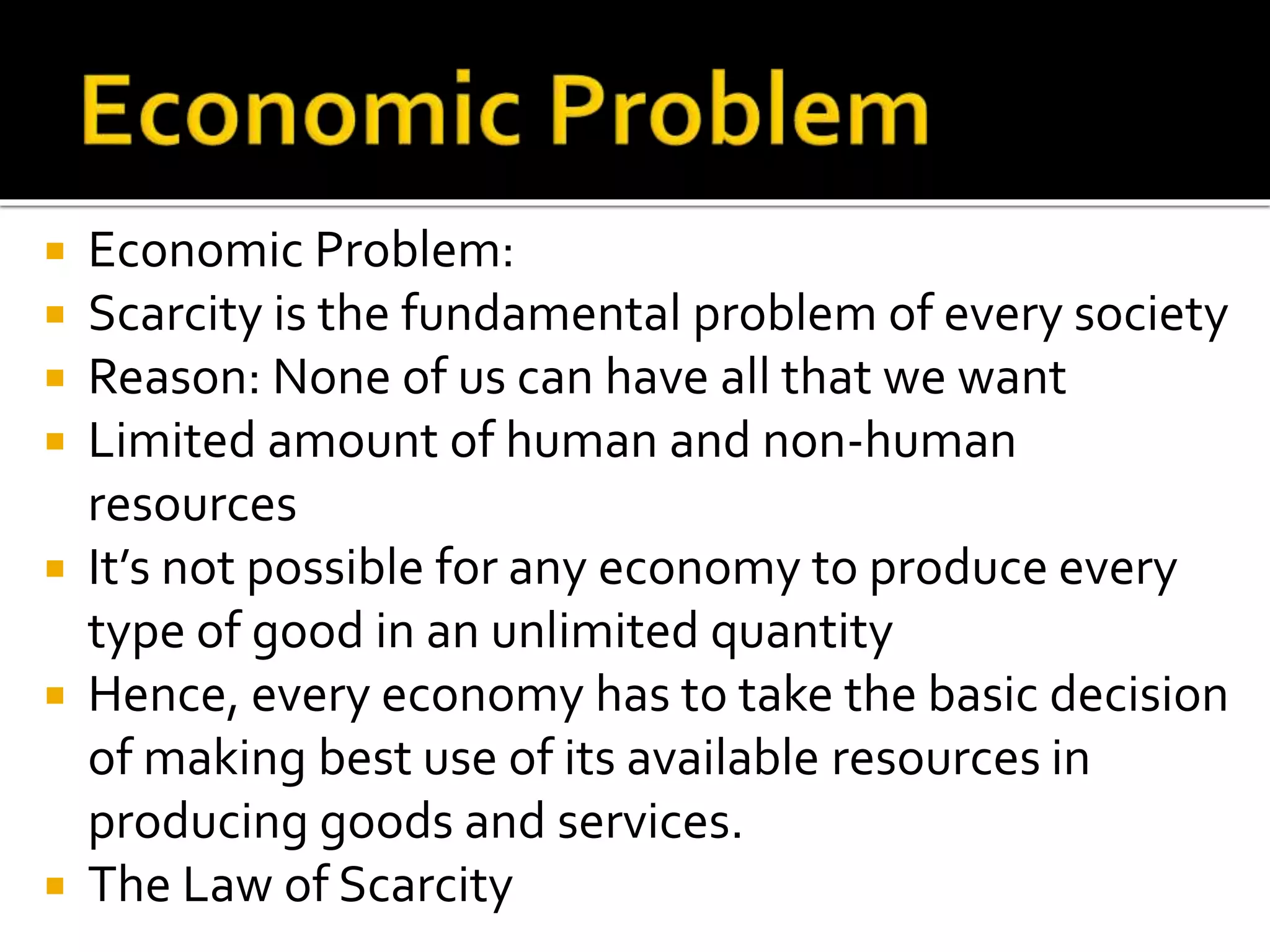
 Economic Problem:
 Scarcity is the fundamental problem of every society
 Reason: None of us can have all that we want
 Limited amount of human and non-human
resources
 It’s not possible for any economy to produce every
type of good in an unlimited quantity
 Hence, every economy has to take the basic decision
of making best use of its available resources in
producing goods and services.
 The Law of Scarcity
 UnlimitedWants
 Multiply over time
 Many wants recurring
 Wants differ in their urgency
 Limited Resources
 Productive resources – scarce
 Labour – by size of population
 Land – by area of the country
 Capital & technology – scarcity of various inputs
 Alternative Uses of Resources
 The available resources should be
allocated among different uses in
such a way that resources are put to
their best possible use.
 What is true of an individual is also
true of an economy. Every economy,
 Capitalist or socialist
 Developed or underdeveloped
 What to produce and how much to
produce?
 How to produce?
 For whom to produce?
 Problems of fuller utilization of
resources.
 Problem of efficiency in utilization of
resources.
 Problem of economic growth
Possibilities Butter
(Million kg)
Guns
(Thousands)
Marginal Opp.
Cost of Butter
(Thousand of
Guns)
A 0 15 -
B 1 14 1
C 2 12 2
D 3 9 3
E 4 5 4
F 5 0 5
The amount of resources is
fixed
Unchanged techniques
Full employment of resources
Resources are not equally
efficient in the production of all
commodities
It slopes downwards
to right
It is concave from the
origin
Problem of Scarcity
Problem of Choice
Problem ofWhat to Produce
Problem of Full and Efficient
utilization of the resources
Problem of Economic Growth
 It is generally defined as the process
whereby real per capita income of a
country increases over a long period of
time
 Focus three things,
1. Rise in PCI
2. Rise in PCI in real terms
3. Long period
 Traditionally, economic development
has been defined as a sustained increase
in real per capita income. (1960s and
1970s)
 The process whereby the real PCI of a
country increases over a long period of
time, along with reduction of poverty,
inequality and unemployment.
Growth Development
Narrow Concept Comprehensive
More O/P Composition of O/P,
Allocation of Resources
Rise in Income Also reduction of
poverty, inequality of
income and employment
Defined strictly in terms
of economic indicator,
i.e., income
But also, non-economic
indicators like literacy,
health services, etc.
Growth Development
Quantitative Also Qualitative
Easier to realise More extensive. Involves
a whole lot of changes in
the society
Developed countries Developing countries
Less government
intervention required
Demands active
involvement of the
government
 Prof.W.W. Rostow
1. Traditional Society
2. Pre-take off stage
3. Take-off stage
4. Drive to Maturity
5. The age of high mass-
consumption
 Absence of modern science and
technology
 Low output and productivity
 Primitive methods of production
 Sufficient to meet the basic
consumption needs
 No saving or investment
 Agriculture is the mainstay
 Transitional era – pre-conditions for
sustained growth are created
 Aspiring for a higher standard of living
 Changes occur in values, social attitude
and expectations
 Education and entrepreneurship spreads
 Technological revolution in agriculture
 Expansion of trade (internal & external)
 Process of economic growth starts
which becomes self sustained (without
govt. action)
 Initiated by a sharp stimulus
 Large increase in the rate of saving and
investment – high rate of growth of o/p
 Essential part – development of one or
more leading sectors in the economy.
 Goal of high level of per capita o/p
 Period of high, long sustained
economic growth
 Effective application of modern
technology in all the sectors
 Rate of investment is well high over
10 % of national income
 Final stage of economic growth
 PCI becomes very high, leading to high
standard of living
 Extensive use of durable consumers’
goods and household gadgets
 Balance of attention of the society is
shifted from problems of production to
problems of consumption.

Basic Problem of an Economy

  • 1.
  • 2.
     Economic Problem: Scarcity is the fundamental problem of every society  Reason: None of us can have all that we want  Limited amount of human and non-human resources  It’s not possible for any economy to produce every type of good in an unlimited quantity  Hence, every economy has to take the basic decision of making best use of its available resources in producing goods and services.  The Law of Scarcity
  • 3.
     UnlimitedWants  Multiplyover time  Many wants recurring  Wants differ in their urgency  Limited Resources  Productive resources – scarce  Labour – by size of population  Land – by area of the country  Capital & technology – scarcity of various inputs  Alternative Uses of Resources
  • 4.
     The availableresources should be allocated among different uses in such a way that resources are put to their best possible use.  What is true of an individual is also true of an economy. Every economy,  Capitalist or socialist  Developed or underdeveloped
  • 5.
     What toproduce and how much to produce?  How to produce?  For whom to produce?  Problems of fuller utilization of resources.  Problem of efficiency in utilization of resources.  Problem of economic growth
  • 6.
    Possibilities Butter (Million kg) Guns (Thousands) MarginalOpp. Cost of Butter (Thousand of Guns) A 0 15 - B 1 14 1 C 2 12 2 D 3 9 3 E 4 5 4 F 5 0 5
  • 13.
    The amount ofresources is fixed Unchanged techniques Full employment of resources Resources are not equally efficient in the production of all commodities
  • 14.
    It slopes downwards toright It is concave from the origin
  • 15.
    Problem of Scarcity Problemof Choice Problem ofWhat to Produce Problem of Full and Efficient utilization of the resources Problem of Economic Growth
  • 16.
     It isgenerally defined as the process whereby real per capita income of a country increases over a long period of time  Focus three things, 1. Rise in PCI 2. Rise in PCI in real terms 3. Long period
  • 17.
     Traditionally, economicdevelopment has been defined as a sustained increase in real per capita income. (1960s and 1970s)  The process whereby the real PCI of a country increases over a long period of time, along with reduction of poverty, inequality and unemployment.
  • 18.
    Growth Development Narrow ConceptComprehensive More O/P Composition of O/P, Allocation of Resources Rise in Income Also reduction of poverty, inequality of income and employment Defined strictly in terms of economic indicator, i.e., income But also, non-economic indicators like literacy, health services, etc.
  • 19.
    Growth Development Quantitative AlsoQualitative Easier to realise More extensive. Involves a whole lot of changes in the society Developed countries Developing countries Less government intervention required Demands active involvement of the government
  • 20.
     Prof.W.W. Rostow 1.Traditional Society 2. Pre-take off stage 3. Take-off stage 4. Drive to Maturity 5. The age of high mass- consumption
  • 21.
     Absence ofmodern science and technology  Low output and productivity  Primitive methods of production  Sufficient to meet the basic consumption needs  No saving or investment  Agriculture is the mainstay
  • 22.
     Transitional era– pre-conditions for sustained growth are created  Aspiring for a higher standard of living  Changes occur in values, social attitude and expectations  Education and entrepreneurship spreads  Technological revolution in agriculture  Expansion of trade (internal & external)
  • 23.
     Process ofeconomic growth starts which becomes self sustained (without govt. action)  Initiated by a sharp stimulus  Large increase in the rate of saving and investment – high rate of growth of o/p  Essential part – development of one or more leading sectors in the economy.
  • 24.
     Goal ofhigh level of per capita o/p  Period of high, long sustained economic growth  Effective application of modern technology in all the sectors  Rate of investment is well high over 10 % of national income
  • 25.
     Final stageof economic growth  PCI becomes very high, leading to high standard of living  Extensive use of durable consumers’ goods and household gadgets  Balance of attention of the society is shifted from problems of production to problems of consumption.