Marginal Utility Analysis
ISC
XII Economics
Chapter 3
Utility
• Utility refers to want-satisfying power of a
commodity.
• It is the ability or capacity of a commodity
to satisfy the human want.
• In objective terms, utility may be defined
as the amount of satisfaction derived from
the consumption of a commodity.
Characteristics of utility
1. It is subjective
2. It is not measurable
3. It is variable
4. It is different from
usefulness
5. It has no ethical, moral
or legal connotations
Total utility
• Total utility refers to the total satisfaction derived
by the consumer from the consumption of a
specific quantity of a commodity, say a number
of mangoes.
• In other words, total utility is the sum total of the
utilities derived ·from all the units consumed of a
commodity.
• For example, the total utility of consuming two
mangoes is the total satisfaction that these two
mangoes provide.
Marginal utility
• Marginal utility refers to the additional
utility derived from the consumption of an
additional unit of a commodity
• Marginal utility of consuming third mango
is the increase in total utility as the
consumption of mangoes is increased
from two mangoes to three mangoes.
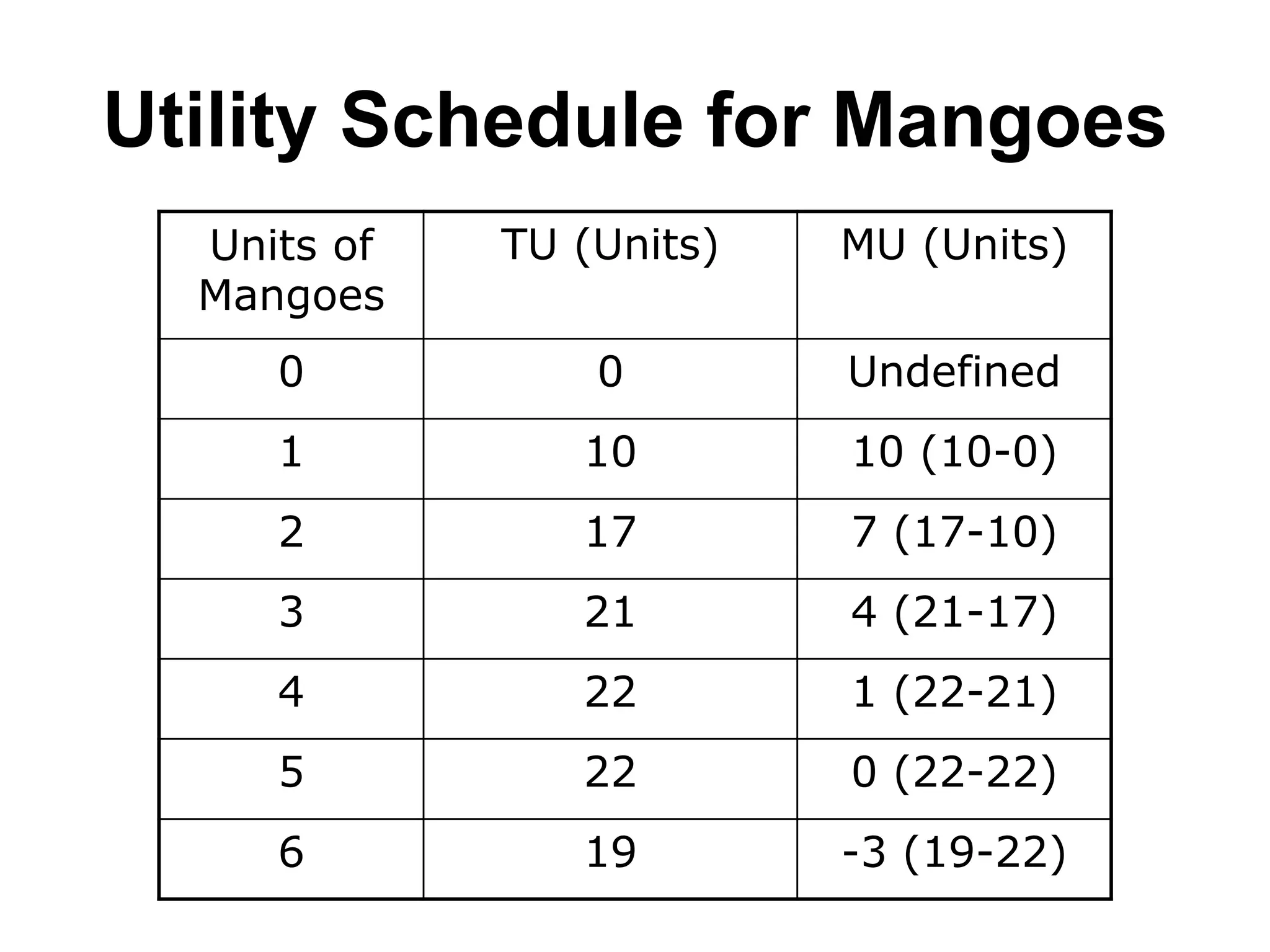
Utility Schedule for Mangoes
Units of
Mangoes
TU (Units) MU (Units)
0 0 Undefined
1 10 10 (10-0)
2 17 7 (17-10)
3 21 4 (21-17)
4 22 1 (22-21)
5 22 0 (22-22)
6 19 -3 (19-22)
• Marginal Utility = The addition
made to the total utility by
addition of one more unit of a
commodity.
• Total Utility = The sum total of all
marginal utilities.
• MU nth = TUn – TUn-1
• TUn = MU1 + MU2 + ….MU nth
Y
O X
10
1
4
7
654321
No of Mangoes
MarginalUtility
MU
Y
O X
10
22
21
17
654321
TU
MU> 0
M MU= 0
MU< 0
No of Mangoes
TotalUtility
Relationship between TU & MU
Explanation
• The total utility cure is concave from above
which indicates declining slope of the curve,
which means declining marginal utility.
• Thus, up to point M, the TU curve has a positive
slope, but the slope goes on decreasing steadily
as quantity consumed is increased.
• So long as total utility increases, marginal utility
is positive. But marginal utility decreases
because total utility increases at a decreasing
rate.
• When total utility is maximum, marginal utility is
zero.
• When total utility declines marginal utility is
negative.
The relationship between the total
utility and marginal utility
When TU is Then MU is
Increasing at a
decreasing rate
Decreasing, but
positive
At the maximum Zero
Decreasing Negative
Law of Diminishing Marginal
Utility
• H.H. Gossen and Alfred Marshall.
• The law states that as the amount
consumed of a commodity increases, the
utility derived by the consumer from the
additional units, i.e. marginal utility, goes
on decreasing.
• "The additional benefit a person derives
from a given increase of his stock of a
thing diminishes with every 1acrease in
the stock that he already has."
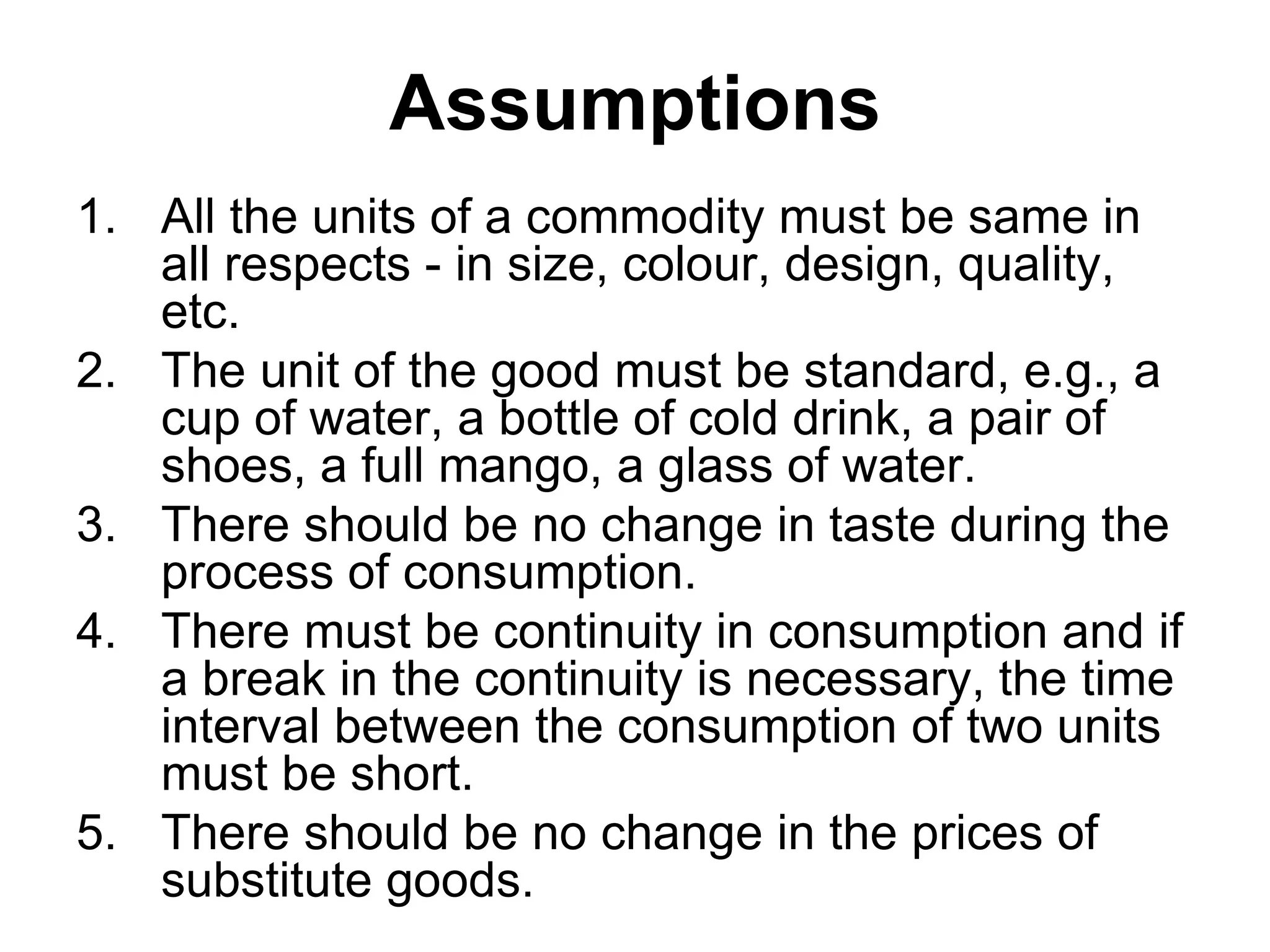
Assumptions
1. All the units of a commodity must be same in
all respects - in size, colour, design, quality,
etc.
2. The unit of the good must be standard, e.g., a
cup of water, a bottle of cold drink, a pair of
shoes, a full mango, a glass of water.
3. There should be no change in taste during the
process of consumption.
4. There must be continuity in consumption and if
a break in the continuity is necessary, the time
interval between the consumption of two units
must be short.
5. There should be no change in the prices of
substitute goods.
Explanation of the Law
• As more and more quantity of a commodity is
consumed, the intensity of desire decreases, and
therefore, the utility derived from the additional unit
decreases
• If there are many uses of a commodity, the most
urgent requirement will be fulfilled first, followed by
the next important use, and so on. .
• Consumer's Equilibrium
• A consumer will be in equilibrium when he spends
his given income on the purchase of different goods
and services so as to maximise his total utility.
• Equilibrium is the ideal position towards which
consumer will like to move.
• It is the position the household regards as the best
under given circumstances.
Consumer Equilibrium
• A consumer will be in equilibrium when he
spends his given income on the purchase
of different goods and services so as to
maximise his total utility.
• Equilibrium is the ideal position towards
which consumer will like to move.
• It is the position which the household
regards as the best under given
circumstances.
Assumptions for explaining the
consumer's equilibrium
1. It is assumed that the consumer is rational, i.e. he
aims at maximising the utility from his purchases.
2. Utility can be measured in money terms, i.e. the
utility of one unit , of a commodity equals the
amount of money (price) which a consumer " is
prepared to pay for it.
3. The law of diminishing marginal utility operates.
4. The utility of each unit of money, such as a ten-
rupee note remains constant.
5. Consumer's income is given and remains constant.
6. Prices of other commodities are assumed to be
given.
Explanation of Consumer's Equilibrium
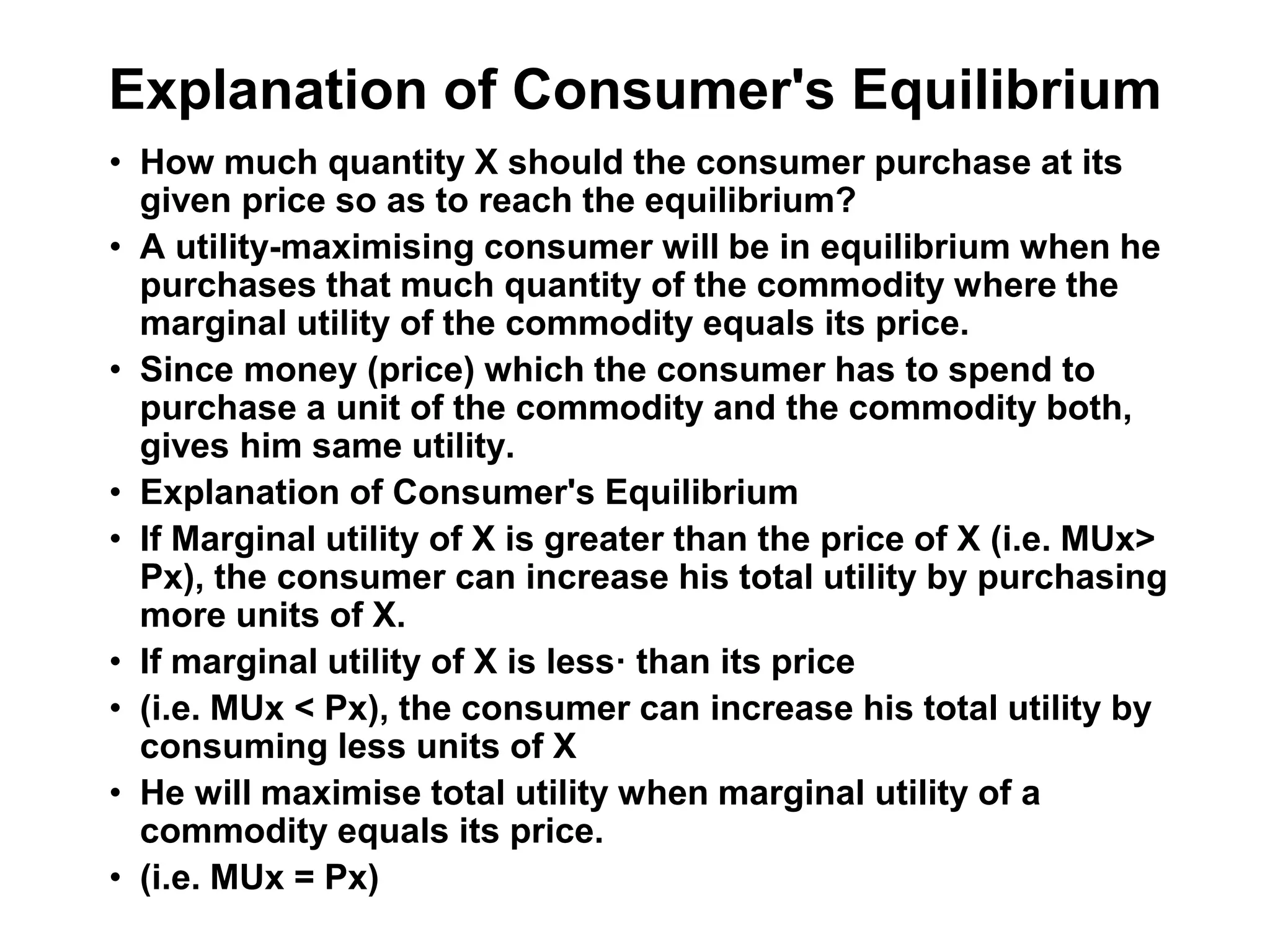
• How much quantity X should the consumer purchase at its
given price so as to reach the equilibrium?
• A utility-maximising consumer will be in equilibrium when he
purchases that much quantity of the commodity where the
marginal utility of the commodity equals its price.
• Since money (price) which the consumer has to spend to
purchase a unit of the commodity and the commodity both,
gives him same utility.
• Explanation of Consumer's Equilibrium
• If Marginal utility of X is greater than the price of X (i.e. MUx>
Px), the consumer can increase his total utility by purchasing
more units of X.
• If marginal utility of X is less· than its price
• (i.e. MUx < Px), the consumer can increase his total utility by
consuming less units of X
• He will maximise total utility when marginal utility of a
commodity equals its price.
• (i.e. MUx = Px)
Consumer Equilibrium in Single
Commodity Case
Units of shirts in
Rs.
Marginal Utility
1 700
2 650
3 600
4 500
5 350
O
Y
X
54321
MU
Units of Shirts
MarginalUtility/Price(Rs)
350
500
600
650
700
P
E
• This is called the law of equi-marginal
utility, since maximum satisfaction is
obtained only be equating marginal
utilities.
• It’s called as the Law of substitution (Since
consumer can substitute one commodity
for another), Law of maximum satisfaction
(since the consumers aim at maximum
satisfaction)
Consumer’s Equilibrium in Two
Commodity Case
Now, MU of a rupee spent on a
good is equal to the MU of the
good divided by its price.
• Symbolically,
• MUm = MUx/Px = Utility obtained by spending
one unit of money on X.
where, MUm = Marginal utility of money.
MUx = Marginal utility of good X.
Px = Price of good X.
Similarly,
MUm = MUy/Py = Utility obtained by spending
one unit of money on y.
where MUm = Marginal utility of good y.
Py = Price of good y.
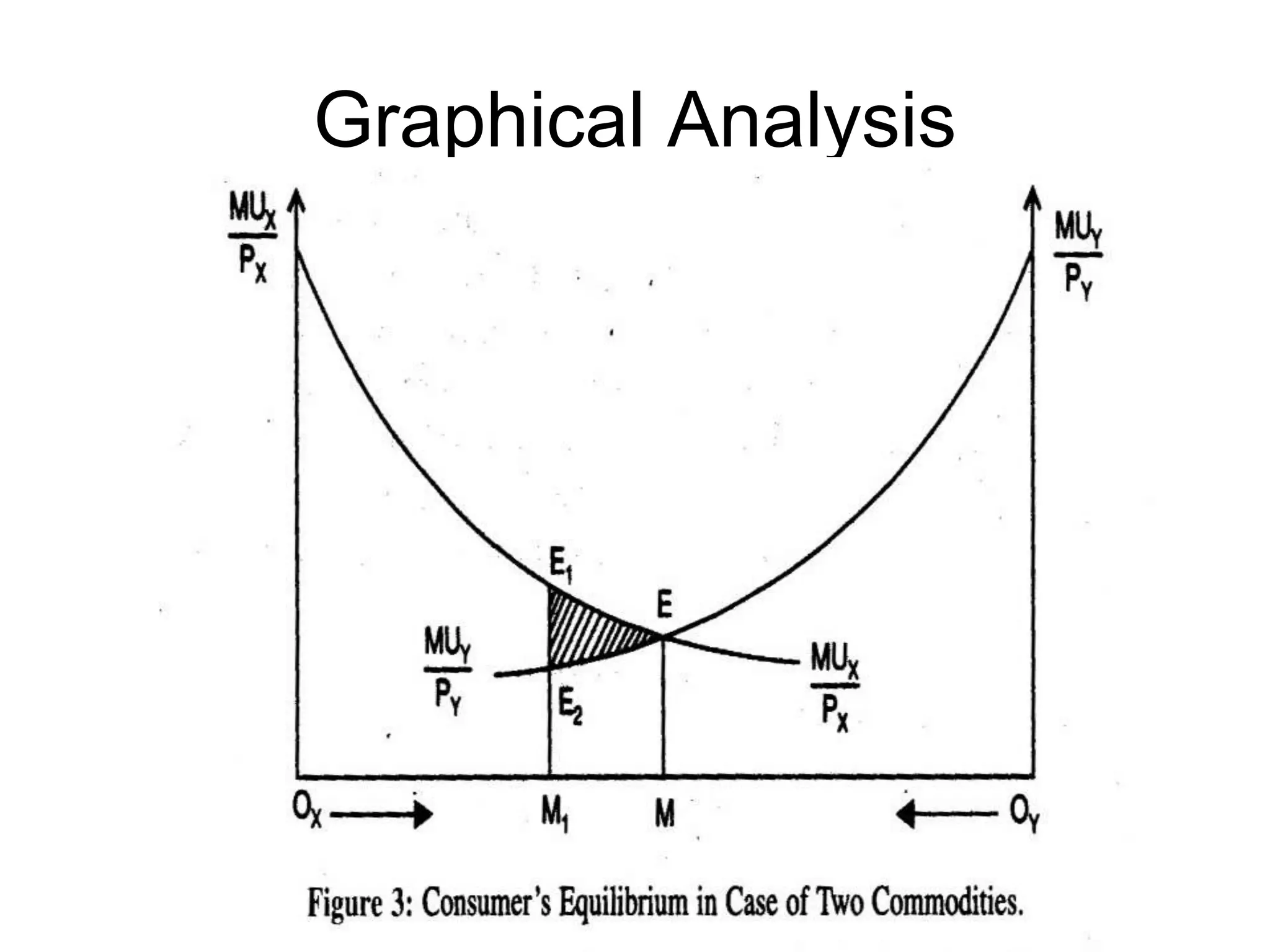
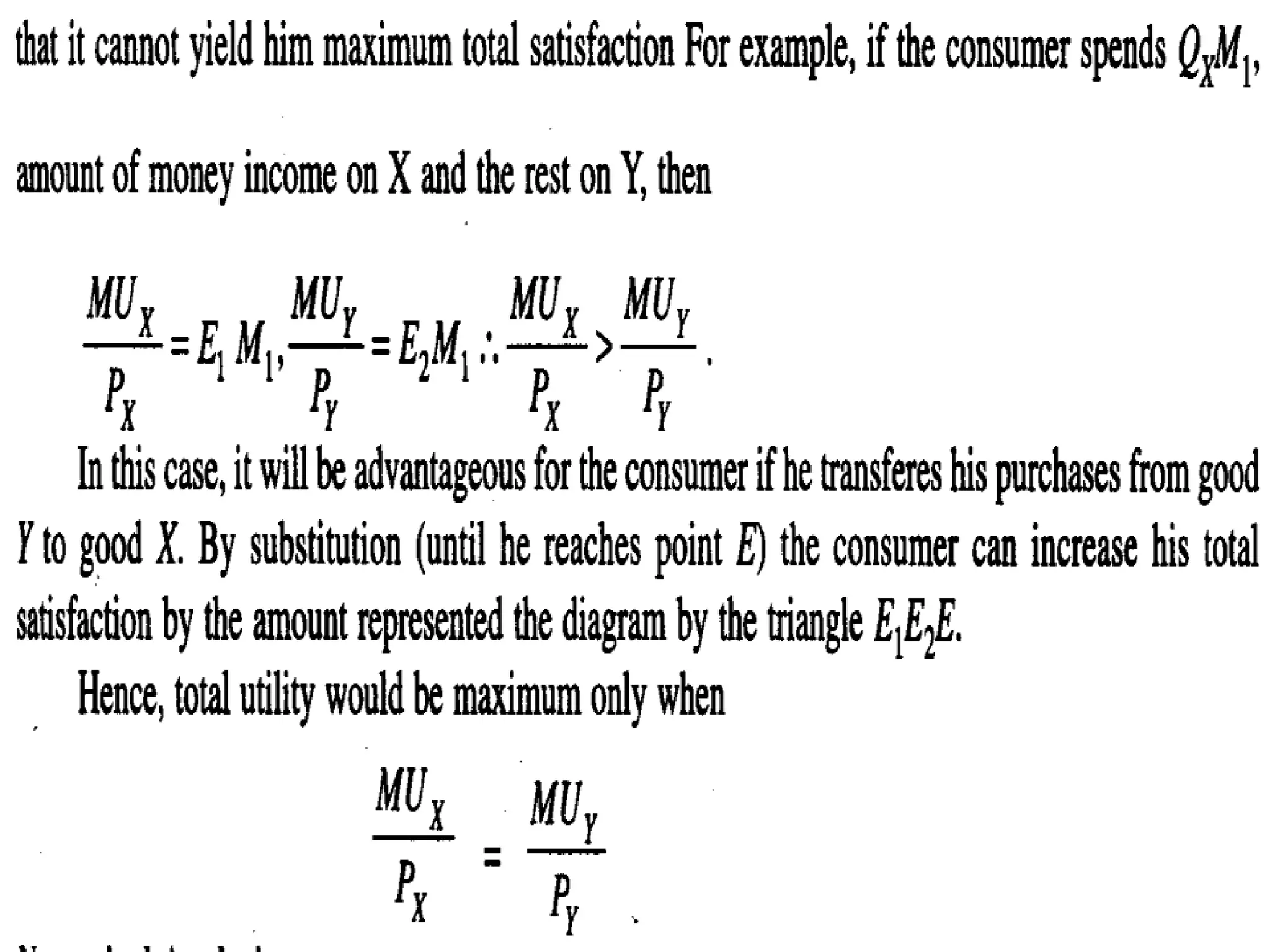
• The consumer will be in equilibrium when
he is spending his money income on two
goods in such a way that MU of last rupee
spent on the two goods is the same.
• That is in equilibrium where
Graphical Analysis
Consumer’s Equilibrium in case of two commodities.
Numerical Analysis:
Let the prices of goods X and Y be Rs. 2 and Rs. 3
respectively and the consumer has Rs. 19 to spend on the two
goods. MU of the money is 6 units.
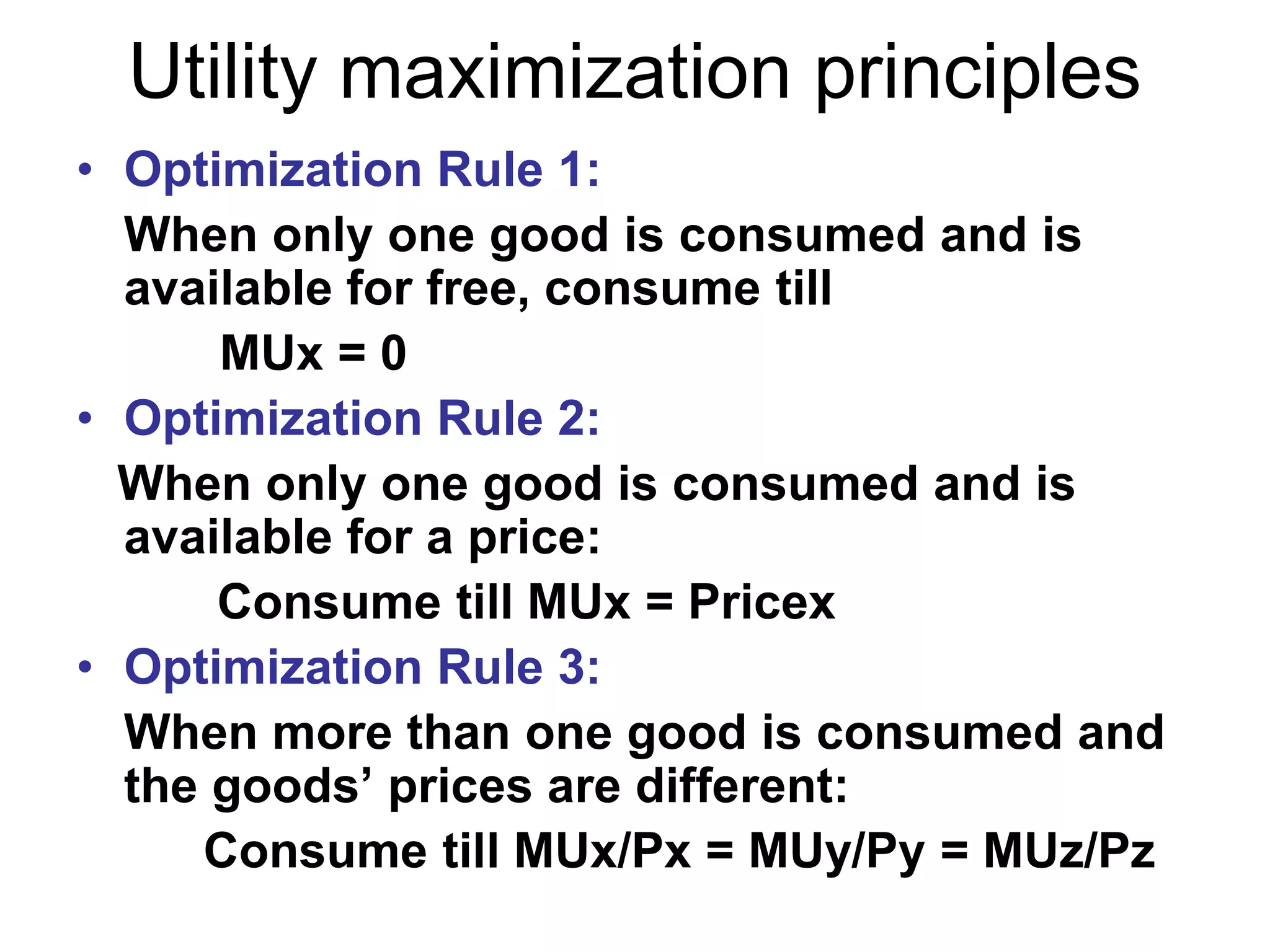
Utility maximization principles
• Optimization Rule 1:
When only one good is consumed and is
available for free, consume till
MUx = 0
• Optimization Rule 2:
When only one good is consumed and is
available for a price:
Consume till MUx = Pricex
• Optimization Rule 3:
When more than one good is consumed and
the goods’ prices are different:
Consume till MUx/Px = MUy/Py = MUz/Pz
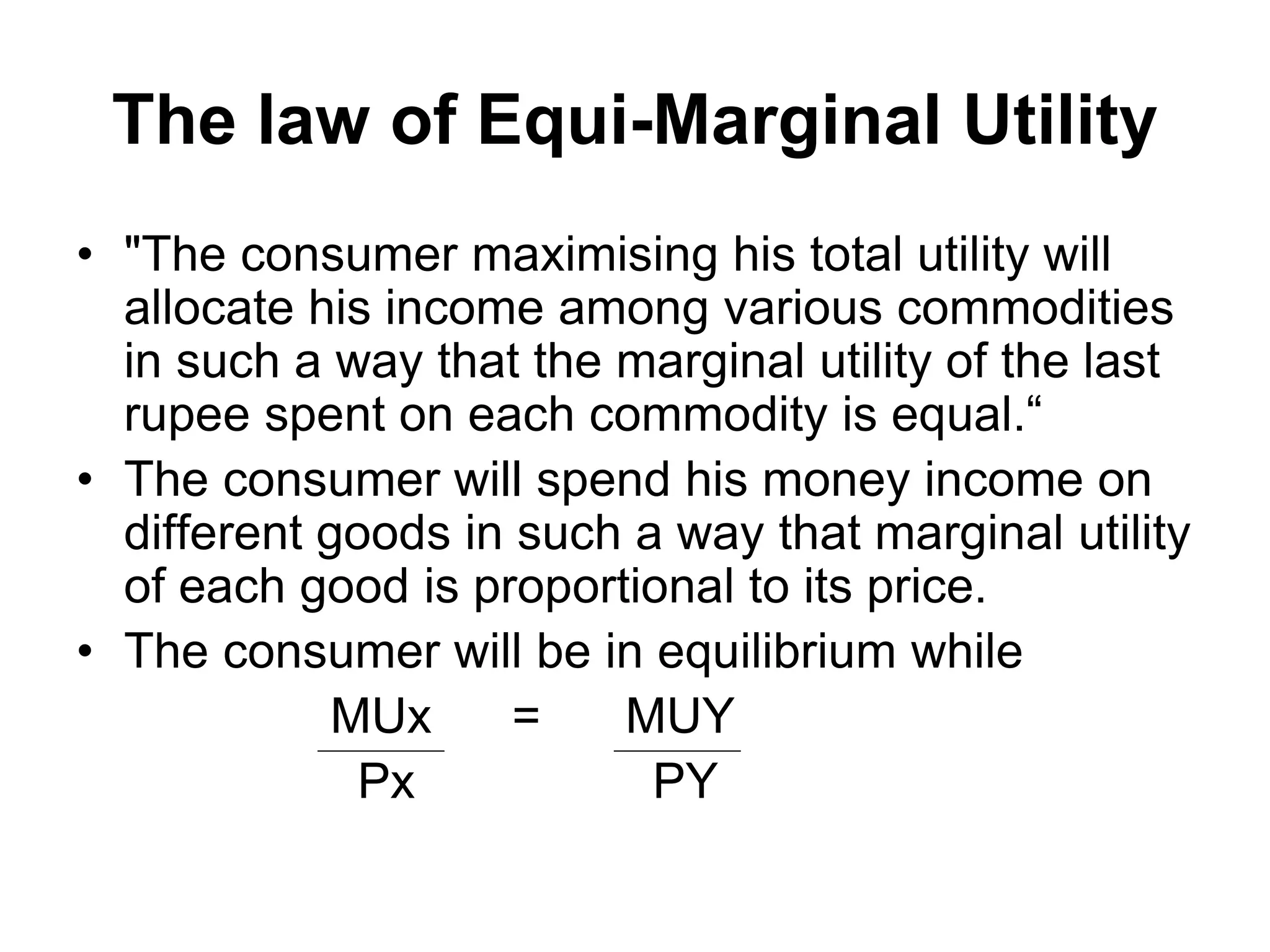
The law of Equi-Marginal Utility
• "The consumer maximising his total utility will
allocate his income among various commodities
in such a way that the marginal utility of the last
rupee spent on each commodity is equal.“
• The consumer will spend his money income on
different goods in such a way that marginal utility
of each good is proportional to its price.
• The consumer will be in equilibrium while
MUx = MUY
Px PY
Utility schedule for X and Y
Units MUx MUy MUx
Px
MUy
Py
1 50 80 10 8
2 45 70 9 7
3 40 60 8 6
4 35 50 7 5
5 30 40 6 4
6 25 30 5 3
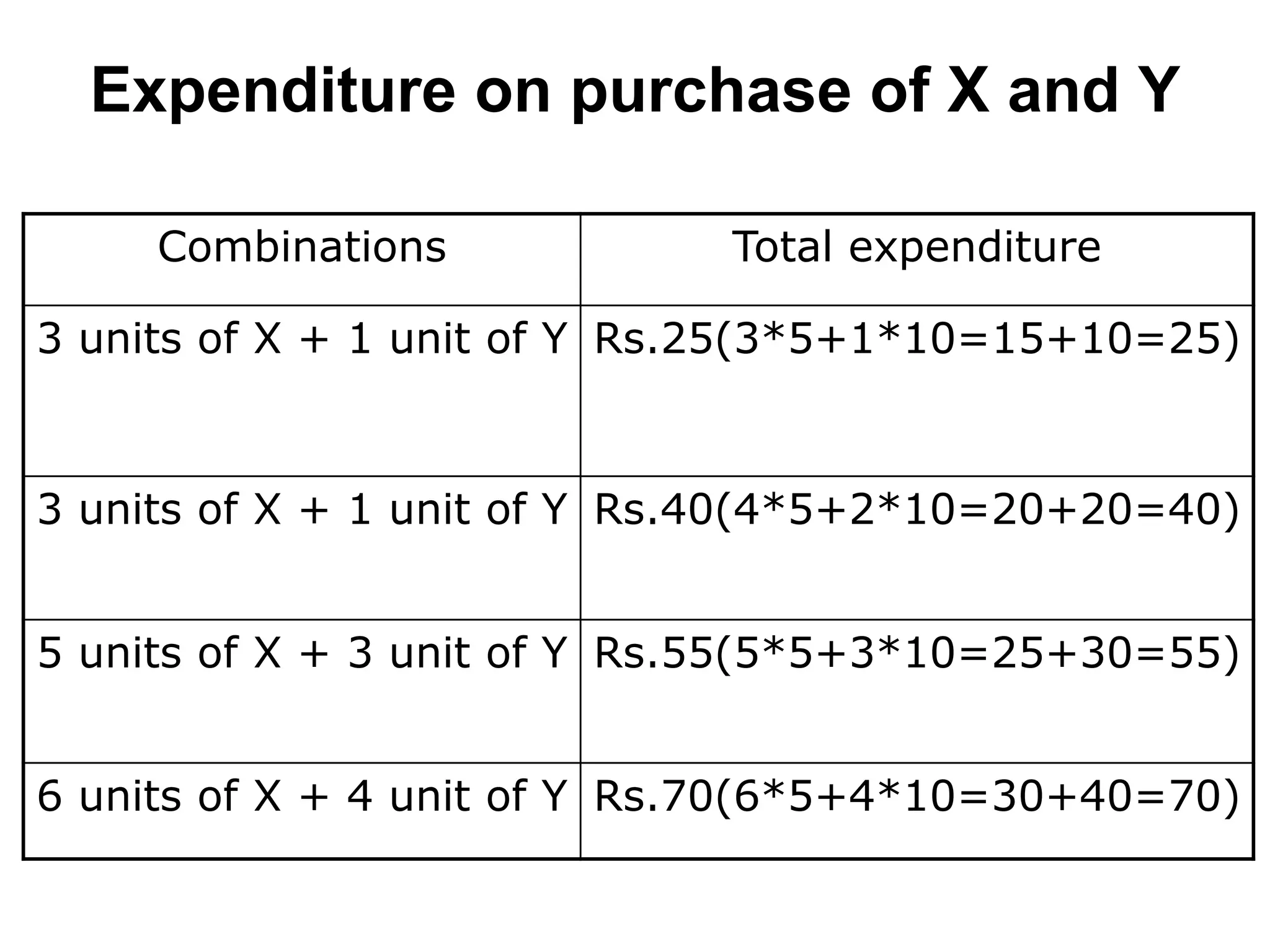
Expenditure on purchase of X and Y
Combinations Total expenditure
3 units of X + 1 unit of Y Rs.25(3*5+1*10=15+10=25)
3 units of X + 1 unit of Y Rs.40(4*5+2*10=20+20=40)
5 units of X + 3 unit of Y Rs.55(5*5+3*10=25+30=55)
6 units of X + 4 unit of Y Rs.70(6*5+4*10=30+40=70)
Limitations of Law of Equi-
Marginal Utility
1. It is difficult for the consumers to know the
marginal utilities from different commodities
because utility cannot be measured.
2. Consumers are in many cases governed by
habits and customs.
3. Many consumers are ignorant, and, therefore,
they may not be able to arrive at equilibrium
position due to their ignorance.
4. In case of expensive and indivisible
commodities such as cars and refrigerators
etc., it is absurd to talk of marginal utility of a
rupee spent.
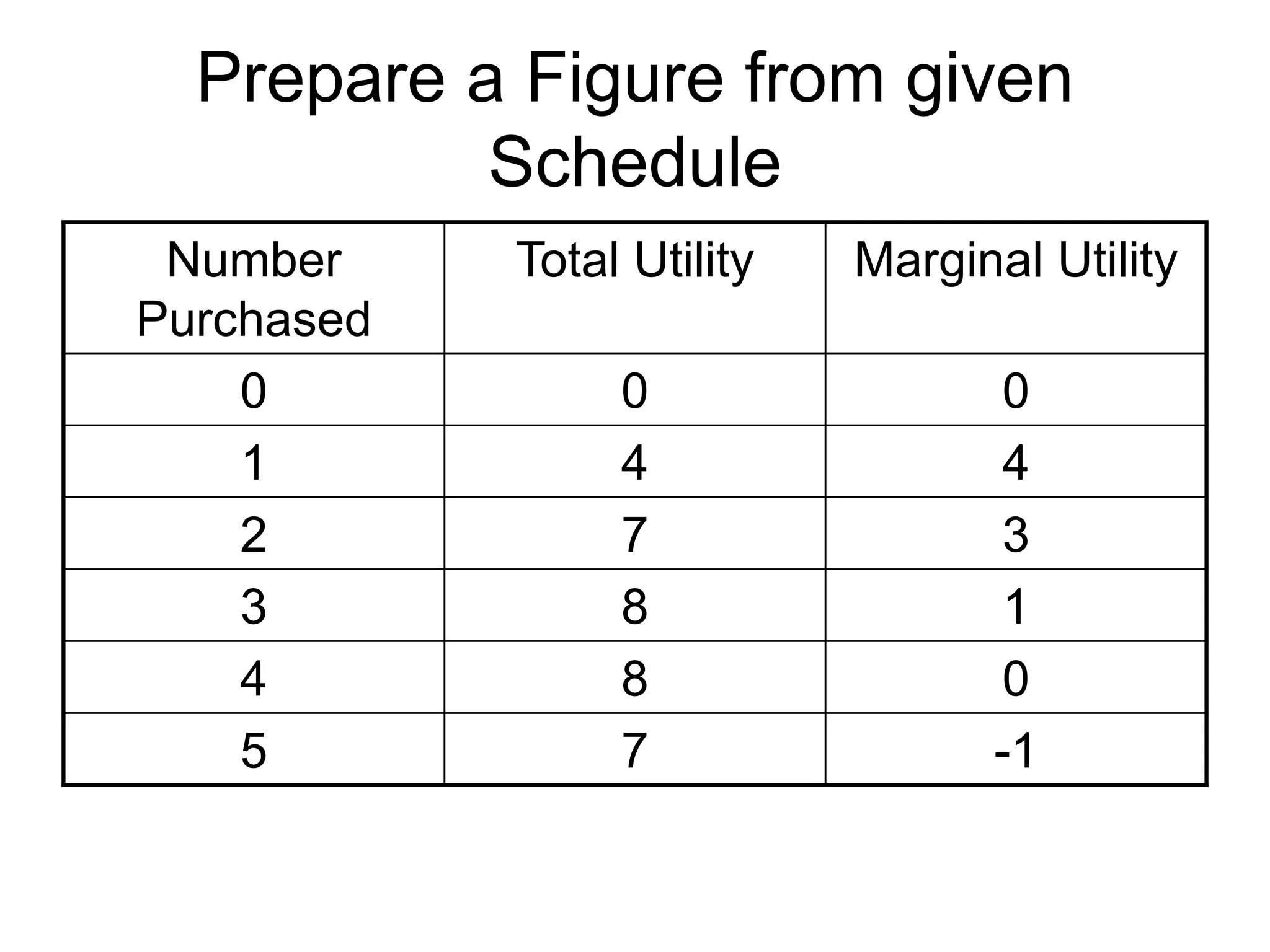
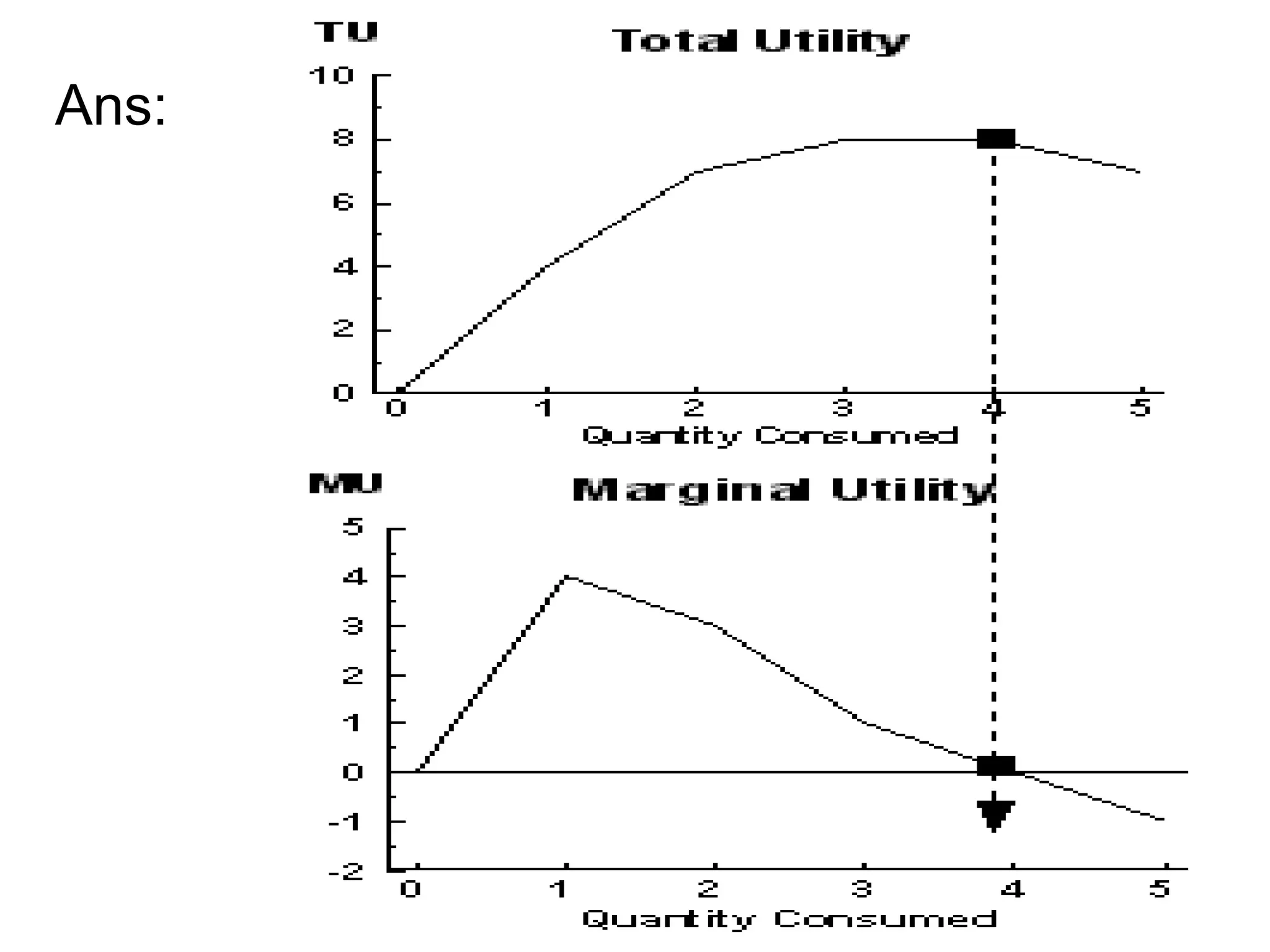
Prepare a Figure from given
Schedule
Number
Purchased
Total Utility Marginal Utility
0 0 0
1 4 4
2 7 3
3 8 1
4 8 0
5 7 -1
Ans:
Prepare a
Schedule from
the figure
Ans:
Units Total Utility Marginal Utility
1 20 20
2 32 12
3 40 8
4 42 2
5 42 0
6 39 –3
Consumer Behaviour

Consumer Behaviour

  • 1.
  • 2.
    Utility • Utility refersto want-satisfying power of a commodity. • It is the ability or capacity of a commodity to satisfy the human want. • In objective terms, utility may be defined as the amount of satisfaction derived from the consumption of a commodity.
  • 3.
    Characteristics of utility 1.It is subjective 2. It is not measurable 3. It is variable 4. It is different from usefulness 5. It has no ethical, moral or legal connotations
  • 4.
    Total utility • Totalutility refers to the total satisfaction derived by the consumer from the consumption of a specific quantity of a commodity, say a number of mangoes. • In other words, total utility is the sum total of the utilities derived ·from all the units consumed of a commodity. • For example, the total utility of consuming two mangoes is the total satisfaction that these two mangoes provide.
  • 5.
    Marginal utility • Marginalutility refers to the additional utility derived from the consumption of an additional unit of a commodity • Marginal utility of consuming third mango is the increase in total utility as the consumption of mangoes is increased from two mangoes to three mangoes.
  • 6.
    Utility Schedule forMangoes Units of Mangoes TU (Units) MU (Units) 0 0 Undefined 1 10 10 (10-0) 2 17 7 (17-10) 3 21 4 (21-17) 4 22 1 (22-21) 5 22 0 (22-22) 6 19 -3 (19-22)
  • 7.
    • Marginal Utility= The addition made to the total utility by addition of one more unit of a commodity. • Total Utility = The sum total of all marginal utilities. • MU nth = TUn – TUn-1 • TUn = MU1 + MU2 + ….MU nth
  • 8.
    Y O X 10 1 4 7 654321 No ofMangoes MarginalUtility MU Y O X 10 22 21 17 654321 TU MU> 0 M MU= 0 MU< 0 No of Mangoes TotalUtility Relationship between TU & MU
  • 9.
    Explanation • The totalutility cure is concave from above which indicates declining slope of the curve, which means declining marginal utility. • Thus, up to point M, the TU curve has a positive slope, but the slope goes on decreasing steadily as quantity consumed is increased. • So long as total utility increases, marginal utility is positive. But marginal utility decreases because total utility increases at a decreasing rate. • When total utility is maximum, marginal utility is zero. • When total utility declines marginal utility is negative.
  • 10.
    The relationship betweenthe total utility and marginal utility When TU is Then MU is Increasing at a decreasing rate Decreasing, but positive At the maximum Zero Decreasing Negative
  • 11.
    Law of DiminishingMarginal Utility • H.H. Gossen and Alfred Marshall. • The law states that as the amount consumed of a commodity increases, the utility derived by the consumer from the additional units, i.e. marginal utility, goes on decreasing. • "The additional benefit a person derives from a given increase of his stock of a thing diminishes with every 1acrease in the stock that he already has."
  • 12.
    Assumptions 1. All theunits of a commodity must be same in all respects - in size, colour, design, quality, etc. 2. The unit of the good must be standard, e.g., a cup of water, a bottle of cold drink, a pair of shoes, a full mango, a glass of water. 3. There should be no change in taste during the process of consumption. 4. There must be continuity in consumption and if a break in the continuity is necessary, the time interval between the consumption of two units must be short. 5. There should be no change in the prices of substitute goods.
  • 13.
    Explanation of theLaw • As more and more quantity of a commodity is consumed, the intensity of desire decreases, and therefore, the utility derived from the additional unit decreases • If there are many uses of a commodity, the most urgent requirement will be fulfilled first, followed by the next important use, and so on. . • Consumer's Equilibrium • A consumer will be in equilibrium when he spends his given income on the purchase of different goods and services so as to maximise his total utility. • Equilibrium is the ideal position towards which consumer will like to move. • It is the position the household regards as the best under given circumstances.
  • 14.
    Consumer Equilibrium • Aconsumer will be in equilibrium when he spends his given income on the purchase of different goods and services so as to maximise his total utility. • Equilibrium is the ideal position towards which consumer will like to move. • It is the position which the household regards as the best under given circumstances.
  • 15.
    Assumptions for explainingthe consumer's equilibrium 1. It is assumed that the consumer is rational, i.e. he aims at maximising the utility from his purchases. 2. Utility can be measured in money terms, i.e. the utility of one unit , of a commodity equals the amount of money (price) which a consumer " is prepared to pay for it. 3. The law of diminishing marginal utility operates. 4. The utility of each unit of money, such as a ten- rupee note remains constant. 5. Consumer's income is given and remains constant. 6. Prices of other commodities are assumed to be given.
  • 16.
    Explanation of Consumer'sEquilibrium • How much quantity X should the consumer purchase at its given price so as to reach the equilibrium? • A utility-maximising consumer will be in equilibrium when he purchases that much quantity of the commodity where the marginal utility of the commodity equals its price. • Since money (price) which the consumer has to spend to purchase a unit of the commodity and the commodity both, gives him same utility. • Explanation of Consumer's Equilibrium • If Marginal utility of X is greater than the price of X (i.e. MUx> Px), the consumer can increase his total utility by purchasing more units of X. • If marginal utility of X is less· than its price • (i.e. MUx < Px), the consumer can increase his total utility by consuming less units of X • He will maximise total utility when marginal utility of a commodity equals its price. • (i.e. MUx = Px)
  • 17.
    Consumer Equilibrium inSingle Commodity Case Units of shirts in Rs. Marginal Utility 1 700 2 650 3 600 4 500 5 350
  • 18.
  • 19.
    • This iscalled the law of equi-marginal utility, since maximum satisfaction is obtained only be equating marginal utilities. • It’s called as the Law of substitution (Since consumer can substitute one commodity for another), Law of maximum satisfaction (since the consumers aim at maximum satisfaction) Consumer’s Equilibrium in Two Commodity Case
  • 20.
    Now, MU ofa rupee spent on a good is equal to the MU of the good divided by its price. • Symbolically, • MUm = MUx/Px = Utility obtained by spending one unit of money on X. where, MUm = Marginal utility of money. MUx = Marginal utility of good X. Px = Price of good X. Similarly, MUm = MUy/Py = Utility obtained by spending one unit of money on y. where MUm = Marginal utility of good y. Py = Price of good y.
  • 21.
    • The consumerwill be in equilibrium when he is spending his money income on two goods in such a way that MU of last rupee spent on the two goods is the same. • That is in equilibrium where
  • 22.
  • 24.
    Numerical Analysis: Let theprices of goods X and Y be Rs. 2 and Rs. 3 respectively and the consumer has Rs. 19 to spend on the two goods. MU of the money is 6 units.
  • 25.
    Utility maximization principles •Optimization Rule 1: When only one good is consumed and is available for free, consume till MUx = 0 • Optimization Rule 2: When only one good is consumed and is available for a price: Consume till MUx = Pricex • Optimization Rule 3: When more than one good is consumed and the goods’ prices are different: Consume till MUx/Px = MUy/Py = MUz/Pz
  • 26.
    The law ofEqui-Marginal Utility • "The consumer maximising his total utility will allocate his income among various commodities in such a way that the marginal utility of the last rupee spent on each commodity is equal.“ • The consumer will spend his money income on different goods in such a way that marginal utility of each good is proportional to its price. • The consumer will be in equilibrium while MUx = MUY Px PY
  • 27.
    Utility schedule forX and Y Units MUx MUy MUx Px MUy Py 1 50 80 10 8 2 45 70 9 7 3 40 60 8 6 4 35 50 7 5 5 30 40 6 4 6 25 30 5 3
  • 28.
    Expenditure on purchaseof X and Y Combinations Total expenditure 3 units of X + 1 unit of Y Rs.25(3*5+1*10=15+10=25) 3 units of X + 1 unit of Y Rs.40(4*5+2*10=20+20=40) 5 units of X + 3 unit of Y Rs.55(5*5+3*10=25+30=55) 6 units of X + 4 unit of Y Rs.70(6*5+4*10=30+40=70)
  • 29.
    Limitations of Lawof Equi- Marginal Utility 1. It is difficult for the consumers to know the marginal utilities from different commodities because utility cannot be measured. 2. Consumers are in many cases governed by habits and customs. 3. Many consumers are ignorant, and, therefore, they may not be able to arrive at equilibrium position due to their ignorance. 4. In case of expensive and indivisible commodities such as cars and refrigerators etc., it is absurd to talk of marginal utility of a rupee spent.
  • 30.
    Prepare a Figurefrom given Schedule Number Purchased Total Utility Marginal Utility 0 0 0 1 4 4 2 7 3 3 8 1 4 8 0 5 7 -1
  • 31.
  • 32.
  • 33.
    Ans: Units Total UtilityMarginal Utility 1 20 20 2 32 12 3 40 8 4 42 2 5 42 0 6 39 –3