UNIVERSITY OF MAKENI
AGRICULTURAL ECONOMICS
GROWTH AND DEVELOPMENT
1. What is Economic growth and Economic
development?
2. What are the indicators of growth and
development?
3. What are the factors affecting Sierra Leone to grow
and subsequently leads to development?
4. What is sustainable development?
5. What are Rostows stages of economic growth?
ECONOMIC GROWTH
Is the increase in the goods and services
produced by an economy, typically a nation, over
a long period of time. It is measured as
percentage increase in real gross domestic
product (GDP) which is gross domestic product
(GDP) adjusted for inflation. GDP is the market
value of all final goods and services produced in
an economy or nation.
FACTORS OF ECONOMIC GROWTH
Growth relates to a gradual increase in one of
the components of Gross Domestic Product:
Consumption,
Government spending,
Investment,
Net exports
MEASUREMENT OF ECONOMIC GROWTH
Economic Growth is measured by quantitative factors such as
increase in real GDP or per capita income.
EFFECT AND RELEVANCE
Economic growth brings quantitative changes in the economy.
Economic growth reflects the growth of national or per capita
income
FACTORS AFFECTING ECONOMIC GROWTH
1. Natural Resources:
The principal factor affecting the development of an economy is the
natural resources. The natural resources include the land area and the
quality of the soil, forest wealth, good river system, minerals and oil
resources, good climate, etc. For economic growth, the existence of
natural resources in abundance is essential. A country deficient in
natural resources may not be in a position to develop rapidly. However,
the availability of rich natural resources are a necessary condition for
economic growth but not a sufficient one. In less developed countries,
natural resources are unutilized, underutilized or misutilised. This is one
of the reasons of their backwardness. On the otherhand countries such
as Japan, Singapore etc. are not endowed with abundant natural
resources but they are among the developed nations of the world.
These countries have shown committment towards preserving the
available resources, putting best efforts to manage the resources,
minimizing waste of resources etc.
2. Technological Progress:
Technological progress is a very important factor in determining
the rate of economic growth. Technological progress mainly
implies the research into the use of new and better methods of
production or the improvement of the old methods. Sometimes
technical progress results in the availability of natural resources.
But generally technological progress results in increase in
productivity. In other words, technological progress increases the
ability to make a more effective and fruitful use of natural and
other resources for increasing production. By the use of improved
technology it is possible to have greater output from the use of
given resources or a given output can be obtained by the use of a
smaller quantity of resources. The technological progress improves
an ability to make a fuller use of the natural resources e.g. with the
aid of power - driven farm equipment a marked increase has been
brought about in agricultural production
3. Human Resources Development:
A good quality of population is very important in
determining the level of economic growth. So the
investment in human capital in the form of
educational and medical and such other social
schemes is very much desirable. Human resource
development increases the knowledge, the skills
and the capabilities of the people that increase
their productivity.
4. Population Growth:
Labor supply comes from population growth and it
provides expanding market for goods and services.
Thus, more labor produces larger output which a wider
market absorbs. In this process, output, income and
employment keep on rising and economic growth
improves. But the population growth should be
normal. A galloping rise in population retards
+Inflation free concept.
ECONOMIC DEVELOPMENT
Economic development is defined as a sustained improvement in
material well being of society. Economic development is a wider
concept than economic growth. Apart from growth of national
income, it includes changes – social, cultural, political as well as
economic which contribute to material progress. It contains
changes in resource supplies, in the rate of capital formation, in
size and composition of population, in technology, skills and
efficiency, in institutional and organizational set-up. These
changes fulfill the wider objectives of ensuring more equitable
income distribution, greater employment and poverty
alleviation. In short, economic development is a process
consisting of a long chain of interrelated changes in fundamental
factors of supply and in the structure of demand, leading to a
rise in the net national product of a country in the long run.
FACTORS OF ECONOMIC DEVELOPMENT
Development relates to growth of
Human capital,
Decrease in inequality figures, and
Structural changes that improve the quality of life of the population.
MEASUREMENT OF ECONOMIC DEVELOPMENT
The qualitative measures such as
HDI (Human Development Index),
Gender- related index,
Human poverty index (HPI),
Infant mortality,
Literacy rate etc. are used to measure economic development.
COMMON FEATURES OF UNDERDEVELOPED COUNTRIES
1. Low per Capita Income: The level of per capita income is very low in
underdeveloped countries.
2. Poor Level of Living: The vast majority of people in underdeveloped nations lie
under the conditions of poverty, malnutrition, disease, illiteracy, etc. Even basic
necessities of life such as minimum food clothing and shelter are not easily
accessible to the poor masses.
3. High Rate of Growth of Population: Population growth in underdeveloped
countries neutralizes economic growth. High population implies greater
consumption expenditure and lower investments in productive activities and
slows down the economic development.
4. Low Levels of Productivity: The Productivity level (i.e. output produced per
person) tends to be very low in an underdeveloped country which is mainly due
to : (i) inefficient workforce which itself is a consequence of poverty, ill health and
lack of education (ii) Low work culture (iii) Low use of capita in the form of
machinery and equipment.
5. Technological Backwardness: In most of the sectors, an
underdeveloped economy the techniques of production
employed are generally obsolete mainly due to low saving
rate.
6. High Level of Unemployment: Unemployment levels are
very high in the underdeveloped countries mainly due to
lack of capital and low level of development in various
economic sectors, these countries are not able to absorb the
rising labor supply.
7. Low Social Indicators of Development: The under-
developed countries have very low social indicators such as
low literacy rate, high infant mortality rate, low expectancy
of life, etc. as compared to the developed countries.
ROSTOWS STAGES OF ECONOMIC GROWTH
Rostow's stages of economic growth model is one of
the major historical models of economic growth. It
was published by American economist Walt Whitman
Rostow in 1960. The model postulates that economic
growth occurs in five basic stages, of varying length:
1. Traditional Stage-
2. Pre-Takeoff
3. Takeoff Stage
4. Maturity Stage
5. High Mass Consumption Stage
(i) Traditional Society:
Rostow has described traditional society as one whose structure is developed
within limited production functions based on pre-Newtonian science and
technology. It means primitive and old methods are used for production.
Production is meant for consumption. Consumption is very limited. There are no
concepts of saving and investment in the economy. The civilization of Middle East
is the best example of this type.
(ii) Pre-Takeoff stage:
In this stage, people think for a higher standard of living. To achieve this good,
structural and economic changes take place in the economy. Saving and
investment in particular activities are encouraged. Education is also spread. This
is the period when preconditions for take-off are developed. The emergence of
new investors and entrepreneurs causes an upward trend in trade and
commerce. Thus, all the efforts are made to fulfill the pre-conditions of economic
growth.
(iii) Take-off Stage:
According to Rostow, take-off is the stage of industrial revolution with the
use of improved technology. It is also called a great watershed in the life of
modern societies. All types of socio-economic infrastructures have been laid.
As a result growth process starts. There is a high rate of saving and
investment and the rate of capital formation is very fast. There is
development of both consumer and capital goods industries.
(iv) Drive to Maturity:
After attaining self-sustained growth, economy is ready for a drive to
maturity. At this stage economy moves towards the goal of becoming a
mature economy. In fact, this is the period when a society has effectively
applied the range of modern technology. Thus modern technology is adopted
in all sectors of production. At this stage, working forces organize themselves
in order to have greater economic and social security. Here international
trade also occupies a significant place. The rate of investment and capital
formation are extraordinarily increased.
(v) High Mass Consumption:
It is the final stage of production. This stage occurs
after attaining the stage of drive to maturity. In this
stage, leading sectors produce durable consumer
goods and services. Per capita output or income of the
country becomes very high. In fact, standard of the
people can be guaranteed for all members of the
society. This led to the foundation of welfare state.
Many countries of Western and Northern Europe have
attained this stage.
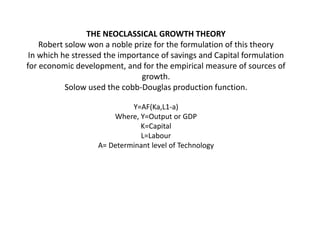
THE NEOCLASSICAL GROWTH THEORY
Robert solow won a noble prize for the formulation of this theory
In which he stressed the importance of savings and Capital formulation
for economic development, and for the empirical measure of sources of
growth.
Solow used the cobb-Douglas production function.
Y=AF(Ka,L1-a)
Where, Y=Output or GDP
K=Capital
L=Labour
A= Determinant level of Technology
THE LEWIS-FEI-RANIS MODEL
He explain how economic growth get started in a less developed country
with traditional agricultural sector and an industrial capitalist sector.
In the Lewis-fei-ranis model, economic growth occur because of the increase
in the size of the industrial sectors, which accumulate capital, relative to the
subsistence agricultural sectors, which amasses no capital at all.
VICIOUS CIRCLE THEORY
The vicious circle theory indicate that poverty perpetuates itself in mutual
reinforcing vicious circle on both the supply side and demand sides.
Supply side: Because income are low, consumption be divertied to savings
for capital formulation. Lack of capital result in low productivity per person,
which perpetuates low level of income. Thus circle complete. A country is
poor because it was previously poor to save and invest.
Demand side: because income are low, market size for consumer goods is to
small to encourage investors. Lack of investment means low productivity
and continued low income. A country is poor because it too poor to provide
market to spur investment
SUSTAINABLE DEVELOPMENT
Sustainable development is development that meets the needs of the present
without compromising the ability of future generations to meet their own needs.
Sustainable development includes the protection of future economic growth and
future development. In other words, it means a better quality of life for everyone,
now and for generations to come. Sustainable development includes the protection
of future economic growth and future development. Growth is essential, but
sustainable development requires it to be different. It must become more
concerned about the physical environment not only to present generation, but to
the future generation also. It means that the current consumption cannot be
financed for long by increasing economic debt and ecological imbalance which
future generation will pay. Sustainable development constantly seeks to achieve
social and economic progress in ways that will not exhaust the earth’s finite natural
resources. Sustainable development is a process of development in which economic
and other policies are designed to bring about development which is economically,
socially and ecologically sustainable. The concept thus is pro-people, pro-job and
pronature. It gives highest priority to poverty reduction, productive employment,
social integration and environmental regeneration
The sustainable development thus requires
1. Preservation of Ecological Resources and greater
use of renewable resources.
2. Encouragement to the use of environmentally-
safe technologies for development purposes i.e.
focus on reduction of all kinds of pollution
involved in the economic activities.
3. Formulation and implementation of policy
framework for people-security and human justice,
including ecological and economic security.
REFERENCES
1. CHAPTER 3. ECONOMIC GROWTH AND ECONOMIC DEVELOPMENT
(Free Material)
2. Dolan & Lindsey (Economics Sixth Edition)
3. Age of sustainable development by Jeff forward by Ban-ki Moon

GROWTH AND DEVELOPMENT.pptx

  • 1.
    UNIVERSITY OF MAKENI AGRICULTURALECONOMICS GROWTH AND DEVELOPMENT
  • 2.
    1. What isEconomic growth and Economic development? 2. What are the indicators of growth and development? 3. What are the factors affecting Sierra Leone to grow and subsequently leads to development? 4. What is sustainable development? 5. What are Rostows stages of economic growth?
  • 3.
    ECONOMIC GROWTH Is theincrease in the goods and services produced by an economy, typically a nation, over a long period of time. It is measured as percentage increase in real gross domestic product (GDP) which is gross domestic product (GDP) adjusted for inflation. GDP is the market value of all final goods and services produced in an economy or nation.
  • 4.
    FACTORS OF ECONOMICGROWTH Growth relates to a gradual increase in one of the components of Gross Domestic Product: Consumption, Government spending, Investment, Net exports
  • 5.
    MEASUREMENT OF ECONOMICGROWTH Economic Growth is measured by quantitative factors such as increase in real GDP or per capita income. EFFECT AND RELEVANCE Economic growth brings quantitative changes in the economy. Economic growth reflects the growth of national or per capita income
  • 6.
    FACTORS AFFECTING ECONOMICGROWTH 1. Natural Resources: The principal factor affecting the development of an economy is the natural resources. The natural resources include the land area and the quality of the soil, forest wealth, good river system, minerals and oil resources, good climate, etc. For economic growth, the existence of natural resources in abundance is essential. A country deficient in natural resources may not be in a position to develop rapidly. However, the availability of rich natural resources are a necessary condition for economic growth but not a sufficient one. In less developed countries, natural resources are unutilized, underutilized or misutilised. This is one of the reasons of their backwardness. On the otherhand countries such as Japan, Singapore etc. are not endowed with abundant natural resources but they are among the developed nations of the world. These countries have shown committment towards preserving the available resources, putting best efforts to manage the resources, minimizing waste of resources etc.
  • 7.
    2. Technological Progress: Technologicalprogress is a very important factor in determining the rate of economic growth. Technological progress mainly implies the research into the use of new and better methods of production or the improvement of the old methods. Sometimes technical progress results in the availability of natural resources. But generally technological progress results in increase in productivity. In other words, technological progress increases the ability to make a more effective and fruitful use of natural and other resources for increasing production. By the use of improved technology it is possible to have greater output from the use of given resources or a given output can be obtained by the use of a smaller quantity of resources. The technological progress improves an ability to make a fuller use of the natural resources e.g. with the aid of power - driven farm equipment a marked increase has been brought about in agricultural production
  • 8.
    3. Human ResourcesDevelopment: A good quality of population is very important in determining the level of economic growth. So the investment in human capital in the form of educational and medical and such other social schemes is very much desirable. Human resource development increases the knowledge, the skills and the capabilities of the people that increase their productivity.
  • 9.
    4. Population Growth: Laborsupply comes from population growth and it provides expanding market for goods and services. Thus, more labor produces larger output which a wider market absorbs. In this process, output, income and employment keep on rising and economic growth improves. But the population growth should be normal. A galloping rise in population retards +Inflation free concept.
  • 10.
    ECONOMIC DEVELOPMENT Economic developmentis defined as a sustained improvement in material well being of society. Economic development is a wider concept than economic growth. Apart from growth of national income, it includes changes – social, cultural, political as well as economic which contribute to material progress. It contains changes in resource supplies, in the rate of capital formation, in size and composition of population, in technology, skills and efficiency, in institutional and organizational set-up. These changes fulfill the wider objectives of ensuring more equitable income distribution, greater employment and poverty alleviation. In short, economic development is a process consisting of a long chain of interrelated changes in fundamental factors of supply and in the structure of demand, leading to a rise in the net national product of a country in the long run.
  • 11.
    FACTORS OF ECONOMICDEVELOPMENT Development relates to growth of Human capital, Decrease in inequality figures, and Structural changes that improve the quality of life of the population. MEASUREMENT OF ECONOMIC DEVELOPMENT The qualitative measures such as HDI (Human Development Index), Gender- related index, Human poverty index (HPI), Infant mortality, Literacy rate etc. are used to measure economic development.
  • 12.
    COMMON FEATURES OFUNDERDEVELOPED COUNTRIES 1. Low per Capita Income: The level of per capita income is very low in underdeveloped countries. 2. Poor Level of Living: The vast majority of people in underdeveloped nations lie under the conditions of poverty, malnutrition, disease, illiteracy, etc. Even basic necessities of life such as minimum food clothing and shelter are not easily accessible to the poor masses. 3. High Rate of Growth of Population: Population growth in underdeveloped countries neutralizes economic growth. High population implies greater consumption expenditure and lower investments in productive activities and slows down the economic development. 4. Low Levels of Productivity: The Productivity level (i.e. output produced per person) tends to be very low in an underdeveloped country which is mainly due to : (i) inefficient workforce which itself is a consequence of poverty, ill health and lack of education (ii) Low work culture (iii) Low use of capita in the form of machinery and equipment.
  • 13.
    5. Technological Backwardness:In most of the sectors, an underdeveloped economy the techniques of production employed are generally obsolete mainly due to low saving rate. 6. High Level of Unemployment: Unemployment levels are very high in the underdeveloped countries mainly due to lack of capital and low level of development in various economic sectors, these countries are not able to absorb the rising labor supply. 7. Low Social Indicators of Development: The under- developed countries have very low social indicators such as low literacy rate, high infant mortality rate, low expectancy of life, etc. as compared to the developed countries.
  • 14.
    ROSTOWS STAGES OFECONOMIC GROWTH Rostow's stages of economic growth model is one of the major historical models of economic growth. It was published by American economist Walt Whitman Rostow in 1960. The model postulates that economic growth occurs in five basic stages, of varying length: 1. Traditional Stage- 2. Pre-Takeoff 3. Takeoff Stage 4. Maturity Stage 5. High Mass Consumption Stage
  • 15.
    (i) Traditional Society: Rostowhas described traditional society as one whose structure is developed within limited production functions based on pre-Newtonian science and technology. It means primitive and old methods are used for production. Production is meant for consumption. Consumption is very limited. There are no concepts of saving and investment in the economy. The civilization of Middle East is the best example of this type. (ii) Pre-Takeoff stage: In this stage, people think for a higher standard of living. To achieve this good, structural and economic changes take place in the economy. Saving and investment in particular activities are encouraged. Education is also spread. This is the period when preconditions for take-off are developed. The emergence of new investors and entrepreneurs causes an upward trend in trade and commerce. Thus, all the efforts are made to fulfill the pre-conditions of economic growth.
  • 16.
    (iii) Take-off Stage: Accordingto Rostow, take-off is the stage of industrial revolution with the use of improved technology. It is also called a great watershed in the life of modern societies. All types of socio-economic infrastructures have been laid. As a result growth process starts. There is a high rate of saving and investment and the rate of capital formation is very fast. There is development of both consumer and capital goods industries. (iv) Drive to Maturity: After attaining self-sustained growth, economy is ready for a drive to maturity. At this stage economy moves towards the goal of becoming a mature economy. In fact, this is the period when a society has effectively applied the range of modern technology. Thus modern technology is adopted in all sectors of production. At this stage, working forces organize themselves in order to have greater economic and social security. Here international trade also occupies a significant place. The rate of investment and capital formation are extraordinarily increased.
  • 17.
    (v) High MassConsumption: It is the final stage of production. This stage occurs after attaining the stage of drive to maturity. In this stage, leading sectors produce durable consumer goods and services. Per capita output or income of the country becomes very high. In fact, standard of the people can be guaranteed for all members of the society. This led to the foundation of welfare state. Many countries of Western and Northern Europe have attained this stage.
  • 18.
    THE NEOCLASSICAL GROWTHTHEORY Robert solow won a noble prize for the formulation of this theory In which he stressed the importance of savings and Capital formulation for economic development, and for the empirical measure of sources of growth. Solow used the cobb-Douglas production function. Y=AF(Ka,L1-a) Where, Y=Output or GDP K=Capital L=Labour A= Determinant level of Technology
  • 19.
    THE LEWIS-FEI-RANIS MODEL Heexplain how economic growth get started in a less developed country with traditional agricultural sector and an industrial capitalist sector. In the Lewis-fei-ranis model, economic growth occur because of the increase in the size of the industrial sectors, which accumulate capital, relative to the subsistence agricultural sectors, which amasses no capital at all. VICIOUS CIRCLE THEORY The vicious circle theory indicate that poverty perpetuates itself in mutual reinforcing vicious circle on both the supply side and demand sides. Supply side: Because income are low, consumption be divertied to savings for capital formulation. Lack of capital result in low productivity per person, which perpetuates low level of income. Thus circle complete. A country is poor because it was previously poor to save and invest. Demand side: because income are low, market size for consumer goods is to small to encourage investors. Lack of investment means low productivity and continued low income. A country is poor because it too poor to provide market to spur investment
  • 20.
    SUSTAINABLE DEVELOPMENT Sustainable developmentis development that meets the needs of the present without compromising the ability of future generations to meet their own needs. Sustainable development includes the protection of future economic growth and future development. In other words, it means a better quality of life for everyone, now and for generations to come. Sustainable development includes the protection of future economic growth and future development. Growth is essential, but sustainable development requires it to be different. It must become more concerned about the physical environment not only to present generation, but to the future generation also. It means that the current consumption cannot be financed for long by increasing economic debt and ecological imbalance which future generation will pay. Sustainable development constantly seeks to achieve social and economic progress in ways that will not exhaust the earth’s finite natural resources. Sustainable development is a process of development in which economic and other policies are designed to bring about development which is economically, socially and ecologically sustainable. The concept thus is pro-people, pro-job and pronature. It gives highest priority to poverty reduction, productive employment, social integration and environmental regeneration
  • 21.
    The sustainable developmentthus requires 1. Preservation of Ecological Resources and greater use of renewable resources. 2. Encouragement to the use of environmentally- safe technologies for development purposes i.e. focus on reduction of all kinds of pollution involved in the economic activities. 3. Formulation and implementation of policy framework for people-security and human justice, including ecological and economic security.
  • 22.
    REFERENCES 1. CHAPTER 3.ECONOMIC GROWTH AND ECONOMIC DEVELOPMENT (Free Material) 2. Dolan & Lindsey (Economics Sixth Edition) 3. Age of sustainable development by Jeff forward by Ban-ki Moon