Chapter 4
*
*
Section 1
*
*Demand is the desire to own something and the
ability to pay for it.
*Price changes always affect the quantity demanded
because people buy less of a good when the price
goes up.
*By analyzing demand schedules and demand curves,
you can see how consumers react to changes in
price.
*
*The law of demand states that:
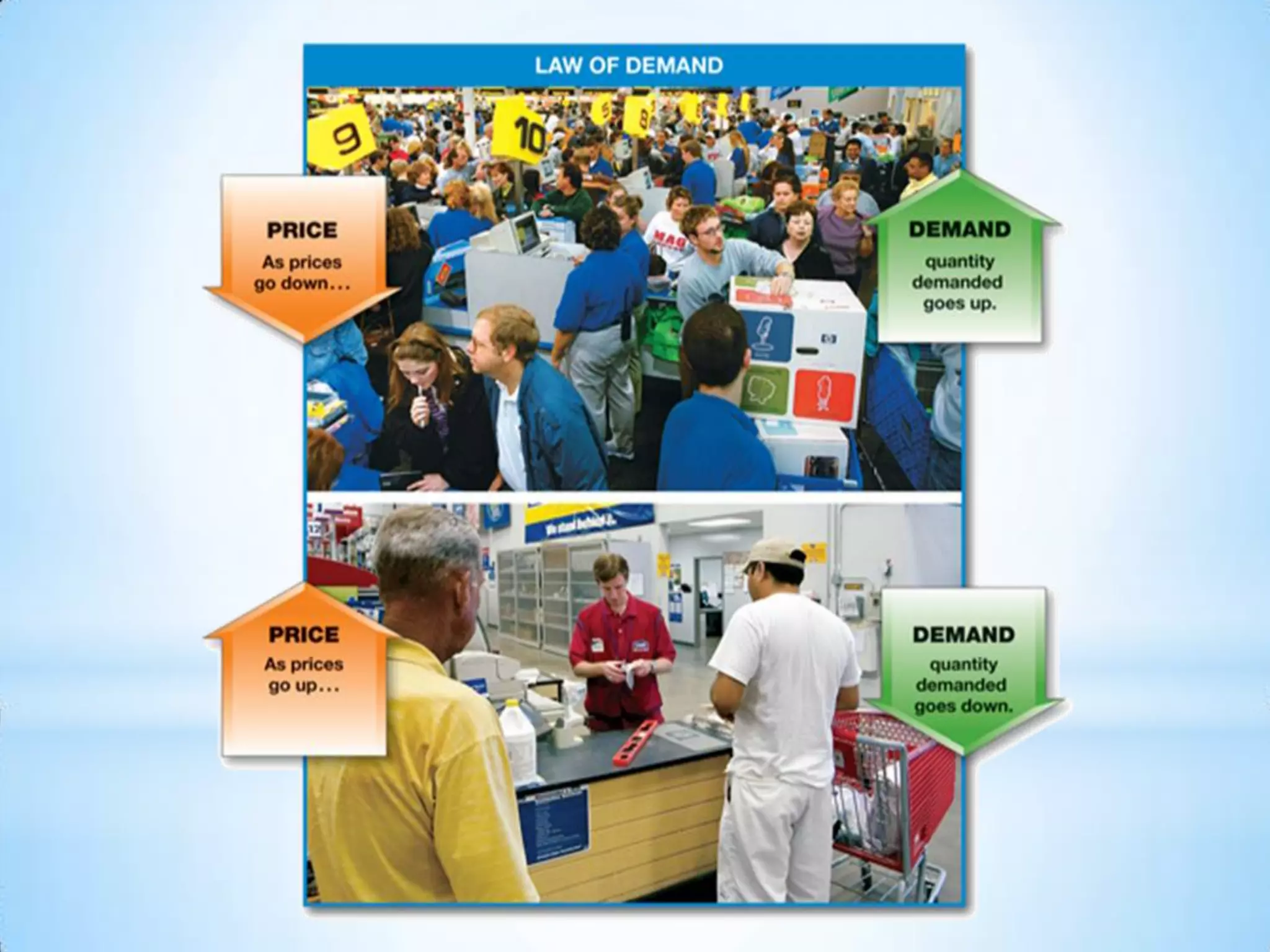
When a good’s price is lower, consumers will buy
more of it. When the price is higher, consumers will
buy less of it.
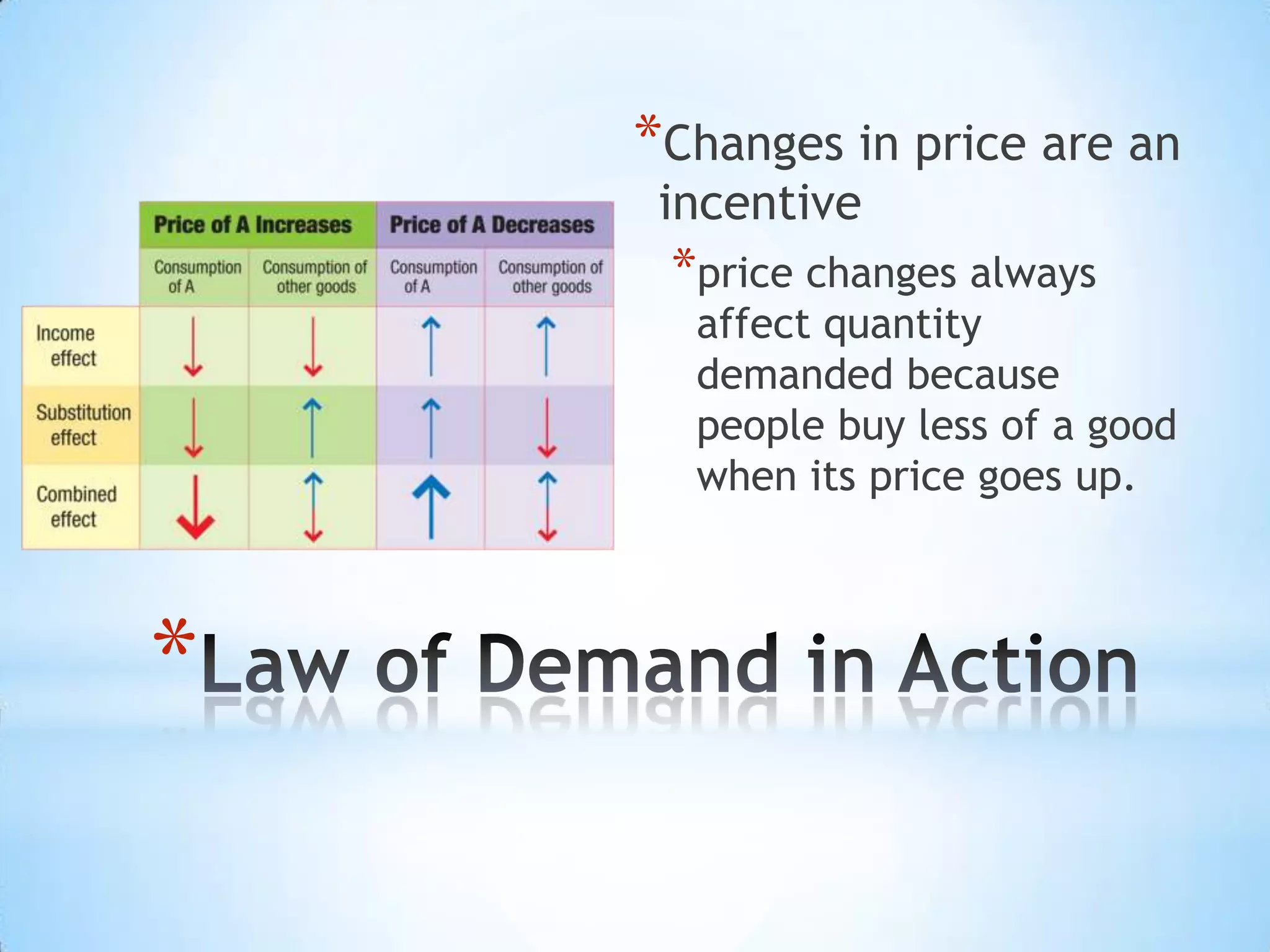
*The law of demand is the result of the substitution effect
and the income effect:
*two ways that a consumer can change his or her spending patterns.
*Together, they explain why an increase in price decreases the amount
consumers purchase.
*
*Changes in price are an
incentive
*price changes always
affect quantity
demanded because
people buy less of a good
when its price goes up.
*
*The substitution effect takes place when a
consumer reacts to a rise in the price of one
good by consuming less of that good and more
of a substitute good.
*The substitution effect can also apply to a drop in
prices
*
*The income effect is the change in consumption
that results when a price increase causes real
income to decline.
*Economists measure consumption in the amount of a
good that is bought, not the amount of money spent on
it.
*The income effect also operates when the price is
lowered. If the price of something drops, you feel
wealthier. If you buy more of a good as a result of a
lower price, that’s the income effect at work.
*
*The law of demand explains how the price of
an item affects the quantity demanded of
that item.
*To have demand for a good, you must be
willing and able to buy it at a specified price.
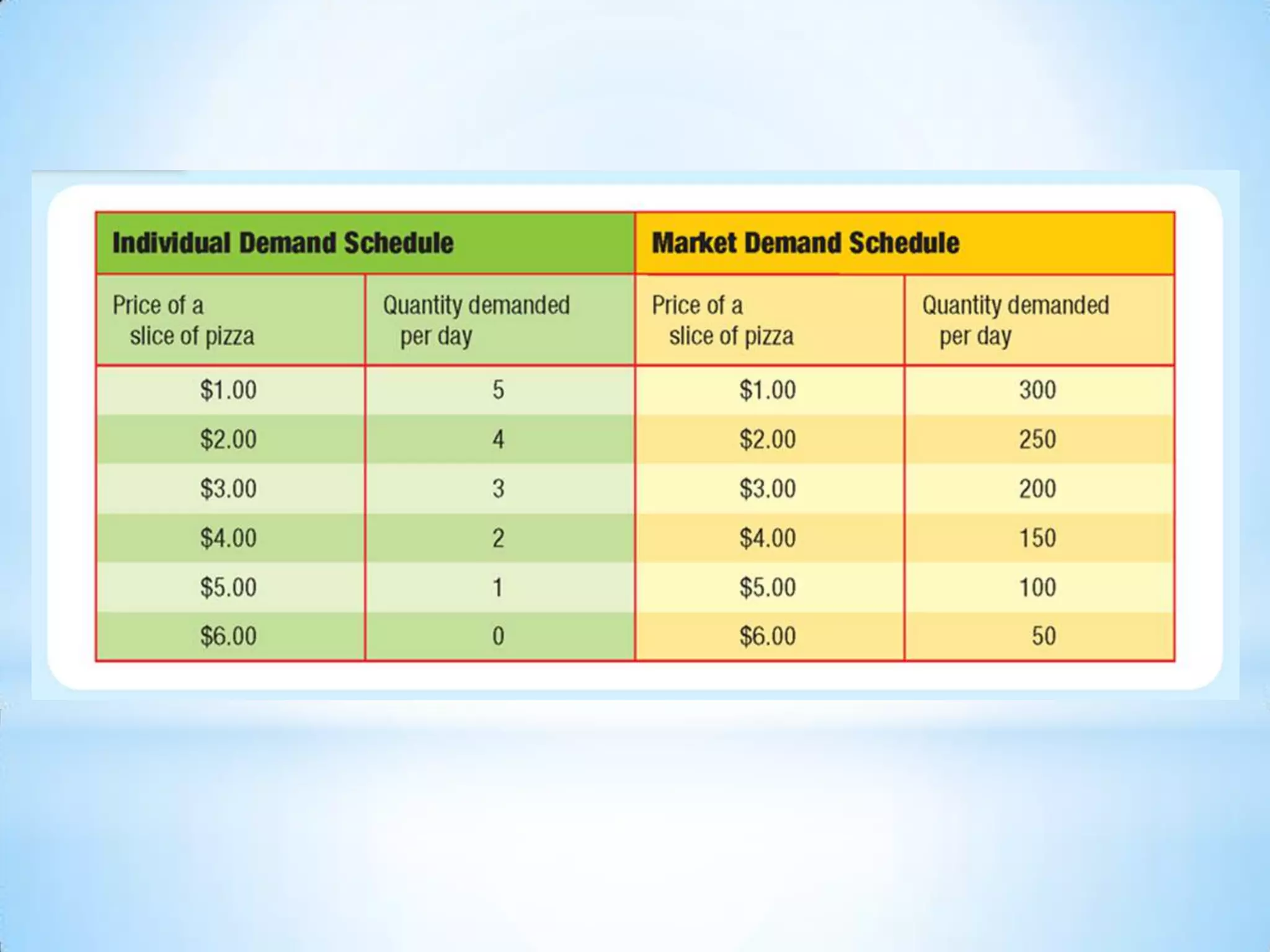
*A demand schedule is a table that lists the
quantity of a good that a person will purchase
at various prices in the market.
*
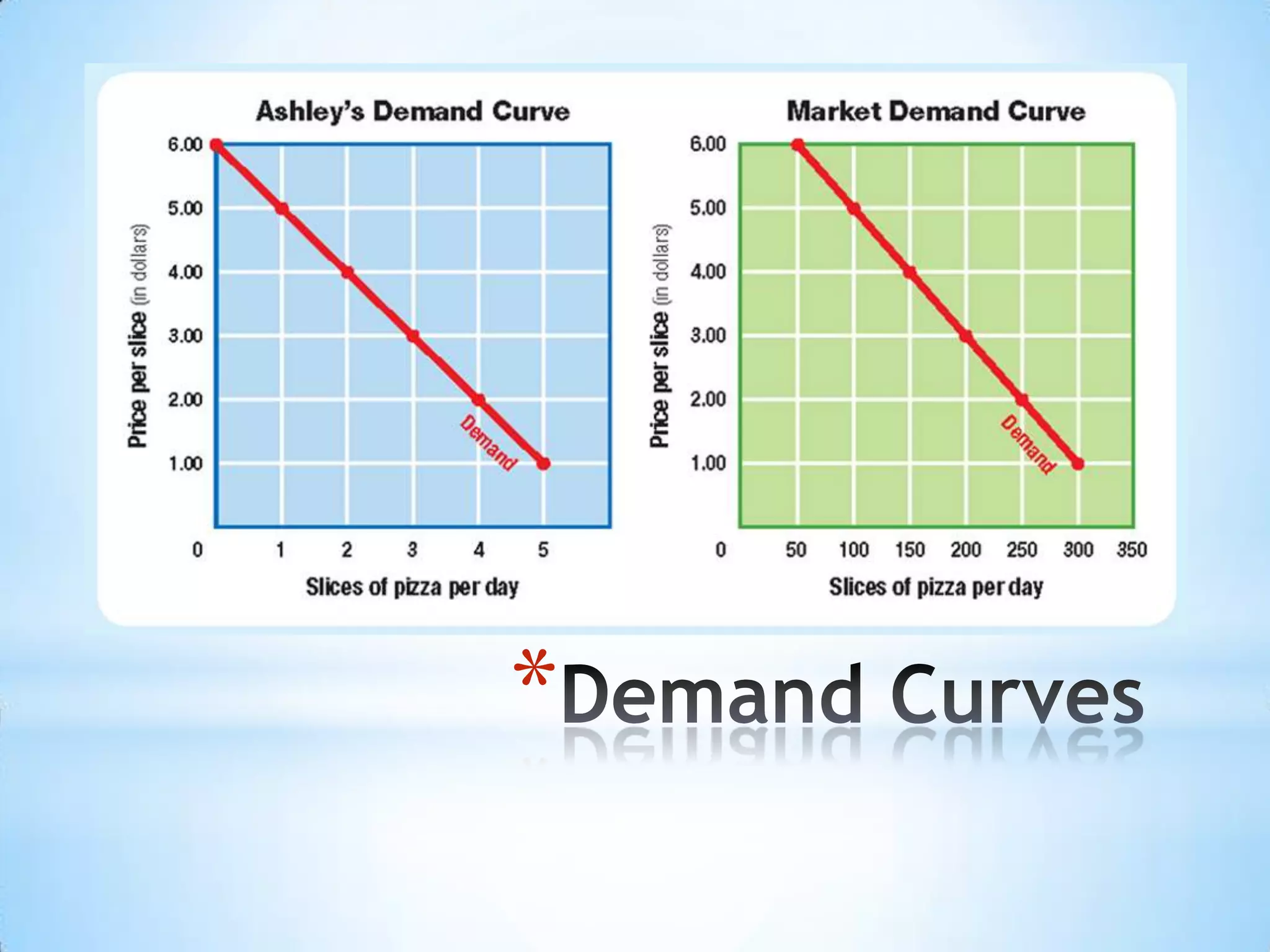
*A market demand schedule shows the quantities
demanded at various prices by all consumers in the
market.
*Market demand schedules are used to predict the total
sales of a commodity at several different prices.
*Market demand schedules exhibit the law of demand:
at higher prices the quantity demanded is lower.
*
*A demand curve is a graphic representation of a
demand schedule.
*The vertical axis is always labeled with the lowest
possible prices at the bottom and the highest
prices at the top.
*The horizontal axis should be labeled with the
lowest possible quantity demanded at the left and
the highest possible quantity demanded on the
right.
*
*
Section 2
*
*Shifts in the demand curve are caused by more than
just price increases and decreases. Other factors
include:
*Income
*Consumer Expectations
*Population
*Demographics
*Consumer Tastes and Advertising
*
*A demand schedule takes into account only changes
in price. It does not consider the effects of news
reports of any one of the thousands of other factors
that change from day to day that could affect the
demand for a particular good.
*A demand curve is accurate only as long as there are
no changes other than price that could affect the
consumer’s decision.
*
*A demand curve is accurate only as long as the ceteris
paribus assumption—that all other things are held
constant—is true.
*When we drop the ceteris paribus rule and allow other
factors to change, we no longer move along the demand
curve. Instead, the entire demand curve shifts.
*A shift in the demand curve means that at every price,
consumers buy a different quantity than before; this shift of the
entire demand curve is what economists refer to as a change in
demand.
*
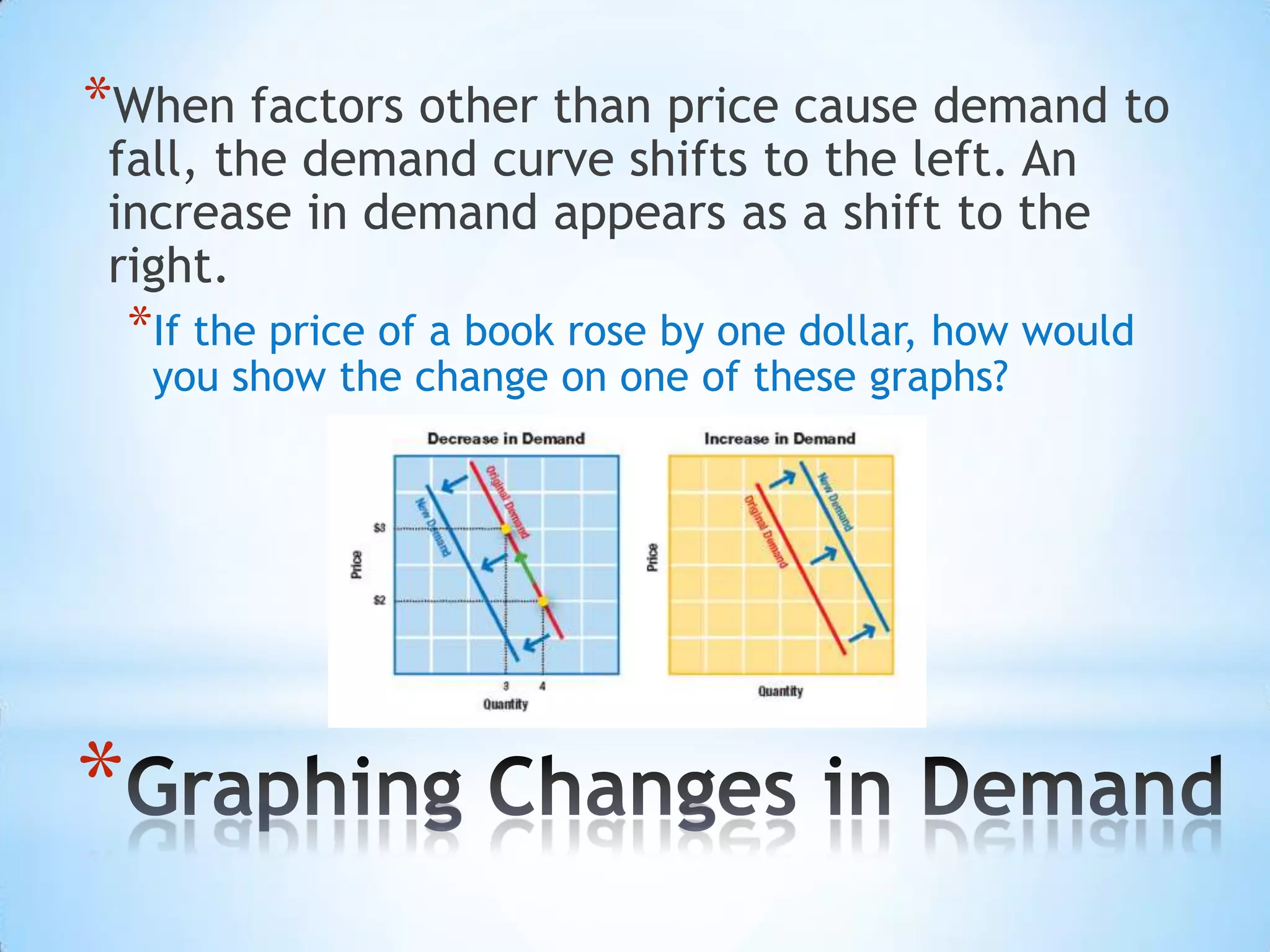
*When factors other than price cause demand to
fall, the demand curve shifts to the left. An
increase in demand appears as a shift to the
right.
*If the price of a book rose by one dollar, how would
you show the change on one of these graphs?
*
*Most items that we purchase are normal
goods, which consumers demand more of
when their income increases.
*A rise in income would cause the demand curve to
shift to the right, indicating an increase in demand.
A fall in income would cause the demand curve to
shift left, indicating a decrease in demand.
*
*The current demand for a good is positively
related to its expected future price.
*If you expect the price to rise, your current
demand will rise, which means you will buy the
good sooner.
*If you expect the price to drop your current
demand will fall, and you will wait for the lower
price.
*
*Changes in the size of the population
will also affect the demand for most
products.
*Population trends can have a
particularly strong effect on certain
goods.
*
*Demographics are the characteristics of
populations, such as age, race, gender,
and occupation.
*Businesses use this data to classify potential
customers.
*Demographics also have a strong influence on
packaging, pricing, and advertising.
*
*Advertising is a factor that shifts the demand
curve because it plays an important role in
many trends.
*Companies spend money on advertising
because they hope that it will increase the
demand for the goods they sell.
*
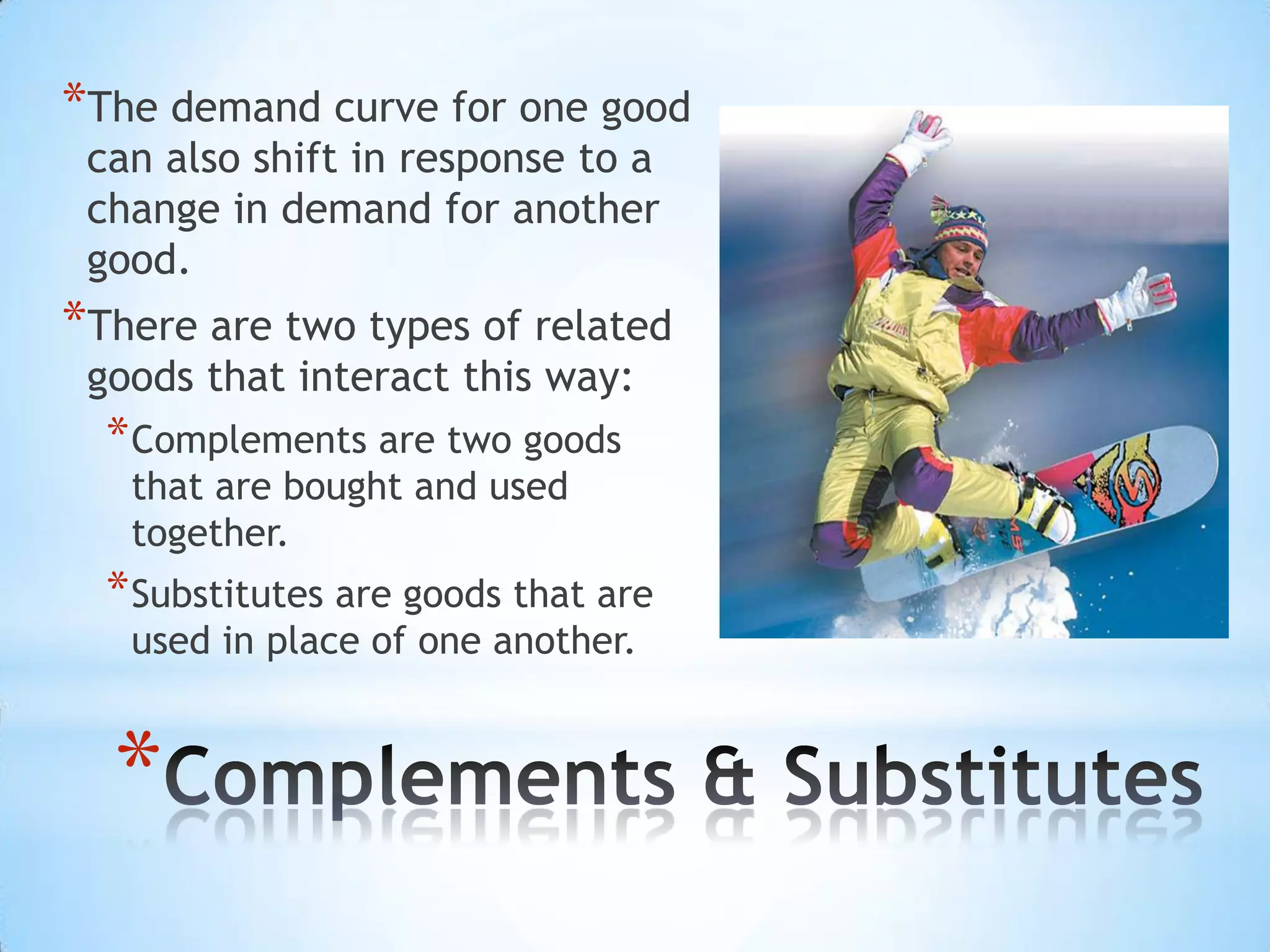
*The demand curve for one good
can also shift in response to a
change in demand for another
good.
*There are two types of related
goods that interact this way:
*Complements are two goods
that are bought and used
together.
*Substitutes are goods that are
used in place of one another.
*
*Elasticity of demand is the way that consumers
respond to price changes; it measures how
drastically buyers will cut back or increase their
demand for a good when the price rises or falls.
*Your demand for a good that you will keep buying
despite a price change is inelastic.
*If you buy much less of a good after a small price
increase, your demand for that good is elastic.
*
Section 3
*
*Elastic Demand comes from one or more of
these factors:
*The availability of substitute goods
*A limited budget that does not allow for
price changes
*The perception of a good as a luxury item.
*
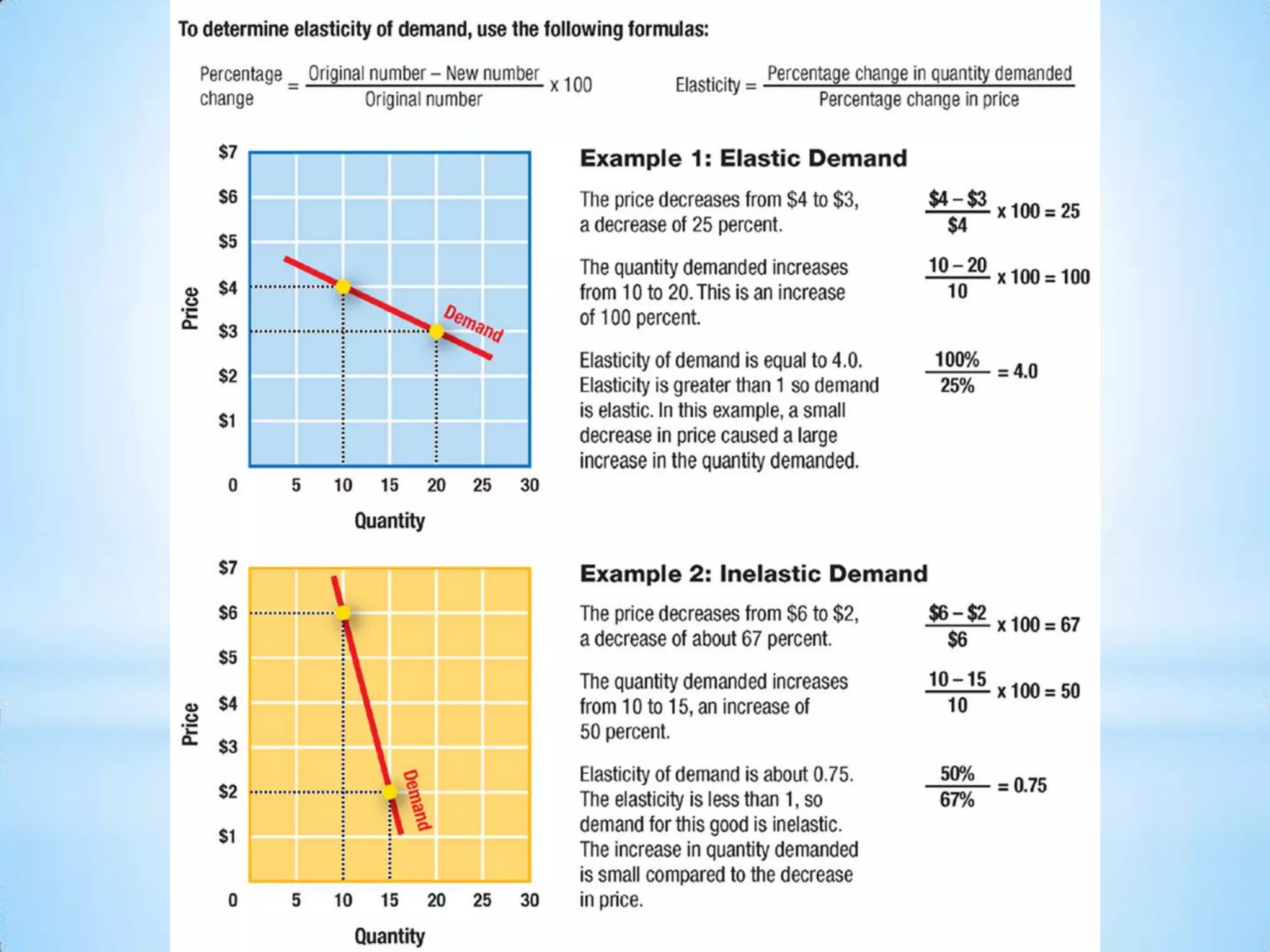
*Calculating elasticity of demand:
*(% change in demand)/(% change in price) x 100
*The law of demand implies that the result will
always be negative.
*increases in the price of a good will always decrease
the quantity demanded
*decrease in the price of a good will always increase
the quantity demanded.
*
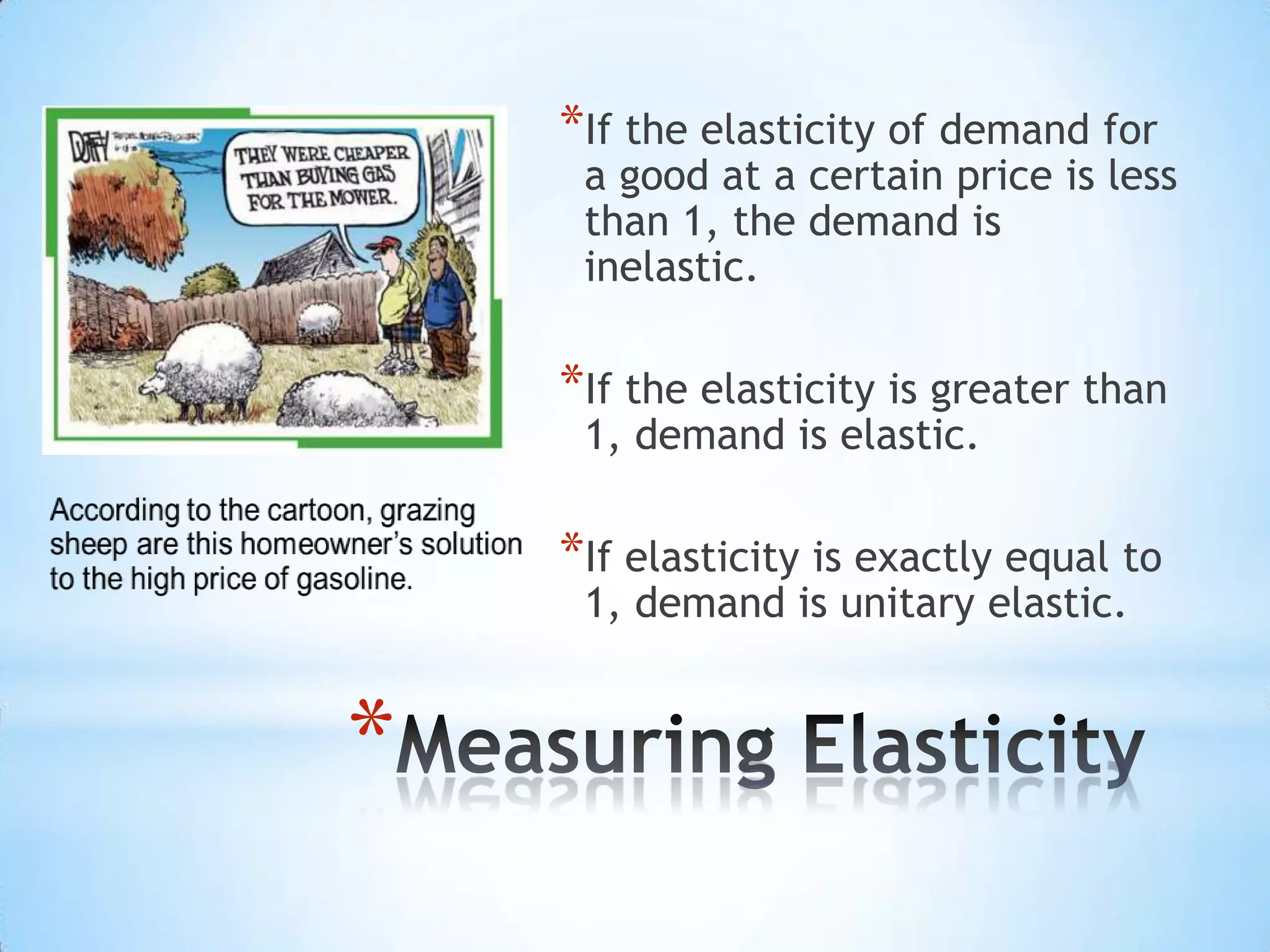
*If the elasticity of demand for
a good at a certain price is less
than 1, the demand is
inelastic.
*If the elasticity is greater than
1, demand is elastic.
*If elasticity is exactly equal to
1, demand is unitary elastic.
*
*Availability of Substitutes
*If there are a few substitutes for a good, then
even when its price rises greatly, you might still
buy it.
*If the lack of substitutes can make demand
inelastic, a wide choice of substitute goods can
make demand elastic.
*
*Relative Importance
*A second factor in determining a good’s elasticity of demand
is how much of your budget you spend on a good.
*Necessities v. Luxuries
*Whether a person considers a good to be a necessity or a
luxury has a great impact on a person’s elasticity of demand
for that good.
*
*Change Over Time
*Consumers do not always react quickly to a price
increase, because it takes time to find substitutes.
Because they cannot respond quickly to price
changes, their demand is inelastic in the short term.
*Demand sometimes becomes more elastic over time as people
eventually find substitutes.
*
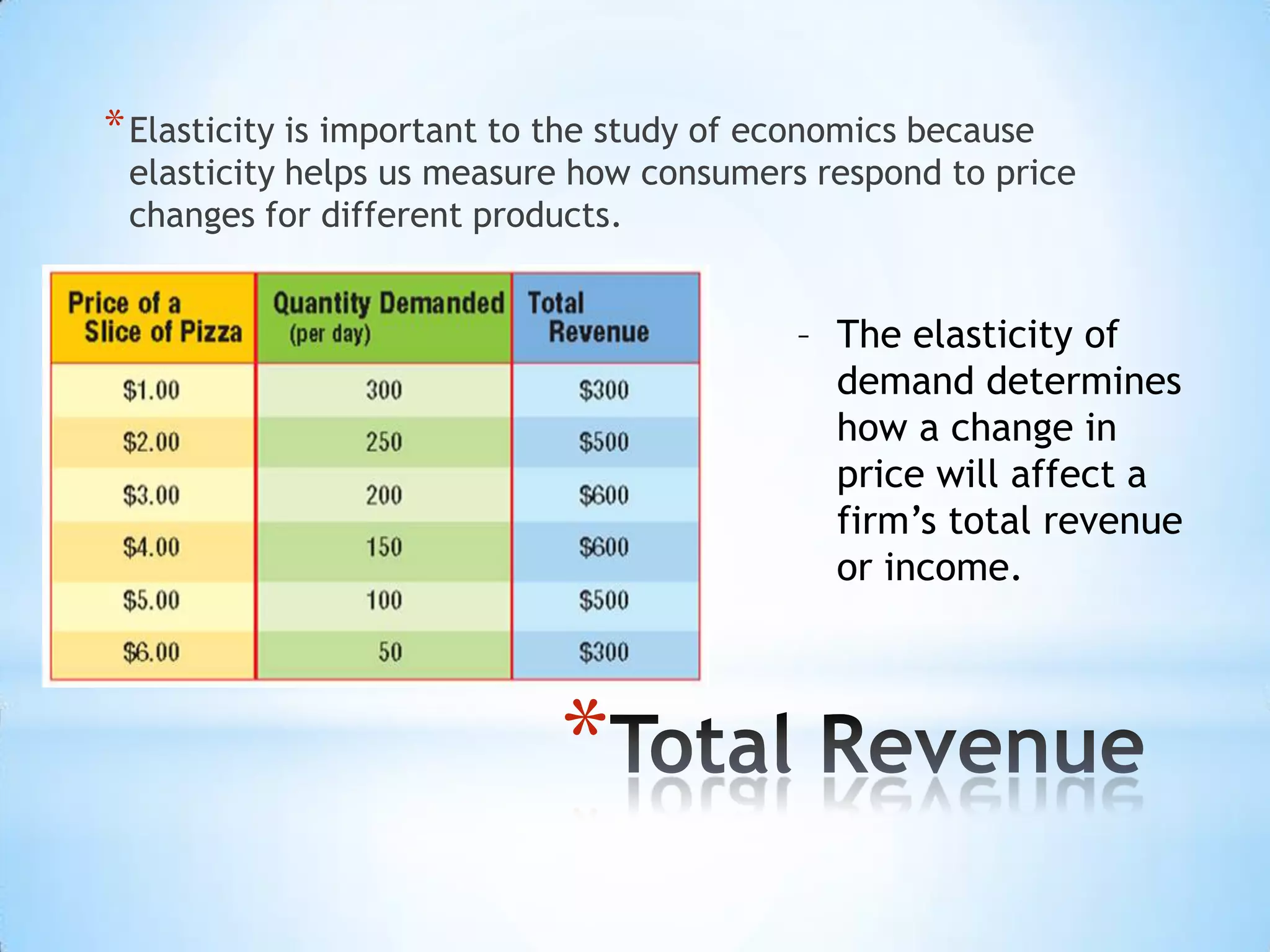
*Elasticity is important to the study of economics because
elasticity helps us measure how consumers respond to price
changes for different products.
– The elasticity of
demand determines
how a change in
price will affect a
firm’s total revenue
or income.
*
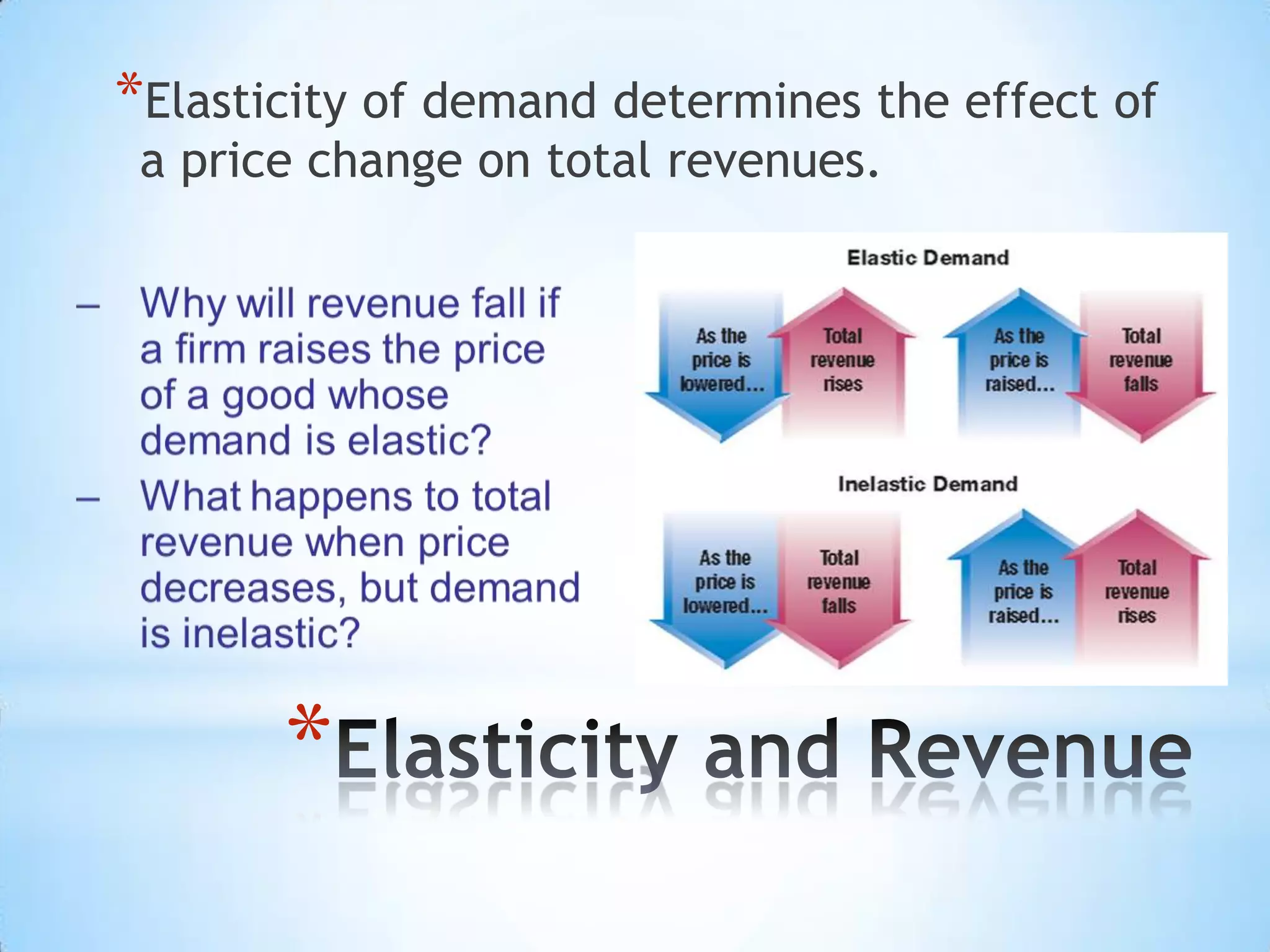
*Elasticity of demand determines the effect of
a price change on total revenues.
*
*Knowledge of how the elasticity of demand can
affect a firm’s total revenues helps the firm
make pricing decisions that lead to the greatest
revenue.
*If a firm knows that the demand for its product is elastic
at the current price, it knows that an increase in price
would reduce total revenue.
*If a firm knows that the demand for its product is
inelastic at its current price, it knows that an increase in
price will increase total revenue.

Economics: Chapter 4

  • 1.
  • 2.
  • 3.
    * *Demand is thedesire to own something and the ability to pay for it. *Price changes always affect the quantity demanded because people buy less of a good when the price goes up. *By analyzing demand schedules and demand curves, you can see how consumers react to changes in price.
  • 4.
    * *The law ofdemand states that: When a good’s price is lower, consumers will buy more of it. When the price is higher, consumers will buy less of it. *The law of demand is the result of the substitution effect and the income effect: *two ways that a consumer can change his or her spending patterns. *Together, they explain why an increase in price decreases the amount consumers purchase.
  • 6.
    * *Changes in priceare an incentive *price changes always affect quantity demanded because people buy less of a good when its price goes up.
  • 7.
    * *The substitution effecttakes place when a consumer reacts to a rise in the price of one good by consuming less of that good and more of a substitute good. *The substitution effect can also apply to a drop in prices
  • 8.
    * *The income effectis the change in consumption that results when a price increase causes real income to decline. *Economists measure consumption in the amount of a good that is bought, not the amount of money spent on it. *The income effect also operates when the price is lowered. If the price of something drops, you feel wealthier. If you buy more of a good as a result of a lower price, that’s the income effect at work.
  • 9.
    * *The law ofdemand explains how the price of an item affects the quantity demanded of that item. *To have demand for a good, you must be willing and able to buy it at a specified price. *A demand schedule is a table that lists the quantity of a good that a person will purchase at various prices in the market.
  • 10.
    * *A market demandschedule shows the quantities demanded at various prices by all consumers in the market. *Market demand schedules are used to predict the total sales of a commodity at several different prices. *Market demand schedules exhibit the law of demand: at higher prices the quantity demanded is lower.
  • 12.
    * *A demand curveis a graphic representation of a demand schedule. *The vertical axis is always labeled with the lowest possible prices at the bottom and the highest prices at the top. *The horizontal axis should be labeled with the lowest possible quantity demanded at the left and the highest possible quantity demanded on the right.
  • 13.
  • 14.
  • 15.
    * *Shifts in thedemand curve are caused by more than just price increases and decreases. Other factors include: *Income *Consumer Expectations *Population *Demographics *Consumer Tastes and Advertising
  • 16.
    * *A demand scheduletakes into account only changes in price. It does not consider the effects of news reports of any one of the thousands of other factors that change from day to day that could affect the demand for a particular good. *A demand curve is accurate only as long as there are no changes other than price that could affect the consumer’s decision.
  • 17.
    * *A demand curveis accurate only as long as the ceteris paribus assumption—that all other things are held constant—is true. *When we drop the ceteris paribus rule and allow other factors to change, we no longer move along the demand curve. Instead, the entire demand curve shifts. *A shift in the demand curve means that at every price, consumers buy a different quantity than before; this shift of the entire demand curve is what economists refer to as a change in demand.
  • 18.
    * *When factors otherthan price cause demand to fall, the demand curve shifts to the left. An increase in demand appears as a shift to the right. *If the price of a book rose by one dollar, how would you show the change on one of these graphs?
  • 19.
    * *Most items thatwe purchase are normal goods, which consumers demand more of when their income increases. *A rise in income would cause the demand curve to shift to the right, indicating an increase in demand. A fall in income would cause the demand curve to shift left, indicating a decrease in demand.
  • 20.
    * *The current demandfor a good is positively related to its expected future price. *If you expect the price to rise, your current demand will rise, which means you will buy the good sooner. *If you expect the price to drop your current demand will fall, and you will wait for the lower price.
  • 21.
    * *Changes in thesize of the population will also affect the demand for most products. *Population trends can have a particularly strong effect on certain goods.
  • 22.
    * *Demographics are thecharacteristics of populations, such as age, race, gender, and occupation. *Businesses use this data to classify potential customers. *Demographics also have a strong influence on packaging, pricing, and advertising.
  • 23.
    * *Advertising is afactor that shifts the demand curve because it plays an important role in many trends. *Companies spend money on advertising because they hope that it will increase the demand for the goods they sell.
  • 24.
    * *The demand curvefor one good can also shift in response to a change in demand for another good. *There are two types of related goods that interact this way: *Complements are two goods that are bought and used together. *Substitutes are goods that are used in place of one another.
  • 25.
    * *Elasticity of demandis the way that consumers respond to price changes; it measures how drastically buyers will cut back or increase their demand for a good when the price rises or falls. *Your demand for a good that you will keep buying despite a price change is inelastic. *If you buy much less of a good after a small price increase, your demand for that good is elastic.
  • 26.
  • 27.
    * *Elastic Demand comesfrom one or more of these factors: *The availability of substitute goods *A limited budget that does not allow for price changes *The perception of a good as a luxury item.
  • 28.
    * *Calculating elasticity ofdemand: *(% change in demand)/(% change in price) x 100 *The law of demand implies that the result will always be negative. *increases in the price of a good will always decrease the quantity demanded *decrease in the price of a good will always increase the quantity demanded.
  • 30.
    * *If the elasticityof demand for a good at a certain price is less than 1, the demand is inelastic. *If the elasticity is greater than 1, demand is elastic. *If elasticity is exactly equal to 1, demand is unitary elastic.
  • 31.
    * *Availability of Substitutes *Ifthere are a few substitutes for a good, then even when its price rises greatly, you might still buy it. *If the lack of substitutes can make demand inelastic, a wide choice of substitute goods can make demand elastic.
  • 32.
    * *Relative Importance *A secondfactor in determining a good’s elasticity of demand is how much of your budget you spend on a good. *Necessities v. Luxuries *Whether a person considers a good to be a necessity or a luxury has a great impact on a person’s elasticity of demand for that good.
  • 33.
    * *Change Over Time *Consumersdo not always react quickly to a price increase, because it takes time to find substitutes. Because they cannot respond quickly to price changes, their demand is inelastic in the short term. *Demand sometimes becomes more elastic over time as people eventually find substitutes.
  • 34.
    * *Elasticity is importantto the study of economics because elasticity helps us measure how consumers respond to price changes for different products. – The elasticity of demand determines how a change in price will affect a firm’s total revenue or income.
  • 35.
    * *Elasticity of demanddetermines the effect of a price change on total revenues.
  • 36.
    * *Knowledge of howthe elasticity of demand can affect a firm’s total revenues helps the firm make pricing decisions that lead to the greatest revenue. *If a firm knows that the demand for its product is elastic at the current price, it knows that an increase in price would reduce total revenue. *If a firm knows that the demand for its product is inelastic at its current price, it knows that an increase in price will increase total revenue.