Unit 1
BASIC ECONOMICS PROBLEM
• Scarcity, choice (opportunity cost) and
resource allocation – Hence the BASIC
ECONOMIC problem
• Factors of Production
• Production possibility curves – shapes and shifts
• Decision making at the margin
• Specialization and exchange
• Division of labour
• Different allocative mechanisms – Planned,
Market & free and Problems of transition
• Ceteris Paribus, Positive and normative
statements
• Money: functions and characteristics
ECONOMICS – “OIKONOMOUS”
oikos – household
nomous– law/ rules; to manage
resources
“Management of Resources”
* MicroEconomics - deals with
individual units or groups
* MacroEconomics - deals with nation
or economy as a whole
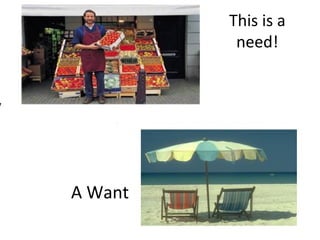
This is a
need!
A Want
Economics
is the
Science of CHOICE
(decisions made by you and me, firms,
government )
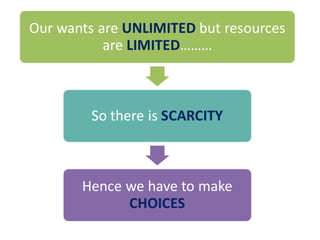
• Hence scarcity forces us to make
choice
• And so Allocation of Resources
Decision on allocation of
resources, Leads to 3 major
economic problem/
questions:
•What to produce
•How to produce
•Whom to produce
• WHAT TO PRODUCE
• Food or Clothes
• Cars or hospitals
• ipods or Cosmetics or military strength
Basic Economic Problem- 3 decisions
 techniques used.
 least cost method of production
 labour intensive or capital intensive
Basic Economic Problem- 3 decisions
HOW TO PRODUCE
 Will everyone get an equal share
of what is produced ?
 Would the income be distributed
equally?
Basic Economic Problem- 3 decisions
for WHOM TO PRODUCE
• Production: Creating goods and
services
• Consumption: Using the goods
and services to satisfy want
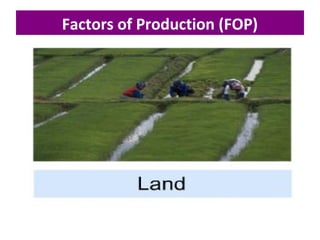
Basic Economic ProblemFactors of Production (FOP)
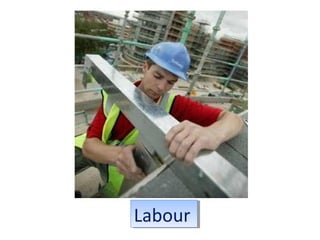
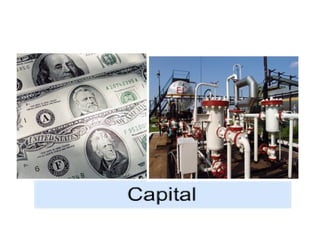
LabourLabour
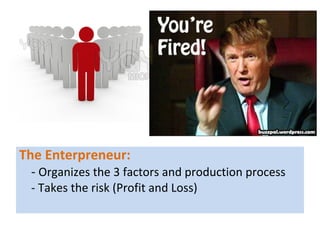
The Enterpreneur:
- Organizes the 3 factors and production process
- Takes the risk (Profit and Loss)
Enhancement of
Production….
• Specialization
• Exchange (Trade)
• Division of Labour
Specialization
• Firms or Individuals or Regions
or Countries producing some
goods and services which they
are best producing at
Exchange
• No economy can be self dependent
but they have to be interdependent
• Trade and exchange of goods and
services helps to resolve the problem
of scarcity to a certain extent
Division of labour
• Adam Smith – division of labour
represents a qualitative increase in
productivity
Production Possibility Curve (PPC)
• Every decision has an opportunity
cost – the cost in foregone
opportunities.
• The production possibilities curve
shows the trade-offs among choices
we make.
• A production possibility curve is used
to illustrate opportunity cost.
• Opportunity Cost is the
highest-valued option
forgone
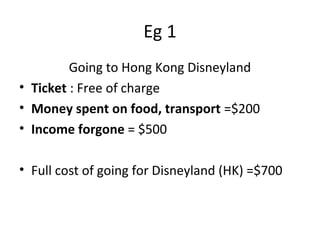
Eg 1
Going to Hong Kong Disneyland
• Ticket : Free of charge
• Money spent on food, transport =$200
• Income forgone = $500
• Full cost of going for Disneyland (HK) =$700
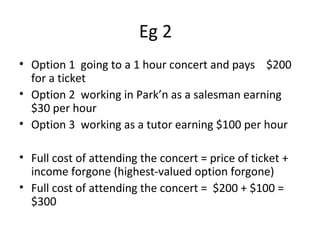
Eg 2
• Option 1 going to a 1 hour concert and pays $200
for a ticket
• Option 2 working in Park’n as a salesman earning
$30 per hour
• Option 3 working as a tutor earning $100 per hour
• Full cost of attending the concert = price of ticket +
income forgone (highest-valued option forgone)
• Full cost of attending the concert = $200 + $100 =
$300
Sli
de
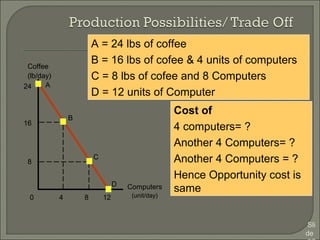
A = 24 lbs of coffee
B = 16 lbs of cofee & 4 units of computers
C = 8 lbs of cofee and 8 Computers
D = 12 units of Computer
Coffee
(lb/day)
Computers
(unit/day)
A
B
C
D
24
0
16
8
4 8 12
Cost of
4 computers= ?
Another 4 Computers= ?
Another 4 Computers = ?
Hence Opportunity cost is
same
In our choices of production,
the opportunity cost may
Remain Constant
Increase
Decrease
Depending on our choices of
Production,
the opportunity cost may
Remain Constant
Increase
Decrease
Unit 1 : Macroeconomics
National Council on Economic
Education
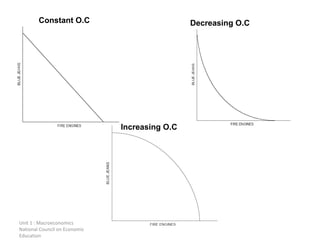
Constant O.C Decreasing O.C
Increasing O.C
PPC is also called:
• Production Possibility Frontier (PPF)
– What you can and cannot produce
• Product Transformation Curve
–What will it cost you to produce the other
good
–When you produce something else, you have to
reallocate resources – “Reallocation of
Resources”
–How easily you can reallocate – Factor Mobility
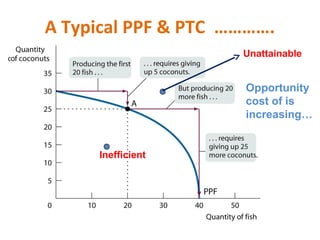
A Typical PPF & PTC ………….
Unattainable
Inefficient
Opportunity
cost of is
increasing…
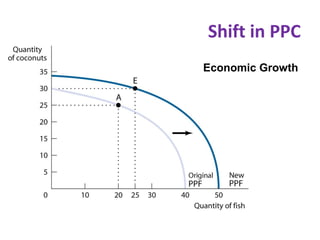
Shift in PPC
Economic Growth
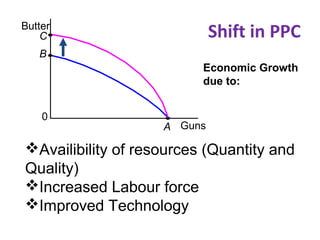
0
B
A
Butter
Guns
C
Availibility of resources (Quantity and
Quality)
Increased Labour force
Improved Technology
Shift in PPC
Economic Growth
due to:
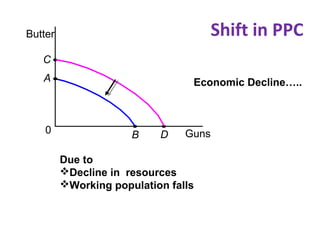
Economic Decline…..
Butter
A
B Guns0
C
D
Due to
Decline in resources
Working population falls
Shift in PPC
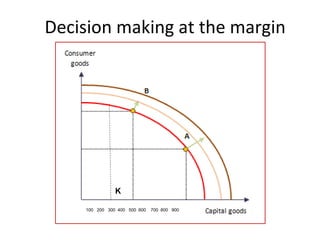
Decision making at the margin
• Consumer Goods
Products purchased by consumers
for personal or household use.
• Capital Goods
Producers’ goods or means of
production (Eg: Machines)
Creating Captial goods  Investment
• More Consumer goods  Higher standard of
living
• But if we do not have sufficient capital goods
to produce consumer goods  In the future
 Standard of living may fall
• So a decision has to be made:
“Whether to produce Consumer Goods or
Capital Goods?”
Decision making at the margin
K
100 200 300 400 500 600 700 800 900
• If Capital goods are less than K 
Economics Decline
• If we produce more capital goods 
In the future  Economic Growth
• Developing Countries
–They have to increase their capital
goods  so more resources are
allocated capital goods  Low
standard of living.
–A minimum amount of resources 
allocated for comsumer goods 
survival of population
–“Subsistence Level of Consumption”
• In under-developed countries or
poorly developing countries………
–Most of resources are allocated for
consumer goods for survival of
population
Economic structure
• The Various Sectors in an Economy
• Primary sector - agriculture, fishing and mining &
oil extraction
• Secondary sector– All Manufacturing activities.
Eg: Food processing, textiles and clothing, iron
and steel production, vehicle manufacturing and
electronics.
• Tertiary sector – service sector. Eg: retailing,
transport, financial services, education, call
centre services & information technology.
Economic System
• Economic system is used to describe the means
or allocative mechanism by which its people,
businesses and government make choices
–The (free) market economy
–The command/planned economy
–Mixed economy
The Characteristics of Market Economy
• Freedom to buy what they want and sell what they make.
• Private property
• Changes in supply and demand control the prices (and hence
what is made and sold) Adam Smith-invisible hand (the price
system)
• Self-interest
• Little government interference (control national defence, act
against monopolies, issue money, raise taxes and protect the
rights of the private sector)
• Market economy is an ideal which does not exist in today’s
economy.
Strengths ofStrengths of (Free) Market Economy(Free) Market Economy
• Freedom exists for everyone involvedFreedom exists for everyone involved
• Relatively small degree of governmentalRelatively small degree of governmental
influenceinfluence
• Variety of goods and services are producedVariety of goods and services are produced
• High degree of consumer satisfactionHigh degree of consumer satisfaction
Weaknesses of (Free) Market EconomyWeaknesses of (Free) Market Economy
• The primary weakness is deciding for whom toThe primary weakness is deciding for whom to
produceproduce
• The young, sick and old would have difficultyThe young, sick and old would have difficulty
in a free market environmentin a free market environment
• Markets sometimes fails (some goods areMarkets sometimes fails (some goods are
overproduction and underproduction or failoverproduction and underproduction or fail
production)production)
TheThe Characteristics of Command (planned)Command (planned)
EconomyEconomy
• The government makes all the key decisions and hasThe government makes all the key decisions and has
complete control over all the resources of the country:complete control over all the resources of the country:
• Public ownership of all propertyPublic ownership of all property
• Centrally planned productionCentrally planned production
• government dictates pricesgovernment dictates prices
• Profit is not a factorProfit is not a factor –– the government produces what itthe government produces what it
feels is in the national interestfeels is in the national interest
TheThe Characteristics of Mixed EconomyMixed Economy
• The government makes some general policyThe government makes some general policy
decisionsdecisions
• Mostly private but some public ownership ofMostly private but some public ownership of
property. Govt also produces Merit Goods.property. Govt also produces Merit Goods.
• In private industry profit is the driverIn private industry profit is the driver
• Government intervention to solve theGovernment intervention to solve the
problem caused by market failure.problem caused by market failure.
Problems of transition when central
planning in an economy is reduced
• Law and order
• Merit goods
• Public goods
• Quality and standards
• Inflation
Positive economics/statement
• Positive statement is about “ what the
world is.” Has a logic or reason…….
• May be wrong!!
• For example:
• Inflation will increases the prices
Normative economics/statement
• “Is what you think the world should be”.
• Involves your judgment or opinions, personal
views, political beliefs and ethics
• For example:
• The government ought to introduce a ban on
smoking in public places.
Money
• A simple definition is that money is
anything that is regularly used to buy goods
and services.
• Normally, this is coins and notes but the
definition also includes cheques, debit cards
and credit cards. Oil/ Platinum/Gold
Barter
• The direct exchange of one good or
service for another in this way is
known as Barter.
Coincidence of wants
• For Barter to happen, both parties in a
transaction must have goods/ services
that each other wants….. coincidence of
wants
• So money is “one such commodity” that
everyone would be willing to accept in
exchange for all other goods and services.
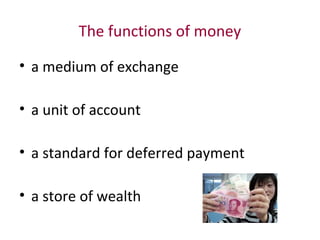
The functions of money
• a medium of exchange
• a unit of account
• a standard for deferred payment
• a store of wealth
57
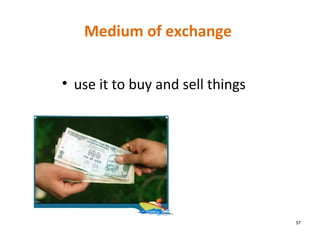
Medium of exchange
• use it to buy and sell things
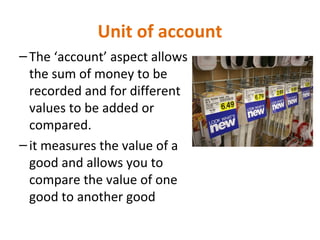
Unit of account
–The ‘account’ aspect allows
the sum of money to be
recorded and for different
values to be added or
compared.
–it measures the value of a
good and allows you to
compare the value of one
good to another good
59
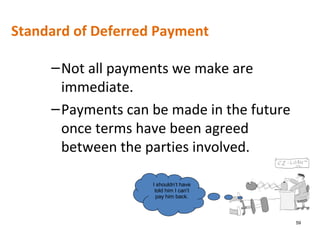
Standard of Deferred Payment
–Not all payments we make are
immediate.
–Payments can be made in the future
once terms have been agreed
between the parties involved.
I shouldn’t have
told him I can’t
pay him back.
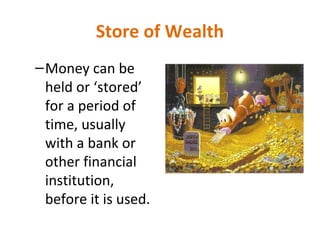
Store of Wealth
–Money can be
held or ‘stored’
for a period of
time, usually
with a bank or
other financial
institution,
before it is used.
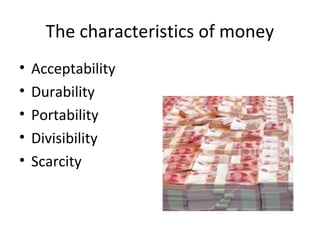
The characteristics of money
• Acceptability
• Durability
• Portability
• Divisibility
• Scarcity
Ceteris paribus
• This Latin phrase translates to –
“with other things the same” or
“all other things being equal or held constant.”
• If the price of beef increases —ceteris
paribus—the quantity of beef demanded
by buyers will decrease.
Intrinsic Value of Coins and Notes
• Intrinsic Value - The market value of the
constituent metal within a coin/ paper of a
currency.
• Intrinsic Value of Coins and Notes is very less
or No Value at all…..

As unit 1 tes

  • 1.
  • 2.
    • Scarcity, choice(opportunity cost) and resource allocation – Hence the BASIC ECONOMIC problem • Factors of Production • Production possibility curves – shapes and shifts • Decision making at the margin • Specialization and exchange • Division of labour • Different allocative mechanisms – Planned, Market & free and Problems of transition • Ceteris Paribus, Positive and normative statements • Money: functions and characteristics
  • 3.
    ECONOMICS – “OIKONOMOUS” oikos– household nomous– law/ rules; to manage resources “Management of Resources”
  • 4.
    * MicroEconomics -deals with individual units or groups * MacroEconomics - deals with nation or economy as a whole
  • 5.
  • 7.
    Economics is the Science ofCHOICE (decisions made by you and me, firms, government )
  • 8.
    • Hence scarcityforces us to make choice • And so Allocation of Resources
  • 9.
    Decision on allocationof resources, Leads to 3 major economic problem/ questions: •What to produce •How to produce •Whom to produce
  • 10.
    • WHAT TOPRODUCE • Food or Clothes • Cars or hospitals • ipods or Cosmetics or military strength Basic Economic Problem- 3 decisions
  • 11.
     techniques used. least cost method of production  labour intensive or capital intensive Basic Economic Problem- 3 decisions HOW TO PRODUCE
  • 12.
     Will everyoneget an equal share of what is produced ?  Would the income be distributed equally? Basic Economic Problem- 3 decisions for WHOM TO PRODUCE
  • 13.
    • Production: Creatinggoods and services • Consumption: Using the goods and services to satisfy want
  • 14.
    Basic Economic ProblemFactorsof Production (FOP)
  • 15.
  • 17.
    The Enterpreneur: - Organizesthe 3 factors and production process - Takes the risk (Profit and Loss)
  • 19.
    Enhancement of Production…. • Specialization •Exchange (Trade) • Division of Labour
  • 20.
    Specialization • Firms orIndividuals or Regions or Countries producing some goods and services which they are best producing at
  • 21.
    Exchange • No economycan be self dependent but they have to be interdependent • Trade and exchange of goods and services helps to resolve the problem of scarcity to a certain extent
  • 22.
    Division of labour •Adam Smith – division of labour represents a qualitative increase in productivity
  • 23.
    Production Possibility Curve(PPC) • Every decision has an opportunity cost – the cost in foregone opportunities. • The production possibilities curve shows the trade-offs among choices we make. • A production possibility curve is used to illustrate opportunity cost.
  • 24.
    • Opportunity Costis the highest-valued option forgone
  • 25.
    Eg 1 Going toHong Kong Disneyland • Ticket : Free of charge • Money spent on food, transport =$200 • Income forgone = $500 • Full cost of going for Disneyland (HK) =$700
  • 26.
    Eg 2 • Option1 going to a 1 hour concert and pays $200 for a ticket • Option 2 working in Park’n as a salesman earning $30 per hour • Option 3 working as a tutor earning $100 per hour • Full cost of attending the concert = price of ticket + income forgone (highest-valued option forgone) • Full cost of attending the concert = $200 + $100 = $300
  • 27.
    Sli de A = 24lbs of coffee B = 16 lbs of cofee & 4 units of computers C = 8 lbs of cofee and 8 Computers D = 12 units of Computer Coffee (lb/day) Computers (unit/day) A B C D 24 0 16 8 4 8 12 Cost of 4 computers= ? Another 4 Computers= ? Another 4 Computers = ? Hence Opportunity cost is same
  • 28.
    In our choicesof production, the opportunity cost may Remain Constant Increase Decrease
  • 29.
    Depending on ourchoices of Production, the opportunity cost may Remain Constant Increase Decrease
  • 30.
    Unit 1 :Macroeconomics National Council on Economic Education Constant O.C Decreasing O.C Increasing O.C
  • 31.
    PPC is alsocalled: • Production Possibility Frontier (PPF) – What you can and cannot produce • Product Transformation Curve –What will it cost you to produce the other good –When you produce something else, you have to reallocate resources – “Reallocation of Resources” –How easily you can reallocate – Factor Mobility
  • 32.
    A Typical PPF& PTC …………. Unattainable Inefficient Opportunity cost of is increasing…
  • 33.
  • 34.
    0 B A Butter Guns C Availibility of resources(Quantity and Quality) Increased Labour force Improved Technology Shift in PPC Economic Growth due to:
  • 35.
    Economic Decline….. Butter A B Guns0 C D Dueto Decline in resources Working population falls Shift in PPC
  • 36.
  • 37.
    • Consumer Goods Productspurchased by consumers for personal or household use. • Capital Goods Producers’ goods or means of production (Eg: Machines) Creating Captial goods  Investment
  • 38.
    • More Consumergoods  Higher standard of living • But if we do not have sufficient capital goods to produce consumer goods  In the future  Standard of living may fall • So a decision has to be made: “Whether to produce Consumer Goods or Capital Goods?”
  • 39.
    Decision making atthe margin K 100 200 300 400 500 600 700 800 900
  • 40.
    • If Capitalgoods are less than K  Economics Decline • If we produce more capital goods  In the future  Economic Growth
  • 41.
    • Developing Countries –Theyhave to increase their capital goods  so more resources are allocated capital goods  Low standard of living. –A minimum amount of resources  allocated for comsumer goods  survival of population –“Subsistence Level of Consumption”
  • 42.
    • In under-developedcountries or poorly developing countries……… –Most of resources are allocated for consumer goods for survival of population
  • 43.
    Economic structure • TheVarious Sectors in an Economy • Primary sector - agriculture, fishing and mining & oil extraction • Secondary sector– All Manufacturing activities. Eg: Food processing, textiles and clothing, iron and steel production, vehicle manufacturing and electronics. • Tertiary sector – service sector. Eg: retailing, transport, financial services, education, call centre services & information technology.
  • 44.
    Economic System • Economicsystem is used to describe the means or allocative mechanism by which its people, businesses and government make choices –The (free) market economy –The command/planned economy –Mixed economy
  • 45.
    The Characteristics ofMarket Economy • Freedom to buy what they want and sell what they make. • Private property • Changes in supply and demand control the prices (and hence what is made and sold) Adam Smith-invisible hand (the price system) • Self-interest • Little government interference (control national defence, act against monopolies, issue money, raise taxes and protect the rights of the private sector) • Market economy is an ideal which does not exist in today’s economy.
  • 46.
    Strengths ofStrengths of(Free) Market Economy(Free) Market Economy • Freedom exists for everyone involvedFreedom exists for everyone involved • Relatively small degree of governmentalRelatively small degree of governmental influenceinfluence • Variety of goods and services are producedVariety of goods and services are produced • High degree of consumer satisfactionHigh degree of consumer satisfaction
  • 47.
    Weaknesses of (Free)Market EconomyWeaknesses of (Free) Market Economy • The primary weakness is deciding for whom toThe primary weakness is deciding for whom to produceproduce • The young, sick and old would have difficultyThe young, sick and old would have difficulty in a free market environmentin a free market environment • Markets sometimes fails (some goods areMarkets sometimes fails (some goods are overproduction and underproduction or failoverproduction and underproduction or fail production)production)
  • 48.
    TheThe Characteristics ofCommand (planned)Command (planned) EconomyEconomy • The government makes all the key decisions and hasThe government makes all the key decisions and has complete control over all the resources of the country:complete control over all the resources of the country: • Public ownership of all propertyPublic ownership of all property • Centrally planned productionCentrally planned production • government dictates pricesgovernment dictates prices • Profit is not a factorProfit is not a factor –– the government produces what itthe government produces what it feels is in the national interestfeels is in the national interest
  • 49.
    TheThe Characteristics ofMixed EconomyMixed Economy • The government makes some general policyThe government makes some general policy decisionsdecisions • Mostly private but some public ownership ofMostly private but some public ownership of property. Govt also produces Merit Goods.property. Govt also produces Merit Goods. • In private industry profit is the driverIn private industry profit is the driver • Government intervention to solve theGovernment intervention to solve the problem caused by market failure.problem caused by market failure.
  • 50.
    Problems of transitionwhen central planning in an economy is reduced • Law and order • Merit goods • Public goods • Quality and standards • Inflation
  • 51.
    Positive economics/statement • Positivestatement is about “ what the world is.” Has a logic or reason……. • May be wrong!! • For example: • Inflation will increases the prices
  • 52.
    Normative economics/statement • “Iswhat you think the world should be”. • Involves your judgment or opinions, personal views, political beliefs and ethics • For example: • The government ought to introduce a ban on smoking in public places.
  • 53.
    Money • A simpledefinition is that money is anything that is regularly used to buy goods and services. • Normally, this is coins and notes but the definition also includes cheques, debit cards and credit cards. Oil/ Platinum/Gold
  • 54.
    Barter • The directexchange of one good or service for another in this way is known as Barter.
  • 55.
    Coincidence of wants •For Barter to happen, both parties in a transaction must have goods/ services that each other wants….. coincidence of wants • So money is “one such commodity” that everyone would be willing to accept in exchange for all other goods and services.
  • 56.
    The functions ofmoney • a medium of exchange • a unit of account • a standard for deferred payment • a store of wealth
  • 57.
    57 Medium of exchange •use it to buy and sell things
  • 58.
    Unit of account –The‘account’ aspect allows the sum of money to be recorded and for different values to be added or compared. –it measures the value of a good and allows you to compare the value of one good to another good
  • 59.
    59 Standard of DeferredPayment –Not all payments we make are immediate. –Payments can be made in the future once terms have been agreed between the parties involved. I shouldn’t have told him I can’t pay him back.
  • 60.
    Store of Wealth –Moneycan be held or ‘stored’ for a period of time, usually with a bank or other financial institution, before it is used.
  • 61.
    The characteristics ofmoney • Acceptability • Durability • Portability • Divisibility • Scarcity
  • 62.
    Ceteris paribus • ThisLatin phrase translates to – “with other things the same” or “all other things being equal or held constant.” • If the price of beef increases —ceteris paribus—the quantity of beef demanded by buyers will decrease.
  • 63.
    Intrinsic Value ofCoins and Notes • Intrinsic Value - The market value of the constituent metal within a coin/ paper of a currency. • Intrinsic Value of Coins and Notes is very less or No Value at all…..