



Economics

Chapter 1

Lecture 1
Economy. . .
. . . The word economy comes from a
Greek word for ―one who manages a
household.‖
Founder of economics
Adam smith is the founder economics (From 16
June 1723 – died 17 July 1790 ). He wrote a
very first book of economics named ―Wealth
of Nations”
Wealth of Nations: the first modern work of
economics. It earned him an enormous
reputation and would become one of the most
influential works on economics ever
published. Smith is widely cited as the father
of modern economics and capitalism.
Economics
Economics is the study of scarcity and
efficiency.
Economics is the study of how society
manages its scarce resources.
Economics is the study of how societies
use scarce resources to produce
commodities and distribute them among
different people.
Economics
Definition of economics "the science which
studies human behavior as a relationship
between ends and scarce means which
have alternative uses."
by Lionel Robbins
Microeconomics and Macroeconomics
 Microeconomics

focuses on the
individual parts of the economy.


How households and firms make
decisions and how they interact in
specific markets

 Macroeconomics

looks at the
economy as a whole.


How the markets, as a whole, interact at
the national level.
Microeconomics and
Macroeconomics
Microeconomics focuses on how decisions are
made by individuals and firms and the consequences
of those decisions.
Ex.:

How much it would cost for a university or
college to offer a new course ─ the cost of the
instructor’s salary, the classroom facilities, the
class materials, and so on.

Having determined the cost, the school can then
decide whether or not to offer the course by
weighing the costs and benefits.
Microeconomics and
Macroeconomics
Macroeconomics examines the aggregate
behavior of the economy (i.e. how the actions of all
the individuals and firms in the economy interact to
produce a particular level of economic performance
as a whole).
Ex.:

Overall level of prices in the economy (how
high or how low they are relative to prices last
year) rather than the price of a particular good or
service.
Scarcity . . .
. . . means that society has limited
resources and therefore cannot produce all
the goods and services people wish to
have.
Scarcity is the situation in which there is not
enough of something to satisfy all the
desires for that thing.
Efficiency
Economic efficiency describes how well a
system generates desired output with a
given set of inputs and available technology.

Efficiency is improved if more output is
generated without changing inputs, or in
other words, the amount of "waste" is
reduced.
Absence of waste.
Needs and Wants


A need is something that is necessary
for organisms to live a healthy life.



The idea of want can be examined from
many perspectives. In secular societies
want might be considered similar to the
emotion desire, which can be studied
scientifically through the disciplines of
psychology or sociology.
Resources
The basic resources that are available to
a society are factors of production:
◦ Natural resources
◦ Human resources

◦ Capital resources
◦ Time resources
Natural resources
It includes good fertile land , rivers ,
mountains, water fall, sunshine and things
that are inside the curst of the earth.
Human resources

All those able bodies, people who are able to
work and contribute to production. it is most
important factor to contributes’ to production
and in the growth of economy. Worker must
acquire education, skill and knowledge.
Capital resources
It includes machine, plants, tools, roads,
bridges and highways. it is also important
factor to contributes’ to production and in
the growth of economy.
Time resources
It is also very important resource, because
utilization of limited time to produce goods
and services to fulfill the needs and wants
of economic requirements.
Economic Problems


Human wants are unlimited, but
resources are not.



Three basic questions must be
answered in order to understand an
economic system:
◦ What to produced?

◦ How to produced?
◦ For whom to produced?
Economic Problems
What to produced?
What goods and services should be produce.
those goods and services are needed by the
economy.
How to produced?
Which resources are utilize (Land, labour, capital
& organization) to produced goods and
services these are required for economy
Economic Problems
For Whom to Produce?
Is production done for army or for producers or for
households. Goods( Guns and butter) and services
education) are required for military or society.
Economics

Chapter 1

Lecture 2
Inputs and Outputs
Resources or factors of production are
the inputs into the process of
production; goods and services of value
to households are the outputs of the
process of production or the result of
any process which you working for.
 Inputs: it can primary such as land and
labour and it can be secondary such as
capital and managerial skill
(entrepreneurial skills).

Capital formation and creation process
Capital formation means creation of new
capital assets.
Process
Saving: that part of an individual income
which is not spent on consumption.
Banks: are financial institutes which accept
deposit and lend it out to entrepreneurs
for production purpose as a loan. They
work for profit it is deference b/w interest
paid to depositor and receive form debtor
Capital formation and creation process
Money: is liquid assets. Money is
lubricant it helps in production. it is
medium of exchange.

Investment is the process of using
resources to produce new capital.
Capital is the accumulation of previous
investment.
Opportunity cost & Trade off
Opportunity cost is that which we give up
or forgo, when we make a decision or a
choice.
 Opportunity cost means the next best
alternative sacrifice. Resources are scarce
so we give up or forgo one and take other
goods or services.
 Trade off means choosing more of one
thing and given up other thing.

Capital Goods and Consumer Goods


Capital goods are goods used to
produce other goods and services.



Consumer goods are goods produced
for present consumption.
Market and its Kinds
A market in economics means settlement of
transaction b/w buyers and sellers. Market
is the institution/place through which
buyers and sellers interact and engage in
exchange.
Market target allocation of scarce resources
in an appropriate and economical manner.

Kinds



Market for goods
Market for services
Economic Systems
Economic systems are the basic
arrangements made by societies to
solve the economic problem.
They include:


◦ Command economies
◦ Laissez-faire economies

◦ Mixed systems
◦ Islamic system
Command economy
In a command economy or Socialism, a
central government either directly or
indirectly sets output targets, incomes,
and prices. All decisions of what, how
and for whom to produce are taken by
state.
Laissez-faire economy or Capitalism
In a laissez-faire economy or capitalism
individuals and firms pursue their own
self-interests without any central
direction or regulation. All decisions of
what, how and for whom to produce are
taken by them self.
Mixed Systems,
Markets, and Governments
Where both government and private sector
are contribute in market.
Since markets are not perfect, governments
intervene and often play a major role in the
economy. Some of the goals of government
are to:
 Minimize market inefficiencies
 Provide public goods
 Redistribute income
The Production Possibility Frontier
With the given resources (land,
labour, capital and organization) &
technology of a country the
maximum amount of output it can
produce is known as production
possibility frontier (ppf)
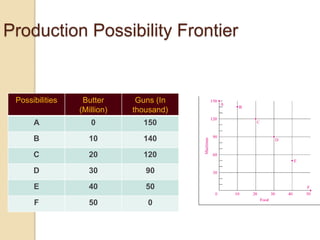
The production possibility frontier (ppf)
is a graph that shows all of the
combinations of goods and services
that can be produced if all of
society’s resources are used
efficiently.
Production Possibility Frontier

Possibilities

Butter
(Million)

Guns (In
thousand)

A

0

150

B

10

140

C

20

120

D

30

90

E

40

50

F

50

0
Production Possibility Frontier




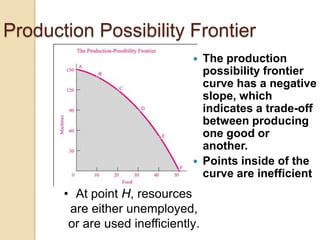
• At point H, resources
are either unemployed,
or are used inefficiently.

The production
possibility frontier
curve has a negative
slope, which
indicates a trade-off
between producing
one good or
another.
Points inside of the
curve are inefficient
Production Possibility Frontier
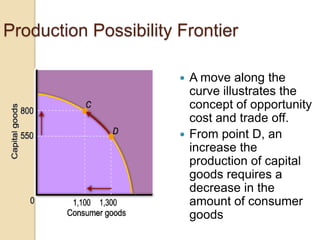
A move along the
curve illustrates the
concept of opportunity
cost and trade off.
 From point D, an
increase the
production of capital
goods requires a
decrease in the
amount of consumer
goods

Production Possibility Frontier




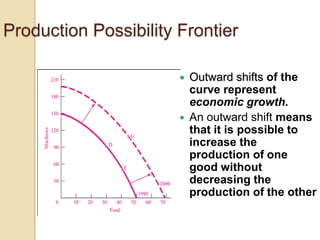
Outward shifts of the
curve represent
economic growth.
An outward shift means
that it is possible to
increase the
production of one
good without
decreasing the
production of the other
Division of labour
Division of labour: means the splitting up
of the process of production into sub
processes. The complete task of product
making is not perform by an individual
but by the group of workers taken up a
certain parts of production. it is also
known as specialization. Concept of
division of labour is given by Adam Smith,
he explain with the example of pin
making factory
Demand & Supply

Chapter 3

Lecture 3
Consumer Demand
Demand in economics means that desire
which is backed by ability to buy and
willingness to buy.


Ability + willingness = demand
Law of Demand
―Other things remains the same ‖ a fall in
price is accompanied by an increase in
quantity demanded and conversely a rise
in price is followed by fall in quantity
demanded.
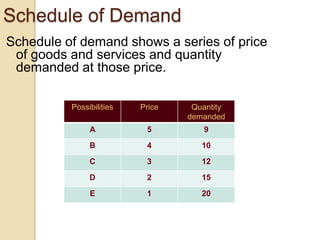
Schedule of Demand
Schedule of demand shows a series of price
of goods and services and quantity
demanded at those price.
Possibilities

Price

Quantity
demanded

A

5

9

B

4

10

C

3

12

D

2

15

E

1

20
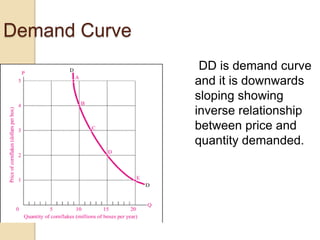
Demand Curve
DD is demand curve
and it is downwards
sloping showing
inverse relationship
between price and
quantity demanded.
Determinants of Demand
Consumer income
 Size of population
 Prices of related goods
 Tastes
 Expectations

Determinants of Demand
Consumer income
Consumer income is major factor that
influence demand, if increase in income
that will increase the demand and vise
versa.
 Increase in income better off
 Decrease in income worse off
Determinants of Demand
Size of population
The size of market is affect demand. the
demand of goods & services in big
market( china) is very large and the
demand of goods & services in small
market (Pakistan) is low.
Determinants of Demand
Substitutes & Complements


When a fall in the price of one good
(Coffee) reduces the demand for
another good (tea), the two goods
are called substitutes.
 When a fall in the price of one good
(milk) increases the demand for
another good (tea), the two goods
are called complements.
Determinants of Demand
Taste
Taste is also important factor that
influence demand reflection of many factor
both physical and psychological that
increase/decrease demand.
Determinants of Demand
Special influences






Climatically change
Religious occasion
Cultural occasion
Other events
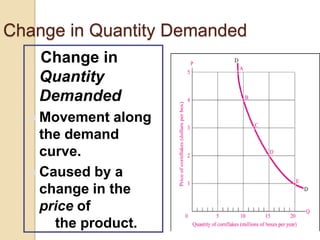
Change in Quantity Demanded
Change in
Quantity
Demanded
 Movement

along
the demand
curve.
 Caused by a
change in the
price of
the product.
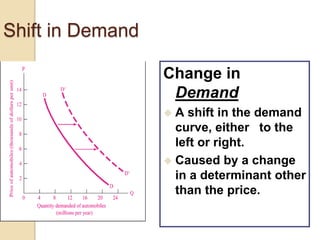
Shift in Demand
Change in
Demand
A shift in the demand
curve, either to the
left or right.
 Caused by a change
in a determinant other
than the price.

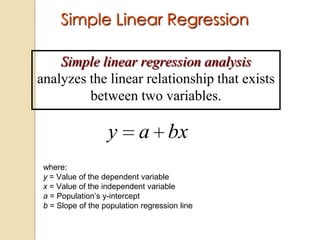
Simple Linear Regression
Simple linear regression analysis
analyzes the linear relationship that exists
between two variables.

y

a bx

where:
y = Value of the dependent variable
x = Value of the independent variable
a = Population’s y-intercept
b = Slope of the population regression line
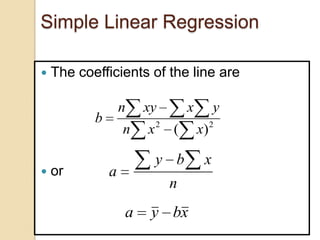
Simple Linear Regression


The coefficients of the line are

n

b



or

n

xy
x

2

x
(

y b

a

n

a

y bx

y
x)

2

x
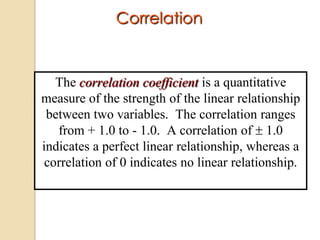
Correlation

The correlation coefficient is a quantitative
measure of the strength of the linear relationship
between two variables. The correlation ranges
from + 1.0 to - 1.0. A correlation of 1.0
indicates a perfect linear relationship, whereas a
correlation of 0 indicates no linear relationship.
An algebraic formula for correlation
coefficient

n

r
[ n(

2

x ) (

xy

x
2

x) ][ n(

y
2

y ) (

2

y) ]
Demand forecasting
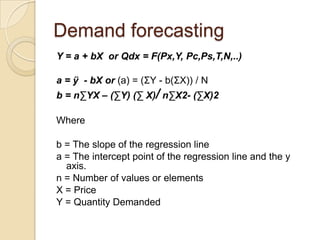
Y = a + bX or Qdx = F(Px,Y, Pc,Ps,T,N,..)

a = ÿ - bX or (a) = (ΣY - b(ΣX)) / N
b = n∑YX – (∑Y) (∑ X)/ n∑X2- (∑X)2
Where
b = The slope of the regression line
a = The intercept point of the regression line and the y
axis.
n = Number of values or elements
X = Price
Y = Quantity Demanded
Demand forecasting
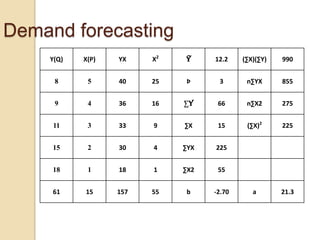
Y(Q)

X(P)

YX

X2

ÿ

12.2

(∑X)(∑Y)

990

8

5

40

25

Þ

3

n∑YX

855

9

4

36

16

∑Y

66

n∑X2

275

11

3

33

9

∑X

15

(∑X)2

225

15

2

30

4

∑YX

225

18

1

18

1

∑X2

55

61

15

157

55

b

-2.70

a

21.3
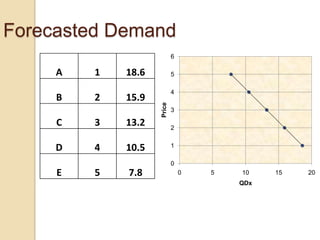
Forecasted Demand
6

B

1
2

18.6
15.9

C

3

13.2

D

4

10.5

5
4
Price

A

3
2
1
0

E

5

7.8

0

5

10
QDx

15

20
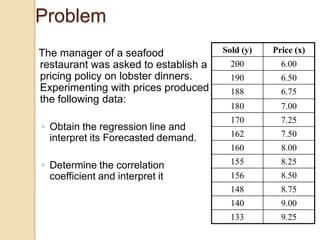
Problem

◦ Obtain the regression line and
interpret its Forecasted demand.

◦ Determine the correlation
coefficient and interpret it

Sold (y)

Price (x)

200

6.00

190

6.50

188

6.75

180

7.00

170

7.25

162

7.50

160

The manager of a seafood
restaurant was asked to establish a
pricing policy on lobster dinners.
Experimenting with prices produced
the following data:

8.00

155

8.25

156

8.50

148

8.75

140

9.00

133

9.25
Demand & Supply

Chapter 3

Lecture 4
Supply and Stock
Supply in economics means the amount of
commodity offered for sale in the market at certain
period of time and at certain price.
Stock means the amount of commodity which is
ready for sale but not offered for sale in the market
and kept back in warehouse.
Durable good have distinction b/w supply and stock.
Non Durable good (perishable)have no distinction
b/w supply and stock.
Law of Supply
―Other things remains the same ‖ a fall in
price is accompanied by an decrease in
quantity Supplied and conversely a rise in
price is fallowed by increase in quantity
Supplied.
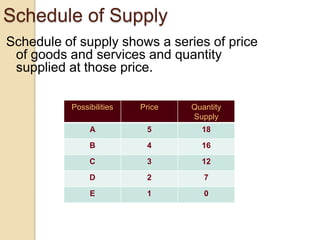
Schedule of Supply
Schedule of supply shows a series of price
of goods and services and quantity
supplied at those price.
Possibilities

Price

Quantity
Supply

A

5

18

B

4

16

C

3

12

D

2

7

E

1

0
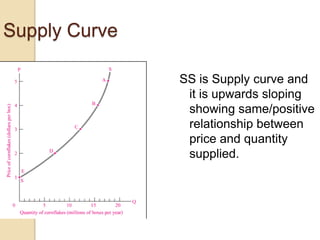
Supply Curve
SS is Supply curve and
it is upwards sloping
showing same/positive
relationship between
price and quantity
supplied.
Determinants of Supply
 Price

of Inputs
 Availability of Inputs
 Technology
 Government policies
 Expectations
Determinants of Supply
Price and Availability of Inputs
Price of Inputs if the price are lowered then
supply will increase and vise versa (e.g.
oil)

Availability of Inputs if inputs are easily
available in market subsequently supply
will increase and vise versa.
Determinants of Supply
Technology
Technology is very essential factor for
influencing supply if latest technology is
use for production supply will increase and
vise versa
Determinants of Supply
Government policies
If government imposes the taxes on inputs
that will lead to decline in supply and if
government reduces the taxes on inputs
afterward supply will increase.
Determinants of Supply Special
influences
Climatically change
 Religious occasion
 Cultural occasion
 Other events

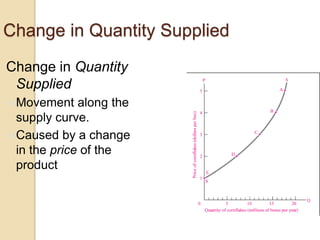
Change in Quantity Supplied
Change in Quantity
Supplied
Movement

along the
supply curve.
Caused by a change
in the price of the
product
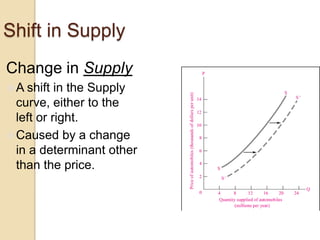
Shift in Supply
Change in Supply
A shift

in the Supply
curve, either to the
left or right.
Caused by a change
in a determinant other
than the price.
Equilibrium
Equilibrium in economics we understand a
state of balance or on interaction between
two opposite forces working in the
opposite direction settle at one point that
is equilibrium price. The term price
equilibrium is market price.
Schedule of Equilibrium
Possibilities

Price

Quantity
demanded

Quantity
supplied

State of the
market

A

5

9

18

Surplus 9mn

B

4

10

16

Surplus 6mn

C

3

12

12

Equilibrium

D

2

15

7

Scarcity
8mn

E

1

20

0

Scarcity
20mn
Equilibrium
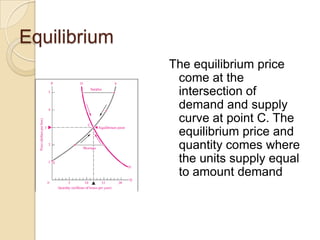
The equilibrium price
come at the
intersection of
demand and supply
curve at point C. The
equilibrium price and
quantity comes where
the units supply equal
to amount demand
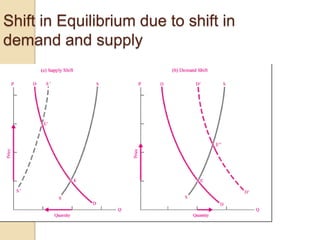
Shift in Equilibrium due to shift in
demand and supply
Elasticity and Its
Application

Chapter 4

Lecture 5
Elasticity . . .
… is a measure of how much buyers
and sellers respond to changes in market
conditions
 … allows us to analyze supply and
demand with greater accuracy.

Price Elasticity of Demand
Price

elasticity of demand is the percentage
change in quantity demanded given a
percent change in the price.

It

is a measure of how much the quantity
demanded of a good responds to a change
in the price of that good.

Responsiveness

of quantity demand due to
change in price is known as elasticity of
demand.
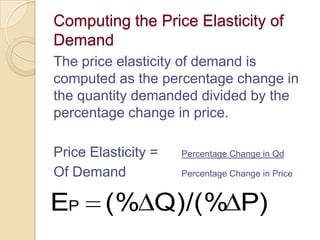
Computing the Price Elasticity of
Demand
The price elasticity of demand is
computed as the percentage change in
the quantity demanded divided by the
percentage change in price.
Price Elasticity =
Of Demand

EP

Percentage Change in Qd
Percentage Change in Price

(% Q)/(% P)
Elasticity, Percentage Change and
Slope
Because the price elasticity of
demand measures how much
quantity demanded responds to
the price, it is closely related to
the slope of the demand curve.
But instead of looking at unit
change, elasticity looks at
percentage change. What do we
mean by percentage change?
Brief Assessment on
Percentages
If there are 50 tomatoes in a store and you
picked 16 of them, what percentage of the
total did you pick?
 Paul used to weigh 200 lbs last year, but
now he only weighs 175 lbs. How many lbs
did he lose? What is the percent change of
the loss?
 What is the average of 300 and 330? What
is the midpoint?

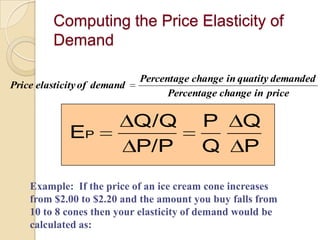
Computing the Price Elasticity of
Demand
Price elasticity of demand

EP

Percentage change in quatity demanded
Percentage change in price

Q/Q
P/P

P
Q

Q
P

Example: If the price of an ice cream cone increases
from $2.00 to $2.20 and the amount you buy falls from
10 to 8 cones then your elasticity of demand would be
calculated as:
Types of Elasticity


Price elasticity



Income elasticity



Cross elasticity
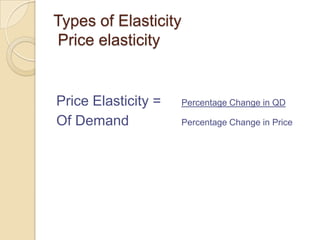
Types of Elasticity
Price elasticity

Price Elasticity =
Of Demand

Percentage Change in QD
Percentage Change in Price
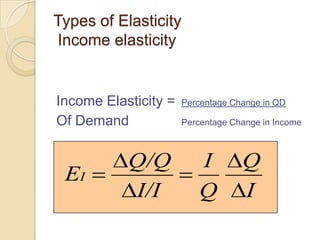
Income Elasticity of Demand
Income

elasticity of demand
measures how much the quantity
demanded of a good responds to a
change in consumers’ income.
It is computed as the percentage
change in the quantity demanded
divided by the percentage change in
income.
Types of Elasticity
Income elasticity

Income Elasticity =
Of Demand

EI

Q/Q
I/I

Percentage Change in QD
Percentage Change in Income

I
Q

Q
I
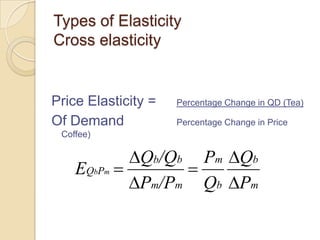
Cross Price Elasticity of Demand
Elasticity measure that looks at the
impact a change in the price of one
good has on the demand of another
good.
 % change in demand Q1/% change in
price of Q2.
 Positive-Substitutes
 Negative-Complements.

Types of Elasticity
Cross elasticity

Price Elasticity =
Of Demand

Percentage Change in QD (Tea)
Percentage Change in Price

Coffee)

EQbPm

Qb/Qb
Pm/Pm

P m Qb
Qb P m
Ranges of Elasticity
Inelastic Demand
Percentage

change in price is greater than
percentage change in quantity demand.
Price elasticity of demand is less than one.

Elastic Demand
Percentage

change in quantity demand is
greater than percentage change in price.
Price elasticity of demand is greater than one.
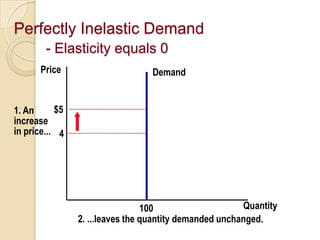
Perfectly Inelastic Demand
- Elasticity equals 0
Price

Demand

$5
1. An
increase
in price... 4

Quantity
100
2. ...leaves the quantity demanded unchanged.
Perfectly Elastic Demand
- Elasticity equals infinity
Price
1. At any price
above $4, quantity
demanded is zero.

Demand

$4
2. At exactly $4,
consumers will
buy any quantity.
3. At a price below $4,
quantity demanded is infinite.

Quantity
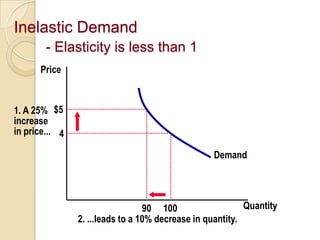
Inelastic Demand
- Elasticity is less than 1
Price

1. A 25% $5
increase
in price... 4
Demand

Quantity
90 100
2. ...leads to a 10% decrease in quantity.
Unit Elastic Demand
- Elasticity equals 1
Price

1. A 25% $5
increase
in price... 4
Demand

Quantity
75
100
2. ...leads to a 25% decrease in quantity.
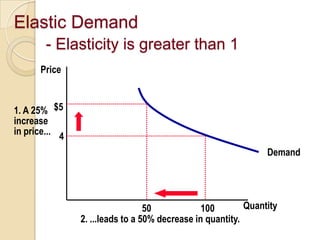
Elastic Demand
- Elasticity is greater than 1
Price

1. A 25% $5
increase
in price... 4
Demand

Quantity
50
100
2. ...leads to a 50% decrease in quantity.
Determinants of
Price Elasticity of Demand


Necessities versus Luxuries



Availability of Close Substitutes



Definition of the Market



Time Horizon
Determinants of Price Elasticity
of Demand


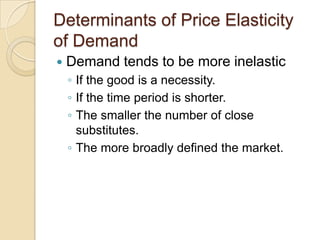
Demand tends to be more inelastic
◦ If the good is a necessity.
◦ If the time period is shorter.
◦ The smaller the number of close
substitutes.
◦ The more broadly defined the market.
Determinants of
Price Elasticity of Demand
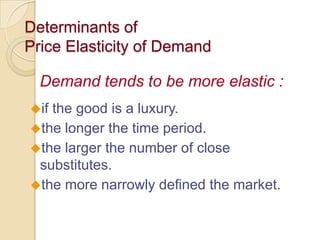
Demand tends to be more elastic :
if

the good is a luxury.
the longer the time period.
the larger the number of close
substitutes.
the more narrowly defined the market.
Method Measuring Elasticity Total
Revenue
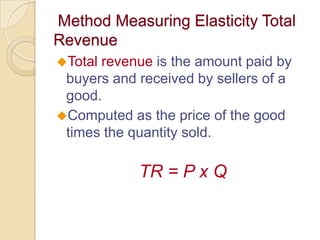
Total

revenue is the amount paid by
buyers and received by sellers of a
good.
Computed as the price of the good
times the quantity sold.

TR = P x Q
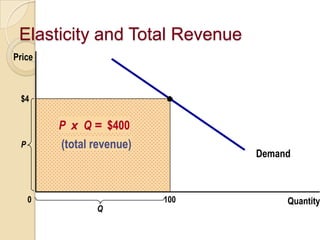
Elasticity and Total Revenue
Price

$4

P x Q = $400
(total revenue)

P

0

Q

Demand

100

Quantity
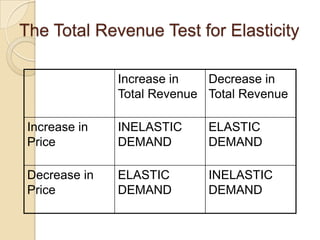
The Total Revenue Test for Elasticity
Increase in
Decrease in
Total Revenue Total Revenue
Increase in
Price

INELASTIC
DEMAND

ELASTIC
DEMAND

Decrease in
Price

ELASTIC
DEMAND

INELASTIC
DEMAND
Method Measuring Elasticity the
Average Formula
The Average (midpoint formula) is preferable when
calculating the price elasticity of demand because it
gives the same answer regardless of the direction of
the change.

(Q2 Q1 )/[(Q2 Q1 )/2]
Price Elasticity of Demand =
(P2 P1 )/[(P2 P1 )/2]
Method Measuring Elasticity the
Average Formula
(Q 2 Q1 )/[(Q 2 Q1 )/2]
Price Elasticity of Demand =
(P2 P1 )/[(P2 P1 )/2]
Example: If the price of an ice cream cone increases
from $2.00 to $2.20 and the amount you buy falls from
10 to 8 cones the your elasticity of demand, using the
midpoint formula, would be calculated as:
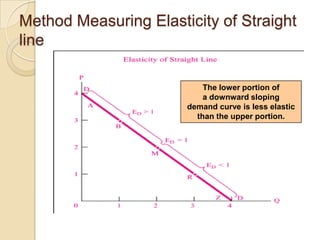
Method Measuring Elasticity of Straight
line
The lower portion of
a downward sloping
demand curve is less elastic
than the upper portion.
Importance of Price Elasticity of
Demand
Profit maximization requires that business
set a price that will maximize the firm’s
profit
 Elasticity tells the firm how much control it
has over using price to raise profit
 If e > 1, then the % Change in QD > %
Change is Price and demand is said to be
elastic


• An increase in price will reduce total revenue
• A decrease in price will increase total revenue
Importance of Price Elasticity of
Demand


If e < 1, then the % change in QD < %
change in price, and demand is said to be
inelastic
• An increase in price will increase total revenue
• A decrease in price will decrease total revenue

 If e = 1, then the % change in QD = %
change in Price, and demand is said to be
unit elastic
• An increase in price will have no impact on total
revenue
• A decrease in price will have no impact on total
revenue
Computing the Price Elasticity of
Supply
The price elasticity of supply is
computed as the percentage change in
the quantity Supplied divided by the
percentage change in price.
Price Elasticity =
Of Supply

Percentage Change in QS
Percentage Change in Price
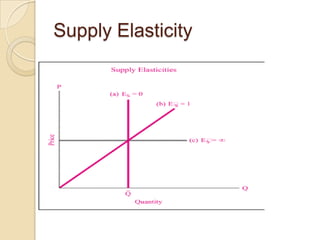
Supply Elasticity
Utility

Chapter 5

Lecture 6
Utility
• The value a consumer places on a unit of a good or
service depends on the pleasure or satisfaction he
or she expects to derive form having or consuming
it at the point of making a consumption (consumer)
choice.
• In economics the satisfaction or pleasure
consumers derive from the consumption of
consumer goods is called “utility”.
• Consumers, however, cannot have every thing they
wish to have. Consumers’ choices are constrained
by their incomes.
•

[

• Within the limits of their incomes, consumers make
their consumption choices by evaluating and
comparing consumer goods with regard to their
“utilities.”
Total Utility versus Marginal Utility
• Marginal utility is the utility a consumer
derives from the last unit of a consumer
good she or he consumes (during a
given consumption period), ceteris
paribus.

• Total utility is the total utility a consumer
derives from the consumption of all of
the units of a good or a combination of
goods over a given consumption
period, ceteris paribus.
Total utility = Sum of marginal utilities
The Law of Diminishing Marginal
Utility
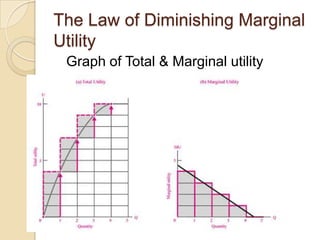
The law of diminishing marginal utility state that: as
the amount of a good consumed increase, the
marginal utility of that good tends to diminish. We
can illustrate this law numerically.
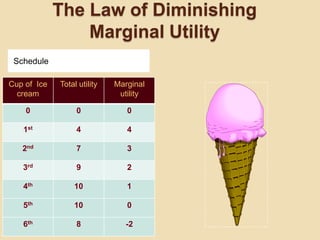
We can take an example of cup of ice cream give to
our consumer without any interval or break then
we will see that marginal utility will be diminish.
If he consume more and more of a good its
marginal utility tends to decline. While its total
utility keeps an increasing but at slower and
slower rate.
The Law of Diminishing Marginal
Utility


Over a given consumption period, the
more of a good a consumer has, or has
consumed, the less marginal utility an
additional unit contributes to his or her
overall satisfaction (total utility).



Alternatively, we could say: over a given
consumption period, as more and more of
a good is consumed by a consumer,
beyond a certain point, the marginal utility
of additional units begins to fall.
The Law of Diminishing
Marginal Utility
Schedule
Cup of Ice
cream

Total utility

Marginal
utility

0

0

0

1st

4

4

2nd

7

3

3rd

9

2

4th

10

1

5th

10

0

6th

8

-2
The Law of Diminishing Marginal
Utility
Graph of Total & Marginal utility
Law of Equi-Marginal Utility
Assumptions
Our consumer is rational person.
 His aim is to maximize his satisfaction.
 Money is limited & price are given and he has
to accept the prices.
 Marginal utility of money is constant.
 Our consumer is facing the law of diminishing
marginal utility in each direction of purchase.
 He will arrange his purchases in order of its
importance

Law of Equi-Marginal Utility


The fundamental condition of maximum
satisfaction or utility is the equi-marginal
principles, it state that ―a consumer having
a fixed income and facing given market
prices of goods will achieve maximum
satisfaction or utility when the marginal
utility of the last dollar spend on each
good is exactly the same as the marginal
utility of the last dollar spent on the any
other good‖.
LAW OF EQUIMARGINAL UTILITY
Marginal
utility of
money

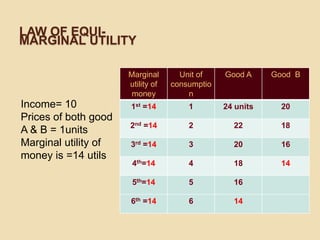
Income= 10
Prices of both good
A & B = 1units
Marginal utility of
money is =14 utils

Unit of
consumptio
n

Good A

Good B

1st =14

1

24 units

20

2nd =14

2

22

18

3rd =14

3

20

16

4th=14

4

18

14

5th=14

5

16

6th =14

6

14
Law of Equi-Marginal Utility
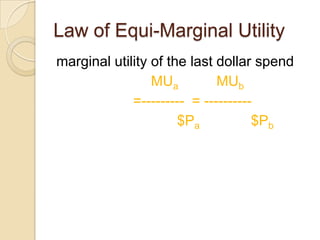
marginal utility of the last dollar spend
MUa
MUb
=--------- = ---------$Pa
$Pb
Indifference Analysis
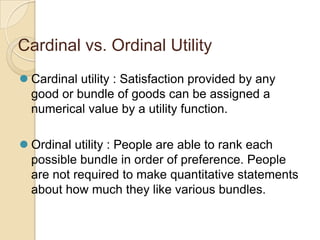
Cardinal vs. Ordinal Utility
 Cardinal utility : Satisfaction provided by any
good or bundle of goods can be assigned a
numerical value by a utility function.

 Ordinal utility : People are able to rank each
possible bundle in order of preference. People
are not required to make quantitative statements
about how much they like various bundles.
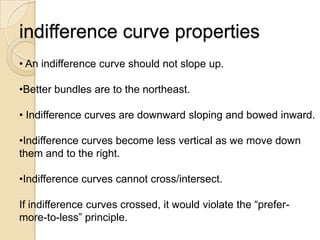
indifference curve properties
• An indifference curve should not slope up.
•Better bundles are to the northeast.
• Indifference curves are downward sloping and bowed inward.
•Indifference curves become less vertical as we move down
them and to the right.
•Indifference curves cannot cross/intersect.
If indifference curves crossed, it would violate the ―prefermore-to-less‖ principle.
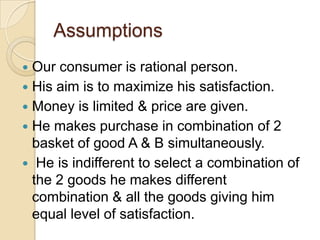
Assumptions
Our consumer is rational person.
 His aim is to maximize his satisfaction.
 Money is limited & price are given.
 He makes purchase in combination of 2
basket of good A & B simultaneously.
 He is indifferent to select a combination of
the 2 goods he makes different
combination & all the goods giving him
equal level of satisfaction.

Indifference Curve


Indifference curve – that is a tool of
which shows different combinations of
two goods given to consumer same
level of satisfaction or a curve that
shows combinations of two goods
among which an individual is
indifferent.



The slope of the indifference curve is
the ratio of marginal utilities of the two
goods.
Indifference Curve


The absolute value of the slope of an
indifference curve is called the
marginal rate of substitution.
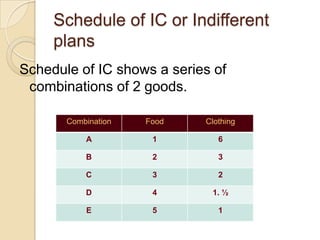
Schedule of IC or Indifferent
plans
Schedule of IC shows a series of
combinations of 2 goods.
Combination

Food

Clothing

A

1

6

B

2

3

C

3

2

D

4

1. ½

E

5

1
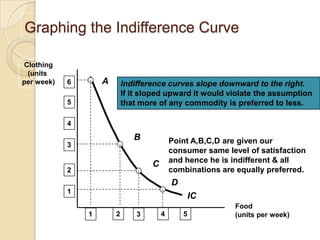
Graphing the Indifference Curve
Clothing
(units
per week)

A

6

Indifference curves slope downward to the right.
If it sloped upward it would violate the assumption
that more of any commodity is preferred to less.

5
4

B

Point A,B,C,D are given our
consumer same level of satisfaction
and hence he is indifferent & all
combinations are equally preferred.

3

C

2

D
1

IC
1

2

3

4

5

Food
(units per week)
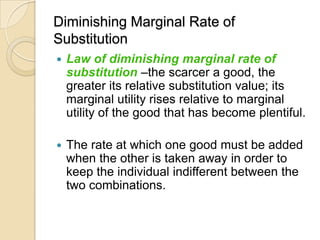
Diminishing Marginal Rate of
Substitution


Law of diminishing marginal rate of
substitution –the scarcer a good, the
greater its relative substitution value; its
marginal utility rises relative to marginal
utility of the good that has become plentiful.



The rate at which one good must be added
when the other is taken away in order to
keep the individual indifferent between the
two combinations.
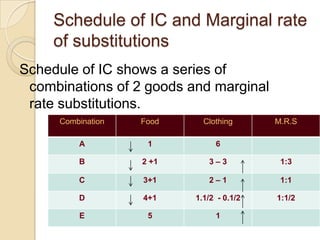
Schedule of IC and Marginal rate
of substitutions
Schedule of IC shows a series of
combinations of 2 goods and marginal
rate substitutions.
Combination

Food

Clothing

M.R.S

A

1

6

B

2 +1

3–3

1:3

C

3+1

2–1

1:1

D

4+1

1.1/2 - 0.1/2

1:1/2

E

5

1
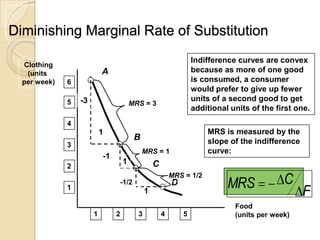
Diminishing Marginal Rate of Substitution
Clothing
(units
per week)

Indifference curves are convex
because as more of one good
is consumed, a consumer
would prefer to give up fewer
units of a second good to get
additional units of the first one.

A
6
5

-3

MRS = 3

4

1

MRS is measured by the
slope of the indifference
curve:

B

3

MRS = 1

-1

1

2

C
MRS = 1/2

D

-1/2

1

1
1

2

3

4

5

MRS

C

Food
(units per week)

F
A Group of Indifference Curves


Consumer’s will have a whole group of
indifference curves, each representing a
different level of satisfaction.



If he/she prefers more to less, Consumer
is better off with the indifference curve that
is extreme to the right.
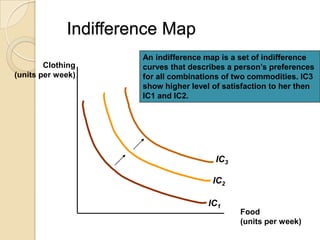
Indifference Map
Clothing
(units per week)

An indifference map is a set of indifference
curves that describes a person’s preferences
for all combinations of two commodities. IC3
show higher level of satisfaction to her then
IC1 and IC2.

IC3
IC2
IC1

Food
(units per week)
Consumer’s Choice
Consumer buy clothing and foods.
 She/he wants to maximize her/his
utility given a budget constraint.

What is a Budget Constraint?


A budget constraint shows the consumer’s
purchase opportunities as every
combination of two goods that can be
bought at given prices using a given
amount of income.
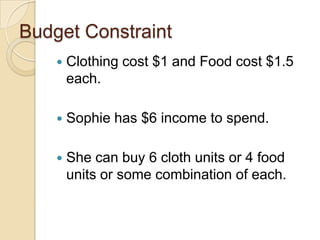
Budget Constraint


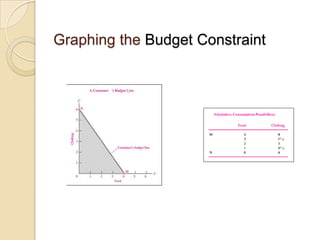
Clothing cost $1 and Food cost $1.5
each.



Sophie has $6 income to spend.



She can buy 6 cloth units or 4 food
units or some combination of each.
Graphing the Budget Constraint
Budget Constraint


The slope of the budget constraint is
the ratio of the prices of the two
goods.

The slope changes when the prices or
income change.
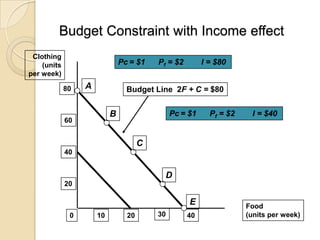
Budget Constraint with Income effect
Clothing
(units
per week)

Pc = $1
80

A

Pf = $2

I = $80

Budget Line 2F + C = $80

B

60

Pc = $1

Pf = $2

I = $40

C
40

D
20

E
0

10

20

30

40

Food
(units per week)
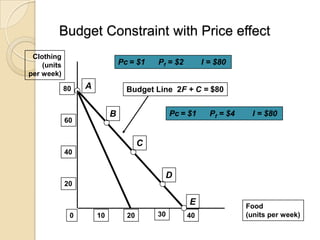
Budget Constraint with Price effect
Clothing
(units
per week)

Pc = $1
80

A

Pf = $2

I = $80

Budget Line 2F + C = $80

B

60

Pc = $1

Pf = $4

I = $80

C
40

D
20

E
0

10

20

30

40

Food
(units per week)
Indifference Curves Equilibrium


Sophie will maximize her satisfaction
by consuming on the highest
indifference curve as possible, given
her budget constraint.



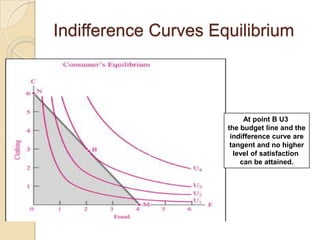
The best combination is the point
where the indifference curve and the
budget line are tangent and that point
shows equilibrium of consumer.
Indifference Curves Equilibrium


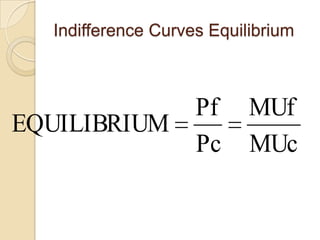
The best combination is the point
where the slope of the budget
line/price ratio equals the slope of the
indifference curve/MRS of two goods.
Indifference Curves Equilibrium

E

At point B U3
the budget line and the
indifference curve are
tangent and no higher
level of satisfaction
can be attained.
Indifference Curves Equilibrium

EQUILIBRIUM

Pf
Pc

MUf
MUc
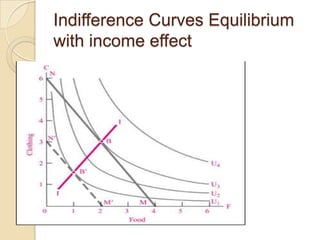
Changes in Income
• An increase in income will cause the
budget constraint out in a parallel
fashion
• Since px/py does not change, the MRS
will stay constant as the worker moves
to higher levels of satisfaction
Indifference Curves Equilibrium
with income effect
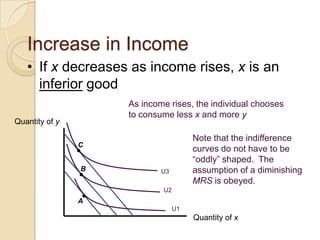
Increase in Income
• If x decreases as income rises, x is an
inferior good
As income rises, the individual chooses
to consume less x and more y

Quantity of y

Note that the indifference
curves do not have to be
―oddly‖ shaped. The
assumption of a diminishing
MRS is obeyed.

C
B

U3
U2

A
U1

Quantity of x
Changes in a Good’s Price
• A change in the price of a good alters
the slope of the budget constraint
– it also changes the MRS at the consumer’s
utility-maximizing choices

• When the price changes, two effects
come into play
– substitution effect
– income effect
Changes in a Good’s Price
• Even if the individual remained on the same
indifference curve when the price
changes, his optimal choice will change
because the MRS must equal the new price
ratio
– the substitution effect

• The price change alters the individual’s
―real‖ income and therefore he must move
to a new indifference curve
– the income effect
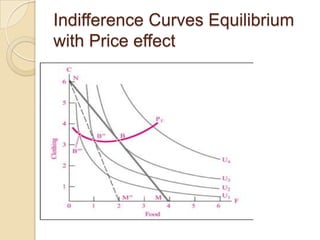
Indifference Curves Equilibrium
with Price effect
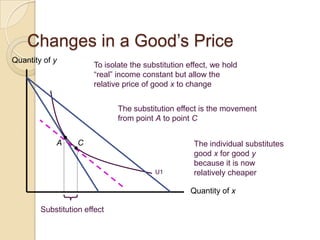
Changes in a Good’s Price
Quantity of y

To isolate the substitution effect, we hold
―real‖ income constant but allow the
relative price of good x to change
The substitution effect is the movement
from point A to point C

A

C

U1

The individual substitutes
good x for good y
because it is now
relatively cheaper
Quantity of x

Substitution effect
Production

Chapter 6

Lecture 10
Production Function
• 1. Production - short run
– Productive efficiency
– The Law of diminishing marginal returns

• 2. Production - long run
– isoquants & isocosts
– least cost method of production
Production
By production in economics we
understands the creations of utility.
Utility can be created in three ways.
Form utility: can be created by changing
the shape of the matter & performing an
act of production (e.g. log of wood).
2. Place utility: the worker creates utility by
changing the place of that matter (e.g.
Coal miner).
1.
Production
3. Time utility: can be created by taking
the product over long period of time
(e.g. crops is harvested, preservation
of grains).
Productivity


Productivity is a measure of the
efficiency of production. Productivity is
a ratio of what is produced to what is
required to produce it. Usually this
ratio is in the form of an average,
expressing the total output divided by
the total input. Productivity is a
measure of output from a production
process, per unit of input.
Productive capacity
Productive capacity: in economy is
determent by the size & quality of labor
force.

By Quality & quantity capital stock(FOPs)
 By nation technical knowledge
 The ability to use the knowledge
 The nature of public & private institutions

Production Function
Production Function: means the
relationship b/w amount of input
required to the amount of output that
can be obtained is called Production
Function. To explain it further we can
say that for given state of engineers &
scientific/ technological knowledge of
production function significance the
maximum amount of that can be
produce with quality of inputs.
Production Function
e.g. the task of ditch digging is perform in
USA where large & expensive tractor is
driven by person along with supervisor the
ditch which is 50ft length & 5ft in depth
can be dough in 2 hours.
Where as the same task is performed in
China where 50 worker with one hand
pickle complete the task in one whole day.
In USA the task is capital intensive & where
as in China the task is labour intensive.
Total, Average and Marginal
Product
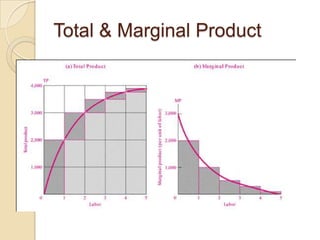
Total product means the total amount
of output produce in physical term like
bushel of wheat/ dozens of boat.
 Average product means total product
divided by number of product.
 Marginal Product means input is the
extra output produce by one addition
units of input while other input are
constant.

Total, Average and Marginal
Product
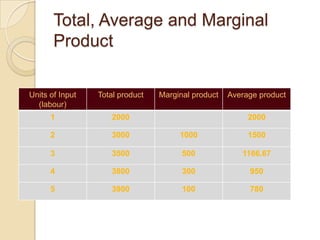
Units of Input
(labour)

Total product

Marginal product

Average product

1

2000

2

3000

1000

1500

3

3500

500

1166.67

4

3800

300

950

5

3900

100

780

2000
Total & Marginal Product
Law of Diminishing Marginal
Returns
This is basic law of production
according this law we get less & less
of extra output. When we will add
additional dozen of input while other
inputs held/remain constant. In other
word the marginal product of each
units of input will declines as the
amount of that input increase, holding
other all inputs remain constant.
Law of Diminishing Marginal
Returns


The L of D.M.R express a very basic
relationship as more & more labour is
add to fixed area of land, machine &
other input the labour has less & less
of other factor to work with. Marginal
product falls because the land get
crowded, the machine is over work so
the marginal product of labour
declines
Law of Increasing Marginal Returns
operate in case of manufacturing
industry because machine are control
by man, he may use better technology
to over come the problem. The
entrepreneur is rational person & he
voids all of the law of diminishing
Marginal returns.
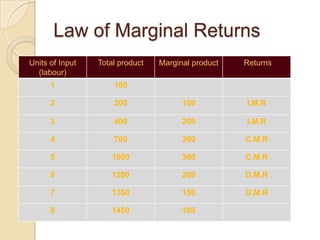
Law of Marginal Returns
Units of Input
(labour)

Total product

Marginal product

Returns

1

100

2

200

100

I.M.R

3

400

200

I.M.R

4

700

300

C.M.R

5

1000

300

C.M.R

6

1200

200

D.M.R

7

1350

150

D.M.R

8

1450

100
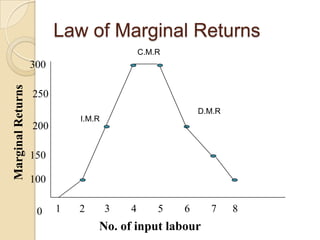
Law of Marginal Returns
C.M.R

Marginal Returns

300

250
D.M.R
I.M.R

200
150
100
0

1

2

3

4

5

6

No. of input labour

7

8
Return To Scale


The laws of Returns to Scale study the behavior of
production when all the productive factors or inputs
are increased or decreased simultaneously in the same
ratio.



We analyze here the effect of doubling, trebling and
so on of all the inputs of productive resources on the
output of the product.
Return To Scale


It has also three distinct stages
◦ Increasing Returns to Scale (10% increase in input
leads to 20% increase in output)
◦ Constant Returns to Scale (10% increase in input
leads to 10% increase in output)
◦ Diminishing Returns to Scale (10% increase in input
leads to 9% increase in output)
Fixed and Variable Costs
Fixed

costs are those costs that do not
vary with the quantity of output
produced.
Variable costs are those costs that do
change as the firm alters the quantity of
output produced.
Short

Run vs. Long Run Costs
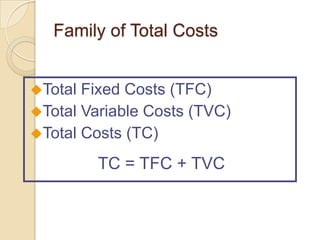
Family of Total Costs
Total

Fixed Costs (TFC)
Total Variable Costs (TVC)
Total Costs (TC)

TC = TFC + TVC
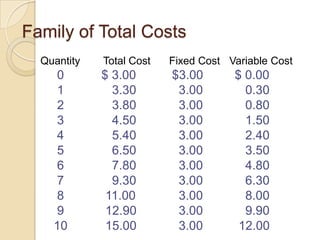
Family of Total Costs
Quantity

0
1
2
3
4
5
6
7
8
9
10

Total Cost

Fixed Cost Variable Cost

$ 3.00
3.30
3.80
4.50
5.40
6.50
7.80
9.30
11.00
12.90
15.00

$3.00
3.00
3.00
3.00
3.00
3.00
3.00
3.00
3.00
3.00
3.00

$ 0.00
0.30
0.80
1.50
2.40
3.50
4.80
6.30
8.00
9.90
12.00
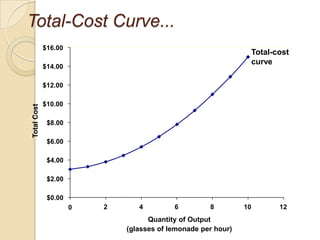
Total-Cost Curve...
$16.00

Total-cost
curve

$14.00

Total Cost

$12.00
$10.00
$8.00
$6.00
$4.00

$2.00
$0.00
0

2

4

6

8

Quantity of Output
(glasses of lemonade per hour)

10

12
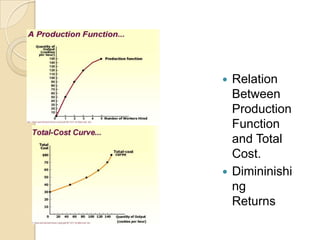
Relation
Between
Production
Function
and Total
Cost.
 Dimininishi
ng
Returns

Average Costs
Average

costs can be determined
by dividing the firm’s costs by the
quantity of output produced.
The average cost is the cost of
each typical unit of product.
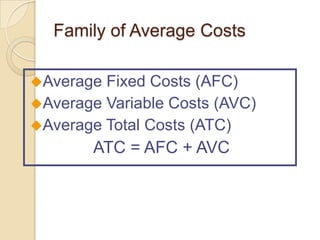
Family of Average Costs
Average

Fixed Costs (AFC)
Average Variable Costs (AVC)
Average Total Costs (ATC)

ATC = AFC + AVC
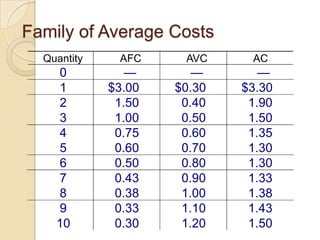
Family of Average Costs
Quantity

0
1
2
3
4
5
6
7
8
9
10

AFC

AVC

—
$3.00
1.50
1.00
0.75
0.60
0.50
0.43
0.38
0.33
0.30

—
$0.30
0.40
0.50
0.60
0.70
0.80
0.90
1.00
1.10
1.20

AC

—
$3.30
1.90
1.50
1.35
1.30
1.30
1.33
1.38
1.43
1.50
Marginal Cost
Marginal

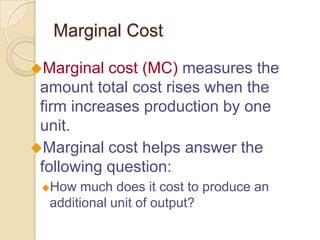
cost (MC) measures the
amount total cost rises when the
firm increases production by one
unit.
Marginal cost helps answer the
following question:
How

much does it cost to produce an
additional unit of output?
Marginal Cost
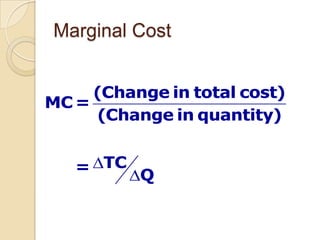
(Change in total cost)
MC =
(Change in quantity)
= TC

Q
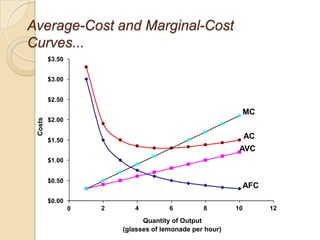
Average-Cost and Marginal-Cost
Curves...
$3.50
$3.00
$2.50

Costs

MC
$2.00

AC

$1.50

AVC
$1.00
$0.50

AFC

$0.00

0

2

4

6

8

Quantity of Output
(glasses of lemonade per hour)

10

12
Three Important Properties of Cost
Curves
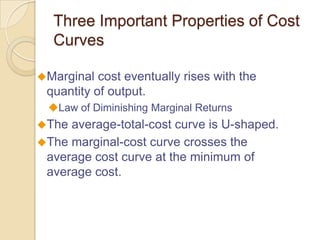
Marginal

cost eventually rises with the
quantity of output.
Law of Diminishing Marginal Returns

The

average-total-cost curve is U-shaped.
The marginal-cost curve crosses the
average cost curve at the minimum of
average cost.
Costs in the Long Run
For many firms, the division of total

costs between fixed and variable costs
depends on the time horizon being
considered.
 In

the short run some costs are fixed.
 In the long run fixed costs become variable
costs.
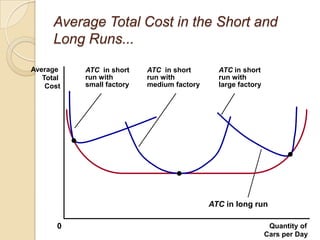
Average Total Cost in the Short and
Long Runs...
Average
Total
Cost

ATC in short
run with
small factory

ATC in short
run with
medium factory

ATC in short
run with
large factory

ATC in long run
0

Quantity of
Cars per Day
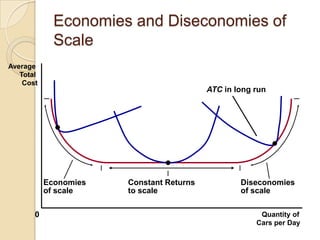
Economies and Diseconomies of
Scale
Average
Total
Cost

ATC in long run

Economies
of scale
0

Constant Returns
to scale

Diseconomies
of scale
Quantity of
Cars per Day
Isoquants


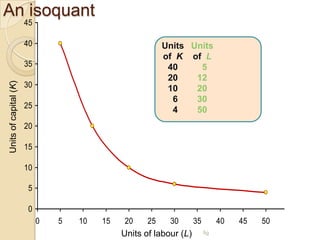
An isoquant
 ―…is a contour line which joins together the
different combinations of two factors of
production that are just physically able to
produce a given quantity of a good.‖



Construction, slope and maps
An isoquant
45
40

Units Units
of K of L
40
5
20
12
10
20
6
30
4
50

Units of capital (K)

35
30
25
20
15
10
5
0
0

5

10

15

20

25

30

Units of labour (L)

35

40
fig

45

50
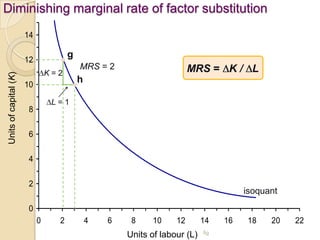
Diminishing marginal rate of factor substitution
14

g

Units of capital (K)

12
K=2

10

MRS = 2

MRS = K / L

h

L=1

8
6
4
2

isoquant

0
0

2

4

6

8

10

12

Units of labour (L)

14
fig

16

18

20

22
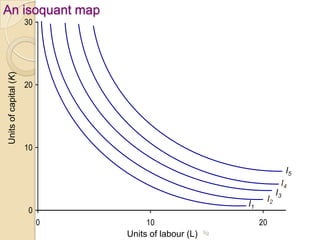
An isoquant map

Units of capital (K)

30

20

10

I5
I4

I1

0
0

10
Units of labour (L)

I2
20

fig

I3
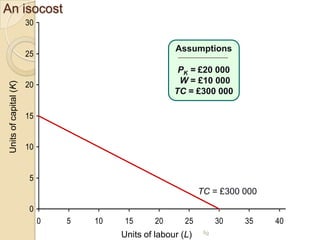
Isocosts
Actual output also depends on costs
 isocosts


 join combinations of K & L - same cost
 assuming constant factor prices



Construction, slope & map
An isocost
30

Assumptions

Units of capital (K)

25

PK = £20 000
W = £10 000
TC = £300 000

20

15

10

5

TC = £300 000
0
0

5

10

15

20

25

Units of labour (L)

30
fig

35

40
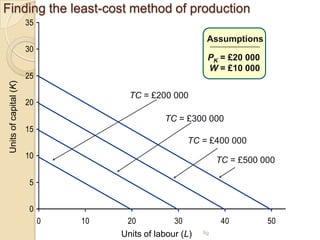
Finding the least-cost method of production
35

Assumptions
30

PK = £20 000
W = £10 000

Units of capital (K)

25

TC = £200 000

20

TC = £300 000
15

TC = £400 000
10

TC = £500 000

5
0
0

10

20

30

Units of labour (L)

40
fig

50
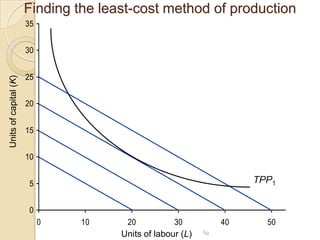
Finding the least-cost method of production
35

Units of capital (K)

30
25
20
15
10

TPP1

5
0
0

10

20

30

Units of labour (L)

40
fig

50
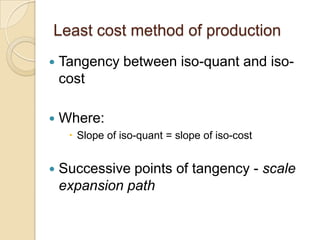
Least cost method of production


Tangency between iso-quant and isocost



Where:
 Slope of iso-quant = slope of iso-cost



Successive points of tangency - scale
expansion path
Firms in Competitive
Markets

Chapter 14
The Meaning of Competition
A perfectly competitive market

has the following characteristics:
 There

are many buyers and sellers in
the market.
 The goods offered by the various
sellers are largely the same.
 Firms can freely enter or exit the
market.
The Meaning of Competition
As a result of its characteristics, the

perfectly competitive market has the
following outcomes:
The

actions of any single buyer or seller
in the market have a negligible impact
on the market price.
Each buyer and seller takes the market
price as given.
 Thus,

each buyer and seller is a price taker.
Example of Competitive Markets
Eggs vs. Nike
Sneakers.
 Pay attention to the
difference between
the two market
structures.
 Which brand names
do you recognize?


QuickTime™ and a
Video decompressor
are needed to see this picture.
Revenue of a Competitive Firm
Total revenue for a firm is the selling
price times the quantity sold.

TR = (P X Q)
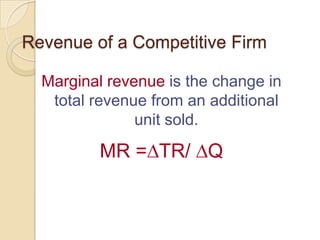
Revenue of a Competitive Firm
Marginal revenue is the change in
total revenue from an additional
unit sold.

MR = TR/ Q
Revenue of a Competitive Firm

For competitive firms, marginal
revenue equals the price of the
good.
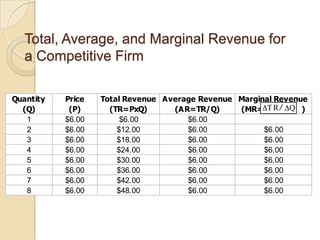
Total, Average, and Marginal Revenue for
a Competitive Firm
Quantity
(Q)
1
2
3
4
5
6
7
8

Price
(P)
$6.00
$6.00
$6.00
$6.00
$6.00
$6.00
$6.00
$6.00

Total Revenue Average Revenue Marginal Revenue
(TR=PxQ)
(AR=TR/Q)
(MR= T R / Q )
$6.00
$6.00
$12.00
$6.00
$6.00
$18.00
$6.00
$6.00
$24.00
$6.00
$6.00
$30.00
$6.00
$6.00
$36.00
$6.00
$6.00
$42.00
$6.00
$6.00
$48.00
$6.00
$6.00
Profit Maximization for the
Competitive Firm
The

goal of a competitive firm is
to maximize profit.
This means that the firm will want
to produce the quantity that
maximizes the difference between
total revenue and total cost.
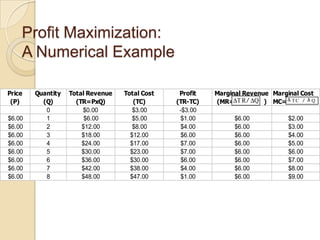
Profit Maximization:
A Numerical Example
Price
(P)
$6.00
$6.00
$6.00
$6.00
$6.00
$6.00
$6.00
$6.00

Quantity
(Q)
0
1
2
3
4
5
6
7
8

Total Revenue
(TR=PxQ)
$0.00
$6.00
$12.00
$18.00
$24.00
$30.00
$36.00
$42.00
$48.00

Total Cost
(TC)
$3.00
$5.00
$8.00
$12.00
$17.00
$23.00
$30.00
$38.00
$47.00

Profit
(TR-TC)
-$3.00
$1.00
$4.00
$6.00
$7.00
$7.00
$6.00
$4.00
$1.00

Marginal Revenue Marginal Cost
(MR= T R / Q ) MC= T C / Q
$6.00
$6.00
$6.00
$6.00
$6.00
$6.00
$6.00
$6.00

$2.00
$3.00
$4.00
$5.00
$6.00
$7.00
$8.00
$9.00
Harcourt, Inc. items and derived items copyright © 2001 by Harcourt, Inc.

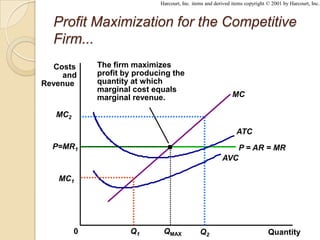
Profit Maximization for the Competitive
Firm...
Costs
and
Revenue

The firm maximizes
profit by producing the
quantity at which
marginal cost equals
marginal revenue.

MC

MC2
ATC
P=MR1

P = AR = MR
AVC

MC1

0

Q1

QMAX

Q2

Quantity
Profit Maximization for the
Competitive Firm
Profit maximization occurs at
the quantity where marginal
revenue equals marginal cost.
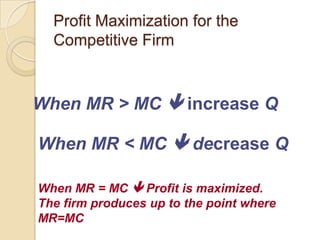
Profit Maximization for the
Competitive Firm

When MR > MC  increase Q
When MR < MC  decrease Q
When MR = MC  Profit is maximized.
The firm produces up to the point where
MR=MC
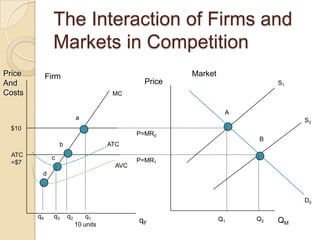
The Interaction of Firms and
Markets in Competition
Price
And
Costs

Market

Firm

Price

S1

MC
A

a

S2

$10

P=MR0

ATC
=$7

B

ATC

b

c
AVC

P=MR1

d

D0
q4

q3

q2

q1
10 units

qF

Q1

Q2

QM
Copyright © 2001 by Harcourt, Inc. All rights reserved

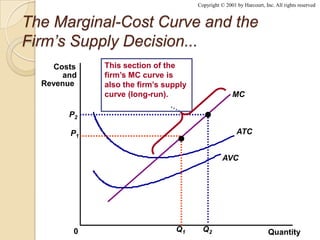
The Marginal-Cost Curve and the
Firm’s Supply Decision...
Costs
and
Revenue

This section of the
firm’s MC curve is
also the firm’s supply
curve (long-run).

MC

P2
ATC

P1

AVC

0

Q1

Q2

Quantity
The Firm’s Short-Run Decision
to Shut Down
A shutdown

refers to a short-run
decision not to produce anything
during a specific period of time
because of current market
conditions.
Exit refers to a long-run decision
to leave the market.
The Firm’s Short-Run Decision to
Shut Down
The firm considers its sunk costs
when deciding to exit, but ignores
them when deciding whether to
shut down.
Sunk

costs are costs that have
already been committed and cannot
be recovered.
The Firm’s Short-Run Decision
to Shut Down
The

firm shuts down if the revenue it
gets from producing is less than the
variable cost of production.

Shut down if TR < VC
Shut down if TR/Q < VC/Q
Shut down if P < AVC
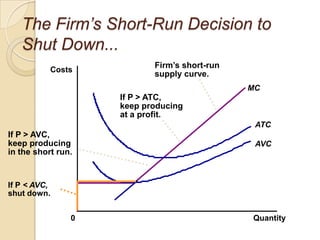
The Firm’s Short-Run Decision to
Shut Down...
Costs

Firm’s short-run
supply curve.
MC

If P > ATC,
keep producing
at a profit.
ATC

If P > AVC,
keep producing
in the short run.

AVC

If P < AVC,
shut down.
0

Quantity
The Firm’s Short-Run Decision to
Shut Down
The portion of the marginal-cost
curve that lies above average
variable cost is the competitive
firm’s short-run supply curve.
The Firm’s Long-Run Decision to
Exit or Enter a Market
In

the long-run, the firm exits if the
revenue it would get from producing is
less than its total cost.

Exit if TR < TC
Exit if TR/Q < TC/Q
Exit if P < ATC
The Firm’s Long-Run Decision to
Exit or Enter a Market
A firm

will enter the industry if such an
action would be profitable.

Enter if TR > TC

Enter if TR/Q > TC/Q
Enter if P > ATC
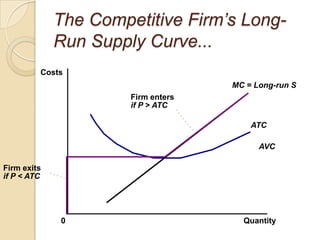
The Competitive Firm’s LongRun Supply Curve...
Costs
MC = Long-run S
Firm enters
if P > ATC
ATC
AVC
Firm exits
if P < ATC

0

Quantity
Monopoly
Chapter 15

Copyright © 2001 by Harcourt, Inc.
All rights reserved. Requests for permission to make copies of any part of the
work should be mailed to:
Permissions Department, Harcourt College Publishers,
6277 Sea Harbor Drive, Orlando, Florida 32887-6777.
Monopoly
While a competitive firm is a
price taker, a monopoly firm is
a price maker.
Monopoly
 A firm

is considered a monopoly if . . .
it is the sole seller of its product.
its product does not have close
substitutes.
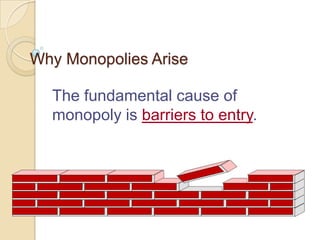
Why Monopolies Arise
The fundamental cause of
monopoly is barriers to entry.
Why Monopolies Arise
Barriers to entry have three sources:


Ownership of a key resource.
◦ This tends to be rare. De Beers is an example



The government gives a single firm the exclusive
right to produce some good.
◦ Patents, Copyrights and Government Licensing.



Costs of production make a single producer more
efficient than a large number of producers.
◦ Natural Monopolies
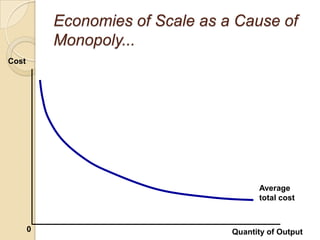
Economies of Scale as a Cause of
Monopoly...
Cost

Average
total cost

0

Quantity of Output
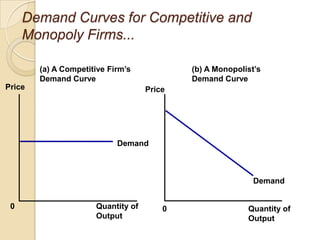
Monopoly versus Competition
Monopoly
 Is the sole producer
 Has a downwardsloping demand curve
 Is a price maker
 Reduces price to
increase sales

Competitive Firm
Is one of many
producers
Has a horizontal
demand curve
Is a price taker
Sells as much or as
little at same price
Demand Curves for Competitive and
Monopoly Firms...
(a) A Competitive Firm’s
Demand Curve
Price

(b) A Monopolist’s
Demand Curve
Price

Demand

Demand
0

Quantity of
Output

0

Quantity of
Output
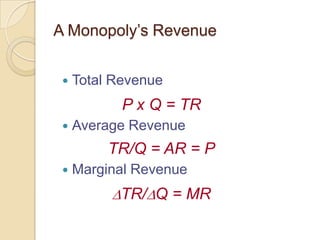
A Monopoly’s Revenue


Total Revenue

P x Q = TR


Average Revenue

TR/Q = AR = P


Marginal Revenue

TR/ Q = MR
A Monopoly’s Marginal Revenue
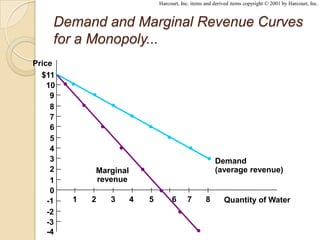
A monopolist’s marginal revenue is
always less than the price of its good.
The

demand curve is downward sloping.
When a monopoly drops the price to sell
one more unit, the revenue received from
previously sold units also decreases.
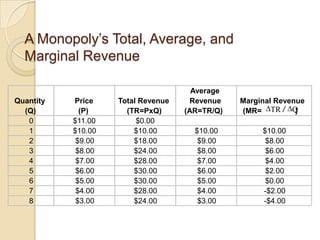
A Monopoly’s Total, Average, and
Marginal Revenue
Quantity
(Q)
0
1
2
3
4
5
6
7
8

Price
(P)
$11.00
$10.00
$9.00
$8.00
$7.00
$6.00
$5.00
$4.00
$3.00

Total Revenue
(TR=PxQ)
$0.00
$10.00
$18.00
$24.00
$28.00
$30.00
$30.00
$28.00
$24.00

Average
Revenue
(AR=TR/Q)
$10.00
$9.00
$8.00
$7.00
$6.00
$5.00
$4.00
$3.00

Marginal Revenue
(MR= TR / Q
)
$10.00
$8.00
$6.00
$4.00
$2.00
$0.00
-$2.00
-$4.00
A Monopoly’s Marginal Revenue
When a monopoly increases the
amount it sells, it has two effects
on total revenue (P x Q).
The

output effect—more output is
sold, so Q is higher.
The price effect—price falls, so P is
lower.
Harcourt, Inc. items and derived items copyright © 2001 by Harcourt, Inc.

Demand and Marginal Revenue Curves
for a Monopoly...
Price
$11
10
9
8
7
6
5
4
3
2
1
0
-1
-2
-3
-4

Demand
(average revenue)

Marginal
revenue
1

2

3

4

5

6

7

8

Quantity of Water
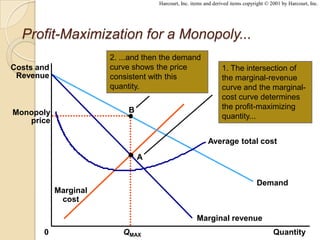
Harcourt, Inc. items and derived items copyright © 2001 by Harcourt, Inc.

Profit-Maximization for a Monopoly...
2. ...and then the demand
curve shows the price
consistent with this
quantity.

Costs and
Revenue

B

Monopoly
price

1. The intersection of
the marginal-revenue
curve and the marginalcost curve determines
the profit-maximizing
quantity...
Average total cost

A
Demand
Marginal
cost

Marginal revenue
0

QMAX

Quantity
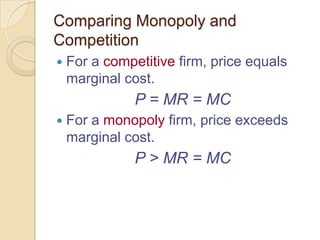
Comparing Monopoly and
Competition


For a competitive firm, price equals
marginal cost.

P = MR = MC


For a monopoly firm, price exceeds
marginal cost.

P > MR = MC
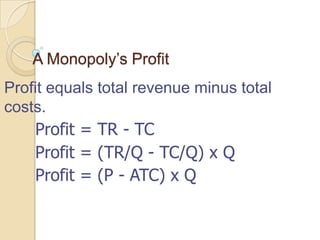
A Monopoly’s Profit

Profit equals total revenue minus total
costs.

Profit = TR - TC
Profit = (TR/Q - TC/Q) x Q
Profit = (P - ATC) x Q
Harcourt, Inc. items and derived items copyright © 2001 by Harcourt, Inc.

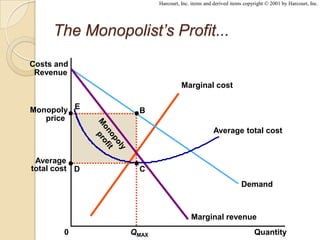
The Monopolist’s Profit...
Costs and
Revenue
Marginal cost
Monopoly E
price

B
Average total cost

Average
total cost D

C
Demand

Marginal revenue
0

QMAX

Quantity
The Monopolist’s Profit
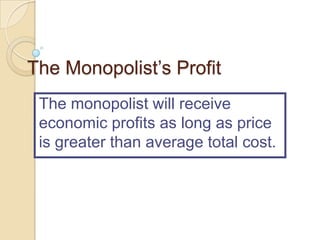
The monopolist will receive
economic profits as long as price
is greater than average total cost.
Public Policy Toward Monopolies
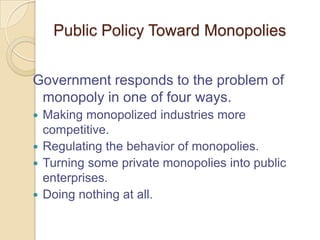
Government responds to the problem of
monopoly in one of four ways.
Making monopolized industries more
competitive.
 Regulating the behavior of monopolies.
 Turning some private monopolies into public
enterprises.
 Doing nothing at all.

Two Important
Antitrust Laws


Sherman Antitrust Act (1890)
Reduced

the market power of the large and
powerful ―trusts‖ of that time period.



Clayton Act (1914)
Strengthened

the government’s powers and
authorized private lawsuits.
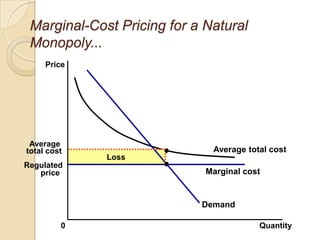
Marginal-Cost Pricing for a Natural
Monopoly...
Price

Average
total cost
Regulated
price

Average total cost
Loss

Marginal cost

Demand
0

Quantity
Price Discrimination
Price discrimination is the practice of selling
the same good at different prices to different
customers, even though the costs for
producing for the two customers are the
same. In order to do this, the firm must have
market power.
Price Discrimination



Two important effects of price discrimination:
 It

can increase the monopolist’s profits.
 It can reduce deadweight loss.


But in order to price discriminate, the firm must
Be able to separate the customers on the basis of willingness to
pay.
 Prevent the customers from reselling the product.

Oligopoly
Chapter 16

Copyright © 2001 by Harcourt, Inc.
All rights reserved. Requests for permission to make copies of any part of the
work should be mailed to:
Permissions Department, Harcourt College Publishers,
6277 Sea Harbor Drive, Orlando, Florida 32887-6777.
Imperfect Competition
Imperfect competition includes
industries in which firms have
competitors but do not face so
much competition that they are
price takers.
Types of Imperfectly Competitive
Markets
Oligopoly
Only a few sellers, each offering a
similar or identical product to the
others.
Monopolistic Competition
Many firms selling products that are
similar but not identical.
The Four Types of Market Structure
Number of Firms?

Many
firms
One
firm

Monopoly

Few
firms

Oligopoly

Type of Products?
Differentiated
products

Identical
products

Monopolistic
Competition

Perfect
Competition

• Tap water

• Tennis balls

• Novels

• Wheat

• Cable TV

• Crude oil

• Movies

• Milk
Characteristics of an Oligopoly
Market
 Few

sellers offering similar or identical
products
 Interdependent firms
 Best off cooperating and acting like a
monopolist by producing a small quantity of
output and charging a price above marginal
cost
 There is a tension between cooperation and
self-interest.
A Duopoly Example
A duopoly is an oligopoly with
only two members. It is the
simplest type of oligopoly.
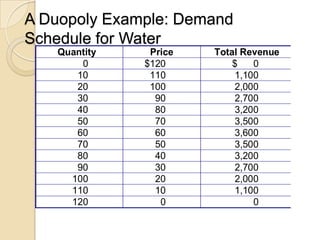
A Duopoly Example: Demand
Schedule for Water
Quantity
0
10
20
30
40
50
60
70
80
90
100
110
120

Price
$120
110
100
90
80
70
60
50
40
30
20
10
0

Total Revenue
$
0
1,100
2,000
2,700
3,200
3,500
3,600
3,500
3,200
2,700
2,000
1,100
0
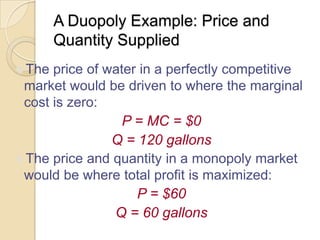
A Duopoly Example: Price and
Quantity Supplied
The price of water in a perfectly competitive

market would be driven to where the marginal
cost is zero:
P = MC = $0
Q = 120 gallons
The price and quantity in a monopoly market
would be where total profit is maximized:
P = $60
Q = 60 gallons
A Duopoly Example: Price and
Quantity Supplied
The socially efficient quantity of water is

120 gallons, but a monopolist would
produce only 60 gallons of water.
So what outcome then could be
expected from duopolists?
Competition, Monopolies, and
Cartels
The duopolists may agree on a

monopoly outcome.
Collusion
The

two firms may agree on the
quantity to produce and the price to
charge.

Cartel
The

two firms may join together and act in
unison.



However, both outcomes are illegal in the United States due
to Antitrust laws.
Summary of Equilibrium for an
Oligopoly
Possible

outcome if oligopoly firms
pursue their own self-interests:
 Joint

output is greater than the monopoly
quantity but less than the competitive
industry quantity.
 Market prices are lower than monopoly
price but greater than competitive price.
 Total profits are less than the monopoly
profit.
How the Size of an Oligopoly
Affects the Market Outcome
How

increasing the number of sellers
affects the price and quantity:
 The

output effect: Because price is above
marginal cost, selling more at the going
price raises profits.
 The price effect: Raising production
lowers the price and the profit per unit on
all units sold.
How the Size of an Oligopoly Affects
the Market Outcome
As

the number of sellers in an oligopoly grows
larger, an oligopolistic market looks more and more
like a competitive market.
The price approaches marginal cost, and the
quantity produced approaches the socially efficient
level.
Game Theory and the Economics
of Cooperation
Game

theory is the study of how people behave in
strategic situations.
Strategic decisions are those in which each person, in
deciding what actions to take, must consider how others
might respond to that action.
Show it’s a Beautiful Mind at this point!-The bar scene
Game Theory and the Economics
of Cooperation
Because

the number of firms in an
oligopolistic market is small, each firm
must act strategically.
Each firm knows that its profit depends
not only on how much it produced but
also on how much the other firms
produce.
The Prisoners’ Dilemma
The prisoners’ dilemma provides
insight into the difficulty in
maintaining cooperation.
Often people (firms) fail to cooperate
with one another even when cooperation
would make them better off.
The Equilibrium for an Oligopoly
A Nash equilibrium is a situation in
which economic actors interacting
with one another each choose their
best strategy given the strategies that
all the others have chosen (I.e.
Dominant Strategy)

Economics chapter 1

  • 1.
  • 2.
    Economy. . . .. . The word economy comes from a Greek word for ―one who manages a household.‖
  • 3.
    Founder of economics Adamsmith is the founder economics (From 16 June 1723 – died 17 July 1790 ). He wrote a very first book of economics named ―Wealth of Nations” Wealth of Nations: the first modern work of economics. It earned him an enormous reputation and would become one of the most influential works on economics ever published. Smith is widely cited as the father of modern economics and capitalism.
  • 4.
    Economics Economics is thestudy of scarcity and efficiency. Economics is the study of how society manages its scarce resources. Economics is the study of how societies use scarce resources to produce commodities and distribute them among different people.
  • 5.
    Economics Definition of economics"the science which studies human behavior as a relationship between ends and scarce means which have alternative uses." by Lionel Robbins
  • 6.
    Microeconomics and Macroeconomics Microeconomics focuses on the individual parts of the economy.  How households and firms make decisions and how they interact in specific markets  Macroeconomics looks at the economy as a whole.  How the markets, as a whole, interact at the national level.
  • 7.
    Microeconomics and Macroeconomics Microeconomics focuseson how decisions are made by individuals and firms and the consequences of those decisions. Ex.: How much it would cost for a university or college to offer a new course ─ the cost of the instructor’s salary, the classroom facilities, the class materials, and so on. Having determined the cost, the school can then decide whether or not to offer the course by weighing the costs and benefits.
  • 8.
    Microeconomics and Macroeconomics Macroeconomics examinesthe aggregate behavior of the economy (i.e. how the actions of all the individuals and firms in the economy interact to produce a particular level of economic performance as a whole). Ex.: Overall level of prices in the economy (how high or how low they are relative to prices last year) rather than the price of a particular good or service.
  • 9.
    Scarcity . .. . . . means that society has limited resources and therefore cannot produce all the goods and services people wish to have. Scarcity is the situation in which there is not enough of something to satisfy all the desires for that thing.
  • 10.
    Efficiency Economic efficiency describeshow well a system generates desired output with a given set of inputs and available technology. Efficiency is improved if more output is generated without changing inputs, or in other words, the amount of "waste" is reduced. Absence of waste.
  • 11.
    Needs and Wants  Aneed is something that is necessary for organisms to live a healthy life.  The idea of want can be examined from many perspectives. In secular societies want might be considered similar to the emotion desire, which can be studied scientifically through the disciplines of psychology or sociology.
  • 12.
    Resources The basic resourcesthat are available to a society are factors of production: ◦ Natural resources ◦ Human resources ◦ Capital resources ◦ Time resources
  • 13.
    Natural resources It includesgood fertile land , rivers , mountains, water fall, sunshine and things that are inside the curst of the earth.
  • 14.
    Human resources All thoseable bodies, people who are able to work and contribute to production. it is most important factor to contributes’ to production and in the growth of economy. Worker must acquire education, skill and knowledge.
  • 15.
    Capital resources It includesmachine, plants, tools, roads, bridges and highways. it is also important factor to contributes’ to production and in the growth of economy.
  • 16.
    Time resources It isalso very important resource, because utilization of limited time to produce goods and services to fulfill the needs and wants of economic requirements.
  • 17.
    Economic Problems  Human wantsare unlimited, but resources are not.  Three basic questions must be answered in order to understand an economic system: ◦ What to produced? ◦ How to produced? ◦ For whom to produced?
  • 18.
    Economic Problems What toproduced? What goods and services should be produce. those goods and services are needed by the economy. How to produced? Which resources are utilize (Land, labour, capital & organization) to produced goods and services these are required for economy
  • 19.
    Economic Problems For Whomto Produce? Is production done for army or for producers or for households. Goods( Guns and butter) and services education) are required for military or society.
  • 20.
  • 21.
    Inputs and Outputs Resourcesor factors of production are the inputs into the process of production; goods and services of value to households are the outputs of the process of production or the result of any process which you working for.  Inputs: it can primary such as land and labour and it can be secondary such as capital and managerial skill (entrepreneurial skills). 
  • 22.
    Capital formation andcreation process Capital formation means creation of new capital assets. Process Saving: that part of an individual income which is not spent on consumption. Banks: are financial institutes which accept deposit and lend it out to entrepreneurs for production purpose as a loan. They work for profit it is deference b/w interest paid to depositor and receive form debtor
  • 23.
    Capital formation andcreation process Money: is liquid assets. Money is lubricant it helps in production. it is medium of exchange. Investment is the process of using resources to produce new capital. Capital is the accumulation of previous investment.
  • 24.
    Opportunity cost &Trade off Opportunity cost is that which we give up or forgo, when we make a decision or a choice.  Opportunity cost means the next best alternative sacrifice. Resources are scarce so we give up or forgo one and take other goods or services.  Trade off means choosing more of one thing and given up other thing. 
  • 25.
    Capital Goods andConsumer Goods  Capital goods are goods used to produce other goods and services.  Consumer goods are goods produced for present consumption.
  • 26.
    Market and itsKinds A market in economics means settlement of transaction b/w buyers and sellers. Market is the institution/place through which buyers and sellers interact and engage in exchange. Market target allocation of scarce resources in an appropriate and economical manner. Kinds   Market for goods Market for services
  • 27.
    Economic Systems Economic systemsare the basic arrangements made by societies to solve the economic problem. They include:  ◦ Command economies ◦ Laissez-faire economies ◦ Mixed systems ◦ Islamic system
  • 28.
    Command economy In acommand economy or Socialism, a central government either directly or indirectly sets output targets, incomes, and prices. All decisions of what, how and for whom to produce are taken by state.
  • 29.
    Laissez-faire economy orCapitalism In a laissez-faire economy or capitalism individuals and firms pursue their own self-interests without any central direction or regulation. All decisions of what, how and for whom to produce are taken by them self.
  • 30.
    Mixed Systems, Markets, andGovernments Where both government and private sector are contribute in market. Since markets are not perfect, governments intervene and often play a major role in the economy. Some of the goals of government are to:  Minimize market inefficiencies  Provide public goods  Redistribute income
  • 31.
    The Production PossibilityFrontier With the given resources (land, labour, capital and organization) & technology of a country the maximum amount of output it can produce is known as production possibility frontier (ppf) The production possibility frontier (ppf) is a graph that shows all of the combinations of goods and services that can be produced if all of society’s resources are used efficiently.
  • 32.
    Production Possibility Frontier Possibilities Butter (Million) Guns(In thousand) A 0 150 B 10 140 C 20 120 D 30 90 E 40 50 F 50 0
  • 33.
    Production Possibility Frontier   •At point H, resources are either unemployed, or are used inefficiently. The production possibility frontier curve has a negative slope, which indicates a trade-off between producing one good or another. Points inside of the curve are inefficient
  • 34.
    Production Possibility Frontier Amove along the curve illustrates the concept of opportunity cost and trade off.  From point D, an increase the production of capital goods requires a decrease in the amount of consumer goods 
  • 35.
    Production Possibility Frontier   Outwardshifts of the curve represent economic growth. An outward shift means that it is possible to increase the production of one good without decreasing the production of the other
  • 36.
    Division of labour Divisionof labour: means the splitting up of the process of production into sub processes. The complete task of product making is not perform by an individual but by the group of workers taken up a certain parts of production. it is also known as specialization. Concept of division of labour is given by Adam Smith, he explain with the example of pin making factory
  • 37.
  • 38.
    Consumer Demand Demand ineconomics means that desire which is backed by ability to buy and willingness to buy.  Ability + willingness = demand
  • 39.
    Law of Demand ―Otherthings remains the same ‖ a fall in price is accompanied by an increase in quantity demanded and conversely a rise in price is followed by fall in quantity demanded.
  • 40.
    Schedule of Demand Scheduleof demand shows a series of price of goods and services and quantity demanded at those price. Possibilities Price Quantity demanded A 5 9 B 4 10 C 3 12 D 2 15 E 1 20
  • 41.
    Demand Curve DD isdemand curve and it is downwards sloping showing inverse relationship between price and quantity demanded.
  • 42.
    Determinants of Demand Consumerincome  Size of population  Prices of related goods  Tastes  Expectations 
  • 43.
    Determinants of Demand Consumerincome Consumer income is major factor that influence demand, if increase in income that will increase the demand and vise versa.  Increase in income better off  Decrease in income worse off
  • 44.
    Determinants of Demand Sizeof population The size of market is affect demand. the demand of goods & services in big market( china) is very large and the demand of goods & services in small market (Pakistan) is low.
  • 45.
    Determinants of Demand Substitutes& Complements  When a fall in the price of one good (Coffee) reduces the demand for another good (tea), the two goods are called substitutes.  When a fall in the price of one good (milk) increases the demand for another good (tea), the two goods are called complements.
  • 46.
    Determinants of Demand Taste Tasteis also important factor that influence demand reflection of many factor both physical and psychological that increase/decrease demand.
  • 47.
    Determinants of Demand Specialinfluences     Climatically change Religious occasion Cultural occasion Other events
  • 48.
    Change in QuantityDemanded Change in Quantity Demanded  Movement along the demand curve.  Caused by a change in the price of the product.
  • 49.
    Shift in Demand Changein Demand A shift in the demand curve, either to the left or right.  Caused by a change in a determinant other than the price. 
  • 50.
    Simple Linear Regression Simplelinear regression analysis analyzes the linear relationship that exists between two variables. y a bx where: y = Value of the dependent variable x = Value of the independent variable a = Population’s y-intercept b = Slope of the population regression line
  • 51.
    Simple Linear Regression  Thecoefficients of the line are n b  or n xy x 2 x ( y b a n a y bx y x) 2 x
  • 52.
    Correlation The correlation coefficientis a quantitative measure of the strength of the linear relationship between two variables. The correlation ranges from + 1.0 to - 1.0. A correlation of 1.0 indicates a perfect linear relationship, whereas a correlation of 0 indicates no linear relationship.
  • 53.
    An algebraic formulafor correlation coefficient n r [ n( 2 x ) ( xy x 2 x) ][ n( y 2 y ) ( 2 y) ]
  • 54.
    Demand forecasting Y =a + bX or Qdx = F(Px,Y, Pc,Ps,T,N,..) a = ÿ - bX or (a) = (ΣY - b(ΣX)) / N b = n∑YX – (∑Y) (∑ X)/ n∑X2- (∑X)2 Where b = The slope of the regression line a = The intercept point of the regression line and the y axis. n = Number of values or elements X = Price Y = Quantity Demanded
  • 55.
  • 56.
  • 57.
    Problem ◦ Obtain theregression line and interpret its Forecasted demand. ◦ Determine the correlation coefficient and interpret it Sold (y) Price (x) 200 6.00 190 6.50 188 6.75 180 7.00 170 7.25 162 7.50 160 The manager of a seafood restaurant was asked to establish a pricing policy on lobster dinners. Experimenting with prices produced the following data: 8.00 155 8.25 156 8.50 148 8.75 140 9.00 133 9.25
  • 58.
  • 59.
    Supply and Stock Supplyin economics means the amount of commodity offered for sale in the market at certain period of time and at certain price. Stock means the amount of commodity which is ready for sale but not offered for sale in the market and kept back in warehouse. Durable good have distinction b/w supply and stock. Non Durable good (perishable)have no distinction b/w supply and stock.
  • 60.
    Law of Supply ―Otherthings remains the same ‖ a fall in price is accompanied by an decrease in quantity Supplied and conversely a rise in price is fallowed by increase in quantity Supplied.
  • 61.
    Schedule of Supply Scheduleof supply shows a series of price of goods and services and quantity supplied at those price. Possibilities Price Quantity Supply A 5 18 B 4 16 C 3 12 D 2 7 E 1 0
  • 62.
    Supply Curve SS isSupply curve and it is upwards sloping showing same/positive relationship between price and quantity supplied.
  • 63.
    Determinants of Supply Price of Inputs  Availability of Inputs  Technology  Government policies  Expectations
  • 64.
    Determinants of Supply Priceand Availability of Inputs Price of Inputs if the price are lowered then supply will increase and vise versa (e.g. oil) Availability of Inputs if inputs are easily available in market subsequently supply will increase and vise versa.
  • 65.
    Determinants of Supply Technology Technologyis very essential factor for influencing supply if latest technology is use for production supply will increase and vise versa
  • 66.
    Determinants of Supply Governmentpolicies If government imposes the taxes on inputs that will lead to decline in supply and if government reduces the taxes on inputs afterward supply will increase.
  • 67.
    Determinants of SupplySpecial influences Climatically change  Religious occasion  Cultural occasion  Other events 
  • 68.
    Change in QuantitySupplied Change in Quantity Supplied Movement along the supply curve. Caused by a change in the price of the product
  • 69.
    Shift in Supply Changein Supply A shift in the Supply curve, either to the left or right. Caused by a change in a determinant other than the price.
  • 70.
    Equilibrium Equilibrium in economicswe understand a state of balance or on interaction between two opposite forces working in the opposite direction settle at one point that is equilibrium price. The term price equilibrium is market price.
  • 71.
    Schedule of Equilibrium Possibilities Price Quantity demanded Quantity supplied Stateof the market A 5 9 18 Surplus 9mn B 4 10 16 Surplus 6mn C 3 12 12 Equilibrium D 2 15 7 Scarcity 8mn E 1 20 0 Scarcity 20mn
  • 72.
    Equilibrium The equilibrium price comeat the intersection of demand and supply curve at point C. The equilibrium price and quantity comes where the units supply equal to amount demand
  • 73.
    Shift in Equilibriumdue to shift in demand and supply
  • 74.
  • 75.
    Elasticity . .. … is a measure of how much buyers and sellers respond to changes in market conditions  … allows us to analyze supply and demand with greater accuracy. 
  • 76.
    Price Elasticity ofDemand Price elasticity of demand is the percentage change in quantity demanded given a percent change in the price. It is a measure of how much the quantity demanded of a good responds to a change in the price of that good. Responsiveness of quantity demand due to change in price is known as elasticity of demand.
  • 77.
    Computing the PriceElasticity of Demand The price elasticity of demand is computed as the percentage change in the quantity demanded divided by the percentage change in price. Price Elasticity = Of Demand EP Percentage Change in Qd Percentage Change in Price (% Q)/(% P)
  • 78.
    Elasticity, Percentage Changeand Slope Because the price elasticity of demand measures how much quantity demanded responds to the price, it is closely related to the slope of the demand curve. But instead of looking at unit change, elasticity looks at percentage change. What do we mean by percentage change?
  • 79.
    Brief Assessment on Percentages Ifthere are 50 tomatoes in a store and you picked 16 of them, what percentage of the total did you pick?  Paul used to weigh 200 lbs last year, but now he only weighs 175 lbs. How many lbs did he lose? What is the percent change of the loss?  What is the average of 300 and 330? What is the midpoint? 
  • 80.
    Computing the PriceElasticity of Demand Price elasticity of demand EP Percentage change in quatity demanded Percentage change in price Q/Q P/P P Q Q P Example: If the price of an ice cream cone increases from $2.00 to $2.20 and the amount you buy falls from 10 to 8 cones then your elasticity of demand would be calculated as:
  • 81.
    Types of Elasticity  Priceelasticity  Income elasticity  Cross elasticity
  • 82.
    Types of Elasticity Priceelasticity Price Elasticity = Of Demand Percentage Change in QD Percentage Change in Price
  • 83.
    Income Elasticity ofDemand Income elasticity of demand measures how much the quantity demanded of a good responds to a change in consumers’ income. It is computed as the percentage change in the quantity demanded divided by the percentage change in income.
  • 84.
    Types of Elasticity Incomeelasticity Income Elasticity = Of Demand EI Q/Q I/I Percentage Change in QD Percentage Change in Income I Q Q I
  • 85.
    Cross Price Elasticityof Demand Elasticity measure that looks at the impact a change in the price of one good has on the demand of another good.  % change in demand Q1/% change in price of Q2.  Positive-Substitutes  Negative-Complements. 
  • 86.
    Types of Elasticity Crosselasticity Price Elasticity = Of Demand Percentage Change in QD (Tea) Percentage Change in Price Coffee) EQbPm Qb/Qb Pm/Pm P m Qb Qb P m
  • 87.
    Ranges of Elasticity InelasticDemand Percentage change in price is greater than percentage change in quantity demand. Price elasticity of demand is less than one. Elastic Demand Percentage change in quantity demand is greater than percentage change in price. Price elasticity of demand is greater than one.
  • 88.
    Perfectly Inelastic Demand -Elasticity equals 0 Price Demand $5 1. An increase in price... 4 Quantity 100 2. ...leaves the quantity demanded unchanged.
  • 89.
    Perfectly Elastic Demand -Elasticity equals infinity Price 1. At any price above $4, quantity demanded is zero. Demand $4 2. At exactly $4, consumers will buy any quantity. 3. At a price below $4, quantity demanded is infinite. Quantity
  • 90.
    Inelastic Demand - Elasticityis less than 1 Price 1. A 25% $5 increase in price... 4 Demand Quantity 90 100 2. ...leads to a 10% decrease in quantity.
  • 91.
    Unit Elastic Demand -Elasticity equals 1 Price 1. A 25% $5 increase in price... 4 Demand Quantity 75 100 2. ...leads to a 25% decrease in quantity.
  • 92.
    Elastic Demand - Elasticityis greater than 1 Price 1. A 25% $5 increase in price... 4 Demand Quantity 50 100 2. ...leads to a 50% decrease in quantity.
  • 93.
    Determinants of Price Elasticityof Demand  Necessities versus Luxuries  Availability of Close Substitutes  Definition of the Market  Time Horizon
  • 94.
    Determinants of PriceElasticity of Demand  Demand tends to be more inelastic ◦ If the good is a necessity. ◦ If the time period is shorter. ◦ The smaller the number of close substitutes. ◦ The more broadly defined the market.
  • 95.
    Determinants of Price Elasticityof Demand Demand tends to be more elastic : if the good is a luxury. the longer the time period. the larger the number of close substitutes. the more narrowly defined the market.
  • 96.
    Method Measuring ElasticityTotal Revenue Total revenue is the amount paid by buyers and received by sellers of a good. Computed as the price of the good times the quantity sold. TR = P x Q
  • 97.
    Elasticity and TotalRevenue Price $4 P x Q = $400 (total revenue) P 0 Q Demand 100 Quantity
  • 98.
    The Total RevenueTest for Elasticity Increase in Decrease in Total Revenue Total Revenue Increase in Price INELASTIC DEMAND ELASTIC DEMAND Decrease in Price ELASTIC DEMAND INELASTIC DEMAND
  • 99.
    Method Measuring Elasticitythe Average Formula The Average (midpoint formula) is preferable when calculating the price elasticity of demand because it gives the same answer regardless of the direction of the change. (Q2 Q1 )/[(Q2 Q1 )/2] Price Elasticity of Demand = (P2 P1 )/[(P2 P1 )/2]
  • 100.
    Method Measuring Elasticitythe Average Formula (Q 2 Q1 )/[(Q 2 Q1 )/2] Price Elasticity of Demand = (P2 P1 )/[(P2 P1 )/2] Example: If the price of an ice cream cone increases from $2.00 to $2.20 and the amount you buy falls from 10 to 8 cones the your elasticity of demand, using the midpoint formula, would be calculated as:
  • 101.
    Method Measuring Elasticityof Straight line The lower portion of a downward sloping demand curve is less elastic than the upper portion.
  • 102.
    Importance of PriceElasticity of Demand Profit maximization requires that business set a price that will maximize the firm’s profit  Elasticity tells the firm how much control it has over using price to raise profit  If e > 1, then the % Change in QD > % Change is Price and demand is said to be elastic  • An increase in price will reduce total revenue • A decrease in price will increase total revenue
  • 103.
    Importance of PriceElasticity of Demand  If e < 1, then the % change in QD < % change in price, and demand is said to be inelastic • An increase in price will increase total revenue • A decrease in price will decrease total revenue  If e = 1, then the % change in QD = % change in Price, and demand is said to be unit elastic • An increase in price will have no impact on total revenue • A decrease in price will have no impact on total revenue
  • 104.
    Computing the PriceElasticity of Supply The price elasticity of supply is computed as the percentage change in the quantity Supplied divided by the percentage change in price. Price Elasticity = Of Supply Percentage Change in QS Percentage Change in Price
  • 105.
  • 106.
  • 107.
    Utility • The valuea consumer places on a unit of a good or service depends on the pleasure or satisfaction he or she expects to derive form having or consuming it at the point of making a consumption (consumer) choice. • In economics the satisfaction or pleasure consumers derive from the consumption of consumer goods is called “utility”. • Consumers, however, cannot have every thing they wish to have. Consumers’ choices are constrained by their incomes. • [ • Within the limits of their incomes, consumers make their consumption choices by evaluating and comparing consumer goods with regard to their “utilities.”
  • 108.
    Total Utility versusMarginal Utility • Marginal utility is the utility a consumer derives from the last unit of a consumer good she or he consumes (during a given consumption period), ceteris paribus. • Total utility is the total utility a consumer derives from the consumption of all of the units of a good or a combination of goods over a given consumption period, ceteris paribus. Total utility = Sum of marginal utilities
  • 109.
    The Law ofDiminishing Marginal Utility The law of diminishing marginal utility state that: as the amount of a good consumed increase, the marginal utility of that good tends to diminish. We can illustrate this law numerically. We can take an example of cup of ice cream give to our consumer without any interval or break then we will see that marginal utility will be diminish. If he consume more and more of a good its marginal utility tends to decline. While its total utility keeps an increasing but at slower and slower rate.
  • 110.
    The Law ofDiminishing Marginal Utility  Over a given consumption period, the more of a good a consumer has, or has consumed, the less marginal utility an additional unit contributes to his or her overall satisfaction (total utility).  Alternatively, we could say: over a given consumption period, as more and more of a good is consumed by a consumer, beyond a certain point, the marginal utility of additional units begins to fall.
  • 111.
    The Law ofDiminishing Marginal Utility Schedule Cup of Ice cream Total utility Marginal utility 0 0 0 1st 4 4 2nd 7 3 3rd 9 2 4th 10 1 5th 10 0 6th 8 -2
  • 112.
    The Law ofDiminishing Marginal Utility Graph of Total & Marginal utility
  • 113.
    Law of Equi-MarginalUtility Assumptions Our consumer is rational person.  His aim is to maximize his satisfaction.  Money is limited & price are given and he has to accept the prices.  Marginal utility of money is constant.  Our consumer is facing the law of diminishing marginal utility in each direction of purchase.  He will arrange his purchases in order of its importance 
  • 114.
    Law of Equi-MarginalUtility  The fundamental condition of maximum satisfaction or utility is the equi-marginal principles, it state that ―a consumer having a fixed income and facing given market prices of goods will achieve maximum satisfaction or utility when the marginal utility of the last dollar spend on each good is exactly the same as the marginal utility of the last dollar spent on the any other good‖.
  • 115.
    LAW OF EQUIMARGINALUTILITY Marginal utility of money Income= 10 Prices of both good A & B = 1units Marginal utility of money is =14 utils Unit of consumptio n Good A Good B 1st =14 1 24 units 20 2nd =14 2 22 18 3rd =14 3 20 16 4th=14 4 18 14 5th=14 5 16 6th =14 6 14
  • 116.
    Law of Equi-MarginalUtility marginal utility of the last dollar spend MUa MUb =--------- = ---------$Pa $Pb
  • 117.
  • 118.
    Cardinal vs. OrdinalUtility  Cardinal utility : Satisfaction provided by any good or bundle of goods can be assigned a numerical value by a utility function.  Ordinal utility : People are able to rank each possible bundle in order of preference. People are not required to make quantitative statements about how much they like various bundles.
  • 119.
    indifference curve properties •An indifference curve should not slope up. •Better bundles are to the northeast. • Indifference curves are downward sloping and bowed inward. •Indifference curves become less vertical as we move down them and to the right. •Indifference curves cannot cross/intersect. If indifference curves crossed, it would violate the ―prefermore-to-less‖ principle.
  • 120.
    Assumptions Our consumer isrational person.  His aim is to maximize his satisfaction.  Money is limited & price are given.  He makes purchase in combination of 2 basket of good A & B simultaneously.  He is indifferent to select a combination of the 2 goods he makes different combination & all the goods giving him equal level of satisfaction. 
  • 121.
    Indifference Curve  Indifference curve– that is a tool of which shows different combinations of two goods given to consumer same level of satisfaction or a curve that shows combinations of two goods among which an individual is indifferent.  The slope of the indifference curve is the ratio of marginal utilities of the two goods.
  • 122.
    Indifference Curve  The absolutevalue of the slope of an indifference curve is called the marginal rate of substitution.
  • 123.
    Schedule of ICor Indifferent plans Schedule of IC shows a series of combinations of 2 goods. Combination Food Clothing A 1 6 B 2 3 C 3 2 D 4 1. ½ E 5 1
  • 124.
    Graphing the IndifferenceCurve Clothing (units per week) A 6 Indifference curves slope downward to the right. If it sloped upward it would violate the assumption that more of any commodity is preferred to less. 5 4 B Point A,B,C,D are given our consumer same level of satisfaction and hence he is indifferent & all combinations are equally preferred. 3 C 2 D 1 IC 1 2 3 4 5 Food (units per week)
  • 125.
    Diminishing Marginal Rateof Substitution  Law of diminishing marginal rate of substitution –the scarcer a good, the greater its relative substitution value; its marginal utility rises relative to marginal utility of the good that has become plentiful.  The rate at which one good must be added when the other is taken away in order to keep the individual indifferent between the two combinations.
  • 126.
    Schedule of ICand Marginal rate of substitutions Schedule of IC shows a series of combinations of 2 goods and marginal rate substitutions. Combination Food Clothing M.R.S A 1 6 B 2 +1 3–3 1:3 C 3+1 2–1 1:1 D 4+1 1.1/2 - 0.1/2 1:1/2 E 5 1
  • 127.
    Diminishing Marginal Rateof Substitution Clothing (units per week) Indifference curves are convex because as more of one good is consumed, a consumer would prefer to give up fewer units of a second good to get additional units of the first one. A 6 5 -3 MRS = 3 4 1 MRS is measured by the slope of the indifference curve: B 3 MRS = 1 -1 1 2 C MRS = 1/2 D -1/2 1 1 1 2 3 4 5 MRS C Food (units per week) F
  • 128.
    A Group ofIndifference Curves  Consumer’s will have a whole group of indifference curves, each representing a different level of satisfaction.  If he/she prefers more to less, Consumer is better off with the indifference curve that is extreme to the right.
  • 129.
    Indifference Map Clothing (units perweek) An indifference map is a set of indifference curves that describes a person’s preferences for all combinations of two commodities. IC3 show higher level of satisfaction to her then IC1 and IC2. IC3 IC2 IC1 Food (units per week)
  • 130.
    Consumer’s Choice Consumer buyclothing and foods.  She/he wants to maximize her/his utility given a budget constraint. 
  • 131.
    What is aBudget Constraint?  A budget constraint shows the consumer’s purchase opportunities as every combination of two goods that can be bought at given prices using a given amount of income.
  • 132.
    Budget Constraint  Clothing cost$1 and Food cost $1.5 each.  Sophie has $6 income to spend.  She can buy 6 cloth units or 4 food units or some combination of each.
  • 133.
  • 134.
    Budget Constraint  The slopeof the budget constraint is the ratio of the prices of the two goods. The slope changes when the prices or income change.
  • 135.
    Budget Constraint withIncome effect Clothing (units per week) Pc = $1 80 A Pf = $2 I = $80 Budget Line 2F + C = $80 B 60 Pc = $1 Pf = $2 I = $40 C 40 D 20 E 0 10 20 30 40 Food (units per week)
  • 136.
    Budget Constraint withPrice effect Clothing (units per week) Pc = $1 80 A Pf = $2 I = $80 Budget Line 2F + C = $80 B 60 Pc = $1 Pf = $4 I = $80 C 40 D 20 E 0 10 20 30 40 Food (units per week)
  • 137.
    Indifference Curves Equilibrium  Sophiewill maximize her satisfaction by consuming on the highest indifference curve as possible, given her budget constraint.  The best combination is the point where the indifference curve and the budget line are tangent and that point shows equilibrium of consumer.
  • 138.
    Indifference Curves Equilibrium  Thebest combination is the point where the slope of the budget line/price ratio equals the slope of the indifference curve/MRS of two goods.
  • 139.
    Indifference Curves Equilibrium E Atpoint B U3 the budget line and the indifference curve are tangent and no higher level of satisfaction can be attained.
  • 140.
  • 141.
    Changes in Income •An increase in income will cause the budget constraint out in a parallel fashion • Since px/py does not change, the MRS will stay constant as the worker moves to higher levels of satisfaction
  • 142.
  • 143.
    Increase in Income •If x decreases as income rises, x is an inferior good As income rises, the individual chooses to consume less x and more y Quantity of y Note that the indifference curves do not have to be ―oddly‖ shaped. The assumption of a diminishing MRS is obeyed. C B U3 U2 A U1 Quantity of x
  • 144.
    Changes in aGood’s Price • A change in the price of a good alters the slope of the budget constraint – it also changes the MRS at the consumer’s utility-maximizing choices • When the price changes, two effects come into play – substitution effect – income effect
  • 145.
    Changes in aGood’s Price • Even if the individual remained on the same indifference curve when the price changes, his optimal choice will change because the MRS must equal the new price ratio – the substitution effect • The price change alters the individual’s ―real‖ income and therefore he must move to a new indifference curve – the income effect
  • 146.
  • 147.
    Changes in aGood’s Price Quantity of y To isolate the substitution effect, we hold ―real‖ income constant but allow the relative price of good x to change The substitution effect is the movement from point A to point C A C U1 The individual substitutes good x for good y because it is now relatively cheaper Quantity of x Substitution effect
  • 148.
  • 149.
    Production Function • 1.Production - short run – Productive efficiency – The Law of diminishing marginal returns • 2. Production - long run – isoquants & isocosts – least cost method of production
  • 150.
    Production By production ineconomics we understands the creations of utility. Utility can be created in three ways. Form utility: can be created by changing the shape of the matter & performing an act of production (e.g. log of wood). 2. Place utility: the worker creates utility by changing the place of that matter (e.g. Coal miner). 1.
  • 151.
    Production 3. Time utility:can be created by taking the product over long period of time (e.g. crops is harvested, preservation of grains).
  • 152.
    Productivity  Productivity is ameasure of the efficiency of production. Productivity is a ratio of what is produced to what is required to produce it. Usually this ratio is in the form of an average, expressing the total output divided by the total input. Productivity is a measure of output from a production process, per unit of input.
  • 153.
    Productive capacity Productive capacity:in economy is determent by the size & quality of labor force. By Quality & quantity capital stock(FOPs)  By nation technical knowledge  The ability to use the knowledge  The nature of public & private institutions 
  • 154.
    Production Function Production Function:means the relationship b/w amount of input required to the amount of output that can be obtained is called Production Function. To explain it further we can say that for given state of engineers & scientific/ technological knowledge of production function significance the maximum amount of that can be produce with quality of inputs.
  • 155.
    Production Function e.g. thetask of ditch digging is perform in USA where large & expensive tractor is driven by person along with supervisor the ditch which is 50ft length & 5ft in depth can be dough in 2 hours. Where as the same task is performed in China where 50 worker with one hand pickle complete the task in one whole day. In USA the task is capital intensive & where as in China the task is labour intensive.
  • 156.
    Total, Average andMarginal Product Total product means the total amount of output produce in physical term like bushel of wheat/ dozens of boat.  Average product means total product divided by number of product.  Marginal Product means input is the extra output produce by one addition units of input while other input are constant. 
  • 157.
    Total, Average andMarginal Product Units of Input (labour) Total product Marginal product Average product 1 2000 2 3000 1000 1500 3 3500 500 1166.67 4 3800 300 950 5 3900 100 780 2000
  • 158.
  • 159.
    Law of DiminishingMarginal Returns This is basic law of production according this law we get less & less of extra output. When we will add additional dozen of input while other inputs held/remain constant. In other word the marginal product of each units of input will declines as the amount of that input increase, holding other all inputs remain constant.
  • 160.
    Law of DiminishingMarginal Returns  The L of D.M.R express a very basic relationship as more & more labour is add to fixed area of land, machine & other input the labour has less & less of other factor to work with. Marginal product falls because the land get crowded, the machine is over work so the marginal product of labour declines
  • 161.
    Law of IncreasingMarginal Returns Law of Increasing Marginal Returns operate in case of manufacturing industry because machine are control by man, he may use better technology to over come the problem. The entrepreneur is rational person & he voids all of the law of diminishing Marginal returns.
  • 162.
    Law of MarginalReturns Units of Input (labour) Total product Marginal product Returns 1 100 2 200 100 I.M.R 3 400 200 I.M.R 4 700 300 C.M.R 5 1000 300 C.M.R 6 1200 200 D.M.R 7 1350 150 D.M.R 8 1450 100
  • 163.
    Law of MarginalReturns C.M.R Marginal Returns 300 250 D.M.R I.M.R 200 150 100 0 1 2 3 4 5 6 No. of input labour 7 8
  • 164.
    Return To Scale  Thelaws of Returns to Scale study the behavior of production when all the productive factors or inputs are increased or decreased simultaneously in the same ratio.  We analyze here the effect of doubling, trebling and so on of all the inputs of productive resources on the output of the product.
  • 165.
    Return To Scale  Ithas also three distinct stages ◦ Increasing Returns to Scale (10% increase in input leads to 20% increase in output) ◦ Constant Returns to Scale (10% increase in input leads to 10% increase in output) ◦ Diminishing Returns to Scale (10% increase in input leads to 9% increase in output)
  • 166.
    Fixed and VariableCosts Fixed costs are those costs that do not vary with the quantity of output produced. Variable costs are those costs that do change as the firm alters the quantity of output produced. Short Run vs. Long Run Costs
  • 167.
    Family of TotalCosts Total Fixed Costs (TFC) Total Variable Costs (TVC) Total Costs (TC) TC = TFC + TVC
  • 168.
    Family of TotalCosts Quantity 0 1 2 3 4 5 6 7 8 9 10 Total Cost Fixed Cost Variable Cost $ 3.00 3.30 3.80 4.50 5.40 6.50 7.80 9.30 11.00 12.90 15.00 $3.00 3.00 3.00 3.00 3.00 3.00 3.00 3.00 3.00 3.00 3.00 $ 0.00 0.30 0.80 1.50 2.40 3.50 4.80 6.30 8.00 9.90 12.00
  • 169.
  • 170.
  • 171.
    Average Costs Average costs canbe determined by dividing the firm’s costs by the quantity of output produced. The average cost is the cost of each typical unit of product.
  • 172.
    Family of AverageCosts Average Fixed Costs (AFC) Average Variable Costs (AVC) Average Total Costs (ATC) ATC = AFC + AVC
  • 173.
    Family of AverageCosts Quantity 0 1 2 3 4 5 6 7 8 9 10 AFC AVC — $3.00 1.50 1.00 0.75 0.60 0.50 0.43 0.38 0.33 0.30 — $0.30 0.40 0.50 0.60 0.70 0.80 0.90 1.00 1.10 1.20 AC — $3.30 1.90 1.50 1.35 1.30 1.30 1.33 1.38 1.43 1.50
  • 174.
    Marginal Cost Marginal cost (MC)measures the amount total cost rises when the firm increases production by one unit. Marginal cost helps answer the following question: How much does it cost to produce an additional unit of output?
  • 175.
    Marginal Cost (Change intotal cost) MC = (Change in quantity) = TC Q
  • 176.
  • 177.
    Three Important Propertiesof Cost Curves Marginal cost eventually rises with the quantity of output. Law of Diminishing Marginal Returns The average-total-cost curve is U-shaped. The marginal-cost curve crosses the average cost curve at the minimum of average cost.
  • 178.
    Costs in theLong Run For many firms, the division of total costs between fixed and variable costs depends on the time horizon being considered.  In the short run some costs are fixed.  In the long run fixed costs become variable costs.
  • 179.
    Average Total Costin the Short and Long Runs... Average Total Cost ATC in short run with small factory ATC in short run with medium factory ATC in short run with large factory ATC in long run 0 Quantity of Cars per Day
  • 180.
    Economies and Diseconomiesof Scale Average Total Cost ATC in long run Economies of scale 0 Constant Returns to scale Diseconomies of scale Quantity of Cars per Day
  • 181.
    Isoquants  An isoquant  ―…isa contour line which joins together the different combinations of two factors of production that are just physically able to produce a given quantity of a good.‖  Construction, slope and maps
  • 182.
    An isoquant 45 40 Units Units ofK of L 40 5 20 12 10 20 6 30 4 50 Units of capital (K) 35 30 25 20 15 10 5 0 0 5 10 15 20 25 30 Units of labour (L) 35 40 fig 45 50
  • 183.
    Diminishing marginal rateof factor substitution 14 g Units of capital (K) 12 K=2 10 MRS = 2 MRS = K / L h L=1 8 6 4 2 isoquant 0 0 2 4 6 8 10 12 Units of labour (L) 14 fig 16 18 20 22
  • 184.
    An isoquant map Unitsof capital (K) 30 20 10 I5 I4 I1 0 0 10 Units of labour (L) I2 20 fig I3
  • 185.
    Isocosts Actual output alsodepends on costs  isocosts   join combinations of K & L - same cost  assuming constant factor prices  Construction, slope & map
  • 186.
    An isocost 30 Assumptions Units ofcapital (K) 25 PK = £20 000 W = £10 000 TC = £300 000 20 15 10 5 TC = £300 000 0 0 5 10 15 20 25 Units of labour (L) 30 fig 35 40
  • 187.
    Finding the least-costmethod of production 35 Assumptions 30 PK = £20 000 W = £10 000 Units of capital (K) 25 TC = £200 000 20 TC = £300 000 15 TC = £400 000 10 TC = £500 000 5 0 0 10 20 30 Units of labour (L) 40 fig 50
  • 188.
    Finding the least-costmethod of production 35 Units of capital (K) 30 25 20 15 10 TPP1 5 0 0 10 20 30 Units of labour (L) 40 fig 50
  • 189.
    Least cost methodof production  Tangency between iso-quant and isocost  Where:  Slope of iso-quant = slope of iso-cost  Successive points of tangency - scale expansion path
  • 190.
  • 191.
    The Meaning ofCompetition A perfectly competitive market has the following characteristics:  There are many buyers and sellers in the market.  The goods offered by the various sellers are largely the same.  Firms can freely enter or exit the market.
  • 192.
    The Meaning ofCompetition As a result of its characteristics, the perfectly competitive market has the following outcomes: The actions of any single buyer or seller in the market have a negligible impact on the market price. Each buyer and seller takes the market price as given.  Thus, each buyer and seller is a price taker.
  • 193.
    Example of CompetitiveMarkets Eggs vs. Nike Sneakers.  Pay attention to the difference between the two market structures.  Which brand names do you recognize?  QuickTime™ and a Video decompressor are needed to see this picture.
  • 194.
    Revenue of aCompetitive Firm Total revenue for a firm is the selling price times the quantity sold. TR = (P X Q)
  • 195.
    Revenue of aCompetitive Firm Marginal revenue is the change in total revenue from an additional unit sold. MR = TR/ Q
  • 196.
    Revenue of aCompetitive Firm For competitive firms, marginal revenue equals the price of the good.
  • 197.
    Total, Average, andMarginal Revenue for a Competitive Firm Quantity (Q) 1 2 3 4 5 6 7 8 Price (P) $6.00 $6.00 $6.00 $6.00 $6.00 $6.00 $6.00 $6.00 Total Revenue Average Revenue Marginal Revenue (TR=PxQ) (AR=TR/Q) (MR= T R / Q ) $6.00 $6.00 $12.00 $6.00 $6.00 $18.00 $6.00 $6.00 $24.00 $6.00 $6.00 $30.00 $6.00 $6.00 $36.00 $6.00 $6.00 $42.00 $6.00 $6.00 $48.00 $6.00 $6.00
  • 198.
    Profit Maximization forthe Competitive Firm The goal of a competitive firm is to maximize profit. This means that the firm will want to produce the quantity that maximizes the difference between total revenue and total cost.
  • 199.
    Profit Maximization: A NumericalExample Price (P) $6.00 $6.00 $6.00 $6.00 $6.00 $6.00 $6.00 $6.00 Quantity (Q) 0 1 2 3 4 5 6 7 8 Total Revenue (TR=PxQ) $0.00 $6.00 $12.00 $18.00 $24.00 $30.00 $36.00 $42.00 $48.00 Total Cost (TC) $3.00 $5.00 $8.00 $12.00 $17.00 $23.00 $30.00 $38.00 $47.00 Profit (TR-TC) -$3.00 $1.00 $4.00 $6.00 $7.00 $7.00 $6.00 $4.00 $1.00 Marginal Revenue Marginal Cost (MR= T R / Q ) MC= T C / Q $6.00 $6.00 $6.00 $6.00 $6.00 $6.00 $6.00 $6.00 $2.00 $3.00 $4.00 $5.00 $6.00 $7.00 $8.00 $9.00
  • 200.
    Harcourt, Inc. itemsand derived items copyright © 2001 by Harcourt, Inc. Profit Maximization for the Competitive Firm... Costs and Revenue The firm maximizes profit by producing the quantity at which marginal cost equals marginal revenue. MC MC2 ATC P=MR1 P = AR = MR AVC MC1 0 Q1 QMAX Q2 Quantity
  • 201.
    Profit Maximization forthe Competitive Firm Profit maximization occurs at the quantity where marginal revenue equals marginal cost.
  • 202.
    Profit Maximization forthe Competitive Firm When MR > MC  increase Q When MR < MC  decrease Q When MR = MC  Profit is maximized. The firm produces up to the point where MR=MC
  • 203.
    The Interaction ofFirms and Markets in Competition Price And Costs Market Firm Price S1 MC A a S2 $10 P=MR0 ATC =$7 B ATC b c AVC P=MR1 d D0 q4 q3 q2 q1 10 units qF Q1 Q2 QM
  • 204.
    Copyright © 2001by Harcourt, Inc. All rights reserved The Marginal-Cost Curve and the Firm’s Supply Decision... Costs and Revenue This section of the firm’s MC curve is also the firm’s supply curve (long-run). MC P2 ATC P1 AVC 0 Q1 Q2 Quantity
  • 205.
    The Firm’s Short-RunDecision to Shut Down A shutdown refers to a short-run decision not to produce anything during a specific period of time because of current market conditions. Exit refers to a long-run decision to leave the market.
  • 206.
    The Firm’s Short-RunDecision to Shut Down The firm considers its sunk costs when deciding to exit, but ignores them when deciding whether to shut down. Sunk costs are costs that have already been committed and cannot be recovered.
  • 207.
    The Firm’s Short-RunDecision to Shut Down The firm shuts down if the revenue it gets from producing is less than the variable cost of production. Shut down if TR < VC Shut down if TR/Q < VC/Q Shut down if P < AVC
  • 208.
    The Firm’s Short-RunDecision to Shut Down... Costs Firm’s short-run supply curve. MC If P > ATC, keep producing at a profit. ATC If P > AVC, keep producing in the short run. AVC If P < AVC, shut down. 0 Quantity
  • 209.
    The Firm’s Short-RunDecision to Shut Down The portion of the marginal-cost curve that lies above average variable cost is the competitive firm’s short-run supply curve.
  • 210.
    The Firm’s Long-RunDecision to Exit or Enter a Market In the long-run, the firm exits if the revenue it would get from producing is less than its total cost. Exit if TR < TC Exit if TR/Q < TC/Q Exit if P < ATC
  • 211.
    The Firm’s Long-RunDecision to Exit or Enter a Market A firm will enter the industry if such an action would be profitable. Enter if TR > TC Enter if TR/Q > TC/Q Enter if P > ATC
  • 212.
    The Competitive Firm’sLongRun Supply Curve... Costs MC = Long-run S Firm enters if P > ATC ATC AVC Firm exits if P < ATC 0 Quantity
  • 213.
    Monopoly Chapter 15 Copyright ©2001 by Harcourt, Inc. All rights reserved. Requests for permission to make copies of any part of the work should be mailed to: Permissions Department, Harcourt College Publishers, 6277 Sea Harbor Drive, Orlando, Florida 32887-6777.
  • 214.
    Monopoly While a competitivefirm is a price taker, a monopoly firm is a price maker.
  • 215.
    Monopoly  A firm isconsidered a monopoly if . . . it is the sole seller of its product. its product does not have close substitutes.
  • 216.
    Why Monopolies Arise Thefundamental cause of monopoly is barriers to entry.
  • 217.
    Why Monopolies Arise Barriersto entry have three sources:  Ownership of a key resource. ◦ This tends to be rare. De Beers is an example  The government gives a single firm the exclusive right to produce some good. ◦ Patents, Copyrights and Government Licensing.  Costs of production make a single producer more efficient than a large number of producers. ◦ Natural Monopolies
  • 218.
    Economies of Scaleas a Cause of Monopoly... Cost Average total cost 0 Quantity of Output
  • 219.
    Monopoly versus Competition Monopoly Is the sole producer  Has a downwardsloping demand curve  Is a price maker  Reduces price to increase sales Competitive Firm Is one of many producers Has a horizontal demand curve Is a price taker Sells as much or as little at same price
  • 220.
    Demand Curves forCompetitive and Monopoly Firms... (a) A Competitive Firm’s Demand Curve Price (b) A Monopolist’s Demand Curve Price Demand Demand 0 Quantity of Output 0 Quantity of Output
  • 221.
    A Monopoly’s Revenue  TotalRevenue P x Q = TR  Average Revenue TR/Q = AR = P  Marginal Revenue TR/ Q = MR
  • 222.
    A Monopoly’s MarginalRevenue A monopolist’s marginal revenue is always less than the price of its good. The demand curve is downward sloping. When a monopoly drops the price to sell one more unit, the revenue received from previously sold units also decreases.
  • 223.
    A Monopoly’s Total,Average, and Marginal Revenue Quantity (Q) 0 1 2 3 4 5 6 7 8 Price (P) $11.00 $10.00 $9.00 $8.00 $7.00 $6.00 $5.00 $4.00 $3.00 Total Revenue (TR=PxQ) $0.00 $10.00 $18.00 $24.00 $28.00 $30.00 $30.00 $28.00 $24.00 Average Revenue (AR=TR/Q) $10.00 $9.00 $8.00 $7.00 $6.00 $5.00 $4.00 $3.00 Marginal Revenue (MR= TR / Q ) $10.00 $8.00 $6.00 $4.00 $2.00 $0.00 -$2.00 -$4.00
  • 224.
    A Monopoly’s MarginalRevenue When a monopoly increases the amount it sells, it has two effects on total revenue (P x Q). The output effect—more output is sold, so Q is higher. The price effect—price falls, so P is lower.
  • 225.
    Harcourt, Inc. itemsand derived items copyright © 2001 by Harcourt, Inc. Demand and Marginal Revenue Curves for a Monopoly... Price $11 10 9 8 7 6 5 4 3 2 1 0 -1 -2 -3 -4 Demand (average revenue) Marginal revenue 1 2 3 4 5 6 7 8 Quantity of Water
  • 226.
    Harcourt, Inc. itemsand derived items copyright © 2001 by Harcourt, Inc. Profit-Maximization for a Monopoly... 2. ...and then the demand curve shows the price consistent with this quantity. Costs and Revenue B Monopoly price 1. The intersection of the marginal-revenue curve and the marginalcost curve determines the profit-maximizing quantity... Average total cost A Demand Marginal cost Marginal revenue 0 QMAX Quantity
  • 227.
    Comparing Monopoly and Competition  Fora competitive firm, price equals marginal cost. P = MR = MC  For a monopoly firm, price exceeds marginal cost. P > MR = MC
  • 228.
    A Monopoly’s Profit Profitequals total revenue minus total costs. Profit = TR - TC Profit = (TR/Q - TC/Q) x Q Profit = (P - ATC) x Q
  • 229.
    Harcourt, Inc. itemsand derived items copyright © 2001 by Harcourt, Inc. The Monopolist’s Profit... Costs and Revenue Marginal cost Monopoly E price B Average total cost Average total cost D C Demand Marginal revenue 0 QMAX Quantity
  • 230.
    The Monopolist’s Profit Themonopolist will receive economic profits as long as price is greater than average total cost.
  • 231.
    Public Policy TowardMonopolies Government responds to the problem of monopoly in one of four ways. Making monopolized industries more competitive.  Regulating the behavior of monopolies.  Turning some private monopolies into public enterprises.  Doing nothing at all. 
  • 232.
    Two Important Antitrust Laws  ShermanAntitrust Act (1890) Reduced the market power of the large and powerful ―trusts‖ of that time period.  Clayton Act (1914) Strengthened the government’s powers and authorized private lawsuits.
  • 233.
    Marginal-Cost Pricing fora Natural Monopoly... Price Average total cost Regulated price Average total cost Loss Marginal cost Demand 0 Quantity
  • 234.
    Price Discrimination Price discriminationis the practice of selling the same good at different prices to different customers, even though the costs for producing for the two customers are the same. In order to do this, the firm must have market power.
  • 235.
    Price Discrimination  Two importanteffects of price discrimination:  It can increase the monopolist’s profits.  It can reduce deadweight loss.  But in order to price discriminate, the firm must Be able to separate the customers on the basis of willingness to pay.  Prevent the customers from reselling the product. 
  • 236.
    Oligopoly Chapter 16 Copyright ©2001 by Harcourt, Inc. All rights reserved. Requests for permission to make copies of any part of the work should be mailed to: Permissions Department, Harcourt College Publishers, 6277 Sea Harbor Drive, Orlando, Florida 32887-6777.
  • 237.
    Imperfect Competition Imperfect competitionincludes industries in which firms have competitors but do not face so much competition that they are price takers.
  • 238.
    Types of ImperfectlyCompetitive Markets Oligopoly Only a few sellers, each offering a similar or identical product to the others. Monopolistic Competition Many firms selling products that are similar but not identical.
  • 239.
    The Four Typesof Market Structure Number of Firms? Many firms One firm Monopoly Few firms Oligopoly Type of Products? Differentiated products Identical products Monopolistic Competition Perfect Competition • Tap water • Tennis balls • Novels • Wheat • Cable TV • Crude oil • Movies • Milk
  • 240.
    Characteristics of anOligopoly Market  Few sellers offering similar or identical products  Interdependent firms  Best off cooperating and acting like a monopolist by producing a small quantity of output and charging a price above marginal cost  There is a tension between cooperation and self-interest.
  • 241.
    A Duopoly Example Aduopoly is an oligopoly with only two members. It is the simplest type of oligopoly.
  • 242.
    A Duopoly Example:Demand Schedule for Water Quantity 0 10 20 30 40 50 60 70 80 90 100 110 120 Price $120 110 100 90 80 70 60 50 40 30 20 10 0 Total Revenue $ 0 1,100 2,000 2,700 3,200 3,500 3,600 3,500 3,200 2,700 2,000 1,100 0
  • 243.
    A Duopoly Example:Price and Quantity Supplied The price of water in a perfectly competitive market would be driven to where the marginal cost is zero: P = MC = $0 Q = 120 gallons The price and quantity in a monopoly market would be where total profit is maximized: P = $60 Q = 60 gallons
  • 244.
    A Duopoly Example:Price and Quantity Supplied The socially efficient quantity of water is 120 gallons, but a monopolist would produce only 60 gallons of water. So what outcome then could be expected from duopolists?
  • 245.
    Competition, Monopolies, and Cartels Theduopolists may agree on a monopoly outcome. Collusion The two firms may agree on the quantity to produce and the price to charge. Cartel The two firms may join together and act in unison.  However, both outcomes are illegal in the United States due to Antitrust laws.
  • 246.
    Summary of Equilibriumfor an Oligopoly Possible outcome if oligopoly firms pursue their own self-interests:  Joint output is greater than the monopoly quantity but less than the competitive industry quantity.  Market prices are lower than monopoly price but greater than competitive price.  Total profits are less than the monopoly profit.
  • 247.
    How the Sizeof an Oligopoly Affects the Market Outcome How increasing the number of sellers affects the price and quantity:  The output effect: Because price is above marginal cost, selling more at the going price raises profits.  The price effect: Raising production lowers the price and the profit per unit on all units sold.
  • 248.
    How the Sizeof an Oligopoly Affects the Market Outcome As the number of sellers in an oligopoly grows larger, an oligopolistic market looks more and more like a competitive market. The price approaches marginal cost, and the quantity produced approaches the socially efficient level.
  • 249.
    Game Theory andthe Economics of Cooperation Game theory is the study of how people behave in strategic situations. Strategic decisions are those in which each person, in deciding what actions to take, must consider how others might respond to that action. Show it’s a Beautiful Mind at this point!-The bar scene
  • 250.
    Game Theory andthe Economics of Cooperation Because the number of firms in an oligopolistic market is small, each firm must act strategically. Each firm knows that its profit depends not only on how much it produced but also on how much the other firms produce.
  • 251.
    The Prisoners’ Dilemma Theprisoners’ dilemma provides insight into the difficulty in maintaining cooperation. Often people (firms) fail to cooperate with one another even when cooperation would make them better off.
  • 252.
    The Equilibrium foran Oligopoly A Nash equilibrium is a situation in which economic actors interacting with one another each choose their best strategy given the strategies that all the others have chosen (I.e. Dominant Strategy)