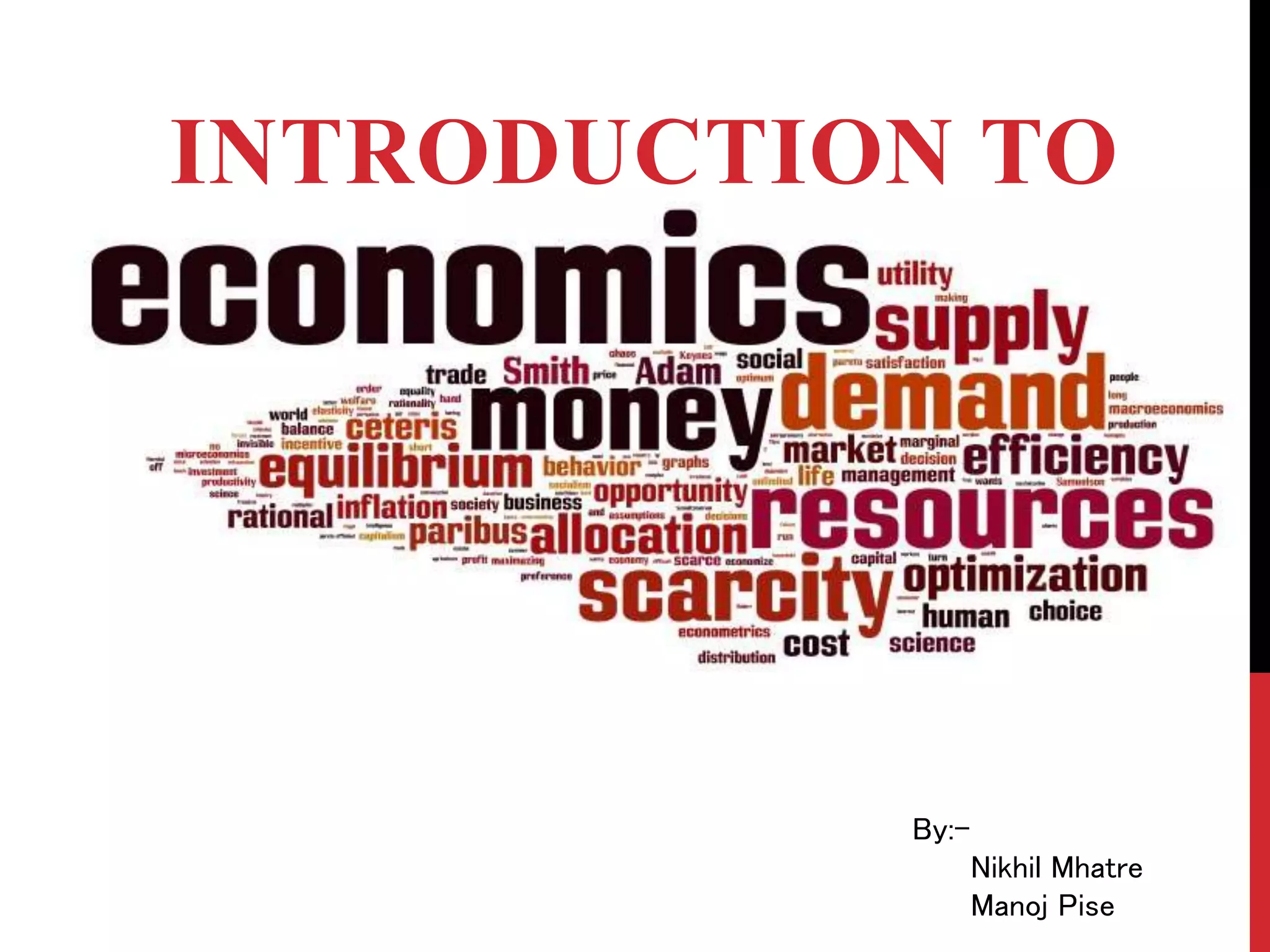
INTRODUCTION TO
ECONOMICS
By:-
Nikhil Mhatre
Manoj Pise
AGENDA
1) What is Economics?
2) Needs – Wants
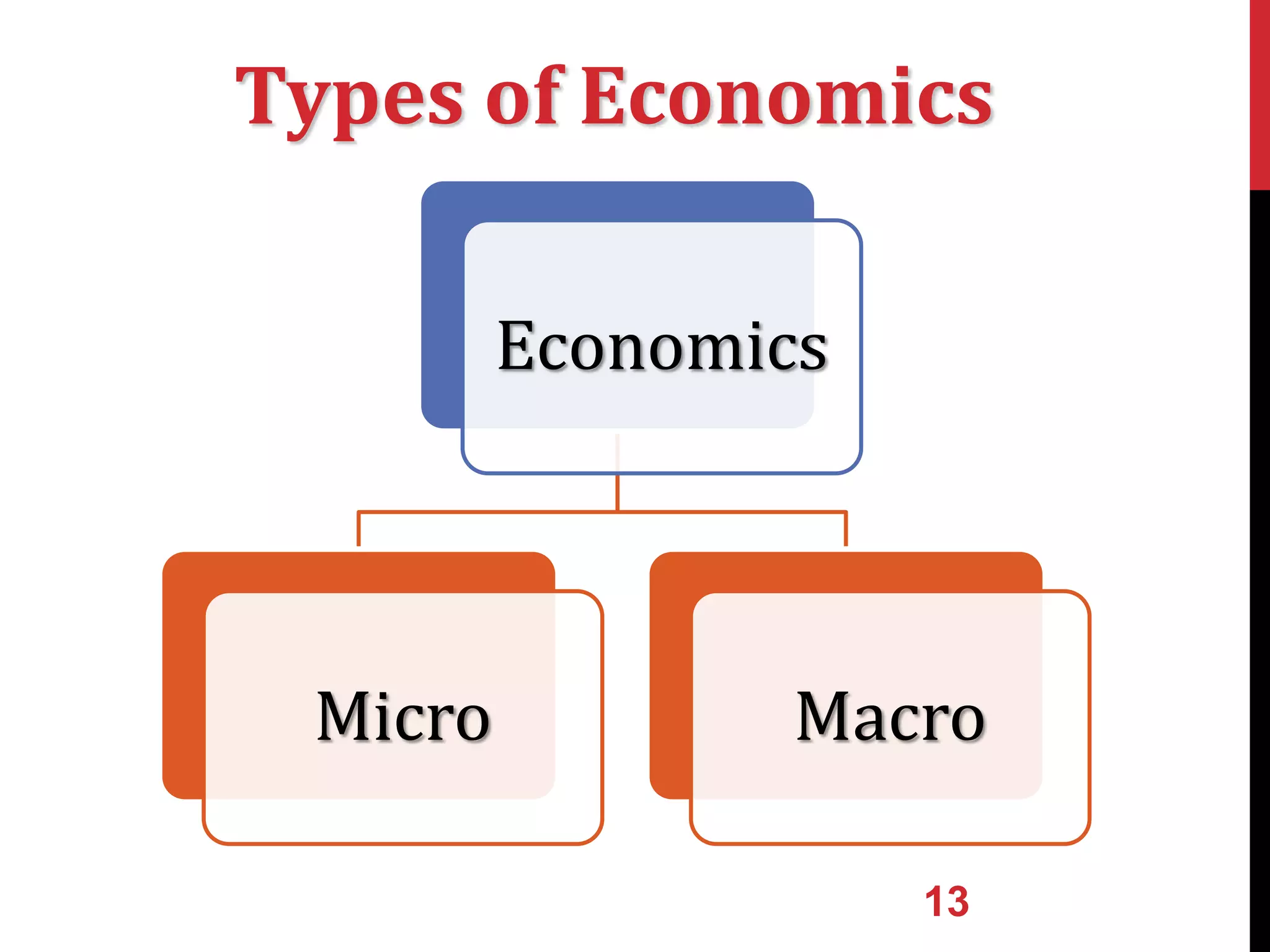
3) Types of Economics
4) Factors of production
5) The Economic Problems
6) Utility
7) Production Possibility Frontier
IMAGINE HOW WOULD BE LIFE LIKE
10000 YEARS AGO?
A NORMAL DAY
FIND FOOD
FIGHT FOR
FOOD
PROTECT YOURSELF FROM OTHER ANIMALS
DO THE SAME THING
EVERYDAY.
WHAT IS ECONOMICS
A social science that studies and
influences human behavior
Economics is the study of what
constitutes rational human behavior in
the endeavor to fulfill needs and wants.
What is Economics?
10
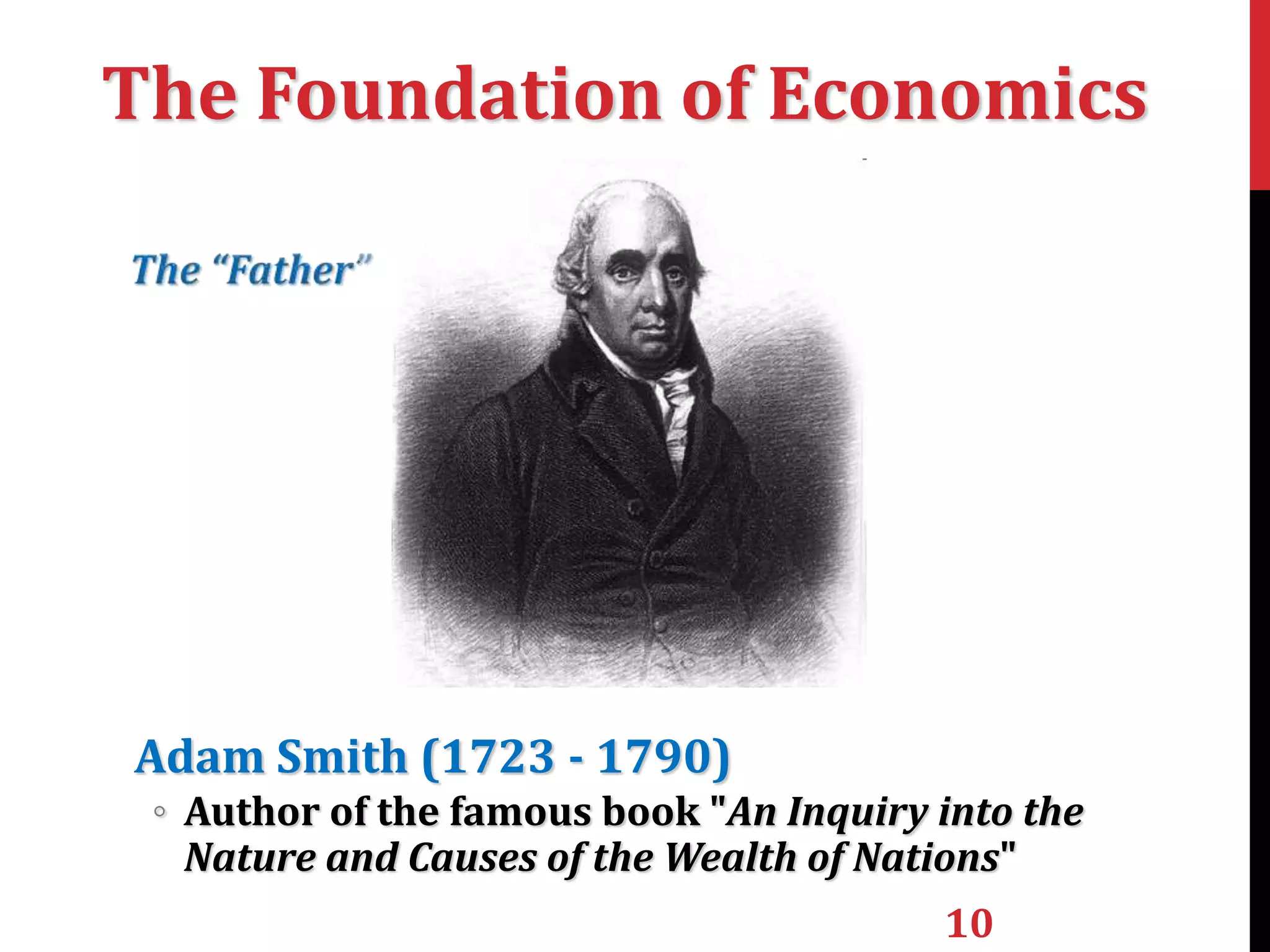
Adam Smith (1723 - 1790)
◦ Author of the famous book "An Inquiry into the
Nature and Causes of the Wealth of Nations"
The Foundation of Economics
THE FOUNDATION OF
ECONOMICS
11
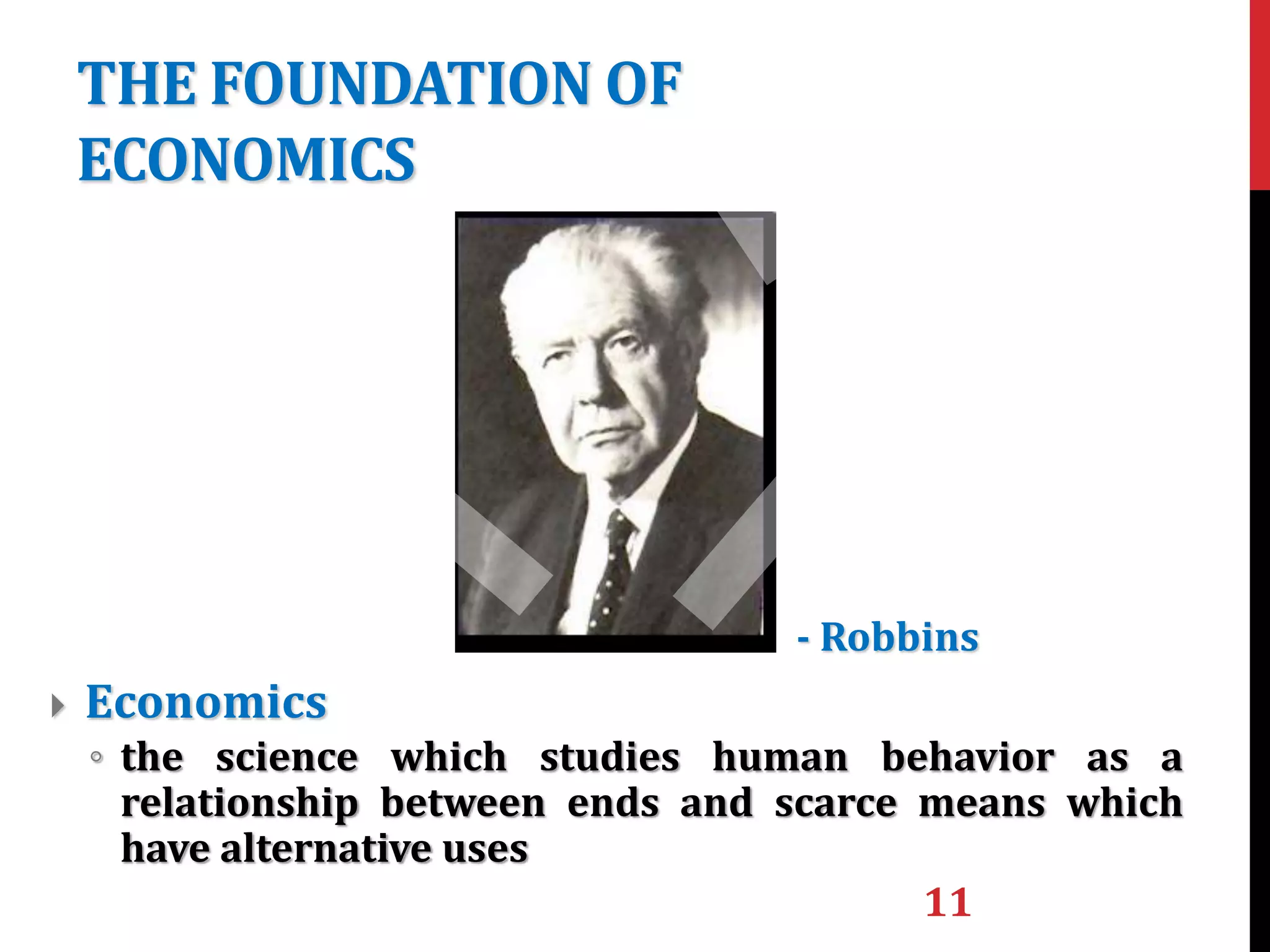
 Economics
◦ the science which studies human behavior as a
relationship between ends and scarce means which
have alternative uses
- Robbins
NEEDS AND WANTS
Needs:- “STUFF” we must have to survive.
• E.g.:- Food, Clothing and Shelter
Wants:- “STUFF” we would really like to have.
• E.g. :- Fancy Food, big screen TV, jewelry.
These are also known as Luxuries.
People try to balance needs and wants.
13
Economics
Micro Macro
Types of Economics
14
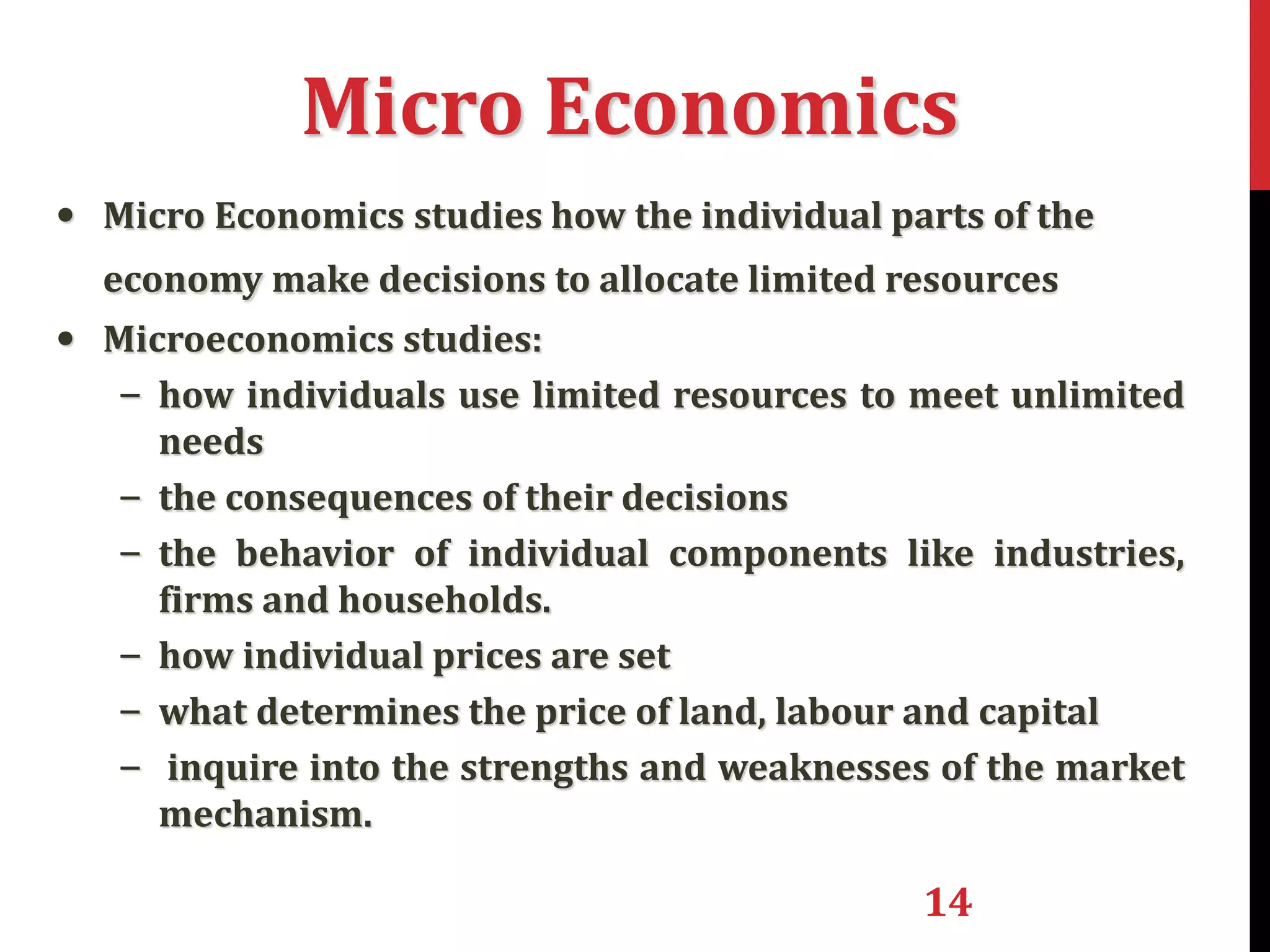
Micro Economics
• Micro Economics studies how the individual parts of the
economy make decisions to allocate limited resources
• Microeconomics studies:
– how individuals use limited resources to meet unlimited
needs
– the consequences of their decisions
– the behavior of individual components like industries,
firms and households.
– how individual prices are set
– what determines the price of land, labour and capital
– inquire into the strengths and weaknesses of the market
mechanism.
15
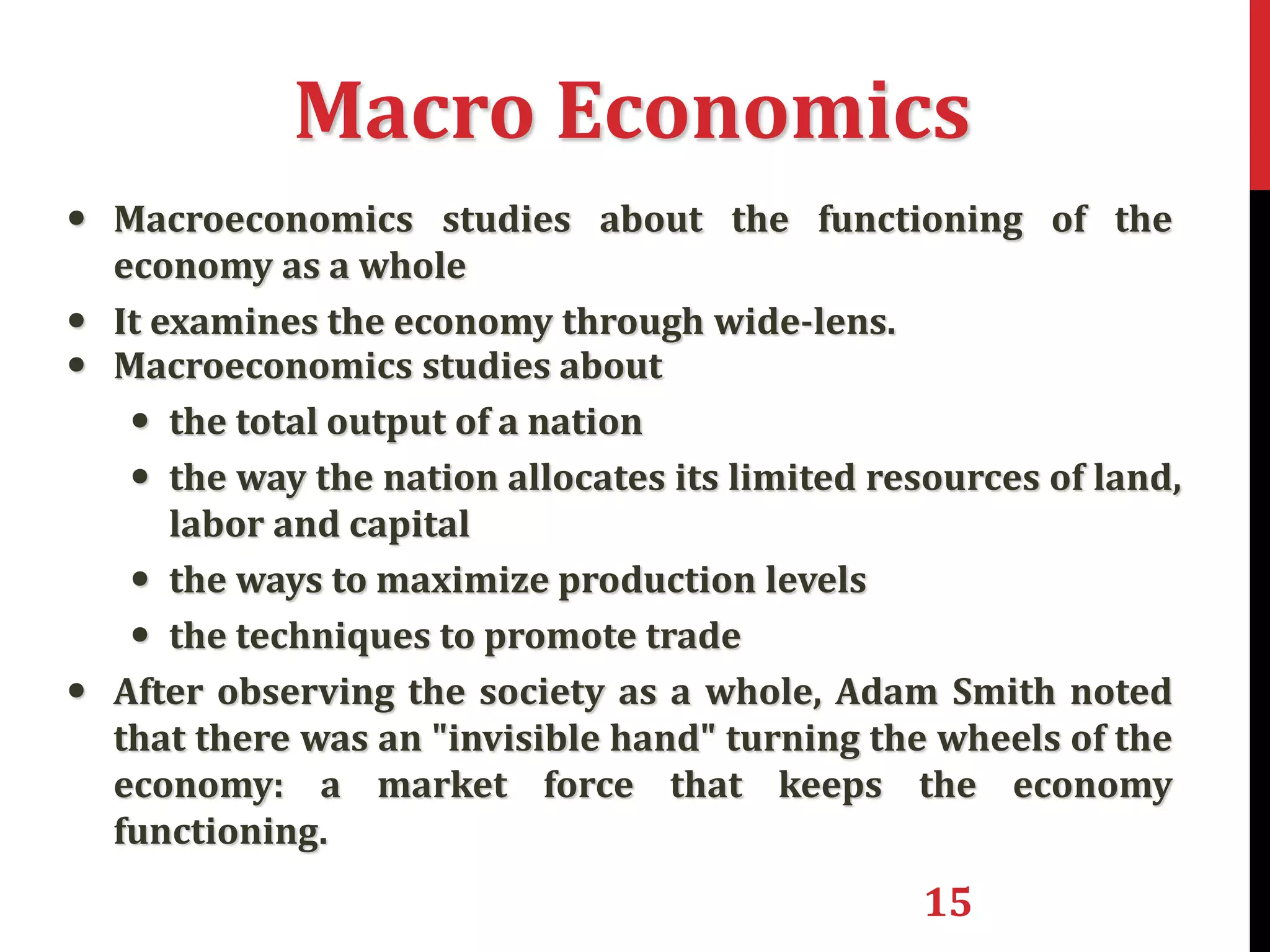
Macro Economics
• Macroeconomics studies about the functioning of the
economy as a whole
• It examines the economy through wide-lens.
• Macroeconomics studies about
• the total output of a nation
• the way the nation allocates its limited resources of land,
labor and capital
• the ways to maximize production levels
• the techniques to promote trade
• After observing the society as a whole, Adam Smith noted
that there was an "invisible hand" turning the wheels of the
economy: a market force that keeps the economy
functioning.
16
The Factors of Production
Product
Land
Labour Capital
Organization
17
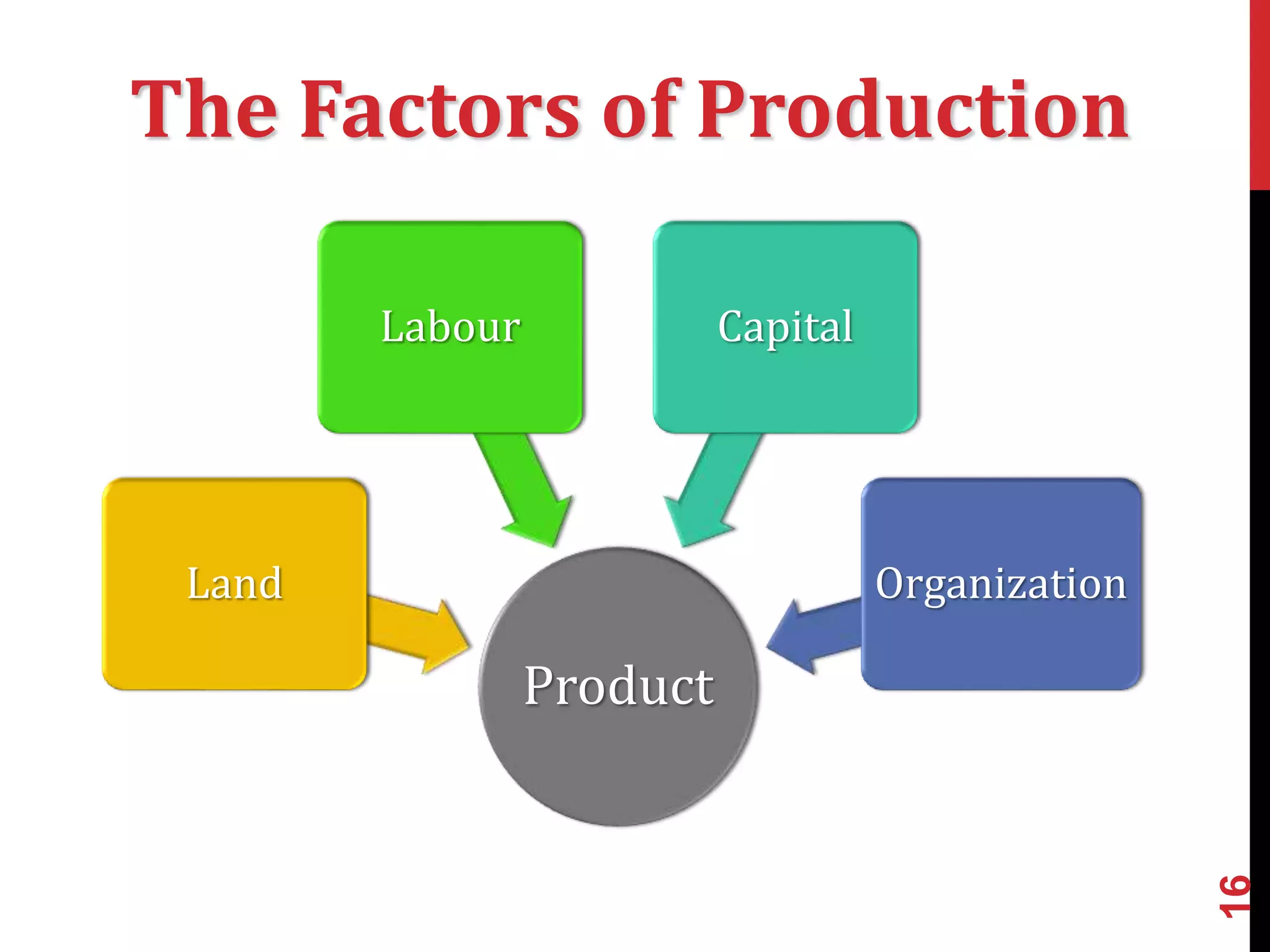
The Factors of
Production
Land includes the “gifts of nature,” or
natural resources not created by
human effort.
Capital includes the
tool,equipment,and factories used in
production.
Labour includes people with all their
efforts and abilities.
Entrepreneurs are individuals who
start a new business or bring a
product to market.
18
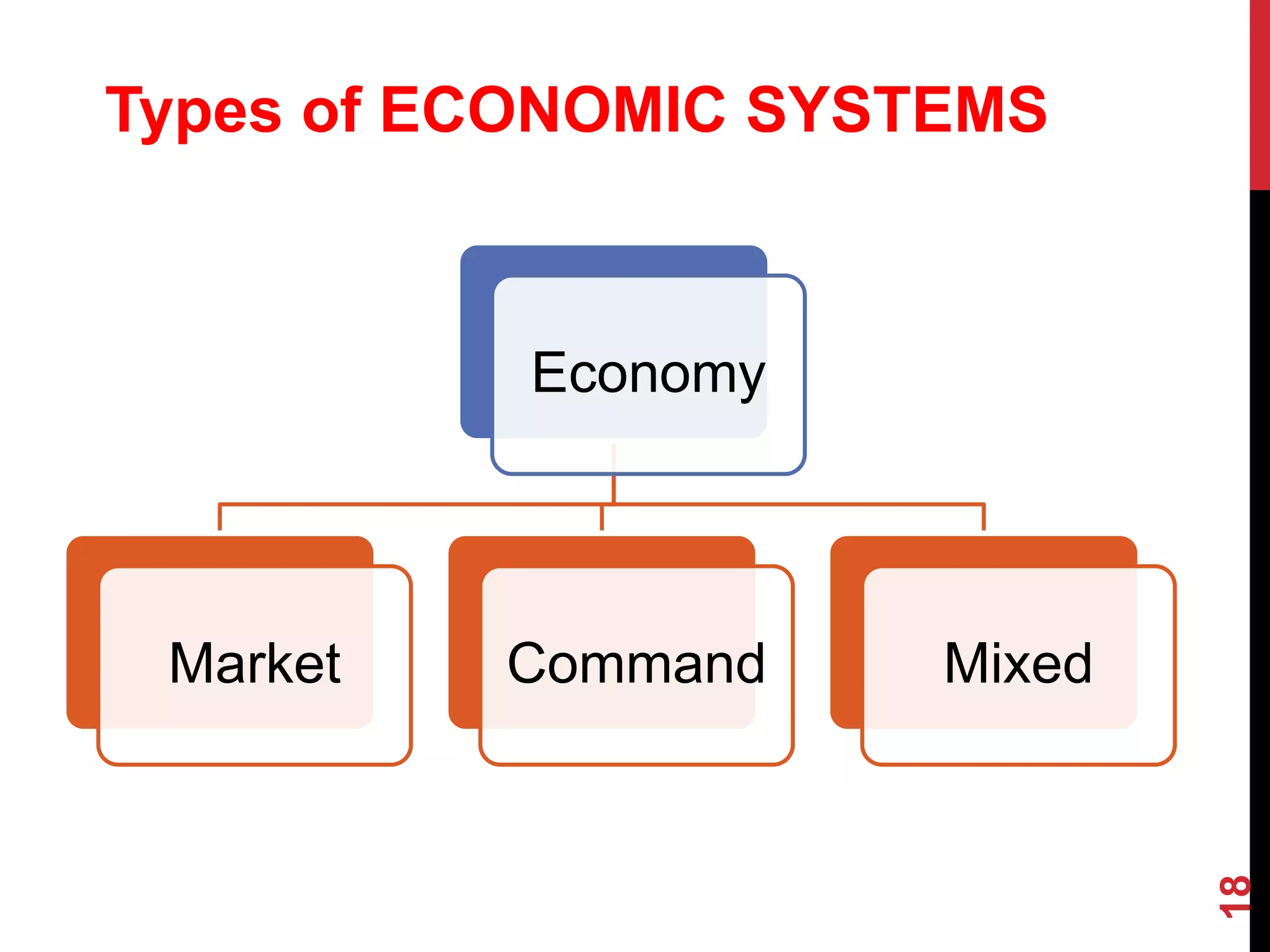
Economy
Market Command Mixed
Types of ECONOMIC SYSTEMS
19
In a pure market economy
there is no government
involvement in economic
decisions.
Market Economies
Contd….
20
The Government lets the market answer the
following three basic economic questions:
1. What ?
Consumers decide what should be produced in a
market economy through the purchases they make.
2.How ?
Production is left entirely up to businesses. Businesses
must be competitive in such an economy and produce
quality products at lower prices than their competitors.
3.For whom ?
In a market economy, the people who have more money
are able to buy more goods and services.
21
In a command economy the
Government takes economic
decisions.
Command Economies
Contd….
22
In a command economy the Government answers
the three basic economic questions.
1. What?
A central planning committee decides what products
are needed.
2. How?
Since the Government owns all means of production in a
command economy, it decides how goods and services
will be produced.
3. For Whom ?
The Government decides who will get what is produced
in a command economy.
Command Economies
23
In the Mixed economies the
Government and the Market work
together in decision making
Mixed Economies
Contd…
THE ECONOMIC PROBLEM
Unlimited Wants
Scarce Resources – Land, Labour, Capital
Many Uses of Resources
24
THE ECONOMIC PROBLEM
What goods and services should an economy produce?
– should the emphasis be on agriculture, manufacturing
or services, should it be on sport and leisure or housing?
How should goods and services be produced?
– labour intensive, capital intensive?
Who should get the goods and services produced?
– Even distribution? More for the rich? For those who
work hard?
25
WHAT IS UTILITY?
Satisfaction
Can not be measured
• Marshall – Utility can be measured in Utils
26
OPPORTUNITY COST
Definition – the cost expressed in terms of
the next best alternative sacrificed
The cost of anything in terms of other things
given up or sacrificed.
27
PRODUCTION POSSIBILITY
FRONTIERS
PPF Shows the different combinations of goods
and services that can be produced with a given
amount of resources
No ‘ideal’ point on the curve
Any point inside the curve – suggests resources
are not being utilised efficiently
Any point outside the curve – not attainable
with the current level of resources
Useful to demonstrate economic growth and
opportunity cost
28
PRODUCTION POSSIBILITY
FRONTIERS
29
Capital Goods
Consumer Goods
Yo
Xo
A
BY1
X1
Assume a
country can
produce two
types of goods
with its
resources –
capital goods
and consumer
goods
If it devotes all
resources to
capital goods it
could produce a
maximum of Ym.
If it devotes all its
resources to
consumer goods it
could produce a
maximum of Xm
Ym
Xm
If the country is
at point A on the
PPF It can
produce the
combination of Yo
capital goods and
Xo consumer
goods
If it reallocates its
resources (moving
round the PPF from A
to B) it can produce
more consumer goods
but only at the expense
of fewer capital goods.
The opportunity cost of
producing an extra Xo –
X1 consumer goods is
Yo – Y1 capital goods.
30
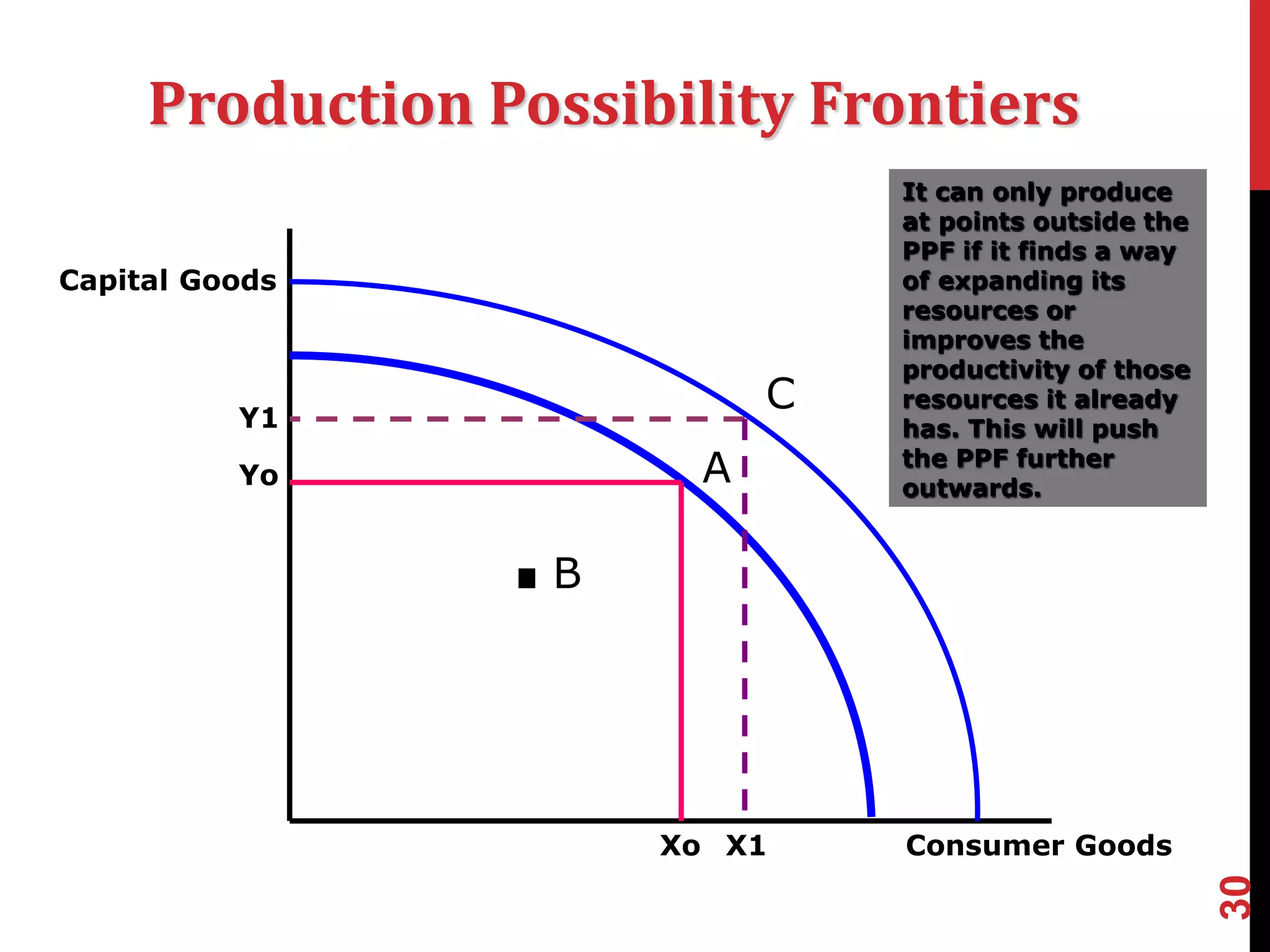
Production Possibility Frontiers
Capital Goods
Consumer Goods
Yo
Xo
A
.B
CY1
X1
Production
inside the
PPF – e.g.
point B
means the
country is not
using all its
resources
It can only produce
at points outside the
PPF if it finds a way
of expanding its
resources or
improves the
productivity of those
resources it already
has. This will push
the PPF further
outwards.
Introduction to Economics

Introduction to Economics

  • 1.
  • 2.
    AGENDA 1) What isEconomics? 2) Needs – Wants 3) Types of Economics 4) Factors of production 5) The Economic Problems 6) Utility 7) Production Possibility Frontier
  • 3.
    IMAGINE HOW WOULDBE LIFE LIKE 10000 YEARS AGO?
  • 4.
  • 5.
  • 6.
    PROTECT YOURSELF FROMOTHER ANIMALS
  • 7.
    DO THE SAMETHING EVERYDAY.
  • 8.
  • 9.
    A social sciencethat studies and influences human behavior Economics is the study of what constitutes rational human behavior in the endeavor to fulfill needs and wants. What is Economics?
  • 10.
    10 Adam Smith (1723- 1790) ◦ Author of the famous book "An Inquiry into the Nature and Causes of the Wealth of Nations" The Foundation of Economics
  • 11.
    THE FOUNDATION OF ECONOMICS 11 Economics ◦ the science which studies human behavior as a relationship between ends and scarce means which have alternative uses - Robbins
  • 12.
    NEEDS AND WANTS Needs:-“STUFF” we must have to survive. • E.g.:- Food, Clothing and Shelter Wants:- “STUFF” we would really like to have. • E.g. :- Fancy Food, big screen TV, jewelry. These are also known as Luxuries. People try to balance needs and wants.
  • 13.
  • 14.
    14 Micro Economics • MicroEconomics studies how the individual parts of the economy make decisions to allocate limited resources • Microeconomics studies: – how individuals use limited resources to meet unlimited needs – the consequences of their decisions – the behavior of individual components like industries, firms and households. – how individual prices are set – what determines the price of land, labour and capital – inquire into the strengths and weaknesses of the market mechanism.
  • 15.
    15 Macro Economics • Macroeconomicsstudies about the functioning of the economy as a whole • It examines the economy through wide-lens. • Macroeconomics studies about • the total output of a nation • the way the nation allocates its limited resources of land, labor and capital • the ways to maximize production levels • the techniques to promote trade • After observing the society as a whole, Adam Smith noted that there was an "invisible hand" turning the wheels of the economy: a market force that keeps the economy functioning.
  • 16.
    16 The Factors ofProduction Product Land Labour Capital Organization
  • 17.
    17 The Factors of Production Landincludes the “gifts of nature,” or natural resources not created by human effort. Capital includes the tool,equipment,and factories used in production. Labour includes people with all their efforts and abilities. Entrepreneurs are individuals who start a new business or bring a product to market.
  • 18.
  • 19.
    19 In a puremarket economy there is no government involvement in economic decisions. Market Economies Contd….
  • 20.
    20 The Government letsthe market answer the following three basic economic questions: 1. What ? Consumers decide what should be produced in a market economy through the purchases they make. 2.How ? Production is left entirely up to businesses. Businesses must be competitive in such an economy and produce quality products at lower prices than their competitors. 3.For whom ? In a market economy, the people who have more money are able to buy more goods and services.
  • 21.
    21 In a commandeconomy the Government takes economic decisions. Command Economies Contd….
  • 22.
    22 In a commandeconomy the Government answers the three basic economic questions. 1. What? A central planning committee decides what products are needed. 2. How? Since the Government owns all means of production in a command economy, it decides how goods and services will be produced. 3. For Whom ? The Government decides who will get what is produced in a command economy. Command Economies
  • 23.
    23 In the Mixedeconomies the Government and the Market work together in decision making Mixed Economies Contd…
  • 24.
    THE ECONOMIC PROBLEM UnlimitedWants Scarce Resources – Land, Labour, Capital Many Uses of Resources 24
  • 25.
    THE ECONOMIC PROBLEM Whatgoods and services should an economy produce? – should the emphasis be on agriculture, manufacturing or services, should it be on sport and leisure or housing? How should goods and services be produced? – labour intensive, capital intensive? Who should get the goods and services produced? – Even distribution? More for the rich? For those who work hard? 25
  • 26.
    WHAT IS UTILITY? Satisfaction Cannot be measured • Marshall – Utility can be measured in Utils 26
  • 27.
    OPPORTUNITY COST Definition –the cost expressed in terms of the next best alternative sacrificed The cost of anything in terms of other things given up or sacrificed. 27
  • 28.
    PRODUCTION POSSIBILITY FRONTIERS PPF Showsthe different combinations of goods and services that can be produced with a given amount of resources No ‘ideal’ point on the curve Any point inside the curve – suggests resources are not being utilised efficiently Any point outside the curve – not attainable with the current level of resources Useful to demonstrate economic growth and opportunity cost 28
  • 29.
    PRODUCTION POSSIBILITY FRONTIERS 29 Capital Goods ConsumerGoods Yo Xo A BY1 X1 Assume a country can produce two types of goods with its resources – capital goods and consumer goods If it devotes all resources to capital goods it could produce a maximum of Ym. If it devotes all its resources to consumer goods it could produce a maximum of Xm Ym Xm If the country is at point A on the PPF It can produce the combination of Yo capital goods and Xo consumer goods If it reallocates its resources (moving round the PPF from A to B) it can produce more consumer goods but only at the expense of fewer capital goods. The opportunity cost of producing an extra Xo – X1 consumer goods is Yo – Y1 capital goods.
  • 30.
    30 Production Possibility Frontiers CapitalGoods Consumer Goods Yo Xo A .B CY1 X1 Production inside the PPF – e.g. point B means the country is not using all its resources It can only produce at points outside the PPF if it finds a way of expanding its resources or improves the productivity of those resources it already has. This will push the PPF further outwards.