Do you want to understand the basic economic questions that every nation faces?
This presentation explains why scarcity and choice are the basics of economics.
FUNDAMENTALS
OF ECONOMICS
At theend of this unit, we should:
Understand the basic economic questions that
every nation faces.
Explain why scarcity and choice are the basics of
economics.
2.
The Basic
Problem in
Economics
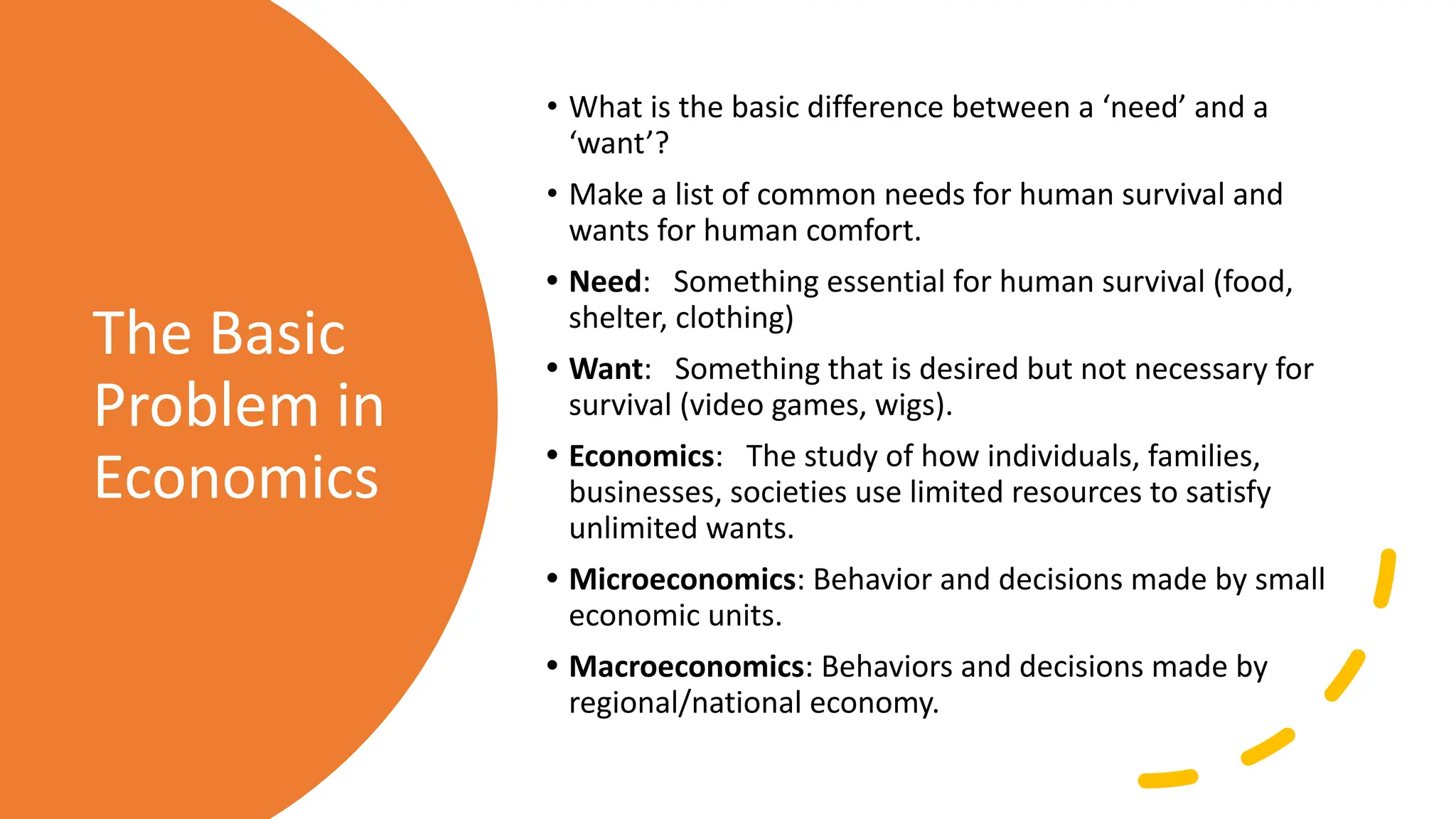
•What is the basic difference between a ‘need’ and a
‘want’?
• Make a list of common needs for human survival and
wants for human comfort.
• Need: Something essential for human survival (food,
shelter, clothing)
• Want: Something that is desired but not necessary for
survival (video games, wigs).
• Economics: The study of how individuals, families,
businesses, societies use limited resources to satisfy
unlimited wants.
• Microeconomics: Behavior and decisions made by small
economic units.
• Macroeconomics: Behaviors and decisions made by
regional/national economy.
3.
Fundamentals
of Economics:
Content
Vocabulary
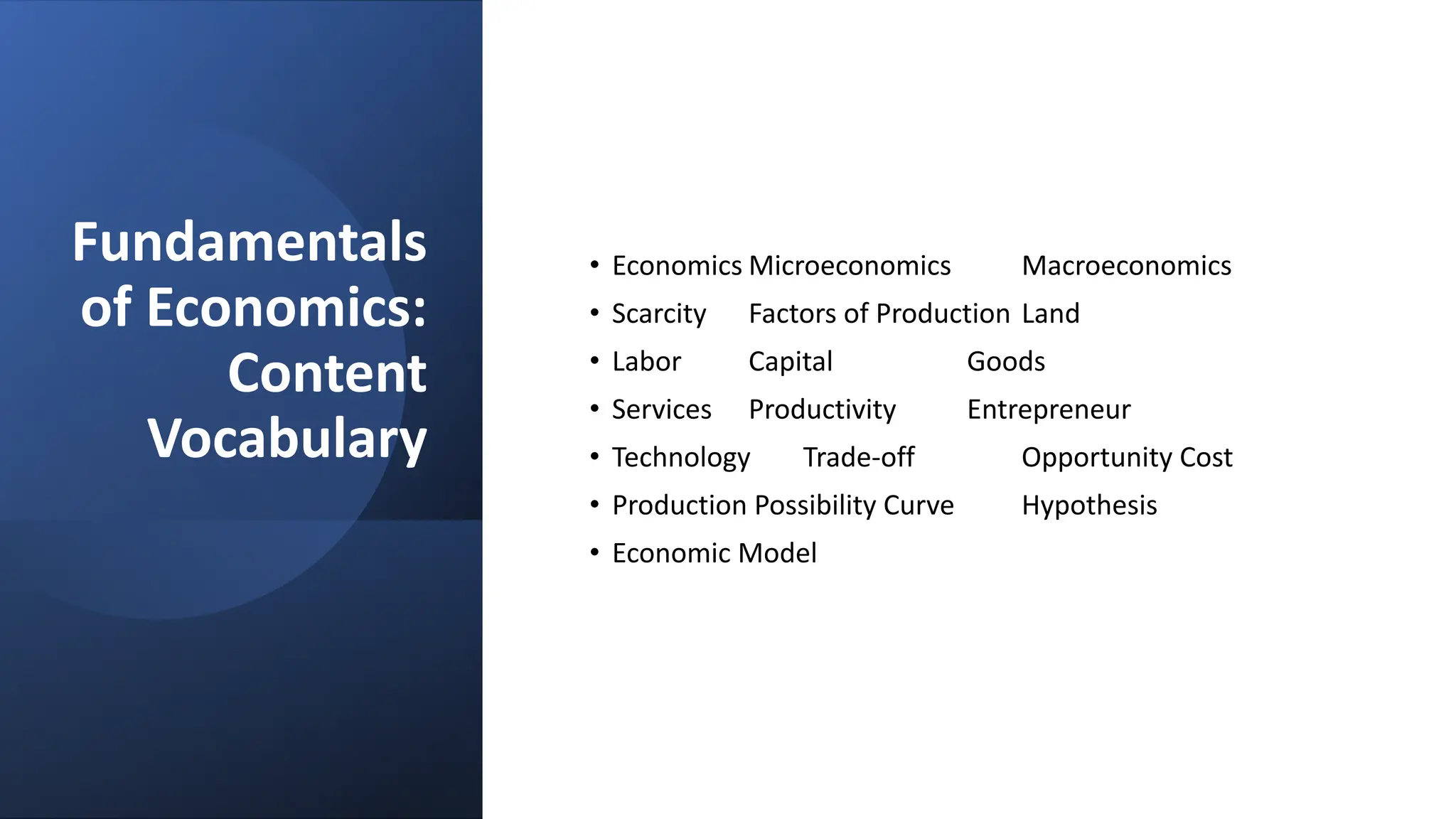
• EconomicsMicroeconomics Macroeconomics
• Scarcity Factors of Production Land
• Labor Capital Goods
• Services Productivity Entrepreneur
• Technology Trade-off Opportunity Cost
• Production Possibility Curve Hypothesis
• Economic Model
4.
Scarcity
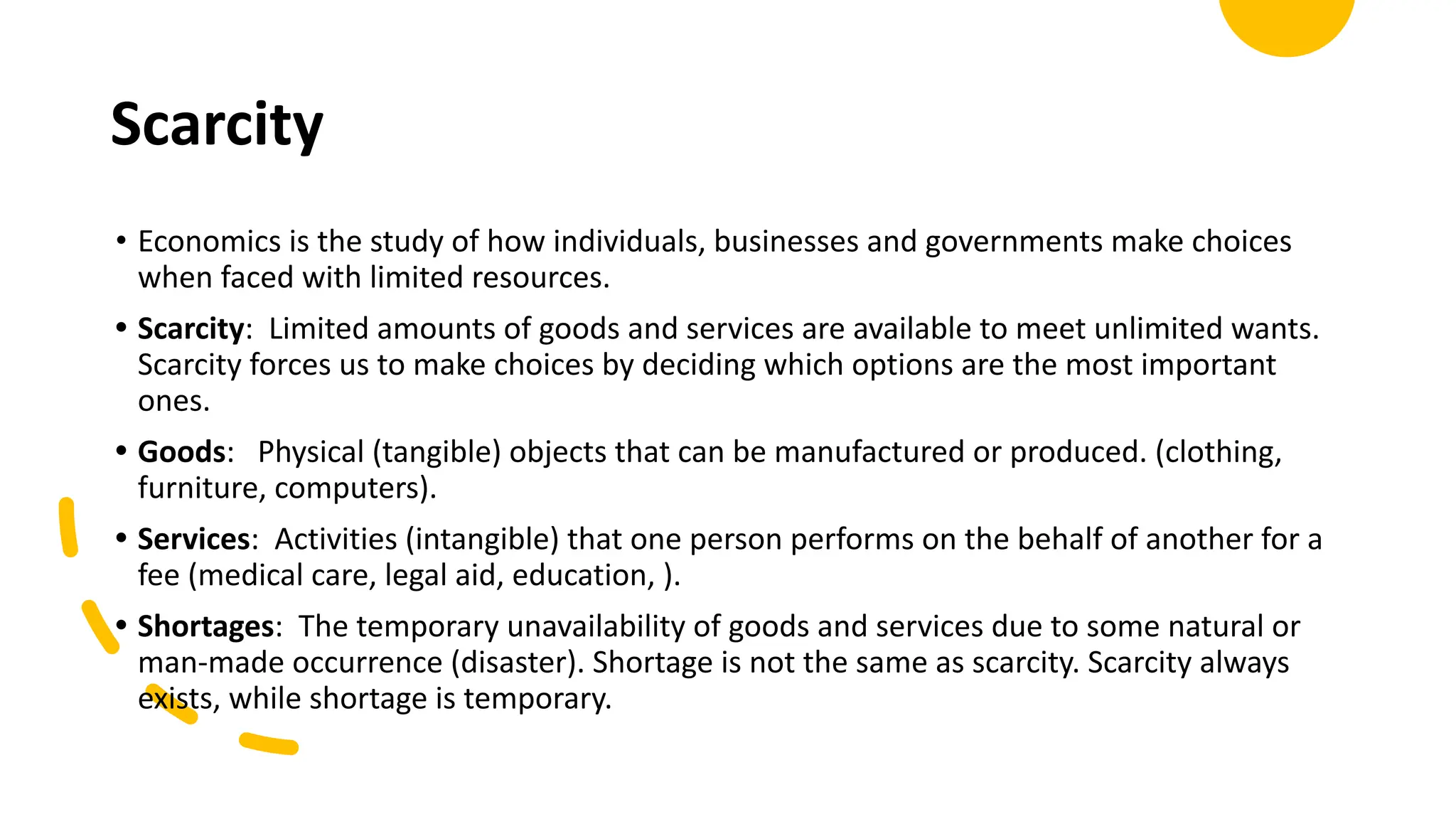
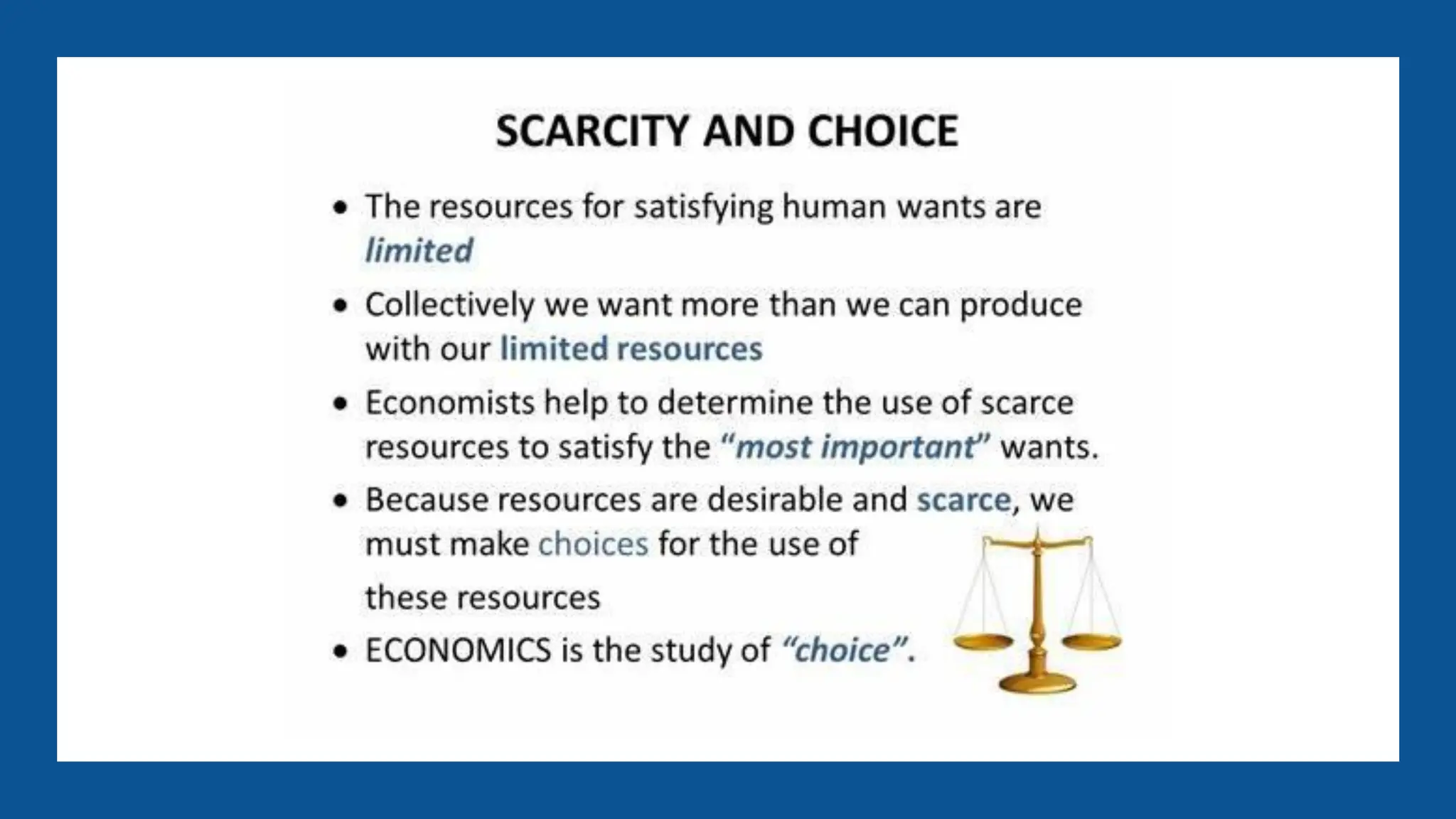
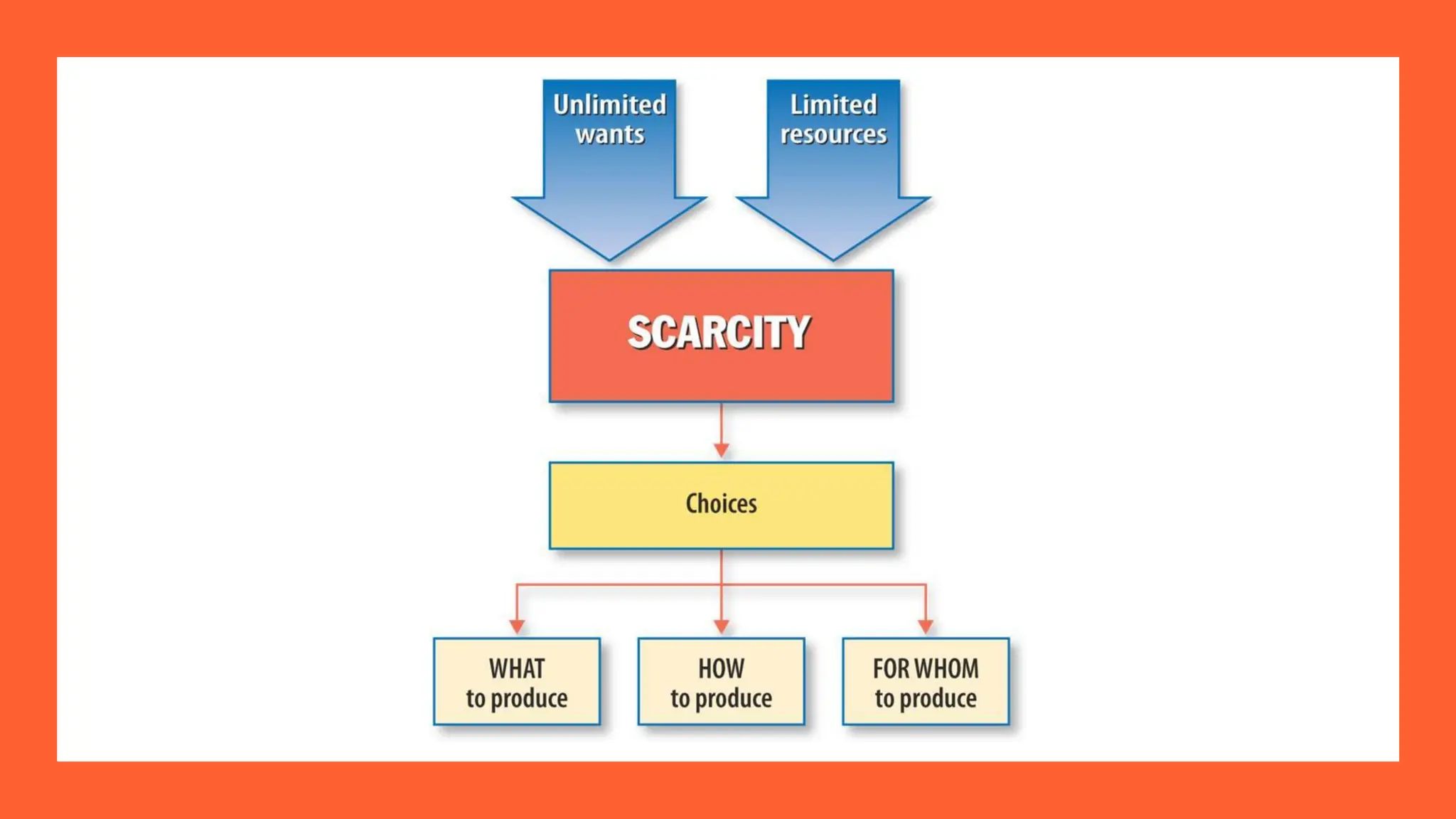
• Economics isthe study of how individuals, businesses and governments make choices
when faced with limited resources.
• Scarcity: Limited amounts of goods and services are available to meet unlimited wants.
Scarcity forces us to make choices by deciding which options are the most important
ones.
• Goods: Physical (tangible) objects that can be manufactured or produced. (clothing,
furniture, computers).
• Services: Activities (intangible) that one person performs on the behalf of another for a
fee (medical care, legal aid, education, ).
• Shortages: The temporary unavailability of goods and services due to some natural or
man-made occurrence (disaster). Shortage is not the same as scarcity. Scarcity always
exists, while shortage is temporary.
7.
The Factors of
Production1
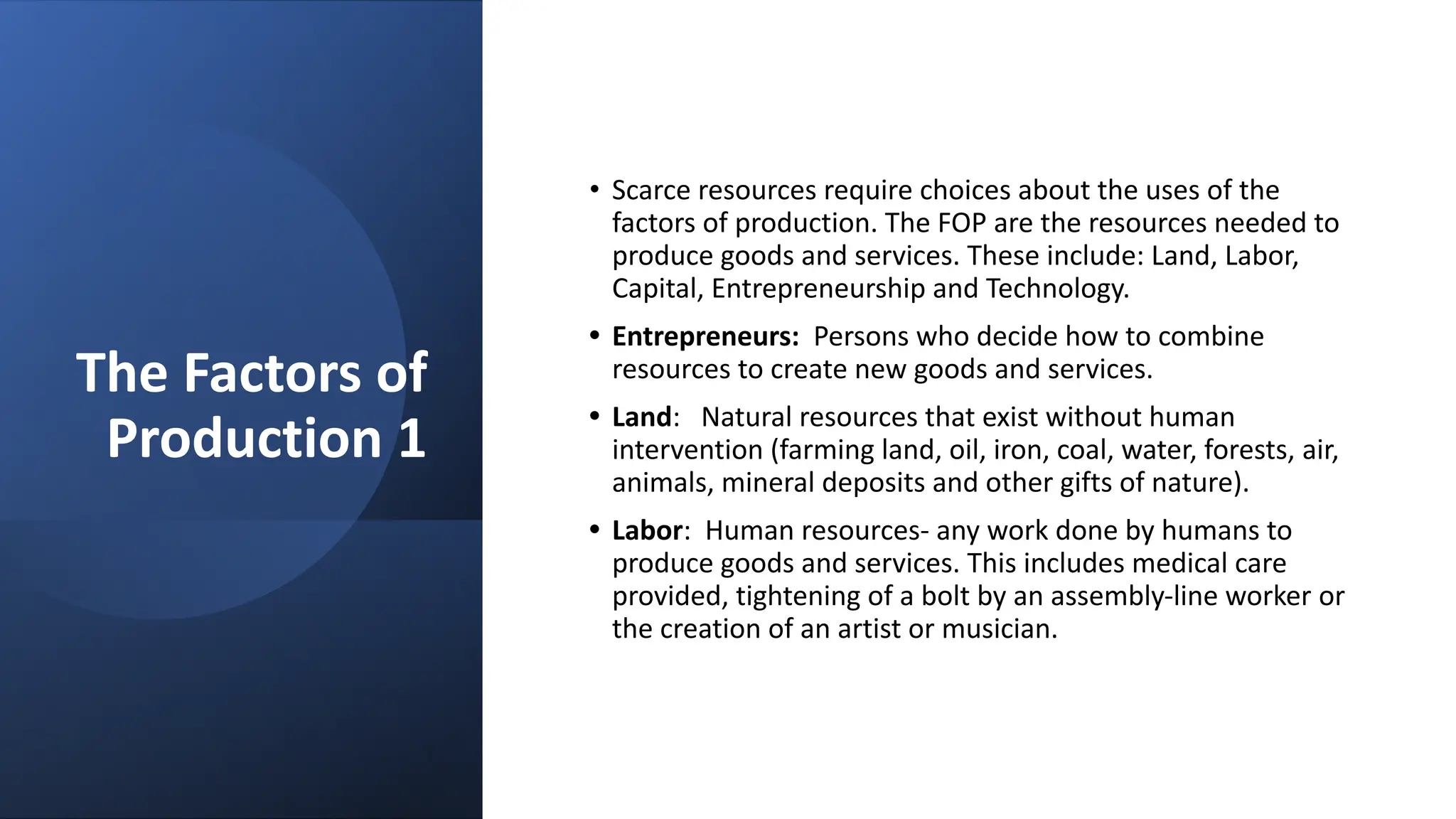
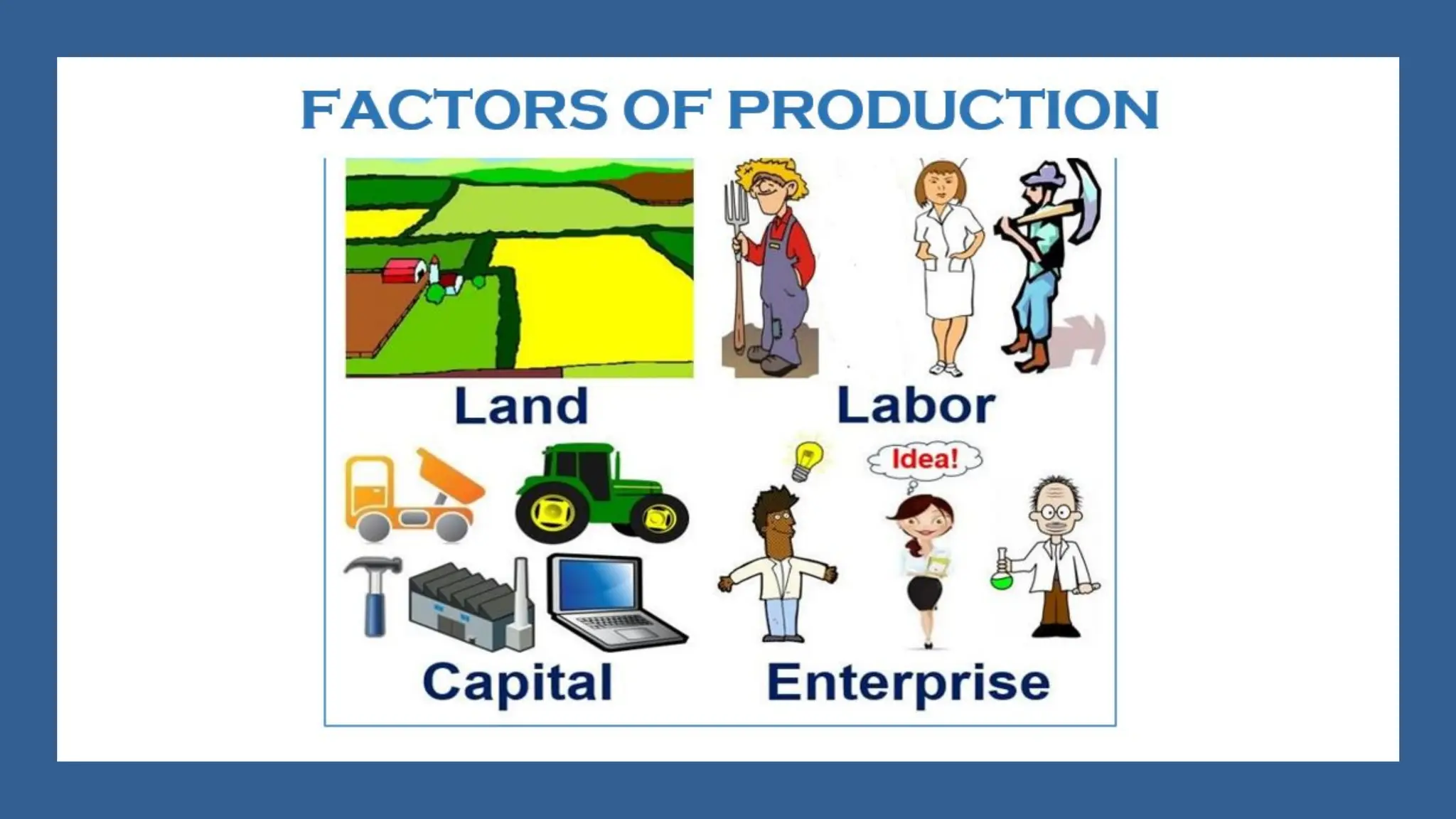
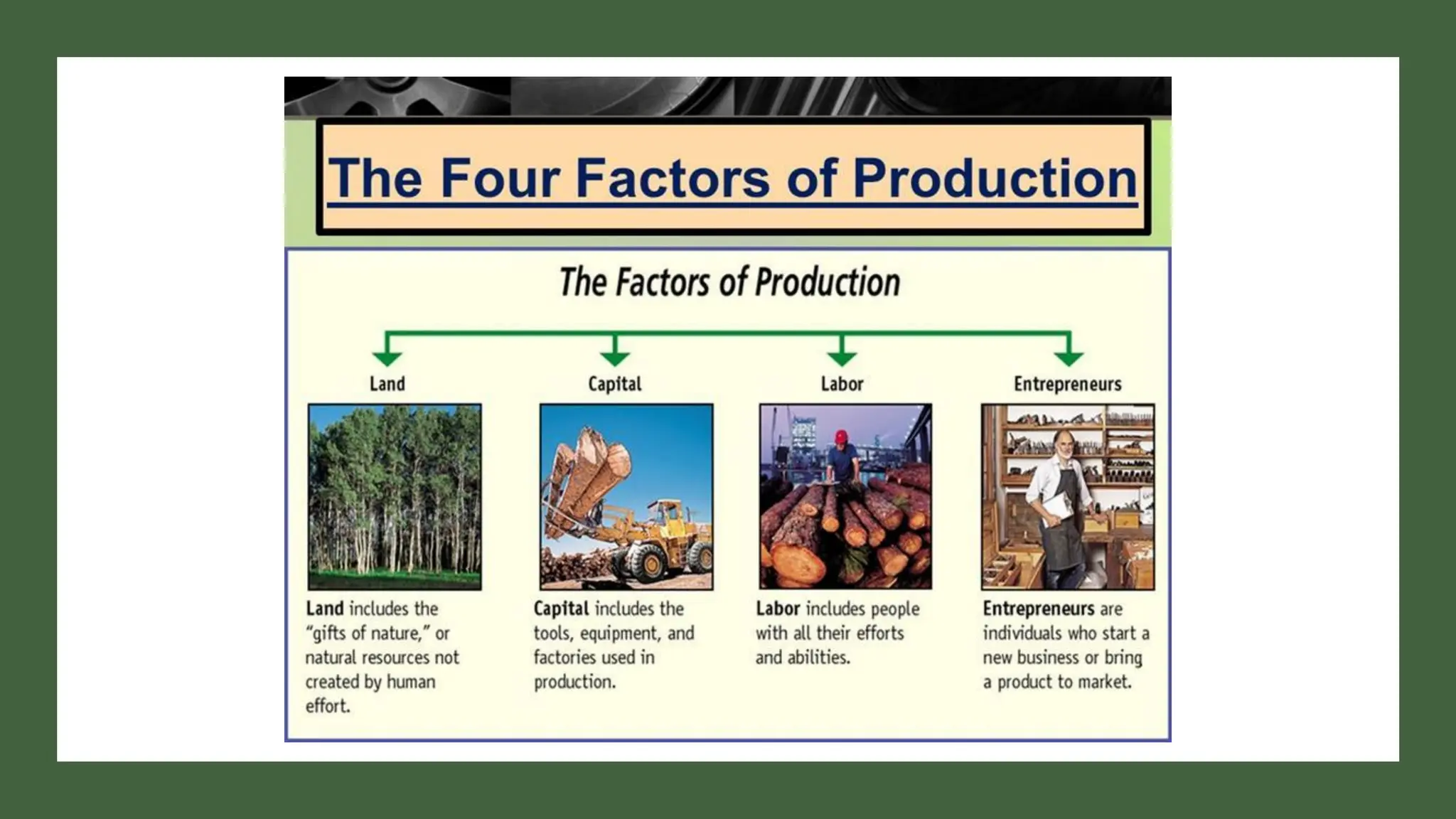
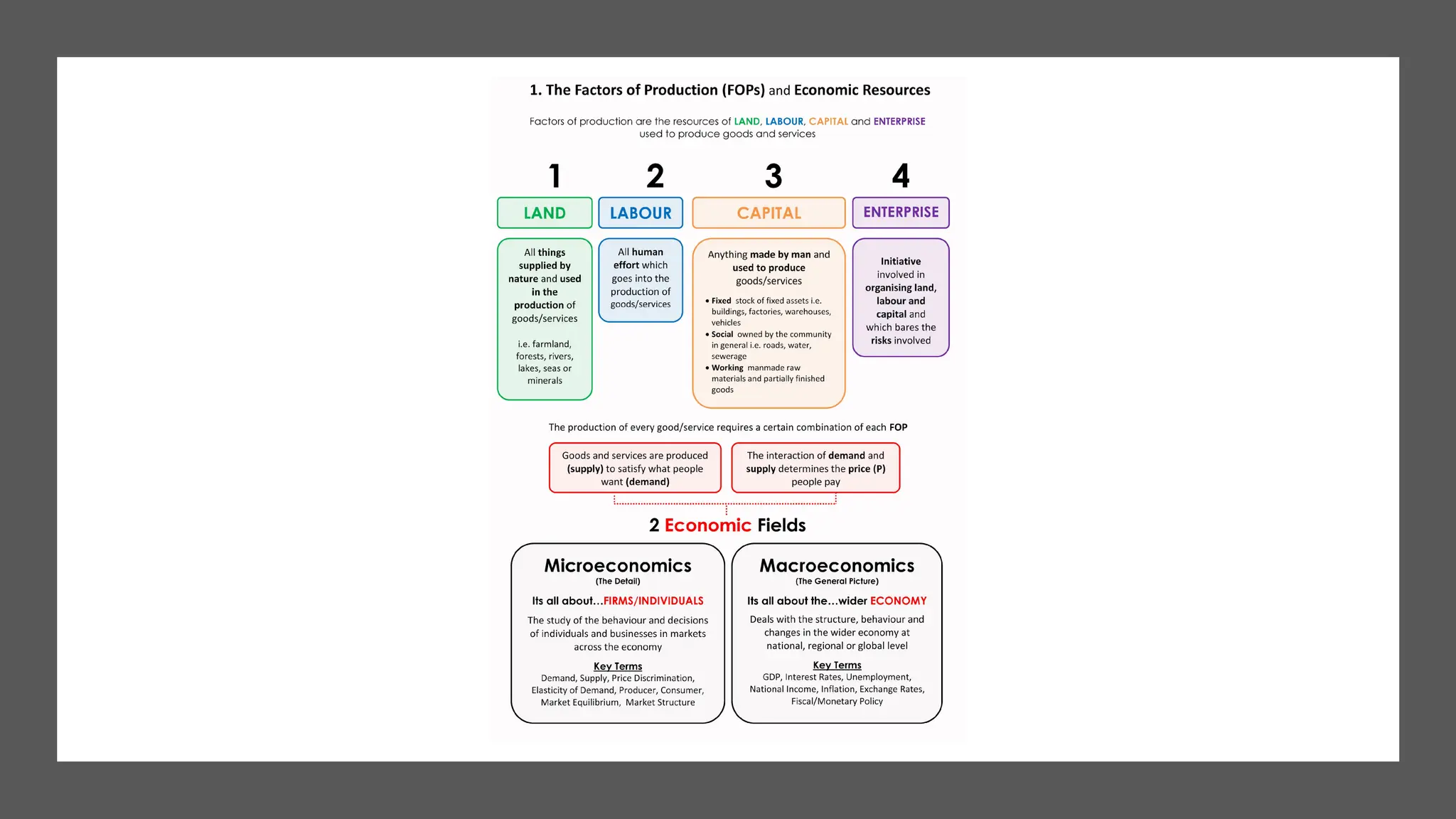
• Scarce resources require choices about the uses of the
factors of production. The FOP are the resources needed to
produce goods and services. These include: Land, Labor,
Capital, Entrepreneurship and Technology.
• Entrepreneurs: Persons who decide how to combine
resources to create new goods and services.
• Land: Natural resources that exist without human
intervention (farming land, oil, iron, coal, water, forests, air,
animals, mineral deposits and other gifts of nature).
• Labor: Human resources- any work done by humans to
produce goods and services. This includes medical care
provided, tightening of a bolt by an assembly-line worker or
the creation of an artist or musician.
8.
Factors of
Production 2
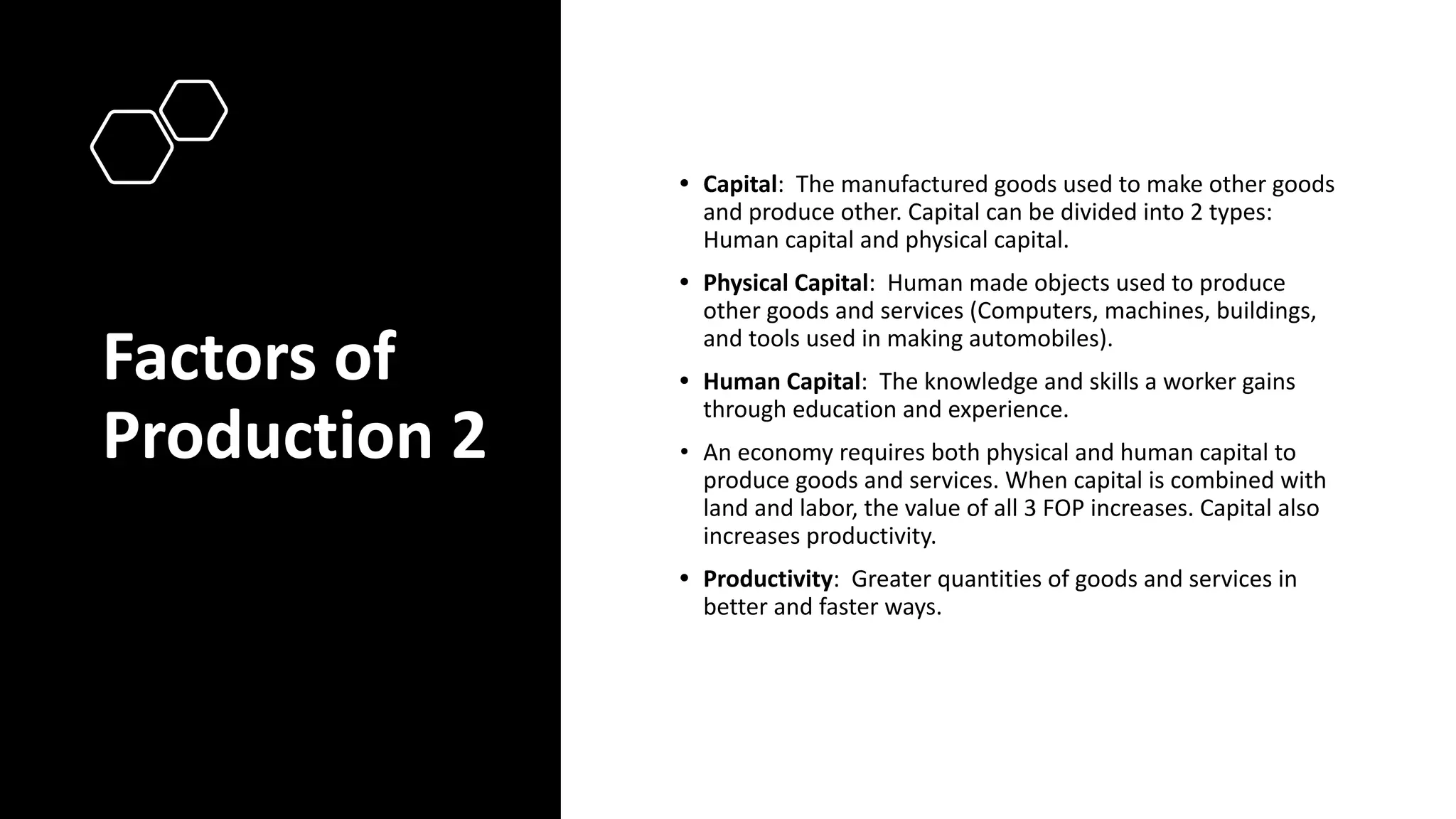
•Capital: The manufactured goods used to make other goods
and produce other. Capital can be divided into 2 types:
Human capital and physical capital.
• Physical Capital: Human made objects used to produce
other goods and services (Computers, machines, buildings,
and tools used in making automobiles).
• Human Capital: The knowledge and skills a worker gains
through education and experience.
• An economy requires both physical and human capital to
produce goods and services. When capital is combined with
land and labor, the value of all 3 FOP increases. Capital also
increases productivity.
• Productivity: Greater quantities of goods and services in
better and faster ways.
9.
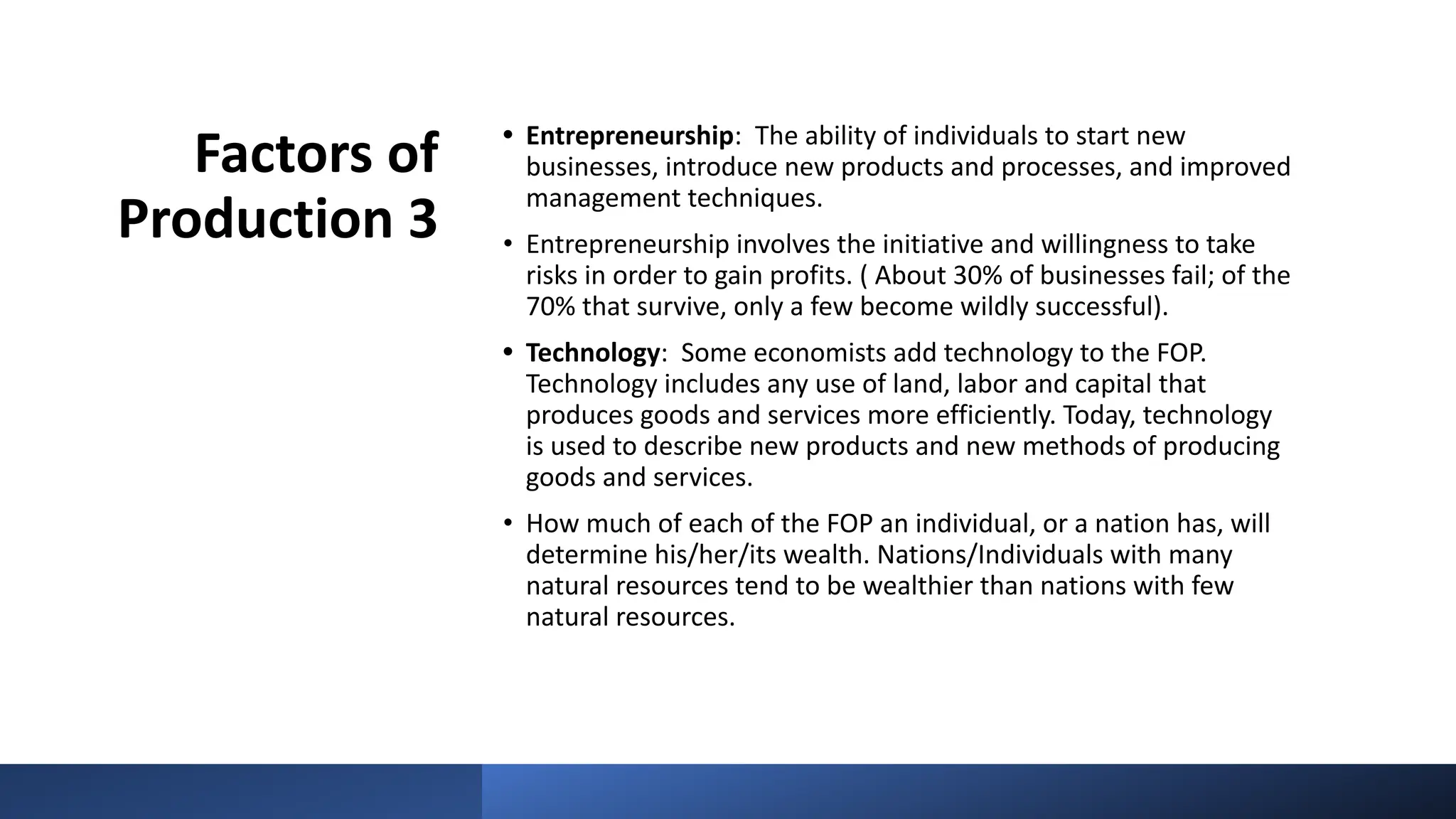
Factors of
Production 3
•Entrepreneurship: The ability of individuals to start new
businesses, introduce new products and processes, and improved
management techniques.
• Entrepreneurship involves the initiative and willingness to take
risks in order to gain profits. ( About 30% of businesses fail; of the
70% that survive, only a few become wildly successful).
• Technology: Some economists add technology to the FOP.
Technology includes any use of land, labor and capital that
produces goods and services more efficiently. Today, technology
is used to describe new products and new methods of producing
goods and services.
• How much of each of the FOP an individual, or a nation has, will
determine his/her/its wealth. Nations/Individuals with many
natural resources tend to be wealthier than nations with few
natural resources.
13.
Trade-Offs
• Economic decisionsalways involve trade-offs that have costs.
The economic choices people make involve the exchanging of
one good/service for another. If you buy an iPhone, you are
exchanging your money for the right to own the iPhone.
• Trade-off: The sacrificing one good or service to purchase or
produce another. It can also be defined as the act of giving up
one benefit in order to gain another, greater benefit.
• Trade-offs often involve things that can be easily measured
(money, property, time). Trade-offs also include values that are
not easily measured (enjoyment, job satisfaction, altruistic
feelings of well being).
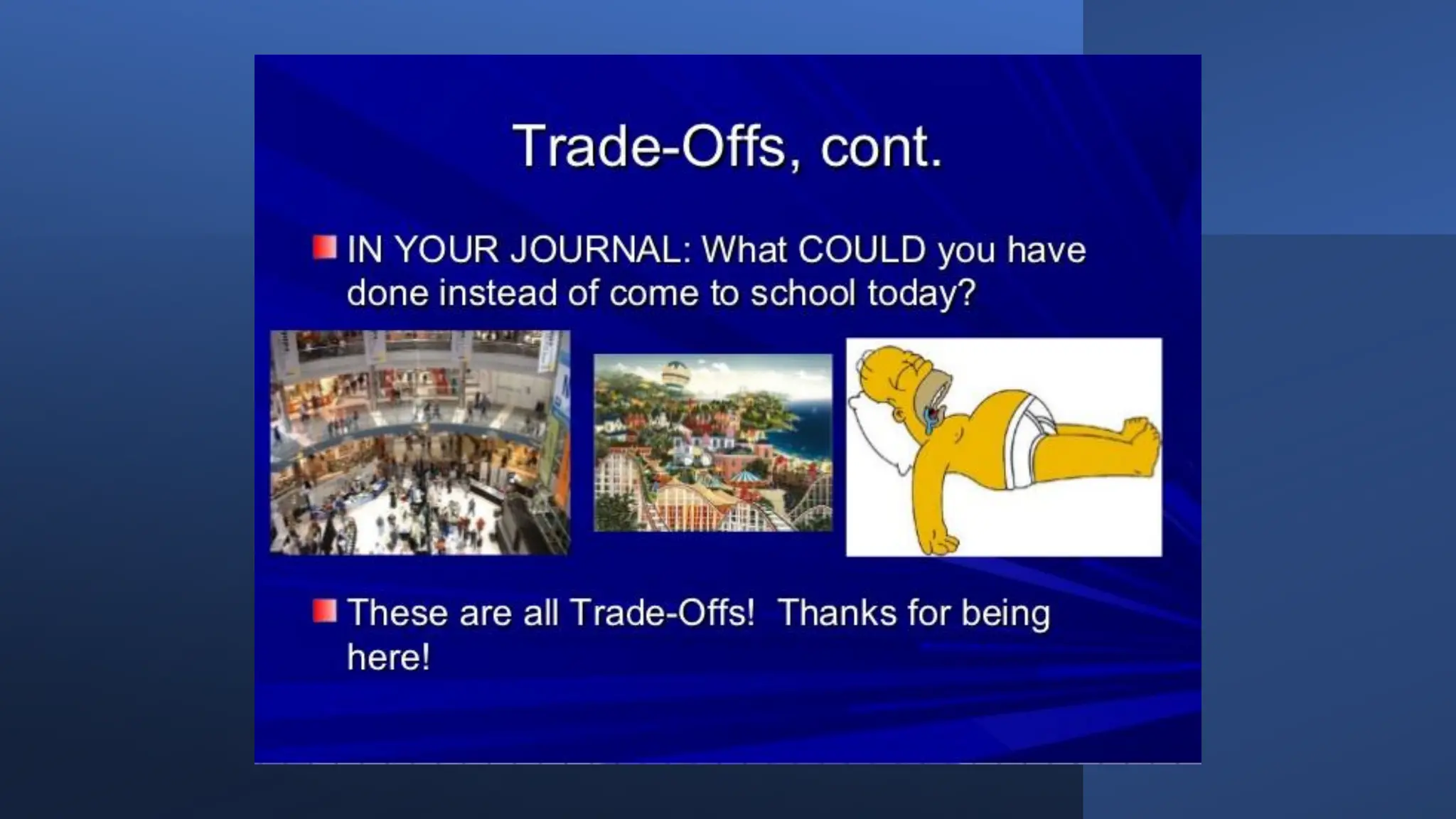
• The cost of a trade-off is what you give up in order to get or do
something else ( when you decide to study Econ for an hour,
you give up other activities you could have been engaged in
during the same time).
• Guns v. Butter: Government trade-off decisions based on the
choice to spending money on military priorities (guns) or
spending money on domestic needs (butter).
15.
Opportunity Cost
•In mosttrade-off situations, one of the rejected alternatives is more
desirable than the rest.
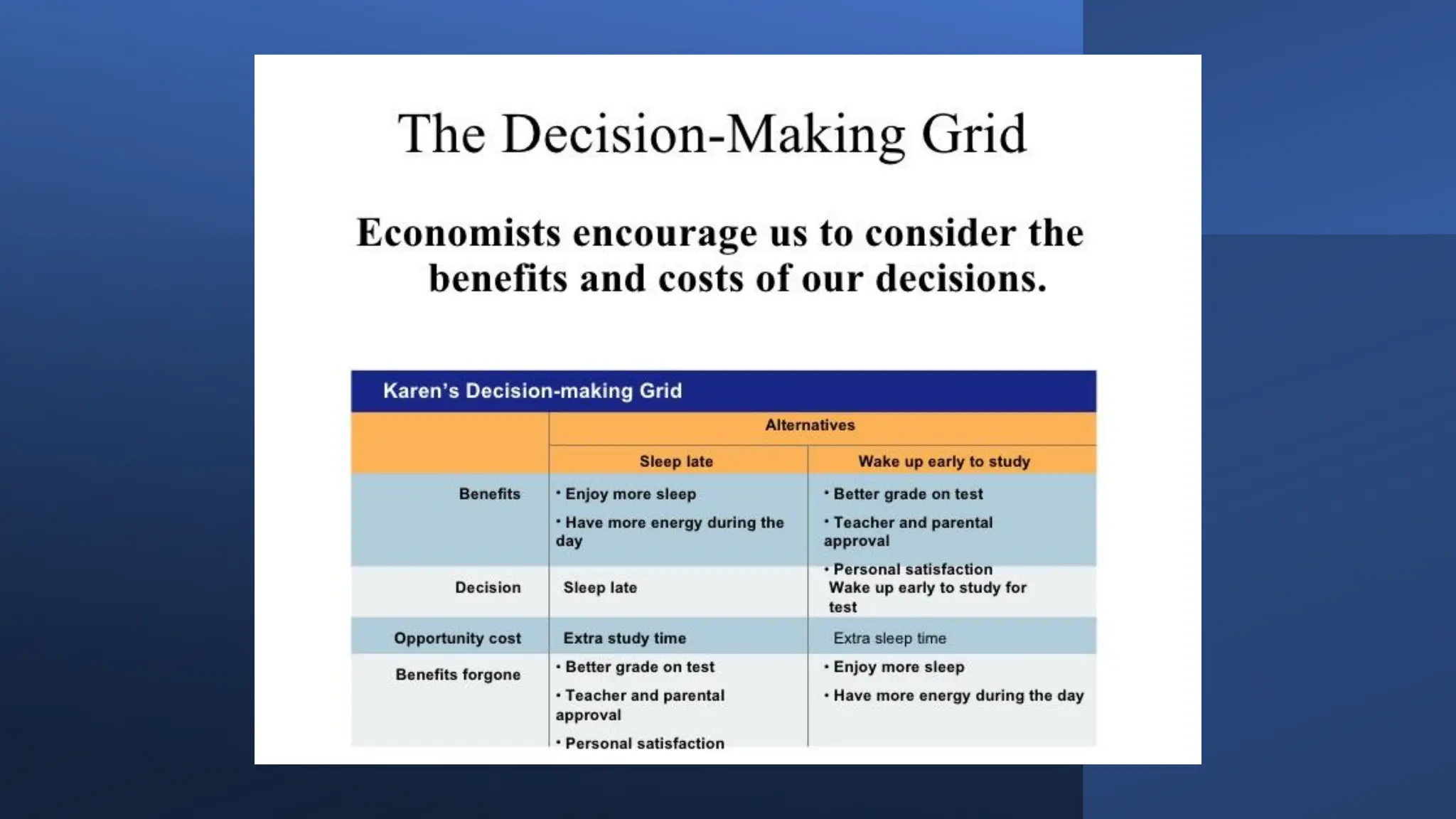
•Opportunity Cost: The most desired alternative that was sacrificed as
a result of the decision. It is the value of the next best alternative that
had to be given up. When one makes a trade-off, they automatically
lose something. That something is the opportunity cost.
•Being aware of trade-offs and opportunity costs is vital to the making
of economic decisions at all levels. Businesses must consider
trade-offs and opportunity costs when they choose to invest funds or
hire workers to produce one good rather than another.
17.
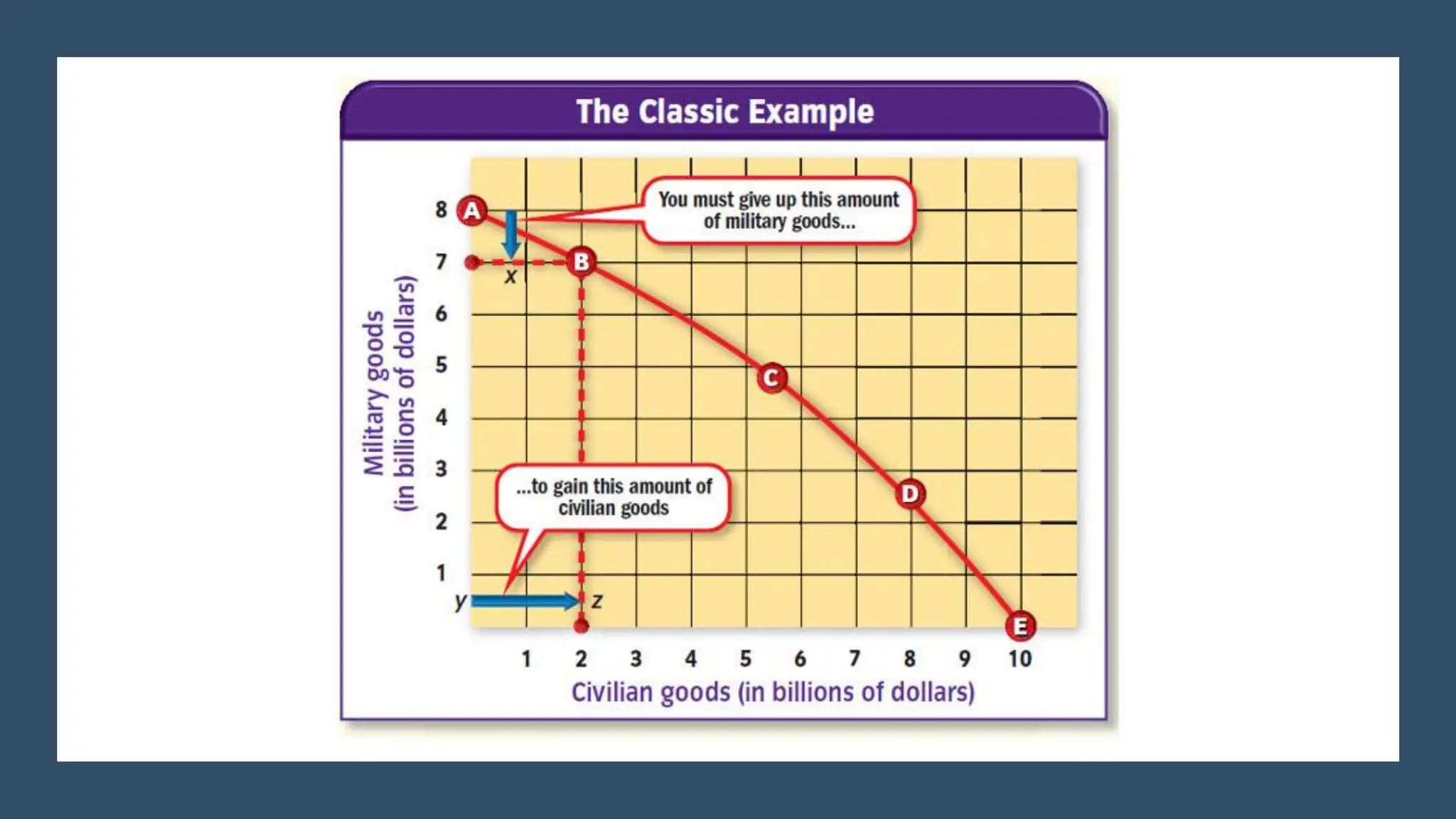
Production Possibility Curve
•Aproduction possibilities curve shows the maximum combinations of
goods and services that can be produced with a given amount of
resources.
•Many businesses produce more than one type of product (an
automobile manufacturer may produce several makes of cars per
plant in a given year. The company produces combinations of goods,
which results in an opportunity cost.
•The classic example of explaining production possibilities in
economics is the trade-off between military defense and civilian
goods (guns v butter).
19.
Economic
Models 1
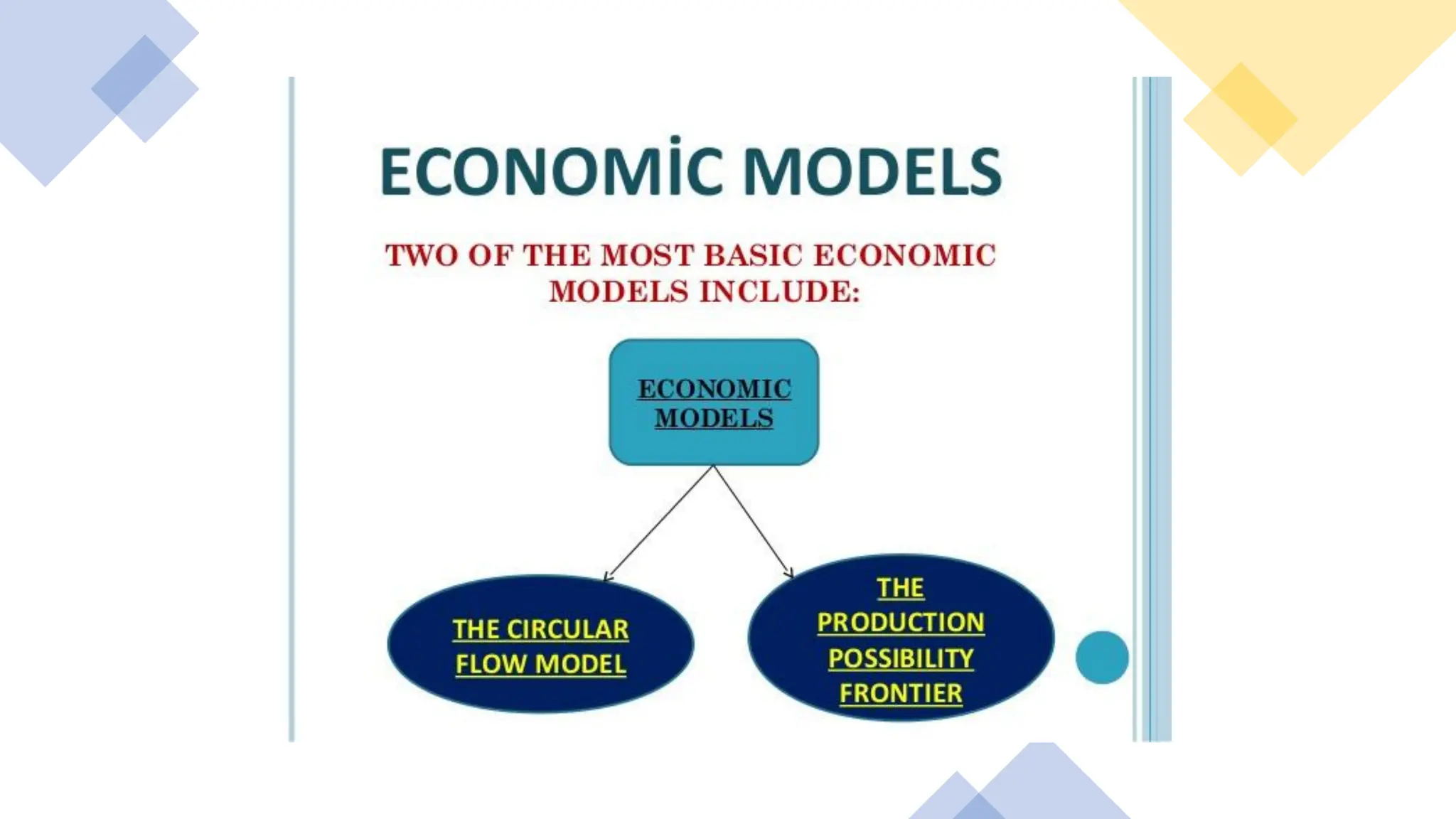
• Economistsconstruct models to investigate the way that
economic systems work.
• To economists, the word economy means all of the activity
in a nation that together affects the production,
distribution, and use of goods and services.
• When economists study specific parts of the economy, they
often formulate theories and gather data from the real
world. These theories are called economic models. The
study of these models can help explain and predict
economic behavior.
• Economic models are simplified representations of the real
world. Economists test these models and use the solutions
to form the basis for actual decisions by businesses or
governments. No economic model records every detail and
relationships that exists about the problem being studied.
20.
Economic
Models 2
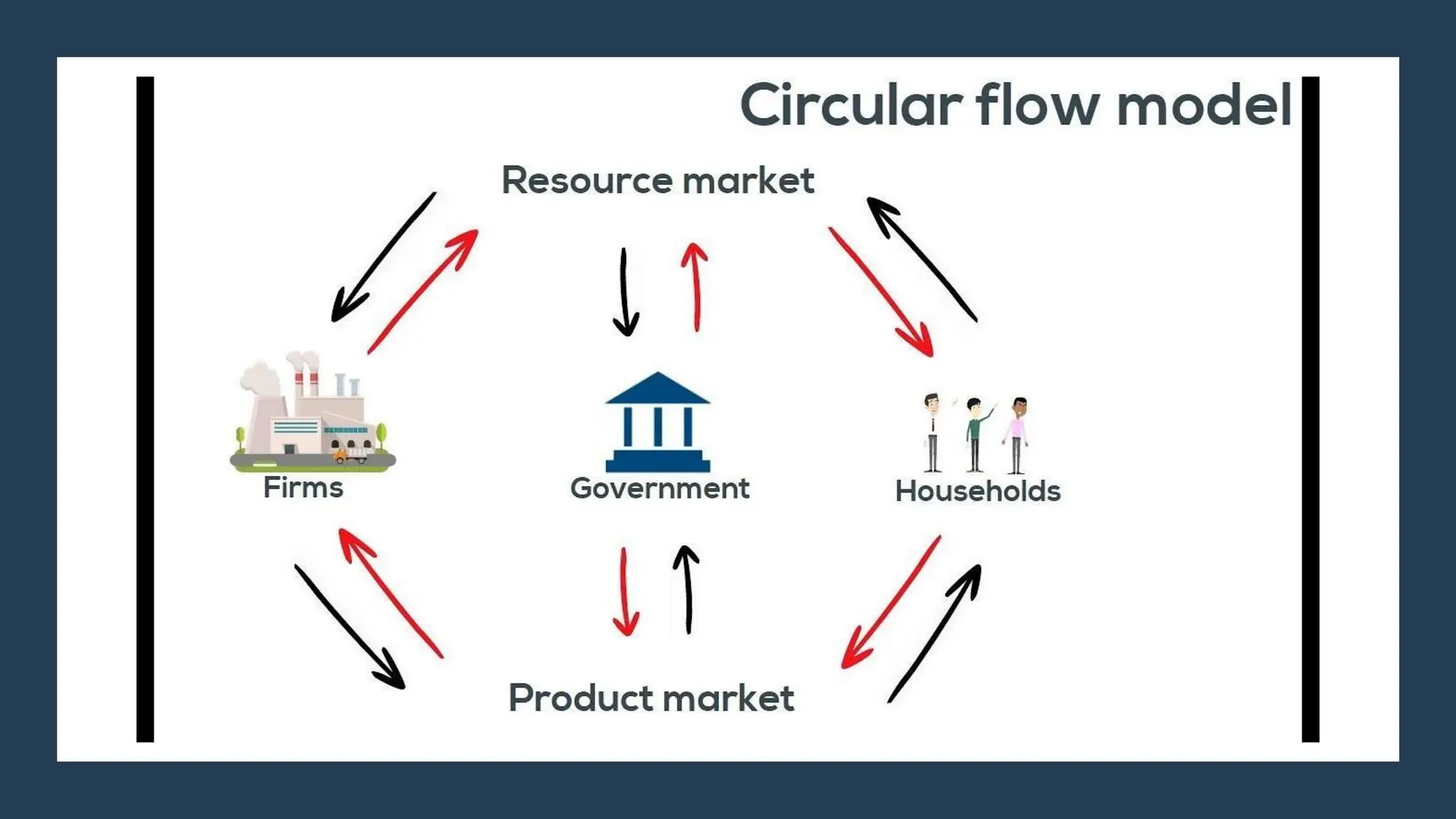
• Economicmodels show a visual representation of
consumer, business and other economic behavior. These
models all relate the way consumers and businesses
react to real-world changes.
• Economic models assume some factors remain constant
(material inputs, weather conditions, etc). A model will
show only the basic factors needed to analyze the
problem at hand.
• An economist begins with some idea about the way
things work, then collects facts and discards those
deemed irrelevant.
• Hypothesis: An educated guess or prediction,
• Testing a model/hypothesis allow economists to see if
the model is credible. Much of the work of economists
involves attempts at predicting how people will react in a
given situation (cutting taxes to stimulate the economy).