Introduction to
ECONOMICS
Prepared by: Arnel O. Rivera
MAT-SS
What is Economics?
Economics is the study of the
allocation of resources among
alternative uses to attain desired ends.
It is a branch of social science which
deals with the study on attaining
human wants and needs.
Divisions of Economics
Macro Economics
 The study of economics as a whole.
 It is concerned with issues and
problems concerning the overall
economy of a nation or the world.
Divisions of Economics
Micro Economics
 The study of individual parts of the
economy.
 It is concerned with issues and
problems facing the individual
components of the economy (supply,
prices of goods etc..)
Divisions of Economics
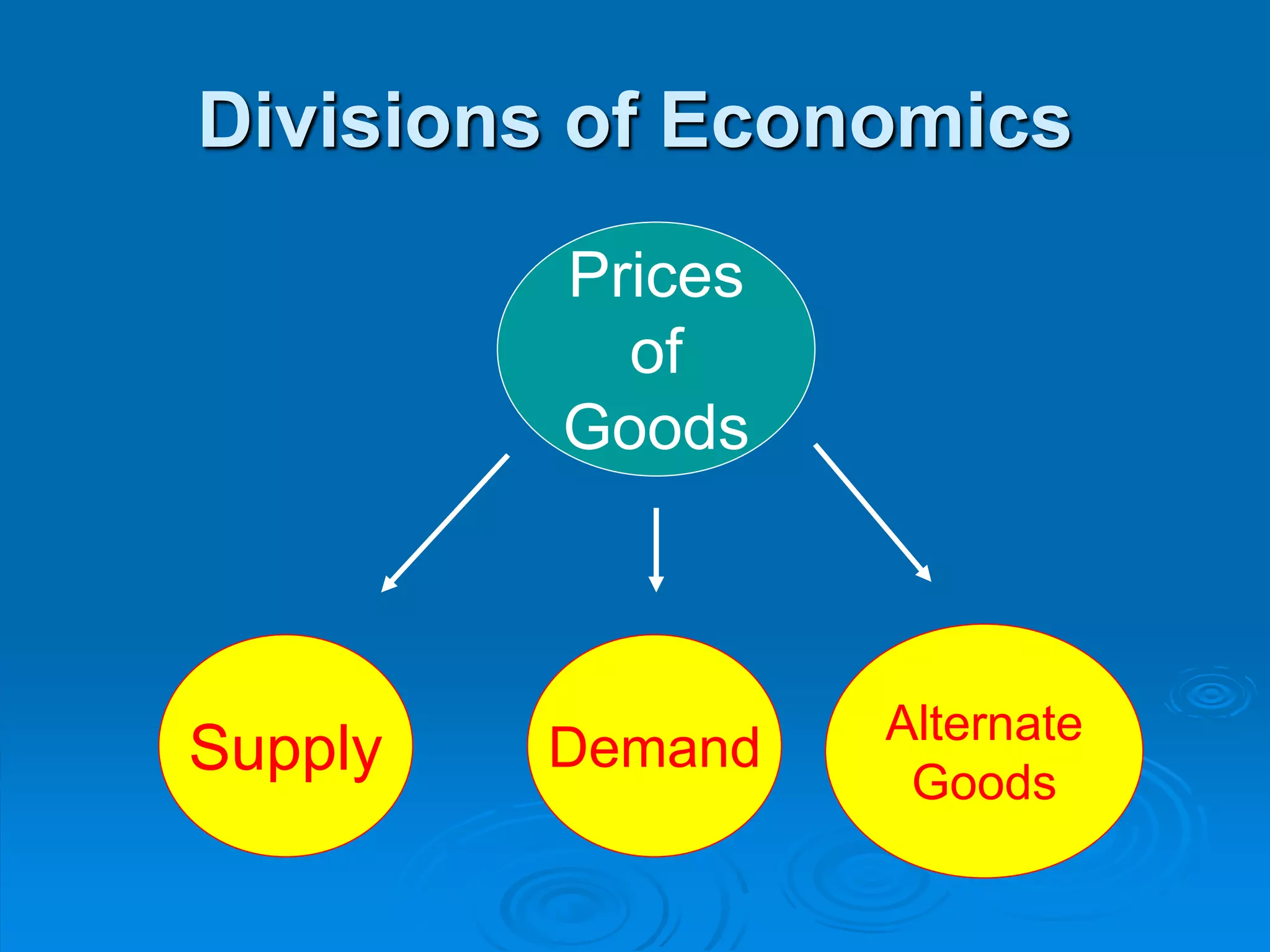
Prices
of
Goods
Supply Demand Alternate
Goods
Needs and Wants
Needs
 These are goods and services that
people needs in order to live.
 Without these things, people cannot
survive.
Needs and Wants
Wants
 These are goods and services that
makes the lives of people easier and
comfortable.
 People can do away with wants, but it
makes their lives more meaningful.
Points to Remember
 Wants and Needs vary from one person to
another.
 Example: To an office worker, a cellphone is
considered as a need but to a farmer it is a
want.
 Wants and needs are never satisfied.
 Example: Cellphone models changes as time
goes by. It may be in today but will become
obsolete in the future.
Economic decision
 We have unlimited wants and wish to
satisfy those wants with available
resources, we have to make choices.
Economic choice involves the
attainment of desired ends through the
allocation of these scarce resources
among alternative uses.
Factors that affect Economic
Decisions
 Desired ends – whatever goal or
objective is identified as urgent.
 Allocation – distributing resources so that
the desired ends are satisfied, partially
satisfied or not satisfied at all
 Alternative uses – refers to the many
different choices which are equally
appealing
Scarcity
Scarcity exists when the
resources of the economy are not
enough to meet the wants or
needs of people or the society.
Types of Scarcity
 Physical Scarcity – when resources
needed to satisfy wants and needs are not
available
 Psychological Scarcity – when resources
are available but cannot be used by the
person or entity to satisfy their wants or
needs
Points to Remember
To attain wants and needs, people
must make use of wise economic
decisions to prevent scarcity. This
can only be achieved by a
comprehensive understanding of the
basic principles of economics.
To download this file, go to:
http://www.slideshare.net/ArnelSSI

Intro to economics

  • 1.
  • 2.
    What is Economics? Economicsis the study of the allocation of resources among alternative uses to attain desired ends. It is a branch of social science which deals with the study on attaining human wants and needs.
  • 3.
    Divisions of Economics MacroEconomics  The study of economics as a whole.  It is concerned with issues and problems concerning the overall economy of a nation or the world.
  • 4.
    Divisions of Economics MicroEconomics  The study of individual parts of the economy.  It is concerned with issues and problems facing the individual components of the economy (supply, prices of goods etc..)
  • 5.
  • 6.
    Needs and Wants Needs These are goods and services that people needs in order to live.  Without these things, people cannot survive.
  • 7.
    Needs and Wants Wants These are goods and services that makes the lives of people easier and comfortable.  People can do away with wants, but it makes their lives more meaningful.
  • 8.
    Points to Remember Wants and Needs vary from one person to another.  Example: To an office worker, a cellphone is considered as a need but to a farmer it is a want.  Wants and needs are never satisfied.  Example: Cellphone models changes as time goes by. It may be in today but will become obsolete in the future.
  • 9.
    Economic decision  Wehave unlimited wants and wish to satisfy those wants with available resources, we have to make choices. Economic choice involves the attainment of desired ends through the allocation of these scarce resources among alternative uses.
  • 10.
    Factors that affectEconomic Decisions  Desired ends – whatever goal or objective is identified as urgent.  Allocation – distributing resources so that the desired ends are satisfied, partially satisfied or not satisfied at all  Alternative uses – refers to the many different choices which are equally appealing
  • 11.
    Scarcity Scarcity exists whenthe resources of the economy are not enough to meet the wants or needs of people or the society.
  • 12.
    Types of Scarcity Physical Scarcity – when resources needed to satisfy wants and needs are not available  Psychological Scarcity – when resources are available but cannot be used by the person or entity to satisfy their wants or needs
  • 13.
    Points to Remember Toattain wants and needs, people must make use of wise economic decisions to prevent scarcity. This can only be achieved by a comprehensive understanding of the basic principles of economics.
  • 14.
    To download thisfile, go to: http://www.slideshare.net/ArnelSSI