CT BRAIN - BASICS D.SUBBURAJ PROF.G .ELANGOVAN’S UNIT
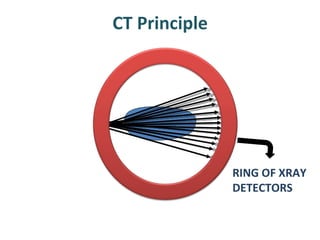
CT Principle RING OF XRAY DETECTORS
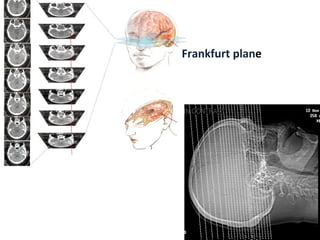
Frankfurt plan e
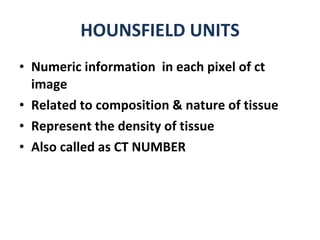
HOUNSFIELD UNITS Numeric information  in each pixel of ct image Related to composition & nature of tissue Represent the density of tissue Also called as CT NUMBER
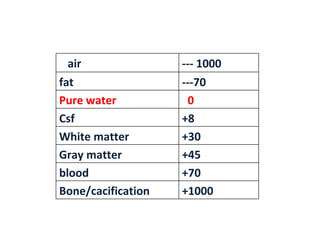
air --- 1000 fat ---70 Pure water 0 Csf +8 White matter +30 Gray matter +45 blood +70 Bone/cacification +1000
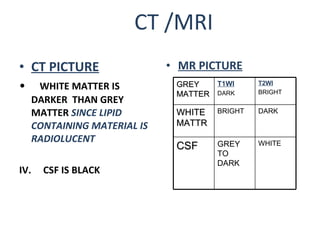
CT /MRI CT PICTURE WHITE MATTER IS DARKER  THAN GREY MATTER  SINCE LIPID CONTAINING MATERIAL IS RADIOLUCENT CSF IS BLACK MR PICTURE GREY MATTER T1WI DARK T2WI BRIGHT WHITE MATTR BRIGHT DARK CSF GREY TO DARK WHITE
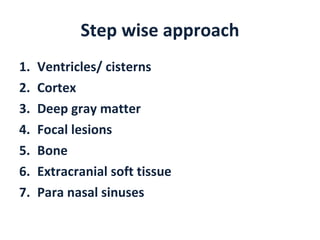
Step wise approach Ventricles/ cisterns Cortex Deep gray matter Focal lesions Bone Extracranial soft tissue Para nasal sinuses
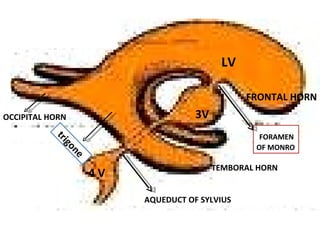
LV FRONTAL HORN TEMBORAL HORN OCCIPITAL HORN FORAMEN OF MONRO 4 V AQUEDUCT OF SYLVIUS 3V trigone
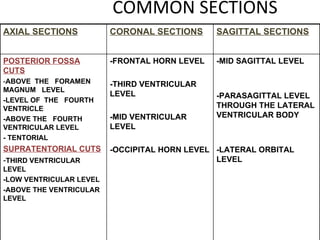
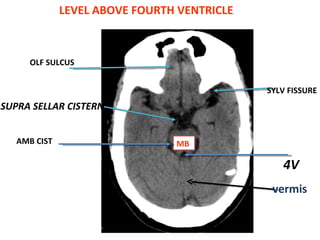
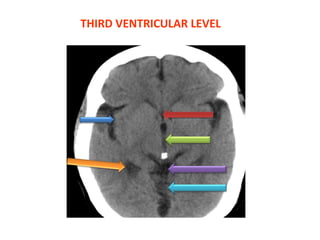
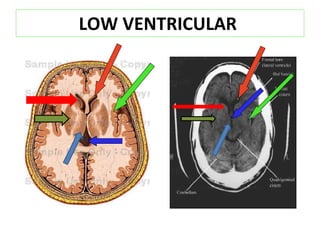
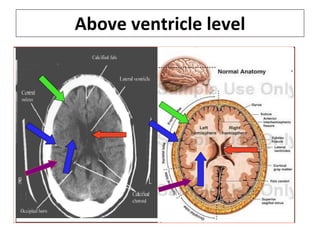
COMMON SECTIONS AXIAL SECTIONS CORONAL SECTIONS SAGITTAL SECTIONS POSTERIOR FOSSA CUTS - ABOVE  THE  FORAMEN  MAGNUM  LEVEL -LEVEL OF  THE  FOURTH VENTRICLE -ABOVE THE  FOURTH VENTRICULAR LEVEL - TENTORIAL SUPRATENTORIAL CUTS - THIRD VENTRICULAR LEVEL -LOW VENTRICULAR LEVEL -ABOVE THE VENTRICULAR LEVEL -FRONTAL HORN LEVEL -THIRD VENTRICULAR  LEVEL -MID VENTRICULAR LEVEL -OCCIPITAL HORN LEVEL -MID SAGITTAL LEVEL -PARASAGITTAL LEVEL THROUGH THE LATERAL VENTRICULAR BODY -LATERAL ORBITAL LEVEL
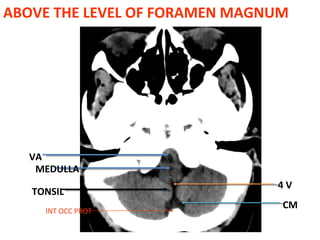
ABOVE THE LEVEL OF FORAMEN MAGNUM VA MEDULLA TONSIL 4 V CM INT OCC PROT
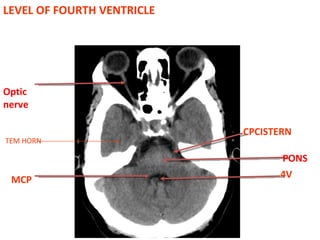
LEVEL OF FOURTH VENTRICLE MCP CPCISTERN PONS 4V TEM HORN Optic nerve
LEVEL ABOVE FOURTH VENTRICLE SUPRA SELLAR CISTERN MB AMB CIST SYLV FISSURE 4V OLF SULCUS vermis
THIRD VENTRICULAR LEVEL
LOW VENTRICULAR
Above ventricle level
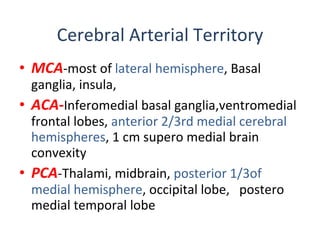
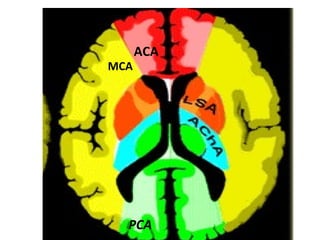
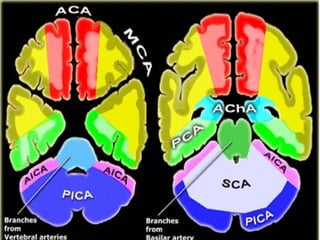
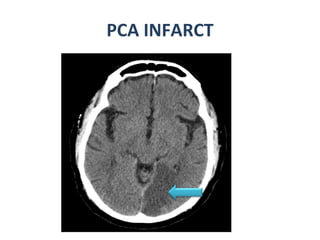
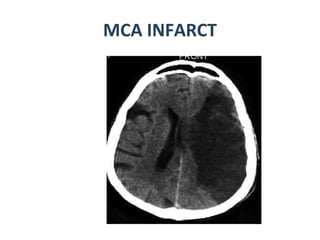
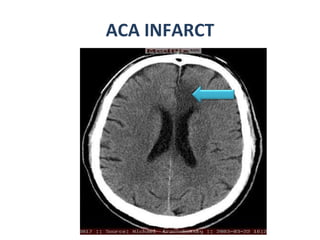
Cerebral Arterial Territory MCA -most of  lateral hemisphere ,  Basal ganglia, insula,  ACA- Inferomedial basal ganglia,ventromedial frontal lobes,  anterior 2/3rd medial cerebral hemispheres , 1 cm supero medial brain convexity PCA -Thalami, midbrain,  posterior 1/3of medial hemisphere , occipital lobe,  postero medial temporal lobe
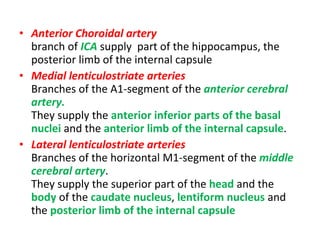
Anterior Choroidal artery branch of  ICA  supply  part of the hippocampus, the posterior limb of the internal capsule  Medial lenticulostriate arteries Branches of the A1-segment of the  anterior cerebral artery.  They supply the  anterior inferior parts of the basal nuclei  and the  anterior limb of the internal capsule . Lateral lenticulostriate arteries Branches of the horizontal M1-segment of the  middle cerebral artery .  They supply the superior part of the  head  and the  body  of the  caudate nucleus ,  lentiform nucleus  and the  posterior limb of the internal capsule
MCA ACA PCA
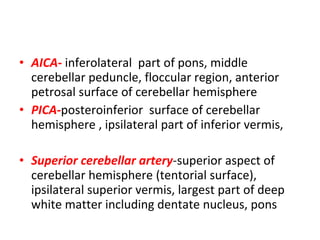
AICA-  inferolateral  part of pons, middle cerebellar peduncle, floccular region, anterior petrosal surface of cerebellar hemisphere PICA- posteroinferior  surface of cerebellar hemisphere , ipsilateral part of inferior vermis,  Superior cerebellar artery -superior aspect of cerebellar hemisphere (tentorial surface), ipsilateral superior vermis, largest part of deep white matter including dentate nucleus, pons
 
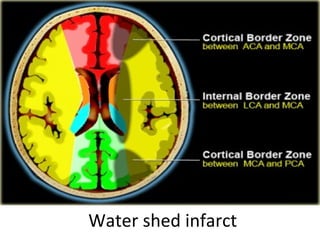
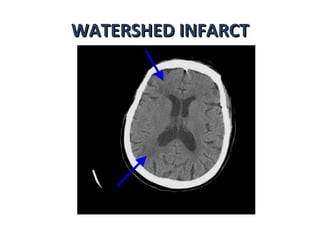
Water shed infarct
CEREBRAL ISCHEMIA
Cerebral ischemia Significantly diminished blood supply to all parts(global ischemia) or selected areas(regional or focal ischemia) of the brain Focal ischemia - cerebral infarction Global ischemia -hypoxic ischemic encephalopathy(HIE),hypotensive cerebral infarction
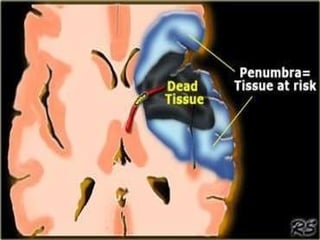
Goal of imaging Exclude  hemorrhage  Identify the presence of an underlying structural lesion such as tumour , vascular malformation ,subdual hematoma that  can mimic stroke Identify stenosis or occlusion of major extra- and intracranial arteries  Differentiate between irreversibly affected brain tissue and reversibly impaired tissue (dead tissue versus tissue at risk)
Infarct  vs pneumbra In the central core of the infarct,  the severity of hypoperfusion results in  irreversible cellular damage .  Around this core, there is a region of decreased flow in which either: The critical flow threshold for  cell death has not reached  Or the duration of ischemia has been insufficient to cause irreversible damage.
 
Hyper acute infarct(<12 hours) Acute infarct(12 - 48 hours) Subacute infarct(2 - 14 days) Chronic infarct(>2 weeks) Old infarct(>2 months )
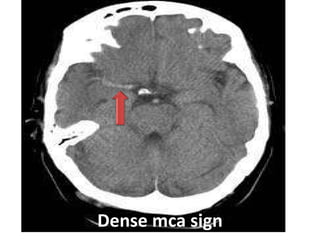
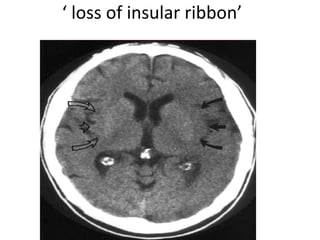
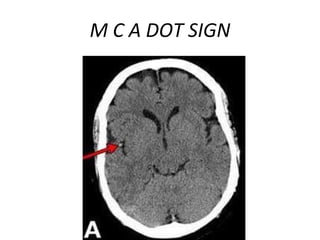
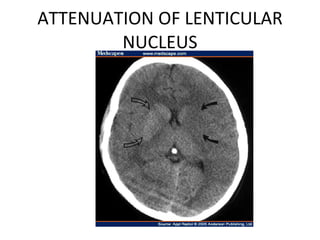
CT-Hyperacute infarct  Hyperdense  MCA sign -acute intraluminal thrombus Attenuation of lentiform nulei Dot sign -occluded MCA branch in sylvian fissure Insular ribbon sign  –grey white interface loss along the lateral insula
Dense mca sign
‘  loss of insular ribbon’
M C A DOT SIGN
ATTENUATION OF LENTICULAR NUCLEUS
CT- Acute infarct Low density basal ganglia Sulcal effacement Wedge shaphed parenchymal hypo density area that involves both grey and white matter  Increasing mass effect Hemorrhagic transformation  may occur -15 to 45%  (  basal ganglia and cortex common site ) in 24 to 48 hours
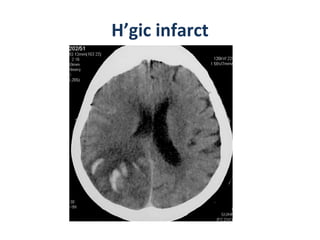
CT – sub acute infarct PLAIN CT Wedge-shaped  area of decreased attenuation involving  gray/white matter  in  typical vascular distribution Mass effect initially increases, then begins to diminish by 7-10 days  H’gic transformation  occurs in 15-20% of MCA occlusions, usually by 48-72 hrs CECT Enhancement patterns typically  patchy May appear as early as 2-3 days , persisting up to 8-10 weeks &quot;2-2-2&quot; rule  = enhancement begins at 2 days, peaks at 2 weeks, disappears by 2 months
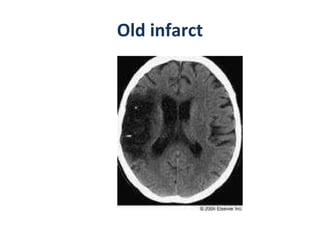
CT-chronic infarct Plain ct  Focal, well-delineated low-attenuation areas in affected vascular distribution sulci become prominent; ipsilateral ventricle enlarges Dystrophic Ca++ may occur in infarcted brain but is very rare CECT :  No enhancement
INFARCT / TUMOUR CLINICAL HISTROY DISTRIBUTION SHAPES GRAY / WHITE INVOLVEMENT ADVANCED IMAGING
VENOUS INFARCT HISTROY BEYOND VASCULAR DISTRIBUTION HAEMORRHAGIC INFARCT THORMBUS IN VENOUS SINUSES SYMMETRICAL LOW ATTENUATION IN DEEP GRAY MATTER  - DEEP CEREBRAL VEIN THORMBUS
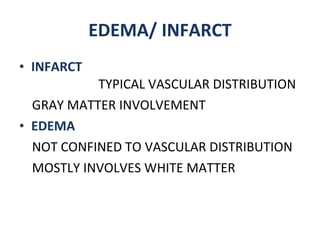
EDEMA/ INFARCT INFARCT  TYPICAL VASCULAR DISTRIBUTION GRAY MATTER INVOLVEMENT EDEMA NOT CONFINED TO VASCULAR DISTRIBUTION MOSTLY INVOLVES WHITE MATTER
PCA INFARCT
MCA INFARCT
ACA INFARCT
WATERSHED INFARCT
Old infarct
H’gic infarct
Thank u

CT Scan - Basics

  • 1.
    CT BRAIN -BASICS D.SUBBURAJ PROF.G .ELANGOVAN’S UNIT
  • 2.
    CT Principle RINGOF XRAY DETECTORS
  • 3.
  • 4.
    HOUNSFIELD UNITS Numericinformation in each pixel of ct image Related to composition & nature of tissue Represent the density of tissue Also called as CT NUMBER
  • 5.
    air --- 1000fat ---70 Pure water 0 Csf +8 White matter +30 Gray matter +45 blood +70 Bone/cacification +1000
  • 6.
    CT /MRI CTPICTURE WHITE MATTER IS DARKER THAN GREY MATTER SINCE LIPID CONTAINING MATERIAL IS RADIOLUCENT CSF IS BLACK MR PICTURE GREY MATTER T1WI DARK T2WI BRIGHT WHITE MATTR BRIGHT DARK CSF GREY TO DARK WHITE
  • 7.
    Step wise approachVentricles/ cisterns Cortex Deep gray matter Focal lesions Bone Extracranial soft tissue Para nasal sinuses
  • 8.
    LV FRONTAL HORNTEMBORAL HORN OCCIPITAL HORN FORAMEN OF MONRO 4 V AQUEDUCT OF SYLVIUS 3V trigone
  • 9.
    COMMON SECTIONS AXIALSECTIONS CORONAL SECTIONS SAGITTAL SECTIONS POSTERIOR FOSSA CUTS - ABOVE THE FORAMEN MAGNUM LEVEL -LEVEL OF THE FOURTH VENTRICLE -ABOVE THE FOURTH VENTRICULAR LEVEL - TENTORIAL SUPRATENTORIAL CUTS - THIRD VENTRICULAR LEVEL -LOW VENTRICULAR LEVEL -ABOVE THE VENTRICULAR LEVEL -FRONTAL HORN LEVEL -THIRD VENTRICULAR LEVEL -MID VENTRICULAR LEVEL -OCCIPITAL HORN LEVEL -MID SAGITTAL LEVEL -PARASAGITTAL LEVEL THROUGH THE LATERAL VENTRICULAR BODY -LATERAL ORBITAL LEVEL
  • 10.
    ABOVE THE LEVELOF FORAMEN MAGNUM VA MEDULLA TONSIL 4 V CM INT OCC PROT
  • 11.
    LEVEL OF FOURTHVENTRICLE MCP CPCISTERN PONS 4V TEM HORN Optic nerve
  • 12.
    LEVEL ABOVE FOURTHVENTRICLE SUPRA SELLAR CISTERN MB AMB CIST SYLV FISSURE 4V OLF SULCUS vermis
  • 13.
  • 14.
  • 15.
  • 16.
    Cerebral Arterial TerritoryMCA -most of lateral hemisphere , Basal ganglia, insula, ACA- Inferomedial basal ganglia,ventromedial frontal lobes, anterior 2/3rd medial cerebral hemispheres , 1 cm supero medial brain convexity PCA -Thalami, midbrain, posterior 1/3of medial hemisphere , occipital lobe, postero medial temporal lobe
  • 17.
    Anterior Choroidal arterybranch of ICA supply part of the hippocampus, the posterior limb of the internal capsule Medial lenticulostriate arteries Branches of the A1-segment of the anterior cerebral artery. They supply the anterior inferior parts of the basal nuclei and the anterior limb of the internal capsule . Lateral lenticulostriate arteries Branches of the horizontal M1-segment of the middle cerebral artery . They supply the superior part of the head and the body of the caudate nucleus , lentiform nucleus and the posterior limb of the internal capsule
  • 18.
  • 19.
    AICA- inferolateral part of pons, middle cerebellar peduncle, floccular region, anterior petrosal surface of cerebellar hemisphere PICA- posteroinferior surface of cerebellar hemisphere , ipsilateral part of inferior vermis, Superior cerebellar artery -superior aspect of cerebellar hemisphere (tentorial surface), ipsilateral superior vermis, largest part of deep white matter including dentate nucleus, pons
  • 20.
  • 21.
  • 22.
  • 23.
    Cerebral ischemia Significantlydiminished blood supply to all parts(global ischemia) or selected areas(regional or focal ischemia) of the brain Focal ischemia - cerebral infarction Global ischemia -hypoxic ischemic encephalopathy(HIE),hypotensive cerebral infarction
  • 24.
    Goal of imagingExclude hemorrhage Identify the presence of an underlying structural lesion such as tumour , vascular malformation ,subdual hematoma that can mimic stroke Identify stenosis or occlusion of major extra- and intracranial arteries Differentiate between irreversibly affected brain tissue and reversibly impaired tissue (dead tissue versus tissue at risk)
  • 25.
    Infarct vspneumbra In the central core of the infarct, the severity of hypoperfusion results in irreversible cellular damage . Around this core, there is a region of decreased flow in which either: The critical flow threshold for cell death has not reached Or the duration of ischemia has been insufficient to cause irreversible damage.
  • 26.
  • 27.
    Hyper acute infarct(<12hours) Acute infarct(12 - 48 hours) Subacute infarct(2 - 14 days) Chronic infarct(>2 weeks) Old infarct(>2 months )
  • 28.
    CT-Hyperacute infarct Hyperdense MCA sign -acute intraluminal thrombus Attenuation of lentiform nulei Dot sign -occluded MCA branch in sylvian fissure Insular ribbon sign –grey white interface loss along the lateral insula
  • 29.
  • 30.
    ‘ lossof insular ribbon’
  • 31.
    M C ADOT SIGN
  • 32.
  • 33.
    CT- Acute infarctLow density basal ganglia Sulcal effacement Wedge shaphed parenchymal hypo density area that involves both grey and white matter Increasing mass effect Hemorrhagic transformation may occur -15 to 45% ( basal ganglia and cortex common site ) in 24 to 48 hours
  • 34.
    CT – subacute infarct PLAIN CT Wedge-shaped area of decreased attenuation involving gray/white matter in typical vascular distribution Mass effect initially increases, then begins to diminish by 7-10 days H’gic transformation occurs in 15-20% of MCA occlusions, usually by 48-72 hrs CECT Enhancement patterns typically patchy May appear as early as 2-3 days , persisting up to 8-10 weeks &quot;2-2-2&quot; rule = enhancement begins at 2 days, peaks at 2 weeks, disappears by 2 months
  • 35.
    CT-chronic infarct Plainct Focal, well-delineated low-attenuation areas in affected vascular distribution sulci become prominent; ipsilateral ventricle enlarges Dystrophic Ca++ may occur in infarcted brain but is very rare CECT : No enhancement
  • 36.
    INFARCT / TUMOURCLINICAL HISTROY DISTRIBUTION SHAPES GRAY / WHITE INVOLVEMENT ADVANCED IMAGING
  • 37.
    VENOUS INFARCT HISTROYBEYOND VASCULAR DISTRIBUTION HAEMORRHAGIC INFARCT THORMBUS IN VENOUS SINUSES SYMMETRICAL LOW ATTENUATION IN DEEP GRAY MATTER - DEEP CEREBRAL VEIN THORMBUS
  • 38.
    EDEMA/ INFARCT INFARCT TYPICAL VASCULAR DISTRIBUTION GRAY MATTER INVOLVEMENT EDEMA NOT CONFINED TO VASCULAR DISTRIBUTION MOSTLY INVOLVES WHITE MATTER
  • 39.
  • 40.
  • 41.
  • 42.
  • 43.
  • 44.
  • 45.