Presented by
Prasad roshan1982@gmail.com
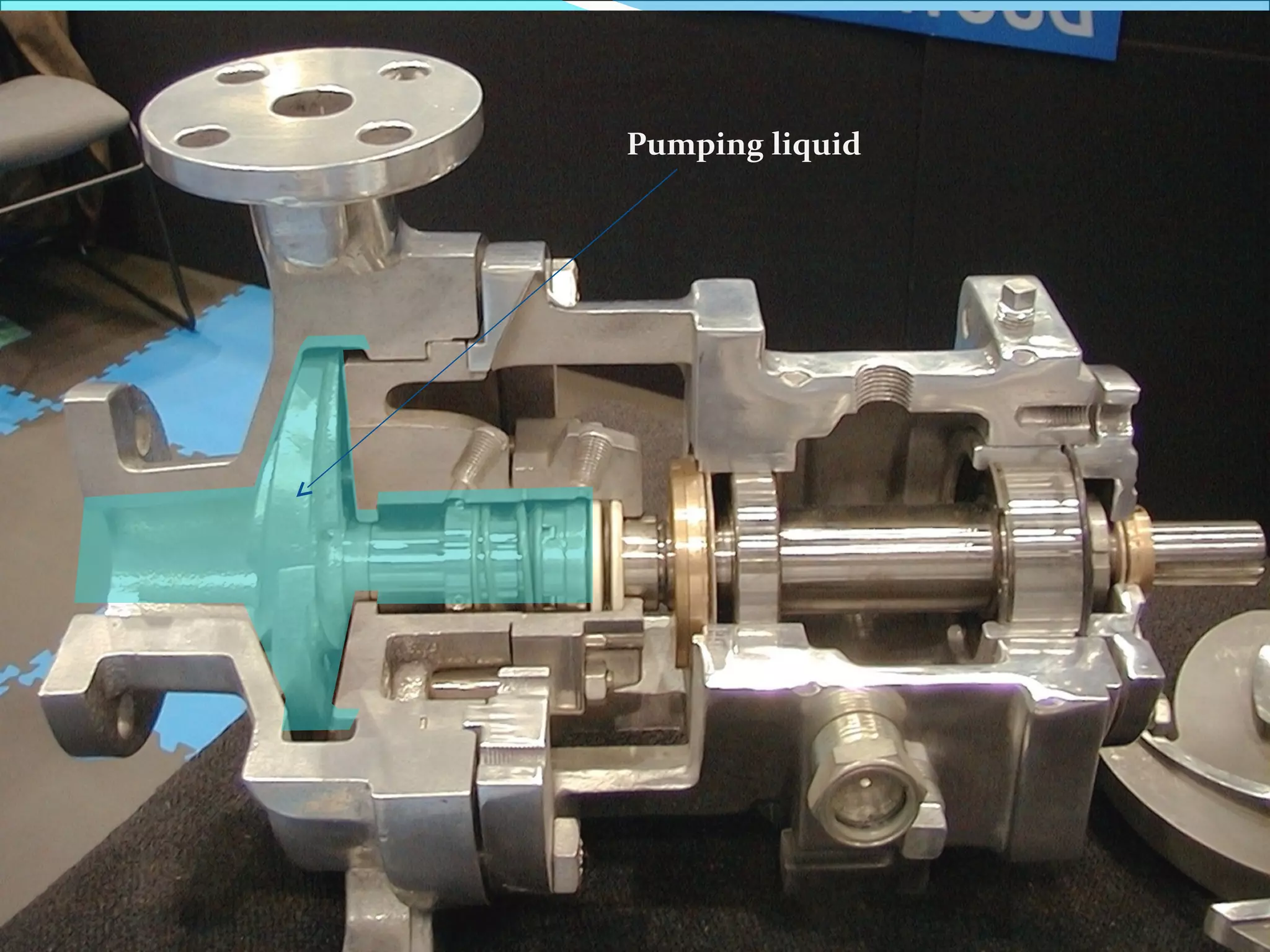
Cross section view of pump with mechanical seal
Pumping liquid
NEED FOR SEALS
Seal is a device for closing a gap or making a joint fluid tight
( liquid or gas )
NEED
* To minimize leakage
* To prevent toxic fluids escaping to atmosphere
* To reduce power loss .
TYPES OF SEALS
 Static Seals
 Dynamic Seals
STATIC SEALS
Sealing takes place between two parts that don’t move in
relation with each other.
Application
- Pipe flanges ,vessel /Tower nozzles, pump casing joint
- Fan /Blower casing joint , Compressor casing joint.
- Turbine casing joint, Heat exchanger joints
Types
- Gaskets
- O-rings
- Liquid gaskets
GASKET
Packing designed to go between two rigid parts in
stationary conditions
May be in form of sheet , strip , bulk.
Properties
Impermeability
Ability to flow into joints
Ageing
Corrosion resistance
Classification of Gaskets
Non-metallic gaskets
Metallic gaskets
Non-metallic gaskets
Asbestos
Cork and rubber
PTFE
METALLIC GASKET
Corrugated
Plain
Asbestos filler
Metal clad
Soft material like asbestos CAF enclosed in metal
covering .
Provides additional mechanical strength
Spiral wound
Alternate layers of v- sections , metallic strip and
non- metallic filler compressed to a predetermined
amount
Metal – SS , Monel , Inconel , Titanium.
Fillers – Asbestos fibres , PTFE lead, ceramic paper,
DYNAMIC SEALS
Used for sealing fluid between parts that move in relation with each
other
Application
* Centrifugal pump gland, valve gland , bearing
housing
* Turbine/compressor inter stage and end sealing
* Reciprocating compressors cylinder sealing
TYPES
 Gland packings
 Mechanical contact seals
 Labyrinth seal
 Oil seal
 Oil film seals
GLAND PACKING
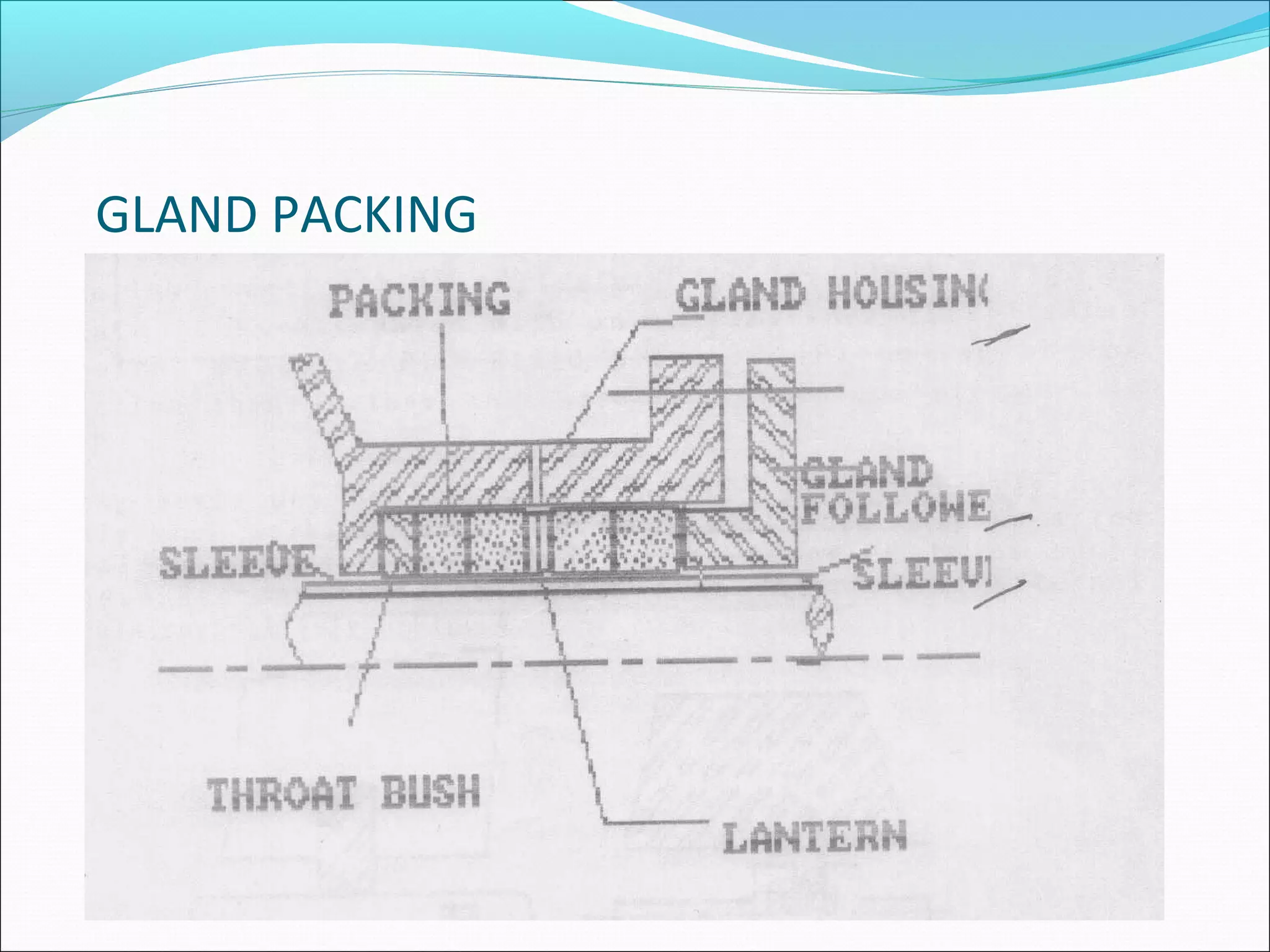
 Enclosed in a stuffing box
 Compressive force by tightening the gland plate
produces radial pressure
 Slight leakage is allowed for lubrication
 Periodic retightening of gland necessary for wear
compensation.
 Lantern ring for cooling /lubrication
Stuffing box pressure No of rings
(bar)
up to 35 4
35-70 6
70-140 8
140 10
Gland packing
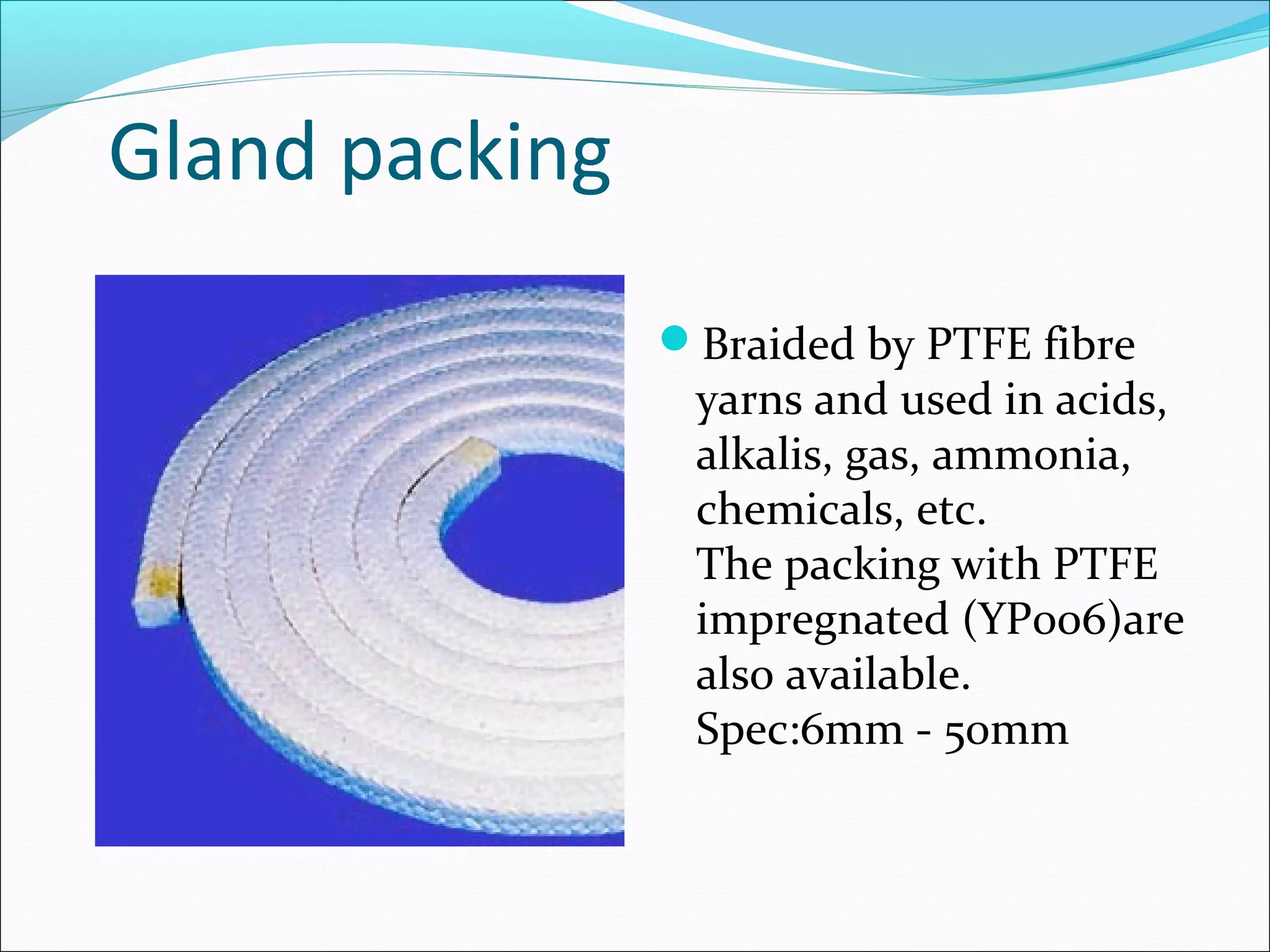
Braided by PTFE fibre
yarns and used in acids,
alkalis, gas, ammonia,
chemicals, etc.
The packing with PTFE
impregnated (YP006)are
also available.
Spec:6mm - 50mm
GLAND PACKING WITH PERMISSIBLE LEAKAGE
GLAND PACKING
GLAND PACKING
• packing material
vegetable based fibre yarns for oil and water service –cotton
hemp flax
textile
asbestos yarns
graphite packings
• lubricants
graphite
mica with Mo di sulphide and PTFE dry lubricant
tallow
silicone greases
WHY MECHANICAL SEALS
CONVENTIONAL SEALING
CONVENTIONAL SEALING IS BY MEANS
OF GLAND PACKING .THE PROBLEMS
WITH GLAND PACKINGS ARE:
1] PRODUCT LOSS
2] EXCESSIVE WEAR ON SHAFT & SLEEVE
3] FREQUENT ADJUSTMENTS
4] ENERGY LOSS
PRODUCT LOSS
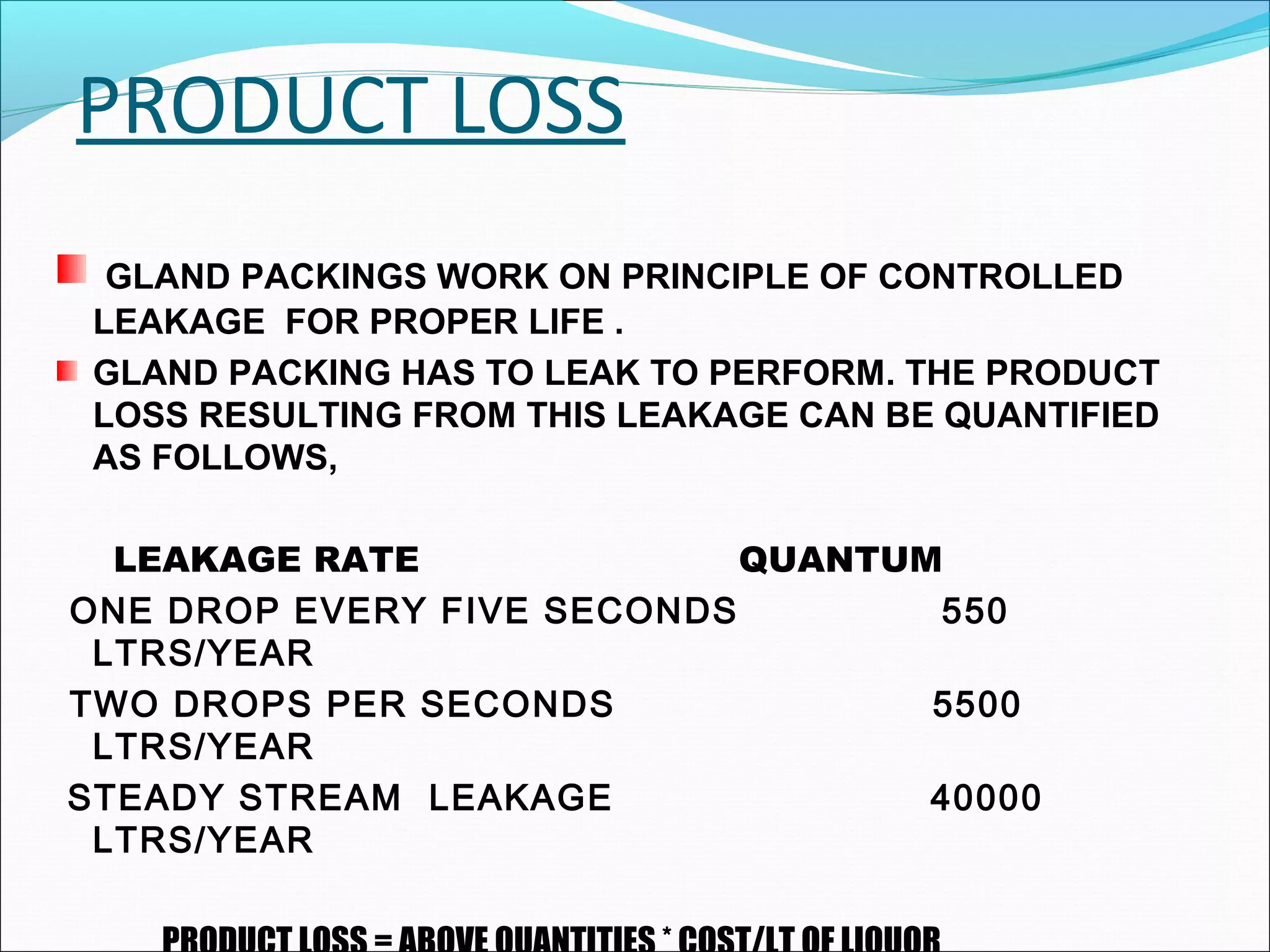
GLAND PACKINGS WORK ON PRINCIPLE OF CONTROLLED
LEAKAGE FOR PROPER LIFE .
GLAND PACKING HAS TO LEAK TO PERFORM. THE PRODUCT
LOSS RESULTING FROM THIS LEAKAGE CAN BE QUANTIFIED
AS FOLLOWS,
LEAKAGE RATE QUANTUM
ONE DROP EVERY FIVE SECONDS 550
LTRS/YEAR
TWO DROPS PER SECONDS 5500
LTRS/YEAR
STEADY STREAM LEAKAGE 40000
LTRS/YEAR
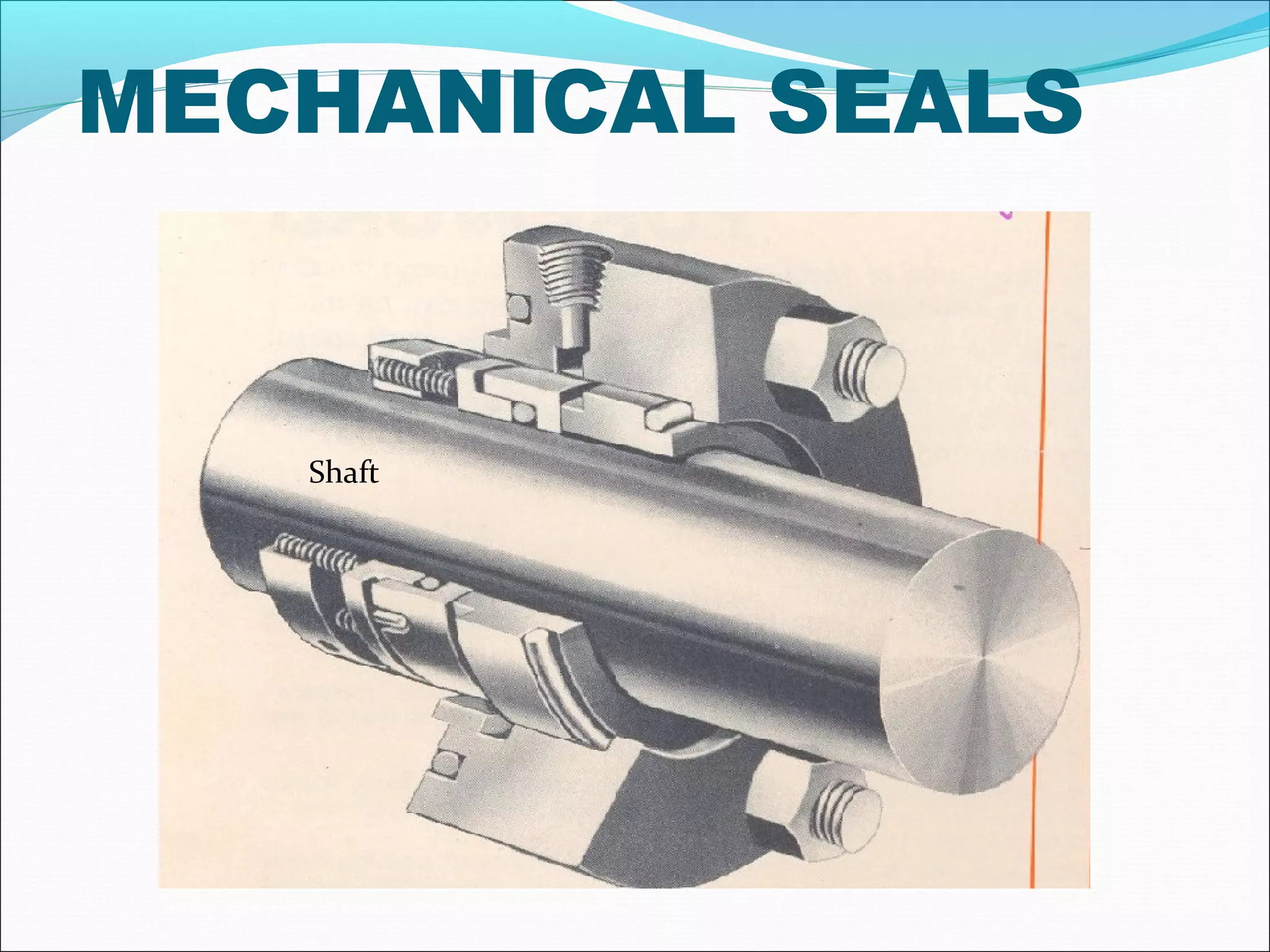
MECHANICAL SEALS
CLASSIFICATION
By arrangement
1. Single seal
- Inside mounted / Outside mounted
2. Multiple design
- Double seal/ Tandem seal
By design
1. Unbalanced seal
2. Balanced seal
3. single spring
4. Multiple spring
5. Pusher seal
6. Non – pusher seal
MECHANICAL SEALS
Components
1. rotary seal face
2. stationary seal face
3. springs
4. retainer
5. sealing /flushing media
6. o-rings
MECHANICAL SEALS
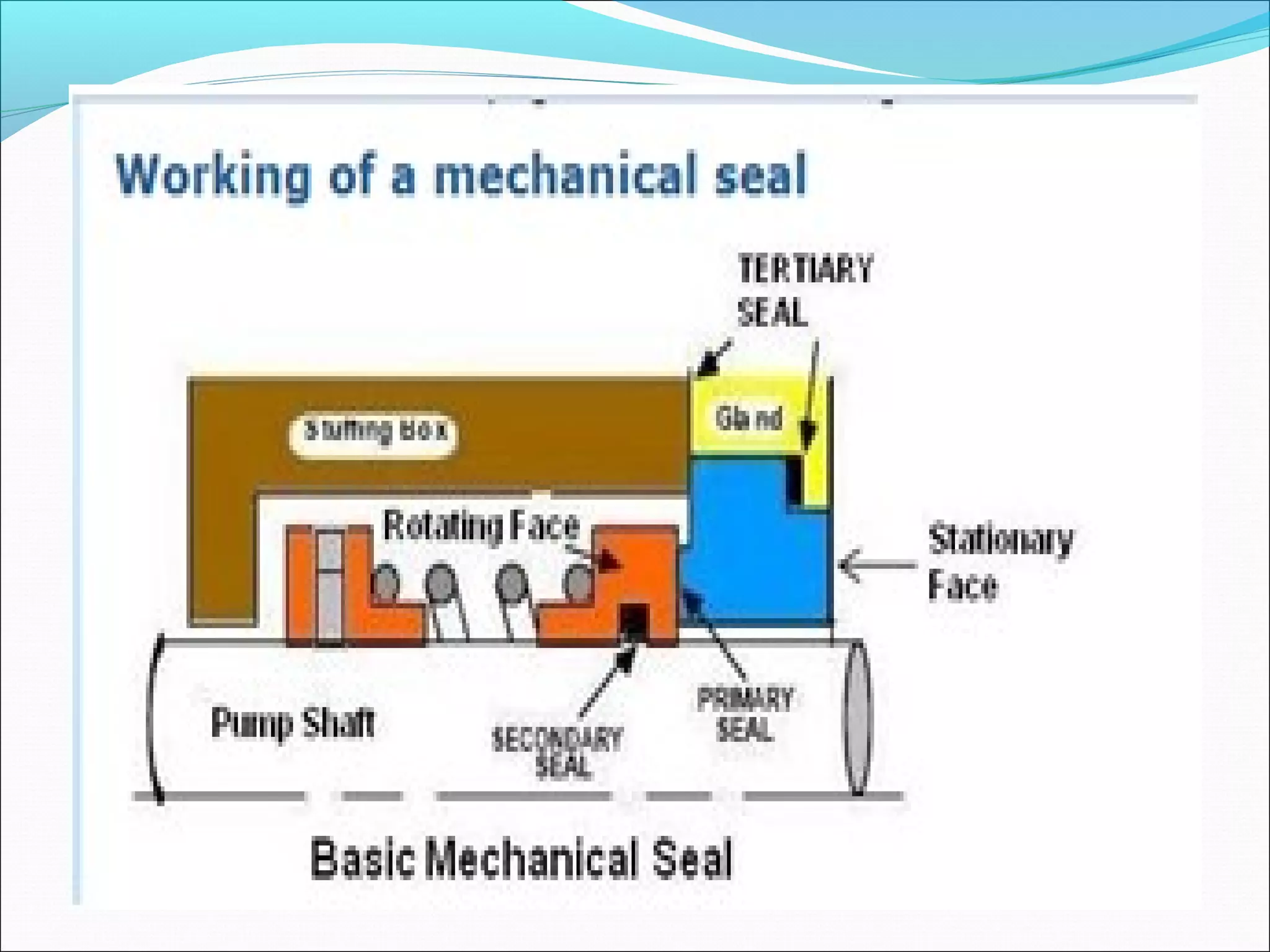
THE BASIC DESIGN OF A MECHANICAL SEAL
COSISTS OF FOLLOWING ELEMENTS.
1] FLEXIBLY MOUNTED SEAL FACE
2] RIGIDLY MOUNTED SEAL FACE
3] COMPRESSION DEVICE
4] DRIVING MECHANISM
5] SECONDARY SEALS
MECHANICAL SEALS
Shaft
Vessel
Shaft
Mechanical seal
for arresting
leakage
Liquid
Agitator
blade
Shaft
Seal
follower
Stuffing box
Retainer Spring Static sealDynamic seal
Liquid
Bolt for locking
Gasket
Secondary
seal
Discharge
Seal flushing line , liquid took from
discharge line
Static & dynamic seal
PRICIPLES OF MECHANICAL SEALS
IN MECHANICAL SEALS, THE SEALING SURFACES
OF EVERY KIND ARE LOCATED IN A PLANE
PERPENDICULAR TO THE SHAFT AND USUALLY
CONSIST OF TWO HIGHLY POLISHED SURFACES
RUNNING ADJACENTLY.
ONE SURFACE BEING CONNECTED TO THE SHAFT
AND THE OTHER TO THE STATIONARY PORTION OF
THE PUMP.THE POLISHED SURFACES WHICH ARE OF
DISSIMILAR
MATERIALS ARE HELD IN COTINUAL CONTACT BY A
SPRING,FORMING A FLUID TIGHT SEAL BETWEEN THE
ROTATING AND STATIONARY MEMBERS WITH VERY
SMALL FRICTIONAL LOSSES .
LEAKAGE - PATH
CLASSIFICATION OF MECHANICAL
SEALS
1] CLASSIFICATOIN BY DESIGN
A] PUSHER TYPE SEALS
a] Unbalanced seals
1) Single spring type
2) Multi spring type
b] Balanced seals
1) Single spring type
2) Multi spring type
B] NON PUSHER TYPE( BELLOWS TYPE) SEALS
a] Metal bellows seals
b] Teflon bellows seals
CLASSIFICATION OF MECHANICAL
SEALS
2] CLASSIFICATION BY ARRANGEMENT:
SINGLE SEALS:
A] SINGLE INTERNALLY MOUNTED SEALS.
B] SINGLE EXTERNALLY MOUNTED SEALS
DOUBLE SEALS:
A] BACK TO BACK SEALS
B] FACE TO FACE SEALS
C] TANDEM SEALS
SINGLE SPRING SEALS
Gap in between seal faces, resulting
leakage
Shaft
Seal
follower
Stuffing box
Retainer Spring
Static sealDynamic seal
Liquid
Gasket
Secondary seal
Shaft
Seal
follower
Stuffing box
Retainer
Spring
Static seal
Dynamic seal
Liquid
Gasket
Secondary
seal
Outside mounted mechanical seal
Liquid
Static seal
Dynamic seal
Liquid
Gasket
Secondary
seal
Barrier fluid 1 bar more
than process
Process liquid
Cooling system and API planes
Process liquid is taken heat which is developed by friction of seal face
SINGLE SPRING SEALS
SINGLE SPRING SEALS
ADVANTAGES:
1] LOW STARTING TORQUE
2] NON-CLOGGING
3] LOW SPRING CONSTANT
LIMITATION:
1] DUE TO SINGLE SPRING THE FACE LOADING IS NOT
ALONG THE PERIPHERY OF THE SEAL
FACES,
[HENCE THESE TYPE OF SEALS ARE NOT
RECOMMENDED FOR VERY HIGH ROTATION SPEEDS]
2]NORMALLY UNIDIRECTIONAL
3] REQUIRE LONG AXIAL SPACE.
MULTI SPRING SEAL
NUMBER OF SMALL SPRINGS ARE USED ON THE
PERIPHERY OF THE SEAL FACE TO GIVE A
UNIFORM FACE LOADING.
THESE SEALS ARE COMPACT IN NATURE AND ARE
UNIVERSALLY USED ON MOST OF THE CLEAR
FLUIDS.
 DUE TO UNIFORMLY LOADED SEAL FACES THE
MULTI SPRING SEALS ARE A MUST FOR HIGH RPM
APLICATION.
MULTI SPRING SEAL
MULTI SPRING SEAL
ADVANTAGES:
1] COMPACT IN COMPARISON WITH SINGLE SPRING SEAL.
2] SPRING LOAD UNIFORM,i.e. UNIFORM FACE LOADING.
3] CAN BE GIVEN FOR HIGHER SPPED THAN SINGLE SPRING.
4] FOR EACH SEAL SIZE DIFFERENT SPRING NOT REQUIRED.
LIMITATION:
1] MORE EXPENSIVE.
2] SPRING CLOGGING POSSIBLE FOR DIRTY LIQUIDS.
NON PUSHER TYPE SEALS
ADVANTAGES:
1] SEAL HANG UP DUE TO SPRING CLOGGING OR
CLOGGING OF DYNAMIC ELASTOMERS ON THE SHAFT.
NON PUSHER TYPE SEALS DO NOT HAVE DYNAMIC
ELASTOMERS AND HENCE THIS PROBLEM IS AVOIDED.
2] NO SHAFT OR SLEEVE FRETTING AS THERE IS NO
DYNAMIC ELASTOMERS.
METAL BELLOWSMETAL BELLOWS
Metal bellows are constructed
by welding “leaflets” into a
series of “convolutions”. This
series of convolutions is
referred to as the “Bellows
Core”.
The photo shown here is a shaft
mounted “Utex-MB”.
Now take a look at how a
bellows seal compensates for
face wear.
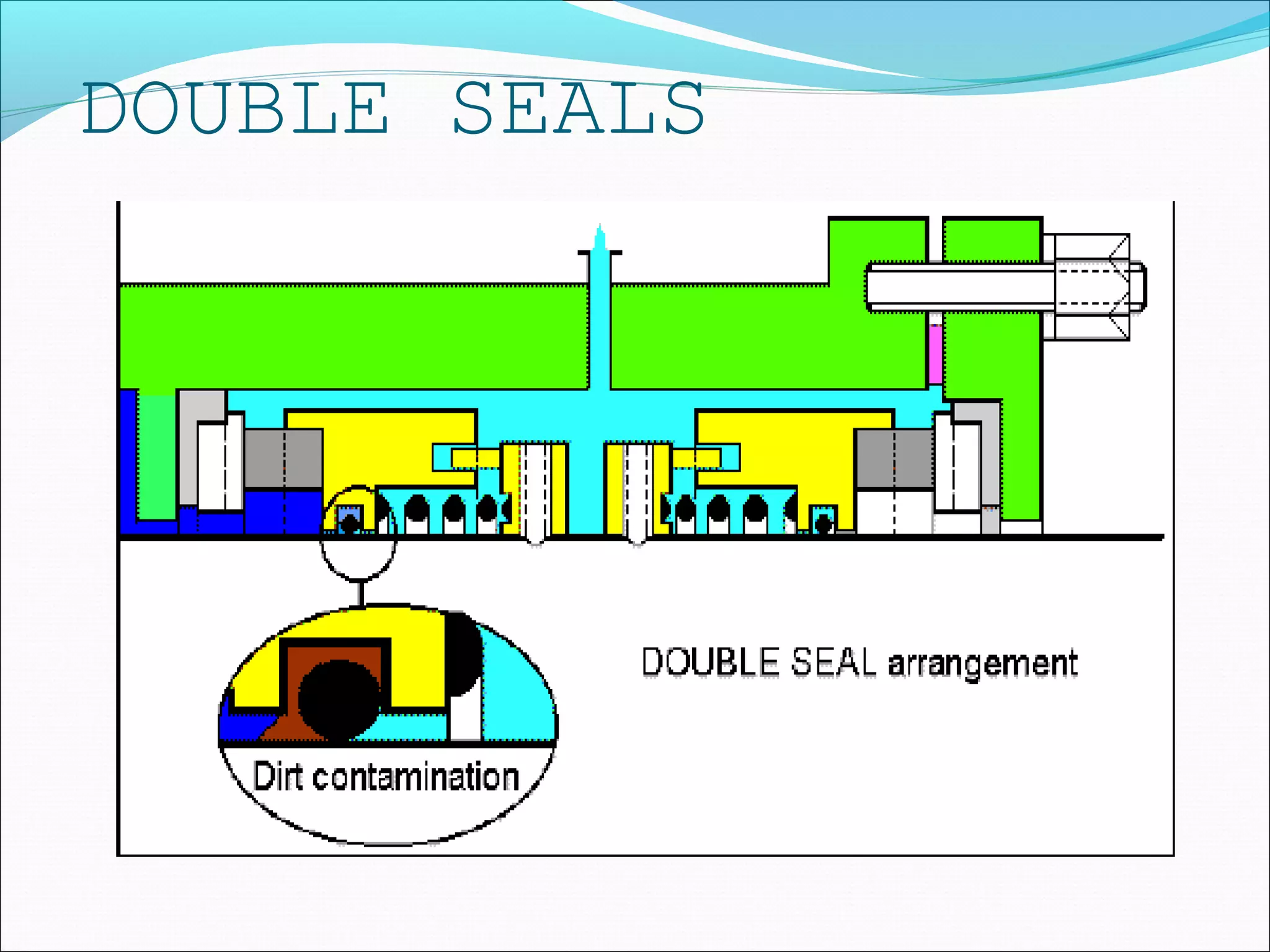
DOUBLE SEALS
Optically Flat Faces
0 psi
Rotary
Face
Stationary
Face
100 psi
MOC – MECHANICAL SEALS
Primary seal
1. Ceramic
2. Carbon
- Resin impregnated – corrosive applications
- Antimony impregnated – non-corrosive
3. Tungsten carbide
- Ni binder
- Co binder
4. Silicon carbide
Secondary seal
Elastomers - Nitrile , Neoprene , Butyl,
Hypalon
Non –Elastomers - PTFE, Graf oil
Spring
SS 304, SS 316, Hastalloy, Monel, Alloy-20
MECHANICAL SEAL
MECHANICAL SEAL
Mechanical seal for pumps

Mechanical seal for pumps

  • 1.
  • 2.
    Cross section viewof pump with mechanical seal
  • 3.
  • 4.
    NEED FOR SEALS Sealis a device for closing a gap or making a joint fluid tight ( liquid or gas ) NEED * To minimize leakage * To prevent toxic fluids escaping to atmosphere * To reduce power loss .
  • 5.
    TYPES OF SEALS Static Seals  Dynamic Seals
  • 6.
    STATIC SEALS Sealing takesplace between two parts that don’t move in relation with each other. Application - Pipe flanges ,vessel /Tower nozzles, pump casing joint - Fan /Blower casing joint , Compressor casing joint. - Turbine casing joint, Heat exchanger joints Types - Gaskets - O-rings - Liquid gaskets
  • 7.
    GASKET Packing designed togo between two rigid parts in stationary conditions May be in form of sheet , strip , bulk. Properties Impermeability Ability to flow into joints Ageing Corrosion resistance
  • 8.
    Classification of Gaskets Non-metallicgaskets Metallic gaskets Non-metallic gaskets Asbestos Cork and rubber PTFE
  • 9.
    METALLIC GASKET Corrugated Plain Asbestos filler Metalclad Soft material like asbestos CAF enclosed in metal covering . Provides additional mechanical strength Spiral wound Alternate layers of v- sections , metallic strip and non- metallic filler compressed to a predetermined amount Metal – SS , Monel , Inconel , Titanium. Fillers – Asbestos fibres , PTFE lead, ceramic paper,
  • 10.
    DYNAMIC SEALS Used forsealing fluid between parts that move in relation with each other Application * Centrifugal pump gland, valve gland , bearing housing * Turbine/compressor inter stage and end sealing * Reciprocating compressors cylinder sealing TYPES  Gland packings  Mechanical contact seals  Labyrinth seal  Oil seal  Oil film seals
  • 11.
    GLAND PACKING  Enclosedin a stuffing box  Compressive force by tightening the gland plate produces radial pressure  Slight leakage is allowed for lubrication  Periodic retightening of gland necessary for wear compensation.  Lantern ring for cooling /lubrication Stuffing box pressure No of rings (bar) up to 35 4 35-70 6 70-140 8 140 10
  • 12.
    Gland packing Braided byPTFE fibre yarns and used in acids, alkalis, gas, ammonia, chemicals, etc. The packing with PTFE impregnated (YP006)are also available. Spec:6mm - 50mm
  • 13.
    GLAND PACKING WITHPERMISSIBLE LEAKAGE
  • 14.
  • 15.
    GLAND PACKING • packingmaterial vegetable based fibre yarns for oil and water service –cotton hemp flax textile asbestos yarns graphite packings • lubricants graphite mica with Mo di sulphide and PTFE dry lubricant tallow silicone greases
  • 16.
    WHY MECHANICAL SEALS CONVENTIONALSEALING CONVENTIONAL SEALING IS BY MEANS OF GLAND PACKING .THE PROBLEMS WITH GLAND PACKINGS ARE: 1] PRODUCT LOSS 2] EXCESSIVE WEAR ON SHAFT & SLEEVE 3] FREQUENT ADJUSTMENTS 4] ENERGY LOSS
  • 17.
    PRODUCT LOSS GLAND PACKINGSWORK ON PRINCIPLE OF CONTROLLED LEAKAGE FOR PROPER LIFE . GLAND PACKING HAS TO LEAK TO PERFORM. THE PRODUCT LOSS RESULTING FROM THIS LEAKAGE CAN BE QUANTIFIED AS FOLLOWS, LEAKAGE RATE QUANTUM ONE DROP EVERY FIVE SECONDS 550 LTRS/YEAR TWO DROPS PER SECONDS 5500 LTRS/YEAR STEADY STREAM LEAKAGE 40000 LTRS/YEAR
  • 18.
    MECHANICAL SEALS CLASSIFICATION By arrangement 1.Single seal - Inside mounted / Outside mounted 2. Multiple design - Double seal/ Tandem seal By design 1. Unbalanced seal 2. Balanced seal 3. single spring 4. Multiple spring 5. Pusher seal 6. Non – pusher seal
  • 19.
    MECHANICAL SEALS Components 1. rotaryseal face 2. stationary seal face 3. springs 4. retainer 5. sealing /flushing media 6. o-rings
  • 21.
    MECHANICAL SEALS THE BASICDESIGN OF A MECHANICAL SEAL COSISTS OF FOLLOWING ELEMENTS. 1] FLEXIBLY MOUNTED SEAL FACE 2] RIGIDLY MOUNTED SEAL FACE 3] COMPRESSION DEVICE 4] DRIVING MECHANISM 5] SECONDARY SEALS
  • 22.
  • 23.
  • 24.
    Shaft Seal follower Stuffing box Retainer SpringStatic sealDynamic seal Liquid Bolt for locking Gasket Secondary seal
  • 25.
    Discharge Seal flushing line, liquid took from discharge line Static & dynamic seal
  • 26.
    PRICIPLES OF MECHANICALSEALS IN MECHANICAL SEALS, THE SEALING SURFACES OF EVERY KIND ARE LOCATED IN A PLANE PERPENDICULAR TO THE SHAFT AND USUALLY CONSIST OF TWO HIGHLY POLISHED SURFACES RUNNING ADJACENTLY. ONE SURFACE BEING CONNECTED TO THE SHAFT AND THE OTHER TO THE STATIONARY PORTION OF THE PUMP.THE POLISHED SURFACES WHICH ARE OF DISSIMILAR MATERIALS ARE HELD IN COTINUAL CONTACT BY A SPRING,FORMING A FLUID TIGHT SEAL BETWEEN THE ROTATING AND STATIONARY MEMBERS WITH VERY SMALL FRICTIONAL LOSSES .
  • 27.
  • 28.
    CLASSIFICATION OF MECHANICAL SEALS 1]CLASSIFICATOIN BY DESIGN A] PUSHER TYPE SEALS a] Unbalanced seals 1) Single spring type 2) Multi spring type b] Balanced seals 1) Single spring type 2) Multi spring type B] NON PUSHER TYPE( BELLOWS TYPE) SEALS a] Metal bellows seals b] Teflon bellows seals
  • 29.
    CLASSIFICATION OF MECHANICAL SEALS 2]CLASSIFICATION BY ARRANGEMENT: SINGLE SEALS: A] SINGLE INTERNALLY MOUNTED SEALS. B] SINGLE EXTERNALLY MOUNTED SEALS DOUBLE SEALS: A] BACK TO BACK SEALS B] FACE TO FACE SEALS C] TANDEM SEALS
  • 30.
  • 31.
    Gap in betweenseal faces, resulting leakage
  • 32.
    Shaft Seal follower Stuffing box Retainer Spring StaticsealDynamic seal Liquid Gasket Secondary seal
  • 33.
    Shaft Seal follower Stuffing box Retainer Spring Static seal Dynamicseal Liquid Gasket Secondary seal Outside mounted mechanical seal Liquid
  • 34.
    Static seal Dynamic seal Liquid Gasket Secondary seal Barrierfluid 1 bar more than process Process liquid
  • 35.
    Cooling system andAPI planes Process liquid is taken heat which is developed by friction of seal face
  • 37.
  • 38.
    SINGLE SPRING SEALS ADVANTAGES: 1]LOW STARTING TORQUE 2] NON-CLOGGING 3] LOW SPRING CONSTANT LIMITATION: 1] DUE TO SINGLE SPRING THE FACE LOADING IS NOT ALONG THE PERIPHERY OF THE SEAL FACES, [HENCE THESE TYPE OF SEALS ARE NOT RECOMMENDED FOR VERY HIGH ROTATION SPEEDS] 2]NORMALLY UNIDIRECTIONAL 3] REQUIRE LONG AXIAL SPACE.
  • 39.
    MULTI SPRING SEAL NUMBEROF SMALL SPRINGS ARE USED ON THE PERIPHERY OF THE SEAL FACE TO GIVE A UNIFORM FACE LOADING. THESE SEALS ARE COMPACT IN NATURE AND ARE UNIVERSALLY USED ON MOST OF THE CLEAR FLUIDS.  DUE TO UNIFORMLY LOADED SEAL FACES THE MULTI SPRING SEALS ARE A MUST FOR HIGH RPM APLICATION.
  • 40.
  • 41.
    MULTI SPRING SEAL ADVANTAGES: 1]COMPACT IN COMPARISON WITH SINGLE SPRING SEAL. 2] SPRING LOAD UNIFORM,i.e. UNIFORM FACE LOADING. 3] CAN BE GIVEN FOR HIGHER SPPED THAN SINGLE SPRING. 4] FOR EACH SEAL SIZE DIFFERENT SPRING NOT REQUIRED. LIMITATION: 1] MORE EXPENSIVE. 2] SPRING CLOGGING POSSIBLE FOR DIRTY LIQUIDS.
  • 42.
  • 43.
    NON PUSHER TYPESEALS ADVANTAGES: 1] SEAL HANG UP DUE TO SPRING CLOGGING OR CLOGGING OF DYNAMIC ELASTOMERS ON THE SHAFT. NON PUSHER TYPE SEALS DO NOT HAVE DYNAMIC ELASTOMERS AND HENCE THIS PROBLEM IS AVOIDED. 2] NO SHAFT OR SLEEVE FRETTING AS THERE IS NO DYNAMIC ELASTOMERS.
  • 44.
    METAL BELLOWSMETAL BELLOWS Metalbellows are constructed by welding “leaflets” into a series of “convolutions”. This series of convolutions is referred to as the “Bellows Core”. The photo shown here is a shaft mounted “Utex-MB”. Now take a look at how a bellows seal compensates for face wear.
  • 45.
  • 46.
    Optically Flat Faces 0psi Rotary Face Stationary Face 100 psi
  • 47.
    MOC – MECHANICALSEALS Primary seal 1. Ceramic 2. Carbon - Resin impregnated – corrosive applications - Antimony impregnated – non-corrosive 3. Tungsten carbide - Ni binder - Co binder 4. Silicon carbide Secondary seal Elastomers - Nitrile , Neoprene , Butyl, Hypalon Non –Elastomers - PTFE, Graf oil Spring SS 304, SS 316, Hastalloy, Monel, Alloy-20
  • 48.
  • 49.