ECO CLUB 
Boss3366
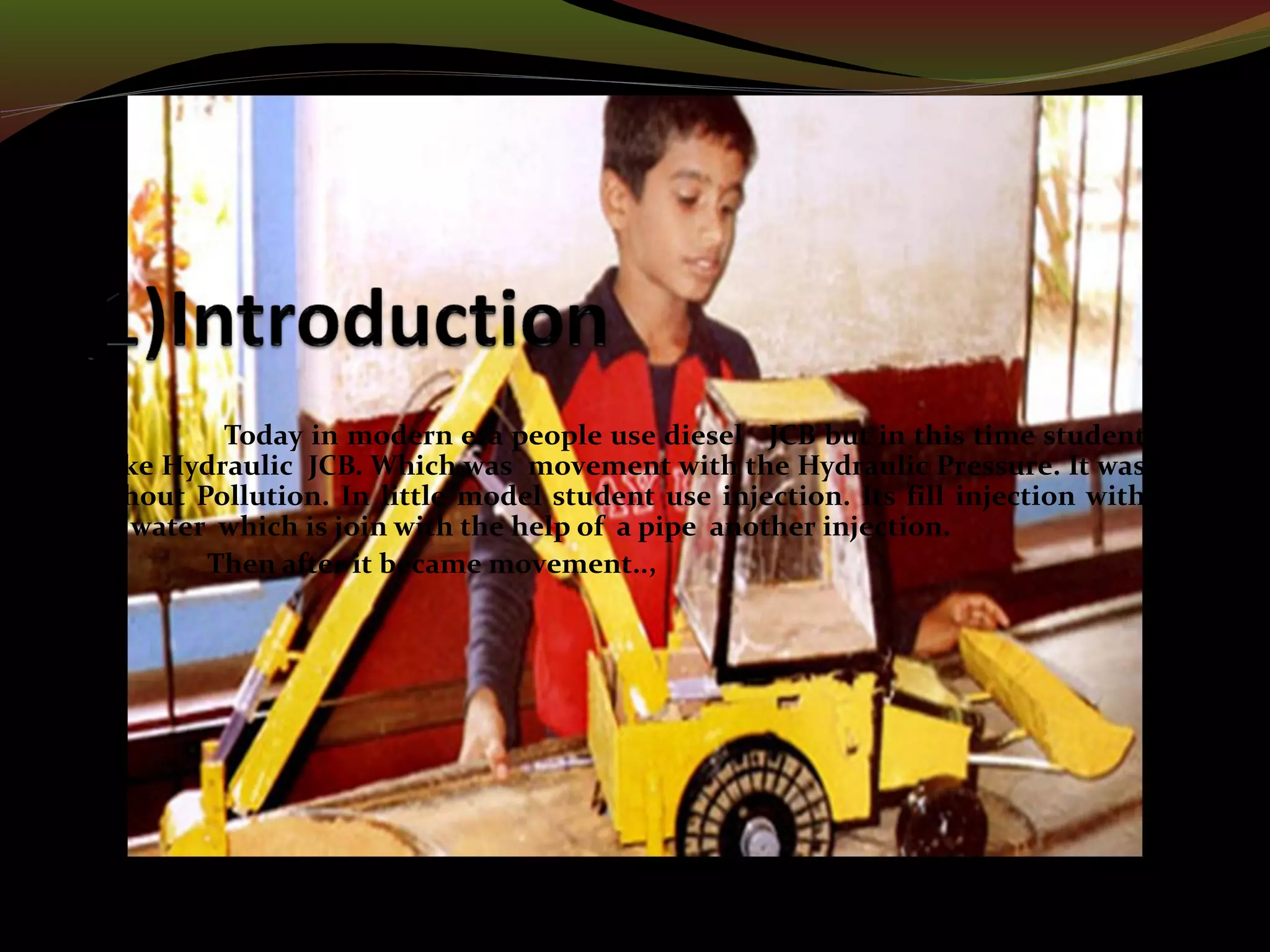
Today in modern era people use diesel JCB but in this time student 
make Hydraulic JCB. Which was movement with the Hydraulic Pressure. It was 
without Pollution. In little model student use injection. Its fill injection with 
the water which is join with the help of a pipe another injection. 
Then after it became movement..,
(2)Hydraulic Principles 
1. Hydraulic systems provide a means of remotely 
controlling a wide range of components by 
transmitting a force through a confined fluid. 
2. Because hydraulics can transmit high forces rapidly 
and accurately along lightweight pipes of any size, 
shape and length, they are the prime source of power 
in aircraft systems such as flying controls, flaps, 
retractable undercarriages and wheel brakes. 
3. The basic principle behind any hydraulic system is 
very simple - pressure applied anywhere to a body of 
fluid causes a force to be transmitted equally in all 
directions, with the force acting at right angles to any 
surface in contact with the fluid.
For the instruction of hydraulic 
principles 
1. Pascal's Law 
2. Hydraulic Pressure and Force 
3. Hydraulic Swash Plate Pump
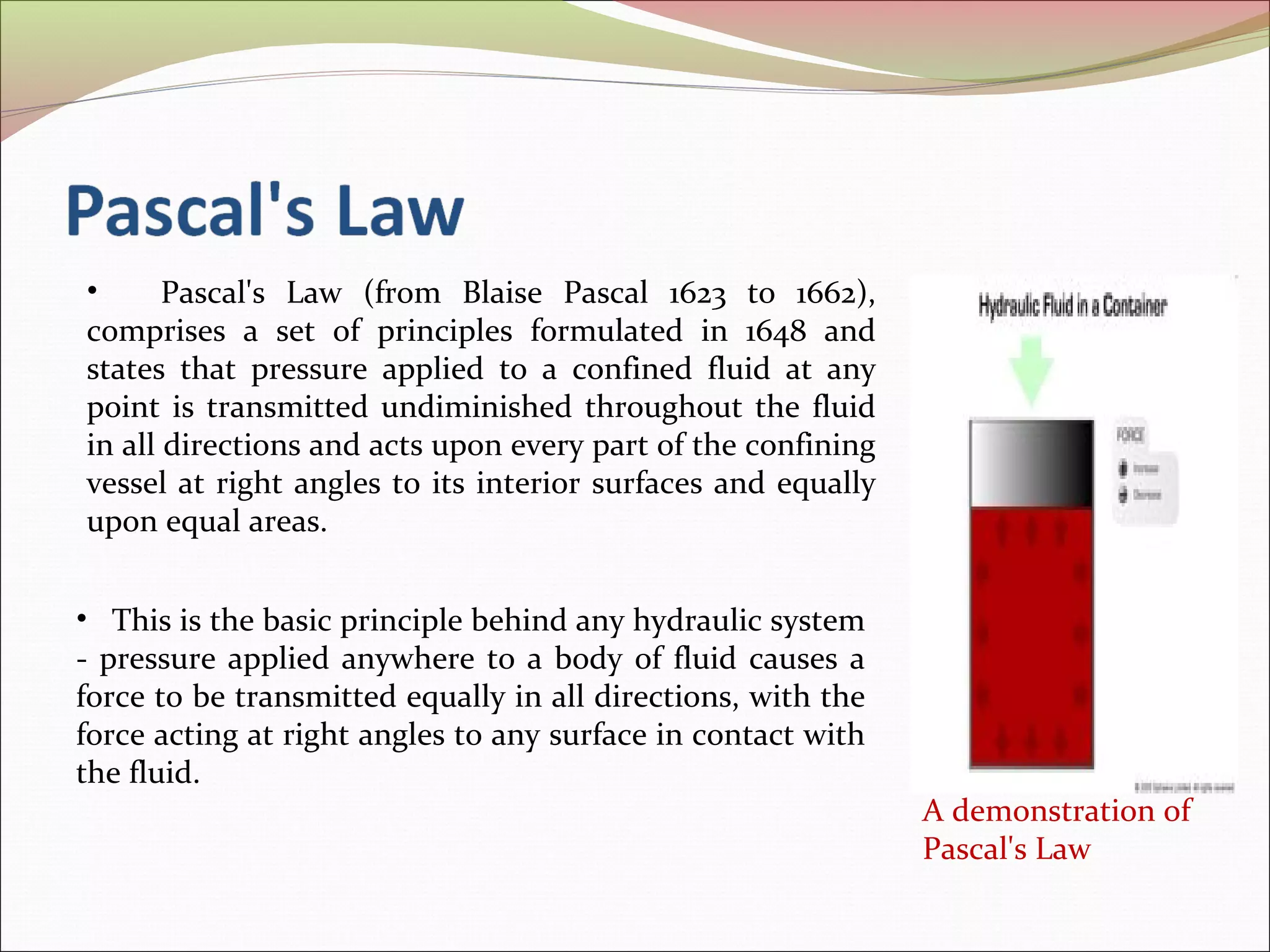
• Pascal's Law (from Blaise Pascal 1623 to 1662), 
comprises a set of principles formulated in 1648 and 
states that pressure applied to a confined fluid at any 
point is transmitted undiminished throughout the fluid 
in all directions and acts upon every part of the confining 
vessel at right angles to its interior surfaces and equally 
upon equal areas. 
A demonstration of 
Pascal's Law 
• This is the basic principle behind any hydraulic system 
- pressure applied anywhere to a body of fluid causes a 
force to be transmitted equally in all directions, with the 
force acting at right angles to any surface in contact with 
the fluid.
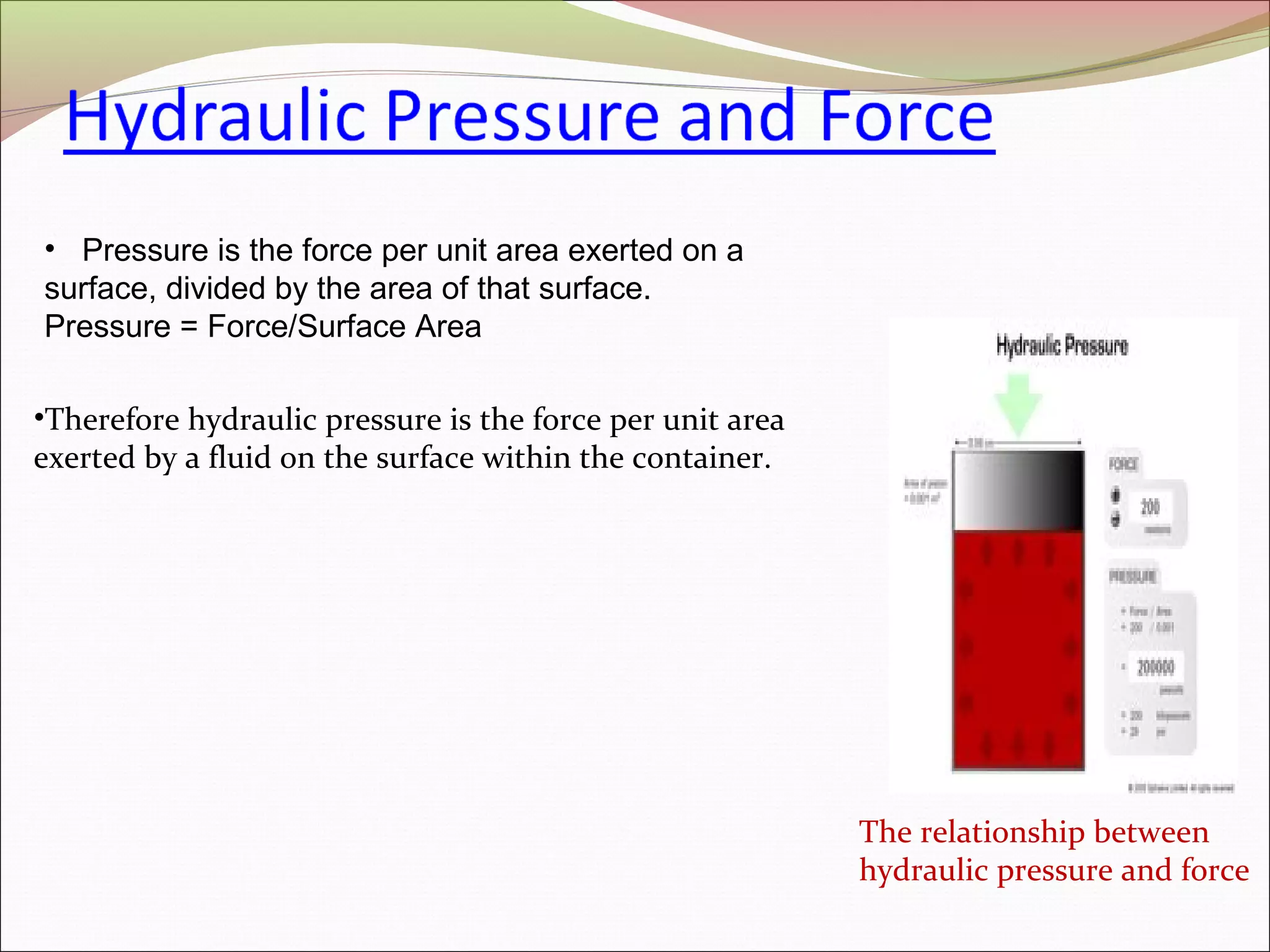
• Pressure is the force per unit area exerted on a 
surface, divided by the area of that surface. 
Pressure = Force/Surface Area 
The relationship between 
hydraulic pressure and force 
•Therefore hydraulic pressure is the force per unit area 
exerted by a fluid on the surface within the container.
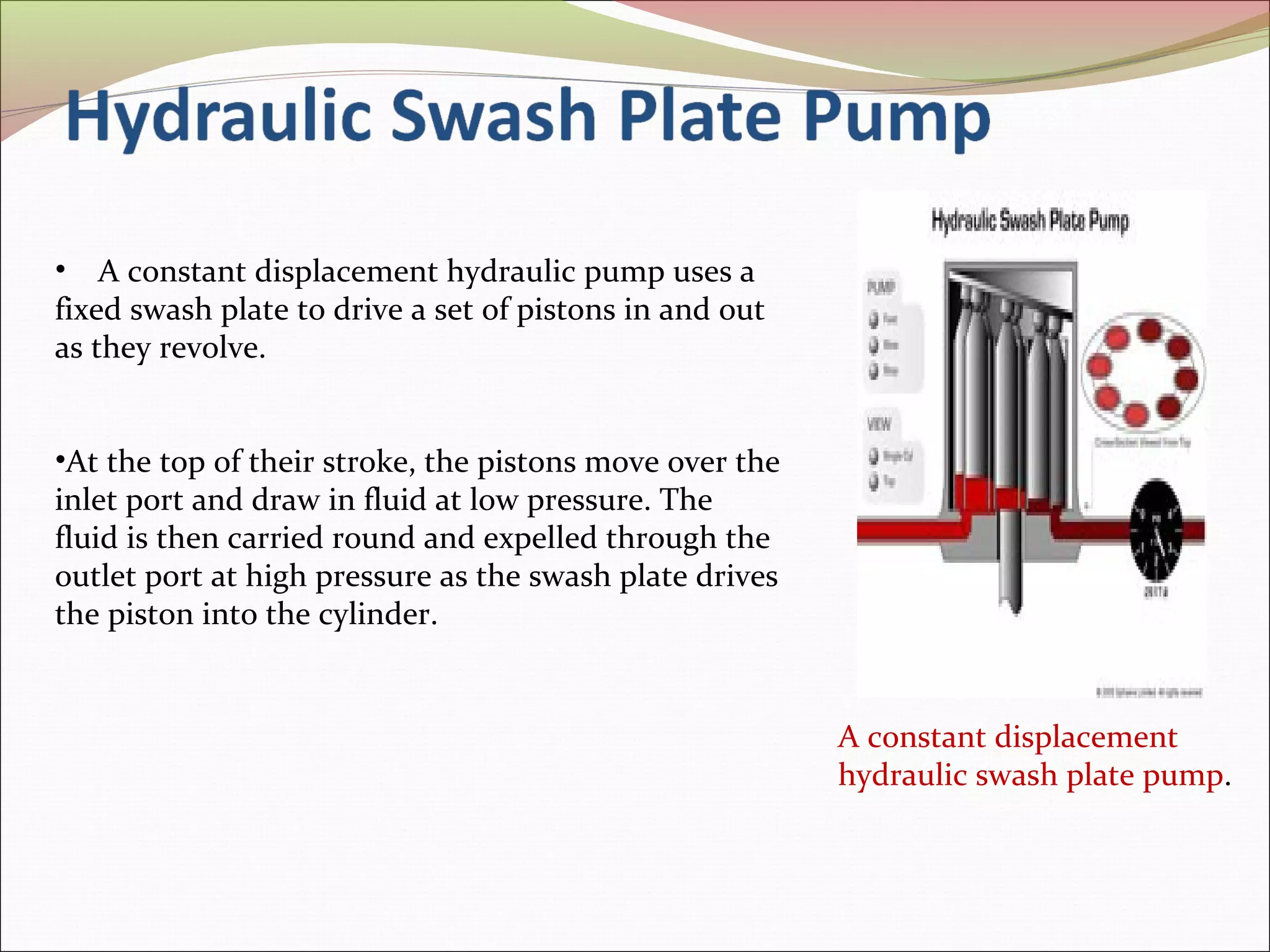
A constant displacement 
hydraulic swash plate pump. 
• A constant displacement hydraulic pump uses a 
fixed swash plate to drive a set of pistons in and out 
as they revolve. 
•At the top of their stroke, the pistons move over the 
inlet port and draw in fluid at low pressure. The 
fluid is then carried round and expelled through the 
outlet port at high pressure as the swash plate drives 
the piston into the cylinder.
Hydraulic Principles 
Fluids cannot be compressed 
Fluids can transmit Movement 
Acts “Like a steel rod” in a closed container 
Master cylinder transmits fluid to wheel 
cylinder or caliper piston bore. 
Fluids can transmit and increase force 
Force 
Area 
Pressure
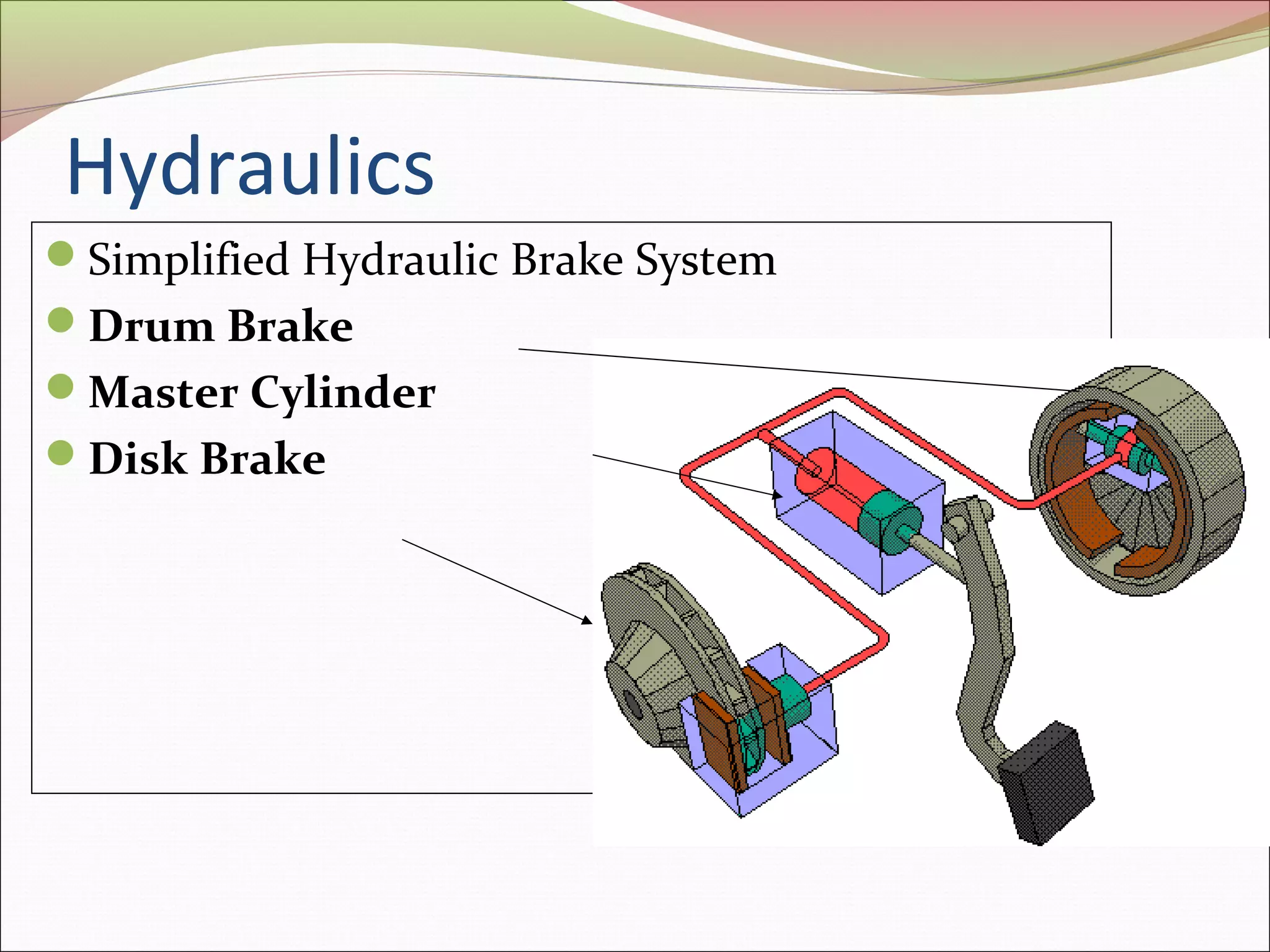
Hydraulics 
Simplified Hydraulic Brake System 
Drum Brake 
Master Cylinder 
Disk Brake
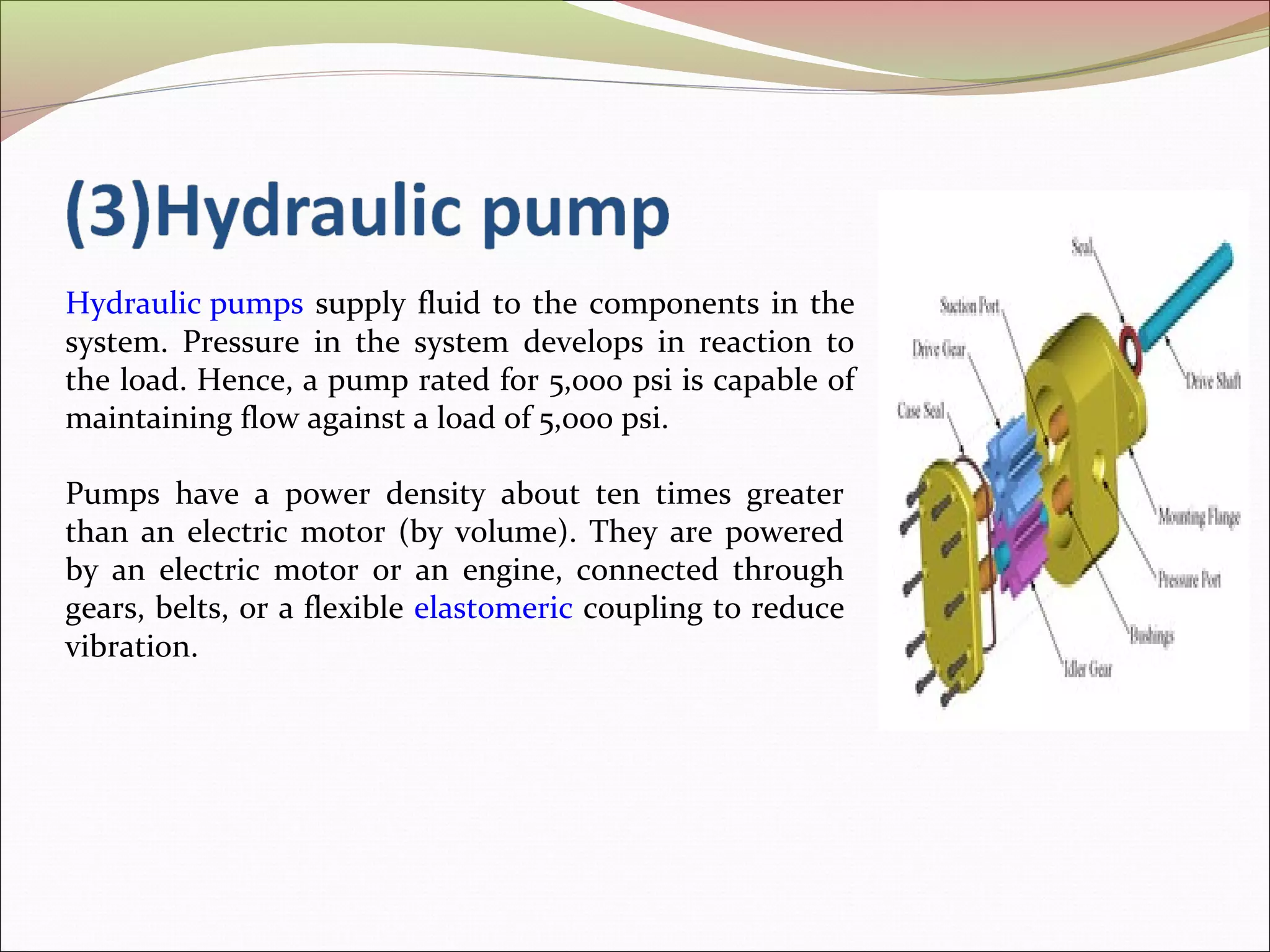
Hydraulic pumps supply fluid to the components in the 
system. Pressure in the system develops in reaction to 
the load. Hence, a pump rated for 5,000 psi is capable of 
maintaining flow against a load of 5,000 psi. 
Pumps have a power density about ten times greater 
than an electric motor (by volume). They are powered 
by an electric motor or an engine, connected through 
gears, belts, or a flexible elastomeric coupling to reduce 
vibration.
Common types of hydraulic pumps to hydraulic 
machinery applications are- 
•Gear pump: cheap, durable, simple. Less efficient, because they are constant 
(fixed) displacement, and mainly suitable for pressures below 20 MPa (3000 
psi). 
•Vane pump: cheap and simple, reliable (especially in g-rotor form). Good for 
higher-flow low-pressure output. 
•Radial piston pump A pump that is normally used for very high pressure at small 
flows. 
Piston pumps are more expensive than gear or vane pumps, but provide longer 
life operating at higher pressure, with difficult fluids and longer continuous 
duty cycles. Piston pumps make up one half of a hydrostatic transmission.
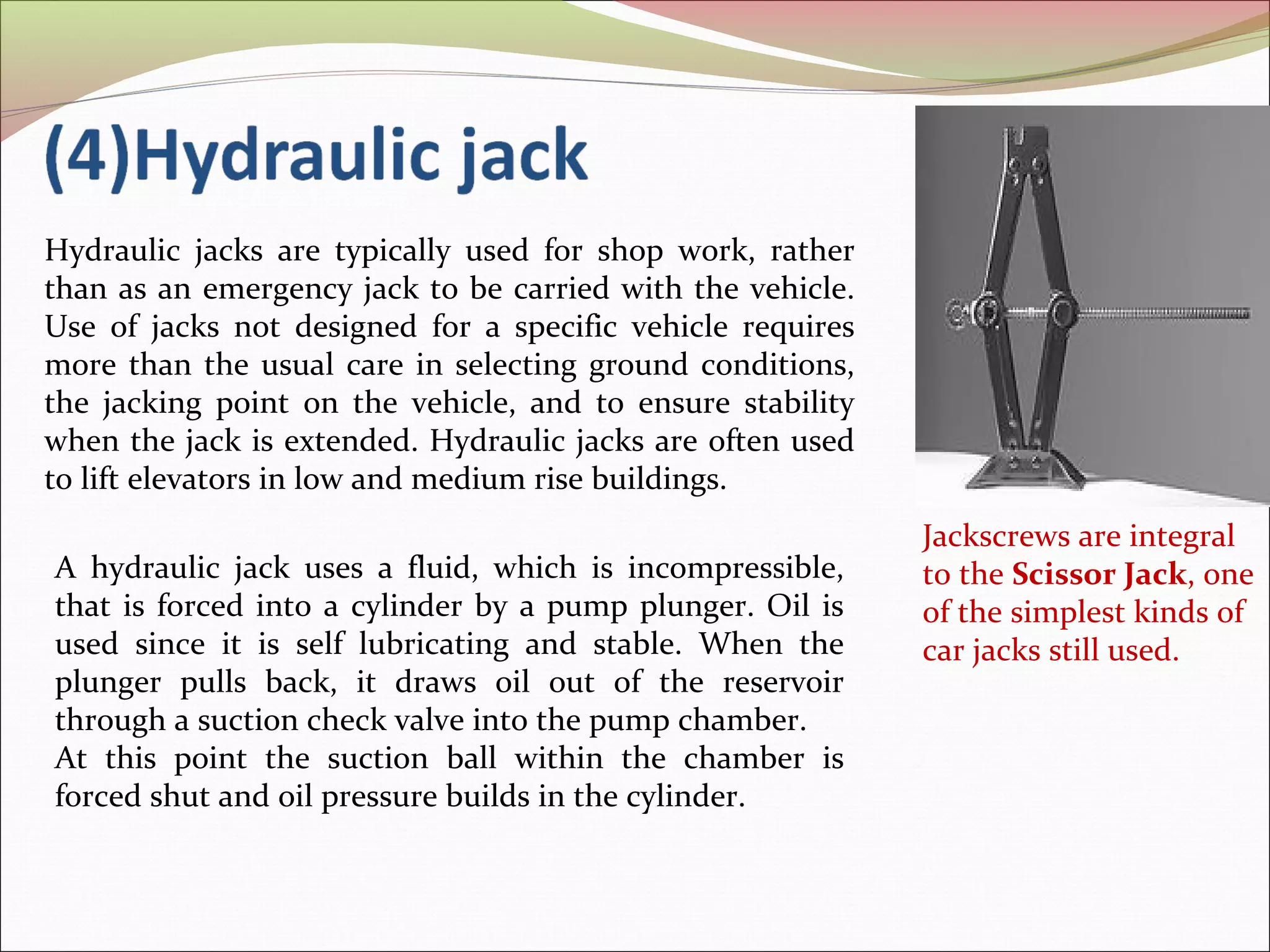
Jackscrews are integral 
to the Scissor Jack, one 
of the simplest kinds of 
car jacks still used. 
Hydraulic jacks are typically used for shop work, rather 
than as an emergency jack to be carried with the vehicle. 
Use of jacks not designed for a specific vehicle requires 
more than the usual care in selecting ground conditions, 
the jacking point on the vehicle, and to ensure stability 
when the jack is extended. Hydraulic jacks are often used 
to lift elevators in low and medium rise buildings. 
A hydraulic jack uses a fluid, which is incompressible, 
that is forced into a cylinder by a pump plunger. Oil is 
used since it is self lubricating and stable. When the 
plunger pulls back, it draws oil out of the reservoir 
through a suction check valve into the pump chamber. 
At this point the suction ball within the chamber is 
forced shut and oil pressure builds in the cylinder.
In a bottle jack the piston is vertical and directly supports a bearing pad 
that contacts the object being lifted. With a single action piston the lift is 
somewhat less than twice the collapsed height of the jack, making it 
suitable only for vehicles with a relatively high clearance. For lifting 
structures such as houses the hydraulic interconnection of multiple vertical 
jacks through valves enables the even distribution of forces while enabling 
close control of the lift. 
In a floor jack (aka 'trolley jack') a horizontal piston pushes on the short 
end of a bellcrank, with the long arm providing the vertical motion to a 
lifting pad, kept horizontal with a horizontal linkage. Floor jacks usually 
include castors and wheels, allowing compensation for the arc taken by the 
lifting pad. This mechanism provide a low profile when collapsed, for easy 
maneuvering underneath the vehicle, while allowing considerable 
extension.
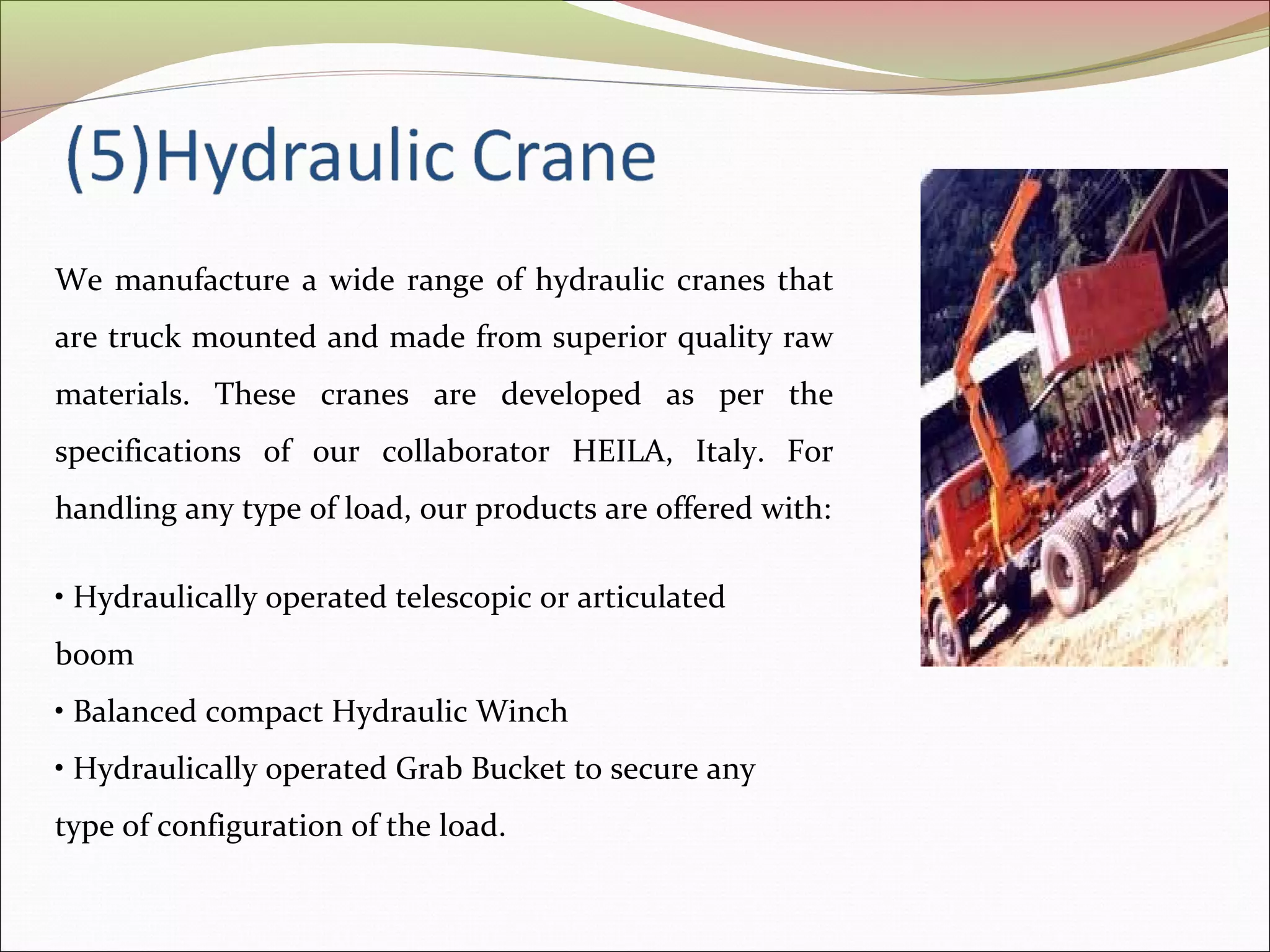
We manufacture a wide range of hydraulic cranes that 
are truck mounted and made from superior quality raw 
materials. These cranes are developed as per the 
specifications of our collaborator HEILA, Italy. For 
handling any type of load, our products are offered with: 
• Hydraulically operated telescopic or articulated 
boom 
• Balanced compact Hydraulic Winch 
• Hydraulically operated Grab Bucket to secure any 
type of configuration of the load.
These cranes are capable of handling loads between 2 tone meter to 35 tone meter. 
Available with hydraulic slewing arrangement up to 380 degree, these cranes are 
capable of picking load and keeping in any direction. This arrangement require 
minimum space in truck leaving major portion of truck empty for self loading. We 
also offer 2 points or 4 points hydraulic stabilizers with our cranes as desired by our 
clients. In order to ensure complete safety, we offer with our products: overload 
protection valve, Hose Fail Safety Valve that helps in adjusting pressure in case of 
excessive load and also ensure that cylinder does not come down with load in case 
of power failure. Designed to perfection, our products can easily mount on trolley, 
trailer, barge or stationary base easily.
By using a proportional ‘soft stop’ system on the higher lift 
machines, Adaptive Load Control overcomes the problem 
caused by a sudden stop creating additional inertia from a 
combination of weight and high reach, that can increase the 
risk of machine forward overturn. The proportional flow 
reduction used for the high reach machines also maximises 
speed of operation so that the operator’s ability to use the 
machine’s full operating envelope is not compromised. – The lift 
performance indicated on the lift chart can be achieved while 
complying with EN15000 using the Adaptive Load Control 
system
12/02/14 
Thank you 
Made by:-Ankush dhaka,Sandeep kumar,Nikhil 
sharma 18

jcb

  • 1.
  • 2.
    Today in modernera people use diesel JCB but in this time student make Hydraulic JCB. Which was movement with the Hydraulic Pressure. It was without Pollution. In little model student use injection. Its fill injection with the water which is join with the help of a pipe another injection. Then after it became movement..,
  • 3.
    (2)Hydraulic Principles 1.Hydraulic systems provide a means of remotely controlling a wide range of components by transmitting a force through a confined fluid. 2. Because hydraulics can transmit high forces rapidly and accurately along lightweight pipes of any size, shape and length, they are the prime source of power in aircraft systems such as flying controls, flaps, retractable undercarriages and wheel brakes. 3. The basic principle behind any hydraulic system is very simple - pressure applied anywhere to a body of fluid causes a force to be transmitted equally in all directions, with the force acting at right angles to any surface in contact with the fluid.
  • 4.
    For the instructionof hydraulic principles 1. Pascal's Law 2. Hydraulic Pressure and Force 3. Hydraulic Swash Plate Pump
  • 5.
    • Pascal's Law(from Blaise Pascal 1623 to 1662), comprises a set of principles formulated in 1648 and states that pressure applied to a confined fluid at any point is transmitted undiminished throughout the fluid in all directions and acts upon every part of the confining vessel at right angles to its interior surfaces and equally upon equal areas. A demonstration of Pascal's Law • This is the basic principle behind any hydraulic system - pressure applied anywhere to a body of fluid causes a force to be transmitted equally in all directions, with the force acting at right angles to any surface in contact with the fluid.
  • 6.
    • Pressure isthe force per unit area exerted on a surface, divided by the area of that surface. Pressure = Force/Surface Area The relationship between hydraulic pressure and force •Therefore hydraulic pressure is the force per unit area exerted by a fluid on the surface within the container.
  • 7.
    A constant displacement hydraulic swash plate pump. • A constant displacement hydraulic pump uses a fixed swash plate to drive a set of pistons in and out as they revolve. •At the top of their stroke, the pistons move over the inlet port and draw in fluid at low pressure. The fluid is then carried round and expelled through the outlet port at high pressure as the swash plate drives the piston into the cylinder.
  • 8.
    Hydraulic Principles Fluidscannot be compressed Fluids can transmit Movement Acts “Like a steel rod” in a closed container Master cylinder transmits fluid to wheel cylinder or caliper piston bore. Fluids can transmit and increase force Force Area Pressure
  • 9.
    Hydraulics Simplified HydraulicBrake System Drum Brake Master Cylinder Disk Brake
  • 10.
    Hydraulic pumps supplyfluid to the components in the system. Pressure in the system develops in reaction to the load. Hence, a pump rated for 5,000 psi is capable of maintaining flow against a load of 5,000 psi. Pumps have a power density about ten times greater than an electric motor (by volume). They are powered by an electric motor or an engine, connected through gears, belts, or a flexible elastomeric coupling to reduce vibration.
  • 11.
    Common types ofhydraulic pumps to hydraulic machinery applications are- •Gear pump: cheap, durable, simple. Less efficient, because they are constant (fixed) displacement, and mainly suitable for pressures below 20 MPa (3000 psi). •Vane pump: cheap and simple, reliable (especially in g-rotor form). Good for higher-flow low-pressure output. •Radial piston pump A pump that is normally used for very high pressure at small flows. Piston pumps are more expensive than gear or vane pumps, but provide longer life operating at higher pressure, with difficult fluids and longer continuous duty cycles. Piston pumps make up one half of a hydrostatic transmission.
  • 12.
    Jackscrews are integral to the Scissor Jack, one of the simplest kinds of car jacks still used. Hydraulic jacks are typically used for shop work, rather than as an emergency jack to be carried with the vehicle. Use of jacks not designed for a specific vehicle requires more than the usual care in selecting ground conditions, the jacking point on the vehicle, and to ensure stability when the jack is extended. Hydraulic jacks are often used to lift elevators in low and medium rise buildings. A hydraulic jack uses a fluid, which is incompressible, that is forced into a cylinder by a pump plunger. Oil is used since it is self lubricating and stable. When the plunger pulls back, it draws oil out of the reservoir through a suction check valve into the pump chamber. At this point the suction ball within the chamber is forced shut and oil pressure builds in the cylinder.
  • 13.
    In a bottlejack the piston is vertical and directly supports a bearing pad that contacts the object being lifted. With a single action piston the lift is somewhat less than twice the collapsed height of the jack, making it suitable only for vehicles with a relatively high clearance. For lifting structures such as houses the hydraulic interconnection of multiple vertical jacks through valves enables the even distribution of forces while enabling close control of the lift. In a floor jack (aka 'trolley jack') a horizontal piston pushes on the short end of a bellcrank, with the long arm providing the vertical motion to a lifting pad, kept horizontal with a horizontal linkage. Floor jacks usually include castors and wheels, allowing compensation for the arc taken by the lifting pad. This mechanism provide a low profile when collapsed, for easy maneuvering underneath the vehicle, while allowing considerable extension.
  • 14.
    We manufacture awide range of hydraulic cranes that are truck mounted and made from superior quality raw materials. These cranes are developed as per the specifications of our collaborator HEILA, Italy. For handling any type of load, our products are offered with: • Hydraulically operated telescopic or articulated boom • Balanced compact Hydraulic Winch • Hydraulically operated Grab Bucket to secure any type of configuration of the load.
  • 15.
    These cranes arecapable of handling loads between 2 tone meter to 35 tone meter. Available with hydraulic slewing arrangement up to 380 degree, these cranes are capable of picking load and keeping in any direction. This arrangement require minimum space in truck leaving major portion of truck empty for self loading. We also offer 2 points or 4 points hydraulic stabilizers with our cranes as desired by our clients. In order to ensure complete safety, we offer with our products: overload protection valve, Hose Fail Safety Valve that helps in adjusting pressure in case of excessive load and also ensure that cylinder does not come down with load in case of power failure. Designed to perfection, our products can easily mount on trolley, trailer, barge or stationary base easily.
  • 16.
    By using aproportional ‘soft stop’ system on the higher lift machines, Adaptive Load Control overcomes the problem caused by a sudden stop creating additional inertia from a combination of weight and high reach, that can increase the risk of machine forward overturn. The proportional flow reduction used for the high reach machines also maximises speed of operation so that the operator’s ability to use the machine’s full operating envelope is not compromised. – The lift performance indicated on the lift chart can be achieved while complying with EN15000 using the Adaptive Load Control system
  • 18.
    12/02/14 Thank you Made by:-Ankush dhaka,Sandeep kumar,Nikhil sharma 18