BY
ASHOK BISHNOI
Lcturer,JINR
INTRODUCTION:-
 Sudden death occur when heartbeat &
breathing stop suddenly or unexpectedly.
the major role of CPR is to provide oxygen to
heart ,brain,& the other vital organ until
medical treatment (advance cardiac life
support-ACLS) can restore normal heart
action.
DEFINITION:-
 Angela Morrow RN
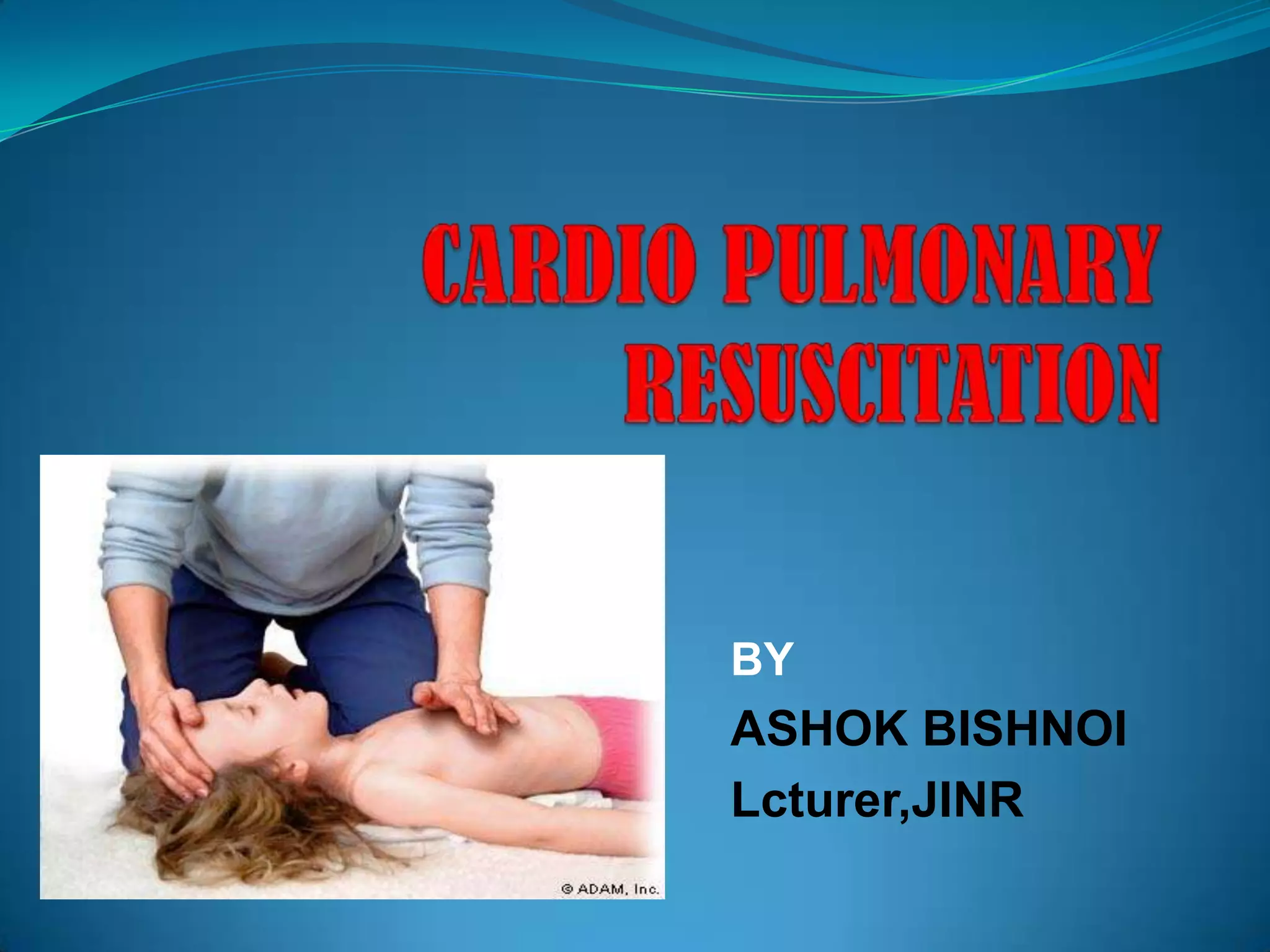
Cardiopulmonary resuscitation
(CPR) is a procedure used when a patient's heart stops
beating and breathing stops. It can involve
compressions of the chest or electrical shocks along
with rescue breathing.
 Mosby medical dictionary
CPR is a basic emergency
procedure for life support consisting of artificial and
manual external cardiac massage
.
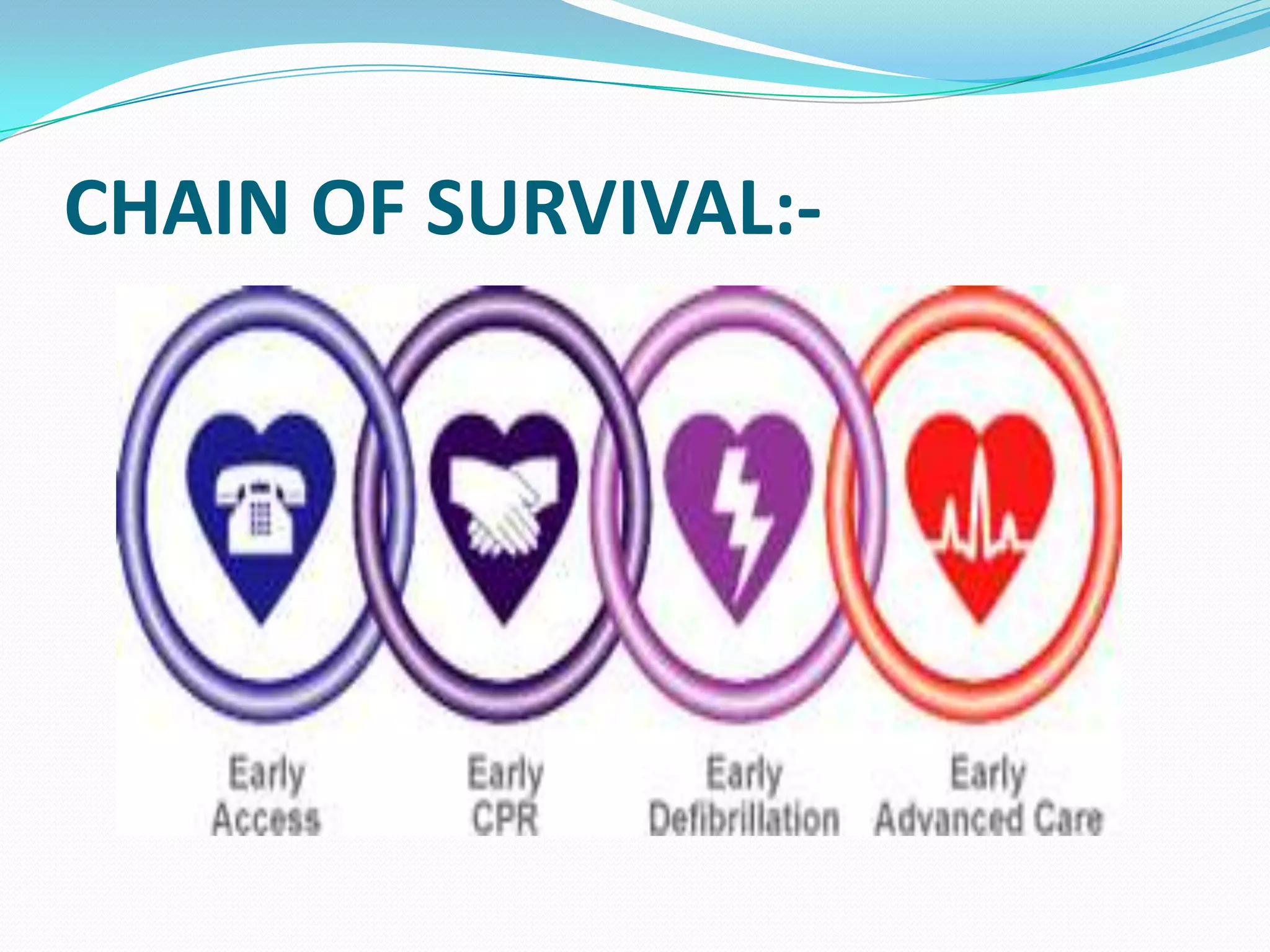
CHAIN OF SURVIVAL:-
INDICATIONS:-
 Cardio vascular disorders
CAD, congenital heart diseases , coronary
embolism, cardiac rupture & dissection
 Pulmonary causes
pulmonary embolism, pulmonary edema, asphyxia
 Metabolic causes
hypoglycemia, electrolyte imbalances
 Fluid imbalance
extensive hemorrhage, hypotension, shock
 Neurological causes
brain injuries, massive cva
 Poisons substance and drug overdose
co poisoning, propanolol over dose
 Other causes
electrical shock, hypothermia, narcotic overdose
WARNING SIGNS OF CARDIO
PULMONARY ARREST:-
 Early signs:
. loss of consciousness & convulsions
 Late signs:
. Apnoea
.Dilated pupils
.Absence of heart sounds
 Other signs
 Changes in respiratory rate
 A weak or irregular pulse
 Bradycardia
 Cyanosis
 Hypothermia
CPR PROCEDURE
EQUIPMENTS
i. Ambu bag and masks with different size.
ii. Oropharyngeal airways.
iii. Endotracheal tubes of appropriate
sizes and stillet.
E
T
T
U
B
E
iv. Paediatric laryngoscope
with straight (Miller) and
curved (McIntosh)
blade – Appropriate sizes.
v. Suction apparatus.
vi. NG tube.
i. IV equipments & fluids
ii. Pulse-oxymetry
iii. Oxygen sources
iv. Automated external defibrillator
v. Emergency drugs
vi. Cardiac monitor
STEPS FOR CPR:-
Airway:-Maintaining an open airway.
Breathing:-Providing artificial ventilation by rescue
breathing.
Circulation:-Promoting artificial circulation by
external cardiac compression.
Defibrillation:-Restoring the heart beat.
Shake shoulders gently
Ask “Are you all right?”
If he responds
• Leave as you find him.
• Find out what is wrong.
• Reassess regularly.
CHECK RESPONSE
(A) AIRWAY :-
 Head tilt chin lift manoeuvre
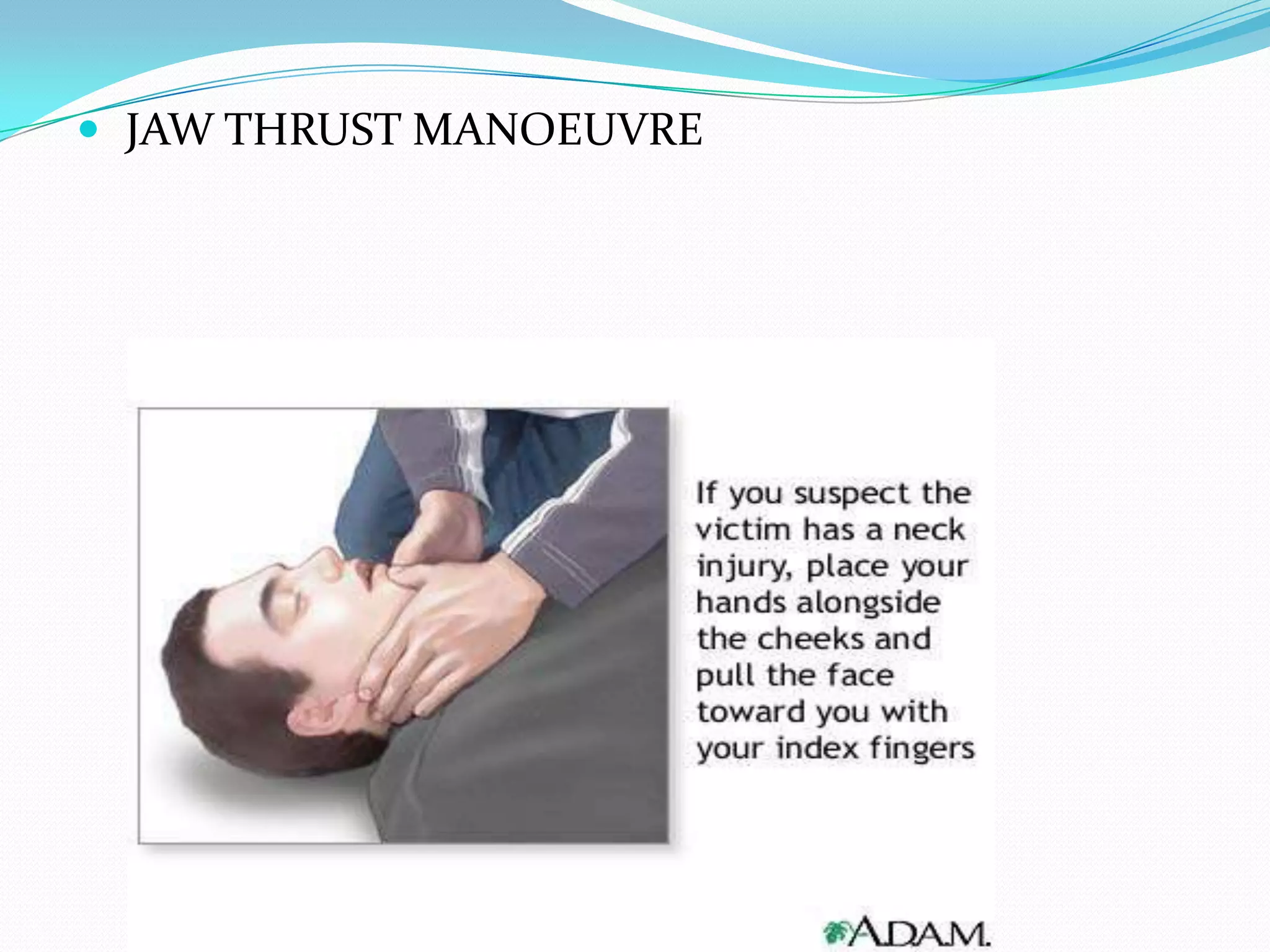
 Jaw thrust manoeuvre
 HEAD TILT CHIN LIFT MANOEUVRE
 JAW THRUST MANOEUVRE
(B) Breathing:-
Look Listen Feel
Method:
 Mouth to mouth ventilation
 Mouth to mask ventilation
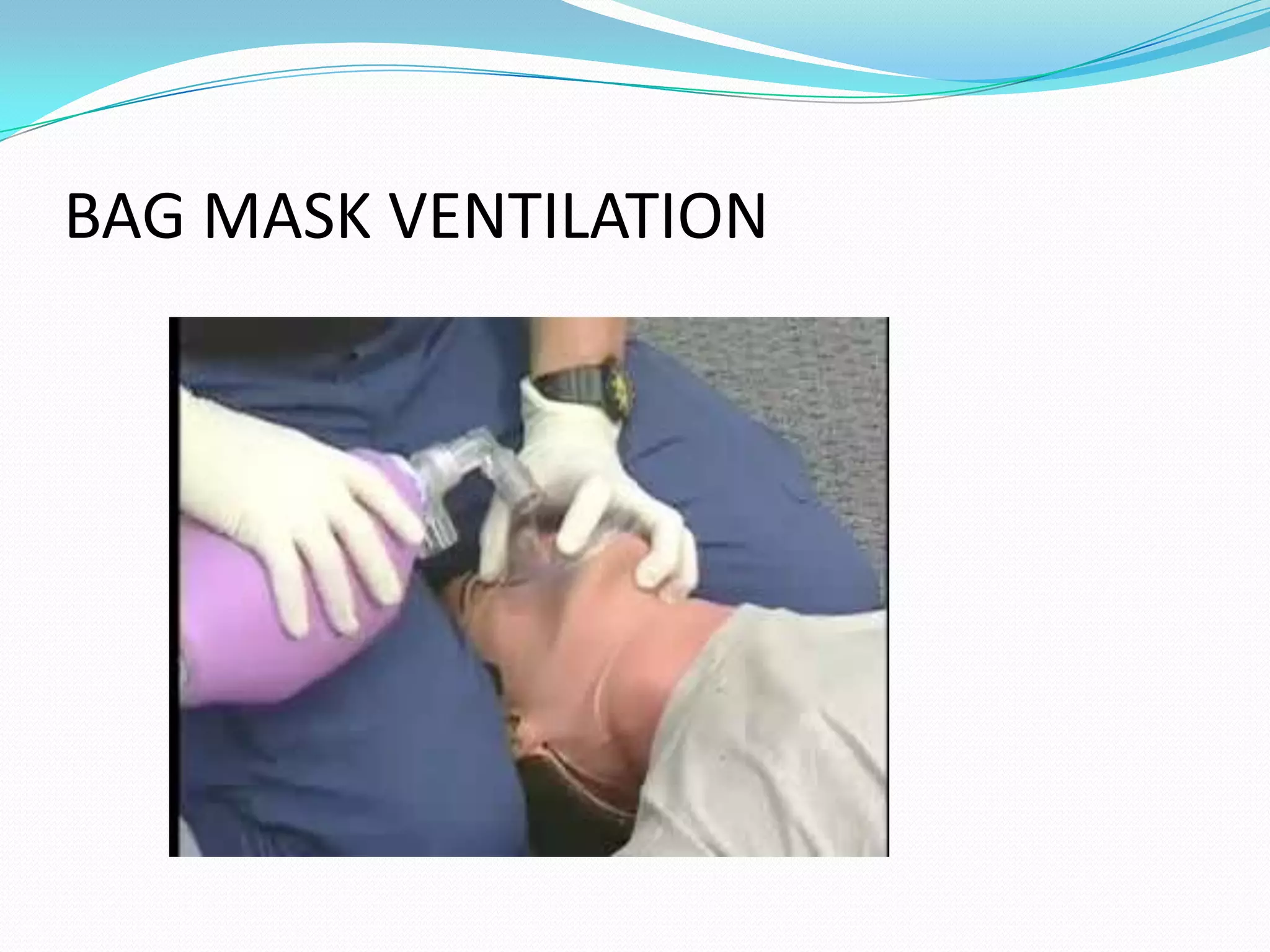
 Bag mask ventilation
 MOUTH TO MOUTH VENTILATION
MOUTH TO MASK VENTILATION
BAG MASK VENTILATION
NEONATAL PEDIATRIC ADULT
(C) Circulation:-
Assess pulse
{Adult}
Assess pulse (infant)
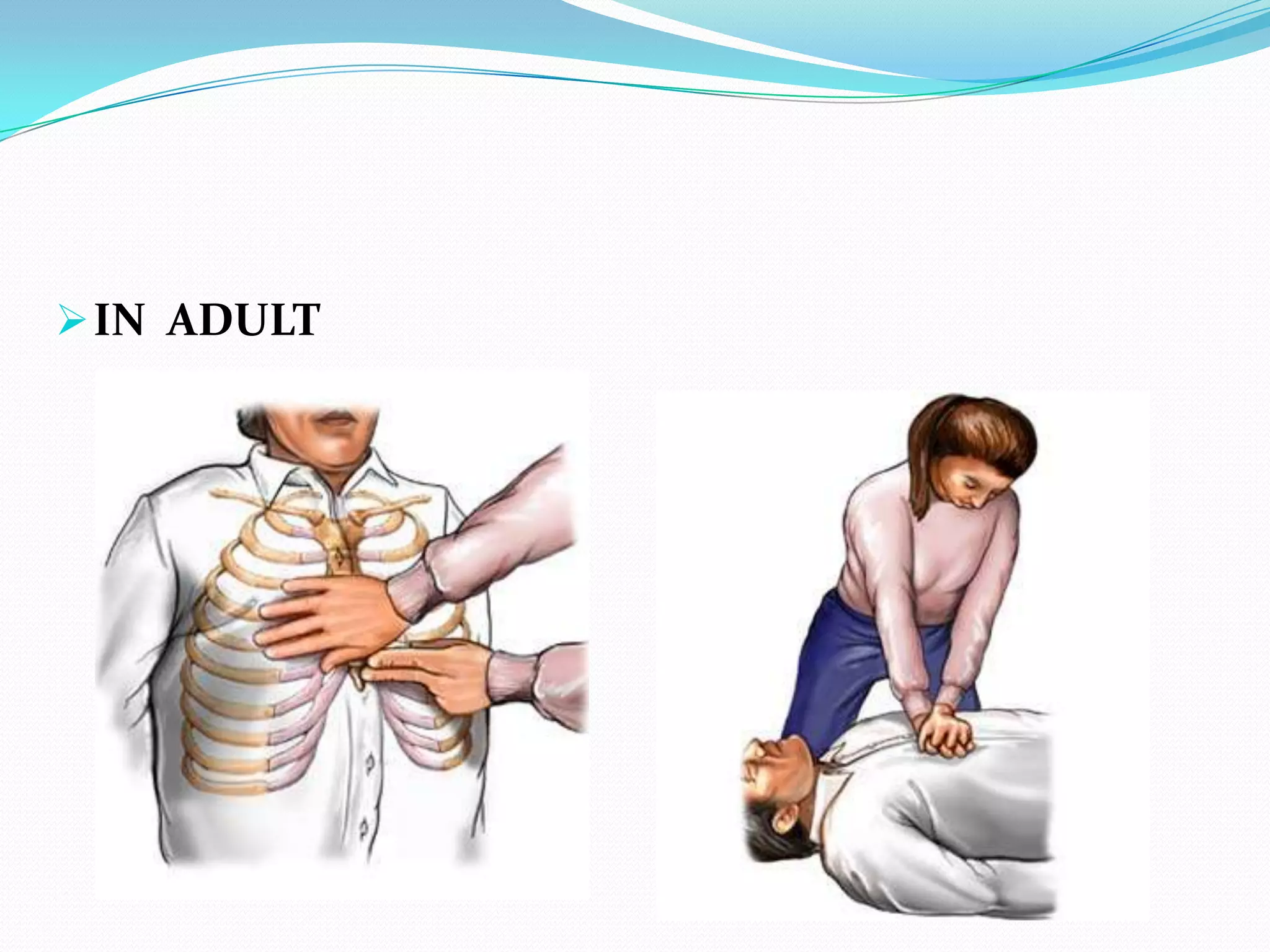
CHEST COMPRESSIONS
• Place the heel of one hand in
the centre of the chest
• Place other hand on top
• Interlock fingers
• Compress the chest
– Rate 100 min-1
– Depth 3-5 cm(1.5 to 2 inches)
– Equal compression : relaxation
• When possible change CPR
operator every 2 min
CHEST COMPRESSIONS
IN ADULT
 IN CHILD
 IN INFANT
(D) DEFIBRILLATION:-
 Device that delivers direct electrical current
across the myocardium. The aim is to produce
synchronous depolarization of cardiac muscle
STRATEGIES:
Test defibrillate for
 full battery charge
 switch on power button
 change paddle mode
 Key issues:
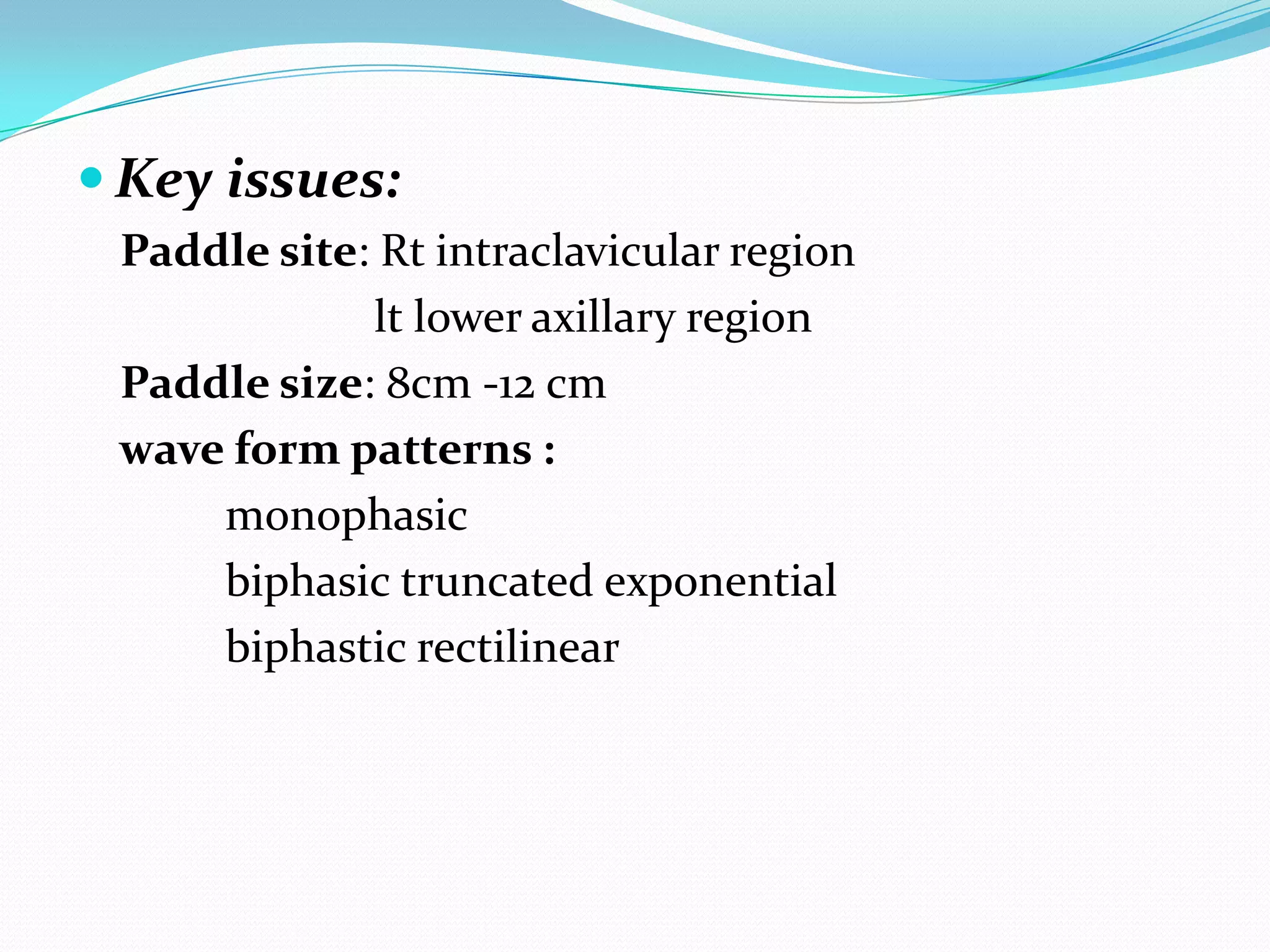
Paddle site: Rt intraclavicular region
lt lower axillary region
Paddle size: 8cm -12 cm
wave form patterns :
monophasic
biphasic truncated exponential
biphastic rectilinear
Energy level:
Pediatric : 2-4 J/kg
Adult: Monophasic=> 360J
Biphasic truncated=> 150-200J
Biphasic rectilinear=> 120 J
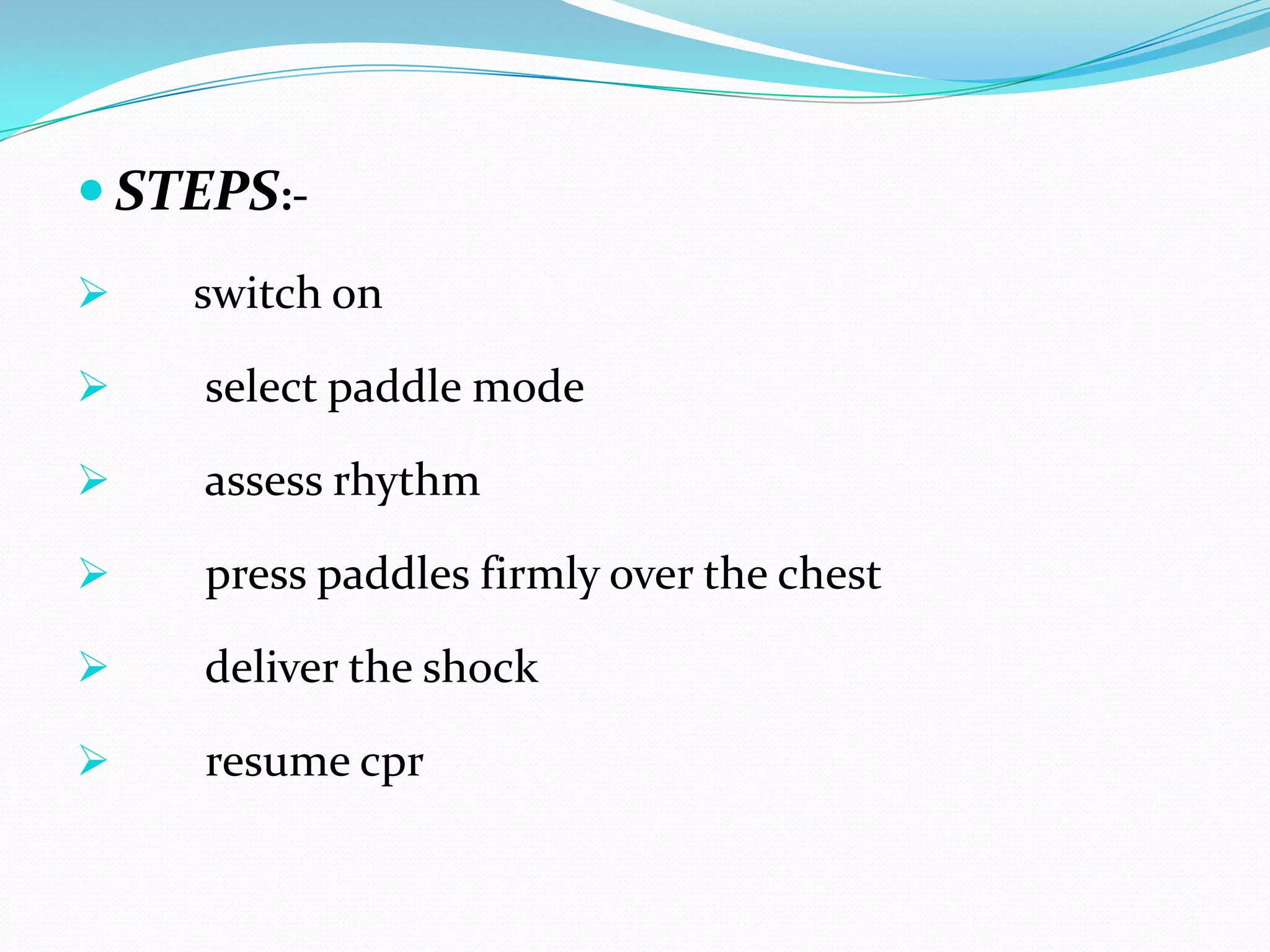
 STEPS:-
 switch on
 select paddle mode
 assess rhythm
 press paddles firmly over the chest
 deliver the shock
 resume cpr
Intensive care:-(shifting in ICU)
 transfer to ICU
 monitor closely and continuously
 monitor vital signs every hour
 watch for convulsions
 intubate if necessary
 catheterize the patient and monitor output
 record the procedure
POST CARDIAC ARREST MANAGEMENT:-
Continued care
 To ensure hemodynamic monitoring
 To minimize the effect of loss of spontaneous
circulation of various organs
 To recognize and treat recurrent cardiac arrests
Objectives:
 Optimize cardio pulmonary function& systemic
perfusion
 Transport victim out of hospital
 Identify and treat thre precipating factor
 Intitute measure to prevent recurrence and improve
neurological function
 Respiratory system;
 Intubate & mechanically ventilate until they are stable
 Administer supplemental oxygen
 Obtain chest x ray
 Administer drugs
 Avoid hyperventilation
 Cardio vascular system:
 Obtain expert consultation
 Monitor ecg , x-ray, lab analysis,
 Monitor intra arterial blood pressure
 Administer drugs
COMPLICATIONS OF CPR:-:-
 Rib fractures
 Laceration related to the tip of the
sternum
 Liver, lung, spleen
 Aspiration
 Vmiting
Cpr ppt

Cpr ppt

  • 1.
  • 2.
    INTRODUCTION:-  Sudden deathoccur when heartbeat & breathing stop suddenly or unexpectedly. the major role of CPR is to provide oxygen to heart ,brain,& the other vital organ until medical treatment (advance cardiac life support-ACLS) can restore normal heart action.
  • 3.
    DEFINITION:-  Angela MorrowRN Cardiopulmonary resuscitation (CPR) is a procedure used when a patient's heart stops beating and breathing stops. It can involve compressions of the chest or electrical shocks along with rescue breathing.  Mosby medical dictionary CPR is a basic emergency procedure for life support consisting of artificial and manual external cardiac massage .
  • 4.
  • 5.
    INDICATIONS:-  Cardio vasculardisorders CAD, congenital heart diseases , coronary embolism, cardiac rupture & dissection  Pulmonary causes pulmonary embolism, pulmonary edema, asphyxia  Metabolic causes hypoglycemia, electrolyte imbalances
  • 6.
     Fluid imbalance extensivehemorrhage, hypotension, shock  Neurological causes brain injuries, massive cva  Poisons substance and drug overdose co poisoning, propanolol over dose  Other causes electrical shock, hypothermia, narcotic overdose
  • 7.
    WARNING SIGNS OFCARDIO PULMONARY ARREST:-  Early signs: . loss of consciousness & convulsions  Late signs: . Apnoea .Dilated pupils .Absence of heart sounds
  • 8.
     Other signs Changes in respiratory rate  A weak or irregular pulse  Bradycardia  Cyanosis  Hypothermia
  • 9.
  • 10.
    EQUIPMENTS i. Ambu bagand masks with different size. ii. Oropharyngeal airways. iii. Endotracheal tubes of appropriate sizes and stillet. E T T U B E
  • 11.
    iv. Paediatric laryngoscope withstraight (Miller) and curved (McIntosh) blade – Appropriate sizes. v. Suction apparatus. vi. NG tube.
  • 12.
    i. IV equipments& fluids ii. Pulse-oxymetry iii. Oxygen sources iv. Automated external defibrillator v. Emergency drugs vi. Cardiac monitor
  • 13.
    STEPS FOR CPR:- Airway:-Maintainingan open airway. Breathing:-Providing artificial ventilation by rescue breathing. Circulation:-Promoting artificial circulation by external cardiac compression. Defibrillation:-Restoring the heart beat.
  • 14.
    Shake shoulders gently Ask“Are you all right?” If he responds • Leave as you find him. • Find out what is wrong. • Reassess regularly. CHECK RESPONSE
  • 15.
    (A) AIRWAY :- Head tilt chin lift manoeuvre  Jaw thrust manoeuvre
  • 16.
     HEAD TILTCHIN LIFT MANOEUVRE
  • 17.
     JAW THRUSTMANOEUVRE
  • 18.
  • 19.
    Method:  Mouth tomouth ventilation  Mouth to mask ventilation  Bag mask ventilation
  • 20.
     MOUTH TOMOUTH VENTILATION
  • 21.
    MOUTH TO MASKVENTILATION
  • 22.
  • 23.
  • 24.
  • 25.
  • 26.
  • 27.
    • Place theheel of one hand in the centre of the chest • Place other hand on top • Interlock fingers • Compress the chest – Rate 100 min-1 – Depth 3-5 cm(1.5 to 2 inches) – Equal compression : relaxation • When possible change CPR operator every 2 min CHEST COMPRESSIONS
  • 28.
  • 29.
  • 30.
  • 31.
    (D) DEFIBRILLATION:-  Devicethat delivers direct electrical current across the myocardium. The aim is to produce synchronous depolarization of cardiac muscle STRATEGIES: Test defibrillate for  full battery charge  switch on power button  change paddle mode
  • 33.
     Key issues: Paddlesite: Rt intraclavicular region lt lower axillary region Paddle size: 8cm -12 cm wave form patterns : monophasic biphasic truncated exponential biphastic rectilinear
  • 34.
    Energy level: Pediatric :2-4 J/kg Adult: Monophasic=> 360J Biphasic truncated=> 150-200J Biphasic rectilinear=> 120 J
  • 36.
     STEPS:-  switchon  select paddle mode  assess rhythm  press paddles firmly over the chest  deliver the shock  resume cpr
  • 37.
    Intensive care:-(shifting inICU)  transfer to ICU  monitor closely and continuously  monitor vital signs every hour  watch for convulsions  intubate if necessary  catheterize the patient and monitor output  record the procedure
  • 38.
    POST CARDIAC ARRESTMANAGEMENT:- Continued care  To ensure hemodynamic monitoring  To minimize the effect of loss of spontaneous circulation of various organs  To recognize and treat recurrent cardiac arrests Objectives:  Optimize cardio pulmonary function& systemic perfusion  Transport victim out of hospital  Identify and treat thre precipating factor  Intitute measure to prevent recurrence and improve neurological function
  • 39.
     Respiratory system; Intubate & mechanically ventilate until they are stable  Administer supplemental oxygen  Obtain chest x ray  Administer drugs  Avoid hyperventilation  Cardio vascular system:  Obtain expert consultation  Monitor ecg , x-ray, lab analysis,  Monitor intra arterial blood pressure  Administer drugs
  • 40.
    COMPLICATIONS OF CPR:-:- Rib fractures  Laceration related to the tip of the sternum  Liver, lung, spleen  Aspiration  Vmiting