PetrochemicalPetrochemical
ProcessesProcesses
22.4.2. DESCRIBE THE BASIC BUILDING BLOCK PROCESSES IN
PETROCHEMICAL TECHNOLOGY
EHTISHAM UL HAQ
Petrochemical Feedstocks
 The refinery products are: naphtha; gas oil and
catalytic cracker gases.
 NOTE:
 In oil industry: gasoline fraction
 In petrochemical industry, naphtha is the
petroleum fraction that boils between 20-80o
C.
 Naphtahas: mix of alkanes, cycloalaknes and
aromatic hydrocarbons.
 Gas oils are mix of have the same components
but with higher molecular weights.
 Gas oils are used in place of naphtha as a
feedstocks for ethylene manufacture.
The Basic building Block Processes
 In USA, large scale cracking : cracker gases are the
precursors fro production of propylene and butenes.
 In Europe and Japan, small scale cracking: cracker
gases are sources fro ethylene.
 Kerosine: chemical feedstock, manufacture of ethylene
• Petrochemical manufacturing involves building blocks processes for the manufacture of
building blocks and intermediates.
• Petrochemical industry is based on intermediates.
• Known Petrochemical Processes: Thermal cracking; catalytic cracking and steam reforming.
The Basic building Block Processes (Cont.)
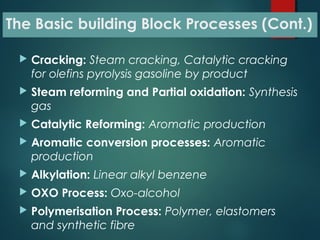
 Cracking: Steam cracking, Catalytic cracking
for olefins pyrolysis gasoline by product
 Steam reforming and Partial oxidation: Synthesis
gas
 Catalytic Reforming: Aromatic production
 Aromatic conversion processes: Aromatic
production
 Alkylation: Linear alkyl benzene
 OXO Process: Oxo-alcohol
 Polymerisation Process: Polymer, elastomers
and synthetic fibre
Thermal Cracking
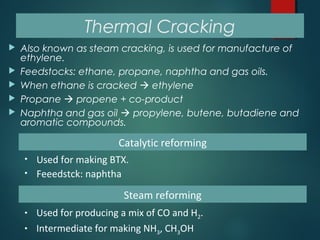
 Also known as steam cracking, is used for manufacture of
ethylene.
 Feedstocks: ethane, propane, naphtha and gas oils.
 When ethane is cracked  ethylene
 Propane  propene + co-product
 Naphtha and gas oil  propylene, butene, butadiene and
aromatic compounds.
Catalytic reforming
• Used for making BTX.
• Feeedstck: naphtha
Steam reforming
• Used for producing a mix of CO and H2.
• Intermediate for making NH3, CH3OH
Petrochemical Process Technology
 Petrochemical processes are normally Continuous
Processes; the raw materials are continuously fed
into the plant so as the products.
 Petrochemical plant would have one or more
reaction systems.
 C6H6 + C2H4  C6H5C2H5  C6H5CH=CH2 + H2
 Polymerization is a process of
reacting monomer molecules together in a chemical reaction to
form polymer chains or three-dimensional networks.
 There are many forms of polymerization and different sys
 Usually at least 100 monomer molecules must be combined to
make a product that has certain unique physical properties—
such as elasticity, high tensile strength, or the ability to form fibres
—that differentiate polymers from substances composed of
smaller and simpler molecules; often, many thousands of
monomer units are incorporated in a single molecule of a
polymer.tems exist to categorize them.
 he formation of stable covalent chemical bonds between the
monomers sets polymerization apart from other processes, such
as crystallization, in which large numbers of molecules aggregate
under the influence of weak intermolecular forces.
Polymerization

basic building block processes in petrochemical technology

  • 1.
    PetrochemicalPetrochemical ProcessesProcesses 22.4.2. DESCRIBE THEBASIC BUILDING BLOCK PROCESSES IN PETROCHEMICAL TECHNOLOGY EHTISHAM UL HAQ
  • 2.
    Petrochemical Feedstocks  Therefinery products are: naphtha; gas oil and catalytic cracker gases.  NOTE:  In oil industry: gasoline fraction  In petrochemical industry, naphtha is the petroleum fraction that boils between 20-80o C.  Naphtahas: mix of alkanes, cycloalaknes and aromatic hydrocarbons.  Gas oils are mix of have the same components but with higher molecular weights.  Gas oils are used in place of naphtha as a feedstocks for ethylene manufacture.
  • 3.
    The Basic buildingBlock Processes  In USA, large scale cracking : cracker gases are the precursors fro production of propylene and butenes.  In Europe and Japan, small scale cracking: cracker gases are sources fro ethylene.  Kerosine: chemical feedstock, manufacture of ethylene • Petrochemical manufacturing involves building blocks processes for the manufacture of building blocks and intermediates. • Petrochemical industry is based on intermediates. • Known Petrochemical Processes: Thermal cracking; catalytic cracking and steam reforming.
  • 4.
    The Basic buildingBlock Processes (Cont.)  Cracking: Steam cracking, Catalytic cracking for olefins pyrolysis gasoline by product  Steam reforming and Partial oxidation: Synthesis gas  Catalytic Reforming: Aromatic production  Aromatic conversion processes: Aromatic production  Alkylation: Linear alkyl benzene  OXO Process: Oxo-alcohol  Polymerisation Process: Polymer, elastomers and synthetic fibre
  • 5.
    Thermal Cracking  Alsoknown as steam cracking, is used for manufacture of ethylene.  Feedstocks: ethane, propane, naphtha and gas oils.  When ethane is cracked  ethylene  Propane  propene + co-product  Naphtha and gas oil  propylene, butene, butadiene and aromatic compounds. Catalytic reforming • Used for making BTX. • Feeedstck: naphtha Steam reforming • Used for producing a mix of CO and H2. • Intermediate for making NH3, CH3OH
  • 6.
    Petrochemical Process Technology Petrochemical processes are normally Continuous Processes; the raw materials are continuously fed into the plant so as the products.  Petrochemical plant would have one or more reaction systems.  C6H6 + C2H4  C6H5C2H5  C6H5CH=CH2 + H2
  • 7.
     Polymerization is aprocess of reacting monomer molecules together in a chemical reaction to form polymer chains or three-dimensional networks.  There are many forms of polymerization and different sys  Usually at least 100 monomer molecules must be combined to make a product that has certain unique physical properties— such as elasticity, high tensile strength, or the ability to form fibres —that differentiate polymers from substances composed of smaller and simpler molecules; often, many thousands of monomer units are incorporated in a single molecule of a polymer.tems exist to categorize them.  he formation of stable covalent chemical bonds between the monomers sets polymerization apart from other processes, such as crystallization, in which large numbers of molecules aggregate under the influence of weak intermolecular forces. Polymerization