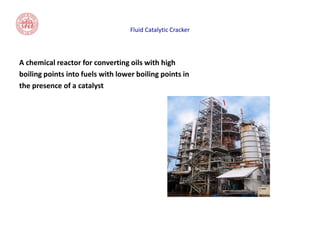
The document discusses fluid catalytic cracking (FCC), which is a process used in oil refineries to convert high-boiling hydrocarbon fractions into more valuable gasoline, diesel, and other products. It involves cracking heavier petroleum fractions with a catalyst at high temperatures in the presence of steam. The heavier fractions are broken up into lighter molecules like liquefied petroleum gas and gasoline. Key aspects covered include the FCC reactor design, catalyst regeneration process, and products produced including gasoline, diesel and light cycle oil.






![Fluid Catalytic Cracker
• History
• In 1855, petroleum cracking methods were pioneered by Chemistry Professor Benjamin Silliman, Jr., of Yale
University (then Sheffield Scientific School at Yale University). Silliman, like his father, were Skull and Bones
members and both Chemistry Professors at SSS.
• The first thermal cracking method, the Burton process, was invented by William M. Burton; the oil industry
first using it to produce gasoline in 1913.
• Catalytic cracking, based upon a process developed by Dr. Alex Golden Oblad at Standard Oil of Indiana has
been used from around 1936. Typical catalysts include alumina, silica, zeolites, and various types of clay
• The world's first oil refinery opened at Ploieşti, Romania in 1856 [1]. Several other refineries were built at that
location with investment from United States companies before being taken over by Nazi Germany during
World War II. Most of these refineries were bombarded by the US Air Force in Operation Tidal Wave, August 1,
1943.
• Another early example is Oljeön preserved as a museum at the UNESCO world heritage site Engelsberg. It
started operation in 1875 and is part of the Ecomuseum Bergslagen.
• The largest oil refinery in the world is in Ras Tanura, Saudi Arabia, owned by Saudi Aramco. The city was
originally built as a sea port, but actually developed because of the huge refinery area. For most of the 20th
century the largest refinery of the world was that of Abadan in Iran.](https://image.slidesharecdn.com/833c358e-3f5b-4a6e-a03f-12b411059759-150520154509-lva1-app6891/85/FCC-16-320.jpg)