C2PT Catalyst Process Technology
Summary of design,
operation, technology
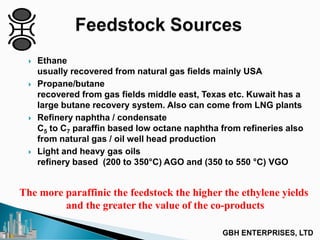
 Ethane
usually recovered from natural gas fields mainly USA
 Propane/butane
recovered from gas fields middle east, Texas etc. Kuwait has a
large butane recovery system. Also can come from LNG plants
 Refinery naphtha / condensate
C5 to C7 paraffin based low octane naphtha from refineries also
from natural gas / oil well head production
 Light and heavy gas oils
refinery based (200 to 350°C) AGO and (350 to 550 °C) VGO
The more paraffinic the feedstock the higher the ethylene yields
and the greater the value of the co-products
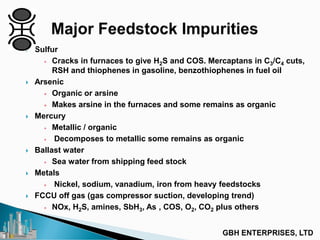
 Sulfur
+ Cracks in furnaces to give H2S and COS. Mercaptans in C3/C4 cuts,
RSH and thiophenes in gasoline, benzothiophenes in fuel oil
 Arsenic
+ Organic or arsine
+ Makes arsine in the furnaces and some remains as organic
 Mercury
+ Metallic / organic
+ Decomposes to metallic some remains as organic
 Ballast water
+ Sea water from shipping feed stock
 Metals
+ Nickel, sodium, vanadium, iron from heavy feedstocks
 FCCU off gas (gas compressor suction, developing trend)
+ NOx, H2S, amines, SbH3, As , COS, O2, CO2 plus others
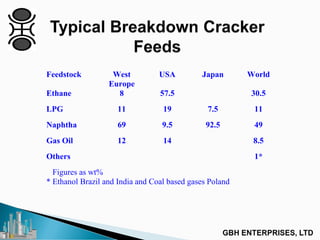
Feedstock West
Europe
USA Japan World
Ethane 8 57.5 30.5
LPG 11 19 7.5 11
Naphtha 69 9.5 92.5 49
Gas Oil 12 14 8.5
Others 1*
Figures as wt%
* Ethanol Brazil and India and Coal based gases Poland
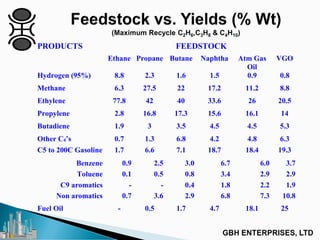
PRODUCTS FEEDSTOCK
Ethane Propane Butane Naphtha Atm Gas
Oil
VGO
Hydrogen (95%) 8.8 2.3 1.6 1.5 0.9 0.8
Methane 6.3 27.5 22 17.2 11.2 8.8
Ethylene 77.8 42 40 33.6 26 20.5
Propylene 2.8 16.8 17.3 15.6 16.1 14
Butadiene 1.9 3 3.5 4.5 4.5 5.3
Other C4’s 0.7 1.3 6.8 4.2 4.8 6.3
C5 to 200C Gasoline 1.7 6.6 7.1 18.7 18.4 19.3
Benzene 0.9 2.5 3.0 6.7 6.0 3.7
Toluene 0.1 0.5 0.8 3.4 2.9 2.9
C9 aromatics - - 0.4 1.8 2.2 1.9
Non aromatics 0.7 3.6 2.9 6.8 7.3 10.8
Fuel Oil - 0.5 1.7 4.7 18.1 25
Paraffin C7H16
Primary Cracking
C3H8 + 1-C4H8
Dehydrogenation
C7H14
Cracked
Products
Butadiene
C4H6
Secondary
Cracking
Propylene
C3H6
Propyne
C3H4
CH4+ C2H4 2C2H4
Acetylene
C2H2
Cyclo additions and
Dehydrogenation
give aromatics pyrolysis
tar and coke
Selectively Hydrogenated Free radical chain reaction
initiated in furnace tubes
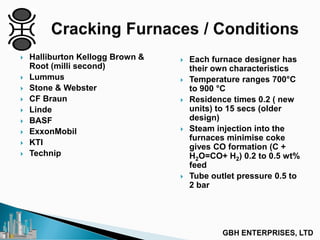
 Halliburton Kellogg Brown &
Root (milli second)
 Lummus
 Stone & Webster
 CF Braun
 Linde
 BASF
 ExxonMobil
 KTI
 Technip
 Each furnace designer has
their own characteristics
 Temperature ranges 700°C
to 900 °C
 Residence times 0.2 ( new
units) to 15 secs (older
design)
 Steam injection into the
furnaces minimise coke
gives CO formation (C +
H2O=CO+ H2) 0.2 to 0.5 wt%
feed
 Tube outlet pressure 0.5 to
2 bar
T
1
0
2
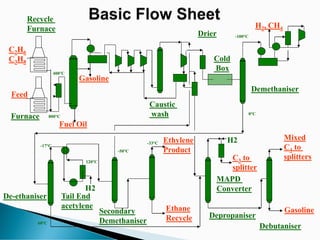
Feed
Gasoline
Fuel Oil
Caustic
wash
Cold
Box
H2, CH4
Demethaniser
H2
De-ethaniser Tail End
acetylene
Mixed
C4 to
splitters
GasolineSecondary
Demethaniser
Ethylene
Product
Ethane
Recycle
800°C
400°C
-100°C
-50°C
-33°C
60°C
-17°C
120°C
0°C
H2
MAPD
Converter
C3 to
splitter
Depropaniser
Debutaniser
Drier
C2H6
C3H8
Recycle
Furnace
Furnace
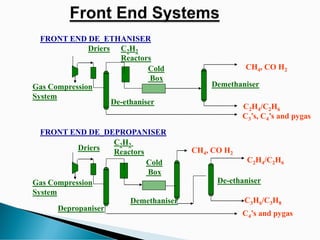
FRONT END DE_ETHANISER
C2H2
Reactors
Driers
T
1
0
2
Cold
Box
C3’s, C4’s and pygas
C2H4/C2H6
CH4, CO H2
Demethaniser
De-ethaniser
FRONT END DE_DEPROPANISER
Driers
T
1
0
2
C4’s and pygas
Depropaniser
C2H2
Reactors
Cold
Box
C2H4/C2H6
CH4, CO H2
De-ethaniser
Demethaniser C3H6/C3H8
Gas Compression
System
Gas Compression
System
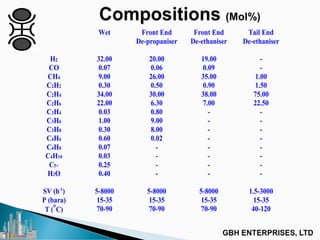
Wet Front End
De-propaniser
Front End
De-ethaniser
Tail End
De-ethaniser
H2 32.00 20.00 19.00 -
CO 0.07 0.06 0.09 -
CH4 9.00 26.00 35.00 1.00
C2H2 0.30 0.50 0.90 1.50
C2H4 34.00 30.00 38.00 75.00
C2H6 22.00 6.30 7.00 22.50
C3H4 0.03 0.80 - -
C3H6 1.00 9.00 - -
C3H8 0.30 8.00 - -
C4H6 0.60 0.02 - -
C4H8 0.07 - - -
C4H10 0.03 - - -
C5+ 0.25 - - -
H2O 0.40 - - -
SV (h-1
) 5-8000 5-8000 5-8000 1.5-3000
P (bara) 15-35 15-35 15-35 15-35
T (°C) 70-90 70-90 70-90 40-120
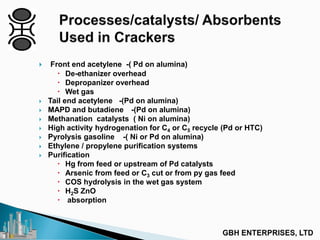
 Front end acetylene -( Pd on alumina)
 De-ethanizer overhead
 Depropanizer overhead
 Wet gas
 Tail end acetylene -(Pd on alumina)
 MAPD and butadiene -(Pd on alumina)
 Methanation catalysts ( Ni on alumina)
 High activity hydrogenation for C4 or C5 recycle (Pd or HTC)
 Pyrolysis gasoline -( Ni or Pd on alumina)
 Ethylene / propylene purification systems
 Purification
 Hg from feed or upstream of Pd catalysts
 Arsenic from feed or C3 cut or from py gas feed
 COS hydrolysis in the wet gas system
 H2S ZnO
 absorption
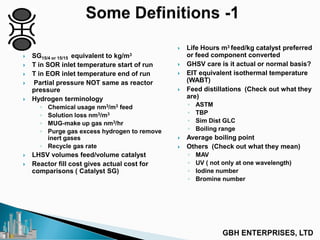
 SG15/4 or 15/15 equivalent to kg/m3
 T in SOR inlet temperature start of run
 T in EOR inlet temperature end of run
 Partial pressure NOT same as reactor
pressure
 Hydrogen terminology
◦ Chemical usage nm3/m3 feed
◦ Solution loss nm3/m3
◦ MUG-make up gas nm3/hr
◦ Purge gas excess hydrogen to remove
inert gases
◦ Recycle gas rate
 LHSV volumes feed/volume catalyst
 Reactor fill cost gives actual cost for
comparisons ( Catalyst SG)
 Life Hours m3 feed/kg catalyst preferred
or feed component converted
 GHSV care is it actual or normal basis?
 EIT equivalent isothermal temperature
(WABT)
 Feed distillations (Check out what they
are)
◦ ASTM
◦ TBP
◦ Sim Dist GLC
◦ Boiling range
 Average boiling point
 Others (Check out what they mean)
◦ MAV
◦ UV ( not only at one wavelength)
◦ Iodine number
◦ Bromine number
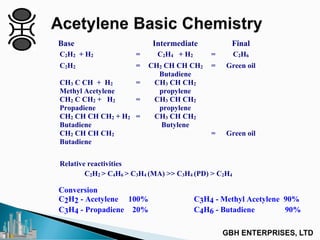
Base Intermediate Final
C2H2 + H2 = C2H4 + H2 = C2H6
C2H2 = CH2 CH CH CH2
Butadiene
= Green oil
CH3 C CH + H2
Methyl Acetylene
= CH3 CH CH2
propylene
CH2 C CH2 + H2
Propadiene
= CH3 CH CH2
propylene
CH2 CH CH CH2 + H2
Butadiene
= CH3 CH CH2
Butylene
CH2 CH CH CH2
Butadiene
= Green oil
Relative reactivities
C2H2 > C4H6 > C3H4 (MA) >> C3H4 (PD) > C2H4
Conversion
C2H2 - Acetylene 100% C3H4 - Methyl Acetylene 90%
C3H4 - Propadiene 20% C4H6 - Butadiene 90%
Ethylene Selectivity :
% SC2H4 = 100 - % SC2H6 - % SC4+ - % SC6+
% SC2H6 is the ethane selectivity :
% SC2H6 = {[(C2H6)out –(C2H6)in]/[(C2H2)in-(C2H2)out ]}x 100
% SC4+ is the total C4 selectivity formed (i.e. Cis- and
trans-but-2-enes, but-1-ene and buta-1,3-diene), :
% SC4+ = {[2x(C4'sformed)]/[(C2H2)in-(C2H2)out]} x 100
(2 moles C2H2  1 mole C4’s)
% SC6+ is the total C6 selectivity formed,:
% SC6+ = {[3x(C6'sformed)]/ [(C2H2)in-(C2H2)out]} x 100
(3 moles C2H2  1 mole C6’s)
Important to ask customer his definition, many variations
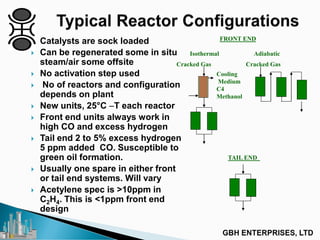
 Catalysts are sock loaded
 Can be regenerated some in situ
steam/air some offsite
 No activation step used
 No of reactors and configuration
depends on plant
 New units, 25°C −T each reactor
 Front end units always work in
high CO and excess hydrogen
 Tail end 2 to 5% excess hydrogen
5 ppm added CO. Susceptible to
green oil formation.
 Usually one spare in either front
or tail end systems. Will vary
 Acetylene spec is >10ppm in
C2H4. This is <1ppm front end
design
Cooling
Medium
C4
Methanol
Cracked Gas Cracked Gas
FRONT END
Isothermal Adiabatic
TAIL END
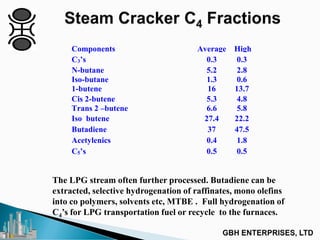
Components Average High
C3’s 0.3 0.3
N-butane 5.2 2.8
Iso-butane 1.3 0.6
1-butene 16 13.7
Cis 2-butene 5.3 4.8
Trans 2 –butene 6.6 5.8
Iso butene 27.4 22.2
Butadiene 37 47.5
Acetylenics 0.4 1.8
C5’s 0.5 0.5
The LPG stream often further processed. Butadiene can be
extracted, selective hydrogenation of raffinates, mono olefins
into co polymers, solvents etc, MTBE . Full hydrogenation of
C4’s for LPG transportation fuel or recycle to the furnaces.
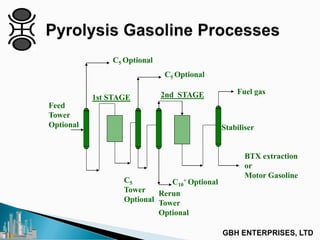
Feed
Tower
Optional
C10
+ Optional
C5 Optional
C5 Optional
Fuel gas
Rerun
Tower
Optional
Stabiliser
BTX extraction
or
Motor Gasoline
1st STAGE 2nd STAGE
C5
Tower
Optional
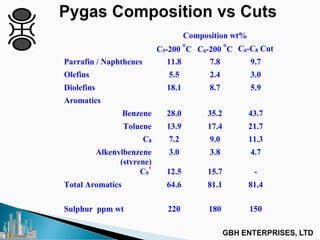
Composition wt%
C5-200 °C C6-200 °C C6-C8 Cut
Parrafin / Naphthenes 11.8 7.8 9.7
Olefins 5.5 2.4 3.0
Diolefins 18.1 8.7 5.9
Aromatics
Benzene 28.0 35.2 43.7
Toluene 13.9 17.4 21.7
C8 7.2 9.0 11.3
Alkenylbenzene
(styrene)
3.0 3.8 4.7
C9
+
12.5 15.7 -
Total Aromatics 64.6 81.1 81.4
Sulphur ppm wt 220 180 150
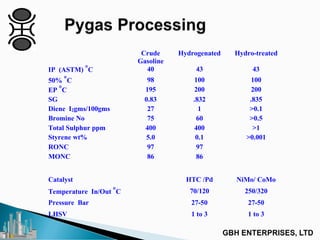
Crude
Gasoline
Hydrogenated Hydro-treated
IP (ASTM) °C 40 43 43
50% °C 98 100 100
EP °C 195 200 200
SG 0.83 .832 .835
Diene I2gms/100gms 27 1 >0.1
Bromine No 75 60 >0.5
Total Sulphur ppm 400 400 >1
Styrene wt% 5.0 0.1 >0.001
RONC 97 97
MONC 86 86
Catalyst HTC /Pd NiMo/ CoMo
Temperature In/Out °C 70/120 250/320
Pressure Bar 27-50 27-50
LHSV 1 to 3 1 to 3
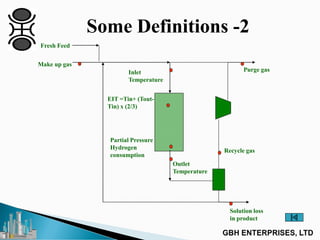
Some Definitions -2
Purge gasInlet
Temperature
Partial Pressure
Hydrogen
consumption
Make up gas
Recycle gas
Solution loss
in product
Outlet
Temperature
EIT =Tin+ (Tout-
Tin) x (2/3)
Fresh Feed
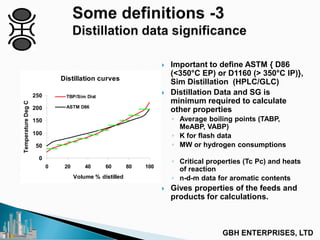
Distillation curves
0
50
100
150
200
250
0 20 40 60 80 100
Volume % distilled
TemperatureDegC
TBP/Sim Dist
ASTM D86
 Important to define ASTM { D86
(<350°C EP) or D1160 (> 350°C IP)},
Sim Distillation (HPLC/GLC)
 Distillation Data and SG is
minimum required to calculate
other properties
◦ Average boiling points (TABP,
MeABP, VABP)
◦ K for flash data
◦ MW or hydrogen consumptions
◦ Critical properties (Tc Pc) and heats
of reaction
◦ n-d-m data for aromatic contents
 Gives properties of the feeds and
products for calculations.
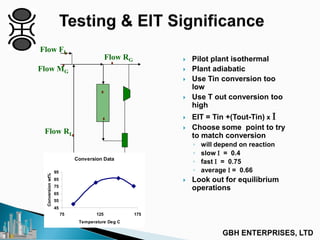
 Pilot plant isothermal
 Plant adiabatic
 Use Tin conversion too
low
 Use T out conversion too
high
 EIT = Tin +(Tout-Tin) x Ι
 Choose some point to try
to match conversion
◦ will depend on reaction
◦ slow Ι = 0.4
◦ fast Ι = 0.75
◦ average Ι = 0.66
 Look out for equilibrium
operations
Flow FL
Flow RL
Flow RG
Flow MG
Conversion Data
45
55
65
75
85
95
75 125 175
Temperature Deg C
Conversionwt%
Ethylene Plant Design Considerations

Ethylene Plant Design Considerations

  • 1.
    C2PT Catalyst ProcessTechnology Summary of design, operation, technology
  • 2.
     Ethane usually recoveredfrom natural gas fields mainly USA  Propane/butane recovered from gas fields middle east, Texas etc. Kuwait has a large butane recovery system. Also can come from LNG plants  Refinery naphtha / condensate C5 to C7 paraffin based low octane naphtha from refineries also from natural gas / oil well head production  Light and heavy gas oils refinery based (200 to 350°C) AGO and (350 to 550 °C) VGO The more paraffinic the feedstock the higher the ethylene yields and the greater the value of the co-products
  • 3.
     Sulfur + Cracksin furnaces to give H2S and COS. Mercaptans in C3/C4 cuts, RSH and thiophenes in gasoline, benzothiophenes in fuel oil  Arsenic + Organic or arsine + Makes arsine in the furnaces and some remains as organic  Mercury + Metallic / organic + Decomposes to metallic some remains as organic  Ballast water + Sea water from shipping feed stock  Metals + Nickel, sodium, vanadium, iron from heavy feedstocks  FCCU off gas (gas compressor suction, developing trend) + NOx, H2S, amines, SbH3, As , COS, O2, CO2 plus others
  • 4.
    Feedstock West Europe USA JapanWorld Ethane 8 57.5 30.5 LPG 11 19 7.5 11 Naphtha 69 9.5 92.5 49 Gas Oil 12 14 8.5 Others 1* Figures as wt% * Ethanol Brazil and India and Coal based gases Poland
  • 5.
    PRODUCTS FEEDSTOCK Ethane PropaneButane Naphtha Atm Gas Oil VGO Hydrogen (95%) 8.8 2.3 1.6 1.5 0.9 0.8 Methane 6.3 27.5 22 17.2 11.2 8.8 Ethylene 77.8 42 40 33.6 26 20.5 Propylene 2.8 16.8 17.3 15.6 16.1 14 Butadiene 1.9 3 3.5 4.5 4.5 5.3 Other C4’s 0.7 1.3 6.8 4.2 4.8 6.3 C5 to 200C Gasoline 1.7 6.6 7.1 18.7 18.4 19.3 Benzene 0.9 2.5 3.0 6.7 6.0 3.7 Toluene 0.1 0.5 0.8 3.4 2.9 2.9 C9 aromatics - - 0.4 1.8 2.2 1.9 Non aromatics 0.7 3.6 2.9 6.8 7.3 10.8 Fuel Oil - 0.5 1.7 4.7 18.1 25
  • 6.
    Paraffin C7H16 Primary Cracking C3H8+ 1-C4H8 Dehydrogenation C7H14 Cracked Products Butadiene C4H6 Secondary Cracking Propylene C3H6 Propyne C3H4 CH4+ C2H4 2C2H4 Acetylene C2H2 Cyclo additions and Dehydrogenation give aromatics pyrolysis tar and coke Selectively Hydrogenated Free radical chain reaction initiated in furnace tubes
  • 7.
     Halliburton KelloggBrown & Root (milli second)  Lummus  Stone & Webster  CF Braun  Linde  BASF  ExxonMobil  KTI  Technip  Each furnace designer has their own characteristics  Temperature ranges 700°C to 900 °C  Residence times 0.2 ( new units) to 15 secs (older design)  Steam injection into the furnaces minimise coke gives CO formation (C + H2O=CO+ H2) 0.2 to 0.5 wt% feed  Tube outlet pressure 0.5 to 2 bar
  • 8.
    T 1 0 2 Feed Gasoline Fuel Oil Caustic wash Cold Box H2, CH4 Demethaniser H2 De-ethaniserTail End acetylene Mixed C4 to splitters GasolineSecondary Demethaniser Ethylene Product Ethane Recycle 800°C 400°C -100°C -50°C -33°C 60°C -17°C 120°C 0°C H2 MAPD Converter C3 to splitter Depropaniser Debutaniser Drier C2H6 C3H8 Recycle Furnace Furnace
  • 9.
    FRONT END DE_ETHANISER C2H2 Reactors Driers T 1 0 2 Cold Box C3’s,C4’s and pygas C2H4/C2H6 CH4, CO H2 Demethaniser De-ethaniser FRONT END DE_DEPROPANISER Driers T 1 0 2 C4’s and pygas Depropaniser C2H2 Reactors Cold Box C2H4/C2H6 CH4, CO H2 De-ethaniser Demethaniser C3H6/C3H8 Gas Compression System Gas Compression System
  • 10.
    Wet Front End De-propaniser FrontEnd De-ethaniser Tail End De-ethaniser H2 32.00 20.00 19.00 - CO 0.07 0.06 0.09 - CH4 9.00 26.00 35.00 1.00 C2H2 0.30 0.50 0.90 1.50 C2H4 34.00 30.00 38.00 75.00 C2H6 22.00 6.30 7.00 22.50 C3H4 0.03 0.80 - - C3H6 1.00 9.00 - - C3H8 0.30 8.00 - - C4H6 0.60 0.02 - - C4H8 0.07 - - - C4H10 0.03 - - - C5+ 0.25 - - - H2O 0.40 - - - SV (h-1 ) 5-8000 5-8000 5-8000 1.5-3000 P (bara) 15-35 15-35 15-35 15-35 T (°C) 70-90 70-90 70-90 40-120
  • 11.
     Front endacetylene -( Pd on alumina)  De-ethanizer overhead  Depropanizer overhead  Wet gas  Tail end acetylene -(Pd on alumina)  MAPD and butadiene -(Pd on alumina)  Methanation catalysts ( Ni on alumina)  High activity hydrogenation for C4 or C5 recycle (Pd or HTC)  Pyrolysis gasoline -( Ni or Pd on alumina)  Ethylene / propylene purification systems  Purification  Hg from feed or upstream of Pd catalysts  Arsenic from feed or C3 cut or from py gas feed  COS hydrolysis in the wet gas system  H2S ZnO  absorption
  • 12.
     SG15/4 or15/15 equivalent to kg/m3  T in SOR inlet temperature start of run  T in EOR inlet temperature end of run  Partial pressure NOT same as reactor pressure  Hydrogen terminology ◦ Chemical usage nm3/m3 feed ◦ Solution loss nm3/m3 ◦ MUG-make up gas nm3/hr ◦ Purge gas excess hydrogen to remove inert gases ◦ Recycle gas rate  LHSV volumes feed/volume catalyst  Reactor fill cost gives actual cost for comparisons ( Catalyst SG)  Life Hours m3 feed/kg catalyst preferred or feed component converted  GHSV care is it actual or normal basis?  EIT equivalent isothermal temperature (WABT)  Feed distillations (Check out what they are) ◦ ASTM ◦ TBP ◦ Sim Dist GLC ◦ Boiling range  Average boiling point  Others (Check out what they mean) ◦ MAV ◦ UV ( not only at one wavelength) ◦ Iodine number ◦ Bromine number
  • 13.
    Base Intermediate Final C2H2+ H2 = C2H4 + H2 = C2H6 C2H2 = CH2 CH CH CH2 Butadiene = Green oil CH3 C CH + H2 Methyl Acetylene = CH3 CH CH2 propylene CH2 C CH2 + H2 Propadiene = CH3 CH CH2 propylene CH2 CH CH CH2 + H2 Butadiene = CH3 CH CH2 Butylene CH2 CH CH CH2 Butadiene = Green oil Relative reactivities C2H2 > C4H6 > C3H4 (MA) >> C3H4 (PD) > C2H4 Conversion C2H2 - Acetylene 100% C3H4 - Methyl Acetylene 90% C3H4 - Propadiene 20% C4H6 - Butadiene 90%
  • 14.
    Ethylene Selectivity : %SC2H4 = 100 - % SC2H6 - % SC4+ - % SC6+ % SC2H6 is the ethane selectivity : % SC2H6 = {[(C2H6)out –(C2H6)in]/[(C2H2)in-(C2H2)out ]}x 100 % SC4+ is the total C4 selectivity formed (i.e. Cis- and trans-but-2-enes, but-1-ene and buta-1,3-diene), : % SC4+ = {[2x(C4'sformed)]/[(C2H2)in-(C2H2)out]} x 100 (2 moles C2H2  1 mole C4’s) % SC6+ is the total C6 selectivity formed,: % SC6+ = {[3x(C6'sformed)]/ [(C2H2)in-(C2H2)out]} x 100 (3 moles C2H2  1 mole C6’s) Important to ask customer his definition, many variations
  • 15.
     Catalysts aresock loaded  Can be regenerated some in situ steam/air some offsite  No activation step used  No of reactors and configuration depends on plant  New units, 25°C −T each reactor  Front end units always work in high CO and excess hydrogen  Tail end 2 to 5% excess hydrogen 5 ppm added CO. Susceptible to green oil formation.  Usually one spare in either front or tail end systems. Will vary  Acetylene spec is >10ppm in C2H4. This is <1ppm front end design Cooling Medium C4 Methanol Cracked Gas Cracked Gas FRONT END Isothermal Adiabatic TAIL END
  • 16.
    Components Average High C3’s0.3 0.3 N-butane 5.2 2.8 Iso-butane 1.3 0.6 1-butene 16 13.7 Cis 2-butene 5.3 4.8 Trans 2 –butene 6.6 5.8 Iso butene 27.4 22.2 Butadiene 37 47.5 Acetylenics 0.4 1.8 C5’s 0.5 0.5 The LPG stream often further processed. Butadiene can be extracted, selective hydrogenation of raffinates, mono olefins into co polymers, solvents etc, MTBE . Full hydrogenation of C4’s for LPG transportation fuel or recycle to the furnaces.
  • 17.
    Feed Tower Optional C10 + Optional C5 Optional C5Optional Fuel gas Rerun Tower Optional Stabiliser BTX extraction or Motor Gasoline 1st STAGE 2nd STAGE C5 Tower Optional
  • 18.
    Composition wt% C5-200 °CC6-200 °C C6-C8 Cut Parrafin / Naphthenes 11.8 7.8 9.7 Olefins 5.5 2.4 3.0 Diolefins 18.1 8.7 5.9 Aromatics Benzene 28.0 35.2 43.7 Toluene 13.9 17.4 21.7 C8 7.2 9.0 11.3 Alkenylbenzene (styrene) 3.0 3.8 4.7 C9 + 12.5 15.7 - Total Aromatics 64.6 81.1 81.4 Sulphur ppm wt 220 180 150
  • 19.
    Crude Gasoline Hydrogenated Hydro-treated IP (ASTM)°C 40 43 43 50% °C 98 100 100 EP °C 195 200 200 SG 0.83 .832 .835 Diene I2gms/100gms 27 1 >0.1 Bromine No 75 60 >0.5 Total Sulphur ppm 400 400 >1 Styrene wt% 5.0 0.1 >0.001 RONC 97 97 MONC 86 86 Catalyst HTC /Pd NiMo/ CoMo Temperature In/Out °C 70/120 250/320 Pressure Bar 27-50 27-50 LHSV 1 to 3 1 to 3
  • 20.
    Some Definitions -2 PurgegasInlet Temperature Partial Pressure Hydrogen consumption Make up gas Recycle gas Solution loss in product Outlet Temperature EIT =Tin+ (Tout- Tin) x (2/3) Fresh Feed
  • 21.
    Distillation curves 0 50 100 150 200 250 0 2040 60 80 100 Volume % distilled TemperatureDegC TBP/Sim Dist ASTM D86  Important to define ASTM { D86 (<350°C EP) or D1160 (> 350°C IP)}, Sim Distillation (HPLC/GLC)  Distillation Data and SG is minimum required to calculate other properties ◦ Average boiling points (TABP, MeABP, VABP) ◦ K for flash data ◦ MW or hydrogen consumptions ◦ Critical properties (Tc Pc) and heats of reaction ◦ n-d-m data for aromatic contents  Gives properties of the feeds and products for calculations.
  • 22.
     Pilot plantisothermal  Plant adiabatic  Use Tin conversion too low  Use T out conversion too high  EIT = Tin +(Tout-Tin) x Ι  Choose some point to try to match conversion ◦ will depend on reaction ◦ slow Ι = 0.4 ◦ fast Ι = 0.75 ◦ average Ι = 0.66  Look out for equilibrium operations Flow FL Flow RL Flow RG Flow MG Conversion Data 45 55 65 75 85 95 75 125 175 Temperature Deg C Conversionwt%