Naphtha Cracking Unit: Ethylene
Production
Literature Survey
Mayank Mehta Rakesh Choudhary
Nikita Mittal Akshara Goyal
CH#2
MALAVIYA
NATIONAL INSTITUTE OF
TECHNOLOGY
DEPARTMENT OF CHEMICAL ENGINEERING 2014-15
Content
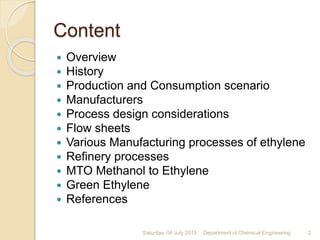
 Overview
 History
 Production and Consumption scenario
 Manufacturers
 Process design considerations
 Flow sheets
 Various Manufacturing processes of ethylene
 Refinery processes
 MTO Methanol to Ethylene
 Green Ethylene
 References
Saturday, 04 July 2015 2Department of Chemical Engineering
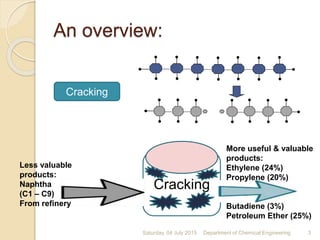
An overview:
Cracking
Cracking
Less valuable
products:
Naphtha
(C1 – C9)
From refinery
More useful & valuable
products:
Ethylene (24%)
Propylene (20%)
Butadiene (3%)
Petroleum Ether (25%)
Saturday, 04 July 2015 3Department of Chemical Engineering
conti...
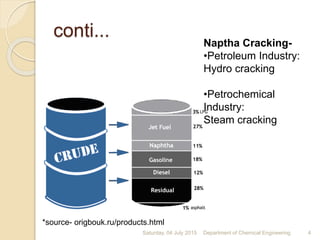
*source- origbouk.ru/products.html
Naptha Cracking-
•Petroleum Industry:
Hydro cracking
•Petrochemical
Industry:
Steam cracking
Saturday, 04 July 2015 4Department of Chemical Engineering
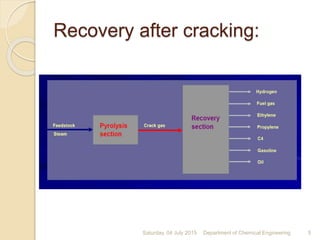
Recovery after cracking:
Saturday, 04 July 2015 5Department of Chemical Engineering
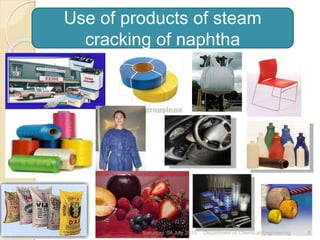
Use of products of steam
cracking of naphtha
Saturday, 04 July 2015 6Department of Chemical Engineering
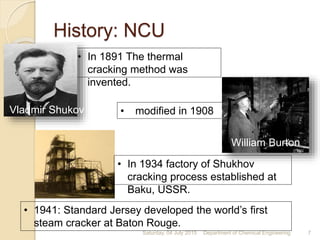
• 1941: Standard Jersey developed the world’s first
steam cracker at Baton Rouge.
• In 1891 The thermal
cracking method was
invented.
• modified in 1908
• In 1934 factory of Shukhov
cracking process established at
Baku, USSR.
William Burton
Vladmir Shukov
History: NCU
Saturday, 04 July 2015 7Department of Chemical Engineering
History: Ethylene
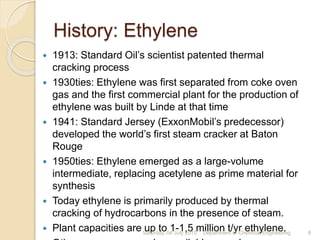
 1913: Standard Oil’s scientist patented thermal
cracking process
 1930ties: Ethylene was first separated from coke oven
gas and the first commercial plant for the production of
ethylene was built by Linde at that time
 1941: Standard Jersey (ExxonMobil’s predecessor)
developed the world’s first steam cracker at Baton
Rouge
 1950ties: Ethylene emerged as a large-volume
intermediate, replacing acetylene as prime material for
synthesis
 Today ethylene is primarily produced by thermal
cracking of hydrocarbons in the presence of steam.
 Plant capacities are up to 1-1,5 million t/yr ethylene.Saturday, 04 July 2015 8Department of Chemical Engineering
Importance of ethylene and
propylene in the chemical industry
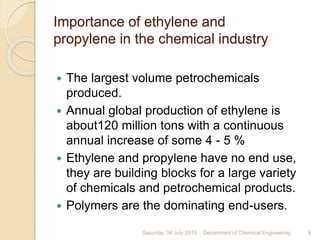
 The largest volume petrochemicals
produced.
 Annual global production of ethylene is
about120 million tons with a continuous
annual increase of some 4 - 5 %
 Ethylene and propylene have no end use,
they are building blocks for a large variety
of chemicals and petrochemical products.
 Polymers are the dominating end-users.
Saturday, 04 July 2015 9Department of Chemical Engineering
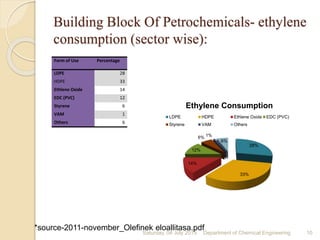
Building Block Of Petrochemicals- ethylene
consumption (sector wise):
*source-2011-november_Olefinek eloallitasa.pdf
Saturday, 04 July 2015 10Department of Chemical Engineering
Form of Use Percentage
LDPE 28
HDPE 33
Ethlene Oxide 14
EDC (PVC) 12
Styrene 6
VAM 1
Others 6
28%
33%
14%
12%
6% 1%
6%
Ethylene Consumption
LDPE HDPE Ethlene Oxide EDC (PVC)
Styrene VAM Others
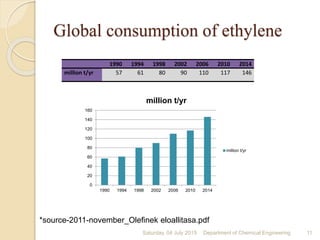
Global consumption of ethylene
*source-2011-november_Olefinek eloallitasa.pdf
Saturday, 04 July 2015 11Department of Chemical Engineering
1990 1994 1998 2002 2006 2010 2014
million t/yr 57 61 80 90 110 117 146
0
20
40
60
80
100
120
140
160
1990 1994 1998 2002 2006 2010 2014
million t/yr
million t/yr
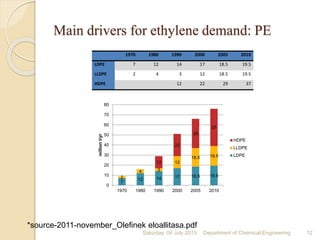
Main drivers for ethylene demand: PE
*source-2011-november_Olefinek eloallitasa.pdf
Saturday, 04 July 2015 12Department of Chemical Engineering
7
12 14 17 18.5 19.52
4 3
12
18.5 19.5
12
22
29
37
0
10
20
30
40
50
60
70
80
1970 1980 1990 2000 2005 2010
milliont/yr
HDPE
LLDPE
LDPE
1970 1980 1990 2000 2005 2010
LDPE 7 12 14 17 18.5 19.5
LLDPE 2 4 3 12 18.5 19.5
HDPE 12 22 29 37
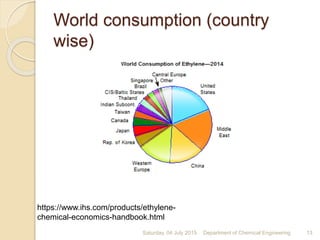
World consumption (country
wise)
https://www.ihs.com/products/ethylene-
chemical-economics-handbook.html
Saturday, 04 July 2015 13Department of Chemical Engineering
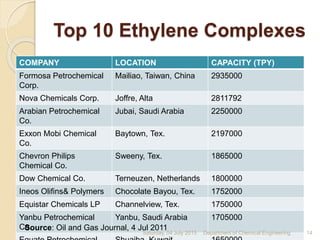
Top 10 Ethylene Complexes
COMPANY LOCATION CAPACITY (TPY)
Formosa Petrochemical
Corp.
Mailiao, Taiwan, China 2935000
Nova Chemicals Corp. Joffre, Alta 2811792
Arabian Petrochemical
Co.
Jubai, Saudi Arabia 2250000
Exxon Mobi Chemical
Co.
Baytown, Tex. 2197000
Chevron Philips
Chemical Co.
Sweeny, Tex. 1865000
Dow Chemical Co. Terneuzen, Netherlands 1800000
Ineos Olifins& Polymers Chocolate Bayou, Tex. 1752000
Equistar Chemicals LP Channelview, Tex. 1750000
Yanbu Petrochemical
Co.
Yanbu, Saudi Arabia 1705000
Source: Oil and Gas Journal, 4 Jul 2011
Saturday, 04 July 2015 14Department of Chemical Engineering
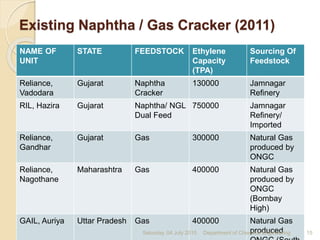
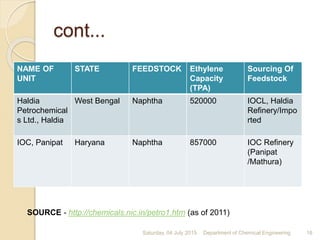
Existing Naphtha / Gas Cracker (2011)
NAME OF
UNIT
STATE FEEDSTOCK Ethylene
Capacity
(TPA)
Sourcing Of
Feedstock
Reliance,
Vadodara
Gujarat Naphtha
Cracker
130000 Jamnagar
Refinery
RIL, Hazira Gujarat Naphtha/ NGL
Dual Feed
750000 Jamnagar
Refinery/
Imported
Reliance,
Gandhar
Gujarat Gas 300000 Natural Gas
produced by
ONGC
Reliance,
Nagothane
Maharashtra Gas 400000 Natural Gas
produced by
ONGC
(Bombay
High)
GAIL, Auriya Uttar Pradesh Gas 400000 Natural Gas
producedSaturday, 04 July 2015 15Department of Chemical Engineering
cont...
NAME OF
UNIT
STATE FEEDSTOCK Ethylene
Capacity
(TPA)
Sourcing Of
Feedstock
Haldia
Petrochemical
s Ltd., Haldia
West Bengal Naphtha 520000 IOCL, Haldia
Refinery/Impo
rted
IOC, Panipat Haryana Naphtha 857000 IOC Refinery
(Panipat
/Mathura)
SOURCE - http://chemicals.nic.in/petro1.htm (as of 2011)
Saturday, 04 July 2015 16Department of Chemical Engineering
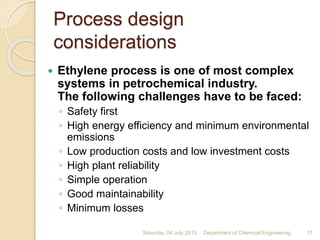
Process design
considerations
 Ethylene process is one of most complex
systems in petrochemical industry.
The following challenges have to be faced:
◦ Safety first
◦ High energy efficiency and minimum environmental
emissions
◦ Low production costs and low investment costs
◦ High plant reliability
◦ Simple operation
◦ Good maintainability
◦ Minimum losses
Saturday, 04 July 2015 17Department of Chemical Engineering
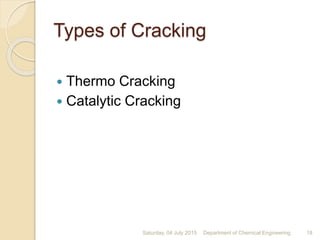
Types of Cracking
 Thermo Cracking
 Catalytic Cracking
Saturday, 04 July 2015 Department of Chemical Engineering 18
Saturday, 04 July 2015 Department of Chemical Engineering 19
Saturday, 04 July 2015 Department of Chemical Engineering 20
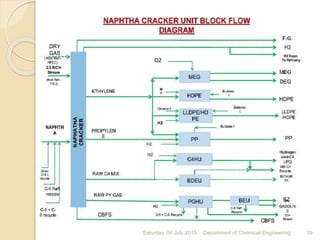
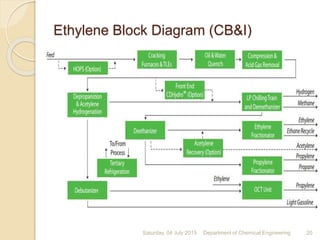
Ethylene Block Diagram (CB&I)
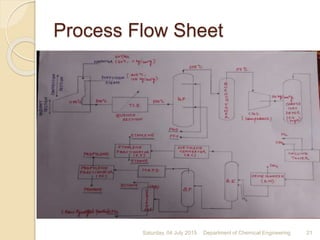
Process Flow Sheet
Saturday, 04 July 2015 Department of Chemical Engineering 21
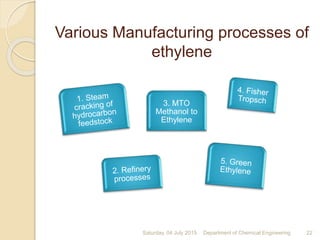
Various Manufacturing processes of
ethylene
Saturday, 04 July 2015 Department of Chemical Engineering 22
3. MTO
Methanol to
Ethylene
Wide range of feedstock for steam
cracking
Saturday, 04 July 2015 Department of Chemical Engineering 23
In middle east and North America, ethane is favoured due to price advantage
Gaseous feeds
• Ethane
• Propane
• N-butane/i-butane
Liquid feeds
• Condensates from
natural gas
• Naphtha
• Atmospheric gas oil
(AGO)
• Hydrocracker residue
(HCR), hydrogenated
vacuum gas oil
(HVGO)
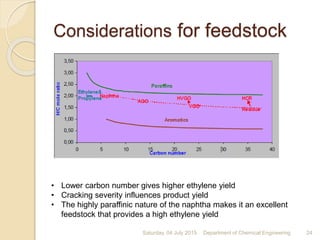
Considerations for feedstock
Saturday, 04 July 2015 Department of Chemical Engineering 24
• Lower carbon number gives higher ethylene yield
• Cracking severity influences product yield
• The highly paraffinic nature of the naphtha makes it an excellent
feedstock that provides a high ethylene yield
Refinery processes
Saturday, 04 July 2015 Department of Chemical Engineering 25
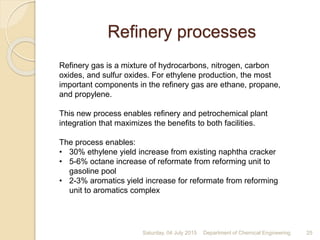
Refinery gas is a mixture of hydrocarbons, nitrogen, carbon
oxides, and sulfur oxides. For ethylene production, the most
important components in the refinery gas are ethane, propane,
and propylene.
This new process enables refinery and petrochemical plant
integration that maximizes the benefits to both facilities.
The process enables:
• 30% ethylene yield increase from existing naphtha cracker
• 5-6% octane increase of reformate from reforming unit to
gasoline pool
• 2-3% aromatics yield increase for reformate from reforming
unit to aromatics complex
MTO Methanol to Ethylene
Saturday, 04 July 2015 Department of Chemical Engineering 26
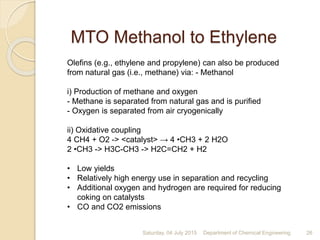
Olefins (e.g., ethylene and propylene) can also be produced
from natural gas (i.e., methane) via: - Methanol
i) Production of methane and oxygen
- Methane is separated from natural gas and is purified
- Oxygen is separated from air cryogenically
ii) Oxidative coupling
4 CH4 + O2 -> <catalyst> → 4 •CH3 + 2 H2O
2 •CH3 -> H3C-CH3 -> H2C=CH2 + H2
• Low yields
• Relatively high energy use in separation and recycling
• Additional oxygen and hydrogen are required for reducing
coking on catalysts
• CO and CO2 emissions
Syngas via Fisher Tropsch
Saturday, 04 July 2015 Department of Chemical Engineering 27
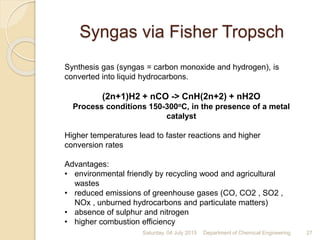
Synthesis gas (syngas = carbon monoxide and hydrogen), is
converted into liquid hydrocarbons.
(2n+1)H2 + nCO -> CnH(2n+2) + nH2O
Process conditions 150-300oC, in the presence of a metal
catalyst
Higher temperatures lead to faster reactions and higher
conversion rates
Advantages:
• environmental friendly by recycling wood and agricultural
wastes
• reduced emissions of greenhouse gases (CO, CO2 , SO2 ,
NOx , unburned hydrocarbons and particulate matters)
• absence of sulphur and nitrogen
• higher combustion efficiency
Green Ethylene
Saturday, 04 July 2015 Department of Chemical Engineering 28
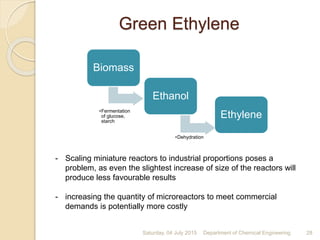
- Scaling miniature reactors to industrial proportions poses a
problem, as even the slightest increase of size of the reactors will
produce less favourable results
- increasing the quantity of microreactors to meet commercial
demands is potentially more costly
Biomass
•Fermentation
of glucose,
starch
Ethanol
•Dehydration
Ethylene
• Olefins from conventional and heavy feedstock's: Energy
use in steam cracking and alternative processes. Energy 31
(2006) 425-251, By Tao Ren, Martin Patel, Kornelis Blok
• http://chemicals.nic.in/petro1.htm (as of 2011)
• http://cpcb.nic.in/upload/NewItems/NewItem_130_emmstdpe
trochemplants.pdf
• https://www.ihs.com/products/ethylene-chemical-economics-
handbook.html
• 2011-november_Olefinek eloallitasa
• James. G. Speight (2006). The Chemistry and Technology of
Petroleum (4th ed.). CRC Press.
• Dr. Ram Prasad (2010). Petroleum refining Technology (1st
edition). Khanna publishers
Saturday, 04 July 2015 29Department of Chemical Engineering
References
Naphtha Cracking Unit: Ethylene
Production
Literature Survey
Mayank Mehta Nikita Mittal Rakesh Choudhary
Akshara Goyal
CH#2
21-02-2015
Saturday, 04 July 2015 30Department of Chemical Engineering

Naphtha Cracking Unit : Ethylene Production

  • 1.
    Naphtha Cracking Unit:Ethylene Production Literature Survey Mayank Mehta Rakesh Choudhary Nikita Mittal Akshara Goyal CH#2 MALAVIYA NATIONAL INSTITUTE OF TECHNOLOGY DEPARTMENT OF CHEMICAL ENGINEERING 2014-15
  • 2.
    Content  Overview  History Production and Consumption scenario  Manufacturers  Process design considerations  Flow sheets  Various Manufacturing processes of ethylene  Refinery processes  MTO Methanol to Ethylene  Green Ethylene  References Saturday, 04 July 2015 2Department of Chemical Engineering
  • 3.
    An overview: Cracking Cracking Less valuable products: Naphtha (C1– C9) From refinery More useful & valuable products: Ethylene (24%) Propylene (20%) Butadiene (3%) Petroleum Ether (25%) Saturday, 04 July 2015 3Department of Chemical Engineering
  • 4.
    conti... *source- origbouk.ru/products.html Naptha Cracking- •PetroleumIndustry: Hydro cracking •Petrochemical Industry: Steam cracking Saturday, 04 July 2015 4Department of Chemical Engineering
  • 5.
    Recovery after cracking: Saturday,04 July 2015 5Department of Chemical Engineering
  • 6.
    Use of productsof steam cracking of naphtha Saturday, 04 July 2015 6Department of Chemical Engineering
  • 7.
    • 1941: StandardJersey developed the world’s first steam cracker at Baton Rouge. • In 1891 The thermal cracking method was invented. • modified in 1908 • In 1934 factory of Shukhov cracking process established at Baku, USSR. William Burton Vladmir Shukov History: NCU Saturday, 04 July 2015 7Department of Chemical Engineering
  • 8.
    History: Ethylene  1913:Standard Oil’s scientist patented thermal cracking process  1930ties: Ethylene was first separated from coke oven gas and the first commercial plant for the production of ethylene was built by Linde at that time  1941: Standard Jersey (ExxonMobil’s predecessor) developed the world’s first steam cracker at Baton Rouge  1950ties: Ethylene emerged as a large-volume intermediate, replacing acetylene as prime material for synthesis  Today ethylene is primarily produced by thermal cracking of hydrocarbons in the presence of steam.  Plant capacities are up to 1-1,5 million t/yr ethylene.Saturday, 04 July 2015 8Department of Chemical Engineering
  • 9.
    Importance of ethyleneand propylene in the chemical industry  The largest volume petrochemicals produced.  Annual global production of ethylene is about120 million tons with a continuous annual increase of some 4 - 5 %  Ethylene and propylene have no end use, they are building blocks for a large variety of chemicals and petrochemical products.  Polymers are the dominating end-users. Saturday, 04 July 2015 9Department of Chemical Engineering
  • 10.
    Building Block OfPetrochemicals- ethylene consumption (sector wise): *source-2011-november_Olefinek eloallitasa.pdf Saturday, 04 July 2015 10Department of Chemical Engineering Form of Use Percentage LDPE 28 HDPE 33 Ethlene Oxide 14 EDC (PVC) 12 Styrene 6 VAM 1 Others 6 28% 33% 14% 12% 6% 1% 6% Ethylene Consumption LDPE HDPE Ethlene Oxide EDC (PVC) Styrene VAM Others
  • 11.
    Global consumption ofethylene *source-2011-november_Olefinek eloallitasa.pdf Saturday, 04 July 2015 11Department of Chemical Engineering 1990 1994 1998 2002 2006 2010 2014 million t/yr 57 61 80 90 110 117 146 0 20 40 60 80 100 120 140 160 1990 1994 1998 2002 2006 2010 2014 million t/yr million t/yr
  • 12.
    Main drivers forethylene demand: PE *source-2011-november_Olefinek eloallitasa.pdf Saturday, 04 July 2015 12Department of Chemical Engineering 7 12 14 17 18.5 19.52 4 3 12 18.5 19.5 12 22 29 37 0 10 20 30 40 50 60 70 80 1970 1980 1990 2000 2005 2010 milliont/yr HDPE LLDPE LDPE 1970 1980 1990 2000 2005 2010 LDPE 7 12 14 17 18.5 19.5 LLDPE 2 4 3 12 18.5 19.5 HDPE 12 22 29 37
  • 13.
  • 14.
    Top 10 EthyleneComplexes COMPANY LOCATION CAPACITY (TPY) Formosa Petrochemical Corp. Mailiao, Taiwan, China 2935000 Nova Chemicals Corp. Joffre, Alta 2811792 Arabian Petrochemical Co. Jubai, Saudi Arabia 2250000 Exxon Mobi Chemical Co. Baytown, Tex. 2197000 Chevron Philips Chemical Co. Sweeny, Tex. 1865000 Dow Chemical Co. Terneuzen, Netherlands 1800000 Ineos Olifins& Polymers Chocolate Bayou, Tex. 1752000 Equistar Chemicals LP Channelview, Tex. 1750000 Yanbu Petrochemical Co. Yanbu, Saudi Arabia 1705000 Source: Oil and Gas Journal, 4 Jul 2011 Saturday, 04 July 2015 14Department of Chemical Engineering
  • 15.
    Existing Naphtha /Gas Cracker (2011) NAME OF UNIT STATE FEEDSTOCK Ethylene Capacity (TPA) Sourcing Of Feedstock Reliance, Vadodara Gujarat Naphtha Cracker 130000 Jamnagar Refinery RIL, Hazira Gujarat Naphtha/ NGL Dual Feed 750000 Jamnagar Refinery/ Imported Reliance, Gandhar Gujarat Gas 300000 Natural Gas produced by ONGC Reliance, Nagothane Maharashtra Gas 400000 Natural Gas produced by ONGC (Bombay High) GAIL, Auriya Uttar Pradesh Gas 400000 Natural Gas producedSaturday, 04 July 2015 15Department of Chemical Engineering
  • 16.
    cont... NAME OF UNIT STATE FEEDSTOCKEthylene Capacity (TPA) Sourcing Of Feedstock Haldia Petrochemical s Ltd., Haldia West Bengal Naphtha 520000 IOCL, Haldia Refinery/Impo rted IOC, Panipat Haryana Naphtha 857000 IOC Refinery (Panipat /Mathura) SOURCE - http://chemicals.nic.in/petro1.htm (as of 2011) Saturday, 04 July 2015 16Department of Chemical Engineering
  • 17.
    Process design considerations  Ethyleneprocess is one of most complex systems in petrochemical industry. The following challenges have to be faced: ◦ Safety first ◦ High energy efficiency and minimum environmental emissions ◦ Low production costs and low investment costs ◦ High plant reliability ◦ Simple operation ◦ Good maintainability ◦ Minimum losses Saturday, 04 July 2015 17Department of Chemical Engineering
  • 18.
    Types of Cracking Thermo Cracking  Catalytic Cracking Saturday, 04 July 2015 Department of Chemical Engineering 18
  • 19.
    Saturday, 04 July2015 Department of Chemical Engineering 19
  • 20.
    Saturday, 04 July2015 Department of Chemical Engineering 20 Ethylene Block Diagram (CB&I)
  • 21.
    Process Flow Sheet Saturday,04 July 2015 Department of Chemical Engineering 21
  • 22.
    Various Manufacturing processesof ethylene Saturday, 04 July 2015 Department of Chemical Engineering 22 3. MTO Methanol to Ethylene
  • 23.
    Wide range offeedstock for steam cracking Saturday, 04 July 2015 Department of Chemical Engineering 23 In middle east and North America, ethane is favoured due to price advantage Gaseous feeds • Ethane • Propane • N-butane/i-butane Liquid feeds • Condensates from natural gas • Naphtha • Atmospheric gas oil (AGO) • Hydrocracker residue (HCR), hydrogenated vacuum gas oil (HVGO)
  • 24.
    Considerations for feedstock Saturday,04 July 2015 Department of Chemical Engineering 24 • Lower carbon number gives higher ethylene yield • Cracking severity influences product yield • The highly paraffinic nature of the naphtha makes it an excellent feedstock that provides a high ethylene yield
  • 25.
    Refinery processes Saturday, 04July 2015 Department of Chemical Engineering 25 Refinery gas is a mixture of hydrocarbons, nitrogen, carbon oxides, and sulfur oxides. For ethylene production, the most important components in the refinery gas are ethane, propane, and propylene. This new process enables refinery and petrochemical plant integration that maximizes the benefits to both facilities. The process enables: • 30% ethylene yield increase from existing naphtha cracker • 5-6% octane increase of reformate from reforming unit to gasoline pool • 2-3% aromatics yield increase for reformate from reforming unit to aromatics complex
  • 26.
    MTO Methanol toEthylene Saturday, 04 July 2015 Department of Chemical Engineering 26 Olefins (e.g., ethylene and propylene) can also be produced from natural gas (i.e., methane) via: - Methanol i) Production of methane and oxygen - Methane is separated from natural gas and is purified - Oxygen is separated from air cryogenically ii) Oxidative coupling 4 CH4 + O2 -> <catalyst> → 4 •CH3 + 2 H2O 2 •CH3 -> H3C-CH3 -> H2C=CH2 + H2 • Low yields • Relatively high energy use in separation and recycling • Additional oxygen and hydrogen are required for reducing coking on catalysts • CO and CO2 emissions
  • 27.
    Syngas via FisherTropsch Saturday, 04 July 2015 Department of Chemical Engineering 27 Synthesis gas (syngas = carbon monoxide and hydrogen), is converted into liquid hydrocarbons. (2n+1)H2 + nCO -> CnH(2n+2) + nH2O Process conditions 150-300oC, in the presence of a metal catalyst Higher temperatures lead to faster reactions and higher conversion rates Advantages: • environmental friendly by recycling wood and agricultural wastes • reduced emissions of greenhouse gases (CO, CO2 , SO2 , NOx , unburned hydrocarbons and particulate matters) • absence of sulphur and nitrogen • higher combustion efficiency
  • 28.
    Green Ethylene Saturday, 04July 2015 Department of Chemical Engineering 28 - Scaling miniature reactors to industrial proportions poses a problem, as even the slightest increase of size of the reactors will produce less favourable results - increasing the quantity of microreactors to meet commercial demands is potentially more costly Biomass •Fermentation of glucose, starch Ethanol •Dehydration Ethylene
  • 29.
    • Olefins fromconventional and heavy feedstock's: Energy use in steam cracking and alternative processes. Energy 31 (2006) 425-251, By Tao Ren, Martin Patel, Kornelis Blok • http://chemicals.nic.in/petro1.htm (as of 2011) • http://cpcb.nic.in/upload/NewItems/NewItem_130_emmstdpe trochemplants.pdf • https://www.ihs.com/products/ethylene-chemical-economics- handbook.html • 2011-november_Olefinek eloallitasa • James. G. Speight (2006). The Chemistry and Technology of Petroleum (4th ed.). CRC Press. • Dr. Ram Prasad (2010). Petroleum refining Technology (1st edition). Khanna publishers Saturday, 04 July 2015 29Department of Chemical Engineering References
  • 30.
    Naphtha Cracking Unit:Ethylene Production Literature Survey Mayank Mehta Nikita Mittal Rakesh Choudhary Akshara Goyal CH#2 21-02-2015 Saturday, 04 July 2015 30Department of Chemical Engineering

Editor's Notes

  • #27 Under 600 oC, the rate of reaction is slow, but above 600 oC undesired oxidations dominate the reactions.
  • #28 FT synthesis combines carbon and hydrogen molecules into chains by reacting carbon monoxide with hydrogen in the presence of a metal catalyst, heat and pressure.
  • #29 Ethylene can alternatively be produced by the dehydration of ethanol, which can be produced from fermentation processes using renewable substrates such as glucose, starch and others.