PRESENTED BY:
Mohd Tauqeer Alam
CSJMA14001390208
Chemical engineering.
B. Tech.( final year )
1 1
PETROLEUM TECHNOLOGY
1) Chemistry of catalytic isomerization
2) UOP Butamer isomerization process
3) UOP Penex process
4) Catalytic polymerization
5) UOP Catalytic polymerization process
6) Alternative UOP tubular reactor
7) IFP Dimersol process
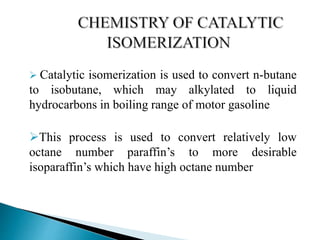
 Catalytic isomerization is used to convert n-butane
to isobutane, which may alkylated to liquid
hydrocarbons in boiling range of motor gasoline
This process is used to convert relatively low
octane number paraffin’s to more desirable
isoparaffin’s which have high octane number
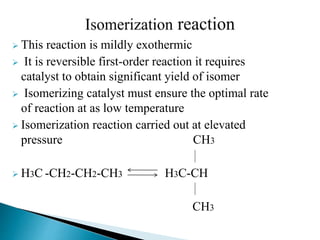
 This reaction is mildly exothermic
 It is reversible first-order reaction it requires
catalyst to obtain significant yield of isomer
 Isomerizing catalyst must ensure the optimal rate
of reaction at as low temperature
 Isomerization reaction carried out at elevated
pressure CH3
 H3C -CH2-CH2-CH3 H3C-CH
CH3
n-Butane
isobutane product
gas
make up hydrogen
furnace
isomerization
reactor
high pressure
separator
stabilizer
Butane feed
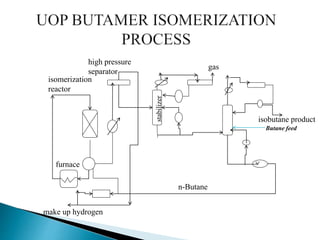
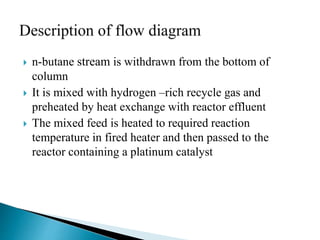
 n-butane stream is withdrawn from the bottom of
column
 It is mixed with hydrogen –rich recycle gas and
preheated by heat exchange with reactor effluent
 The mixed feed is heated to required reaction
temperature in fired heater and then passed to the
reactor containing a platinum catalyst
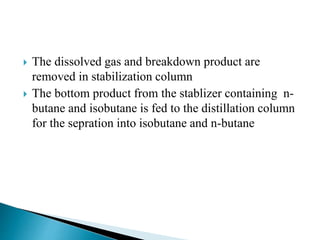
 The dissolved gas and breakdown product are
removed in stabilization column
 The bottom product from the stablizer containing n-
butane and isobutane is fed to the distillation column
for the sepration into isobutane and n-butane
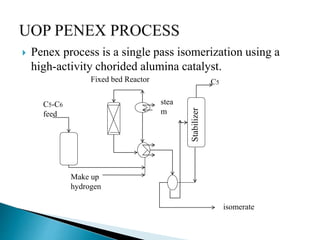
 Penex process is a single pass isomerization using a
high-activity chorided alumina catalyst.
C5-C6
feed
Fixed bed Reactor
stea
m
C5
Make up
hydrogen
isomerate
Stabilizer
 Isomerization increases the octane value of C5-C6
fractions by converting normal paraffins to there
isomers using several options
 Recycle options are available by adding product
iso/normal parrafin separation consisting of molecular
sieves or fractionation
 TIP process-integrated recycle isomerization consisting
of UOP’s zeolite isomerization and IsoSiv processes for
iso/normal paraffin separation
 Polymerization is a process by which two or more
molecules combined to produce a single larger
molecule
 Catalytic polymerization in a petroleum refinery is
used to convert light olefins, such as propane and
butenes, into a high octane number motor gasoline
component(polymer gasoline)
 This process is also used for producing straight chain
C₇-C₉ olefins which are subsequently used for the
manufacture of speciality alcohols
 This process can be used for the alkylation of
aromatics with olefins to form products such as
cumene and ethyl benzene
 Catalytic polymerization most often carried out with
the use of solid phosphoric acid supported on
kieselguhr
 Feedstock to a catalytic polymerization unit consist
of C₃-C₄ products from fluid catalytic cracking as
well as visbreaking and coking operation
 A final water wash removes presses of ammonia and
other basic compound
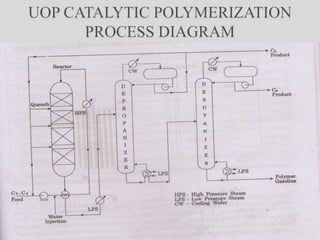
 The catalytic polymerization reaction is exothermic.
It release about 1550 kcal/kg and 920kcal/kg of olefin
converted for propane and butene
 The catalytic is arranged in a series of separate
weights
 This allows the injection of cold recycle propane as
quench
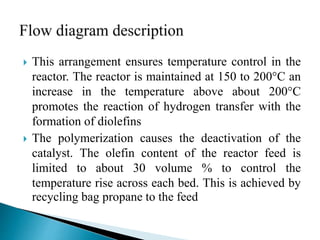
 This arrangement ensures temperature control in the
reactor. The reactor is maintained at 150 to 200°C an
increase in the temperature above about 200°C
promotes the reaction of hydrogen transfer with the
formation of diolefins
 The polymerization causes the deactivation of the
catalyst. The olefin content of the reactor feed is
limited to about 30 volume % to control the
temperature rise across each bed. This is achieved by
recycling bag propane to the feed
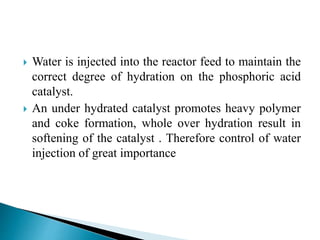
 Water is injected into the reactor feed to maintain the
correct degree of hydration on the phosphoric acid
catalyst.
 An under hydrated catalyst promotes heavy polymer
and coke formation, whole over hydration result in
softening of the catalyst . Therefore control of water
injection of great importance
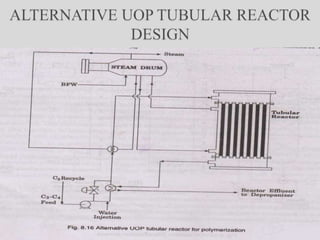
 In this design, the catalyst is contained in large
number of 2-inch vertical tubes this tubes are
surrounded by a water jacket to remove the
exothermic hit of reaction
 The steam generated in the water jacket is then
utilized to preheat the feed with C₄ and mixed C₃-
C₄ feedstock, the olefin contents are allowed to 50
moles%, but the design can accept reactor feedstocks
containing 45 mole % olefin with C₃ stream because
of higher reaction
 The quantity of recycle required by the tubular
reactor system and this results in reduced energy
consumption in producing the recycle stream.
 Depending on feedstock quality, operating condition
and catalytic activity, olefin conversion of 85-95%
can be achieved in the catalytic polymerization
process.
 The motor octane number (high-speed knocking
characteristic) of polymer gasoline is poor due to its
highly olefinis nature.
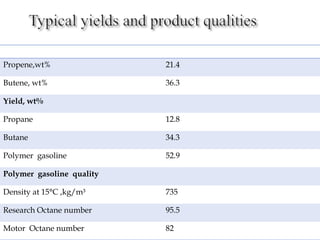
Feedstock- mixed C3 –C4 steam
Propene,wt% 21.4
Butene, wt% 36.3
Yield, wt%
Propane 12.8
Butane 34.3
Polymer gasoline 52.9
Polymer gasoline quality
Density at 15°C ,kg/m³ 735
Research Octane number 95.5
Motor Octane number 82
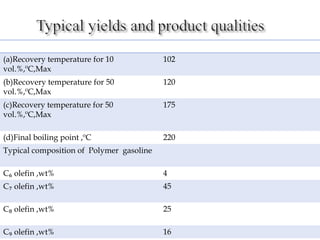
Distillation
(a)Recovery temperature for 10
vol.%,ºC,Max
102
(b)Recovery temperature for 50
vol.%,ºC,Max
120
(c)Recovery temperature for 50
vol.%,ºC,Max
175
(d)Final boiling point ,ºC 220
Typical composition of Polymer gasoline
C₆ olefin ,wt% 4
C₇ olefin ,wt% 45
C₈ olefin ,wt% 25
C₉ olefin ,wt% 16
 The IFP dimersol process dimerizes propane to
hexene which is a high octane number motor gasoline
blending component, this process is reported to give a
product containing 80 to 85 weight% hexene
 This result in a lower density, lower boiling point
which is a more desirable component in the final
motor gasoline blend
 This process can also be used for demerizing butene
to produce linear C₈ olefins or co-demerizing
propane and butene to produce C₇ olefin
 The linear C₇ and C₈ olefins formed are used for
specialty alcohols manufacture
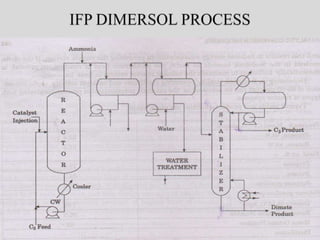
 The catalyst comprises nickel co-ordination complex and
aluminium alkyl which are continuously injected in
small concentration into the feedstock
 The polymerization takes place at ambient temperature
with sufficient pressure to maintain liquid phase
 The exothermic heat of reaction is removed in the
recycle cooler to control the reactor temperature. The
ammonia is injected in the reactor and this destroys the
catalyst
 In organic material from the product stream are then
extracted by water washing. The separation of C₃
stream(LPG) and the dimate product is done in the stabilizer
 The dimersol catalyst is believed to be very sensitive to
feedstock impurities such as water, sulphur, ammonia,
diolefins and acetylenes. Therefore, feedstock is usually
given treatment including drying over molecular sieves
 This process is unsuitable for feedstock containing
significant concentration of isobutene and so cannot be used
for C₄ or mixed C₃-C₄ streams from catalytic crackers
catalytic isomerization

catalytic isomerization

  • 1.
    PRESENTED BY: Mohd TauqeerAlam CSJMA14001390208 Chemical engineering. B. Tech.( final year ) 1 1 PETROLEUM TECHNOLOGY
  • 2.
    1) Chemistry ofcatalytic isomerization 2) UOP Butamer isomerization process 3) UOP Penex process 4) Catalytic polymerization 5) UOP Catalytic polymerization process 6) Alternative UOP tubular reactor 7) IFP Dimersol process
  • 3.
     Catalytic isomerizationis used to convert n-butane to isobutane, which may alkylated to liquid hydrocarbons in boiling range of motor gasoline This process is used to convert relatively low octane number paraffin’s to more desirable isoparaffin’s which have high octane number
  • 4.
     This reactionis mildly exothermic  It is reversible first-order reaction it requires catalyst to obtain significant yield of isomer  Isomerizing catalyst must ensure the optimal rate of reaction at as low temperature  Isomerization reaction carried out at elevated pressure CH3  H3C -CH2-CH2-CH3 H3C-CH CH3
  • 5.
    n-Butane isobutane product gas make uphydrogen furnace isomerization reactor high pressure separator stabilizer Butane feed
  • 6.
     n-butane streamis withdrawn from the bottom of column  It is mixed with hydrogen –rich recycle gas and preheated by heat exchange with reactor effluent  The mixed feed is heated to required reaction temperature in fired heater and then passed to the reactor containing a platinum catalyst
  • 7.
     The dissolvedgas and breakdown product are removed in stabilization column  The bottom product from the stablizer containing n- butane and isobutane is fed to the distillation column for the sepration into isobutane and n-butane
  • 8.
     Penex processis a single pass isomerization using a high-activity chorided alumina catalyst. C5-C6 feed Fixed bed Reactor stea m C5 Make up hydrogen isomerate Stabilizer
  • 9.
     Isomerization increasesthe octane value of C5-C6 fractions by converting normal paraffins to there isomers using several options  Recycle options are available by adding product iso/normal parrafin separation consisting of molecular sieves or fractionation  TIP process-integrated recycle isomerization consisting of UOP’s zeolite isomerization and IsoSiv processes for iso/normal paraffin separation
  • 11.
     Polymerization isa process by which two or more molecules combined to produce a single larger molecule  Catalytic polymerization in a petroleum refinery is used to convert light olefins, such as propane and butenes, into a high octane number motor gasoline component(polymer gasoline)
  • 12.
     This processis also used for producing straight chain C₇-C₉ olefins which are subsequently used for the manufacture of speciality alcohols  This process can be used for the alkylation of aromatics with olefins to form products such as cumene and ethyl benzene  Catalytic polymerization most often carried out with the use of solid phosphoric acid supported on kieselguhr
  • 13.
     Feedstock toa catalytic polymerization unit consist of C₃-C₄ products from fluid catalytic cracking as well as visbreaking and coking operation  A final water wash removes presses of ammonia and other basic compound
  • 14.
     The catalyticpolymerization reaction is exothermic. It release about 1550 kcal/kg and 920kcal/kg of olefin converted for propane and butene  The catalytic is arranged in a series of separate weights  This allows the injection of cold recycle propane as quench
  • 16.
     This arrangementensures temperature control in the reactor. The reactor is maintained at 150 to 200°C an increase in the temperature above about 200°C promotes the reaction of hydrogen transfer with the formation of diolefins  The polymerization causes the deactivation of the catalyst. The olefin content of the reactor feed is limited to about 30 volume % to control the temperature rise across each bed. This is achieved by recycling bag propane to the feed
  • 17.
     Water isinjected into the reactor feed to maintain the correct degree of hydration on the phosphoric acid catalyst.  An under hydrated catalyst promotes heavy polymer and coke formation, whole over hydration result in softening of the catalyst . Therefore control of water injection of great importance
  • 19.
     In thisdesign, the catalyst is contained in large number of 2-inch vertical tubes this tubes are surrounded by a water jacket to remove the exothermic hit of reaction  The steam generated in the water jacket is then utilized to preheat the feed with C₄ and mixed C₃- C₄ feedstock, the olefin contents are allowed to 50 moles%, but the design can accept reactor feedstocks containing 45 mole % olefin with C₃ stream because of higher reaction
  • 20.
     The quantityof recycle required by the tubular reactor system and this results in reduced energy consumption in producing the recycle stream.  Depending on feedstock quality, operating condition and catalytic activity, olefin conversion of 85-95% can be achieved in the catalytic polymerization process.  The motor octane number (high-speed knocking characteristic) of polymer gasoline is poor due to its highly olefinis nature.
  • 21.
    Feedstock- mixed C3–C4 steam Propene,wt% 21.4 Butene, wt% 36.3 Yield, wt% Propane 12.8 Butane 34.3 Polymer gasoline 52.9 Polymer gasoline quality Density at 15°C ,kg/m³ 735 Research Octane number 95.5 Motor Octane number 82
  • 22.
    Distillation (a)Recovery temperature for10 vol.%,ºC,Max 102 (b)Recovery temperature for 50 vol.%,ºC,Max 120 (c)Recovery temperature for 50 vol.%,ºC,Max 175 (d)Final boiling point ,ºC 220 Typical composition of Polymer gasoline C₆ olefin ,wt% 4 C₇ olefin ,wt% 45 C₈ olefin ,wt% 25 C₉ olefin ,wt% 16
  • 23.
     The IFPdimersol process dimerizes propane to hexene which is a high octane number motor gasoline blending component, this process is reported to give a product containing 80 to 85 weight% hexene  This result in a lower density, lower boiling point which is a more desirable component in the final motor gasoline blend  This process can also be used for demerizing butene to produce linear C₈ olefins or co-demerizing propane and butene to produce C₇ olefin
  • 24.
     The linearC₇ and C₈ olefins formed are used for specialty alcohols manufacture  The catalyst comprises nickel co-ordination complex and aluminium alkyl which are continuously injected in small concentration into the feedstock  The polymerization takes place at ambient temperature with sufficient pressure to maintain liquid phase  The exothermic heat of reaction is removed in the recycle cooler to control the reactor temperature. The ammonia is injected in the reactor and this destroys the catalyst
  • 26.
     In organicmaterial from the product stream are then extracted by water washing. The separation of C₃ stream(LPG) and the dimate product is done in the stabilizer  The dimersol catalyst is believed to be very sensitive to feedstock impurities such as water, sulphur, ammonia, diolefins and acetylenes. Therefore, feedstock is usually given treatment including drying over molecular sieves  This process is unsuitable for feedstock containing significant concentration of isobutene and so cannot be used for C₄ or mixed C₃-C₄ streams from catalytic crackers