
PETROCHEMICALS AND
POLYMERS
Jershan A.
Devadas
FOSSIL FUELS
Formed in the earth’s crust from material that was
once living
COAL - fossil plant material
PETROLEUM/ CRUDE OIL - bodies of marine
organisms
NATURAL GAS - bodies of marine organisms
It takes millions of years for the formation of these
fossil fuels
Non-renewable
Finite resource.
PETROLEUM -
FORMATION1) Marine creatures died, sank to the seabed and were covered by
mud.
2) High pressure, high temperature and bacteria acting changes
them to petroleum and natural gas.
3) Organic material broke down into hydrocarbons.
4) Compression of mud transformed the hydrocarbon into shale.
5) Geological movements and pressure changed this shale into
harder rocks, squeezing out oil and gas.
6) Oil and gas moves upwards through the porous rocks and
becomes trapped by a layer of non-porous rocks.
7) Reservoirs of oil and gas are created – they spread throughout
FRACTIONAL
DISTILLATIONPetroleum – mixture of different hydrocarbon
molecules
Hydrocarbon molecules are separated by refining.
This is done by fractional distillation in a oil refinery.
90% petroleum is used as a fuel; 10% petroleum is
used as a feedstock.
Petroleum is separated into different fractions –
groups of hydrocarbons that have different boiling
points.
Separation takes place by fractional distillation in a
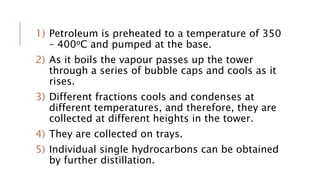
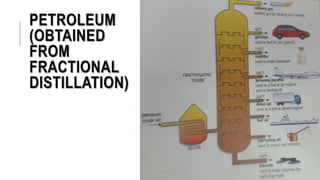
1) Petroleum is preheated to a temperature of 350
– 400oC and pumped at the base.
2) As it boils the vapour passes up the tower
through a series of bubble caps and cools as it
rises.
3) Different fractions cools and condenses at
different temperatures, and therefore, they are
collected at different heights in the tower.
4) They are collected on trays.
5) Individual single hydrocarbons can be obtained
by further distillation.
PETROLEUM
(OBTAINED
FROM
FRACTIONAL
DISTILLATION)
CATALYTIC CRACKING
For lighter fractions, such as gasoline, demand is high.
For heavier fractions, such as kerosene, the demand is low.
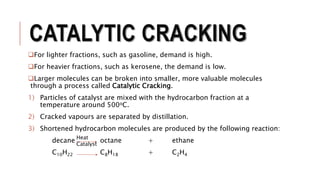
Larger molecules can be broken into smaller, more valuable molecules
through a process called Catalytic Cracking.
1) Particles of catalyst are mixed with the hydrocarbon fraction at a
temperature around 500oC.
2) Cracked vapours are separated by distillation.
3) Shortened hydrocarbon molecules are produced by the following reaction:
decane octane + ethane
C10H22 C8H18 + C2H4
Heat
Catalyst
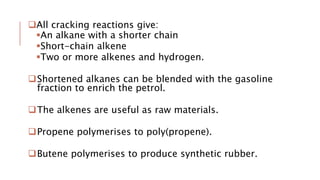
All cracking reactions give:
An alkane with a shorter chain
Short-chain alkene
Two or more alkenes and hydrogen.
Shortened alkanes can be blended with the gasoline
fraction to enrich the petrol.
The alkenes are useful as raw materials.
Propene polymerises to poly(propene).
Butene polymerises to produce synthetic rubber.
BLENDING GASOLINE
Some of the products from cracking are added to the
gasoline fraction to improve the quality of petrol.
High-quality petrol contains many branched-chain
hydrocarbons, made by re-forming, so that the fuel
does not ignite too soon.
Unleaded Petrol is used in modern cars fitted with
catalytic converter.
Levels of sulfur dioxide, carbon monoxide, unburnt
hydrocarbons and oxides of nitrogen are reduced
using catalytic converter.
ALTERNATIVE FUELS
AND ENERGY SOURCES
FUELS
Diesel
Gasoline from
methanol
LPG and CNG
Biofuels
Others (ethanol and
hydrogen - powered
vehicles, electric, solar,
etc.)
ENERGY SOURCES
Biogas
Anaerobic bacteria
decompose organic
matter under geologic
conditions to produce
natural gas (methane)
Methane is useful for
heating, cooking and
the solid is used as a
ADDITION
POLYMERISATI
ON
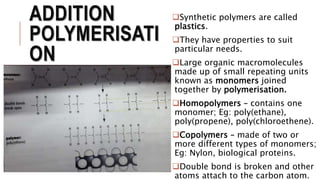
Synthetic polymers are called
plastics.
They have properties to suit
particular needs.
Large organic macromolecules
made up of small repeating units
known as monomers joined
together by polymerisation.
Homopolymers – contains one
monomer; Eg: poly(ethane),
poly(propene), poly(chloroethene).
Copolymers – made of two or
more different types of monomers;
Eg: Nylon, biological proteins.
Double bond is broken and other
atoms attach to the carbon atom.
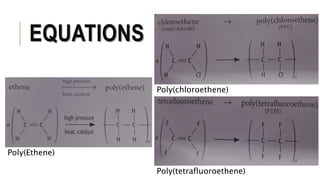
EQUATIONS
Poly(Ethene)
Poly(chloroethene)
Poly(tetrafluoroethene)
PROPERTIES OF
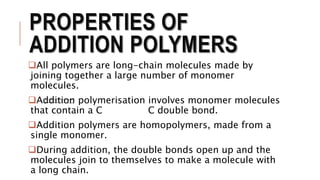
ADDITION POLYMERS
All polymers are long-chain molecules made by
joining together a large number of monomer
molecules.
Addition polymerisation involves monomer molecules
that contain a C C double bond.
Addition polymers are homopolymers, made from a
single monomer.
During addition, the double bonds open up and the
molecules join to themselves to make a molecule with
a long chain.
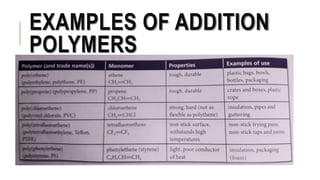
EXAMPLES OF ADDITION
POLYMERS
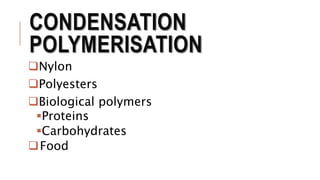
CONDENSATION
POLYMERISATION
Nylon
Polyesters
Biological polymers
Proteins
Carbohydrates
Food
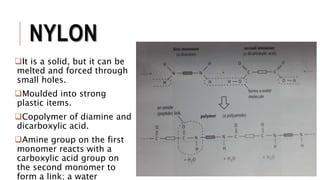
NYLON
It is a solid, but it can be
melted and forced through
small holes.
Moulded into strong
plastic items.
Copolymer of diamine and
dicarboxylic acid.
Amine group on the first
monomer reacts with a
carboxylic acid group on
the second monomer to
form a link; a water
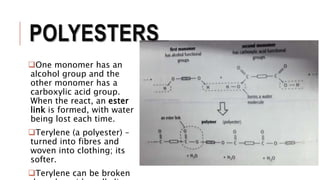
POLYESTERS
One monomer has an
alcohol group and the
other monomer has a
carboxylic acid group.
When the react, an ester
link is formed, with water
being lost each time.
Terylene (a polyester) –
turned into fibres and
woven into clothing; its
softer.
Terylene can be broken
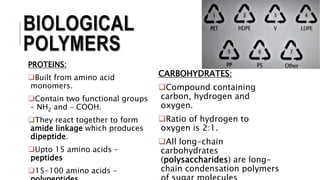
BIOLOGICAL
POLYMERS
PROTEINS:
Built from amino acid
monomers.
Contain two functional groups
– NH2 and – COOH.
They react together to form
amide linkage which produces
dipeptide.
Upto 15 amino acids –
peptides
15-100 amino acids –
CARBOHYDRATES:
Compound containing
carbon, hydrogen and
oxygen.
Ratio of hydrogen to
oxygen is 2:1.
All long-chain
carbohydrates
(polysaccharides) are long-
chain condensation polymers
FOOD
Main constituents are proteins, carbohydrates and
fats.
Digested and converted back to their monomers,
which are used as building blocks or sources of
energy.
FATS – mixture if large molecules that are the esters
of long-chain carboxylic acid molecules and glycerol.
Fats that contain unsaturated acids are called
unsaturated or polyunsaturated fats.
Fats that contain saturated acids are called saturated
Petrochemicals and polymers

Petrochemicals and polymers

  • 1.
  • 2.
    FOSSIL FUELS Formed inthe earth’s crust from material that was once living COAL - fossil plant material PETROLEUM/ CRUDE OIL - bodies of marine organisms NATURAL GAS - bodies of marine organisms It takes millions of years for the formation of these fossil fuels Non-renewable Finite resource.
  • 3.
    PETROLEUM - FORMATION1) Marinecreatures died, sank to the seabed and were covered by mud. 2) High pressure, high temperature and bacteria acting changes them to petroleum and natural gas. 3) Organic material broke down into hydrocarbons. 4) Compression of mud transformed the hydrocarbon into shale. 5) Geological movements and pressure changed this shale into harder rocks, squeezing out oil and gas. 6) Oil and gas moves upwards through the porous rocks and becomes trapped by a layer of non-porous rocks. 7) Reservoirs of oil and gas are created – they spread throughout
  • 4.
    FRACTIONAL DISTILLATIONPetroleum – mixtureof different hydrocarbon molecules Hydrocarbon molecules are separated by refining. This is done by fractional distillation in a oil refinery. 90% petroleum is used as a fuel; 10% petroleum is used as a feedstock. Petroleum is separated into different fractions – groups of hydrocarbons that have different boiling points. Separation takes place by fractional distillation in a
  • 5.
    1) Petroleum ispreheated to a temperature of 350 – 400oC and pumped at the base. 2) As it boils the vapour passes up the tower through a series of bubble caps and cools as it rises. 3) Different fractions cools and condenses at different temperatures, and therefore, they are collected at different heights in the tower. 4) They are collected on trays. 5) Individual single hydrocarbons can be obtained by further distillation.
  • 6.
  • 7.
    CATALYTIC CRACKING For lighterfractions, such as gasoline, demand is high. For heavier fractions, such as kerosene, the demand is low. Larger molecules can be broken into smaller, more valuable molecules through a process called Catalytic Cracking. 1) Particles of catalyst are mixed with the hydrocarbon fraction at a temperature around 500oC. 2) Cracked vapours are separated by distillation. 3) Shortened hydrocarbon molecules are produced by the following reaction: decane octane + ethane C10H22 C8H18 + C2H4 Heat Catalyst
  • 8.
    All cracking reactionsgive: An alkane with a shorter chain Short-chain alkene Two or more alkenes and hydrogen. Shortened alkanes can be blended with the gasoline fraction to enrich the petrol. The alkenes are useful as raw materials. Propene polymerises to poly(propene). Butene polymerises to produce synthetic rubber.
  • 9.
    BLENDING GASOLINE Some ofthe products from cracking are added to the gasoline fraction to improve the quality of petrol. High-quality petrol contains many branched-chain hydrocarbons, made by re-forming, so that the fuel does not ignite too soon. Unleaded Petrol is used in modern cars fitted with catalytic converter. Levels of sulfur dioxide, carbon monoxide, unburnt hydrocarbons and oxides of nitrogen are reduced using catalytic converter.
  • 10.
    ALTERNATIVE FUELS AND ENERGYSOURCES FUELS Diesel Gasoline from methanol LPG and CNG Biofuels Others (ethanol and hydrogen - powered vehicles, electric, solar, etc.) ENERGY SOURCES Biogas Anaerobic bacteria decompose organic matter under geologic conditions to produce natural gas (methane) Methane is useful for heating, cooking and the solid is used as a
  • 11.
    ADDITION POLYMERISATI ON Synthetic polymers arecalled plastics. They have properties to suit particular needs. Large organic macromolecules made up of small repeating units known as monomers joined together by polymerisation. Homopolymers – contains one monomer; Eg: poly(ethane), poly(propene), poly(chloroethene). Copolymers – made of two or more different types of monomers; Eg: Nylon, biological proteins. Double bond is broken and other atoms attach to the carbon atom.
  • 12.
  • 13.
    PROPERTIES OF ADDITION POLYMERS Allpolymers are long-chain molecules made by joining together a large number of monomer molecules. Addition polymerisation involves monomer molecules that contain a C C double bond. Addition polymers are homopolymers, made from a single monomer. During addition, the double bonds open up and the molecules join to themselves to make a molecule with a long chain.
  • 14.
  • 15.
  • 16.
    NYLON It is asolid, but it can be melted and forced through small holes. Moulded into strong plastic items. Copolymer of diamine and dicarboxylic acid. Amine group on the first monomer reacts with a carboxylic acid group on the second monomer to form a link; a water
  • 17.
    POLYESTERS One monomer hasan alcohol group and the other monomer has a carboxylic acid group. When the react, an ester link is formed, with water being lost each time. Terylene (a polyester) – turned into fibres and woven into clothing; its softer. Terylene can be broken
  • 18.
    BIOLOGICAL POLYMERS PROTEINS: Built from aminoacid monomers. Contain two functional groups – NH2 and – COOH. They react together to form amide linkage which produces dipeptide. Upto 15 amino acids – peptides 15-100 amino acids – CARBOHYDRATES: Compound containing carbon, hydrogen and oxygen. Ratio of hydrogen to oxygen is 2:1. All long-chain carbohydrates (polysaccharides) are long- chain condensation polymers
  • 19.
    FOOD Main constituents areproteins, carbohydrates and fats. Digested and converted back to their monomers, which are used as building blocks or sources of energy. FATS – mixture if large molecules that are the esters of long-chain carboxylic acid molecules and glycerol. Fats that contain unsaturated acids are called unsaturated or polyunsaturated fats. Fats that contain saturated acids are called saturated