Gasoline
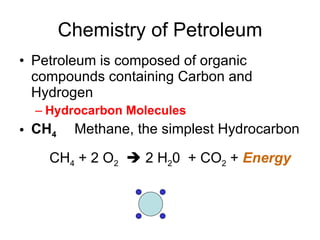
Chemistry of Petroleum Petroleum is composed of organic compounds containing Carbon and Hydrogen Hydrocarbon Molecules CH 4   Methane, the simplest Hydrocarbon CH 4  + 2 O 2     2 H 2 0  + CO 2  +  Energy
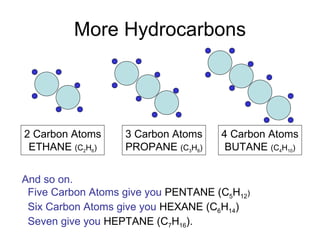
More Hydrocarbons 2 Carbon Atoms ETHANE  (C 2 H 6 ) 3 Carbon Atoms PROPANE  (C 3 H 8 ) 4 Carbon Atoms BUTANE  (C 4 H 10 ) And so on.  Five Carbon Atoms give you  PENTANE (C 5 H 12 ) Six Carbon Atoms give you  HEXANE (C 6 H 14 ) Seven give you  HEPTANE (C 7 H 16 ).
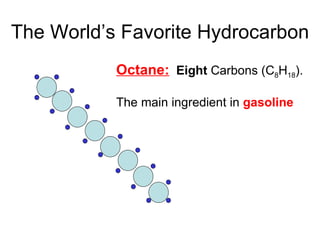
The World’s Favorite Hydrocarbon Octane:   Eight  Carbons (C 8 H 18 ). The main ingredient in  gasoline
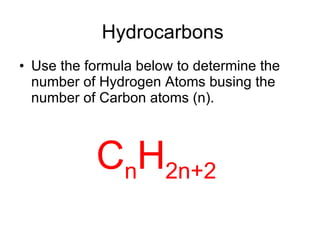
Use the formula below to determine the number of Hydrogen Atoms busing the number of Carbon atoms (n). C n H 2n+2 Hydrocarbons
Chemistry of Petroleum Temperature and number of carbon atoms determine the form of petroleum  At Ordinary surface temperatures:  Less than 5 Carbon atoms Gas  5 to 15 Carbon Atoms Free-Flowing Liquids. CRUDE OIL Greater than 15 Thick viscous liquids to waxy solids.
Crude Oil Liquid petroleum recovered directly from the well is called crude (unrefined  or unprocessed)  oil.  Crude oil is comprised of a mixture of hydrocarbon molecules  Light (sweet) Crude   low S impurities Can easily be refined to gasoline Produced in Nigeria, U.S. Gulf States, Canada   Heavy (sour) Crude   high S impurities Difficult to refine to gasoline Produced in Saudi Arabia, Mexico, Venezuela, Iraq
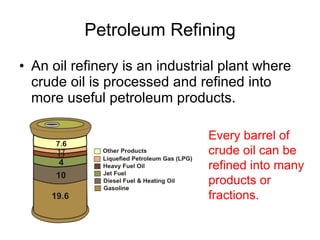
Petroleum Refining An oil refinery is an industrial plant where crude oil is processed and refined into more useful petroleum products.  Every barrel of crude oil can be refined into many products or fractions.
Crude Oil Fractions Petroleum gas  (1-4 Carbons) used for heating, cooking,  making plastics Naphtha  (8 Carbons) dry cleaning solution; intermediate that will be further processed to make gasoline Gasoline  (8 Carbons) motor fuel Kerosene  (12 Carbons) fuel for jet engines and tractors; starting material for making other products
Crude Oil Fractions Gas Oil or Diesel  (16 Carbons) used for diesel fuel and heating oil; starting material for making other Lubricating Oil  (36 Carbons) used for motor oil, grease, other lubricants Heavy gas or Fuel oil  (44 Carbons)  used for industrial fuel; starting material for making other products Residuals  (80 Carbons) coke, asphalt, tar, waxes; starting material for making other products
Components of a Refinery
Fractional Distillation  The hydrocarbons in crude oil have different boiling points, according to the number of carbon atoms their molecules contain and how they are arranged. Fractional distillation uses the difference in boiling point to separate the hydrocarbons in crude oil.  The fractionating column is cooler at the top than the bottom, so the vapors cool as they rise.
Fractional Distillation
Fractional Distillation Vapors condense onto a tray when they reach the part of the column which is cooler than their boiling point.  As the last gases from the bottom of the column pass through the holes in a tray, any lighter hydrocarbons still in the condensed liquid are boiled off, and rise through the column.
Chemical Processing Very few of the components come out of the fractional distillation column ready for market.  Many of them must be chemically processed to make other fractions.  For example, only 40% of distilled crude oil is gasoline After distillation, one fraction can be changed into another by two methods of chemical processing:  Cracking and  Unification
Cracking Cracking breaks large chains into smaller chains.  After various hydrocarbons are cracked into smaller hydrocarbons, the products go through another fractional distillation column to separate them.
Unification Unification combines smaller hydrocarbons into larger ones A reformer combines chains to make   naphtha into gasoline. A significant by-product of this reaction is hydrogen gas, which is then either used for hydrocracking or sold.
Refineries and the Environment The refining process releases numerous different chemicals into the atmosphere; consequently, there are substantial air pollution emissions.  Due to pollution problems there is strong pressure to prevent the development of new refineries, and no major refinery has been built in the U.S. since 1976. However, many existing refineries have been expanded during that time.
Illinois leads the Midwest in crude oil refining capacity with four refineries.  About 5.2% of U.S. Petroleum is refined in Illinois and is mainly supplied by the Tar Sands on Canada. Illinois Refineries
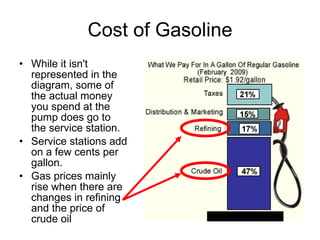
Cost of Gasoline While it isn't represented in the diagram, some of the actual money you spend at the pump does go to the service station.  Service stations add on a few cents per gallon.  Gas prices mainly rise when there are changes in refining and the price of crude oil
Gasoline (4-Stroke) Engine Burns fuel and air in enclosed space producing hot gases Allows heat to flow from hot engine to cold outside air Converts some of this heat into useful work Example of a Heat Engine
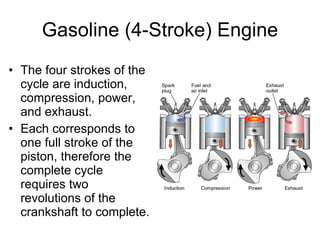
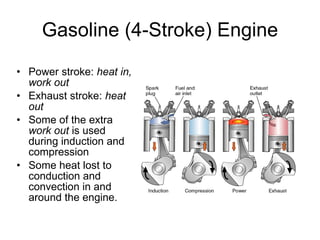
Gasoline (4-Stroke) Engine The four strokes of the cycle are induction, compression, power, and exhaust.   Each corresponds to one full stroke of the piston, therefore the complete cycle requires two revolutions of the crankshaft to complete.
Induction Stroke During the induction stroke, the piston moves downward, drawing a fresh charge of vaporized fuel/air mixture.  The carburetor mixes the fuel and air.
Compression Stroke As the piston rises the poppet valve is forced shut by the increased cylinder pressure.   Flywheel momentum drives the piston upward, compressing the fuel/air mixture. Compressed Fuel is easier to ignite.
Power Stroke At the top of the compression stroke the spark plug fires, igniting the compressed fuel.   As the fuel burns it expands, driving the piston downward. Chemical energy converted to thermal energy converted to mechanical energy.
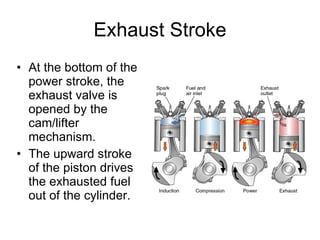
Exhaust Stroke At the bottom of the power stroke, the exhaust valve is opened by the cam/lifter mechanism.   The upward stroke of the piston drives the exhausted fuel out of the cylinder.
Gasoline (4-Stroke) Engine Power stroke:  heat in, work out Exhaust stroke:  heat out Some of the extra  work out  is used during induction and compression Some heat lost to conduction and convection in and around the engine.
Gasoline and 4-stroke Engines A 4-stroke engine is designed to run on a refined mixture of hydrocarbons from C7–Heptane and C8–Octane. This mixture is called Gasoline C7 and C8 vaporize at temperatures below the boiling point of water.  That's why if you spill gasoline on the ground it evaporates very quickly.
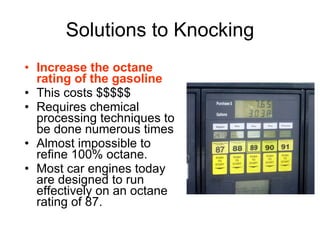
Octane Rating The  octane rating  of gasoline tells you how much the fuel can be compressed before it spontaneously ignites.  Eighty-seven-octane gasoline is gasoline that contains 87-percent octane and 13-percent heptane  Most gas stations offer three octane grades:  regular, usually 87 octane mid-grade, usually 89 octane  premium usually 92 or 93.  The ratings must be posted on bright yellow stickers on each gasoline pump.
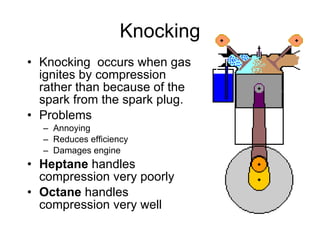
Knocking Knocking  occurs when gas ignites by compression rather than because of the spark from the spark plug. Problems Annoying Reduces efficiency Damages engine Heptane  handles compression very poorly Octane  handles compression very well
Solutions to Knocking Increase the octane rating of the gasoline This costs $$$$$ Requires chemical processing techniques to be done numerous times Almost impossible to refine 100% octane. Most car engines today are designed to run effectively on an octane rating of 87.
Gasoline Additives During WWI, it was discovered that you can add a chemical called tetraethyl lead to gasoline and significantly improve its octane rating.  Lower octane grades of gasoline could be made usable by adding this chemical.  This led to the widespread use of "ethyl" or "leaded" gasoline.
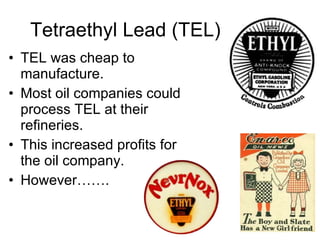
Tetraethyl Lead (TEL) TEL was cheap to manufacture. Most oil companies could process TEL at their refineries. This increased profits for the oil company. However…….
Tetraethyl Lead (TEL) Due to the combustion of TEL in gasoline, the Earth became covered in a thin layer of lead. Even glacial ice at the north pole recorded an alarming increase of lead during the mid to late 1900s.
Health Risks of TEL Exposure Acute Exposure in Adults Blindness Brain Damage Kidney disease Cancers Death Low Level Exposure in Children Lowered IQ Reading and Learning Disablities Impaired hearing Hyperactivity Impaired Growth
Removal of TEL In the early 1970s, catalytic converters were required in vehicles by the Clean Air Act to reduce smog forming pollutants. Lead from gasoline additives clogs a catalytic converter. Note:  Leaded Gasoline was not phased out due to health concerns directly from the lead!
Removal of TEL Leaded gasoline was phased out in the United States staring in 1973 due to the Clean Air Act. Illegal to sell leaded gasoline for on-road  vehicles as of January 1, 1996. Fuel containing lead may continue to be sold for off-road uses, including aircraft, racing cars, farm equipment, and marine engines until 2008
Lead is Still a Problem Most of the 7 million tons of lead burned in the gasoline in the United States in the twentieth century remains ---  in the soil, air, and water and in the bodies of living organisms.
MTBE MTBE has been used in U.S. gasoline at low levels since 1979 to replace TEL to increase its octane rating and help prevent engine knocking.  A hydrocarbon molecule that is created at a refinery from methanol.  Big money maker for petrochemical companies Gasoline can contain as much as 10 percent to 15 percent MTBE.
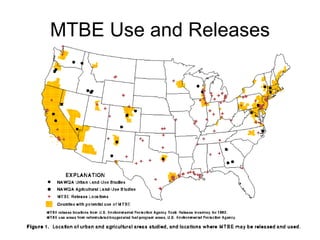
MTBE Use and Releases
MTBE The main problem with MTBE is that it is thought to be  carcinogenic  and it mixes easily with water.  If gasoline containing MTBE leaks from an underground tank at a gas station, it can get into groundwater and contaminate wells.  Twenty seven states have passed laws  to ban MTBE in certain areas.

Gasoline

  • 1.
  • 2.
    Chemistry of PetroleumPetroleum is composed of organic compounds containing Carbon and Hydrogen Hydrocarbon Molecules CH 4 Methane, the simplest Hydrocarbon CH 4 + 2 O 2  2 H 2 0 + CO 2 + Energy
  • 3.
    More Hydrocarbons 2Carbon Atoms ETHANE (C 2 H 6 ) 3 Carbon Atoms PROPANE (C 3 H 8 ) 4 Carbon Atoms BUTANE (C 4 H 10 ) And so on. Five Carbon Atoms give you PENTANE (C 5 H 12 ) Six Carbon Atoms give you HEXANE (C 6 H 14 ) Seven give you HEPTANE (C 7 H 16 ).
  • 4.
    The World’s FavoriteHydrocarbon Octane: Eight Carbons (C 8 H 18 ). The main ingredient in gasoline
  • 5.
    Use the formulabelow to determine the number of Hydrogen Atoms busing the number of Carbon atoms (n). C n H 2n+2 Hydrocarbons
  • 6.
    Chemistry of PetroleumTemperature and number of carbon atoms determine the form of petroleum At Ordinary surface temperatures: Less than 5 Carbon atoms Gas 5 to 15 Carbon Atoms Free-Flowing Liquids. CRUDE OIL Greater than 15 Thick viscous liquids to waxy solids.
  • 7.
    Crude Oil Liquidpetroleum recovered directly from the well is called crude (unrefined or unprocessed) oil. Crude oil is comprised of a mixture of hydrocarbon molecules Light (sweet) Crude low S impurities Can easily be refined to gasoline Produced in Nigeria, U.S. Gulf States, Canada  Heavy (sour) Crude high S impurities Difficult to refine to gasoline Produced in Saudi Arabia, Mexico, Venezuela, Iraq
  • 8.
    Petroleum Refining Anoil refinery is an industrial plant where crude oil is processed and refined into more useful petroleum products. Every barrel of crude oil can be refined into many products or fractions.
  • 9.
    Crude Oil FractionsPetroleum gas (1-4 Carbons) used for heating, cooking, making plastics Naphtha (8 Carbons) dry cleaning solution; intermediate that will be further processed to make gasoline Gasoline (8 Carbons) motor fuel Kerosene (12 Carbons) fuel for jet engines and tractors; starting material for making other products
  • 10.
    Crude Oil FractionsGas Oil or Diesel (16 Carbons) used for diesel fuel and heating oil; starting material for making other Lubricating Oil (36 Carbons) used for motor oil, grease, other lubricants Heavy gas or Fuel oil (44 Carbons) used for industrial fuel; starting material for making other products Residuals (80 Carbons) coke, asphalt, tar, waxes; starting material for making other products
  • 11.
  • 12.
    Fractional Distillation The hydrocarbons in crude oil have different boiling points, according to the number of carbon atoms their molecules contain and how they are arranged. Fractional distillation uses the difference in boiling point to separate the hydrocarbons in crude oil. The fractionating column is cooler at the top than the bottom, so the vapors cool as they rise.
  • 13.
  • 14.
    Fractional Distillation Vaporscondense onto a tray when they reach the part of the column which is cooler than their boiling point. As the last gases from the bottom of the column pass through the holes in a tray, any lighter hydrocarbons still in the condensed liquid are boiled off, and rise through the column.
  • 15.
    Chemical Processing Veryfew of the components come out of the fractional distillation column ready for market. Many of them must be chemically processed to make other fractions. For example, only 40% of distilled crude oil is gasoline After distillation, one fraction can be changed into another by two methods of chemical processing: Cracking and Unification
  • 16.
    Cracking Cracking breakslarge chains into smaller chains. After various hydrocarbons are cracked into smaller hydrocarbons, the products go through another fractional distillation column to separate them.
  • 17.
    Unification Unification combinessmaller hydrocarbons into larger ones A reformer combines chains to make naphtha into gasoline. A significant by-product of this reaction is hydrogen gas, which is then either used for hydrocracking or sold.
  • 18.
    Refineries and theEnvironment The refining process releases numerous different chemicals into the atmosphere; consequently, there are substantial air pollution emissions. Due to pollution problems there is strong pressure to prevent the development of new refineries, and no major refinery has been built in the U.S. since 1976. However, many existing refineries have been expanded during that time.
  • 19.
    Illinois leads theMidwest in crude oil refining capacity with four refineries. About 5.2% of U.S. Petroleum is refined in Illinois and is mainly supplied by the Tar Sands on Canada. Illinois Refineries
  • 20.
    Cost of GasolineWhile it isn't represented in the diagram, some of the actual money you spend at the pump does go to the service station. Service stations add on a few cents per gallon. Gas prices mainly rise when there are changes in refining and the price of crude oil
  • 21.
    Gasoline (4-Stroke) EngineBurns fuel and air in enclosed space producing hot gases Allows heat to flow from hot engine to cold outside air Converts some of this heat into useful work Example of a Heat Engine
  • 22.
    Gasoline (4-Stroke) EngineThe four strokes of the cycle are induction, compression, power, and exhaust.  Each corresponds to one full stroke of the piston, therefore the complete cycle requires two revolutions of the crankshaft to complete.
  • 23.
    Induction Stroke Duringthe induction stroke, the piston moves downward, drawing a fresh charge of vaporized fuel/air mixture. The carburetor mixes the fuel and air.
  • 24.
    Compression Stroke Asthe piston rises the poppet valve is forced shut by the increased cylinder pressure.  Flywheel momentum drives the piston upward, compressing the fuel/air mixture. Compressed Fuel is easier to ignite.
  • 25.
    Power Stroke Atthe top of the compression stroke the spark plug fires, igniting the compressed fuel.  As the fuel burns it expands, driving the piston downward. Chemical energy converted to thermal energy converted to mechanical energy.
  • 26.
    Exhaust Stroke Atthe bottom of the power stroke, the exhaust valve is opened by the cam/lifter mechanism.  The upward stroke of the piston drives the exhausted fuel out of the cylinder.
  • 27.
    Gasoline (4-Stroke) EnginePower stroke: heat in, work out Exhaust stroke: heat out Some of the extra work out is used during induction and compression Some heat lost to conduction and convection in and around the engine.
  • 28.
    Gasoline and 4-strokeEngines A 4-stroke engine is designed to run on a refined mixture of hydrocarbons from C7–Heptane and C8–Octane. This mixture is called Gasoline C7 and C8 vaporize at temperatures below the boiling point of water. That's why if you spill gasoline on the ground it evaporates very quickly.
  • 29.
    Octane Rating The octane rating of gasoline tells you how much the fuel can be compressed before it spontaneously ignites. Eighty-seven-octane gasoline is gasoline that contains 87-percent octane and 13-percent heptane Most gas stations offer three octane grades: regular, usually 87 octane mid-grade, usually 89 octane premium usually 92 or 93. The ratings must be posted on bright yellow stickers on each gasoline pump.
  • 30.
    Knocking Knocking occurs when gas ignites by compression rather than because of the spark from the spark plug. Problems Annoying Reduces efficiency Damages engine Heptane handles compression very poorly Octane handles compression very well
  • 31.
    Solutions to KnockingIncrease the octane rating of the gasoline This costs $$$$$ Requires chemical processing techniques to be done numerous times Almost impossible to refine 100% octane. Most car engines today are designed to run effectively on an octane rating of 87.
  • 32.
    Gasoline Additives DuringWWI, it was discovered that you can add a chemical called tetraethyl lead to gasoline and significantly improve its octane rating. Lower octane grades of gasoline could be made usable by adding this chemical. This led to the widespread use of "ethyl" or "leaded" gasoline.
  • 33.
    Tetraethyl Lead (TEL)TEL was cheap to manufacture. Most oil companies could process TEL at their refineries. This increased profits for the oil company. However…….
  • 34.
    Tetraethyl Lead (TEL)Due to the combustion of TEL in gasoline, the Earth became covered in a thin layer of lead. Even glacial ice at the north pole recorded an alarming increase of lead during the mid to late 1900s.
  • 35.
    Health Risks ofTEL Exposure Acute Exposure in Adults Blindness Brain Damage Kidney disease Cancers Death Low Level Exposure in Children Lowered IQ Reading and Learning Disablities Impaired hearing Hyperactivity Impaired Growth
  • 36.
    Removal of TELIn the early 1970s, catalytic converters were required in vehicles by the Clean Air Act to reduce smog forming pollutants. Lead from gasoline additives clogs a catalytic converter. Note: Leaded Gasoline was not phased out due to health concerns directly from the lead!
  • 37.
    Removal of TELLeaded gasoline was phased out in the United States staring in 1973 due to the Clean Air Act. Illegal to sell leaded gasoline for on-road vehicles as of January 1, 1996. Fuel containing lead may continue to be sold for off-road uses, including aircraft, racing cars, farm equipment, and marine engines until 2008
  • 38.
    Lead is Stilla Problem Most of the 7 million tons of lead burned in the gasoline in the United States in the twentieth century remains --- in the soil, air, and water and in the bodies of living organisms.
  • 39.
    MTBE MTBE hasbeen used in U.S. gasoline at low levels since 1979 to replace TEL to increase its octane rating and help prevent engine knocking. A hydrocarbon molecule that is created at a refinery from methanol. Big money maker for petrochemical companies Gasoline can contain as much as 10 percent to 15 percent MTBE.
  • 40.
    MTBE Use andReleases
  • 41.
    MTBE The mainproblem with MTBE is that it is thought to be carcinogenic and it mixes easily with water. If gasoline containing MTBE leaks from an underground tank at a gas station, it can get into groundwater and contaminate wells. Twenty seven states have passed laws to ban MTBE in certain areas.