Petrochemical
Engineers
make a
world of difference
Where Would We Be Without
Petroleum?
Some of the products are as follows:
Balloons
Bandages
Blenders
Cameras
Candles
CD Players
Clothing
Compact
Discs/DVDs
Containers
Crayons
Deodorant
Dyes
Footballs
Furniture
Garbage Bags
Glasses
Glue
Golf Balls
Hang Gliders
House Paint
Insecticides
Life Jackets
Lipstick
Luggage
Medical Equipment
Perfumes
Photographic Film
Photographs
Piano Keys
Roller Blades
Roofing
Shampoo
Shaving Cream
Surfboards
Telephones
Tents
Toys
Umbrellas
Fossil Fuels – Nature’s Battery
Fossil Fuels
 Oil
 Natural Gas
 Coal
Source: US Energy Information Administration
Today’s Energy
 85.5 percent = fossil fuels
 14.5 percent = nuclear and all other sources
By 2025
 87 percent = fossil fuels (oil, gas, coal)
 13 percent = nuclear and all other sources
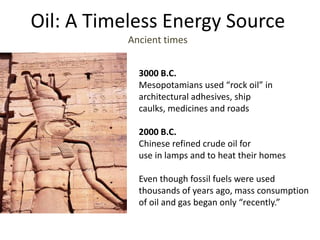
Oil: A Timeless Energy Source
Ancient times
3000 B.C.
Mesopotamians used “rock oil” in
architectural adhesives, ship
caulks, medicines and roads
2000 B.C.
Chinese refined crude oil for
use in lamps and to heat their homes
Even though fossil fuels were used
thousands of years ago, mass consumption
of oil and gas began only “recently.”
Mid-1800s
Whales hunted to near extinction
1849
Method to distill kerosene from petroleum
discovered
1853
Polish chemist Ignancy Lukasiewiz discovered how to
make kerosene from crude oil on an industrial scale.
1859
Kerosene took over lighting market.
Oil: A Timeless Energy Source
Oil industry saves the whales
1847
The world’s first oil well was drilled in Baku, Azerbaijan
1851
Scottish chemist James Young opens the world’s first oil refinery near
Edinburgh, Scotland
1859
Colonel Edwin Drake drilled the first successful commercial oil well in
northwestern Pennsylvania.
1896
The first known offshore oil well is drilled at the end of a 300-foot wharf
in Summerland, California.
1901
On January 10, Spindletop, an oil field located just south of
Beaumont, Texas, produces a "gusher" that spills out 100,000 barrels of
oil per day.
1917
The Bolivar Coastal field, South America’s largest oil field, discovered in
Venezuela
Oil: A Timeless Energy Source
Dawn of a new age
James Young
Colonel Edwin Drake
1903
Entrepreneur Henry Ford incorporates the Ford Motor Company.
1908
Ford's mass-produced Model T drives consumer demand for
gasoline.
125,000 cars on US roads.
Oil is found in Persia (modern Iran), leading to the formation of
Anglo-Persian Oil company, the forerunner of BP
1930
26.7 million cars in the US.
1938
Major oil reserves are discovered in Kuwait and Saudi Arabia
1950 – present
Oil became most-used energy source because of automobiles.
Oil: A Timeless Energy Source
Cars drive need for oil
1993 – present
US imports more oil than it produces - needed
because of growing petroleum demand used for
fuel, electricity and manufacturing plastic.
2007
World uses about 86 million barrels of oil per
day – 40,000 gallons every second
Oil: A Timeless Energy Source
Recent consumption
World Demand for Energy Will
Continue to Grow
Source: IEA World Energy Outlook 2008
World energy demand expands by 45% between now and 2030 –an average rate of increase of 1.6%
per year –with coal accounting for more than a third of the overall rise
Who Will Discover Oil and Gas in
the Future?
The Finders
Geoscientists (geologists, geophysicists)
• Study the Earth to search for clues to where oil and gas might be hidden
• Analyze minerals, soil, and rocks samples
• Evaluate underground geologic structures to find oil and gas fields
The Movers
Petrochemical engineers
• Determine best drilling methods to find oil and gas deep in the Earth
• Manage production when oil and gas are drained from underground
Biodiesel is America’s first
Advanced Biofuel. It is a
renewable, clean-burning diesel
replacement that is reducing U.S.
dependence on imported
diesel, creating green jobs and
improving our environment. It is
made from an increasingly diverse
mix of resources including
agricultural oils, recycled cooking
oil and animal fats and meets the
strict specifications of ASTM
D6751.
BIODIESEL
Petroleum Engineers
work in teams to…
• Use creative solutions to find oil and gas
• Understand rock formations
• Analyze oil and gas fields’ qualities
• Monitor drilling and production
• Design equipment, processes so maximum
amount of oil and gas is recovered
• Manage drilling of oil and gas wells
• Ensure operation runs smoothly and safely
 High seas
 Remote jungles
 Vast deserts
 Mountain ranges
 In laboratories
 Offices
 Outdoor sites
across the world
Petroleum Engineers
work in a variety of settings
Petrochemical engineers…
• Are good communicators
• Enjoy creative problem solving
• Like working with people
• Excel at maths and science
• Are analytical
• Adapt easily to change
• Thrive on challenges
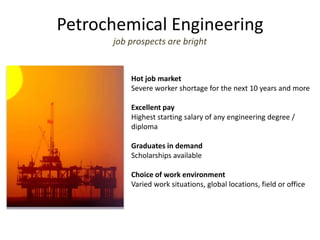
Petrochemical Engineering
job prospects are bright
Hot job market
Severe worker shortage for the next 10 years and more
Excellent pay
Highest starting salary of any engineering degree /
diploma
Graduates in demand
Scholarships available
Choice of work environment
Varied work situations, global locations, field or office
Petrochemical Engineering
Areas of Specialty
Petroleum Engineers
 production engineer
 drilling engineer
 reservoir engineer
 completion engineer
 environmental engineer
 and more!
Allied careers
 petro-physics
 geology
 geosciences
 geophysics
 chemistry
 hydraulics
 environmental sciences
 information technology
 safety
Petrochemical Engineering
Prepare for your career
• Take college preparatory
courses, including advanced maths and
science courses
• Participate in engineering and
technology student organizations
• Take part in science fairs and maths
competitions
• Read about diploma in Petrochemical
engineering on
http://www.gurukashiuniversity.in/
Plan your future
Plan your future in petrochemical engineering at Guru Kashi University
• Listing of petroleum related engineering university programs
• Scholarships
• Career guidance
Contact for more career information:
Toll Free: 1800 180 2601 Landline: 01655 324777 Admission Help
lines
+91 99142 83400, +91 99142 86400 +91 99142 25400,
+91 99145 78400
info@gurukashiuniversity.in
Petrochemical engineers

Petrochemical engineers

  • 2.
  • 3.
    Where Would WeBe Without Petroleum? Some of the products are as follows: Balloons Bandages Blenders Cameras Candles CD Players Clothing Compact Discs/DVDs Containers Crayons Deodorant Dyes Footballs Furniture Garbage Bags Glasses Glue Golf Balls Hang Gliders House Paint Insecticides Life Jackets Lipstick Luggage Medical Equipment Perfumes Photographic Film Photographs Piano Keys Roller Blades Roofing Shampoo Shaving Cream Surfboards Telephones Tents Toys Umbrellas
  • 4.
    Fossil Fuels –Nature’s Battery Fossil Fuels  Oil  Natural Gas  Coal Source: US Energy Information Administration Today’s Energy  85.5 percent = fossil fuels  14.5 percent = nuclear and all other sources By 2025  87 percent = fossil fuels (oil, gas, coal)  13 percent = nuclear and all other sources
  • 5.
    Oil: A TimelessEnergy Source Ancient times 3000 B.C. Mesopotamians used “rock oil” in architectural adhesives, ship caulks, medicines and roads 2000 B.C. Chinese refined crude oil for use in lamps and to heat their homes Even though fossil fuels were used thousands of years ago, mass consumption of oil and gas began only “recently.”
  • 6.
    Mid-1800s Whales hunted tonear extinction 1849 Method to distill kerosene from petroleum discovered 1853 Polish chemist Ignancy Lukasiewiz discovered how to make kerosene from crude oil on an industrial scale. 1859 Kerosene took over lighting market. Oil: A Timeless Energy Source Oil industry saves the whales
  • 7.
    1847 The world’s firstoil well was drilled in Baku, Azerbaijan 1851 Scottish chemist James Young opens the world’s first oil refinery near Edinburgh, Scotland 1859 Colonel Edwin Drake drilled the first successful commercial oil well in northwestern Pennsylvania. 1896 The first known offshore oil well is drilled at the end of a 300-foot wharf in Summerland, California. 1901 On January 10, Spindletop, an oil field located just south of Beaumont, Texas, produces a "gusher" that spills out 100,000 barrels of oil per day. 1917 The Bolivar Coastal field, South America’s largest oil field, discovered in Venezuela Oil: A Timeless Energy Source Dawn of a new age James Young Colonel Edwin Drake
  • 8.
    1903 Entrepreneur Henry Fordincorporates the Ford Motor Company. 1908 Ford's mass-produced Model T drives consumer demand for gasoline. 125,000 cars on US roads. Oil is found in Persia (modern Iran), leading to the formation of Anglo-Persian Oil company, the forerunner of BP 1930 26.7 million cars in the US. 1938 Major oil reserves are discovered in Kuwait and Saudi Arabia 1950 – present Oil became most-used energy source because of automobiles. Oil: A Timeless Energy Source Cars drive need for oil
  • 9.
    1993 – present USimports more oil than it produces - needed because of growing petroleum demand used for fuel, electricity and manufacturing plastic. 2007 World uses about 86 million barrels of oil per day – 40,000 gallons every second Oil: A Timeless Energy Source Recent consumption
  • 10.
    World Demand forEnergy Will Continue to Grow Source: IEA World Energy Outlook 2008 World energy demand expands by 45% between now and 2030 –an average rate of increase of 1.6% per year –with coal accounting for more than a third of the overall rise
  • 11.
    Who Will DiscoverOil and Gas in the Future? The Finders Geoscientists (geologists, geophysicists) • Study the Earth to search for clues to where oil and gas might be hidden • Analyze minerals, soil, and rocks samples • Evaluate underground geologic structures to find oil and gas fields The Movers Petrochemical engineers • Determine best drilling methods to find oil and gas deep in the Earth • Manage production when oil and gas are drained from underground
  • 12.
    Biodiesel is America’sfirst Advanced Biofuel. It is a renewable, clean-burning diesel replacement that is reducing U.S. dependence on imported diesel, creating green jobs and improving our environment. It is made from an increasingly diverse mix of resources including agricultural oils, recycled cooking oil and animal fats and meets the strict specifications of ASTM D6751. BIODIESEL
  • 13.
    Petroleum Engineers work inteams to… • Use creative solutions to find oil and gas • Understand rock formations • Analyze oil and gas fields’ qualities • Monitor drilling and production • Design equipment, processes so maximum amount of oil and gas is recovered • Manage drilling of oil and gas wells • Ensure operation runs smoothly and safely
  • 14.
     High seas Remote jungles  Vast deserts  Mountain ranges  In laboratories  Offices  Outdoor sites across the world Petroleum Engineers work in a variety of settings
  • 15.
    Petrochemical engineers… • Aregood communicators • Enjoy creative problem solving • Like working with people • Excel at maths and science • Are analytical • Adapt easily to change • Thrive on challenges
  • 16.
    Petrochemical Engineering job prospectsare bright Hot job market Severe worker shortage for the next 10 years and more Excellent pay Highest starting salary of any engineering degree / diploma Graduates in demand Scholarships available Choice of work environment Varied work situations, global locations, field or office
  • 17.
    Petrochemical Engineering Areas ofSpecialty Petroleum Engineers  production engineer  drilling engineer  reservoir engineer  completion engineer  environmental engineer  and more! Allied careers  petro-physics  geology  geosciences  geophysics  chemistry  hydraulics  environmental sciences  information technology  safety
  • 18.
    Petrochemical Engineering Prepare foryour career • Take college preparatory courses, including advanced maths and science courses • Participate in engineering and technology student organizations • Take part in science fairs and maths competitions • Read about diploma in Petrochemical engineering on http://www.gurukashiuniversity.in/
  • 19.
    Plan your future Planyour future in petrochemical engineering at Guru Kashi University • Listing of petroleum related engineering university programs • Scholarships • Career guidance Contact for more career information: Toll Free: 1800 180 2601 Landline: 01655 324777 Admission Help lines +91 99142 83400, +91 99142 86400 +91 99142 25400, +91 99145 78400 info@gurukashiuniversity.in