Topic:
Polymerization Process for
Gasoline
Producti
on
ENCH4PP Petroleum and Synthetic Fuel Processing
24 April 2014
Presenter 1: Jesantha Govender
Presenter 2: Shristhi Sewpersad
Presenter 3: Waseem Amra
1
Lecturer: Prof A.H. Mohammadi
What is polymerization in the petroleum
industry?
• Polymerization in the petroleum industry is the conversion of light
olefin gases including ethylene, propylene, and butylene into
hydrocarbons of higher molecular weight and a higher octane number
(>90).
• It may be accomplished thermally or in the presence of a catalyst at
lower temperatures.
• This process combines two or more identical olefin molecules to form
a single molecule with the same elements in the same proportions as
the original molecules but two or three times their molecular weight.
• It is a controlled process in which olefin gases are converted to
liquid condensation products that may be suitable for gasoline
or other liquid fuels.
2
Historical Development of alkylation and
polymerization in the petroleum industry?
• Polymerization, as practiced in the petroleum industry, is a process
that can claim to be the earliest to employ catalysts on a
commercial scale.
• In the early 1930’s large amounts of olefins, particularly light
olefins, became available in copious quantities from catalytic
cracking plants in refineries.
• While these olefins may be used as petrochemical feedstock,
many conventional petroleum refineries producing petroleum
fuels and lubricants are not capable of diverting these materials to
petrochemical uses.
• Processes for producing fuels from these cracking off gases are
therefore desirable and from the early days, a number of
different process evolved.
3
• Since the middle and late 1950s, polymerization has been
supplemented by alkylation as a method of conversion of light
(C3 and C4) gases to gasoline fractions.
• The alkylation reaction also achieves a longer chain molecule by
the combination of two smaller molecules, one being an olefin and
the other an isoparaffin (usually isobutane).
• During World War II, alkylation became the main process for the
manufacture of isooctane, a primary component in the blending
of aviation gasoline.
Historical Development
4
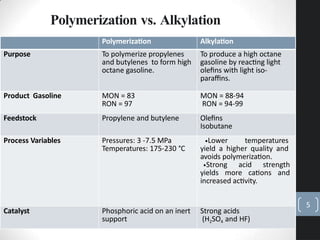
Polymerization vs. Alkylation
Polymerization Alkylation
Purpose To polymerize propylenes
and butylenes to form high
octane gasoline.
To produce a high octane
gasoline by reacting light
olefins with light iso-
paraffins.
Product Gasoline MON = 83
RON = 97
MON = 88-94
RON = 94-99
Feedstock Propylene and butylene Olefins
Isobutane
Process Variables Pressures: 3 -7.5 MPa
Temperatures: 175-230 °C
•Lower temperatures
yield a higher quality and
avoids polymerization.
•Strong acid strength
yields more cations and
increased activity.
Catalyst Phosphoric acid on an inert
support
Strong acids
(H2SO4 and HF)
5
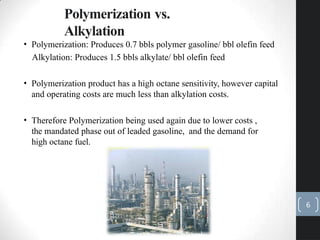
• Polymerization: Produces 0.7 bbls polymer gasoline/ bbl olefin feed
Alkylation: Produces 1.5 bbls alkylate/ bbl olefin feed
• Polymerization product has a high octane sensitivity, however capital
and operating costs are much less than alkylation costs.
• Therefore Polymerization being used again due to lower costs ,
the mandated phase out of leaded gasoline, and the demand for
high octane fuel.
Polymerization vs.
Alkylation
6
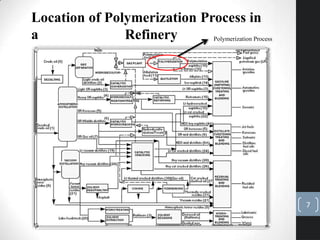
Polymerization Process
Location of Polymerization Process in
a Refinery
7
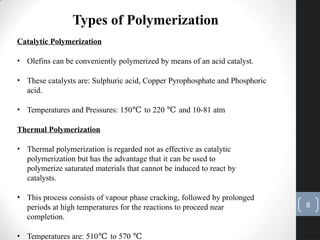
Types of Polymerization
Catalytic Polymerization
• Olefins can be conveniently polymerized by means of an acid catalyst.
• These catalysts are: Sulphuric acid, Copper Pyrophosphate and Phosphoric
acid.
• Temperatures and Pressures: 150℃ to 220 ℃ and 10-81 atm
Thermal Polymerization
• Thermal polymerization is regarded not as effective as catalytic
polymerization but has the advantage that it can be used to
polymerize saturated materials that cannot be induced to react by
catalysts.
• This process consists of vapour phase cracking, followed by prolonged
periods at high temperatures for the reactions to proceed near
completion.
• Temperatures are: 510℃ to 570 ℃
8
Polymerization
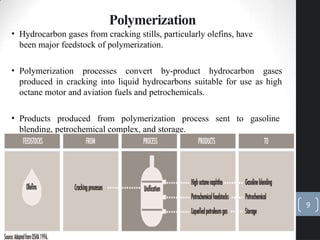
• Hydrocarbon gases from cracking stills, particularly olefins, have
been major feedstock of polymerization.
• Polymerization processes convert by-product hydrocarbon gases
produced in cracking into liquid hydrocarbons suitable for use as high
octane motor and aviation fuels and petrochemicals.
• Products produced from polymerization process sent to gasoline
blending, petrochemical complex, and storage.
9
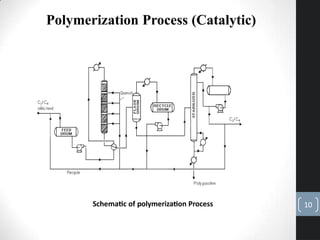
Polymerization Process (Catalytic)
Schematic of polymerization Process 10
Polymerization Process
(Catalytic)
• The olefin feedstock is pretreated to remove sulphur compounds and other
undesirables.
• Then sent to a reactor in which it is passed over a phosphorus catalyst, usually a solid
catalyst or liquid phosphoric acid, where an exothermic polymeric reaction occurs.
• Catalyst: Normally 0.6 – 1.2 kg catalyst consumed/ m3 polymerate produced.
• This requires the use of cooling water and the injection of cold feedstock into the
reactor to control temperatures at various pressures.
• Acid in the liquids is removed by caustic wash, the liquids are fractionated, and the
acid catalyst is recycled. The vapour is fractionated to remove butanes and neutralized
to remove traces of acid.
• LPG (C3, C4) & Naphtha (C4, C5) produced
• Operating Conditions:
 Temperature – Feed is heated to 200◦C before contacting catalyst bed Pressure –
Reactor pressure of 30 bar is maintained.
11
Polymerization
Reaction
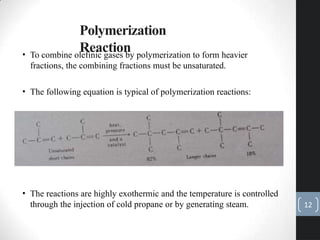
• To combine olefinic gases by polymerization to form heavier
fractions, the combining fractions must be unsaturated.
• The following equation is typical of polymerization reactions:
• The reactions are highly exothermic and the temperature is controlled
through the injection of cold propane or by generating steam. 12
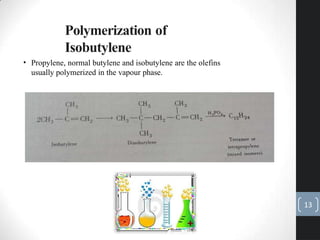
Polymerization of
Isobutylene
• Propylene, normal butylene and isobutylene are the olefins
usually polymerized in the vapour phase.
13
Safety and Health Considerations
Fire Prevention and Protection
• Polymerization is a closed process where the potential for a fire exists
due to leaks or releases reaching a source of ignition.
Safety
• The potential for an uncontrolled exothermic reaction exists should loss of
cooling water occur.
• Severe corrosion leading to equipment failure will occur should water
make contact with the phosphoric acid, such as during shutdowns.
Corrosion may also occur in piping manifolds, reboilers, exchangers, and
other locations where acid may settle out.
Health
• Potential for exposure to caustic wash (sodium hydroxide), to phosphoric
acid used in the process or washed out during turnarounds, and to catalyst
dust
14
15
Thank you
Questions
16

Polymerization Process for Gasoline Production.pptx

  • 1.
    Topic: Polymerization Process for Gasoline Producti on ENCH4PPPetroleum and Synthetic Fuel Processing 24 April 2014 Presenter 1: Jesantha Govender Presenter 2: Shristhi Sewpersad Presenter 3: Waseem Amra 1 Lecturer: Prof A.H. Mohammadi
  • 2.
    What is polymerizationin the petroleum industry? • Polymerization in the petroleum industry is the conversion of light olefin gases including ethylene, propylene, and butylene into hydrocarbons of higher molecular weight and a higher octane number (>90). • It may be accomplished thermally or in the presence of a catalyst at lower temperatures. • This process combines two or more identical olefin molecules to form a single molecule with the same elements in the same proportions as the original molecules but two or three times their molecular weight. • It is a controlled process in which olefin gases are converted to liquid condensation products that may be suitable for gasoline or other liquid fuels. 2
  • 3.
    Historical Development ofalkylation and polymerization in the petroleum industry? • Polymerization, as practiced in the petroleum industry, is a process that can claim to be the earliest to employ catalysts on a commercial scale. • In the early 1930’s large amounts of olefins, particularly light olefins, became available in copious quantities from catalytic cracking plants in refineries. • While these olefins may be used as petrochemical feedstock, many conventional petroleum refineries producing petroleum fuels and lubricants are not capable of diverting these materials to petrochemical uses. • Processes for producing fuels from these cracking off gases are therefore desirable and from the early days, a number of different process evolved. 3
  • 4.
    • Since themiddle and late 1950s, polymerization has been supplemented by alkylation as a method of conversion of light (C3 and C4) gases to gasoline fractions. • The alkylation reaction also achieves a longer chain molecule by the combination of two smaller molecules, one being an olefin and the other an isoparaffin (usually isobutane). • During World War II, alkylation became the main process for the manufacture of isooctane, a primary component in the blending of aviation gasoline. Historical Development 4
  • 5.
    Polymerization vs. Alkylation PolymerizationAlkylation Purpose To polymerize propylenes and butylenes to form high octane gasoline. To produce a high octane gasoline by reacting light olefins with light iso- paraffins. Product Gasoline MON = 83 RON = 97 MON = 88-94 RON = 94-99 Feedstock Propylene and butylene Olefins Isobutane Process Variables Pressures: 3 -7.5 MPa Temperatures: 175-230 °C •Lower temperatures yield a higher quality and avoids polymerization. •Strong acid strength yields more cations and increased activity. Catalyst Phosphoric acid on an inert support Strong acids (H2SO4 and HF) 5
  • 6.
    • Polymerization: Produces0.7 bbls polymer gasoline/ bbl olefin feed Alkylation: Produces 1.5 bbls alkylate/ bbl olefin feed • Polymerization product has a high octane sensitivity, however capital and operating costs are much less than alkylation costs. • Therefore Polymerization being used again due to lower costs , the mandated phase out of leaded gasoline, and the demand for high octane fuel. Polymerization vs. Alkylation 6
  • 7.
    Polymerization Process Location ofPolymerization Process in a Refinery 7
  • 8.
    Types of Polymerization CatalyticPolymerization • Olefins can be conveniently polymerized by means of an acid catalyst. • These catalysts are: Sulphuric acid, Copper Pyrophosphate and Phosphoric acid. • Temperatures and Pressures: 150℃ to 220 ℃ and 10-81 atm Thermal Polymerization • Thermal polymerization is regarded not as effective as catalytic polymerization but has the advantage that it can be used to polymerize saturated materials that cannot be induced to react by catalysts. • This process consists of vapour phase cracking, followed by prolonged periods at high temperatures for the reactions to proceed near completion. • Temperatures are: 510℃ to 570 ℃ 8
  • 9.
    Polymerization • Hydrocarbon gasesfrom cracking stills, particularly olefins, have been major feedstock of polymerization. • Polymerization processes convert by-product hydrocarbon gases produced in cracking into liquid hydrocarbons suitable for use as high octane motor and aviation fuels and petrochemicals. • Products produced from polymerization process sent to gasoline blending, petrochemical complex, and storage. 9
  • 10.
  • 11.
    Polymerization Process (Catalytic) • Theolefin feedstock is pretreated to remove sulphur compounds and other undesirables. • Then sent to a reactor in which it is passed over a phosphorus catalyst, usually a solid catalyst or liquid phosphoric acid, where an exothermic polymeric reaction occurs. • Catalyst: Normally 0.6 – 1.2 kg catalyst consumed/ m3 polymerate produced. • This requires the use of cooling water and the injection of cold feedstock into the reactor to control temperatures at various pressures. • Acid in the liquids is removed by caustic wash, the liquids are fractionated, and the acid catalyst is recycled. The vapour is fractionated to remove butanes and neutralized to remove traces of acid. • LPG (C3, C4) & Naphtha (C4, C5) produced • Operating Conditions:  Temperature – Feed is heated to 200◦C before contacting catalyst bed Pressure – Reactor pressure of 30 bar is maintained. 11
  • 12.
    Polymerization Reaction • To combineolefinic gases by polymerization to form heavier fractions, the combining fractions must be unsaturated. • The following equation is typical of polymerization reactions: • The reactions are highly exothermic and the temperature is controlled through the injection of cold propane or by generating steam. 12
  • 13.
    Polymerization of Isobutylene • Propylene,normal butylene and isobutylene are the olefins usually polymerized in the vapour phase. 13
  • 14.
    Safety and HealthConsiderations Fire Prevention and Protection • Polymerization is a closed process where the potential for a fire exists due to leaks or releases reaching a source of ignition. Safety • The potential for an uncontrolled exothermic reaction exists should loss of cooling water occur. • Severe corrosion leading to equipment failure will occur should water make contact with the phosphoric acid, such as during shutdowns. Corrosion may also occur in piping manifolds, reboilers, exchangers, and other locations where acid may settle out. Health • Potential for exposure to caustic wash (sodium hydroxide), to phosphoric acid used in the process or washed out during turnarounds, and to catalyst dust 14
  • 15.
  • 16.