NAPHTHA CRACKING
RANJIT KUMAR KUSH
CSJMA14001390216
CHEMICAL ENGG
SUBMITTED T0
Dr. BRISHTI MITRA
HOD (CHEMICAL) 1
CONTENT
• NAPHTHA
• PROPERTY OF NAPTHA
• CRACKING
• NEED FOR CRACKING
• NAPTHA CRACKING
• USE OF NAPTHA
• CONCLUSION
• REFERENCES
2
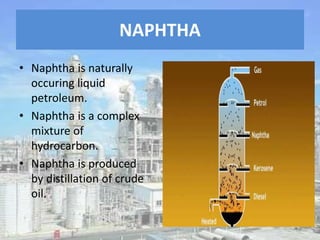
NAPHTHA
• Naphtha is naturally
occuring liquid
petroleum.
• Naphtha is a complex
mixture of
hydrocarbon.
• Naphtha is produced
by distillation of crude
oil.
3
PROPERTY OF NAPHTHA
• Boiling range of naphtha's are 85 ⁰c to 200 ⁰c.
• Naphtha is a colorless to reddish brown liquid.
• Naphtha is a volatile aromatic compound also.
• Naphtha is light poisonous also.
4
CLASSIFICATION OF NAPHTHA
• Naphtha fraction boils below 100 ⁰c is
called light naphtha.
• Naphtha fraction boils above 100 ⁰c to
below 150 ⁰c is called intermediate.
• Naphtha fraction boils above 150 ⁰c is
called heavy naphtha.
5
CRACKING
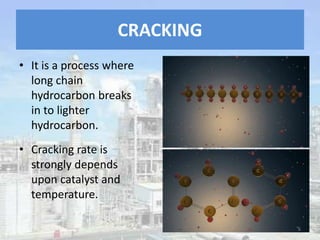
• It is a process where
long chain
hydrocarbon breaks
in to lighter
hydrocarbon.
• Cracking rate is
strongly depends
upon catalyst and
temperature.
6
NEED FOR CRACKING
• For producing petrol
the most valuable
fraction is naphtha.
• It is used as feedstock in
petroleum industry.
• To produce most
valuable from valuable
product.
7
NAPHTHA CRACKING
THREE TYPES OF CRACKING
• HYDROCRACKING
• CATALYTIC CRACKING
• STEAM CRACKING
8
HYDROCRACKING
• It is carried out with presence of hydrogen.
• The pressure of reactor is 80 atm.
• It is also used for cracking of heavy gas
oil.
9
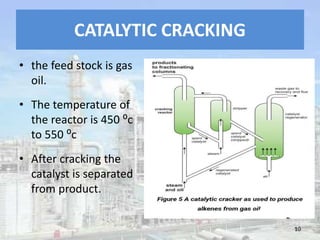
CATALYTIC CRACKING
• the feed stock is gas
oil.
• The temperature of
the reactor is 450 ⁰c
to 550 ⁰c
• After cracking the
catalyst is separated
from product.
10
STEAM CRACKING
• It is most technically
complex plant.
• It is energy intensive
plant in chemical
industry.
• It is operated at 100 K
to 1400 K.
• Pressure of steam
distillation is 100 atm.
11
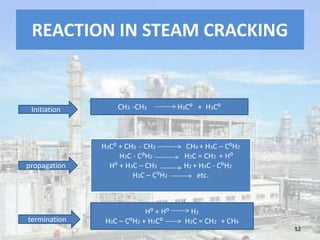
REACTION IN STEAM CRACKING
CH3 -CH3 H3C⁰ + H3C⁰
H3C⁰ + CH3 - CH3 CH4 + H3C – C⁰H2
H3C - C⁰H2 H2C = CH2 + H⁰
H⁰ + H3C – CH3 H2 + H3C - C⁰H2
H3C – C⁰H2 etc.
H⁰ + H⁰ H2
H3C – C⁰H2 + H3C⁰ H2C = CH2 + CH4
Initiation
propagation
termination
12
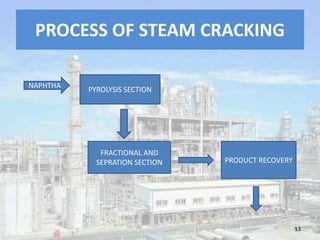
PROCESS OF STEAM CRACKING
NAPHTHA
PYROLYSIS SECTION
FRACTIONAL AND
SEPRATION SECTION PRODUCT RECOVERY
13
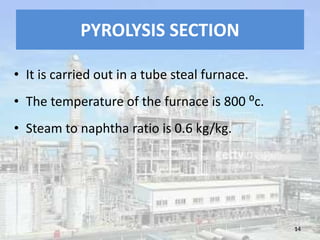
PYROLYSIS SECTION
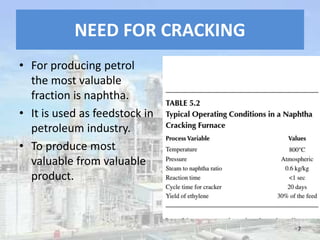
• It is carried out in a tube steal furnace.
• The temperature of the furnace is 800 ⁰c.
• Steam to naphtha ratio is 0.6 kg/kg.
14
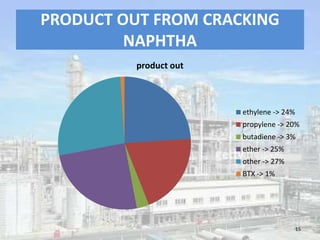
PRODUCT OUT FROM CRACKING
NAPHTHA
product out
ethylene -> 24%
propylene -> 20%
butadiene -> 3%
ether -> 25%
other -> 27%
BTX -> 1%
15
USE OF NAPHTHA
• Naptha is used as gasoline at high octane
number.
• Naptha is used as solvent steam cracker in
industry.
• Thinner for paints, varnishes.
• Used for commercial solvent like rubber.
16
CONCLUSION
• Naphthas are called petroleum ether,
petroleum sprit, mineral spirits, paraffin,
benzene, white oils and refined solvent.
17
REFERENCES
• Dr Ram Prasad (2010).petroleum refining
technology. Khanna publications.
• Heinz Heinemann. Fundamentals of
petroleum and petrochemical engineering.
Uttam ray chaudhari.
• www.collactioncare.org
• www.essentialchemicalindustry.org
• en.wikipedia.org
• http://giphy.com
18
19

Naptha cracking

  • 1.
    NAPHTHA CRACKING RANJIT KUMARKUSH CSJMA14001390216 CHEMICAL ENGG SUBMITTED T0 Dr. BRISHTI MITRA HOD (CHEMICAL) 1
  • 2.
    CONTENT • NAPHTHA • PROPERTYOF NAPTHA • CRACKING • NEED FOR CRACKING • NAPTHA CRACKING • USE OF NAPTHA • CONCLUSION • REFERENCES 2
  • 3.
    NAPHTHA • Naphtha isnaturally occuring liquid petroleum. • Naphtha is a complex mixture of hydrocarbon. • Naphtha is produced by distillation of crude oil. 3
  • 4.
    PROPERTY OF NAPHTHA •Boiling range of naphtha's are 85 ⁰c to 200 ⁰c. • Naphtha is a colorless to reddish brown liquid. • Naphtha is a volatile aromatic compound also. • Naphtha is light poisonous also. 4
  • 5.
    CLASSIFICATION OF NAPHTHA •Naphtha fraction boils below 100 ⁰c is called light naphtha. • Naphtha fraction boils above 100 ⁰c to below 150 ⁰c is called intermediate. • Naphtha fraction boils above 150 ⁰c is called heavy naphtha. 5
  • 6.
    CRACKING • It isa process where long chain hydrocarbon breaks in to lighter hydrocarbon. • Cracking rate is strongly depends upon catalyst and temperature. 6
  • 7.
    NEED FOR CRACKING •For producing petrol the most valuable fraction is naphtha. • It is used as feedstock in petroleum industry. • To produce most valuable from valuable product. 7
  • 8.
    NAPHTHA CRACKING THREE TYPESOF CRACKING • HYDROCRACKING • CATALYTIC CRACKING • STEAM CRACKING 8
  • 9.
    HYDROCRACKING • It iscarried out with presence of hydrogen. • The pressure of reactor is 80 atm. • It is also used for cracking of heavy gas oil. 9
  • 10.
    CATALYTIC CRACKING • thefeed stock is gas oil. • The temperature of the reactor is 450 ⁰c to 550 ⁰c • After cracking the catalyst is separated from product. 10
  • 11.
    STEAM CRACKING • Itis most technically complex plant. • It is energy intensive plant in chemical industry. • It is operated at 100 K to 1400 K. • Pressure of steam distillation is 100 atm. 11
  • 12.
    REACTION IN STEAMCRACKING CH3 -CH3 H3C⁰ + H3C⁰ H3C⁰ + CH3 - CH3 CH4 + H3C – C⁰H2 H3C - C⁰H2 H2C = CH2 + H⁰ H⁰ + H3C – CH3 H2 + H3C - C⁰H2 H3C – C⁰H2 etc. H⁰ + H⁰ H2 H3C – C⁰H2 + H3C⁰ H2C = CH2 + CH4 Initiation propagation termination 12
  • 13.
    PROCESS OF STEAMCRACKING NAPHTHA PYROLYSIS SECTION FRACTIONAL AND SEPRATION SECTION PRODUCT RECOVERY 13
  • 14.
    PYROLYSIS SECTION • Itis carried out in a tube steal furnace. • The temperature of the furnace is 800 ⁰c. • Steam to naphtha ratio is 0.6 kg/kg. 14
  • 15.
    PRODUCT OUT FROMCRACKING NAPHTHA product out ethylene -> 24% propylene -> 20% butadiene -> 3% ether -> 25% other -> 27% BTX -> 1% 15
  • 16.
    USE OF NAPHTHA •Naptha is used as gasoline at high octane number. • Naptha is used as solvent steam cracker in industry. • Thinner for paints, varnishes. • Used for commercial solvent like rubber. 16
  • 17.
    CONCLUSION • Naphthas arecalled petroleum ether, petroleum sprit, mineral spirits, paraffin, benzene, white oils and refined solvent. 17
  • 18.
    REFERENCES • Dr RamPrasad (2010).petroleum refining technology. Khanna publications. • Heinz Heinemann. Fundamentals of petroleum and petrochemical engineering. Uttam ray chaudhari. • www.collactioncare.org • www.essentialchemicalindustry.org • en.wikipedia.org • http://giphy.com 18
  • 19.