Biochemistry for nurses
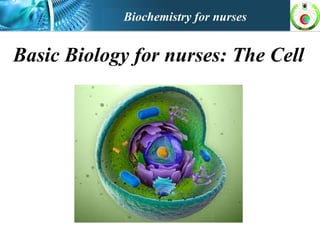
Basic Biology for nurses: The Cell
Dr Hakim Mehenni
Email: dr.hakimmehenni.uqu@gmail.com
https://sites.google.com/site/drhakimmehenni/
Biochemistry for nurses
General informations on the cell
The cell is a basic unit of living organisms.
It can perform all the functions of the organism: metabolism, movement,
growth and reproduction.
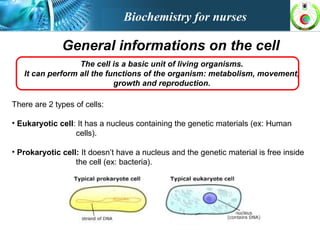
There are 2 types of cells:
• Eukaryotic cell: It has a nucleus containing the genetic materials (ex: Human
cells).
• Prokaryotic cell: It doesn’t have a nucleus and the genetic material is free inside
the cell (ex: bacteria).
Biochemistry for nurses
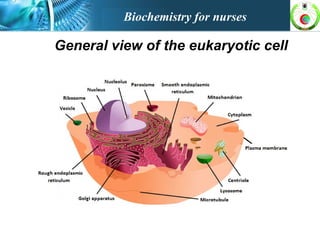
General view of the eukaryotic cell
Biochemistry for nurses
The cell membrane
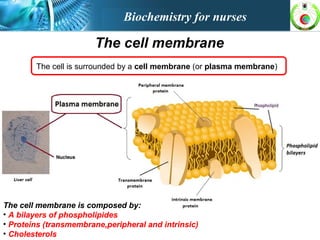
The cell is surrounded by a cell membrane (or plasma membrane)
The cell membrane is composed by:
• A bilayers of phospholipides
• Proteins (transmembrane,peripheral and intrinsic)
• Cholesterols
The cell membrane is composed by:
• A bilayers of phospholipides
• Proteins (transmembrane,peripheral and intrinsic)
• Cholesterols
Biochemistry for nurses
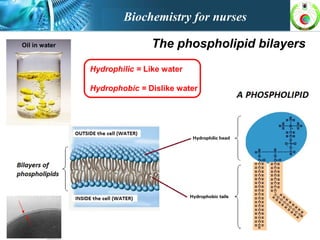
The phospholipid bilayersOil in water
Hydrophilic = Like water
Hydrophobic = Dislike water
Biochemistry for nurses
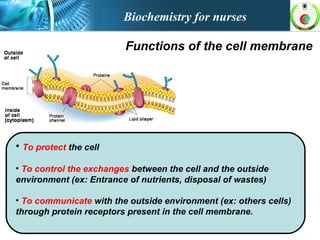
• To protect the cell
• To control the exchanges between the cell and the outside
environment (ex: Entrance of nutrients, disposal of wastes)
• To communicate with the outside environment (ex: others cells)
through protein receptors present in the cell membrane.
Functions of the cell membrane
Biochemistry for nurses
The membrane transports
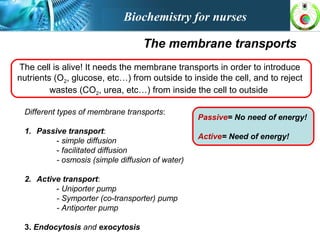
The cell is alive! It needs the membrane transports in order to introduce
nutrients (O2, glucose, etc…) from outside to inside the cell, and to reject
wastes (CO2, urea, etc…) from inside the cell to outside
Different types of membrane transports:
1. Passive transport:
- simple diffusion
- facilitated diffusion
- osmosis (simple diffusion of water)
2. Active transport:
- Uniporter pump
- Symporter (co-transporter) pump
- Antiporter pump
3. Endocytosis and exocytosis
Passive= No need of energy!
Active= Need of energy!
Biochemistry for nurses
Passive transports No need of energy to work!
Simple diffusion
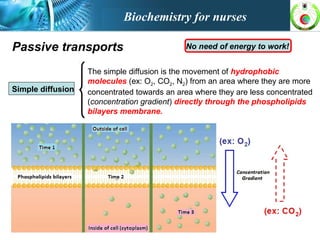
The simple diffusion is the movement of hydrophobic
molecules (ex: O2, CO2, N2) from an area where they are more
concentrated towards an area where they are less concentrated
(concentration gradient) directly through the phospholipids
bilayers membrane.
Biochemistry for nurses
Facilitated diffusion
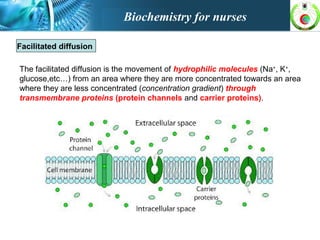
The facilitated diffusion is the movement of hydrophilic molecules (Na+
, K+
,
glucose,etc…) from an area where they are more concentrated towards an area
where they are less concentrated (concentration gradient) through
transmembrane proteins (protein channels and carrier proteins).
Biochemistry for nurses
Facilitated diffusion
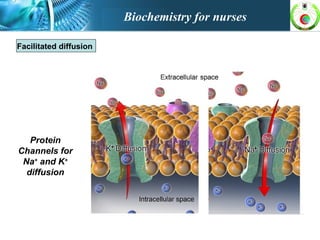
Protein
Channels for
Na+
and K+
diffusion
Biochemistry for nurses
Facilitated diffusion
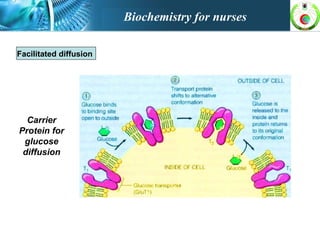
Carrier
Protein for
glucose
diffusion
Biochemistry for nurses
OSMOSIS
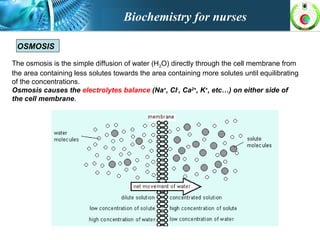
The osmosis is the simple diffusion of water (H2O) directly through the cell membrane from
the area containing less solutes towards the area containing more solutes until equilibrating
of the concentrations.
Osmosis causes the electrolytes balance (Na+
, Cl-
, Ca2+
, K+
, etc…) on either side of
the cell membrane.
Biochemistry for nurses
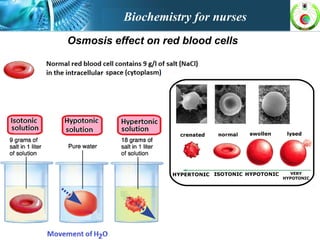
Osmosis effect on red blood cells
Biochemistry for nurses
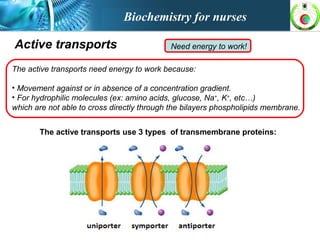
Active transports Need energy to work!
The active transports need energy to work because:
• Movement against or in absence of a concentration gradient.
• For hydrophilic molecules (ex: amino acids, glucose, Na+
, K+
, etc…)
which are not able to cross directly through the bilayers phospholipids membrane.
The active transports use 3 types of transmembrane proteins:
Biochemistry for nurses
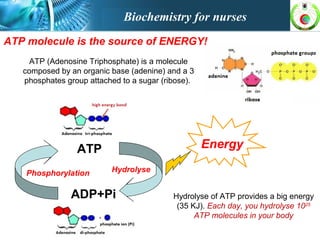
ATP
ADP+Pi
Energy
HydrolysePhosphorylation
Hydrolyse of ATP provides a big energy
(35 KJ). Each day, you hydrolyse 1025
ATP molecules in your body
ATP (Adenosine Triphosphate) is a molecule
composed by an organic base (adenine) and a 3
phosphates group attached to a sugar (ribose).
ATP molecule is the source of ENERGY!
Biochemistry for nurses
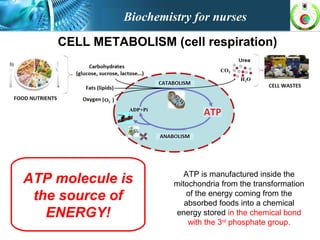
ATP molecule is
the source of
ENERGY!
CELL METABOLISM (cell respiration)
ATP is manufactured inside the
mitochondria from the transformation
of the energy coming from the
absorbed foods into a chemical
energy stored in the chemical bond
with the 3rd
phosphate group.
Biochemistry for nurses
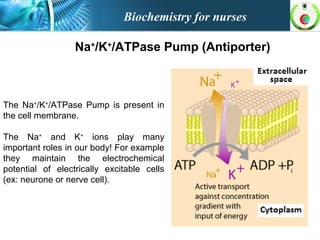
Na+
/K+
/ATPase Pump (Antiporter)
The Na+
/K+
/ATPase Pump is present in
the cell membrane.
The Na+
and K+
ions play many
important roles in our body! For example
they maintain the electrochemical
potential of electrically excitable cells
(ex: neurone or nerve cell).
Biochemistry for nurses
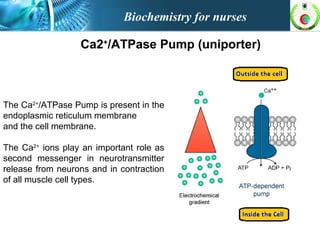
Ca2+
/ATPase Pump (uniporter)
The Ca2+
/ATPase Pump is present in the
endoplasmic reticulum membrane
and the cell membrane.
The Ca2+
ions play an important role as
second messenger in neurotransmitter
release from neurons and in contraction
of all muscle cell types.
Biochemistry for nurses
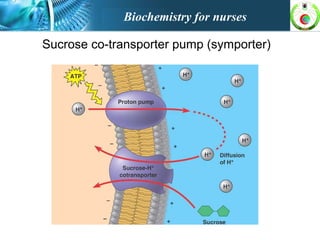
Sucrose co-transporter pump (symporter)
Biochemistry for nurses
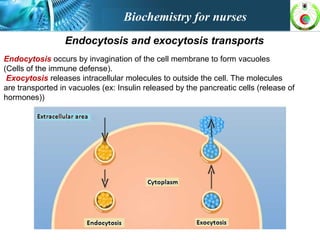
Endocytosis and exocytosis transports
Endocytosis occurs by invagination of the cell membrane to form vacuoles
(Cells of the immune defense).
Exocytosis releases intracellular molecules to outside the cell. The molecules
are transported in vacuoles (ex: Insulin released by the pancreatic cells (release of
hormones))
Biochemistry for nurses
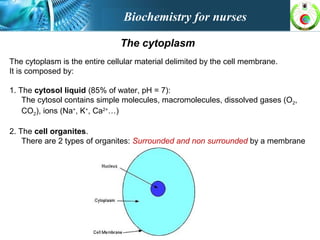
The cytoplasm
The cytoplasm is the entire cellular material delimited by the cell membrane.
It is composed by:
1. The cytosol liquid (85% of water, pH = 7):
The cytosol contains simple molecules, macromolecules, dissolved gases (O2,
CO2), ions (Na+
, K+
, Ca2+
…)
2. The cell organites.
There are 2 types of organites: Surrounded and non surrounded by a membrane
Biochemistry for nurses
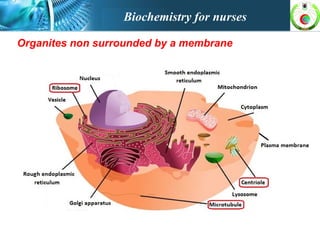
Organites non surrounded by a membrane
Biochemistry for nurses
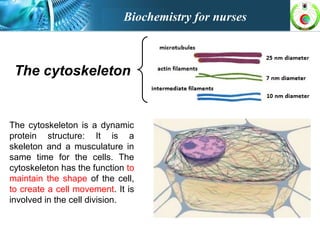
The cytoskeleton
The cytoskeleton is a dynamic
protein structure: It is a
skeleton and a musculature in
same time for the cells. The
cytoskeleton has the function to
maintain the shape of the cell,
to create a cell movement. It is
involved in the cell division.
Biochemistry for nurses
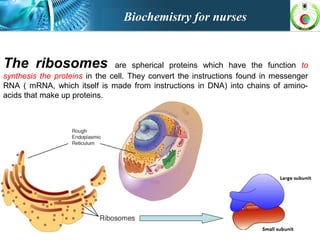
The ribosomes are spherical proteins which have the function to
synthesis the proteins in the cell. They convert the instructions found in messenger
RNA ( mRNA, which itself is made from instructions in DNA) into chains of amino-
acids that make up proteins.
Biochemistry for nurses
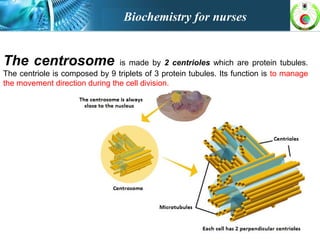
The centrosome is made by 2 centrioles which are protein tubules.
The centriole is composed by 9 triplets of 3 protein tubules. Its function is to manage
the movement direction during the cell division.
Biochemistry for nurses
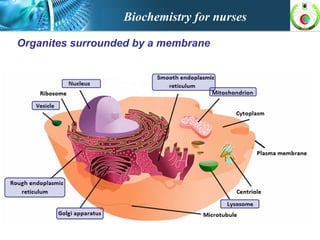
Organites surrounded by a membrane
Biochemistry for nurses
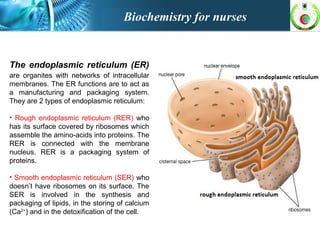
The endoplasmic reticulum (ER)
are organites with networks of intracellular
membranes. The ER functions are to act as
a manufacturing and packaging system.
They are 2 types of endoplasmic reticulum:
• Rough endoplasmic reticulum (RER) who
has its surface covered by ribosomes which
assemble the amino-acids into proteins. The
RER is connected with the membrane
nucleus. RER is a packaging system of
proteins.
• Smooth endoplasmic reticulum (SER) who
doesn’t have ribosomes on its surface. The
SER is involved in the synthesis and
packaging of lipids, in the storing of calcium
(Ca2+
) and in the detoxification of the cell.
Biochemistry for nurses
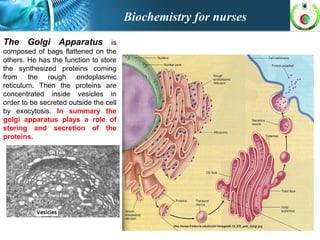
The Golgi Apparatus is
composed of bags flattened on the
others. He has the function to store
the synthesized proteins coming
from the rough endoplasmic
reticulum. Then the proteins are
concentrated inside vesicles in
order to be secreted outside the cell
by exocytosis. In summary the
golgi apparatus plays a role of
storing and secretion of the
proteins.
Biochemistry for nurses
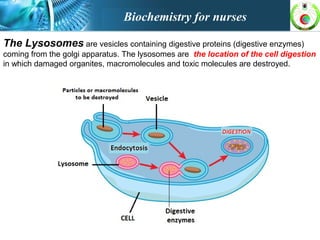
The Lysosomes are vesicles containing digestive proteins (digestive enzymes)
coming from the golgi apparatus. The lysosomes are the location of the cell digestion
in which damaged organites, macromolecules and toxic molecules are destroyed.
Biochemistry for nurses
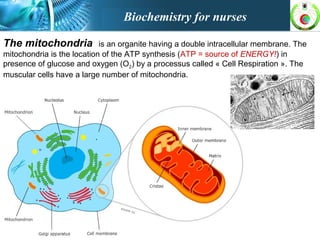
The mitochondria is an organite having a double intracellular membrane. The
mitochondria is the location of the ATP synthesis (ATP = source of ENERGY!) in
presence of glucose and oxygen (O2) by a processus called « Cell Respiration ». The
muscular cells have a large number of mitochondria.
Biochemistry for nurses
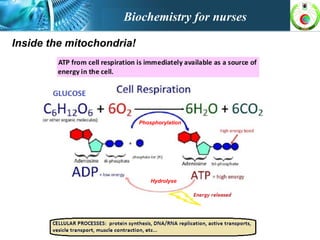
Inside the mitochondria!
Biochemistry for nurses
Phosphorylation
Hydrolyse
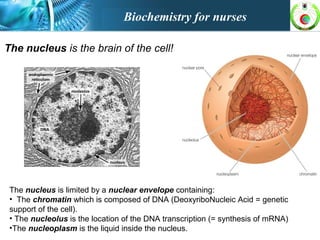
The nucleus is limited by a nuclear envelope containing:
• The chromatin which is composed of DNA (DeoxyriboNucleic Acid = genetic
support of the cell).
• The nucleolus is the location of the DNA transcription (= synthesis of mRNA)
•The nucleoplasm is the liquid inside the nucleus.
The nucleus is the brain of the cell!
Biochemistry for nurses
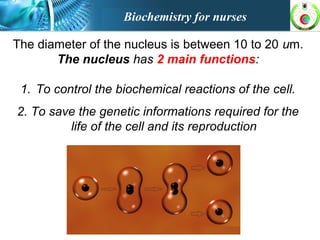
The diameter of the nucleus is between 10 to 20 um.
The nucleus has 2 main functions:
1. To control the biochemical reactions of the cell.
2. To save the genetic informations required for the
life of the cell and its reproduction
Biochemistry for nurses

Basic biology for nurses

  • 1.
    Biochemistry for nurses BasicBiology for nurses: The Cell
  • 2.
    Dr Hakim Mehenni Email:dr.hakimmehenni.uqu@gmail.com https://sites.google.com/site/drhakimmehenni/ Biochemistry for nurses
  • 3.
    General informations onthe cell The cell is a basic unit of living organisms. It can perform all the functions of the organism: metabolism, movement, growth and reproduction. There are 2 types of cells: • Eukaryotic cell: It has a nucleus containing the genetic materials (ex: Human cells). • Prokaryotic cell: It doesn’t have a nucleus and the genetic material is free inside the cell (ex: bacteria). Biochemistry for nurses
  • 4.
    General view ofthe eukaryotic cell Biochemistry for nurses
  • 5.
    The cell membrane Thecell is surrounded by a cell membrane (or plasma membrane) The cell membrane is composed by: • A bilayers of phospholipides • Proteins (transmembrane,peripheral and intrinsic) • Cholesterols The cell membrane is composed by: • A bilayers of phospholipides • Proteins (transmembrane,peripheral and intrinsic) • Cholesterols Biochemistry for nurses
  • 6.
    The phospholipid bilayersOilin water Hydrophilic = Like water Hydrophobic = Dislike water Biochemistry for nurses
  • 7.
    • To protectthe cell • To control the exchanges between the cell and the outside environment (ex: Entrance of nutrients, disposal of wastes) • To communicate with the outside environment (ex: others cells) through protein receptors present in the cell membrane. Functions of the cell membrane Biochemistry for nurses
  • 8.
    The membrane transports Thecell is alive! It needs the membrane transports in order to introduce nutrients (O2, glucose, etc…) from outside to inside the cell, and to reject wastes (CO2, urea, etc…) from inside the cell to outside Different types of membrane transports: 1. Passive transport: - simple diffusion - facilitated diffusion - osmosis (simple diffusion of water) 2. Active transport: - Uniporter pump - Symporter (co-transporter) pump - Antiporter pump 3. Endocytosis and exocytosis Passive= No need of energy! Active= Need of energy! Biochemistry for nurses
  • 9.
    Passive transports Noneed of energy to work! Simple diffusion The simple diffusion is the movement of hydrophobic molecules (ex: O2, CO2, N2) from an area where they are more concentrated towards an area where they are less concentrated (concentration gradient) directly through the phospholipids bilayers membrane. Biochemistry for nurses
  • 10.
    Facilitated diffusion The facilitateddiffusion is the movement of hydrophilic molecules (Na+ , K+ , glucose,etc…) from an area where they are more concentrated towards an area where they are less concentrated (concentration gradient) through transmembrane proteins (protein channels and carrier proteins). Biochemistry for nurses
  • 11.
    Facilitated diffusion Protein Channels for Na+ andK+ diffusion Biochemistry for nurses
  • 12.
  • 13.
    OSMOSIS The osmosis isthe simple diffusion of water (H2O) directly through the cell membrane from the area containing less solutes towards the area containing more solutes until equilibrating of the concentrations. Osmosis causes the electrolytes balance (Na+ , Cl- , Ca2+ , K+ , etc…) on either side of the cell membrane. Biochemistry for nurses
  • 14.
    Osmosis effect onred blood cells Biochemistry for nurses
  • 15.
    Active transports Needenergy to work! The active transports need energy to work because: • Movement against or in absence of a concentration gradient. • For hydrophilic molecules (ex: amino acids, glucose, Na+ , K+ , etc…) which are not able to cross directly through the bilayers phospholipids membrane. The active transports use 3 types of transmembrane proteins: Biochemistry for nurses
  • 16.
    ATP ADP+Pi Energy HydrolysePhosphorylation Hydrolyse of ATPprovides a big energy (35 KJ). Each day, you hydrolyse 1025 ATP molecules in your body ATP (Adenosine Triphosphate) is a molecule composed by an organic base (adenine) and a 3 phosphates group attached to a sugar (ribose). ATP molecule is the source of ENERGY! Biochemistry for nurses
  • 17.
    ATP molecule is thesource of ENERGY! CELL METABOLISM (cell respiration) ATP is manufactured inside the mitochondria from the transformation of the energy coming from the absorbed foods into a chemical energy stored in the chemical bond with the 3rd phosphate group. Biochemistry for nurses
  • 18.
    Na+ /K+ /ATPase Pump (Antiporter) TheNa+ /K+ /ATPase Pump is present in the cell membrane. The Na+ and K+ ions play many important roles in our body! For example they maintain the electrochemical potential of electrically excitable cells (ex: neurone or nerve cell). Biochemistry for nurses
  • 19.
    Ca2+ /ATPase Pump (uniporter) TheCa2+ /ATPase Pump is present in the endoplasmic reticulum membrane and the cell membrane. The Ca2+ ions play an important role as second messenger in neurotransmitter release from neurons and in contraction of all muscle cell types. Biochemistry for nurses
  • 20.
    Sucrose co-transporter pump(symporter) Biochemistry for nurses
  • 21.
    Endocytosis and exocytosistransports Endocytosis occurs by invagination of the cell membrane to form vacuoles (Cells of the immune defense). Exocytosis releases intracellular molecules to outside the cell. The molecules are transported in vacuoles (ex: Insulin released by the pancreatic cells (release of hormones)) Biochemistry for nurses
  • 22.
    The cytoplasm The cytoplasmis the entire cellular material delimited by the cell membrane. It is composed by: 1. The cytosol liquid (85% of water, pH = 7): The cytosol contains simple molecules, macromolecules, dissolved gases (O2, CO2), ions (Na+ , K+ , Ca2+ …) 2. The cell organites. There are 2 types of organites: Surrounded and non surrounded by a membrane Biochemistry for nurses
  • 23.
    Organites non surroundedby a membrane Biochemistry for nurses
  • 24.
    The cytoskeleton The cytoskeletonis a dynamic protein structure: It is a skeleton and a musculature in same time for the cells. The cytoskeleton has the function to maintain the shape of the cell, to create a cell movement. It is involved in the cell division. Biochemistry for nurses
  • 25.
    The ribosomes arespherical proteins which have the function to synthesis the proteins in the cell. They convert the instructions found in messenger RNA ( mRNA, which itself is made from instructions in DNA) into chains of amino- acids that make up proteins. Biochemistry for nurses
  • 26.
    The centrosome ismade by 2 centrioles which are protein tubules. The centriole is composed by 9 triplets of 3 protein tubules. Its function is to manage the movement direction during the cell division. Biochemistry for nurses
  • 27.
    Organites surrounded bya membrane Biochemistry for nurses
  • 28.
    The endoplasmic reticulum(ER) are organites with networks of intracellular membranes. The ER functions are to act as a manufacturing and packaging system. They are 2 types of endoplasmic reticulum: • Rough endoplasmic reticulum (RER) who has its surface covered by ribosomes which assemble the amino-acids into proteins. The RER is connected with the membrane nucleus. RER is a packaging system of proteins. • Smooth endoplasmic reticulum (SER) who doesn’t have ribosomes on its surface. The SER is involved in the synthesis and packaging of lipids, in the storing of calcium (Ca2+ ) and in the detoxification of the cell. Biochemistry for nurses
  • 29.
    The Golgi Apparatusis composed of bags flattened on the others. He has the function to store the synthesized proteins coming from the rough endoplasmic reticulum. Then the proteins are concentrated inside vesicles in order to be secreted outside the cell by exocytosis. In summary the golgi apparatus plays a role of storing and secretion of the proteins. Biochemistry for nurses
  • 30.
    The Lysosomes arevesicles containing digestive proteins (digestive enzymes) coming from the golgi apparatus. The lysosomes are the location of the cell digestion in which damaged organites, macromolecules and toxic molecules are destroyed. Biochemistry for nurses
  • 31.
    The mitochondria isan organite having a double intracellular membrane. The mitochondria is the location of the ATP synthesis (ATP = source of ENERGY!) in presence of glucose and oxygen (O2) by a processus called « Cell Respiration ». The muscular cells have a large number of mitochondria. Biochemistry for nurses
  • 32.
    Inside the mitochondria! Biochemistryfor nurses Phosphorylation Hydrolyse
  • 33.
    The nucleus islimited by a nuclear envelope containing: • The chromatin which is composed of DNA (DeoxyriboNucleic Acid = genetic support of the cell). • The nucleolus is the location of the DNA transcription (= synthesis of mRNA) •The nucleoplasm is the liquid inside the nucleus. The nucleus is the brain of the cell! Biochemistry for nurses
  • 34.
    The diameter ofthe nucleus is between 10 to 20 um. The nucleus has 2 main functions: 1. To control the biochemical reactions of the cell. 2. To save the genetic informations required for the life of the cell and its reproduction Biochemistry for nurses