Animal TissuesBy: Mr. Nikko Lorenz Lawsin
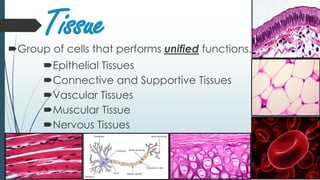
TissueGroup of cells that performs unified functions.
Epithelial Tissues
Connective and Supportive Tissues
Vascular Tissues
Muscular Tissue
Nervous Tissues
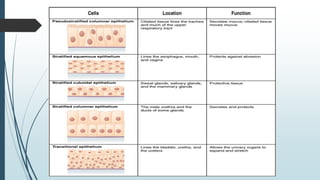
Epithelial Tissue
•For protection.
•Simple vs. Stratified (name of the strata
depends on the topmost layer.
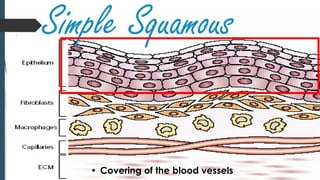
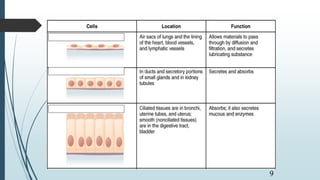
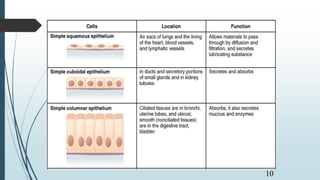
Simple Squamous
• Covering of the blood vessels
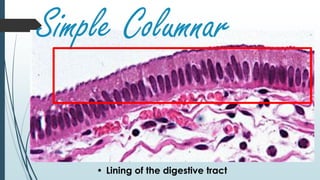
Simple Columnar
• Lining of the digestive tract
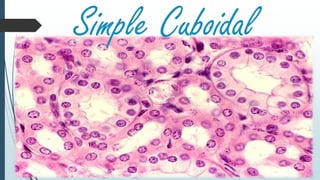
Simple Cuboidal
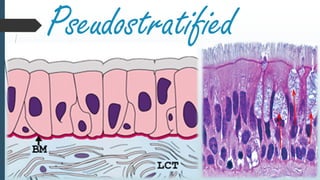
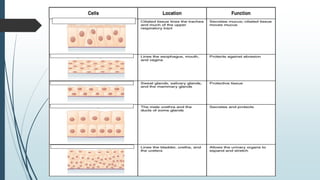
Pseudostratified
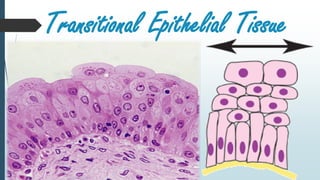
Transitional Epithelial Tissue
9
10
11
12
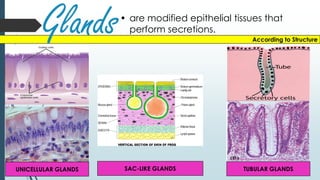
• are modified epithelial tissues that
perform secretions.
According to Structure
Glands
UNICELLULAR GLANDS SAC-LIKE GLANDS TUBULAR GLANDS
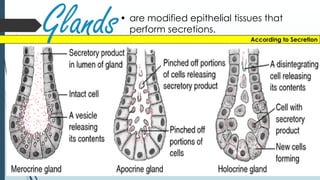
• are modified epithelial tissues that
perform secretions.
According to Secretion
Glands
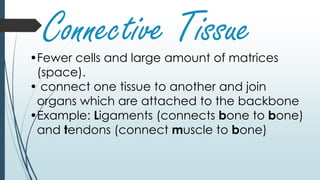
Connective Tissue•Fewer cells and large amount of matrices
(space).
• connect one tissue to another and join
organs which are attached to the backbone
•Example: Ligaments (connects bone to bone)
and tendons (connect muscle to bone)
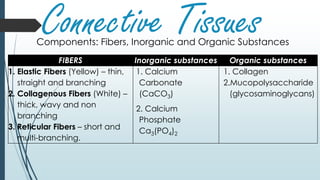
Connective TissuesComponents: Fibers, Inorganic and Organic Substances
FIBERS Inorganic substances Organic substances
1. Elastic Fibers (Yellow) – thin,
straight and branching
2. Collagenous Fibers (White) –
thick, wavy and non
branching
3. Reticular Fibers – short and
multi-branching.
1. Calcium
Carbonate
(CaCO3)
2. Calcium
Phosphate
Ca3(PO4)2
1. Collagen
2.Mucopolysaccharide
(glycosaminoglycans)
Types of Connective Tissue
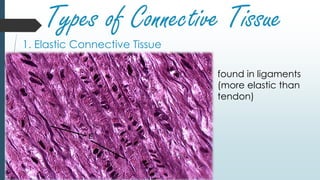
1. Elastic Connective Tissue
found in ligaments
(more elastic than
tendon)
Types of Connective Tissue
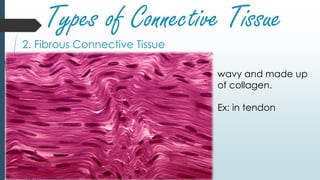
2. Fibrous Connective Tissue
wavy and made up
of collagen.
Ex: in tendon
Types of Connective Tissue
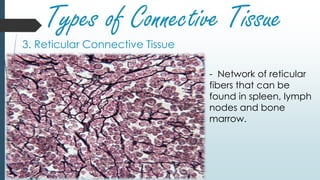
3. Reticular Connective Tissue
- Network of reticular
fibers that can be
found in spleen, lymph
nodes and bone
marrow.
Types of Connective Tissue
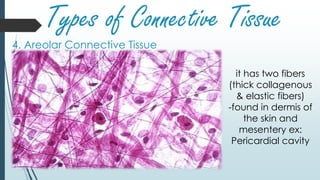
4. Areolar Connective Tissue
it has two fibers
(thick collagenous
& elastic fibers)
-found in dermis of
the skin and
mesentery ex:
Pericardial cavity
Types of Connective Tissue
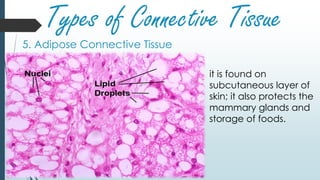
5. Adipose Connective Tissue
it is found on
subcutaneous layer of
skin; it also protects the
mammary glands and
storage of foods.
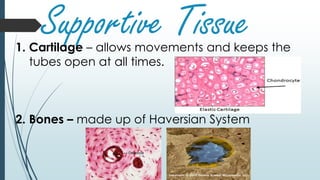
Supportive Tissue1. Cartilage – allows movements and keeps the
tubes open at all times.
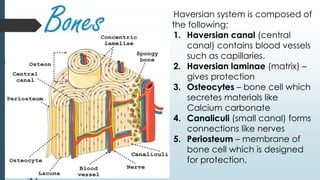
2. Bones – made up of Haversian System
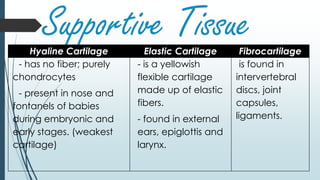
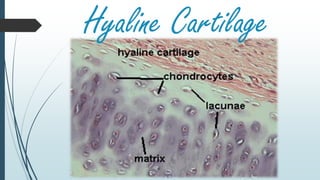
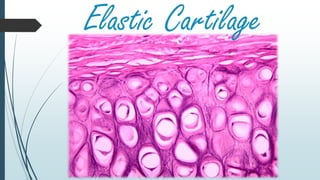
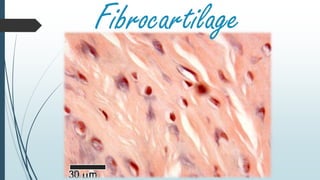
Supportive TissueHyaline Cartilage Elastic Cartilage Fibrocartilage
- has no fiber; purely
chondrocytes
- present in nose and
fontanels of babies
during embryonic and
early stages. (weakest
cartilage)
- is a yellowish
flexible cartilage
made up of elastic
fibers.
- found in external
ears, epiglottis and
larynx.
is found in
intervertebral
discs, joint
capsules,
ligaments.
Hyaline Cartilage
Elastic Cartilage
Fibrocartilage
Bones Haversian system is composed of
the following;
1. Haversian canal (central
canal) contains blood vessels
such as capillaries.
2. Haversian laminae (matrix) –
gives protection
3. Osteocytes – bone cell which
secretes materials like
Calcium carbonate
4. Canaliculi (small canal) forms
connections like nerves
5. Periosteum – membrane of
bone cell which is designed
for protection.
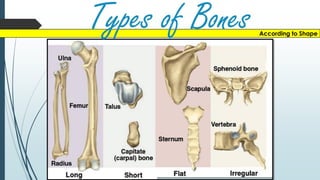
According to Shape
Types of Bones
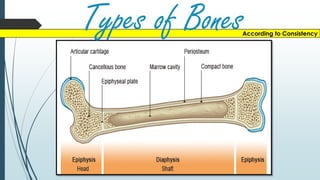
According to Consistency
Types of Bones
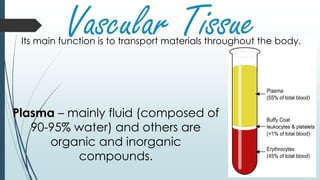
Vascular Tissue
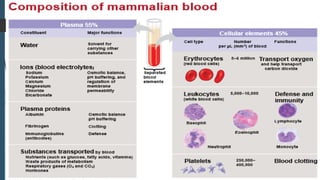
Plasma – mainly fluid (composed of
90-95% water) and others are
organic and inorganic
compounds.
Its main function is to transport materials throughout the body.
Vascular
Tissues
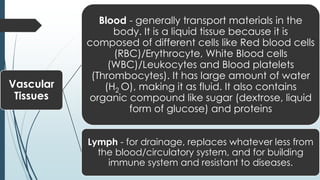
Blood - generally transport materials in the
body. It is a liquid tissue because it is
composed of different cells like Red blood cells
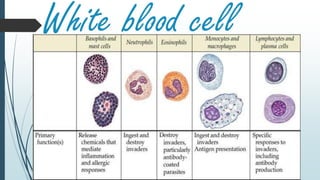
(RBC)/Erythrocyte, White Blood cells
(WBC)/Leukocytes and Blood platelets
(Thrombocytes). It has large amount of water
(H2 O), making it as fluid. It also contains
organic compound like sugar (dextrose, liquid
form of glucose) and proteins
Lymph - for drainage, replaces whatever less from
the blood/circulatory system, and for building
immune system and resistant to diseases.
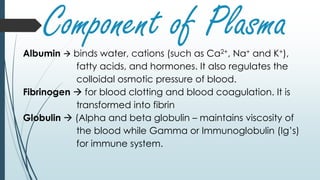
Albumin  binds water, cations (such as Ca2+, Na+ and K+),
fatty acids, and hormones. It also regulates the
colloidal osmotic pressure of blood.
Fibrinogen  for blood clotting and blood coagulation. It is
transformed into fibrin
Globulin  (Alpha and beta globulin – maintains viscosity of
the blood while Gamma or Immunoglobulin (Ig’s)
for immune system.
Component of Plasma
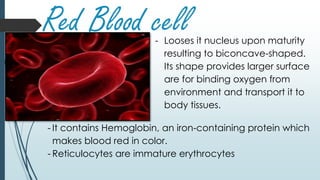
Red Blood cell- Looses it nucleus upon maturity
resulting to biconcave-shaped.
Its shape provides larger surface
are for binding oxygen from
environment and transport it to
body tissues.
- It contains Hemoglobin, an iron-containing protein which
makes blood red in color.
- Reticulocytes are immature erythrocytes
White blood cell
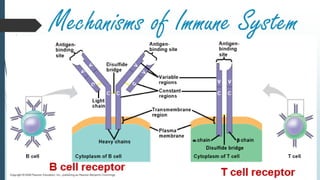
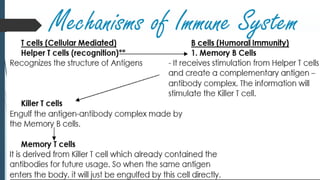
Mechanisms of Immune System
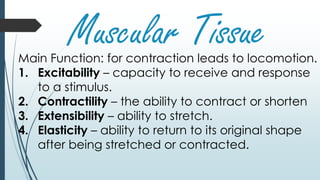
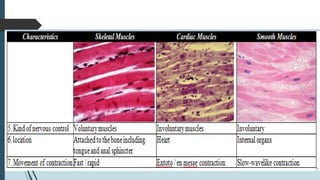
Muscular TissueMain Function: for contraction leads to locomotion.
1. Excitability – capacity to receive and response
to a stimulus.
2. Contractility – the ability to contract or shorten
3. Extensibility – ability to stretch.
4. Elasticity – ability to return to its original shape
after being stretched or contracted.
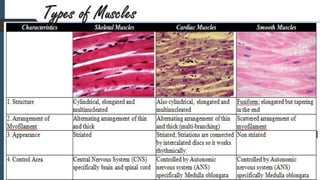
Types of Muscles
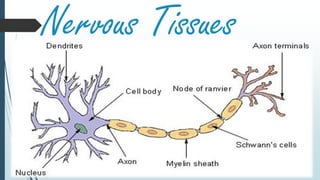
Nervous Tissues
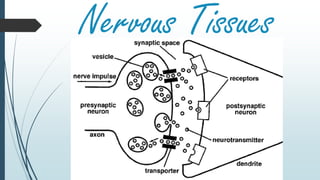
Nervous Tissues
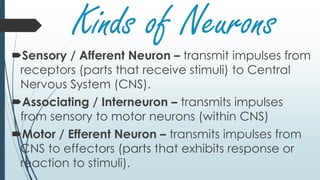
Kinds of Neurons
Sensory / Afferent Neuron – transmit impulses from
receptors (parts that receive stimuli) to Central
Nervous System (CNS).
Associating / Interneuron – transmits impulses
from sensory to motor neurons (within CNS)
Motor / Efferent Neuron – transmits impulses from
CNS to effectors (parts that exhibits response or
reaction to stimuli).
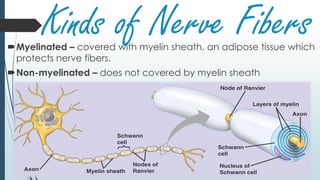
Kinds of Nerve FibersMyelinated – covered with myelin sheath, an adipose tissue which
protects nerve fibers.
Non-myelinated – does not covered by myelin sheath
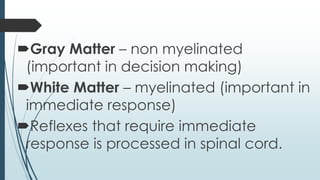
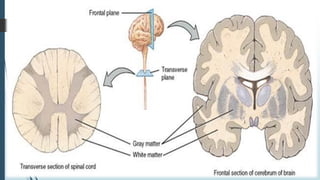
Gray Matter – non myelinated
(important in decision making)
White Matter – myelinated (important in
immediate response)
Reflexes that require immediate
response is processed in spinal cord.
Types of Neural Circuit
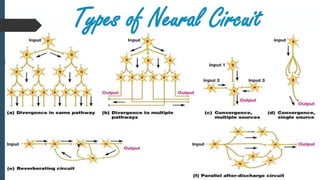
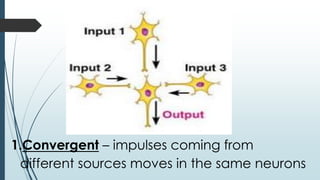
1.Convergent – impulses coming from
different sources moves in the same neurons
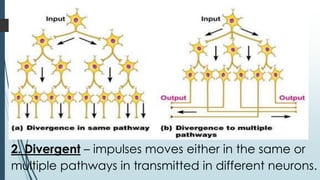
2. Divergent – impulses moves either in the same or
multiple pathways in transmitted in different neurons.
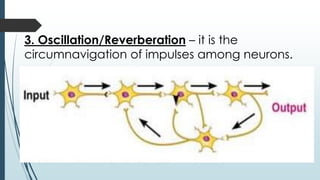
3. Oscillation/Reverberation – it is the
circumnavigation of impulses among neurons.
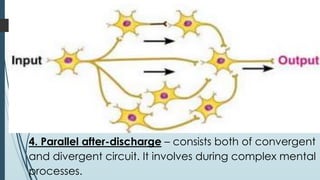
4. Parallel after-discharge – consists both of convergent
and divergent circuit. It involves during complex mental
processes.

Lesson 11 animal tissues

  • 1.
    Animal TissuesBy: Mr.Nikko Lorenz Lawsin
  • 2.
    TissueGroup of cellsthat performs unified functions. Epithelial Tissues Connective and Supportive Tissues Vascular Tissues Muscular Tissue Nervous Tissues
  • 3.
    Epithelial Tissue •For protection. •Simplevs. Stratified (name of the strata depends on the topmost layer.
  • 4.
    Simple Squamous • Coveringof the blood vessels
  • 5.
    Simple Columnar • Liningof the digestive tract
  • 6.
  • 7.
  • 8.
  • 9.
  • 10.
  • 11.
  • 12.
  • 13.
    • are modifiedepithelial tissues that perform secretions. According to Structure Glands UNICELLULAR GLANDS SAC-LIKE GLANDS TUBULAR GLANDS
  • 14.
    • are modifiedepithelial tissues that perform secretions. According to Secretion Glands
  • 15.
    Connective Tissue•Fewer cellsand large amount of matrices (space). • connect one tissue to another and join organs which are attached to the backbone •Example: Ligaments (connects bone to bone) and tendons (connect muscle to bone)
  • 16.
    Connective TissuesComponents: Fibers,Inorganic and Organic Substances FIBERS Inorganic substances Organic substances 1. Elastic Fibers (Yellow) – thin, straight and branching 2. Collagenous Fibers (White) – thick, wavy and non branching 3. Reticular Fibers – short and multi-branching. 1. Calcium Carbonate (CaCO3) 2. Calcium Phosphate Ca3(PO4)2 1. Collagen 2.Mucopolysaccharide (glycosaminoglycans)
  • 17.
    Types of ConnectiveTissue 1. Elastic Connective Tissue found in ligaments (more elastic than tendon)
  • 18.
    Types of ConnectiveTissue 2. Fibrous Connective Tissue wavy and made up of collagen. Ex: in tendon
  • 19.
    Types of ConnectiveTissue 3. Reticular Connective Tissue - Network of reticular fibers that can be found in spleen, lymph nodes and bone marrow.
  • 20.
    Types of ConnectiveTissue 4. Areolar Connective Tissue it has two fibers (thick collagenous & elastic fibers) -found in dermis of the skin and mesentery ex: Pericardial cavity
  • 21.
    Types of ConnectiveTissue 5. Adipose Connective Tissue it is found on subcutaneous layer of skin; it also protects the mammary glands and storage of foods.
  • 22.
    Supportive Tissue1. Cartilage– allows movements and keeps the tubes open at all times. 2. Bones – made up of Haversian System
  • 23.
    Supportive TissueHyaline CartilageElastic Cartilage Fibrocartilage - has no fiber; purely chondrocytes - present in nose and fontanels of babies during embryonic and early stages. (weakest cartilage) - is a yellowish flexible cartilage made up of elastic fibers. - found in external ears, epiglottis and larynx. is found in intervertebral discs, joint capsules, ligaments.
  • 24.
  • 25.
  • 26.
  • 27.
    Bones Haversian systemis composed of the following; 1. Haversian canal (central canal) contains blood vessels such as capillaries. 2. Haversian laminae (matrix) – gives protection 3. Osteocytes – bone cell which secretes materials like Calcium carbonate 4. Canaliculi (small canal) forms connections like nerves 5. Periosteum – membrane of bone cell which is designed for protection.
  • 28.
  • 29.
  • 30.
    Vascular Tissue Plasma –mainly fluid (composed of 90-95% water) and others are organic and inorganic compounds. Its main function is to transport materials throughout the body.
  • 31.
    Vascular Tissues Blood - generallytransport materials in the body. It is a liquid tissue because it is composed of different cells like Red blood cells (RBC)/Erythrocyte, White Blood cells (WBC)/Leukocytes and Blood platelets (Thrombocytes). It has large amount of water (H2 O), making it as fluid. It also contains organic compound like sugar (dextrose, liquid form of glucose) and proteins Lymph - for drainage, replaces whatever less from the blood/circulatory system, and for building immune system and resistant to diseases.
  • 33.
    Albumin  bindswater, cations (such as Ca2+, Na+ and K+), fatty acids, and hormones. It also regulates the colloidal osmotic pressure of blood. Fibrinogen  for blood clotting and blood coagulation. It is transformed into fibrin Globulin  (Alpha and beta globulin – maintains viscosity of the blood while Gamma or Immunoglobulin (Ig’s) for immune system. Component of Plasma
  • 34.
    Red Blood cell-Looses it nucleus upon maturity resulting to biconcave-shaped. Its shape provides larger surface are for binding oxygen from environment and transport it to body tissues. - It contains Hemoglobin, an iron-containing protein which makes blood red in color. - Reticulocytes are immature erythrocytes
  • 35.
  • 36.
  • 37.
  • 38.
    Muscular TissueMain Function:for contraction leads to locomotion. 1. Excitability – capacity to receive and response to a stimulus. 2. Contractility – the ability to contract or shorten 3. Extensibility – ability to stretch. 4. Elasticity – ability to return to its original shape after being stretched or contracted.
  • 39.
  • 41.
  • 42.
  • 43.
    Kinds of Neurons Sensory/ Afferent Neuron – transmit impulses from receptors (parts that receive stimuli) to Central Nervous System (CNS). Associating / Interneuron – transmits impulses from sensory to motor neurons (within CNS) Motor / Efferent Neuron – transmits impulses from CNS to effectors (parts that exhibits response or reaction to stimuli).
  • 44.
    Kinds of NerveFibersMyelinated – covered with myelin sheath, an adipose tissue which protects nerve fibers. Non-myelinated – does not covered by myelin sheath
  • 45.
    Gray Matter –non myelinated (important in decision making) White Matter – myelinated (important in immediate response) Reflexes that require immediate response is processed in spinal cord.
  • 47.
  • 48.
    1.Convergent – impulsescoming from different sources moves in the same neurons
  • 49.
    2. Divergent –impulses moves either in the same or multiple pathways in transmitted in different neurons.
  • 50.
    3. Oscillation/Reverberation –it is the circumnavigation of impulses among neurons.
  • 51.
    4. Parallel after-discharge– consists both of convergent and divergent circuit. It involves during complex mental processes.