
Dr. Ashwani Dhingra
Associate Professor
GGSCOP, Yamunanagar
(Cell and its Biochemical Organization)
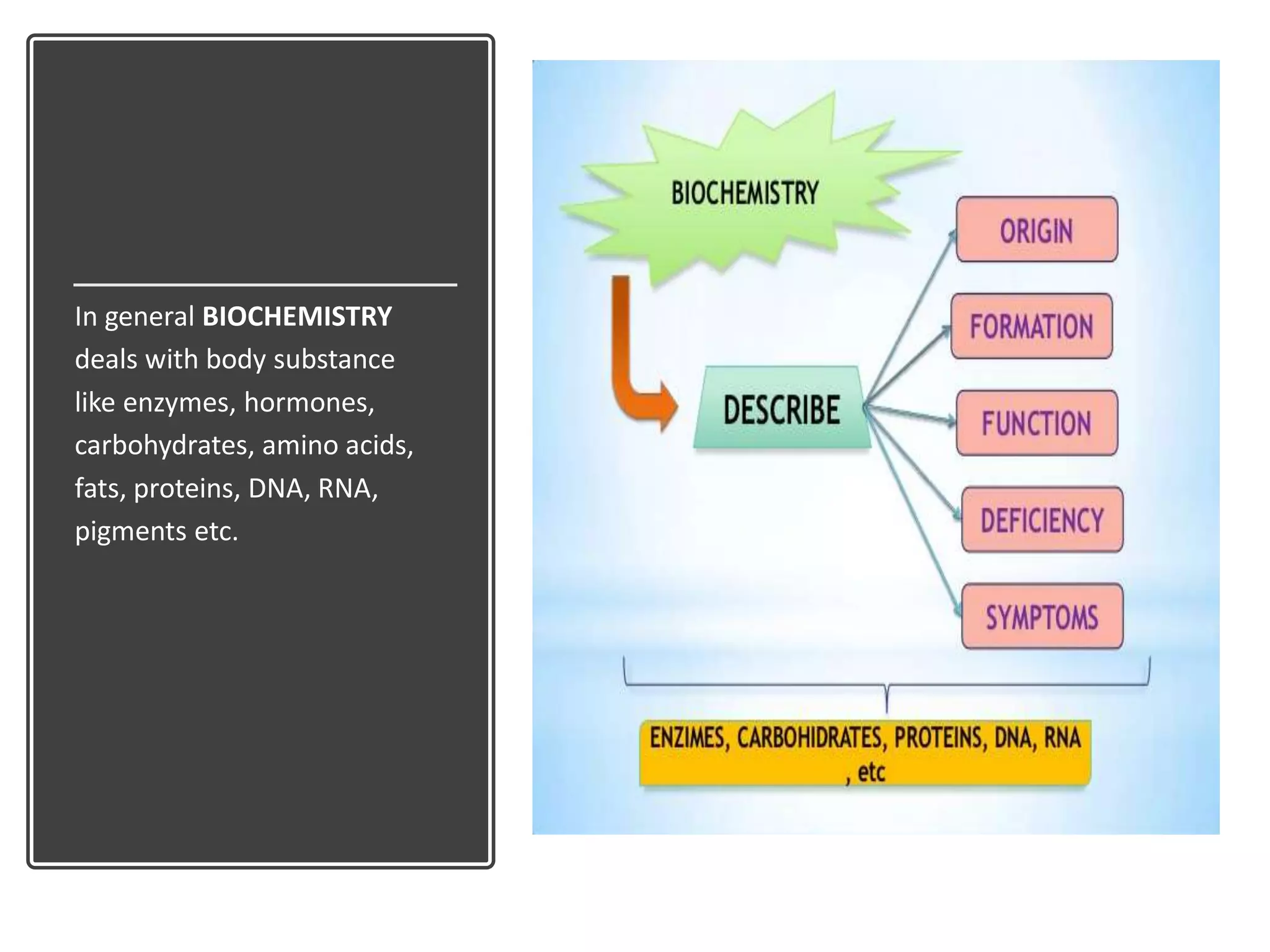
In general BIOCHEMISTRY
deals with body substance
like enzymes, hormones,
carbohydrates, amino acids,
fats, proteins, DNA, RNA,
pigments etc.
DEFINATION
The branch of science
concerned with the
chemical and physico-
chemical processes and
substances which occur
within living-organisms.
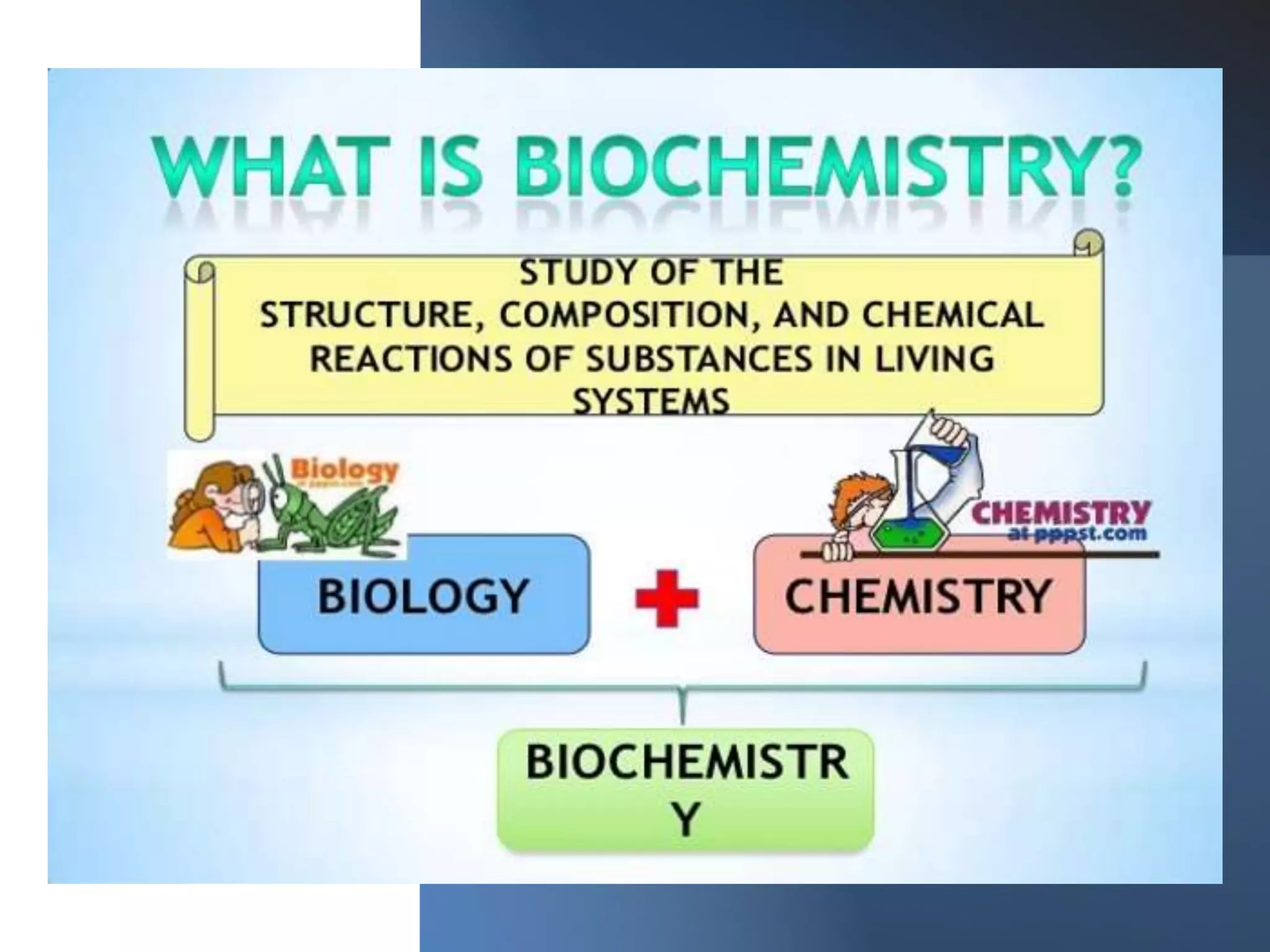
Biochemistry is a branch of
science which deals with
chemical basis of life
in plants and animals.
ROLE OF
BIOCHEMISTRY
MEDICINE
1. Physiology: Biochemistry helps one
understand the biochemical changes and
related physiological alteration in the
body.
2. Pathology: Based on the symptoms
described by the patient, physician can
get clue on the biochemical change and
the associated disorder. For example, if a
patient complains about stiffness in small
joints, then physician may predict it to be
gout and get confirmed by evaluating uric
acid levels in the blood. As uric acid
accumulation in blood results in gout.
3. Nutrition deficiency:
The function and role of vitamin in body
is described only by biochemistry.
4. Hormonal deficiency: There are many
disorders due to hormonal imbalance in
especially women and children. The
formation, role of hormones in the normal
body function is taught in biochemistry
by which the physician can understand
the concerned problem during treatment.
PHARMACY
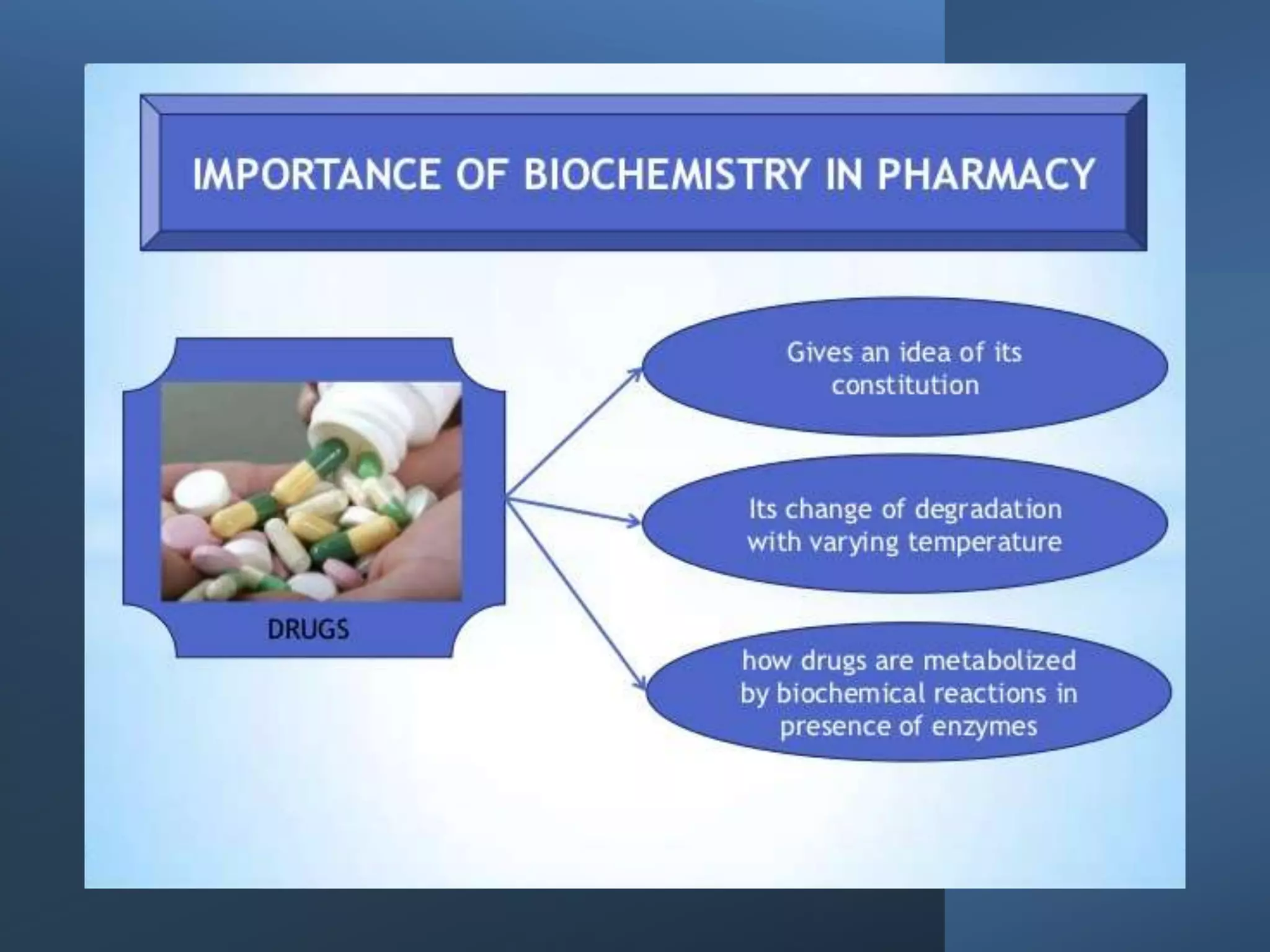
1. Drug Constitution: Biochemistry gives
an idea of the constitution of the drug, its
chances of degradation with varying
temperature etc. and helps improve
efficiency, minimize side effects etc.
2. The half-life: This is a test done on
biochemical drugs to know how long a
drug is stable when kept at so and so
temperature.
3. Drug storage: storage condition required
can be estimated by biochemical test.For
example many enzymes, hormones are
stored for dispensing. These get
deteriorated over time due to temperature
or oxidation, contamination and also due
to improper storage.
4. Drug metabolism: It also gives an idea of
how drug molecules are metabolized by
many biochemical reactions in presence
of enzymes. This helps to avoid drugs
which have poor metabolism or those with
excessive side effects from being
prescribed or dispensed to the patient.
5. Biochemical tests: These tests helps fix
the specific half-life or date of expiry for
drugs.
ROLE OF
BIOCHEMISTRY
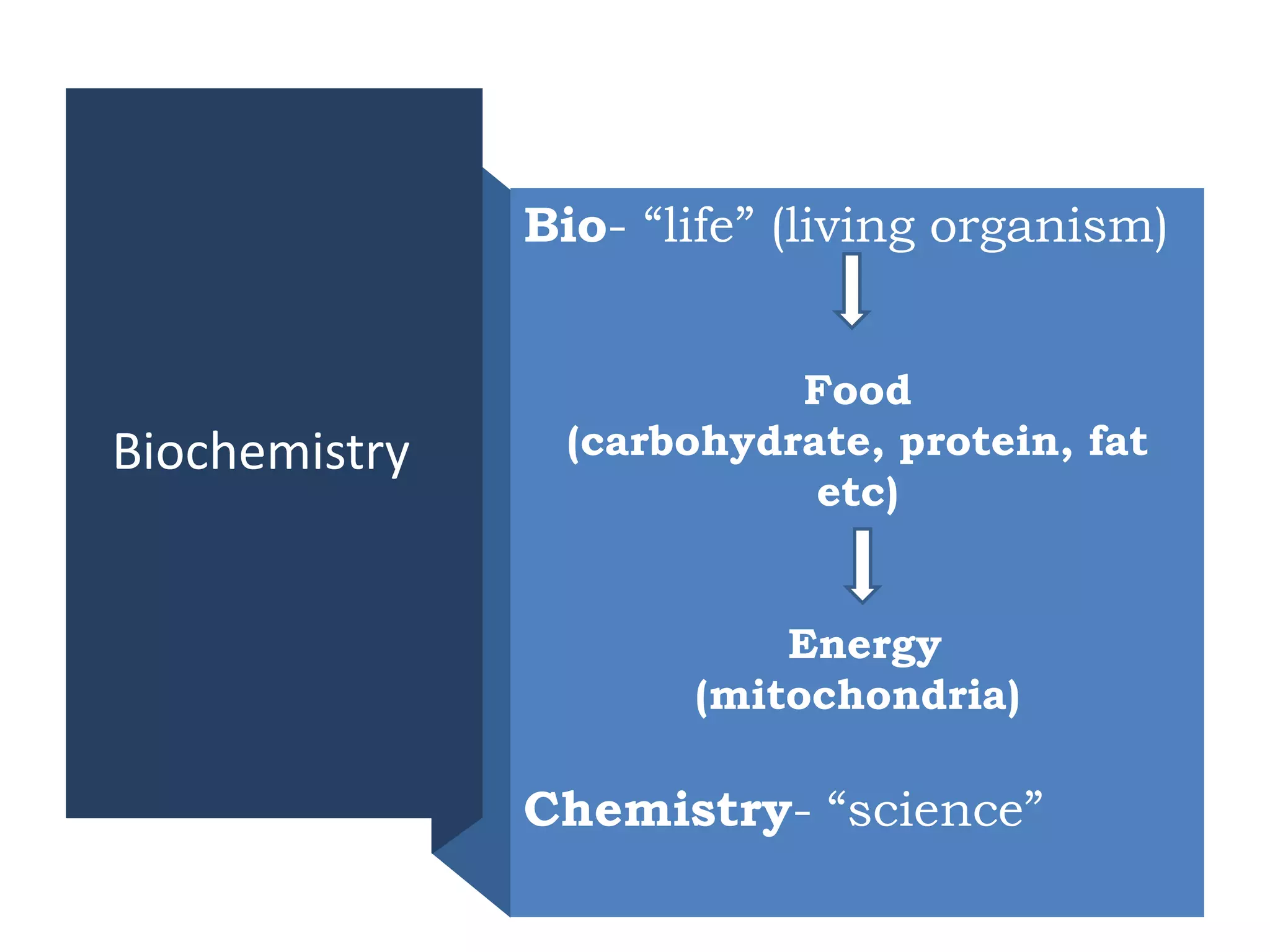
Biochemistry
Bio- ā€œlifeā€ (living organism)
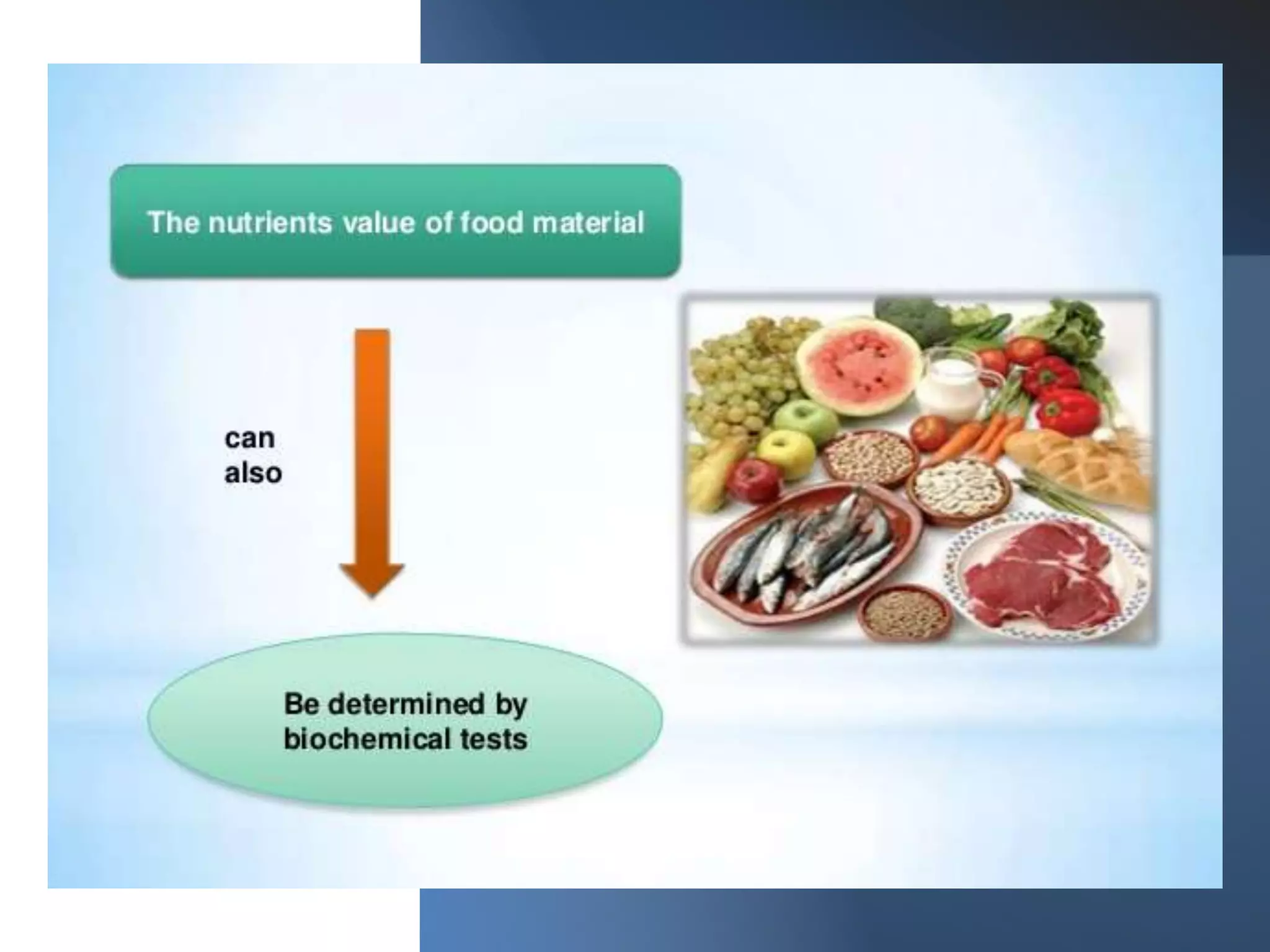
Food
(carbohydrate, protein, fat
etc)
Energy
(mitochondria)
Chemistry- ā€œscienceā€
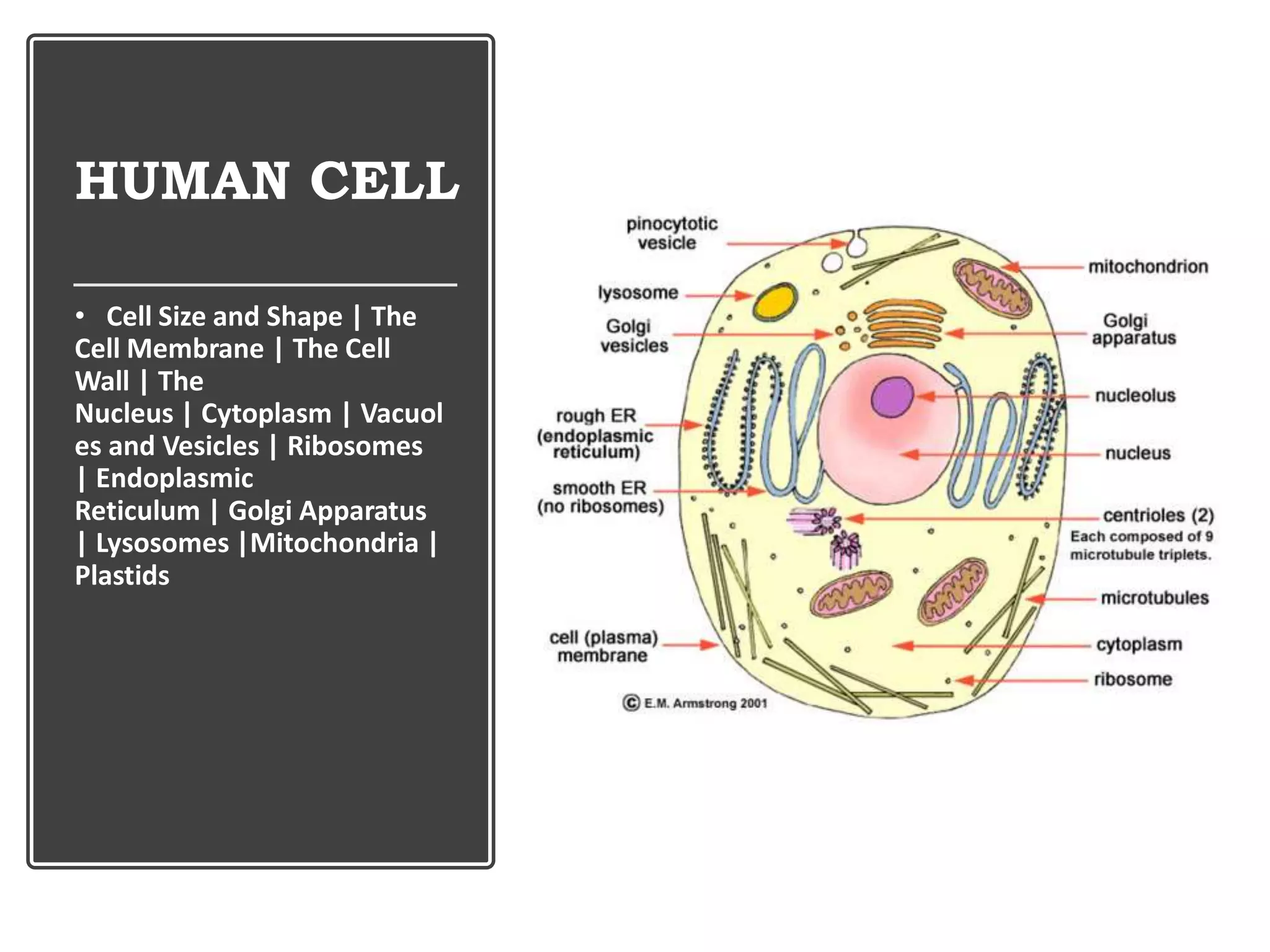
HUMAN CELL
• Cell Size and Shape | The
Cell Membrane | The Cell
Wall | The
Nucleus | Cytoplasm | Vacuol
es and Vesicles | Ribosomes
| Endoplasmic
Reticulum | Golgi Apparatus
| Lysosomes |Mitochondria |
Plastids
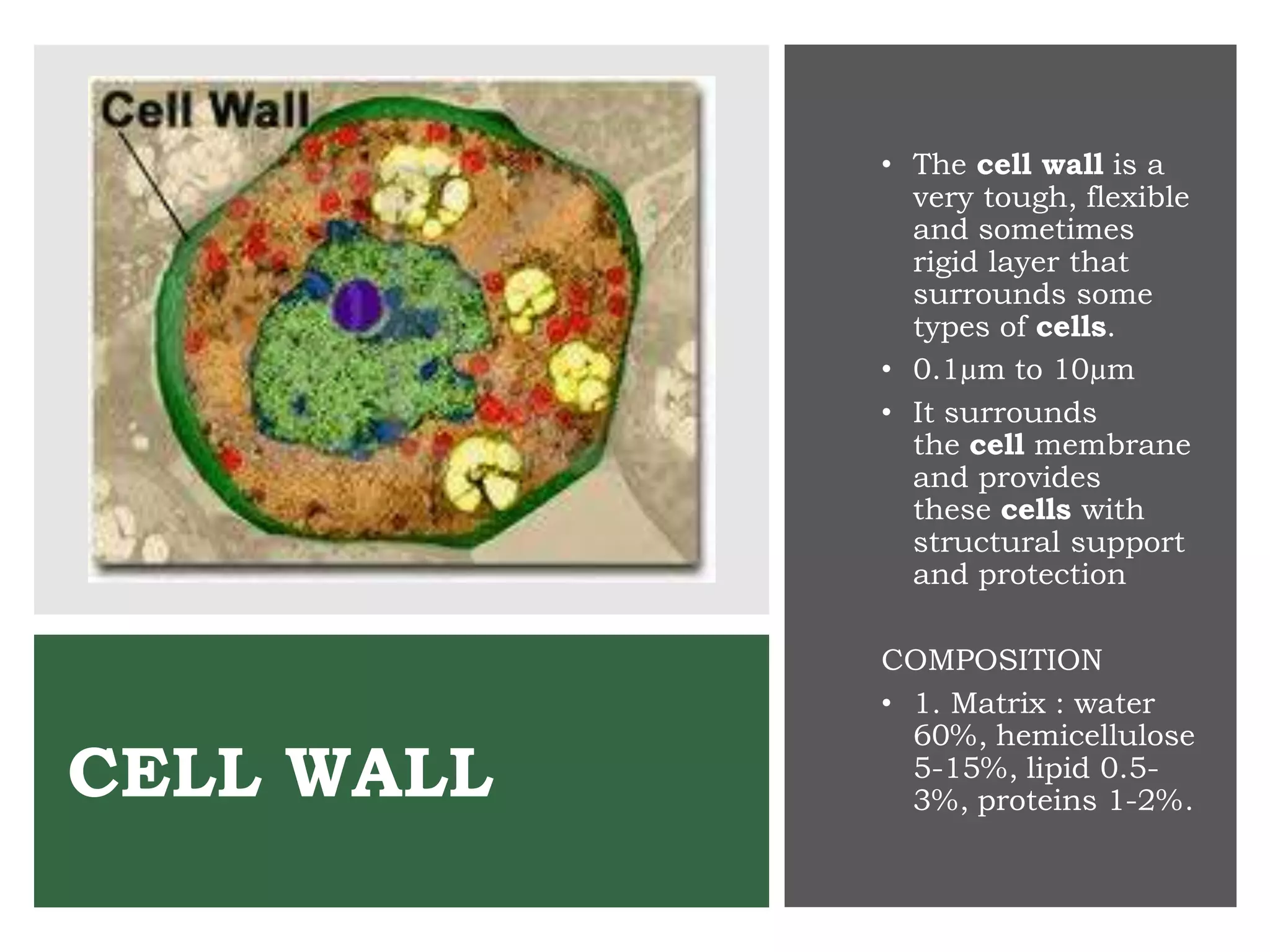
CELL WALL
• The cell wall is a
very tough, flexible
and sometimes
rigid layer that
surrounds some
types of cells.
• 0.1µm to 10µm
• It surrounds
the cell membrane
and provides
these cells with
structural support
and protection
COMPOSITION
• 1. Matrix : water
60%, hemicellulose
5-15%, lipid 0.5-
3%, proteins 1-2%.
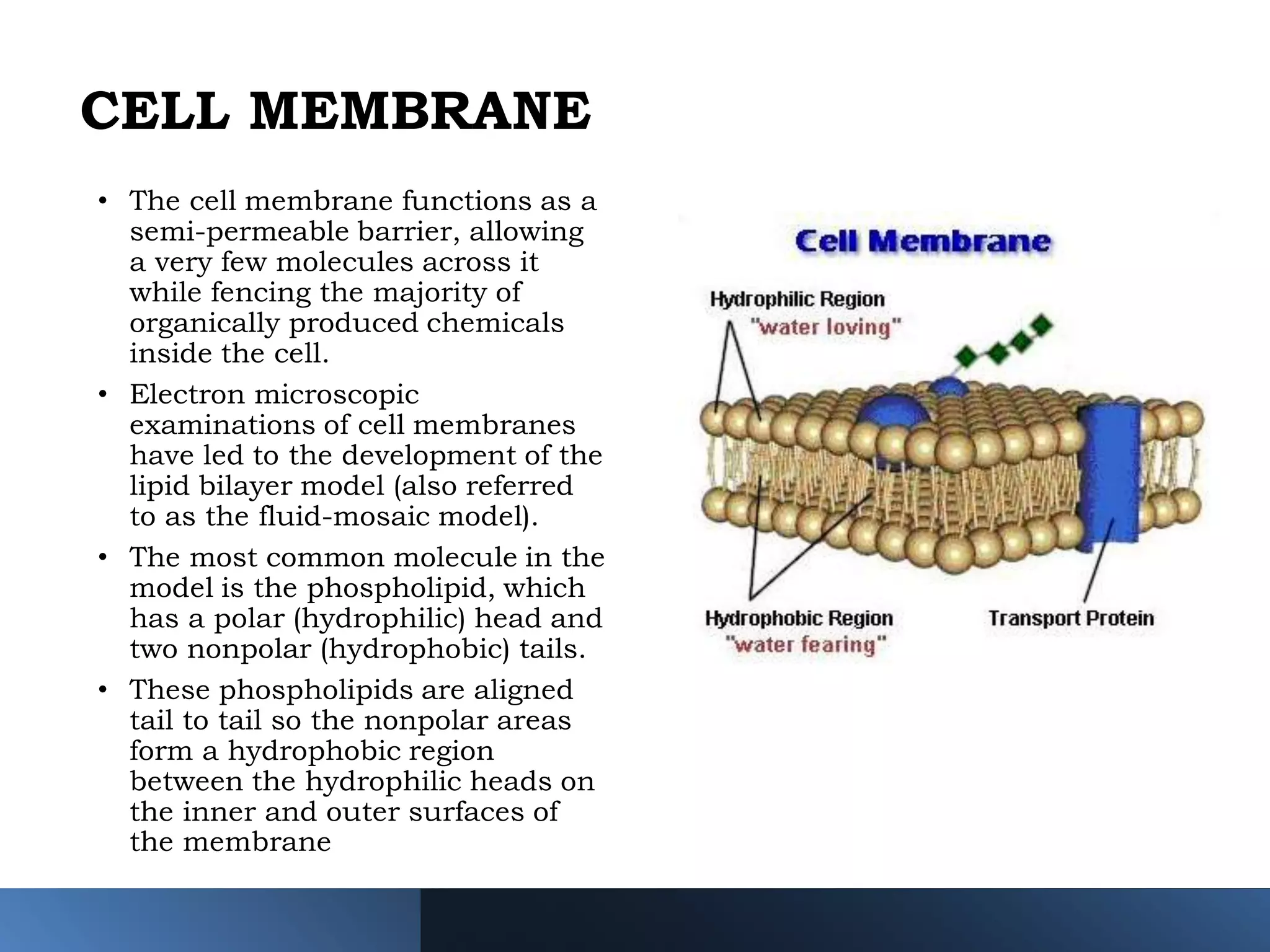
• The cell membrane functions as a
semi-permeable barrier, allowing
a very few molecules across it
while fencing the majority of
organically produced chemicals
inside the cell.
• Electron microscopic
examinations of cell membranes
have led to the development of the
lipid bilayer model (also referred
to as the fluid-mosaic model).
• The most common molecule in the
model is the phospholipid, which
has a polar (hydrophilic) head and
two nonpolar (hydrophobic) tails.
• These phospholipids are aligned
tail to tail so the nonpolar areas
form a hydrophobic region
between the hydrophilic heads on
the inner and outer surfaces of
the membrane
CELL MEMBRANE
THE NUCLEUS
• The nucleus, occurs only in
eukaryotic cells. It is the location for most
of the nucleic acids a cell makes, such as
DNA and RNA.
• Deoxyribonucleic acid, DNA, is the
physical carrier of inheritance and with
exception of plastid DNA (p DNA and m
DNA, found in the chloroplast and
mitochondrion respectively) all DNA is
restricted to the nucleus.
• Ribonucleic acid, RNA, is formed in the
nucleus using the DNA base sequence as
a template.
• RNA moves out into the cytoplasm where
it functions in the assembly of proteins.
The nucleolus is an area of the nucleus
(usually two nucleoli per nucleus)
where ribosomes are constructed.
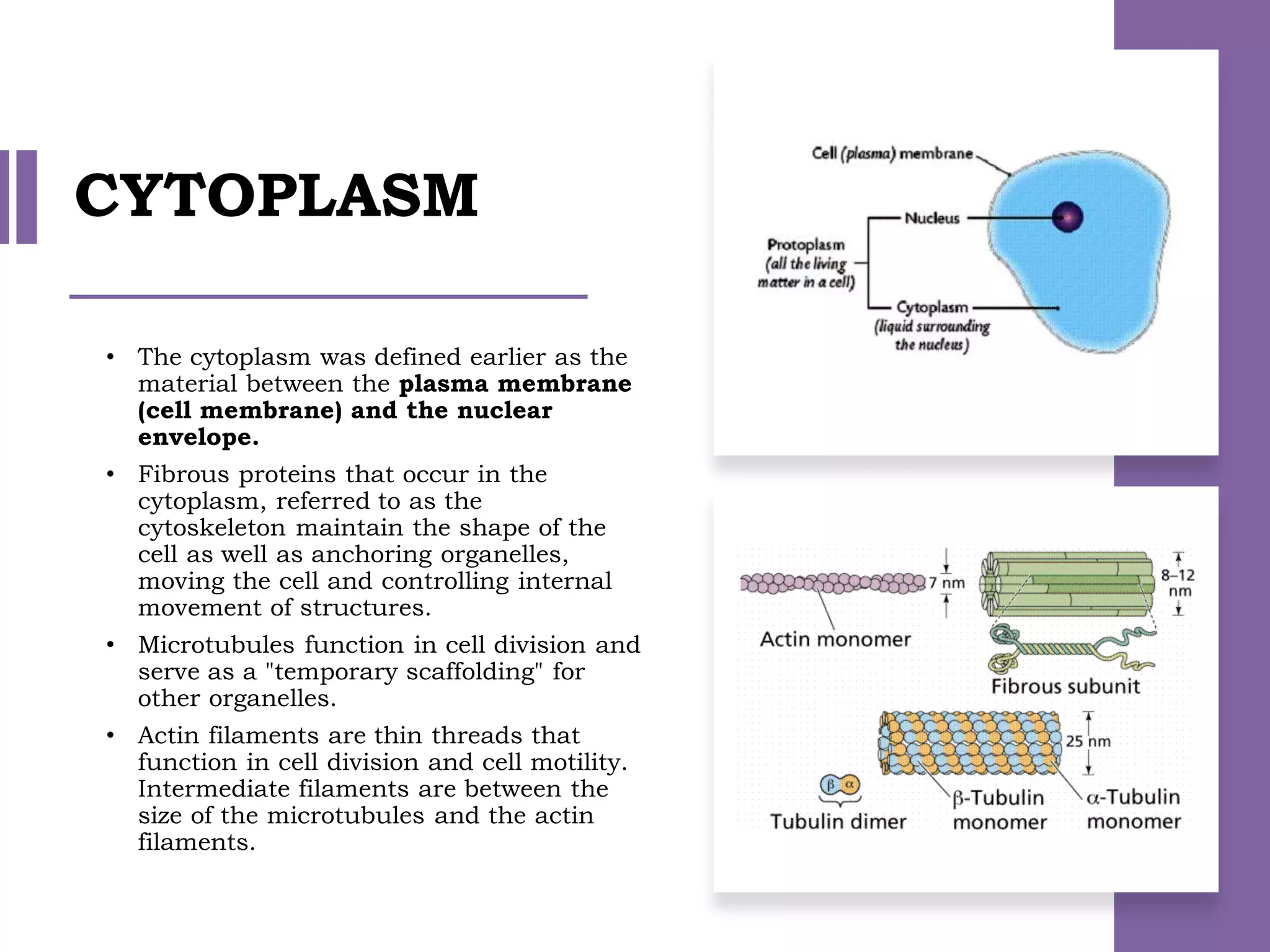
CYTOPLASM
• The cytoplasm was defined earlier as the
material between the plasma membrane
(cell membrane) and the nuclear
envelope.
• Fibrous proteins that occur in the
cytoplasm, referred to as the
cytoskeleton maintain the shape of the
cell as well as anchoring organelles,
moving the cell and controlling internal
movement of structures.
• Microtubules function in cell division and
serve as a "temporary scaffolding" for
other organelles.
• Actin filaments are thin threads that
function in cell division and cell motility.
Intermediate filaments are between the
size of the microtubules and the actin
filaments.
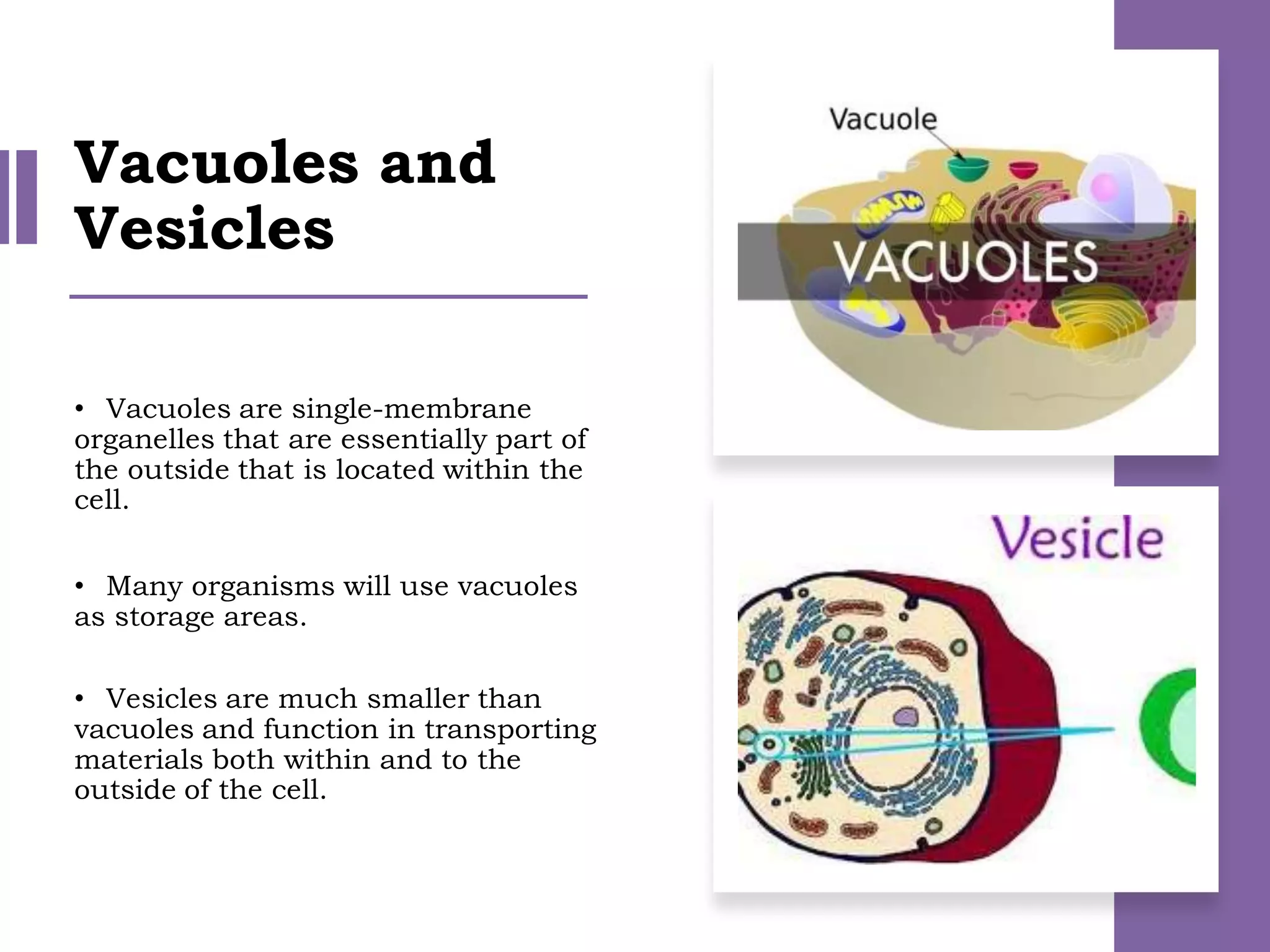
• Vacuoles are single-membrane
organelles that are essentially part of
the outside that is located within the
cell.
• Many organisms will use vacuoles
as storage areas.
• Vesicles are much smaller than
vacuoles and function in transporting
materials both within and to the
outside of the cell.
Vacuoles and
Vesicles
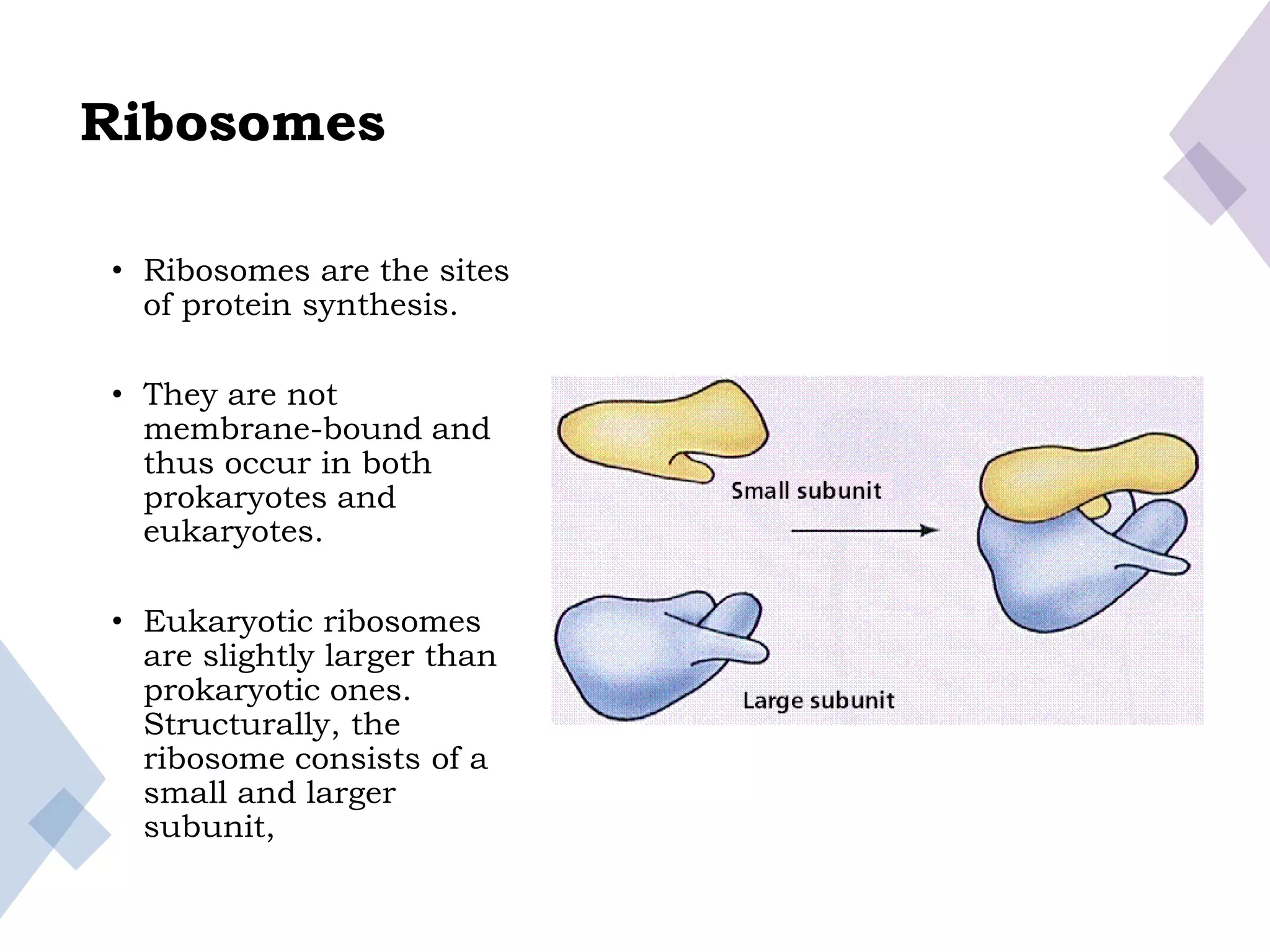
Ribosomes
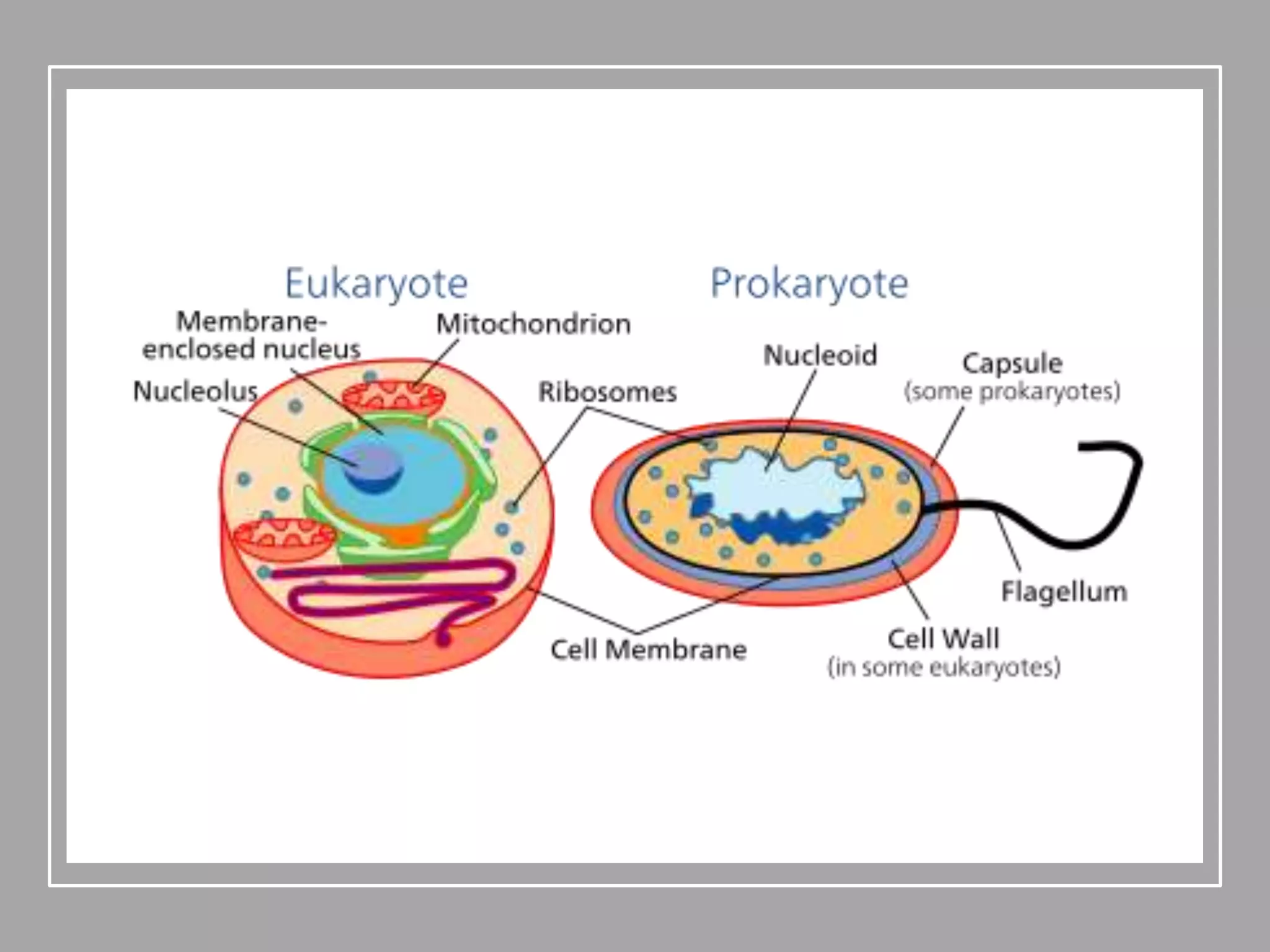
• Ribosomes are the sites
of protein synthesis.
• They are not
membrane-bound and
thus occur in both
prokaryotes and
eukaryotes.
• Eukaryotic ribosomes
are slightly larger than
prokaryotic ones.
Structurally, the
ribosome consists of a
small and larger
subunit,
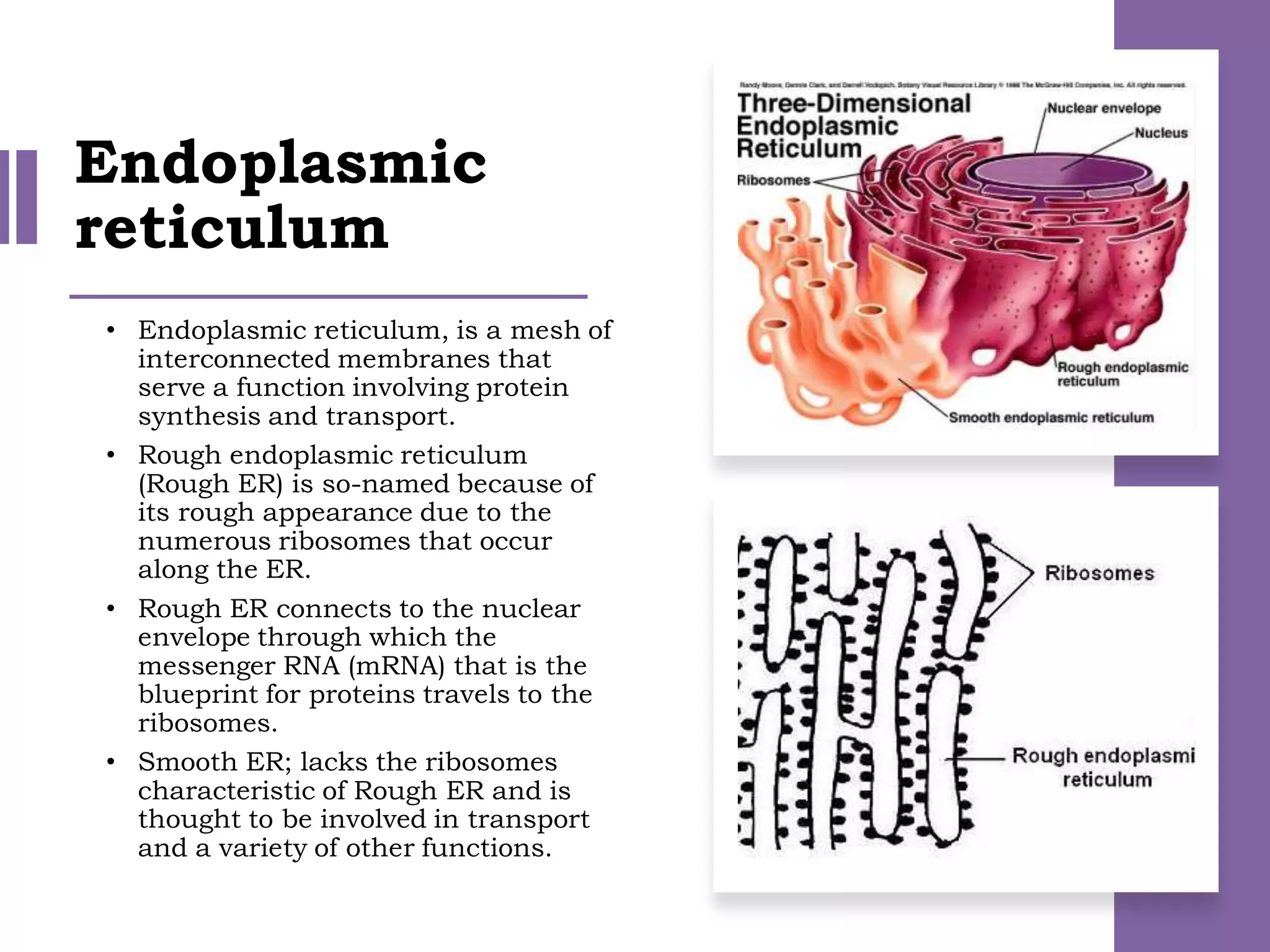
• Endoplasmic reticulum, is a mesh of
interconnected membranes that
serve a function involving protein
synthesis and transport.
• Rough endoplasmic reticulum
(Rough ER) is so-named because of
its rough appearance due to the
numerous ribosomes that occur
along the ER.
• Rough ER connects to the nuclear
envelope through which the
messenger RNA (mRNA) that is the
blueprint for proteins travels to the
ribosomes.
• Smooth ER; lacks the ribosomes
characteristic of Rough ER and is
thought to be involved in transport
and a variety of other functions.
Endoplasmic
reticulum
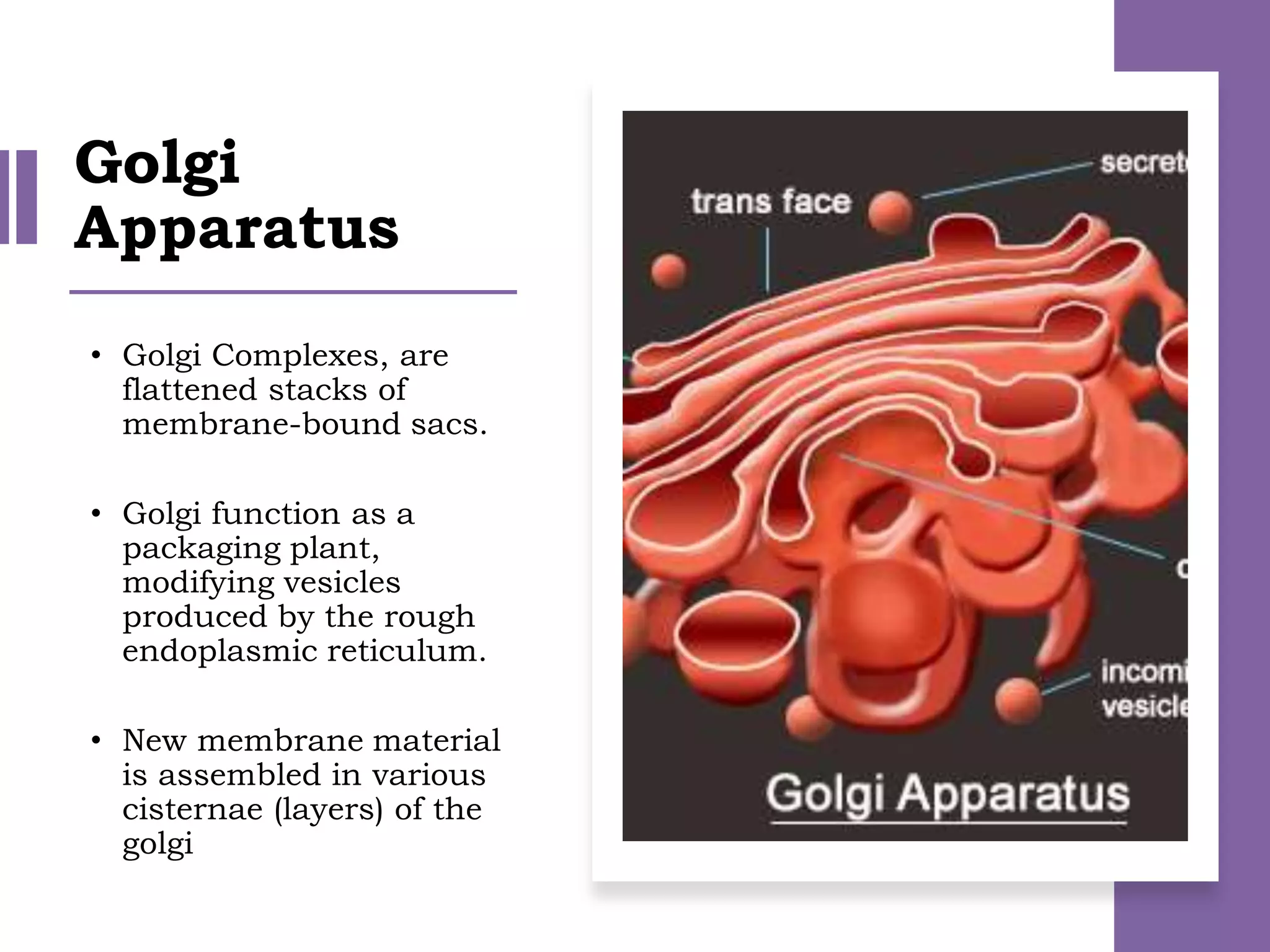
• Golgi Complexes, are
flattened stacks of
membrane-bound sacs.
• Golgi function as a
packaging plant,
modifying vesicles
produced by the rough
endoplasmic reticulum.
• New membrane material
is assembled in various
cisternae (layers) of the
golgi
Golgi
Apparatus
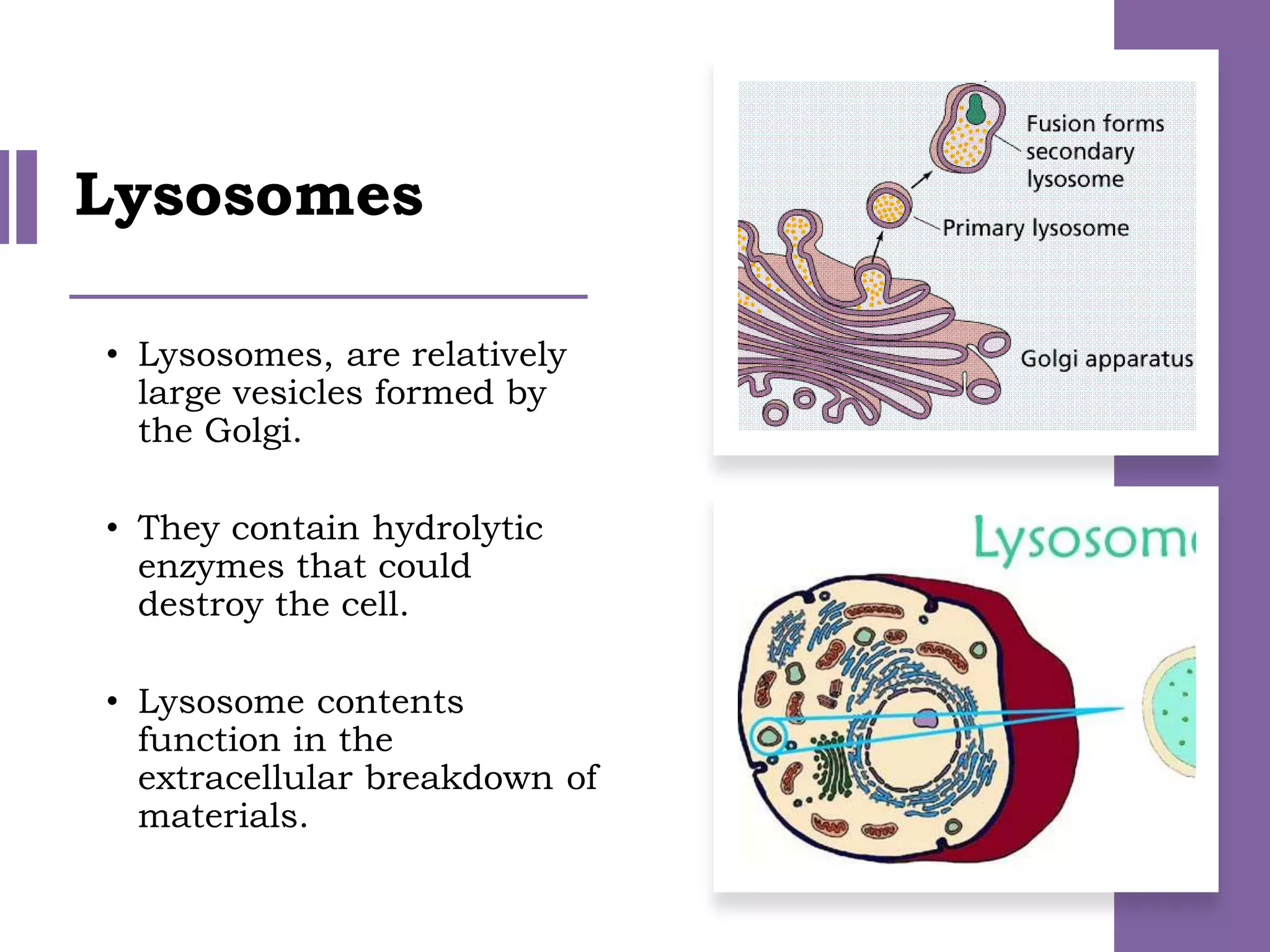
• Lysosomes, are relatively
large vesicles formed by
the Golgi.
• They contain hydrolytic
enzymes that could
destroy the cell.
• Lysosome contents
function in the
extracellular breakdown of
materials.
Lysosomes
• Mitochondria contain their own DNA
(termed m DNA) and are thought to
represent bacteria-like organisms
incorporated into eukaryotic cells over 700
million years ago (perhaps even as far back
as 1.5 billion years ago).
• They function as the sites of energy release
(following glycolysis in the cytoplasm) and
ATP formation (by chemiosmosis).
• The mitochondrion has been termed the
powerhouse of the cell. Mitochondria are
bounded by two membranes.
• The inner membrane folds into a series
of cristae, which are the surfaces on which
adenosine triphosphate (ATP) is generated.
• The matrix is the area of the mitochondrion
surrounded by the inner mitochondrial
membrane. Ribosomes and mitochondrial
DNA are found in the matrix.
Mitochondria
Thank you

Biochemistry (Cell and its Biochemical Organization)

  • 1.
    Dr. Ashwani Dhingra AssociateProfessor GGSCOP, Yamunanagar (Cell and its Biochemical Organization)
  • 3.
    In general BIOCHEMISTRY dealswith body substance like enzymes, hormones, carbohydrates, amino acids, fats, proteins, DNA, RNA, pigments etc.
  • 7.
    DEFINATION The branch ofscience concerned with the chemical and physico- chemical processes and substances which occur within living-organisms. Biochemistry is a branch of science which deals with chemical basis of life in plants and animals.
  • 8.
    ROLE OF BIOCHEMISTRY MEDICINE 1. Physiology:Biochemistry helps one understand the biochemical changes and related physiological alteration in the body. 2. Pathology: Based on the symptoms described by the patient, physician can get clue on the biochemical change and the associated disorder. For example, if a patient complains about stiffness in small joints, then physician may predict it to be gout and get confirmed by evaluating uric acid levels in the blood. As uric acid accumulation in blood results in gout. 3. Nutrition deficiency: The function and role of vitamin in body is described only by biochemistry. 4. Hormonal deficiency: There are many disorders due to hormonal imbalance in especially women and children. The formation, role of hormones in the normal body function is taught in biochemistry by which the physician can understand the concerned problem during treatment.
  • 9.
    PHARMACY 1. Drug Constitution:Biochemistry gives an idea of the constitution of the drug, its chances of degradation with varying temperature etc. and helps improve efficiency, minimize side effects etc. 2. The half-life: This is a test done on biochemical drugs to know how long a drug is stable when kept at so and so temperature. 3. Drug storage: storage condition required can be estimated by biochemical test.For example many enzymes, hormones are stored for dispensing. These get deteriorated over time due to temperature or oxidation, contamination and also due to improper storage. 4. Drug metabolism: It also gives an idea of how drug molecules are metabolized by many biochemical reactions in presence of enzymes. This helps to avoid drugs which have poor metabolism or those with excessive side effects from being prescribed or dispensed to the patient. 5. Biochemical tests: These tests helps fix the specific half-life or date of expiry for drugs. ROLE OF BIOCHEMISTRY
  • 10.
    Biochemistry Bio- ā€œlifeā€ (livingorganism) Food (carbohydrate, protein, fat etc) Energy (mitochondria) Chemistry- ā€œscienceā€
  • 11.
    HUMAN CELL • CellSize and Shape | The Cell Membrane | The Cell Wall | The Nucleus | Cytoplasm | Vacuol es and Vesicles | Ribosomes | Endoplasmic Reticulum | Golgi Apparatus | Lysosomes |Mitochondria | Plastids
  • 12.
    CELL WALL • Thecell wall is a very tough, flexible and sometimes rigid layer that surrounds some types of cells. • 0.1µm to 10µm • It surrounds the cell membrane and provides these cells with structural support and protection COMPOSITION • 1. Matrix : water 60%, hemicellulose 5-15%, lipid 0.5- 3%, proteins 1-2%.
  • 13.
    • The cellmembrane functions as a semi-permeable barrier, allowing a very few molecules across it while fencing the majority of organically produced chemicals inside the cell. • Electron microscopic examinations of cell membranes have led to the development of the lipid bilayer model (also referred to as the fluid-mosaic model). • The most common molecule in the model is the phospholipid, which has a polar (hydrophilic) head and two nonpolar (hydrophobic) tails. • These phospholipids are aligned tail to tail so the nonpolar areas form a hydrophobic region between the hydrophilic heads on the inner and outer surfaces of the membrane CELL MEMBRANE
  • 14.
    THE NUCLEUS • Thenucleus, occurs only in eukaryotic cells. It is the location for most of the nucleic acids a cell makes, such as DNA and RNA. • Deoxyribonucleic acid, DNA, is the physical carrier of inheritance and with exception of plastid DNA (p DNA and m DNA, found in the chloroplast and mitochondrion respectively) all DNA is restricted to the nucleus. • Ribonucleic acid, RNA, is formed in the nucleus using the DNA base sequence as a template. • RNA moves out into the cytoplasm where it functions in the assembly of proteins. The nucleolus is an area of the nucleus (usually two nucleoli per nucleus) where ribosomes are constructed.
  • 15.
    CYTOPLASM • The cytoplasmwas defined earlier as the material between the plasma membrane (cell membrane) and the nuclear envelope. • Fibrous proteins that occur in the cytoplasm, referred to as the cytoskeleton maintain the shape of the cell as well as anchoring organelles, moving the cell and controlling internal movement of structures. • Microtubules function in cell division and serve as a "temporary scaffolding" for other organelles. • Actin filaments are thin threads that function in cell division and cell motility. Intermediate filaments are between the size of the microtubules and the actin filaments.
  • 16.
    • Vacuoles aresingle-membrane organelles that are essentially part of the outside that is located within the cell. • Many organisms will use vacuoles as storage areas. • Vesicles are much smaller than vacuoles and function in transporting materials both within and to the outside of the cell. Vacuoles and Vesicles
  • 17.
    Ribosomes • Ribosomes arethe sites of protein synthesis. • They are not membrane-bound and thus occur in both prokaryotes and eukaryotes. • Eukaryotic ribosomes are slightly larger than prokaryotic ones. Structurally, the ribosome consists of a small and larger subunit,
  • 18.
    • Endoplasmic reticulum,is a mesh of interconnected membranes that serve a function involving protein synthesis and transport. • Rough endoplasmic reticulum (Rough ER) is so-named because of its rough appearance due to the numerous ribosomes that occur along the ER. • Rough ER connects to the nuclear envelope through which the messenger RNA (mRNA) that is the blueprint for proteins travels to the ribosomes. • Smooth ER; lacks the ribosomes characteristic of Rough ER and is thought to be involved in transport and a variety of other functions. Endoplasmic reticulum
  • 19.
    • Golgi Complexes,are flattened stacks of membrane-bound sacs. • Golgi function as a packaging plant, modifying vesicles produced by the rough endoplasmic reticulum. • New membrane material is assembled in various cisternae (layers) of the golgi Golgi Apparatus
  • 20.
    • Lysosomes, arerelatively large vesicles formed by the Golgi. • They contain hydrolytic enzymes that could destroy the cell. • Lysosome contents function in the extracellular breakdown of materials. Lysosomes
  • 21.
    • Mitochondria containtheir own DNA (termed m DNA) and are thought to represent bacteria-like organisms incorporated into eukaryotic cells over 700 million years ago (perhaps even as far back as 1.5 billion years ago). • They function as the sites of energy release (following glycolysis in the cytoplasm) and ATP formation (by chemiosmosis). • The mitochondrion has been termed the powerhouse of the cell. Mitochondria are bounded by two membranes. • The inner membrane folds into a series of cristae, which are the surfaces on which adenosine triphosphate (ATP) is generated. • The matrix is the area of the mitochondrion surrounded by the inner mitochondrial membrane. Ribosomes and mitochondrial DNA are found in the matrix. Mitochondria
  • 23.