Basic Aerodynamics III. Basic Aerodynamics   The Atmosphere Physics The Airfoil Lift & Drag Stability Large Aircraft Flight Controls Aircraft Stability Stability:  General To insure an airplane has good handling qualities in all flight regimes, we need it to be STABLE, MANEUVERABLE, and CONTROLLABLE STABILITY is the characteristic of an airplane in flight that causes it to return to a condition of equilibrium, or steady flight, after it is disturbed.
Basic Aerodynamics III. Basic Aerodynamics   The Atmosphere Physics The Airfoil Lift & Drag Stability Large Aircraft Flight Controls Aircraft Stability Stability:  General To insure an airplane has good handling qualities in all flight regimes, we need it to be STABLE, MANEUVERABLE, and CONTROLLABLE MANEUVERABLILITY is the characteristic that permits the pilot to easily move the airplane about its axes and to withstand the stress from these moves
Basic Aerodynamics III. Basic Aerodynamics   The Atmosphere Physics The Airfoil Lift & Drag Stability Large Aircraft Flight Controls Aircraft Stability Stability:  General To insure an airplane has good handling qualities in all flight regimes, we need it to be STABLE, MANEUVERABLE, and CONTROLLABLE CONTROLLABILITY is the capability to respond to the pilot’s control inputs
Basic Aerodynamics III. Basic Aerodynamics   The Atmosphere Physics The Airfoil Lift & Drag Stability Large Aircraft Flight Controls Aircraft Stability Stability:  General Unfortunately, these characteristics are at odds with each other Increase in one leads to a decrease in another = all airplane designs are compromises If make it too stable = it’s hard to control
Basic Aerodynamics III. Basic Aerodynamics   The Atmosphere Physics The Airfoil Lift & Drag Stability Large Aircraft Flight Controls Aircraft Stability Stability:  General Types 2 TYPES OF STABILITY STATIC The ability of an object to return to its equilibrium state after being disturbed DYNAMIC The way the object moves after being disturbed
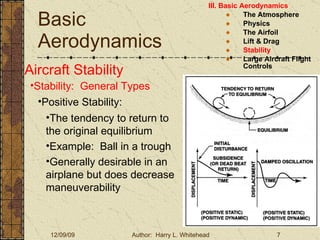
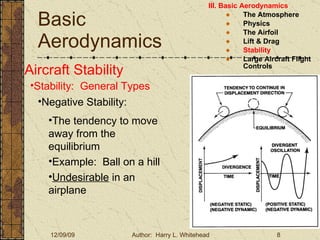
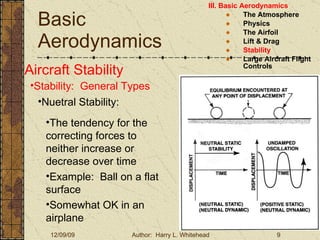
Basic Aerodynamics III. Basic Aerodynamics   The Atmosphere Physics The Airfoil Lift & Drag Stability Large Aircraft Flight Controls Aircraft Stability Stability:  General Types 3 CONDITIONS OF STABILITY: POSITIVE The disruption of an object gets less over time NEGATIVE  The disruption gets greater over time NUETRAL The disruption neither increases or decreases over time
Basic Aerodynamics III. Basic Aerodynamics   The Atmosphere Physics The Airfoil Lift & Drag Stability Large Aircraft Flight Controls Aircraft Stability Stability:  General Types The tendency to return to the original equilibrium Example:  Ball in a trough Generally desirable in an airplane but does decrease maneuverability Positive Stability:
Basic Aerodynamics III. Basic Aerodynamics   The Atmosphere Physics The Airfoil Lift & Drag Stability Large Aircraft Flight Controls Aircraft Stability Stability:  General Types The tendency to move away from the equilibrium Example:  Ball on a hill Undesirable  in an airplane Negative Stability:
Basic Aerodynamics III. Basic Aerodynamics   The Atmosphere Physics The Airfoil Lift & Drag Stability Large Aircraft Flight Controls Aircraft Stability Stability:  General Types The tendency for the correcting forces to neither increase or decrease over time Example:  Ball on a flat surface Somewhat OK in an airplane Nuetral Stability:
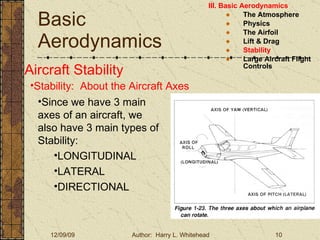
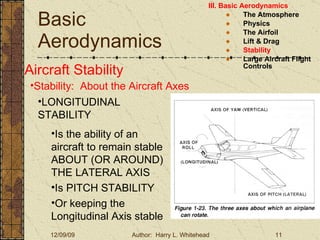
Basic Aerodynamics III. Basic Aerodynamics   The Atmosphere Physics The Airfoil Lift & Drag Stability Large Aircraft Flight Controls Aircraft Stability Stability:  About the Aircraft Axes Since we have 3 main axes of an aircraft, we also have 3 main types of Stability: LONGITUDINAL LATERAL DIRECTIONAL
Basic Aerodynamics III. Basic Aerodynamics   The Atmosphere Physics The Airfoil Lift & Drag Stability Large Aircraft Flight Controls Aircraft Stability Stability:  About the Aircraft Axes LONGITUDINAL STABILITY Is the ability of an aircraft to remain stable ABOUT (OR AROUND) THE LATERAL AXIS Is PITCH STABILITY Or keeping the Longitudinal Axis stable
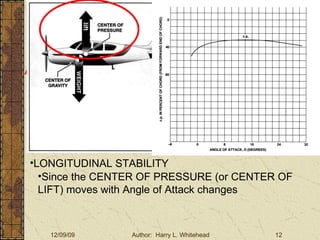
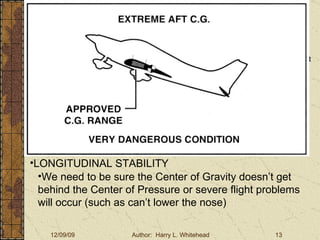
Basic Aerodynamics III. Basic Aerodynamics   The Atmosphere Physics The Airfoil Lift & Drag Stability Large Aircraft Flight Controls Aircraft Stability Stability:  About the Aircraft Axes LONGITUDINAL STABILITY Since the CENTER OF PRESSURE (or CENTER OF LIFT) moves with Angle of Attack changes
Basic Aerodynamics III. Basic Aerodynamics   The Atmosphere Physics The Airfoil Lift & Drag Stability Large Aircraft Flight Controls Aircraft Stability Stability:  About the Aircraft Axes LONGITUDINAL STABILITY We need to be sure the Center of Gravity doesn’t get behind the Center of Pressure or severe flight problems will occur (such as can’t lower the nose)
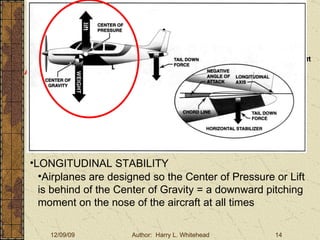
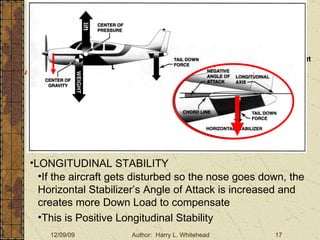
Basic Aerodynamics III. Basic Aerodynamics   The Atmosphere Physics The Airfoil Lift & Drag Stability Large Aircraft Flight Controls Aircraft Stability Stability:  About the Aircraft Axes LONGITUDINAL STABILITY Airplanes are designed so the Center of Pressure or Lift is behind of the Center of Gravity = a downward pitching moment on the nose of the aircraft at all times
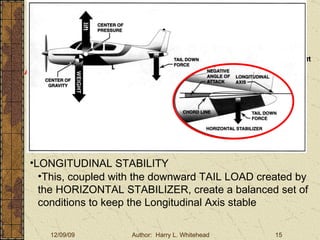
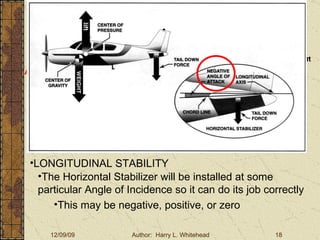
Basic Aerodynamics III. Basic Aerodynamics   The Atmosphere Physics The Airfoil Lift & Drag Stability Large Aircraft Flight Controls Aircraft Stability Stability:  About the Aircraft Axes LONGITUDINAL STABILITY This, coupled with the downward TAIL LOAD created by the HORIZONTAL STABILIZER, create a balanced set of conditions to keep the Longitudinal Axis stable
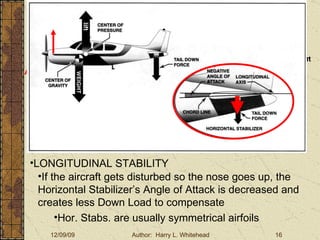
Basic Aerodynamics III. Basic Aerodynamics   The Atmosphere Physics The Airfoil Lift & Drag Stability Large Aircraft Flight Controls Aircraft Stability Stability:  About the Aircraft Axes LONGITUDINAL STABILITY If the aircraft gets disturbed so the nose goes up, the Horizontal Stabilizer’s Angle of Attack is decreased and creates less Down Load to compensate Hor. Stabs. are usually symmetrical airfoils
Basic Aerodynamics III. Basic Aerodynamics   The Atmosphere Physics The Airfoil Lift & Drag Stability Large Aircraft Flight Controls Aircraft Stability Stability:  About the Aircraft Axes LONGITUDINAL STABILITY If the aircraft gets disturbed so the nose goes down, the Horizontal Stabilizer’s Angle of Attack is increased and creates more Down Load to compensate This is Positive Longitudinal Stability
Basic Aerodynamics III. Basic Aerodynamics   The Atmosphere Physics The Airfoil Lift & Drag Stability Large Aircraft Flight Controls Aircraft Stability Stability:  About the Aircraft Axes LONGITUDINAL STABILITY The Horizontal Stabilizer will be installed at some particular Angle of Incidence so it can do its job correctly This may be negative, positive, or zero
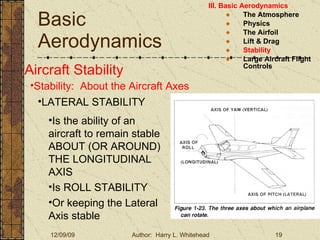
Basic Aerodynamics III. Basic Aerodynamics   The Atmosphere Physics The Airfoil Lift & Drag Stability Large Aircraft Flight Controls Aircraft Stability Stability:  About the Aircraft Axes LATERAL STABILITY Is the ability of an aircraft to remain stable ABOUT (OR AROUND) THE LONGITUDINAL AXIS Is ROLL STABILITY Or keeping the Lateral Axis stable
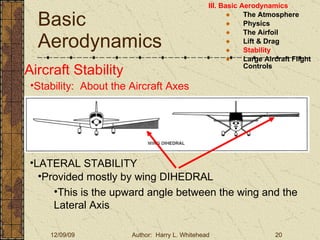
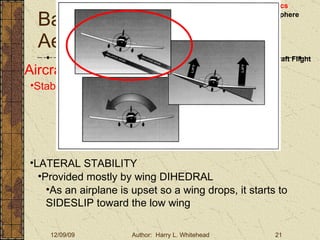
Basic Aerodynamics III. Basic Aerodynamics   The Atmosphere Physics The Airfoil Lift & Drag Stability Large Aircraft Flight Controls Aircraft Stability Stability:  About the Aircraft Axes LATERAL STABILITY Provided mostly by wing DIHEDRAL This is the upward angle between the wing and the Lateral Axis
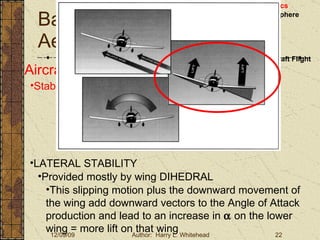
Basic Aerodynamics III. Basic Aerodynamics   The Atmosphere Physics The Airfoil Lift & Drag Stability Large Aircraft Flight Controls Aircraft Stability Stability:  About the Aircraft Axes LATERAL STABILITY Provided mostly by wing DIHEDRAL As an airplane is upset so a wing drops, it starts to SIDESLIP toward the low wing
Basic Aerodynamics III. Basic Aerodynamics   The Atmosphere Physics The Airfoil Lift & Drag Stability Large Aircraft Flight Controls Aircraft Stability Stability:  About the Aircraft Axes LATERAL STABILITY Provided mostly by wing DIHEDRAL This slipping motion plus the downward movement of the wing add downward vectors to the Angle of Attack production and lead to an increase in     on the lower wing = more lift on that wing
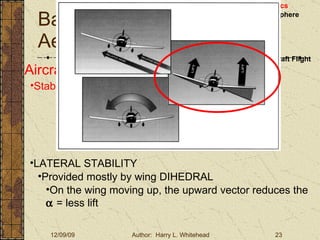
Basic Aerodynamics III. Basic Aerodynamics   The Atmosphere Physics The Airfoil Lift & Drag Stability Large Aircraft Flight Controls Aircraft Stability Stability:  About the Aircraft Axes LATERAL STABILITY Provided mostly by wing DIHEDRAL On the wing moving up, the upward vector reduces the    = less lift
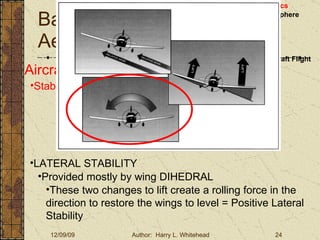
Basic Aerodynamics III. Basic Aerodynamics   The Atmosphere Physics The Airfoil Lift & Drag Stability Large Aircraft Flight Controls Aircraft Stability Stability:  About the Aircraft Axes LATERAL STABILITY Provided mostly by wing DIHEDRAL These two changes to lift create a rolling force in the direction to restore the wings to level = Positive Lateral Stability
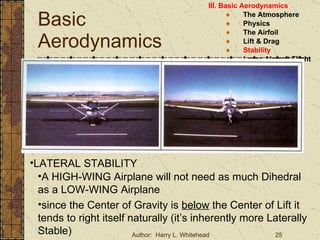
Basic Aerodynamics III. Basic Aerodynamics   The Atmosphere Physics The Airfoil Lift & Drag Stability Large Aircraft Flight Controls Aircraft Stability Stability:  About the Aircraft Axes LATERAL STABILITY A HIGH-WING Airplane will not need as much Dihedral as a LOW-WING Airplane  since the Center of Gravity is  below  the Center of Lift it tends to right itself naturally (it’s inherently more Laterally Stable)
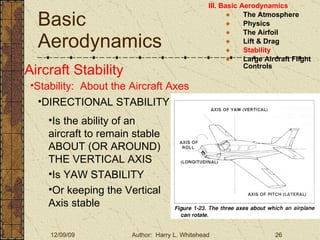
Basic Aerodynamics III. Basic Aerodynamics   The Atmosphere Physics The Airfoil Lift & Drag Stability Large Aircraft Flight Controls Aircraft Stability Stability:  About the Aircraft Axes DIRECTIONAL STABILITY Is the ability of an aircraft to remain stable ABOUT (OR AROUND) THE VERTICAL AXIS Is YAW STABILITY Or keeping the Vertical Axis stable
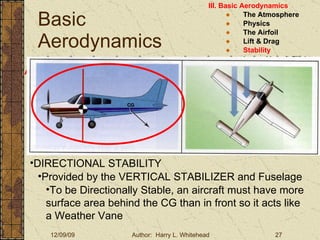
Basic Aerodynamics III. Basic Aerodynamics   The Atmosphere Physics The Airfoil Lift & Drag Stability Large Aircraft Flight Controls Aircraft Stability Stability:  About the Aircraft Axes DIRECTIONAL STABILITY Provided by the VERTICAL STABILIZER and Fuselage To be Directionally Stable, an aircraft must have more surface area behind the CG than in front so it acts like a Weather Vane
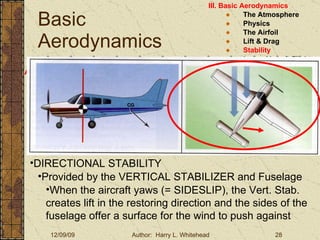
Basic Aerodynamics III. Basic Aerodynamics   The Atmosphere Physics The Airfoil Lift & Drag Stability Large Aircraft Flight Controls Aircraft Stability Stability:  About the Aircraft Axes DIRECTIONAL STABILITY Provided by the VERTICAL STABILIZER and Fuselage When the aircraft yaws (= SIDESLIP), the Vert. Stab. creates lift in the restoring direction and the sides of the fuselage offer a surface for the wind to push against
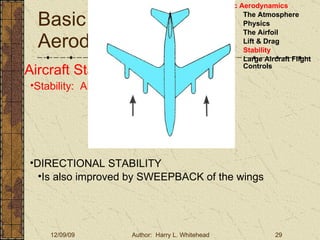
Basic Aerodynamics III. Basic Aerodynamics   The Atmosphere Physics The Airfoil Lift & Drag Stability Large Aircraft Flight Controls Aircraft Stability Stability:  About the Aircraft Axes DIRECTIONAL STABILITY Is also improved by SWEEPBACK of the wings
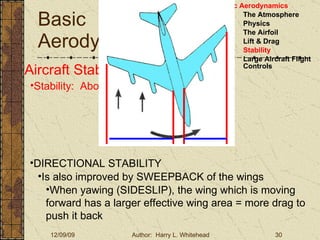
Basic Aerodynamics III. Basic Aerodynamics   The Atmosphere Physics The Airfoil Lift & Drag Stability Large Aircraft Flight Controls Aircraft Stability Stability:  About the Aircraft Axes DIRECTIONAL STABILITY Is also improved by SWEEPBACK of the wings When yawing (SIDESLIP), the wing which is moving forward has a larger effective wing area = more drag to push it back
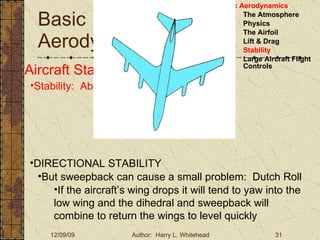
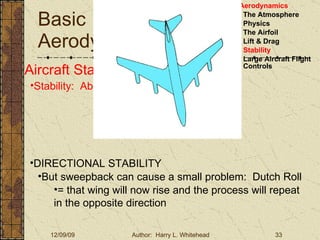
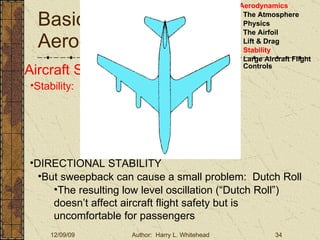
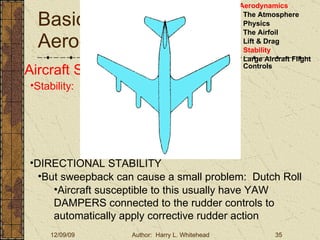
Basic Aerodynamics III. Basic Aerodynamics   The Atmosphere Physics The Airfoil Lift & Drag Stability Large Aircraft Flight Controls Aircraft Stability Stability:  About the Aircraft Axes DIRECTIONAL STABILITY But sweepback can cause a small problem:  Dutch Roll If the aircraft’s wing drops it will tend to yaw into the low wing and the dihedral and sweepback will combine to return the wings to level quickly
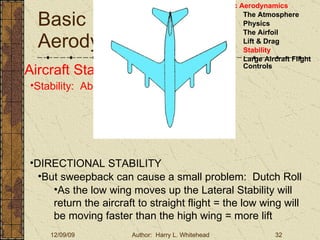
Basic Aerodynamics III. Basic Aerodynamics   The Atmosphere Physics The Airfoil Lift & Drag Stability Large Aircraft Flight Controls Aircraft Stability Stability:  About the Aircraft Axes DIRECTIONAL STABILITY But sweepback can cause a small problem:  Dutch Roll As the low wing moves up the Lateral Stability will return the aircraft to straight flight = the low wing will be moving faster than the high wing = more lift
Basic Aerodynamics III. Basic Aerodynamics   The Atmosphere Physics The Airfoil Lift & Drag Stability Large Aircraft Flight Controls Aircraft Stability Stability:  About the Aircraft Axes DIRECTIONAL STABILITY But sweepback can cause a small problem:  Dutch Roll = that wing will now rise and the process will repeat in the opposite direction
Basic Aerodynamics III. Basic Aerodynamics   The Atmosphere Physics The Airfoil Lift & Drag Stability Large Aircraft Flight Controls Aircraft Stability Stability:  About the Aircraft Axes DIRECTIONAL STABILITY But sweepback can cause a small problem:  Dutch Roll The resulting low level oscillation (“Dutch Roll”) doesn’t affect aircraft flight safety but is uncomfortable for passengers
Basic Aerodynamics III. Basic Aerodynamics   The Atmosphere Physics The Airfoil Lift & Drag Stability Large Aircraft Flight Controls Aircraft Stability Stability:  About the Aircraft Axes DIRECTIONAL STABILITY But sweepback can cause a small problem:  Dutch Roll Aircraft susceptible to this usually have YAW DAMPERS connected to the rudder controls to automatically apply corrective rudder action
Basic Aerodynamics III. Basic Aerodynamics   The Atmosphere Physics The Airfoil Lift & Drag Stability Large Aircraft Flight Controls Large Aircraft Controls Large aircraft, like small, control the aircraft about the same 3 axes:  Lateral, Longitudinal, and Vertical Major differences: More control surfaces  Hydraulic actuated Power-boosted Hydraulic cylinder in parallel with control rods Pilot moves surface and valve to actuate hydraulic cylinder to help
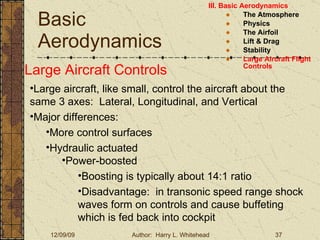
Basic Aerodynamics III. Basic Aerodynamics   The Atmosphere Physics The Airfoil Lift & Drag Stability Large Aircraft Flight Controls Large Aircraft Controls Large aircraft, like small, control the aircraft about the same 3 axes:  Lateral, Longitudinal, and Vertical Major differences: More control surfaces  Hydraulic actuated Power-boosted Boosting is typically about 14:1 ratio Disadvantage:  in transonic speed range shock waves form on controls and cause buffeting which is fed back into cockpit
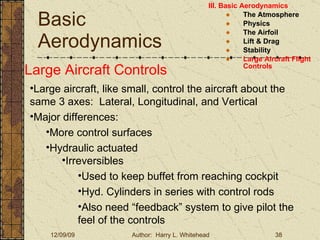
Basic Aerodynamics III. Basic Aerodynamics   The Atmosphere Physics The Airfoil Lift & Drag Stability Large Aircraft Flight Controls Large Aircraft Controls Large aircraft, like small, control the aircraft about the same 3 axes:  Lateral, Longitudinal, and Vertical Major differences: More control surfaces  Hydraulic actuated Irreversibles Used to keep buffet from reaching cockpit Hyd. Cylinders in series with control rods Also need “feedback” system to give pilot the feel of the controls
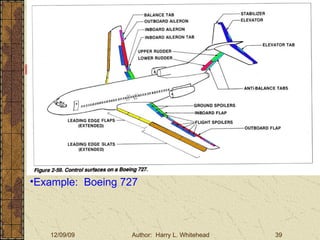
Basic Aerodynamics III. Basic Aerodynamics   The Atmosphere Physics The Airfoil Lift & Drag Stability Large Aircraft Flight Controls Large Aircraft Controls Example:  Boeing 727
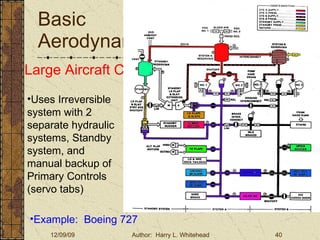
Basic Aerodynamics III. Basic Aerodynamics   The Atmosphere Physics The Airfoil Lift & Drag Stability Large Aircraft Flight Controls Large Aircraft Controls Example:  Boeing 727 Uses Irreversible system with 2 separate hydraulic systems, Standby system, and manual backup of Primary Controls (servo tabs)
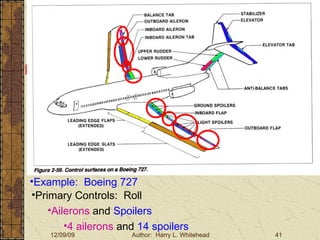
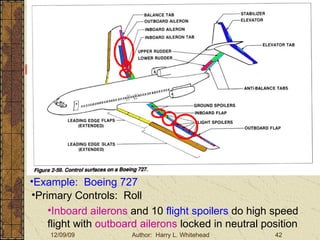
Basic Aerodynamics III. Basic Aerodynamics   The Atmosphere Physics The Airfoil Lift & Drag Stability Large Aircraft Flight Controls Large Aircraft Controls Example:  Boeing 727 Primary Controls:  Roll Ailerons  and  Spoilers 4 ailerons  and  14 spoilers
Basic Aerodynamics III. Basic Aerodynamics   The Atmosphere Physics The Airfoil Lift & Drag Stability Large Aircraft Flight Controls Large Aircraft Controls Example:  Boeing 727 Primary Controls:  Roll Inboard ailerons  and 10  flight spoilers  do high speed flight with  outboard ailerons  locked in neutral position
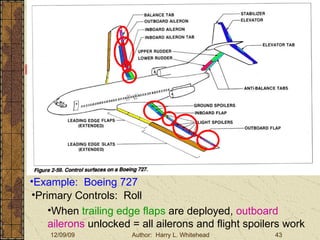
Basic Aerodynamics III. Basic Aerodynamics   The Atmosphere Physics The Airfoil Lift & Drag Stability Large Aircraft Flight Controls Large Aircraft Controls Example:  Boeing 727 Primary Controls:  Roll When  trailing edge flaps  are deployed,  outboard ailerons  unlocked = all ailerons and flight spoilers work
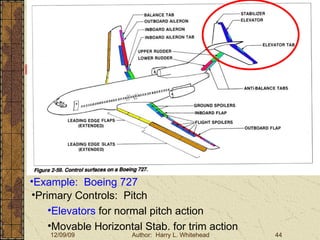
Basic Aerodynamics III. Basic Aerodynamics   The Atmosphere Physics The Airfoil Lift & Drag Stability Large Aircraft Flight Controls Large Aircraft Controls Example:  Boeing 727 Primary Controls:  Pitch Elevators  for normal pitch action Movable Horizontal Stab. for trim action
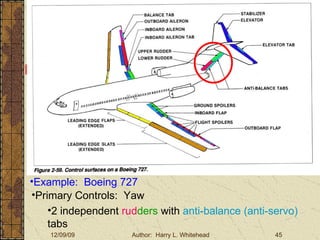
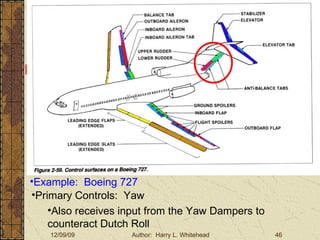
Basic Aerodynamics III. Basic Aerodynamics   The Atmosphere Physics The Airfoil Lift & Drag Stability Large Aircraft Flight Controls Large Aircraft Controls Example:  Boeing 727 Primary Controls:  Yaw 2 independent  rud ders  with  anti-balance (anti-servo)  tabs
Basic Aerodynamics III. Basic Aerodynamics   The Atmosphere Physics The Airfoil Lift & Drag Stability Large Aircraft Flight Controls Large Aircraft Controls Example:  Boeing 727 Primary Controls:  Yaw Also receives input from the Yaw Dampers to counteract Dutch Roll
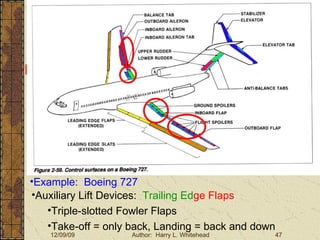
Basic Aerodynamics III. Basic Aerodynamics   The Atmosphere Physics The Airfoil Lift & Drag Stability Large Aircraft Flight Controls Large Aircraft Controls Example:  Boeing 727 Auxiliary Lift Devices:  Trailing Ed ge Flaps Triple-slotted Fowler Flaps Take-off = only back, Landing = back and down
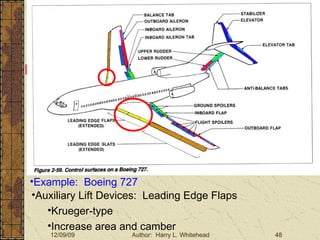
Basic Aerodynamics III. Basic Aerodynamics   The Atmosphere Physics The Airfoil Lift & Drag Stability Large Aircraft Flight Controls Large Aircraft Controls Example:  Boeing 727 Auxiliary Lift Devices:  Leading Edge Flaps Krueger-type Increase area and camber
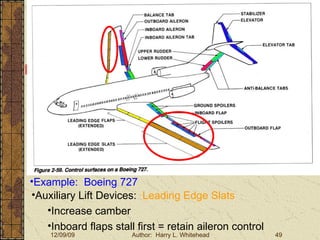
Basic Aerodynamics III. Basic Aerodynamics   The Atmosphere Physics The Airfoil Lift & Drag Stability Large Aircraft Flight Controls Large Aircraft Controls Example:  Boeing 727 Auxiliary Lift Devices:  Leading Edge Slats Increase camber Inboard flaps stall first = retain aileron control
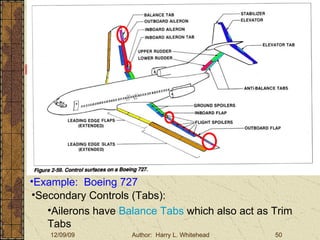
Basic Aerodynamics III. Basic Aerodynamics   The Atmosphere Physics The Airfoil Lift & Drag Stability Large Aircraft Flight Controls Large Aircraft Controls Example:  Boeing 727 Secondary Controls (Tabs):  Ailerons have  Balance Tabs  which also act as Trim Tabs
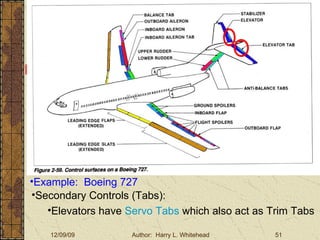
Basic Aerodynamics III. Basic Aerodynamics   The Atmosphere Physics The Airfoil Lift & Drag Stability Large Aircraft Flight Controls Large Aircraft Controls Example:  Boeing 727 Secondary Controls (Tabs):  Elevators have  Servo Tabs  which also act as Trim Tabs
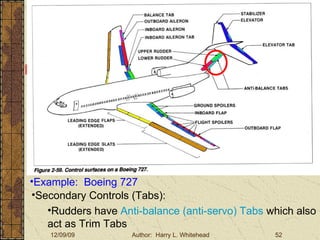
Basic Aerodynamics III. Basic Aerodynamics   The Atmosphere Physics The Airfoil Lift & Drag Stability Large Aircraft Flight Controls Large Aircraft Controls Example:  Boeing 727 Secondary Controls (Tabs):  Rudders have  Anti-balance (anti-servo) Tabs  which also act as Trim Tabs
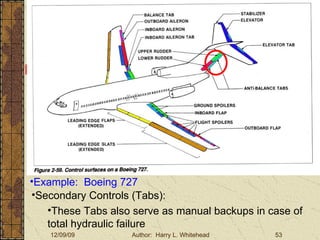
Basic Aerodynamics III. Basic Aerodynamics   The Atmosphere Physics The Airfoil Lift & Drag Stability Large Aircraft Flight Controls Large Aircraft Controls Example:  Boeing 727 Secondary Controls (Tabs):  These Tabs also serve as manual backups in case of total hydraulic failure
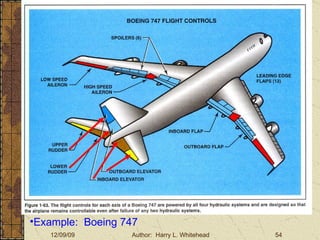
Basic Aerodynamics III. Basic Aerodynamics   The Atmosphere Physics The Airfoil Lift & Drag Stability Large Aircraft Flight Controls Large Aircraft Controls Example:  Boeing 747
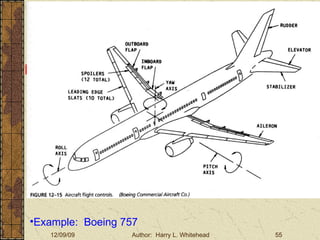
Basic Aerodynamics III. Basic Aerodynamics   The Atmosphere Physics The Airfoil Lift & Drag Stability Large Aircraft Flight Controls Large Aircraft Controls Example:  Boeing 757
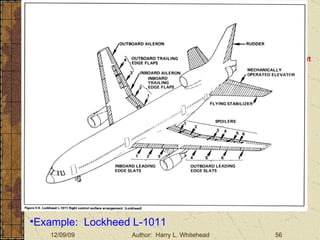
Basic Aerodynamics III. Basic Aerodynamics   The Atmosphere Physics The Airfoil Lift & Drag Stability Large Aircraft Flight Controls Large Aircraft Controls Example:  Lockheed L-1011
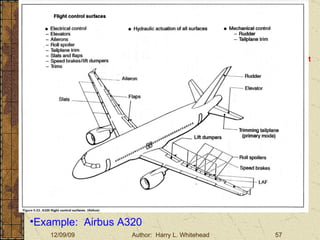
Basic Aerodynamics III. Basic Aerodynamics   The Atmosphere Physics The Airfoil Lift & Drag Stability Large Aircraft Flight Controls Large Aircraft Controls Example:  Airbus A320
Basic Aerodynamics III. Basic Aerodynamics   The Atmosphere Physics The Airfoil Lift & Drag Stability Large Aircraft Flight Controls

Basic Aerodynamics Ii Stability Large

  • 1.
    Basic Aerodynamics III.Basic Aerodynamics The Atmosphere Physics The Airfoil Lift & Drag Stability Large Aircraft Flight Controls Aircraft Stability Stability: General To insure an airplane has good handling qualities in all flight regimes, we need it to be STABLE, MANEUVERABLE, and CONTROLLABLE STABILITY is the characteristic of an airplane in flight that causes it to return to a condition of equilibrium, or steady flight, after it is disturbed.
  • 2.
    Basic Aerodynamics III.Basic Aerodynamics The Atmosphere Physics The Airfoil Lift & Drag Stability Large Aircraft Flight Controls Aircraft Stability Stability: General To insure an airplane has good handling qualities in all flight regimes, we need it to be STABLE, MANEUVERABLE, and CONTROLLABLE MANEUVERABLILITY is the characteristic that permits the pilot to easily move the airplane about its axes and to withstand the stress from these moves
  • 3.
    Basic Aerodynamics III.Basic Aerodynamics The Atmosphere Physics The Airfoil Lift & Drag Stability Large Aircraft Flight Controls Aircraft Stability Stability: General To insure an airplane has good handling qualities in all flight regimes, we need it to be STABLE, MANEUVERABLE, and CONTROLLABLE CONTROLLABILITY is the capability to respond to the pilot’s control inputs
  • 4.
    Basic Aerodynamics III.Basic Aerodynamics The Atmosphere Physics The Airfoil Lift & Drag Stability Large Aircraft Flight Controls Aircraft Stability Stability: General Unfortunately, these characteristics are at odds with each other Increase in one leads to a decrease in another = all airplane designs are compromises If make it too stable = it’s hard to control
  • 5.
    Basic Aerodynamics III.Basic Aerodynamics The Atmosphere Physics The Airfoil Lift & Drag Stability Large Aircraft Flight Controls Aircraft Stability Stability: General Types 2 TYPES OF STABILITY STATIC The ability of an object to return to its equilibrium state after being disturbed DYNAMIC The way the object moves after being disturbed
  • 6.
    Basic Aerodynamics III.Basic Aerodynamics The Atmosphere Physics The Airfoil Lift & Drag Stability Large Aircraft Flight Controls Aircraft Stability Stability: General Types 3 CONDITIONS OF STABILITY: POSITIVE The disruption of an object gets less over time NEGATIVE The disruption gets greater over time NUETRAL The disruption neither increases or decreases over time
  • 7.
    Basic Aerodynamics III.Basic Aerodynamics The Atmosphere Physics The Airfoil Lift & Drag Stability Large Aircraft Flight Controls Aircraft Stability Stability: General Types The tendency to return to the original equilibrium Example: Ball in a trough Generally desirable in an airplane but does decrease maneuverability Positive Stability:
  • 8.
    Basic Aerodynamics III.Basic Aerodynamics The Atmosphere Physics The Airfoil Lift & Drag Stability Large Aircraft Flight Controls Aircraft Stability Stability: General Types The tendency to move away from the equilibrium Example: Ball on a hill Undesirable in an airplane Negative Stability:
  • 9.
    Basic Aerodynamics III.Basic Aerodynamics The Atmosphere Physics The Airfoil Lift & Drag Stability Large Aircraft Flight Controls Aircraft Stability Stability: General Types The tendency for the correcting forces to neither increase or decrease over time Example: Ball on a flat surface Somewhat OK in an airplane Nuetral Stability:
  • 10.
    Basic Aerodynamics III.Basic Aerodynamics The Atmosphere Physics The Airfoil Lift & Drag Stability Large Aircraft Flight Controls Aircraft Stability Stability: About the Aircraft Axes Since we have 3 main axes of an aircraft, we also have 3 main types of Stability: LONGITUDINAL LATERAL DIRECTIONAL
  • 11.
    Basic Aerodynamics III.Basic Aerodynamics The Atmosphere Physics The Airfoil Lift & Drag Stability Large Aircraft Flight Controls Aircraft Stability Stability: About the Aircraft Axes LONGITUDINAL STABILITY Is the ability of an aircraft to remain stable ABOUT (OR AROUND) THE LATERAL AXIS Is PITCH STABILITY Or keeping the Longitudinal Axis stable
  • 12.
    Basic Aerodynamics III.Basic Aerodynamics The Atmosphere Physics The Airfoil Lift & Drag Stability Large Aircraft Flight Controls Aircraft Stability Stability: About the Aircraft Axes LONGITUDINAL STABILITY Since the CENTER OF PRESSURE (or CENTER OF LIFT) moves with Angle of Attack changes
  • 13.
    Basic Aerodynamics III.Basic Aerodynamics The Atmosphere Physics The Airfoil Lift & Drag Stability Large Aircraft Flight Controls Aircraft Stability Stability: About the Aircraft Axes LONGITUDINAL STABILITY We need to be sure the Center of Gravity doesn’t get behind the Center of Pressure or severe flight problems will occur (such as can’t lower the nose)
  • 14.
    Basic Aerodynamics III.Basic Aerodynamics The Atmosphere Physics The Airfoil Lift & Drag Stability Large Aircraft Flight Controls Aircraft Stability Stability: About the Aircraft Axes LONGITUDINAL STABILITY Airplanes are designed so the Center of Pressure or Lift is behind of the Center of Gravity = a downward pitching moment on the nose of the aircraft at all times
  • 15.
    Basic Aerodynamics III.Basic Aerodynamics The Atmosphere Physics The Airfoil Lift & Drag Stability Large Aircraft Flight Controls Aircraft Stability Stability: About the Aircraft Axes LONGITUDINAL STABILITY This, coupled with the downward TAIL LOAD created by the HORIZONTAL STABILIZER, create a balanced set of conditions to keep the Longitudinal Axis stable
  • 16.
    Basic Aerodynamics III.Basic Aerodynamics The Atmosphere Physics The Airfoil Lift & Drag Stability Large Aircraft Flight Controls Aircraft Stability Stability: About the Aircraft Axes LONGITUDINAL STABILITY If the aircraft gets disturbed so the nose goes up, the Horizontal Stabilizer’s Angle of Attack is decreased and creates less Down Load to compensate Hor. Stabs. are usually symmetrical airfoils
  • 17.
    Basic Aerodynamics III.Basic Aerodynamics The Atmosphere Physics The Airfoil Lift & Drag Stability Large Aircraft Flight Controls Aircraft Stability Stability: About the Aircraft Axes LONGITUDINAL STABILITY If the aircraft gets disturbed so the nose goes down, the Horizontal Stabilizer’s Angle of Attack is increased and creates more Down Load to compensate This is Positive Longitudinal Stability
  • 18.
    Basic Aerodynamics III.Basic Aerodynamics The Atmosphere Physics The Airfoil Lift & Drag Stability Large Aircraft Flight Controls Aircraft Stability Stability: About the Aircraft Axes LONGITUDINAL STABILITY The Horizontal Stabilizer will be installed at some particular Angle of Incidence so it can do its job correctly This may be negative, positive, or zero
  • 19.
    Basic Aerodynamics III.Basic Aerodynamics The Atmosphere Physics The Airfoil Lift & Drag Stability Large Aircraft Flight Controls Aircraft Stability Stability: About the Aircraft Axes LATERAL STABILITY Is the ability of an aircraft to remain stable ABOUT (OR AROUND) THE LONGITUDINAL AXIS Is ROLL STABILITY Or keeping the Lateral Axis stable
  • 20.
    Basic Aerodynamics III.Basic Aerodynamics The Atmosphere Physics The Airfoil Lift & Drag Stability Large Aircraft Flight Controls Aircraft Stability Stability: About the Aircraft Axes LATERAL STABILITY Provided mostly by wing DIHEDRAL This is the upward angle between the wing and the Lateral Axis
  • 21.
    Basic Aerodynamics III.Basic Aerodynamics The Atmosphere Physics The Airfoil Lift & Drag Stability Large Aircraft Flight Controls Aircraft Stability Stability: About the Aircraft Axes LATERAL STABILITY Provided mostly by wing DIHEDRAL As an airplane is upset so a wing drops, it starts to SIDESLIP toward the low wing
  • 22.
    Basic Aerodynamics III.Basic Aerodynamics The Atmosphere Physics The Airfoil Lift & Drag Stability Large Aircraft Flight Controls Aircraft Stability Stability: About the Aircraft Axes LATERAL STABILITY Provided mostly by wing DIHEDRAL This slipping motion plus the downward movement of the wing add downward vectors to the Angle of Attack production and lead to an increase in  on the lower wing = more lift on that wing
  • 23.
    Basic Aerodynamics III.Basic Aerodynamics The Atmosphere Physics The Airfoil Lift & Drag Stability Large Aircraft Flight Controls Aircraft Stability Stability: About the Aircraft Axes LATERAL STABILITY Provided mostly by wing DIHEDRAL On the wing moving up, the upward vector reduces the  = less lift
  • 24.
    Basic Aerodynamics III.Basic Aerodynamics The Atmosphere Physics The Airfoil Lift & Drag Stability Large Aircraft Flight Controls Aircraft Stability Stability: About the Aircraft Axes LATERAL STABILITY Provided mostly by wing DIHEDRAL These two changes to lift create a rolling force in the direction to restore the wings to level = Positive Lateral Stability
  • 25.
    Basic Aerodynamics III.Basic Aerodynamics The Atmosphere Physics The Airfoil Lift & Drag Stability Large Aircraft Flight Controls Aircraft Stability Stability: About the Aircraft Axes LATERAL STABILITY A HIGH-WING Airplane will not need as much Dihedral as a LOW-WING Airplane since the Center of Gravity is below the Center of Lift it tends to right itself naturally (it’s inherently more Laterally Stable)
  • 26.
    Basic Aerodynamics III.Basic Aerodynamics The Atmosphere Physics The Airfoil Lift & Drag Stability Large Aircraft Flight Controls Aircraft Stability Stability: About the Aircraft Axes DIRECTIONAL STABILITY Is the ability of an aircraft to remain stable ABOUT (OR AROUND) THE VERTICAL AXIS Is YAW STABILITY Or keeping the Vertical Axis stable
  • 27.
    Basic Aerodynamics III.Basic Aerodynamics The Atmosphere Physics The Airfoil Lift & Drag Stability Large Aircraft Flight Controls Aircraft Stability Stability: About the Aircraft Axes DIRECTIONAL STABILITY Provided by the VERTICAL STABILIZER and Fuselage To be Directionally Stable, an aircraft must have more surface area behind the CG than in front so it acts like a Weather Vane
  • 28.
    Basic Aerodynamics III.Basic Aerodynamics The Atmosphere Physics The Airfoil Lift & Drag Stability Large Aircraft Flight Controls Aircraft Stability Stability: About the Aircraft Axes DIRECTIONAL STABILITY Provided by the VERTICAL STABILIZER and Fuselage When the aircraft yaws (= SIDESLIP), the Vert. Stab. creates lift in the restoring direction and the sides of the fuselage offer a surface for the wind to push against
  • 29.
    Basic Aerodynamics III.Basic Aerodynamics The Atmosphere Physics The Airfoil Lift & Drag Stability Large Aircraft Flight Controls Aircraft Stability Stability: About the Aircraft Axes DIRECTIONAL STABILITY Is also improved by SWEEPBACK of the wings
  • 30.
    Basic Aerodynamics III.Basic Aerodynamics The Atmosphere Physics The Airfoil Lift & Drag Stability Large Aircraft Flight Controls Aircraft Stability Stability: About the Aircraft Axes DIRECTIONAL STABILITY Is also improved by SWEEPBACK of the wings When yawing (SIDESLIP), the wing which is moving forward has a larger effective wing area = more drag to push it back
  • 31.
    Basic Aerodynamics III.Basic Aerodynamics The Atmosphere Physics The Airfoil Lift & Drag Stability Large Aircraft Flight Controls Aircraft Stability Stability: About the Aircraft Axes DIRECTIONAL STABILITY But sweepback can cause a small problem: Dutch Roll If the aircraft’s wing drops it will tend to yaw into the low wing and the dihedral and sweepback will combine to return the wings to level quickly
  • 32.
    Basic Aerodynamics III.Basic Aerodynamics The Atmosphere Physics The Airfoil Lift & Drag Stability Large Aircraft Flight Controls Aircraft Stability Stability: About the Aircraft Axes DIRECTIONAL STABILITY But sweepback can cause a small problem: Dutch Roll As the low wing moves up the Lateral Stability will return the aircraft to straight flight = the low wing will be moving faster than the high wing = more lift
  • 33.
    Basic Aerodynamics III.Basic Aerodynamics The Atmosphere Physics The Airfoil Lift & Drag Stability Large Aircraft Flight Controls Aircraft Stability Stability: About the Aircraft Axes DIRECTIONAL STABILITY But sweepback can cause a small problem: Dutch Roll = that wing will now rise and the process will repeat in the opposite direction
  • 34.
    Basic Aerodynamics III.Basic Aerodynamics The Atmosphere Physics The Airfoil Lift & Drag Stability Large Aircraft Flight Controls Aircraft Stability Stability: About the Aircraft Axes DIRECTIONAL STABILITY But sweepback can cause a small problem: Dutch Roll The resulting low level oscillation (“Dutch Roll”) doesn’t affect aircraft flight safety but is uncomfortable for passengers
  • 35.
    Basic Aerodynamics III.Basic Aerodynamics The Atmosphere Physics The Airfoil Lift & Drag Stability Large Aircraft Flight Controls Aircraft Stability Stability: About the Aircraft Axes DIRECTIONAL STABILITY But sweepback can cause a small problem: Dutch Roll Aircraft susceptible to this usually have YAW DAMPERS connected to the rudder controls to automatically apply corrective rudder action
  • 36.
    Basic Aerodynamics III.Basic Aerodynamics The Atmosphere Physics The Airfoil Lift & Drag Stability Large Aircraft Flight Controls Large Aircraft Controls Large aircraft, like small, control the aircraft about the same 3 axes: Lateral, Longitudinal, and Vertical Major differences: More control surfaces Hydraulic actuated Power-boosted Hydraulic cylinder in parallel with control rods Pilot moves surface and valve to actuate hydraulic cylinder to help
  • 37.
    Basic Aerodynamics III.Basic Aerodynamics The Atmosphere Physics The Airfoil Lift & Drag Stability Large Aircraft Flight Controls Large Aircraft Controls Large aircraft, like small, control the aircraft about the same 3 axes: Lateral, Longitudinal, and Vertical Major differences: More control surfaces Hydraulic actuated Power-boosted Boosting is typically about 14:1 ratio Disadvantage: in transonic speed range shock waves form on controls and cause buffeting which is fed back into cockpit
  • 38.
    Basic Aerodynamics III.Basic Aerodynamics The Atmosphere Physics The Airfoil Lift & Drag Stability Large Aircraft Flight Controls Large Aircraft Controls Large aircraft, like small, control the aircraft about the same 3 axes: Lateral, Longitudinal, and Vertical Major differences: More control surfaces Hydraulic actuated Irreversibles Used to keep buffet from reaching cockpit Hyd. Cylinders in series with control rods Also need “feedback” system to give pilot the feel of the controls
  • 39.
    Basic Aerodynamics III.Basic Aerodynamics The Atmosphere Physics The Airfoil Lift & Drag Stability Large Aircraft Flight Controls Large Aircraft Controls Example: Boeing 727
  • 40.
    Basic Aerodynamics III.Basic Aerodynamics The Atmosphere Physics The Airfoil Lift & Drag Stability Large Aircraft Flight Controls Large Aircraft Controls Example: Boeing 727 Uses Irreversible system with 2 separate hydraulic systems, Standby system, and manual backup of Primary Controls (servo tabs)
  • 41.
    Basic Aerodynamics III.Basic Aerodynamics The Atmosphere Physics The Airfoil Lift & Drag Stability Large Aircraft Flight Controls Large Aircraft Controls Example: Boeing 727 Primary Controls: Roll Ailerons and Spoilers 4 ailerons and 14 spoilers
  • 42.
    Basic Aerodynamics III.Basic Aerodynamics The Atmosphere Physics The Airfoil Lift & Drag Stability Large Aircraft Flight Controls Large Aircraft Controls Example: Boeing 727 Primary Controls: Roll Inboard ailerons and 10 flight spoilers do high speed flight with outboard ailerons locked in neutral position
  • 43.
    Basic Aerodynamics III.Basic Aerodynamics The Atmosphere Physics The Airfoil Lift & Drag Stability Large Aircraft Flight Controls Large Aircraft Controls Example: Boeing 727 Primary Controls: Roll When trailing edge flaps are deployed, outboard ailerons unlocked = all ailerons and flight spoilers work
  • 44.
    Basic Aerodynamics III.Basic Aerodynamics The Atmosphere Physics The Airfoil Lift & Drag Stability Large Aircraft Flight Controls Large Aircraft Controls Example: Boeing 727 Primary Controls: Pitch Elevators for normal pitch action Movable Horizontal Stab. for trim action
  • 45.
    Basic Aerodynamics III.Basic Aerodynamics The Atmosphere Physics The Airfoil Lift & Drag Stability Large Aircraft Flight Controls Large Aircraft Controls Example: Boeing 727 Primary Controls: Yaw 2 independent rud ders with anti-balance (anti-servo) tabs
  • 46.
    Basic Aerodynamics III.Basic Aerodynamics The Atmosphere Physics The Airfoil Lift & Drag Stability Large Aircraft Flight Controls Large Aircraft Controls Example: Boeing 727 Primary Controls: Yaw Also receives input from the Yaw Dampers to counteract Dutch Roll
  • 47.
    Basic Aerodynamics III.Basic Aerodynamics The Atmosphere Physics The Airfoil Lift & Drag Stability Large Aircraft Flight Controls Large Aircraft Controls Example: Boeing 727 Auxiliary Lift Devices: Trailing Ed ge Flaps Triple-slotted Fowler Flaps Take-off = only back, Landing = back and down
  • 48.
    Basic Aerodynamics III.Basic Aerodynamics The Atmosphere Physics The Airfoil Lift & Drag Stability Large Aircraft Flight Controls Large Aircraft Controls Example: Boeing 727 Auxiliary Lift Devices: Leading Edge Flaps Krueger-type Increase area and camber
  • 49.
    Basic Aerodynamics III.Basic Aerodynamics The Atmosphere Physics The Airfoil Lift & Drag Stability Large Aircraft Flight Controls Large Aircraft Controls Example: Boeing 727 Auxiliary Lift Devices: Leading Edge Slats Increase camber Inboard flaps stall first = retain aileron control
  • 50.
    Basic Aerodynamics III.Basic Aerodynamics The Atmosphere Physics The Airfoil Lift & Drag Stability Large Aircraft Flight Controls Large Aircraft Controls Example: Boeing 727 Secondary Controls (Tabs): Ailerons have Balance Tabs which also act as Trim Tabs
  • 51.
    Basic Aerodynamics III.Basic Aerodynamics The Atmosphere Physics The Airfoil Lift & Drag Stability Large Aircraft Flight Controls Large Aircraft Controls Example: Boeing 727 Secondary Controls (Tabs): Elevators have Servo Tabs which also act as Trim Tabs
  • 52.
    Basic Aerodynamics III.Basic Aerodynamics The Atmosphere Physics The Airfoil Lift & Drag Stability Large Aircraft Flight Controls Large Aircraft Controls Example: Boeing 727 Secondary Controls (Tabs): Rudders have Anti-balance (anti-servo) Tabs which also act as Trim Tabs
  • 53.
    Basic Aerodynamics III.Basic Aerodynamics The Atmosphere Physics The Airfoil Lift & Drag Stability Large Aircraft Flight Controls Large Aircraft Controls Example: Boeing 727 Secondary Controls (Tabs): These Tabs also serve as manual backups in case of total hydraulic failure
  • 54.
    Basic Aerodynamics III.Basic Aerodynamics The Atmosphere Physics The Airfoil Lift & Drag Stability Large Aircraft Flight Controls Large Aircraft Controls Example: Boeing 747
  • 55.
    Basic Aerodynamics III.Basic Aerodynamics The Atmosphere Physics The Airfoil Lift & Drag Stability Large Aircraft Flight Controls Large Aircraft Controls Example: Boeing 757
  • 56.
    Basic Aerodynamics III.Basic Aerodynamics The Atmosphere Physics The Airfoil Lift & Drag Stability Large Aircraft Flight Controls Large Aircraft Controls Example: Lockheed L-1011
  • 57.
    Basic Aerodynamics III.Basic Aerodynamics The Atmosphere Physics The Airfoil Lift & Drag Stability Large Aircraft Flight Controls Large Aircraft Controls Example: Airbus A320
  • 58.
    Basic Aerodynamics III.Basic Aerodynamics The Atmosphere Physics The Airfoil Lift & Drag Stability Large Aircraft Flight Controls