Advanced Aerodynamics
Fundamental Flight Maneuvers
• Straight and Level
• Turns
• Climbs
• Descents
Four Aerodynamic Forces
• Lift
• Thrust
• Drag
• Weight
• When are they in equilibrium?
Four Aerodynamic Forces
• In steady-state or unaccelerated
straight and level flight
• What happens when you initiate
a climb?
Four Aerodynamic Forces
• Lift briefly exceeds weight.
• Rearward component of the Lift
adds to drag
• Upward component of Thrust is
called the Lift of Thrust
Four Aerodynamic Forces
• Once the climb is established,
the forces are again balanced
Lift
• Which of Newton’s laws of
motion are used to describe lift?
Lift
• Second law of motion says that a
force results whenever a mass is
accelerated F = ma
• Third law states for every action
there is an equal and opposite
reaction
Bernoulli’s Principle
• As the velocity of a fluid
increase, its internal pressure
decreases
• High pressure under the wing and
lower pressure above the wing’s
surface
Lift
• In what direction does lift act?
• Perpendicular to the relative wind
• Drag acts parallel to the flight
path in the same direction as the
relative wind
Lift
• Angle of incidence
• Angle of attack
• Washout
Lift Equation
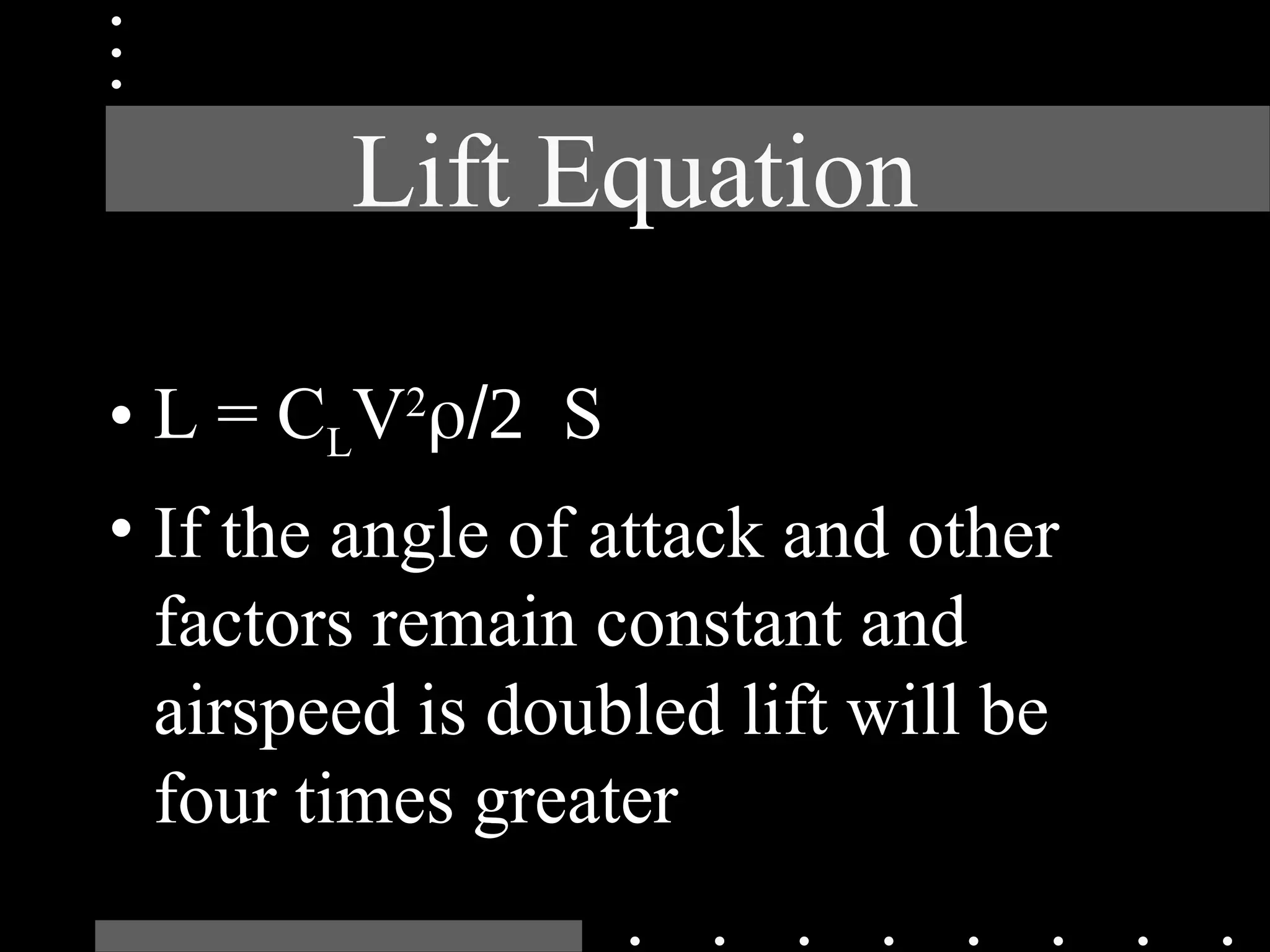
• L = CLV2
S
• If the angle of attack and other
factors remain constant and
airspeed is doubled lift will be
four times greater
Controlling Lift
• What are four ways commonly
used to control lift?
Controlling Lift
• Increase airspeed
• Change the angle of attack
• Change the shape of the airfoil
• Change the total area of the
wings
Angle of Attack
• Directly controls the distribution
of pressure acting on a wing. By
changing the angle of attack,
you can control the airplane’s
lift, airspeed and drag.
Angle of Attack
• Angle of attack at which a wing
stalls remains constant
regardless of weight, dynamic
pressure, bank angle or pitch
attitude.
Angle of Attack
• When the angle of attack of a
symmetrical airfoil is increased,
the center of pressure will
remain unaffected.
Angle of Attack
• At high angle of attack,
pressure increases below the
wing, and the increase in lift is
accompanied by an increase in
induced drag.
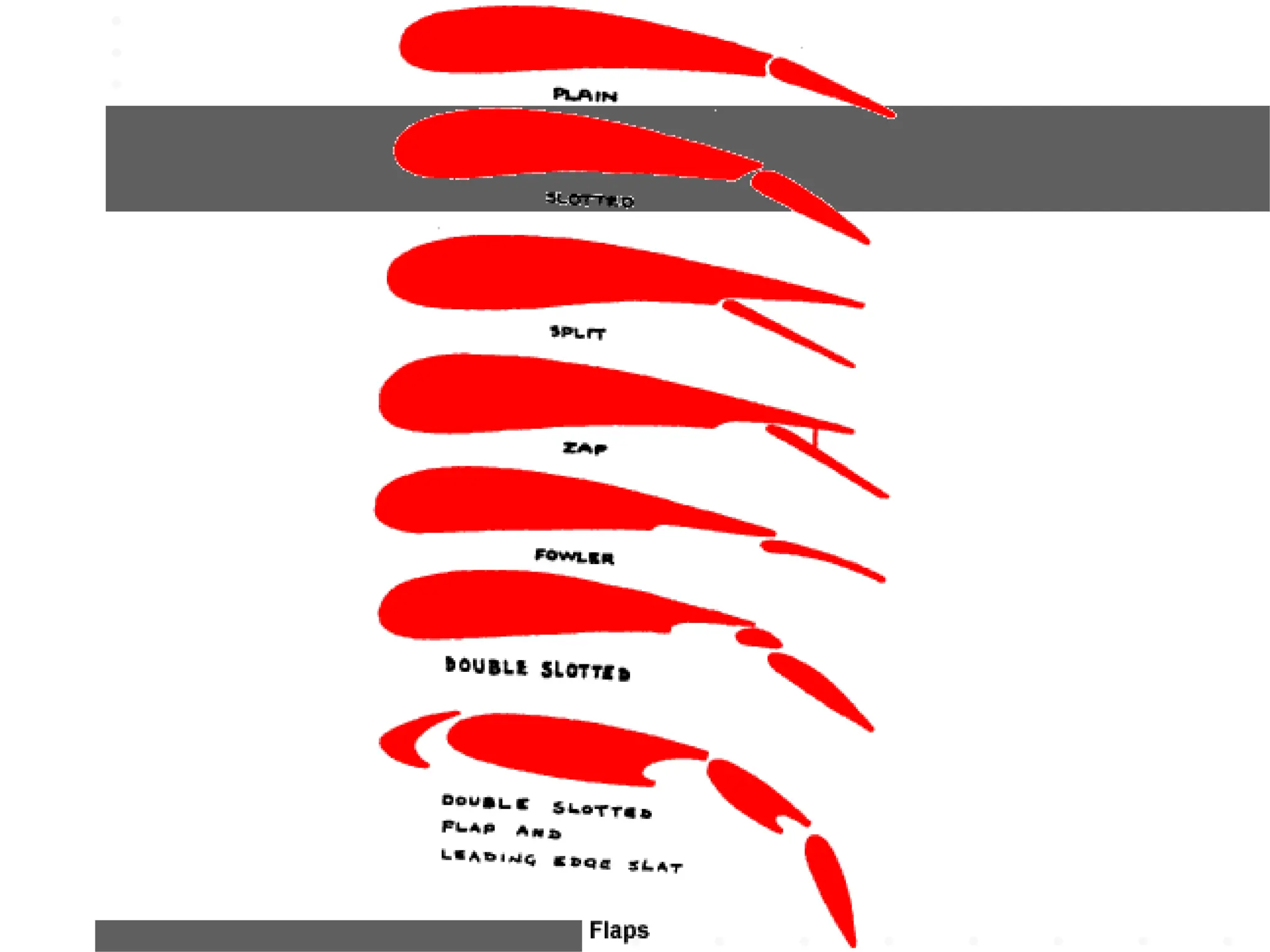
Flaps
• What are the four types of flaps
found on general aviation
aircraft?
Flaps
• Plain
• Split
• Slotted
• Fowler
Leading Edge Devices
• Slot
• Slats
• Leading Edge Flaps
Drag
• Induced drag is a by-product of
lift and is greatly affected by
changes of airspeed.
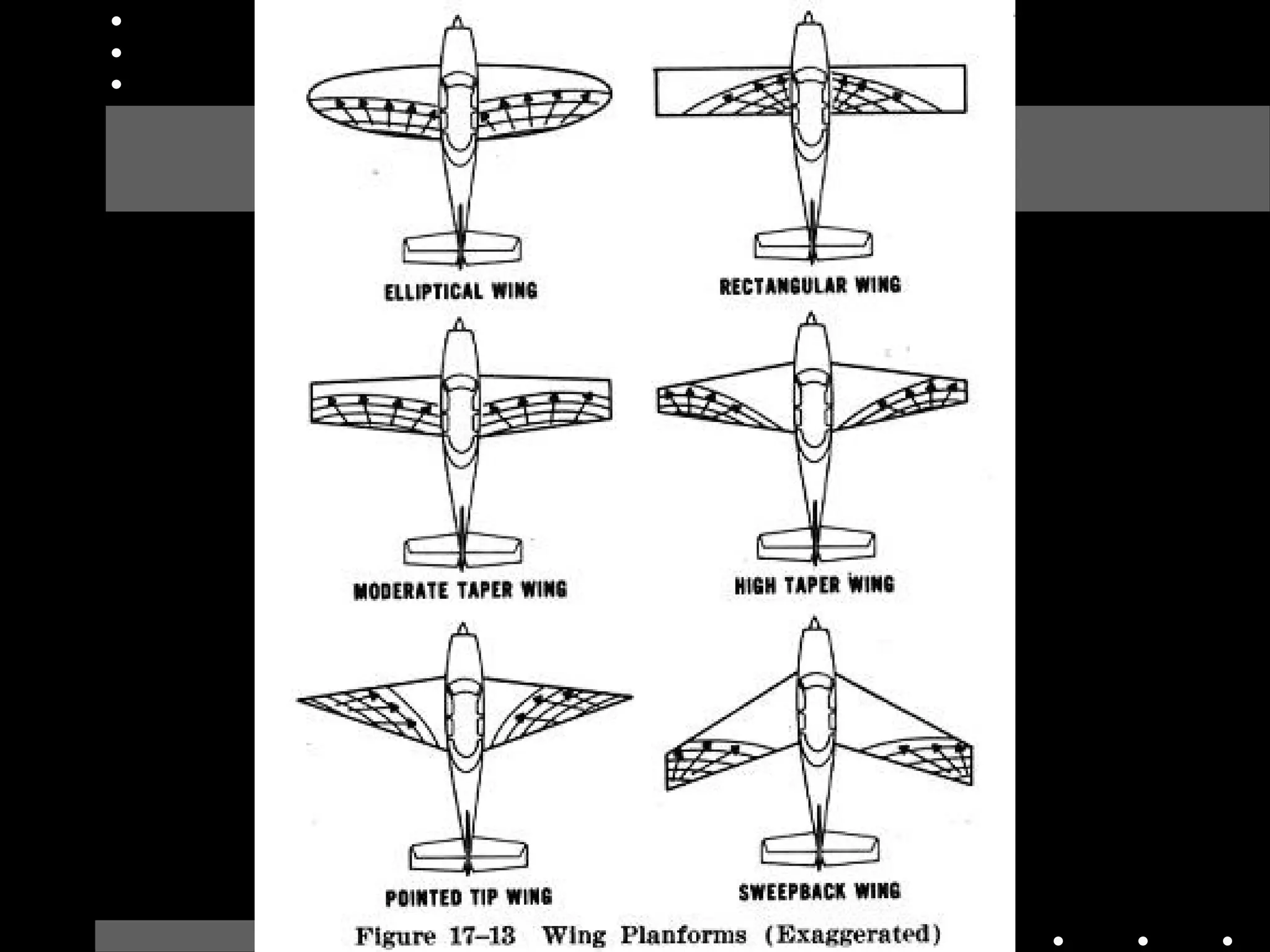
Wing Planform
• Name several wing shapes and
their advantages?
Wing Planform
• Elliptical - Excellent load
distribution for high-G
maneuvering and low drag for
high speeds
• Rectangular - stall first at root,
least expensive
Wing Planform
• Tapered - Favorable stall
characteristics with good load
distribution, saves weight
• Delta - supersonic flight
Wing Planform
• How do you find the Aspect
Ratio of an airplane?
Wing Planform
• Found by dividing the
wingspan by the average cord.
• What is a typical aspect ratio
for typical training aircraft?
• Gliders?
Wing Planform
• Gliders - 20 to 30
• Training Aircraft - 7 to 9
Wing Planform
• What is sweep?
• A line connecting the 25% cord points of all
the wing ribs which is not perpendicular to
the longitudinal axis of the plane is said to
be swept
• The sweep can be forward but most are back
Wing Planform
• What is a device that is used to
block or diffuse wing tip
vortices?
Wing Planform
• Winglets
• Winglets can increase fuel
efficiency at high speeds at
altitudes by as much as 16 to
26%
Ground Effect
• Where is ground effect found?
Ground Effect
• Within one wingspan of the
ground
• An airplane leaving ground
effect will experience an
increase in what kind of drag?
Ground Effect
• Induced Drag
• Induced Drag is only about half
of its usual value when the
wing is at 10% of its span
above the ground
Drag
• What kind of drags rate of
increase is proportional to the
square of the airspeed?
Drag
• What kind of drags rate of
increase is proportional to the
square of the airspeed?
• Parasite Drag
• What kinds of drag make up
parasite Drag
Drag
• Form Drag - based on the shape
of the plane, how well
streamlined and amount of
frontal area.
Drag
• Interference Drag - created when
the airflow around one part of the
airplane interacts with the airflow
around another.
• Skin Friction Drag - surface
friction
Total Drag
• The sum of the induced drag and
the parasite drag.
• Total drag is lowest at the
airspeed which produces the
highest ratio of lift to drag
L/Dmax
Total Drag
• Best power-off glide range
• Greatest Range
High Drag Devices
• Spoilers
• Speed Brakes
Spoilers
• What are the advantages of
using spoilers?
Spoilers
• Rapid descent without reducing power,
engine stays warm
• Maintain normal descent speed
• Help slow to landing gear extension speed
• Descent rapidly through icing
• Stay at high altitudes longer
Thrust
• Opposes drag. If greater than
drag, the airplane is accelerating
• A pound of Thrust must be
available for each pound of
drag.
Thrust
• Power is the rate at which work
is done. It takes less power to
do the same amount of work at
a slower rate.
Propeller Efficiency
• High angle of attack at root,
low angle of attack at tip
• Elliptical planform
• High Aspect ratio
Max Level Flight Speed
• Intersection of the Power or
Thrust required curve with the
Power or Thrust available
curve.
Load Factor
• Ratio between the lift generated
by the wings at any given time
divided by the total weight of
the airplane.
Load Factor
• What is the relationship
between a heavily loaded
airplane and stall speed
compared to a lightly loaded
airplane?
Load Factor
• A heavily loaded plane stalls at a
higher speed than a lightly loaded
airplane.
• It needs a higher angle of attack to
generate required lift at any given
speed than when lightly loaded.
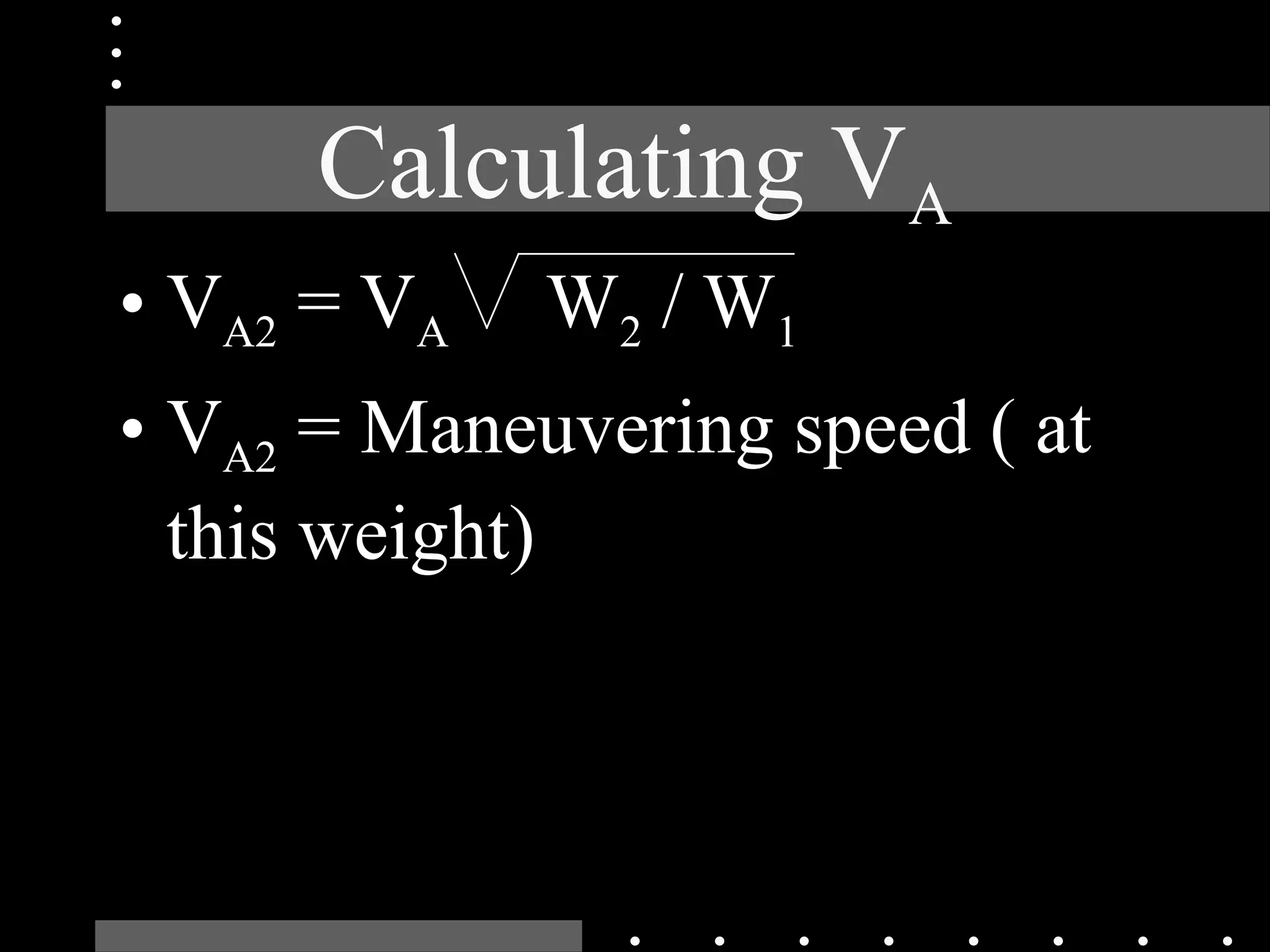
Calculating VA
• VA2 = VA W2 / W1
• VA2 = Maneuvering speed ( at
this weight)
Calculating VA
• VA = Maneuvering speed at
Maximum weight
• W2 = Actual Airplane Weight
• W1 = Maximum Weight
V-G Diagram
• Relates velocity to load factor
• Applies to one airplane type
• Valid for a specific weight,
configuration and altitude
Aircraft Stability
• Static Stability
• Dynamic Stability
Aircraft Stability
• Longitudinal Stability
• Stable in pitch or stable about
the lateral axis
• Motion of the plane controlled
by the elevators
Aircraft Stability
• Achieved by locating the center
of gravity slightly ahead of the
center of lift
• Need a tail down force on the
elevator
Aircraft Stability
• Lateral stability
• Return to wings level following a
roll deviation
• Dihedral
–Low wing aircraft have more
• Sweep
Aircraft Stability
• Sweep may be used when
dihedral would be inappropriate
such as in an aerobatic airplane
that needs lateral stability while
inverted
Aircraft Stability
• Directional Stability
• Vertical tail and sides of the
fuselage contribute forces which
help to keep the longitudinal axis
aligned with the relative wind.
Flight Maneuvers
• Straight and Level
• To maintain altitude while
airspeed is being reduced, the
angle of attack must be
increased
Flight Maneuvers
• Climbs
• Transitioning to a climb, angle
of attack increases and lift
momentarily increases
–Thrust acts along the flight path
Climb Performance
• Decreases with altitude
• Absolute Ceiling
• Service Ceiling
Turns
• What force turns an airplane?
Turns
• The horizontal component of lift.
• Load Factor and Turns
• The relationship between angle of
bank , load factor, and stall speed
is the same for all airplanes
Turns
• Rate and radius
• Steeper bank reduces turn
radius and increases the rate of
turn, but produces higher load
factors
Turns
• A given airspeed and bank
angle will produce a specific
rate and radius of turn in any
airplane
• Adverse Yaw
Stalls
• Angle of attack
• Power-on stalls
• Power-off stalls
• Accelerated stall
Stalls
• Secondary stall
• Cross-controlled stall
• Elevator trim stall
Stalls
• Total weight, load factor, and
CG location affect stall speed
Spins
• Incipient spin
• Fully developed spin
• Spin recovery
• What type of spin can result if the
CG is too far aft and the rotation is
around the CG?
Spins
• Flat Spin
• Spin Recovery
Spin Recovery
• Throttle to idle
• Neutralize the ailerons
• Determine the direction or
rotation
• Apply full opposite rudder
Spin Recovery
• Apply forward elevator
• As rotation stops, neutralize the
rudder
• Gradually apply aft elevator to
return to level flight
One of the main functions of flaps
during the approach and landing is to
.
A. decrease lift, thus
enabling a steeper-than-
normal approach to be made.
B. decrease the angle of
descent without increasing
the airspeed.
C. provide the same amount
of lift at a slower airspeed
One of the main functions of flaps
during the approach and landing is to
C. provide the same amount of lift at
a slower airspeed
Which is true regarding the use of flaps
during level turns?
A. The raising of flaps increases the
stall speed.
B. The lowering of flaps increases the
stall speed.
C. Raising flaps will require added
forward pressure on the yoke or stick.
Which is true regarding the use of flaps
during level turns?
A. The raising of flaps increases the
stall speed.
A rectangular wing, as compared to
other wing planforms, has a tendency
to stall first at the
A. center trailing edge, with the stall
progression outward toward the wing root and
tip.
B. wing root, with the stall progression toward
the wing tip.
C. wingtip, with the stall progression toward
the wing root.
A rectangular wing, as compared to
other wing planforms, has a tendency
to stall first at the
B. wing root, with the stall
progression toward the wing tip.
By changing the angle of attack of a wing,
the pilot can control the airplane's
A. lift, airspeed, and CG.
B. lift and airspeed, but not drag.
C. lift, airspeed, and drag.
By changing the angle of attack of a wing,
the pilot can control the airplane's
C. lift, airspeed, and drag.
The angle of attack of a wing directly
controls the
A. amount of airflow above and below the
wing.
B. angle of incidence of the wing.
C. distribution of pressures acting on the
wing.
The angle of attack of a wing directly
controls the
C. distribution of pressures acting on the
wing.
The angle of attack at which a wing
stalls remains constant regardless of
A. dynamic pressure, but varies with weight,
bank angle, and pitch attitude.
B. weight, dynamic pressure, bank angle, or
pitch attitude.
C. weight and pitch attitude, but varies with
dynamic pressure and bank angle.
The angle of attack at which a wing
stalls remains constant regardless of
B. weight, dynamic pressure, bank
angle, or pitch attitude.
The need to slow an aircraft below VA is
brought about by the following weather
phenomenon:
A. Turbulence which causes a decrease
in stall speed.
B. High density altitude which
increases the indicated stall speed.
C. Turbulence which causes an increase
in stall speed.
The need to slow an aircraft below VA is
brought about by the following weather
phenomenon:
C. Turbulence which causes an increase in
stall speed.
Stall speed is affected by
A. angle of attack, weight, and air
density.
B. weight, load factor, and power.
C. load factor, angle of attack, and
power.
Stall speed is affected by
B. weight, load factor, and power.
The stalling speed of an airplane is most
affected by
A. variations in airplane loading.
B. variations in flight altitude.
C. changes in air density.
The stalling speed of an airplane is most
affected by
A. variations in airplane loading.
An airplane will stall at the same
A. airspeed regardless of the attitude with
relation to the horizon.
B. angle of attack and attitude with relation
to the horizon.
C. angle of attack regardless of the attitude
with relation to the horizon.
An airplane will stall at the same
C. angle of attack regardless of
the attitude with relation to the
horizon.
In a rapid recovery from a dive, the
effects of load factor would cause the
stall speed to
A. not vary.
B. increase.
C. decrease.
In a rapid recovery from a dive, the
effects of load factor would cause the
stall speed to
B. increase.
Recovery from a stall in any airplane
becomes more difficult when its
A.elevator trim is adjusted nosedown.
B.center of gravity moves forward.
C.center of gravity moves aft
Recovery from a stall in any airplane
becomes more difficult when its
C.center of gravity moves aft
(Refer to figure 2.) Select the correct
statement regarding stall speeds.
A. Power-off stalls occur at higher airspeeds
with the gear and flaps down.
B. In a 60° bank the airplane stalls at a lower
airspeed with the gear up.
C. Power-on stalls occur at lower airspeeds
in shallower banks.
(Refer to figure 2.) Select the correct
statement regarding stall speeds.
C. Power-on stalls occur at lower
airspeeds in shallower banks.
Refer to figure 2.) Select the correct
statement regarding stall speeds. The
airplane will stall
A. 10 knots higher in a 45° bank, power-on stall,
than in a wings-level stall.
B. 10 knots higher in a power-on, 60° bank, with
gear and flaps up, than with gear and flaps down.
C. 25 knots lower in a power-off, flaps-up, 60° bank,
than in a power-off, flaps-down, wings-level
configuration.
Refer to figure 2.) Select the correct
statement regarding stall speeds. The
airplane will stall
B. 10 knots higher in a power-on, 60°
bank, with gear and flaps up, than with gear
and flaps down.
advanced-aerodynamic highspeed aerodynamics s.ppt

  • 1.
  • 2.
    Fundamental Flight Maneuvers •Straight and Level • Turns • Climbs • Descents
  • 3.
    Four Aerodynamic Forces •Lift • Thrust • Drag • Weight • When are they in equilibrium?
  • 4.
    Four Aerodynamic Forces •In steady-state or unaccelerated straight and level flight • What happens when you initiate a climb?
  • 5.
    Four Aerodynamic Forces •Lift briefly exceeds weight. • Rearward component of the Lift adds to drag • Upward component of Thrust is called the Lift of Thrust
  • 6.
    Four Aerodynamic Forces •Once the climb is established, the forces are again balanced
  • 7.
    Lift • Which ofNewton’s laws of motion are used to describe lift?
  • 8.
    Lift • Second lawof motion says that a force results whenever a mass is accelerated F = ma • Third law states for every action there is an equal and opposite reaction
  • 9.
    Bernoulli’s Principle • Asthe velocity of a fluid increase, its internal pressure decreases • High pressure under the wing and lower pressure above the wing’s surface
  • 10.
    Lift • In whatdirection does lift act? • Perpendicular to the relative wind • Drag acts parallel to the flight path in the same direction as the relative wind
  • 11.
    Lift • Angle ofincidence • Angle of attack • Washout
  • 12.
    Lift Equation • L= CLV2 S • If the angle of attack and other factors remain constant and airspeed is doubled lift will be four times greater
  • 13.
    Controlling Lift • Whatare four ways commonly used to control lift?
  • 14.
    Controlling Lift • Increaseairspeed • Change the angle of attack • Change the shape of the airfoil • Change the total area of the wings
  • 15.
    Angle of Attack •Directly controls the distribution of pressure acting on a wing. By changing the angle of attack, you can control the airplane’s lift, airspeed and drag.
  • 16.
    Angle of Attack •Angle of attack at which a wing stalls remains constant regardless of weight, dynamic pressure, bank angle or pitch attitude.
  • 17.
    Angle of Attack •When the angle of attack of a symmetrical airfoil is increased, the center of pressure will remain unaffected.
  • 18.
    Angle of Attack •At high angle of attack, pressure increases below the wing, and the increase in lift is accompanied by an increase in induced drag.
  • 19.
    Flaps • What arethe four types of flaps found on general aviation aircraft?
  • 20.
  • 22.
    Leading Edge Devices •Slot • Slats • Leading Edge Flaps
  • 24.
    Drag • Induced dragis a by-product of lift and is greatly affected by changes of airspeed.
  • 25.
    Wing Planform • Nameseveral wing shapes and their advantages?
  • 26.
    Wing Planform • Elliptical- Excellent load distribution for high-G maneuvering and low drag for high speeds • Rectangular - stall first at root, least expensive
  • 27.
    Wing Planform • Tapered- Favorable stall characteristics with good load distribution, saves weight • Delta - supersonic flight
  • 29.
    Wing Planform • Howdo you find the Aspect Ratio of an airplane?
  • 30.
    Wing Planform • Foundby dividing the wingspan by the average cord. • What is a typical aspect ratio for typical training aircraft? • Gliders?
  • 31.
    Wing Planform • Gliders- 20 to 30 • Training Aircraft - 7 to 9
  • 32.
    Wing Planform • Whatis sweep? • A line connecting the 25% cord points of all the wing ribs which is not perpendicular to the longitudinal axis of the plane is said to be swept • The sweep can be forward but most are back
  • 33.
    Wing Planform • Whatis a device that is used to block or diffuse wing tip vortices?
  • 34.
    Wing Planform • Winglets •Winglets can increase fuel efficiency at high speeds at altitudes by as much as 16 to 26%
  • 36.
    Ground Effect • Whereis ground effect found?
  • 37.
    Ground Effect • Withinone wingspan of the ground • An airplane leaving ground effect will experience an increase in what kind of drag?
  • 38.
    Ground Effect • InducedDrag • Induced Drag is only about half of its usual value when the wing is at 10% of its span above the ground
  • 39.
    Drag • What kindof drags rate of increase is proportional to the square of the airspeed?
  • 40.
    Drag • What kindof drags rate of increase is proportional to the square of the airspeed? • Parasite Drag • What kinds of drag make up parasite Drag
  • 41.
    Drag • Form Drag- based on the shape of the plane, how well streamlined and amount of frontal area.
  • 42.
    Drag • Interference Drag- created when the airflow around one part of the airplane interacts with the airflow around another. • Skin Friction Drag - surface friction
  • 43.
    Total Drag • Thesum of the induced drag and the parasite drag. • Total drag is lowest at the airspeed which produces the highest ratio of lift to drag L/Dmax
  • 44.
    Total Drag • Bestpower-off glide range • Greatest Range
  • 45.
    High Drag Devices •Spoilers • Speed Brakes
  • 46.
    Spoilers • What arethe advantages of using spoilers?
  • 47.
    Spoilers • Rapid descentwithout reducing power, engine stays warm • Maintain normal descent speed • Help slow to landing gear extension speed • Descent rapidly through icing • Stay at high altitudes longer
  • 48.
    Thrust • Opposes drag.If greater than drag, the airplane is accelerating • A pound of Thrust must be available for each pound of drag.
  • 49.
    Thrust • Power isthe rate at which work is done. It takes less power to do the same amount of work at a slower rate.
  • 50.
    Propeller Efficiency • Highangle of attack at root, low angle of attack at tip • Elliptical planform • High Aspect ratio
  • 51.
    Max Level FlightSpeed • Intersection of the Power or Thrust required curve with the Power or Thrust available curve.
  • 52.
    Load Factor • Ratiobetween the lift generated by the wings at any given time divided by the total weight of the airplane.
  • 53.
    Load Factor • Whatis the relationship between a heavily loaded airplane and stall speed compared to a lightly loaded airplane?
  • 54.
    Load Factor • Aheavily loaded plane stalls at a higher speed than a lightly loaded airplane. • It needs a higher angle of attack to generate required lift at any given speed than when lightly loaded.
  • 55.
    Calculating VA • VA2= VA W2 / W1 • VA2 = Maneuvering speed ( at this weight)
  • 56.
    Calculating VA • VA= Maneuvering speed at Maximum weight • W2 = Actual Airplane Weight • W1 = Maximum Weight
  • 57.
    V-G Diagram • Relatesvelocity to load factor • Applies to one airplane type • Valid for a specific weight, configuration and altitude
  • 58.
    Aircraft Stability • StaticStability • Dynamic Stability
  • 59.
    Aircraft Stability • LongitudinalStability • Stable in pitch or stable about the lateral axis • Motion of the plane controlled by the elevators
  • 60.
    Aircraft Stability • Achievedby locating the center of gravity slightly ahead of the center of lift • Need a tail down force on the elevator
  • 61.
    Aircraft Stability • Lateralstability • Return to wings level following a roll deviation • Dihedral –Low wing aircraft have more • Sweep
  • 62.
    Aircraft Stability • Sweepmay be used when dihedral would be inappropriate such as in an aerobatic airplane that needs lateral stability while inverted
  • 63.
    Aircraft Stability • DirectionalStability • Vertical tail and sides of the fuselage contribute forces which help to keep the longitudinal axis aligned with the relative wind.
  • 64.
    Flight Maneuvers • Straightand Level • To maintain altitude while airspeed is being reduced, the angle of attack must be increased
  • 65.
    Flight Maneuvers • Climbs •Transitioning to a climb, angle of attack increases and lift momentarily increases –Thrust acts along the flight path
  • 66.
    Climb Performance • Decreaseswith altitude • Absolute Ceiling • Service Ceiling
  • 67.
    Turns • What forceturns an airplane?
  • 68.
    Turns • The horizontalcomponent of lift. • Load Factor and Turns • The relationship between angle of bank , load factor, and stall speed is the same for all airplanes
  • 69.
    Turns • Rate andradius • Steeper bank reduces turn radius and increases the rate of turn, but produces higher load factors
  • 70.
    Turns • A givenairspeed and bank angle will produce a specific rate and radius of turn in any airplane • Adverse Yaw
  • 71.
    Stalls • Angle ofattack • Power-on stalls • Power-off stalls • Accelerated stall
  • 72.
    Stalls • Secondary stall •Cross-controlled stall • Elevator trim stall
  • 73.
    Stalls • Total weight,load factor, and CG location affect stall speed
  • 74.
    Spins • Incipient spin •Fully developed spin • Spin recovery • What type of spin can result if the CG is too far aft and the rotation is around the CG?
  • 75.
  • 76.
    Spin Recovery • Throttleto idle • Neutralize the ailerons • Determine the direction or rotation • Apply full opposite rudder
  • 77.
    Spin Recovery • Applyforward elevator • As rotation stops, neutralize the rudder • Gradually apply aft elevator to return to level flight
  • 78.
    One of themain functions of flaps during the approach and landing is to .
  • 79.
    A. decrease lift,thus enabling a steeper-than- normal approach to be made. B. decrease the angle of descent without increasing the airspeed. C. provide the same amount of lift at a slower airspeed
  • 80.
    One of themain functions of flaps during the approach and landing is to C. provide the same amount of lift at a slower airspeed
  • 81.
    Which is trueregarding the use of flaps during level turns?
  • 82.
    A. The raisingof flaps increases the stall speed. B. The lowering of flaps increases the stall speed. C. Raising flaps will require added forward pressure on the yoke or stick.
  • 83.
    Which is trueregarding the use of flaps during level turns? A. The raising of flaps increases the stall speed.
  • 84.
    A rectangular wing,as compared to other wing planforms, has a tendency to stall first at the
  • 85.
    A. center trailingedge, with the stall progression outward toward the wing root and tip. B. wing root, with the stall progression toward the wing tip. C. wingtip, with the stall progression toward the wing root.
  • 86.
    A rectangular wing,as compared to other wing planforms, has a tendency to stall first at the B. wing root, with the stall progression toward the wing tip.
  • 87.
    By changing theangle of attack of a wing, the pilot can control the airplane's A. lift, airspeed, and CG. B. lift and airspeed, but not drag. C. lift, airspeed, and drag.
  • 88.
    By changing theangle of attack of a wing, the pilot can control the airplane's C. lift, airspeed, and drag.
  • 89.
    The angle ofattack of a wing directly controls the A. amount of airflow above and below the wing. B. angle of incidence of the wing. C. distribution of pressures acting on the wing.
  • 90.
    The angle ofattack of a wing directly controls the C. distribution of pressures acting on the wing.
  • 91.
    The angle ofattack at which a wing stalls remains constant regardless of
  • 92.
    A. dynamic pressure,but varies with weight, bank angle, and pitch attitude. B. weight, dynamic pressure, bank angle, or pitch attitude. C. weight and pitch attitude, but varies with dynamic pressure and bank angle.
  • 93.
    The angle ofattack at which a wing stalls remains constant regardless of B. weight, dynamic pressure, bank angle, or pitch attitude.
  • 94.
    The need toslow an aircraft below VA is brought about by the following weather phenomenon:
  • 95.
    A. Turbulence whichcauses a decrease in stall speed. B. High density altitude which increases the indicated stall speed. C. Turbulence which causes an increase in stall speed.
  • 96.
    The need toslow an aircraft below VA is brought about by the following weather phenomenon: C. Turbulence which causes an increase in stall speed.
  • 97.
    Stall speed isaffected by A. angle of attack, weight, and air density. B. weight, load factor, and power. C. load factor, angle of attack, and power.
  • 98.
    Stall speed isaffected by B. weight, load factor, and power.
  • 99.
    The stalling speedof an airplane is most affected by A. variations in airplane loading. B. variations in flight altitude. C. changes in air density.
  • 100.
    The stalling speedof an airplane is most affected by A. variations in airplane loading.
  • 101.
    An airplane willstall at the same
  • 102.
    A. airspeed regardlessof the attitude with relation to the horizon. B. angle of attack and attitude with relation to the horizon. C. angle of attack regardless of the attitude with relation to the horizon.
  • 103.
    An airplane willstall at the same C. angle of attack regardless of the attitude with relation to the horizon.
  • 104.
    In a rapidrecovery from a dive, the effects of load factor would cause the stall speed to A. not vary. B. increase. C. decrease.
  • 105.
    In a rapidrecovery from a dive, the effects of load factor would cause the stall speed to B. increase.
  • 106.
    Recovery from astall in any airplane becomes more difficult when its A.elevator trim is adjusted nosedown. B.center of gravity moves forward. C.center of gravity moves aft
  • 107.
    Recovery from astall in any airplane becomes more difficult when its C.center of gravity moves aft
  • 108.
    (Refer to figure2.) Select the correct statement regarding stall speeds.
  • 109.
    A. Power-off stallsoccur at higher airspeeds with the gear and flaps down. B. In a 60° bank the airplane stalls at a lower airspeed with the gear up. C. Power-on stalls occur at lower airspeeds in shallower banks.
  • 110.
    (Refer to figure2.) Select the correct statement regarding stall speeds. C. Power-on stalls occur at lower airspeeds in shallower banks.
  • 111.
    Refer to figure2.) Select the correct statement regarding stall speeds. The airplane will stall
  • 112.
    A. 10 knotshigher in a 45° bank, power-on stall, than in a wings-level stall. B. 10 knots higher in a power-on, 60° bank, with gear and flaps up, than with gear and flaps down. C. 25 knots lower in a power-off, flaps-up, 60° bank, than in a power-off, flaps-down, wings-level configuration.
  • 113.
    Refer to figure2.) Select the correct statement regarding stall speeds. The airplane will stall B. 10 knots higher in a power-on, 60° bank, with gear and flaps up, than with gear and flaps down.