We will study
•What do we mean by aircraft stability and
control?
• Static and Dynamic Stability
• Longitudinal, lateral and roll stability
• Necessary Conditions for Longitudinal stability
• Stability Margin
• Relaxed Stability Margin
3.
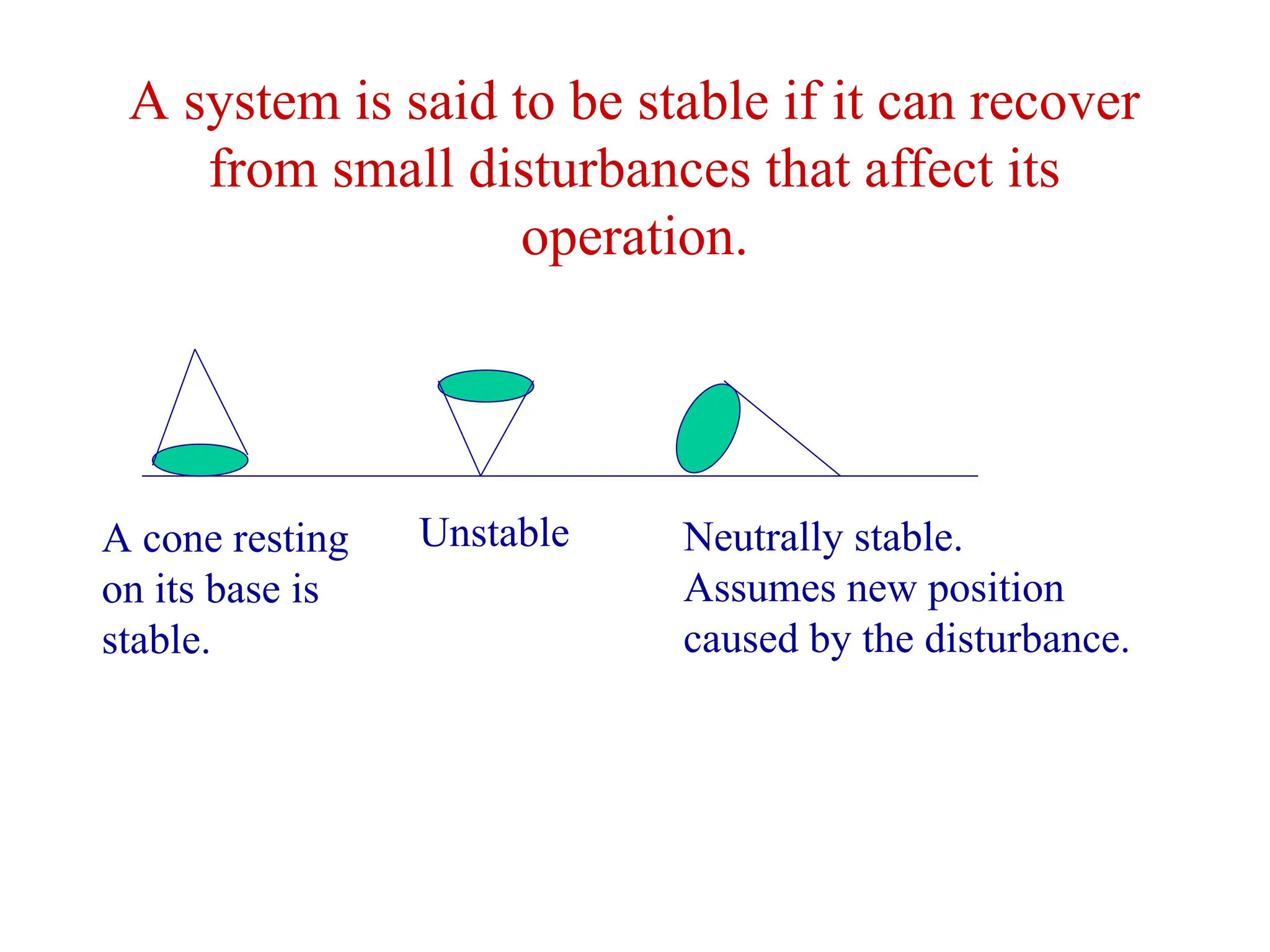
A system issaid to be stable if it can recover
from small disturbances that affect its
operation.
A cone resting
on its base is
stable.
Unstable Neutrally stable.
Assumes new position
caused by the disturbance.
4.
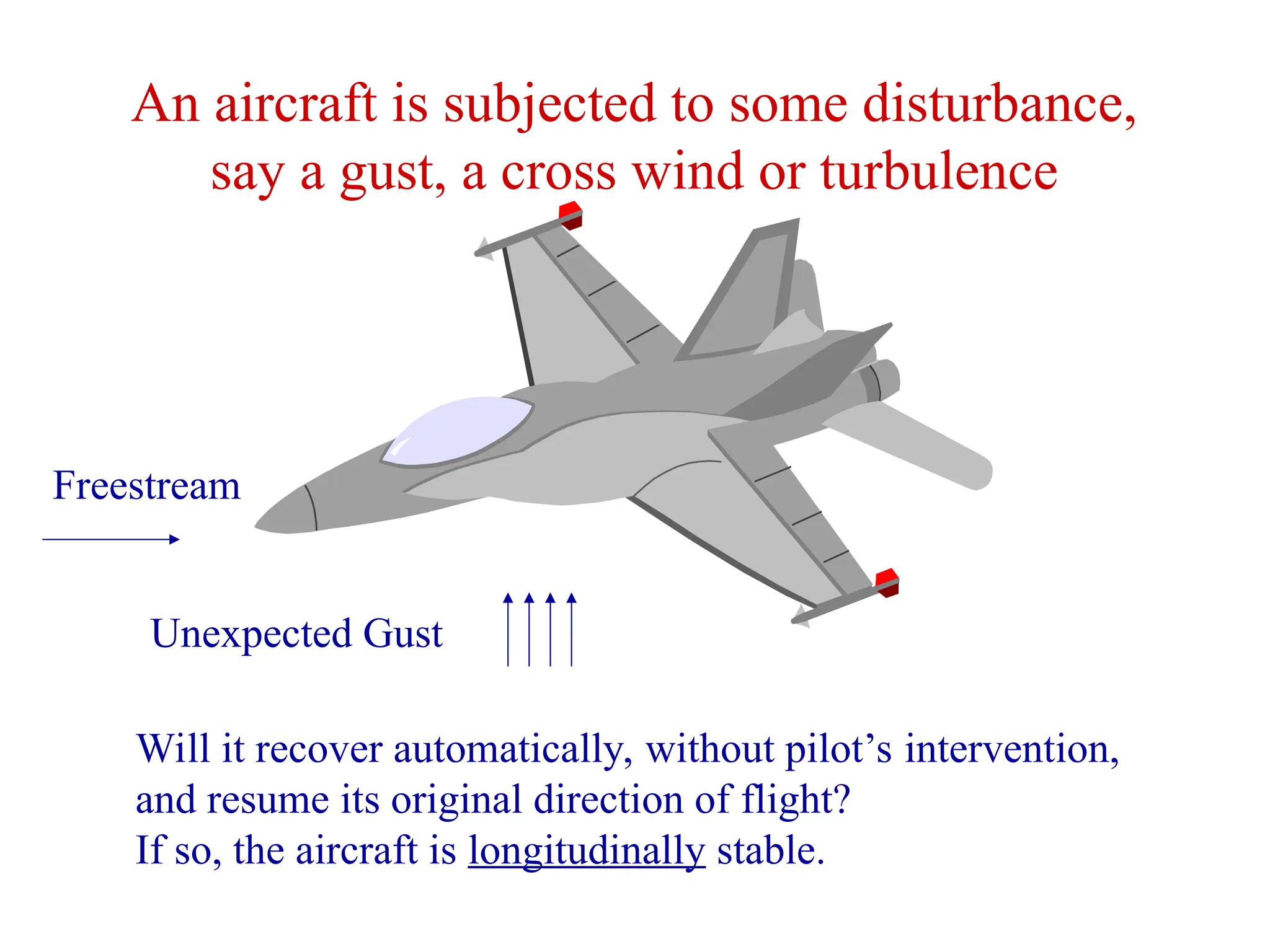
An aircraft issubjected to some disturbance,
say a gust, a cross wind or turbulence
Unexpected Gust
Will it recover automatically, without pilot’s intervention,
and resume its original direction of flight?
If so, the aircraft is longitudinally stable.
Freestream
5.
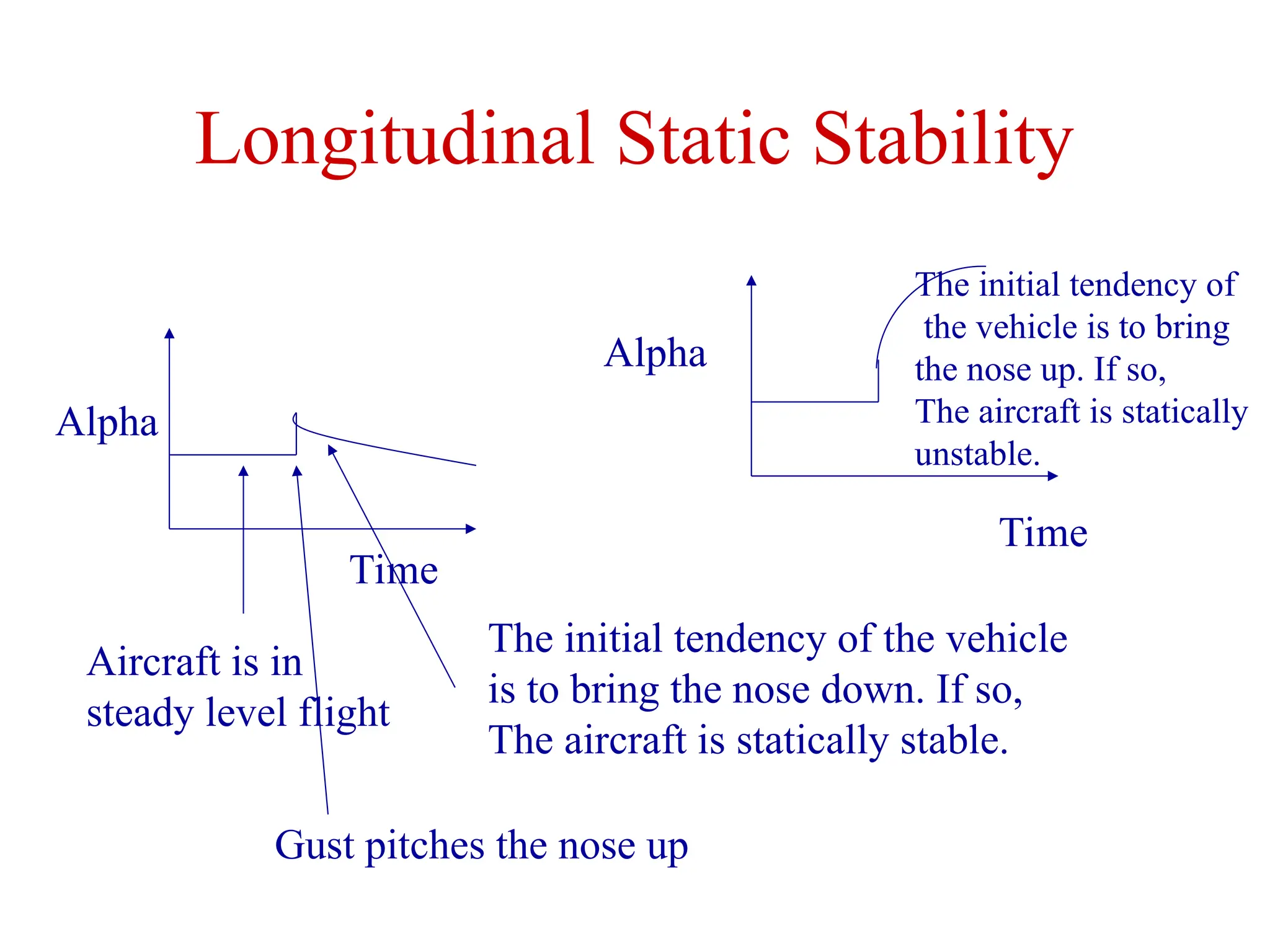
Longitudinal Static Stability
Time
Alpha
Aircraftis in
steady level flight
Gust pitches the nose up
The initial tendency of the vehicle
is to bring the nose down. If so,
The aircraft is statically stable.
Alpha
Time
The initial tendency of
the vehicle is to bring
the nose up. If so,
The aircraft is statically
unstable.
6.
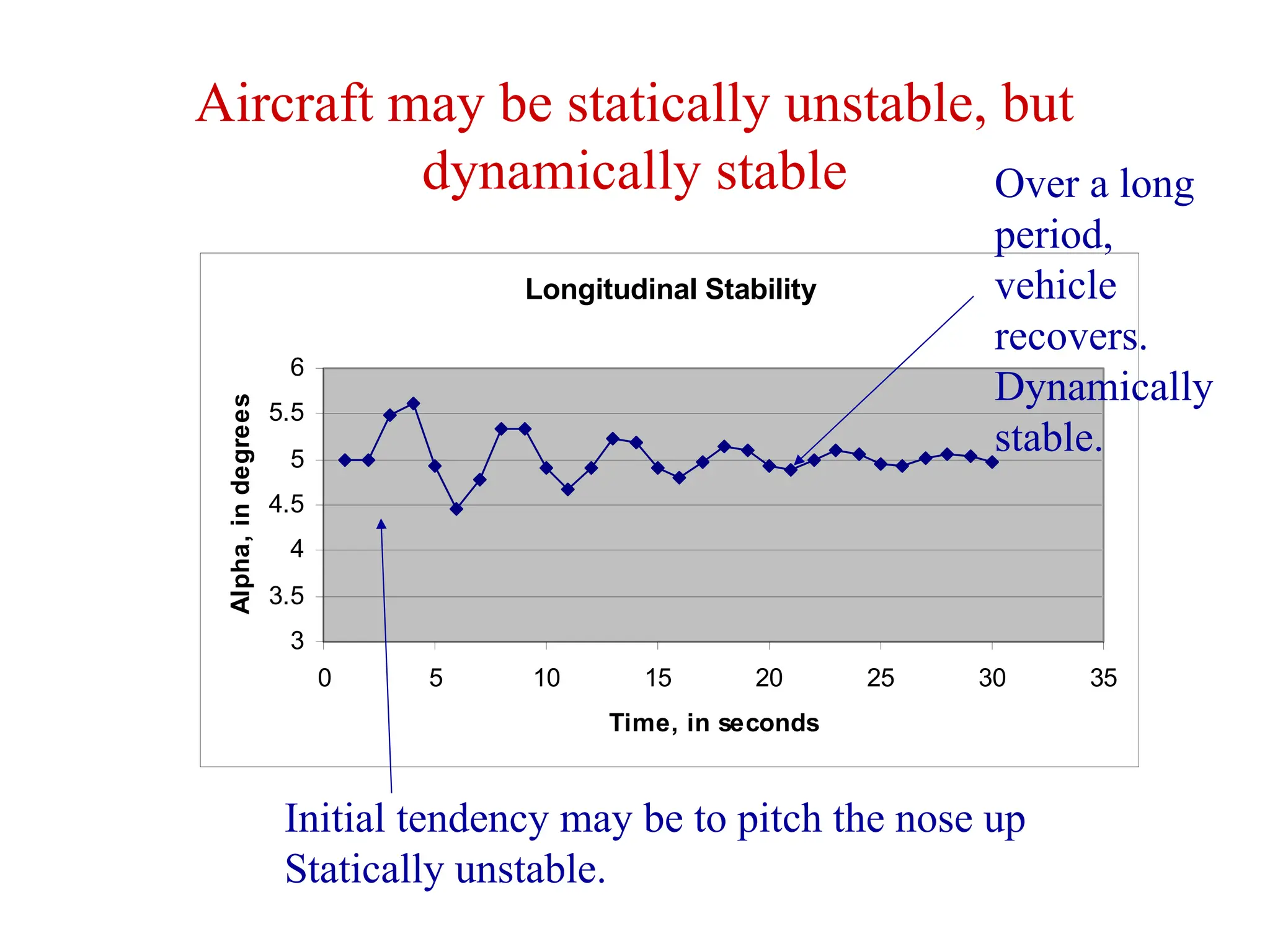
Aircraft may bestatically unstable, but
dynamically stable
Longitudinal Stability
3
3.5
4
4.5
5
5.5
6
0 5 10 15 20 25 30 35
Time, in seconds
Alpha,
in
degrees
Initial tendency may be to pitch the nose up
Statically unstable.
Over a long
period,
vehicle
recovers.
Dynamically
stable.
7.
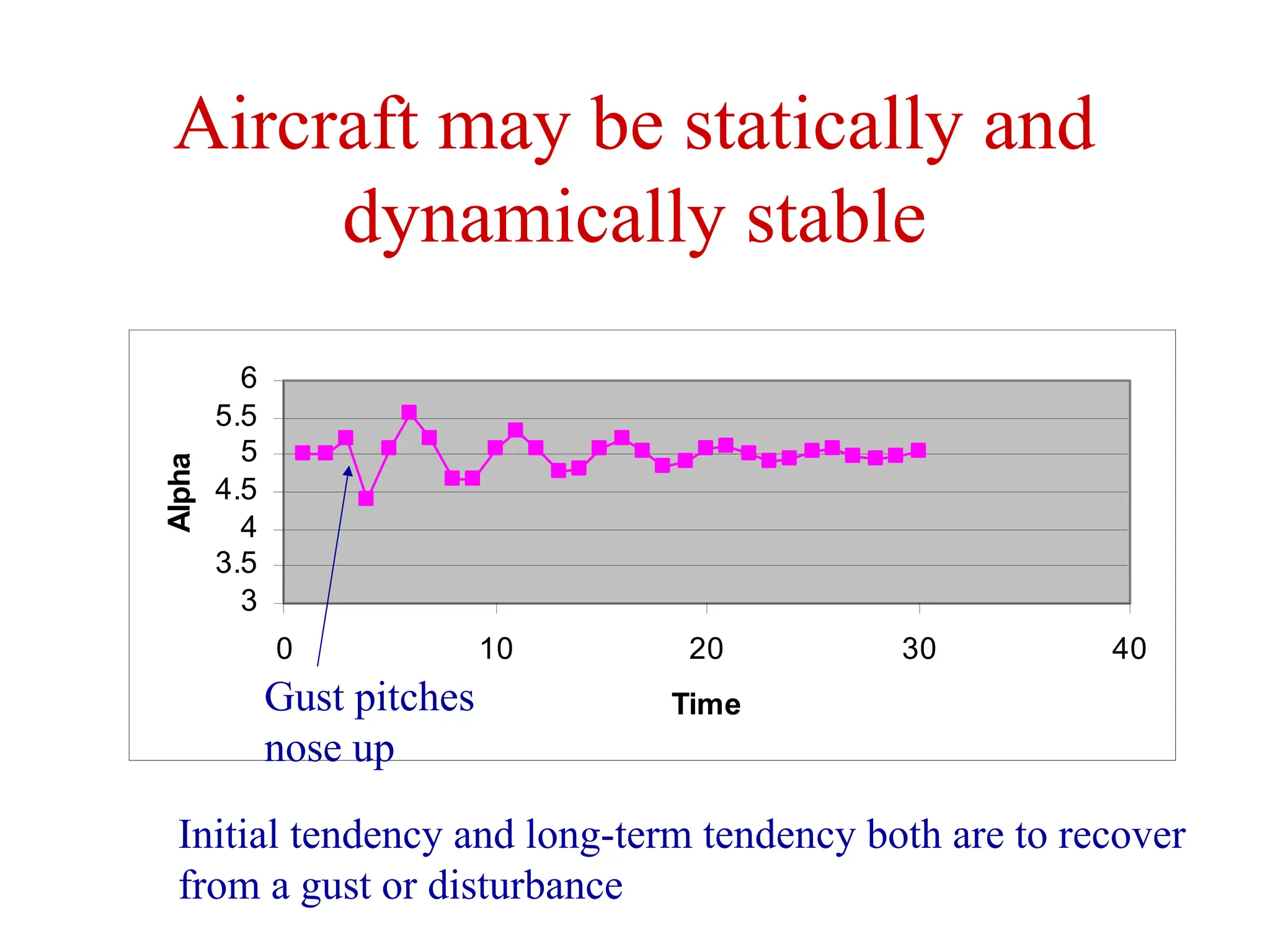
Aircraft may bestatically and
dynamically stable
3
3.5
4
4.5
5
5.5
6
0 10 20 30 40
Time
Alpha
Initial tendency and long-term tendency both are to recover
from a gust or disturbance
Gust pitches
nose up
8.
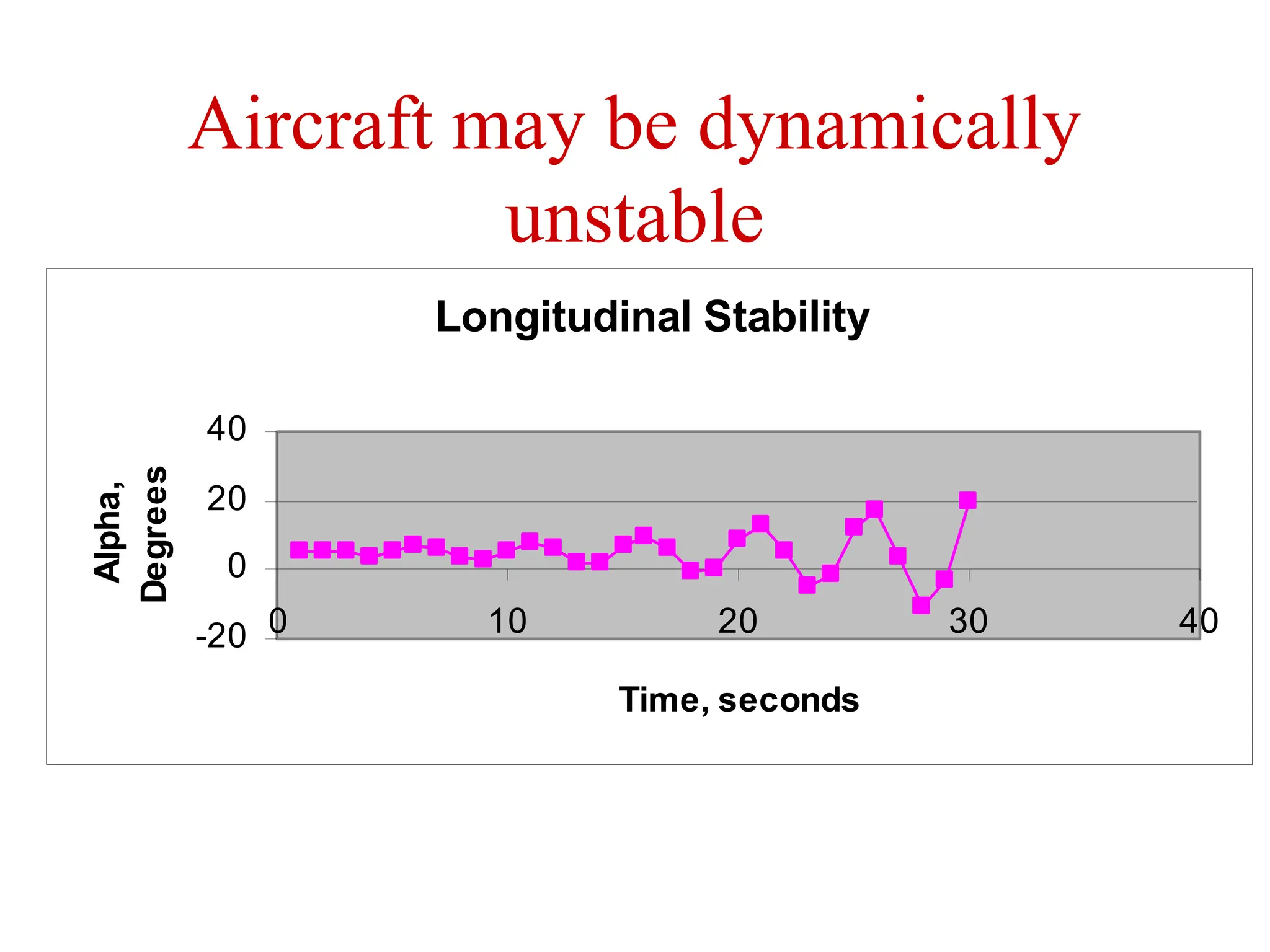
Aircraft may bedynamically
unstable
Longitudinal Stability
-20
0
20
40
0 10 20 30 40
Time, seconds
Alpha,
Degrees
9.
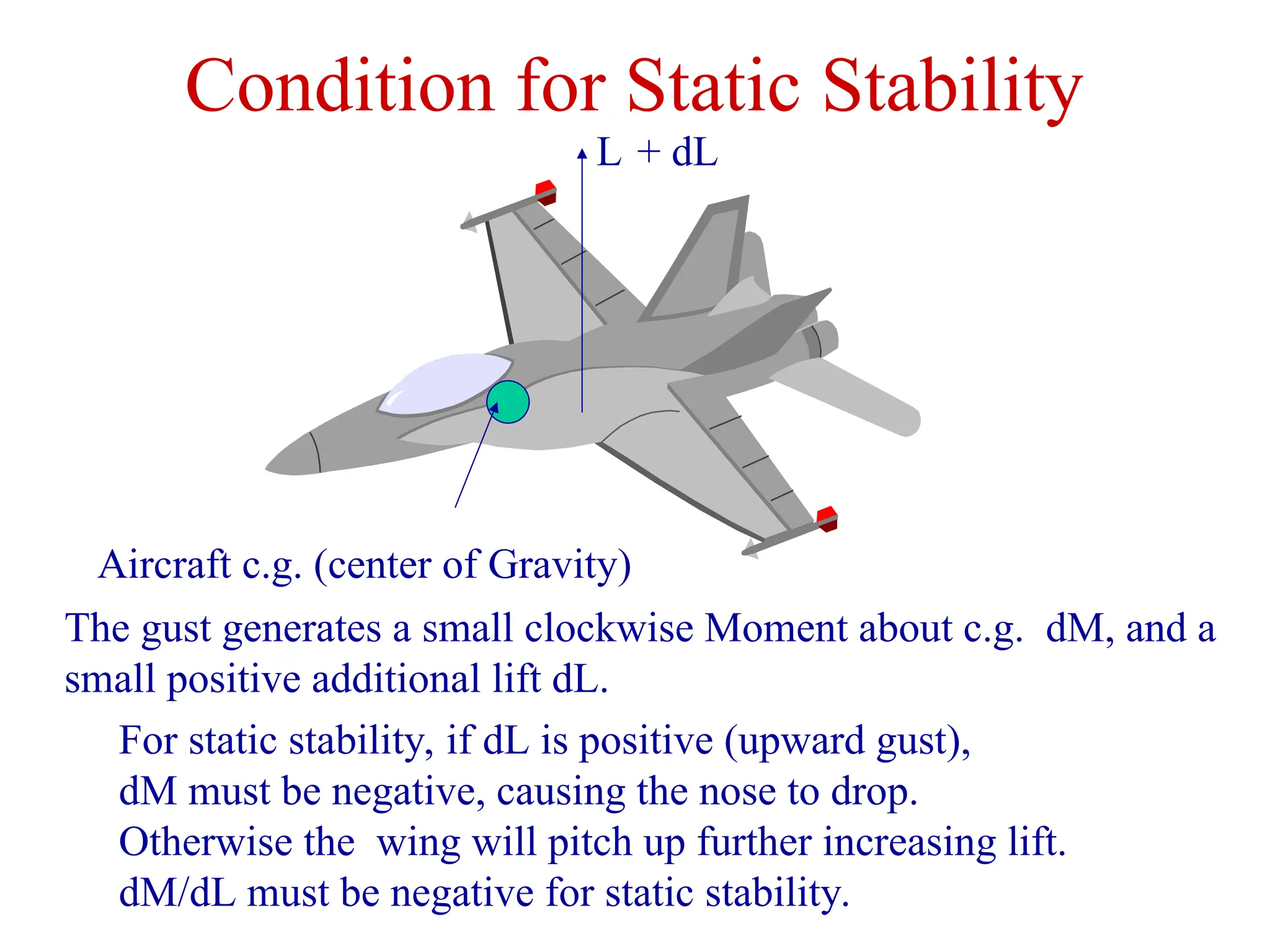
Condition for StaticStability
L
Aircraft c.g. (center of Gravity)
+ dL
The gust generates a small clockwise Moment about c.g. dM, and a
small positive additional lift dL.
For static stability, if dL is positive (upward gust),
dM must be negative, causing the nose to drop.
Otherwise the wing will pitch up further increasing lift.
dM/dL must be negative for static stability.
10.
Nondimensionalization
Lift and pitchingmoment M are usually non-dimensionalized.
L is divided by [1/2 V
2
S] to yield CL
M is divided by [1/2 V
2
S c] to yield CM
Here c is a reference length, e.g. average chord.
From the previous slide, dM/dL must be negative for static stability.
In nondimensional form, dCM/dCL must be negative for
static stability.
The quantity -dCM/dCL is called the static stability margin.
Notice the negative sign.
The more positive it is, the more longitudinally stable the aircraft.
11.
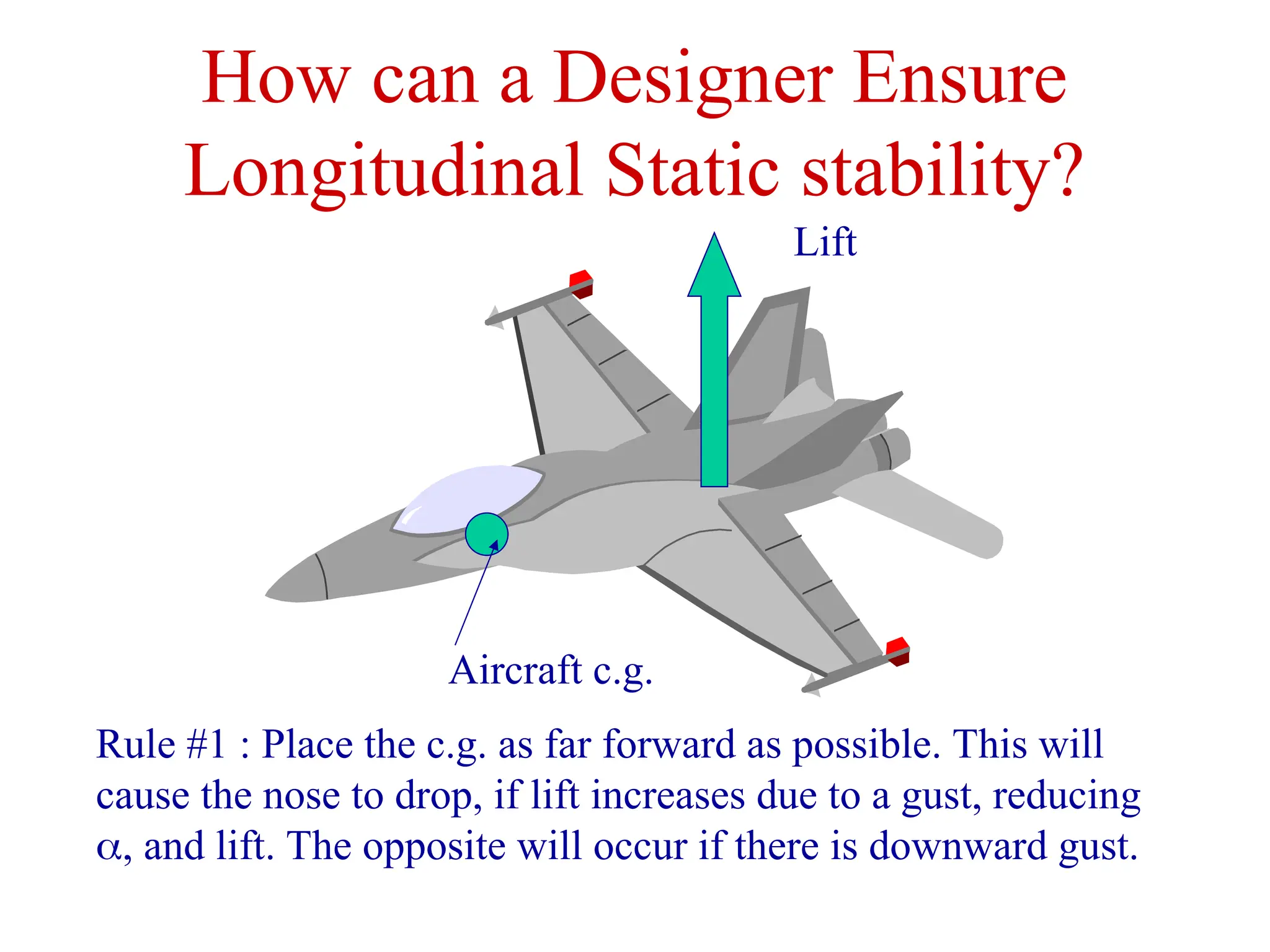
How can aDesigner Ensure
Longitudinal Static stability?
Aircraft c.g.
Lift
Rule #1 : Place the c.g. as far forward as possible. This will
cause the nose to drop, if lift increases due to a gust, reducing
, and lift. The opposite will occur if there is downward gust.
12.
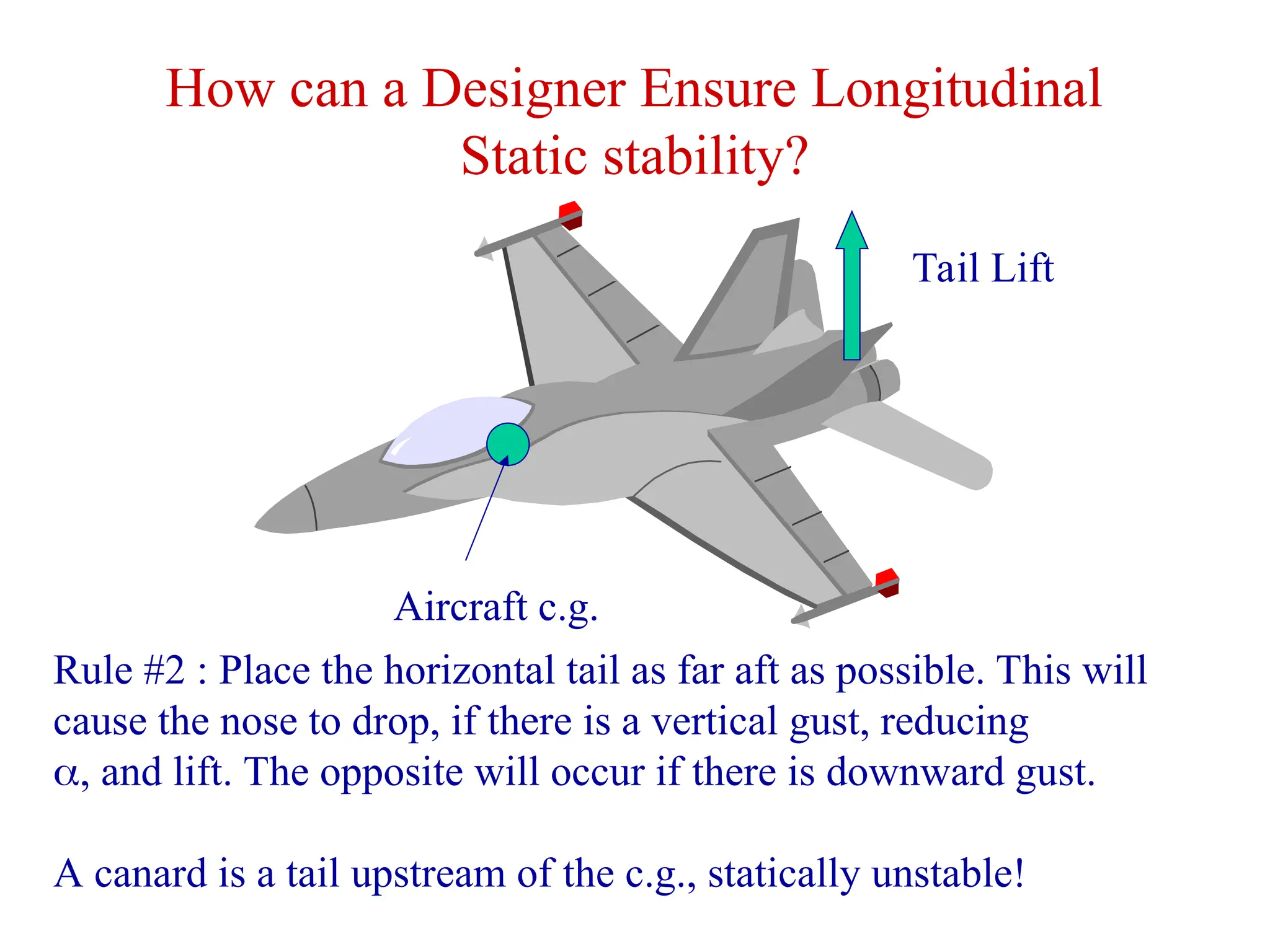
How can aDesigner Ensure Longitudinal
Static stability?
Aircraft c.g.
Tail Lift
Rule #2 : Place the horizontal tail as far aft as possible. This will
cause the nose to drop, if there is a vertical gust, reducing
, and lift. The opposite will occur if there is downward gust.
A canard is a tail upstream of the c.g., statically unstable!
13.
The price paidfor a large static
stability margin
• The aircraft may become sluggish, hard to
maneuver. The tail will resist the pilot’s attempt to
change the aircraft “angle of attack.”
• A large tail adds to aircraft weight, and cost.
• A smaller tail will require a long fuselage(“ a long
enough crowbar!”) to generate enough of a
pitching moment to bring the nose up or down.
• Tail generates drag, including wave drag!
14.
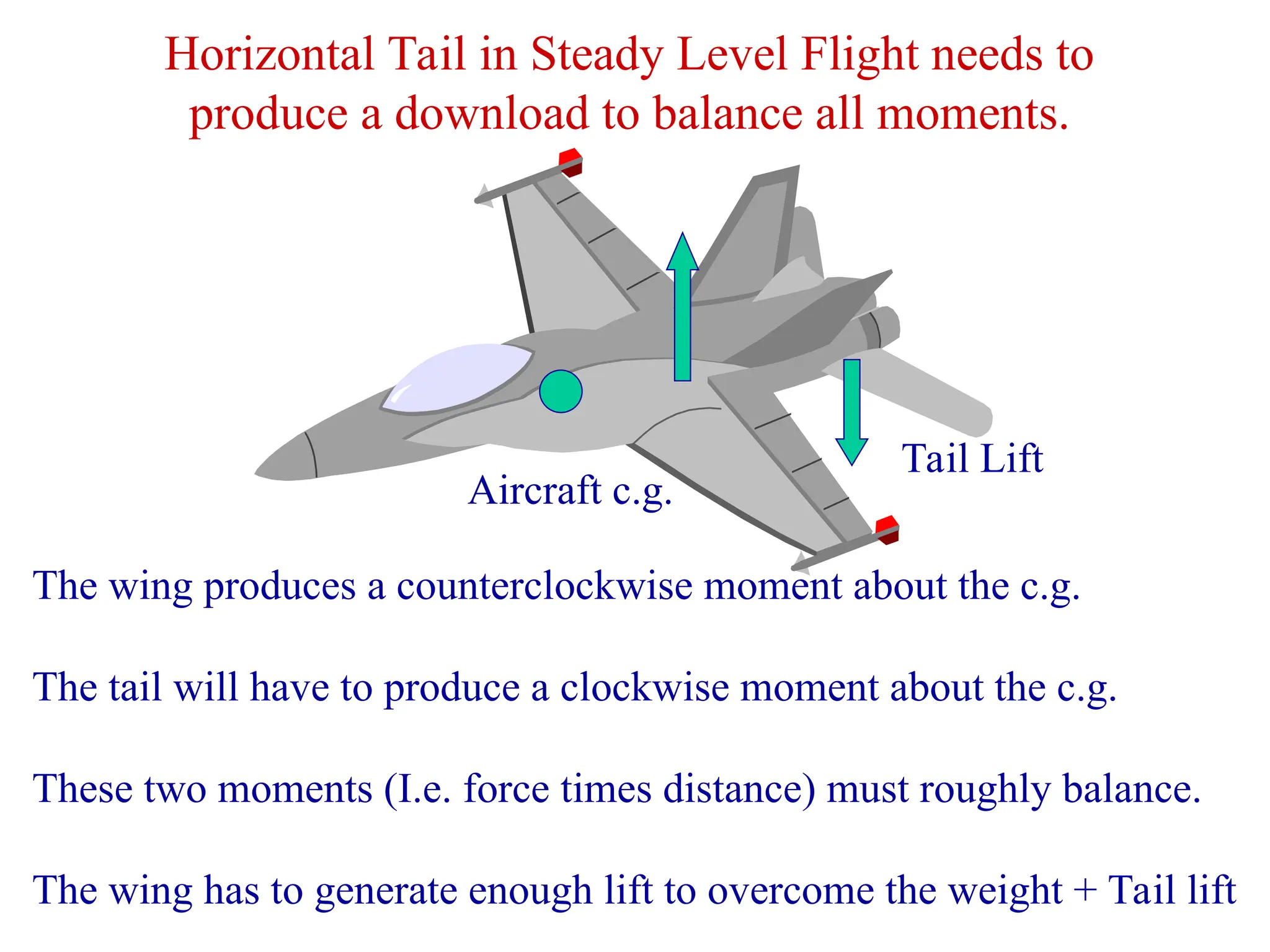
Horizontal Tail inSteady Level Flight needs to
produce a download to balance all moments.
Aircraft c.g.
Tail Lift
The wing produces a counterclockwise moment about the c.g.
The tail will have to produce a clockwise moment about the c.g.
These two moments (I.e. force times distance) must roughly balance.
The wing has to generate enough lift to overcome the weight + Tail lift
15.
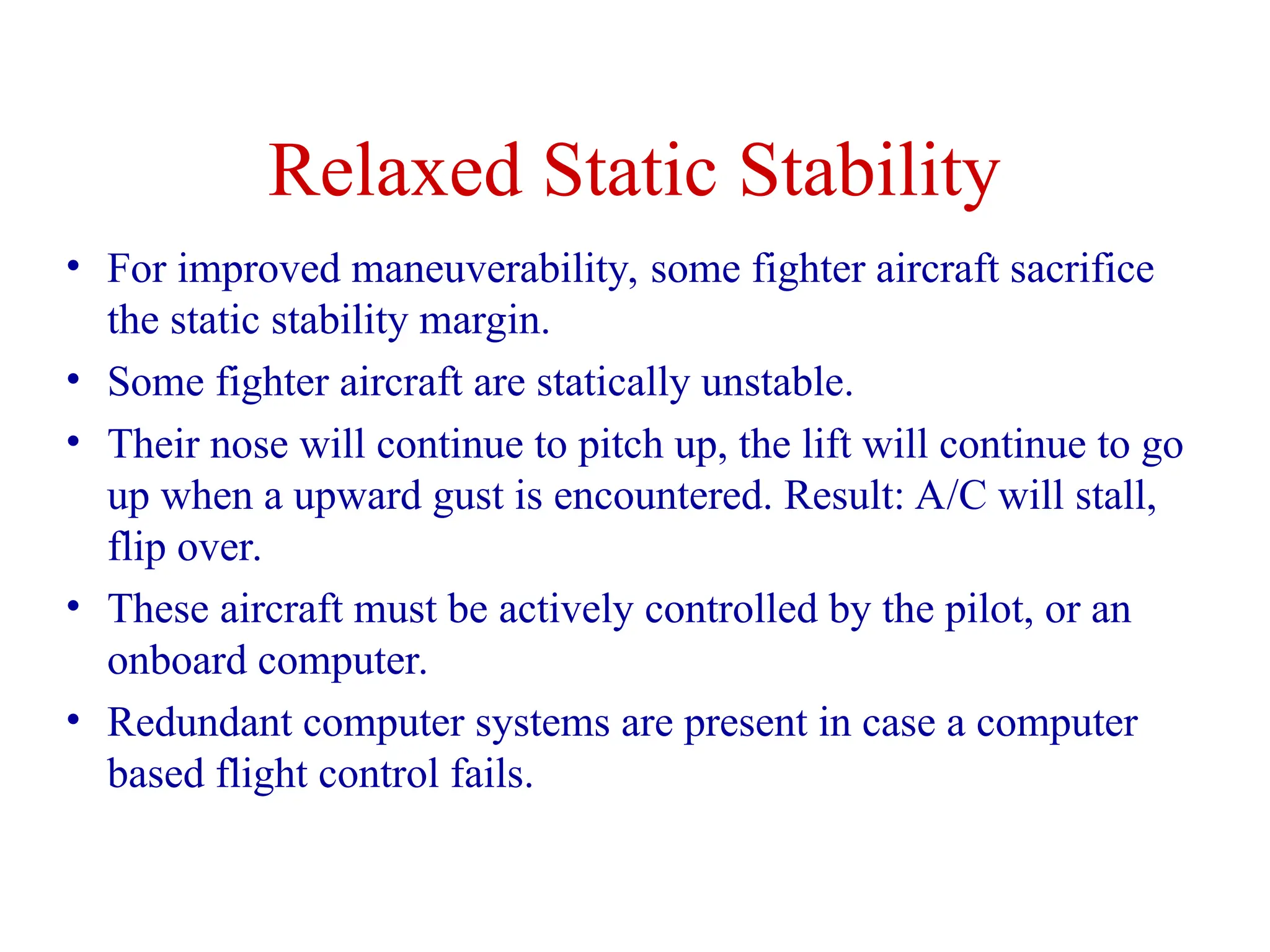
Relaxed Static Stability
•For improved maneuverability, some fighter aircraft sacrifice
the static stability margin.
• Some fighter aircraft are statically unstable.
• Their nose will continue to pitch up, the lift will continue to go
up when a upward gust is encountered. Result: A/C will stall,
flip over.
• These aircraft must be actively controlled by the pilot, or an
onboard computer.
• Redundant computer systems are present in case a computer
based flight control fails.
16.
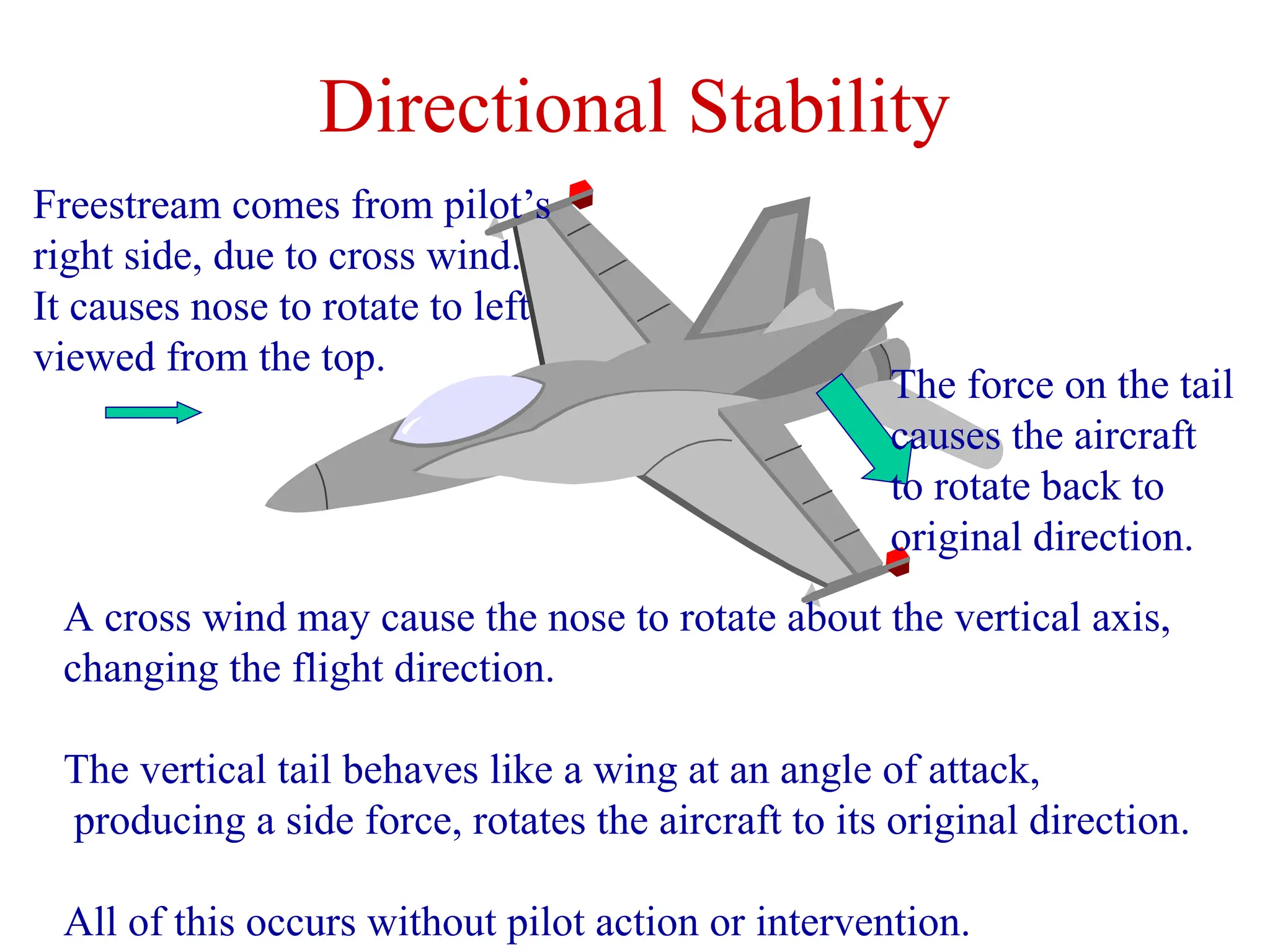
Directional Stability
A crosswind may cause the nose to rotate about the vertical axis,
changing the flight direction.
The vertical tail behaves like a wing at an angle of attack,
producing a side force, rotates the aircraft to its original direction.
All of this occurs without pilot action or intervention.
Freestream comes from pilot’s
right side, due to cross wind.
It causes nose to rotate to left
viewed from the top.
The force on the tail
causes the aircraft
to rotate back to
original direction.
17.
Why twin tail?
•Some fighter aircraft have twin tails.
• Each of the tails may be small, reducing radar
cross section.
• Alternatively, twice the surface means twice
the amount of side force that can be generated,
giving good directional control.
• Disadvantage: Cost of manufacturing, weight
go up.
18.
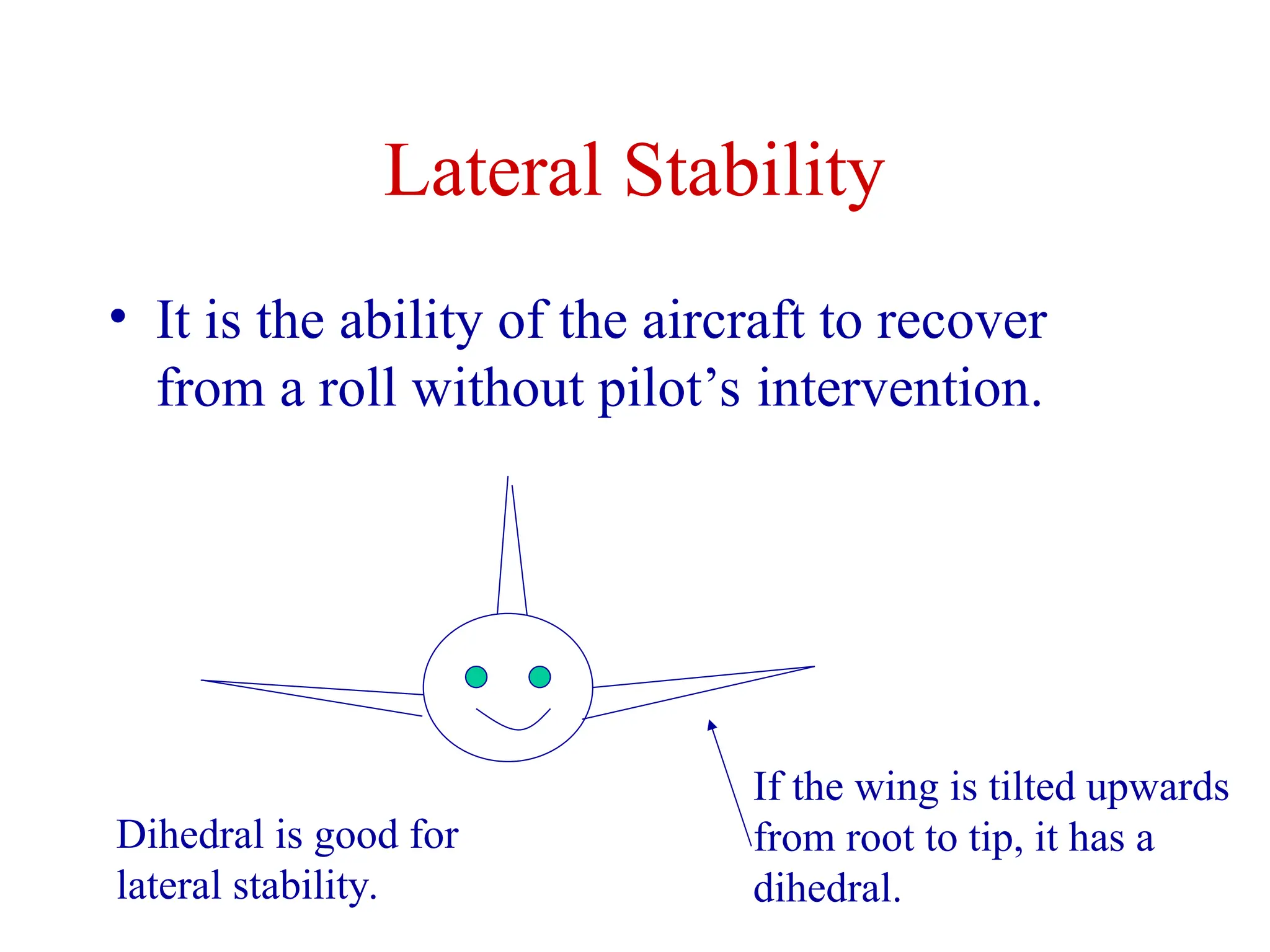
Lateral Stability
• Itis the ability of the aircraft to recover
from a roll without pilot’s intervention.
If the wing is tilted upwards
from root to tip, it has a
dihedral.
Dihedral is good for
lateral stability.
19.
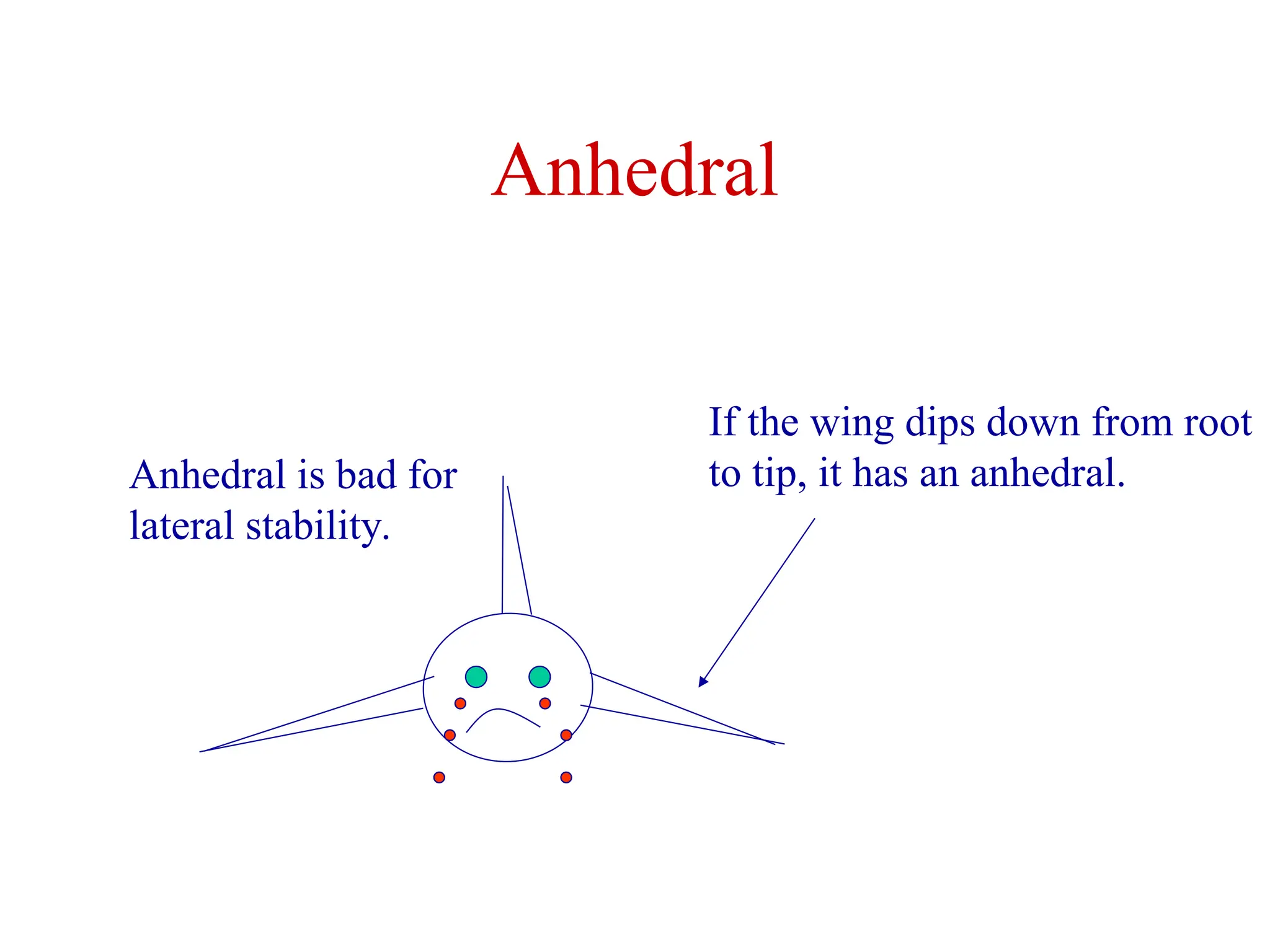
Anhedral
If the wingdips down from root
to tip, it has an anhedral.
Anhedral is bad for
lateral stability.
20.
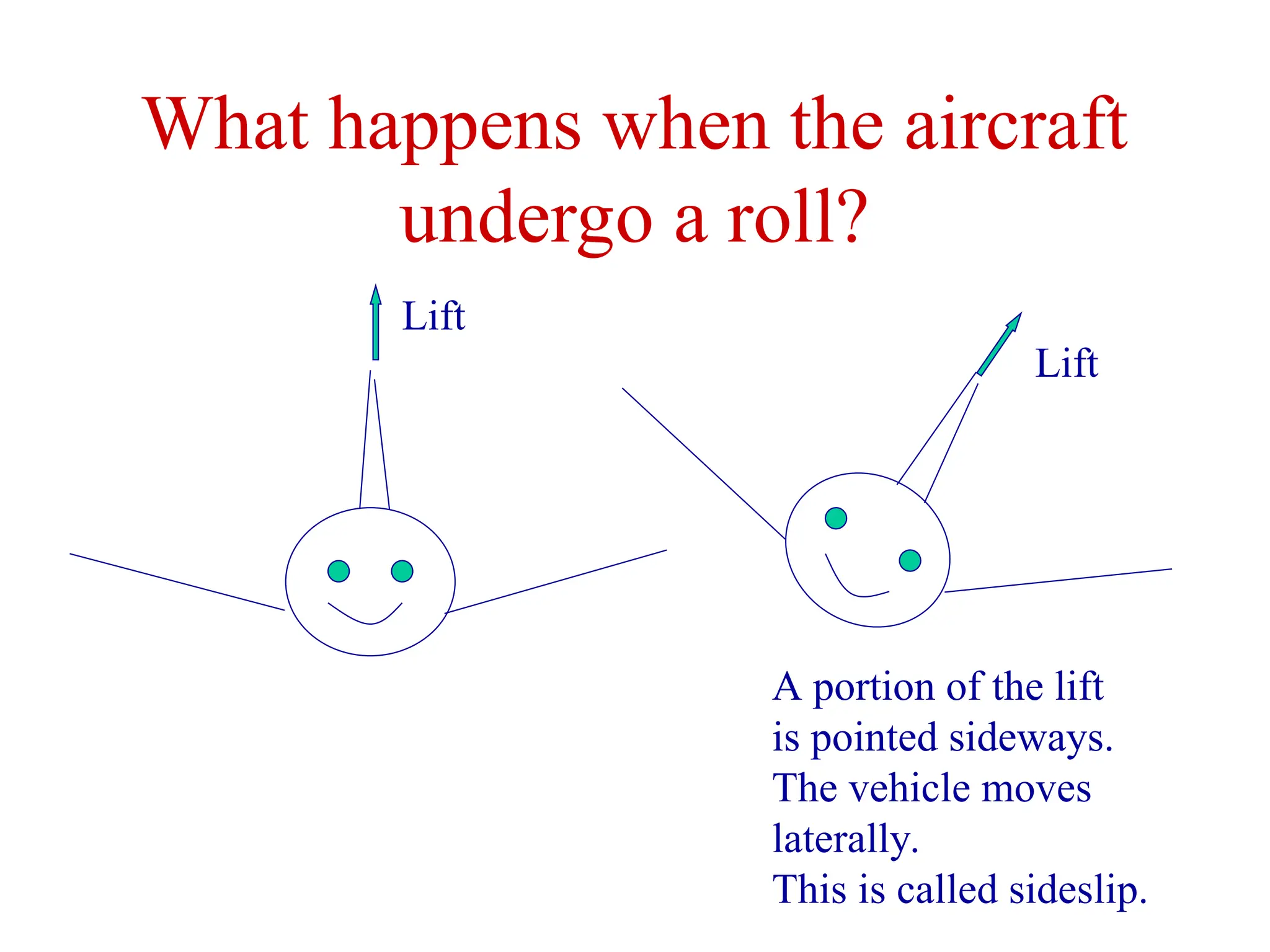
What happens whenthe aircraft
undergo a roll?
Lift
Lift
A portion of the lift
is pointed sideways.
The vehicle moves
laterally.
This is called sideslip.
21.
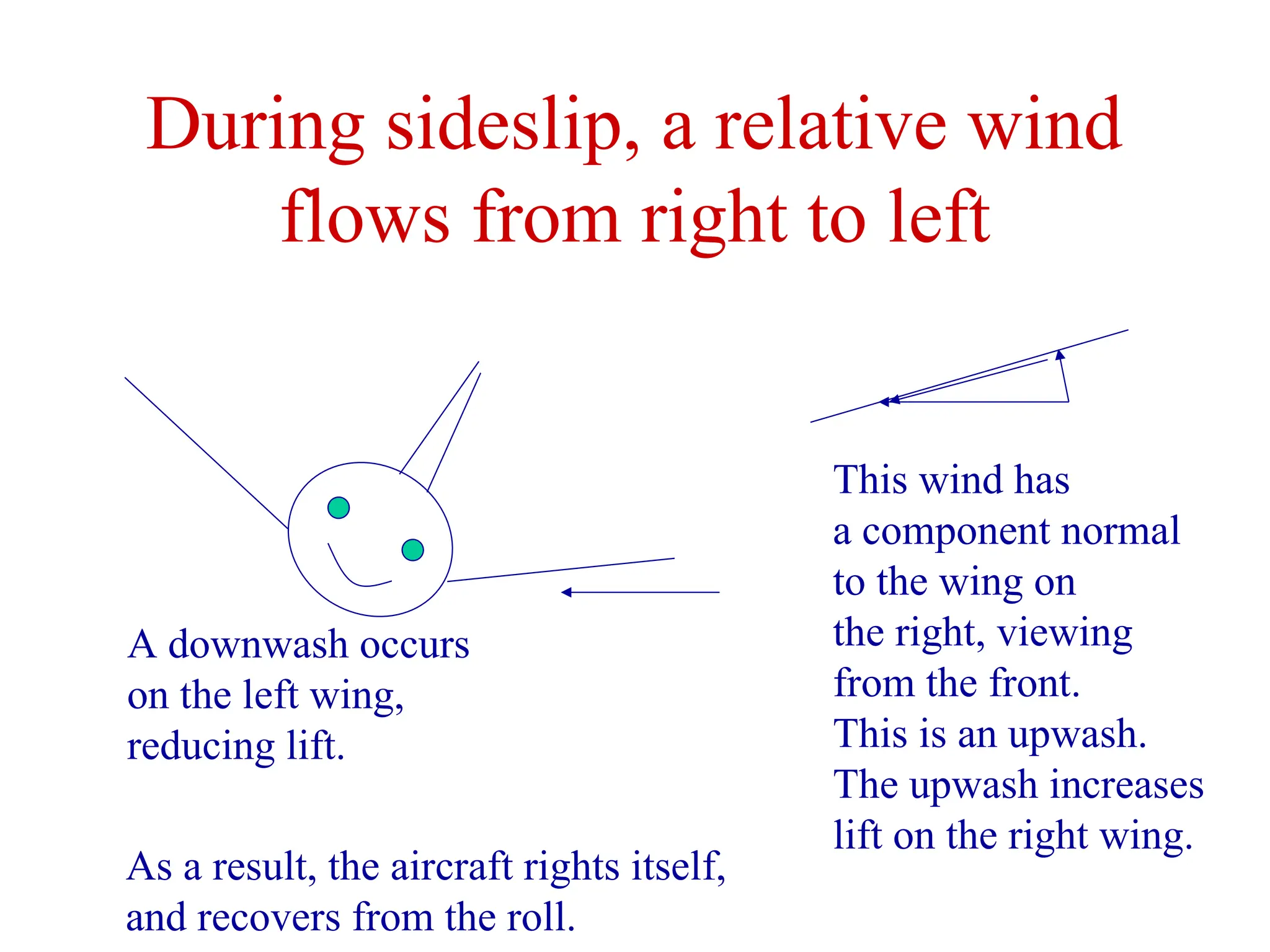
During sideslip, arelative wind
flows from right to left
This wind has
a component normal
to the wing on
the right, viewing
from the front.
This is an upwash.
The upwash increases
lift on the right wing.
A downwash occurs
on the left wing,
reducing lift.
As a result, the aircraft rights itself,
and recovers from the roll.
![Nondimensionalization
Lift and pitching moment M are usually non-dimensionalized.
L is divided by [1/2 V
2
S] to yield CL
M is divided by [1/2 V
2
S c] to yield CM
Here c is a reference length, e.g. average chord.
From the previous slide, dM/dL must be negative for static stability.
In nondimensional form, dCM/dCL must be negative for
static stability.
The quantity -dCM/dCL is called the static stability margin.
Notice the negative sign.
The more positive it is, the more longitudinally stable the aircraft.](https://image.slidesharecdn.com/lecture-251126062735-6e928263/75/Lecture11-Static-and-Dynamic-Stability-ppt-10-2048.jpg)