AVAF 209 - IV.  Assembly and Rigging Rigging Specifications Airplane Assembly Flight Control Systems Control Surface Balancing Biplanes
Rigging  Specifications Should check “Rigging” during all required inspections and anytime any control or major assembly (I.e. wing) is removed and reinstalled “Rigging” = check systems and control surface travel and adjust as necessary Test fly aircraft after reinstallation and adjust as necessary IV.  Assembly & Rigging Rigging Specifications Airplane Assembly Flight Control Systems Control Surface Balancing Biplanes
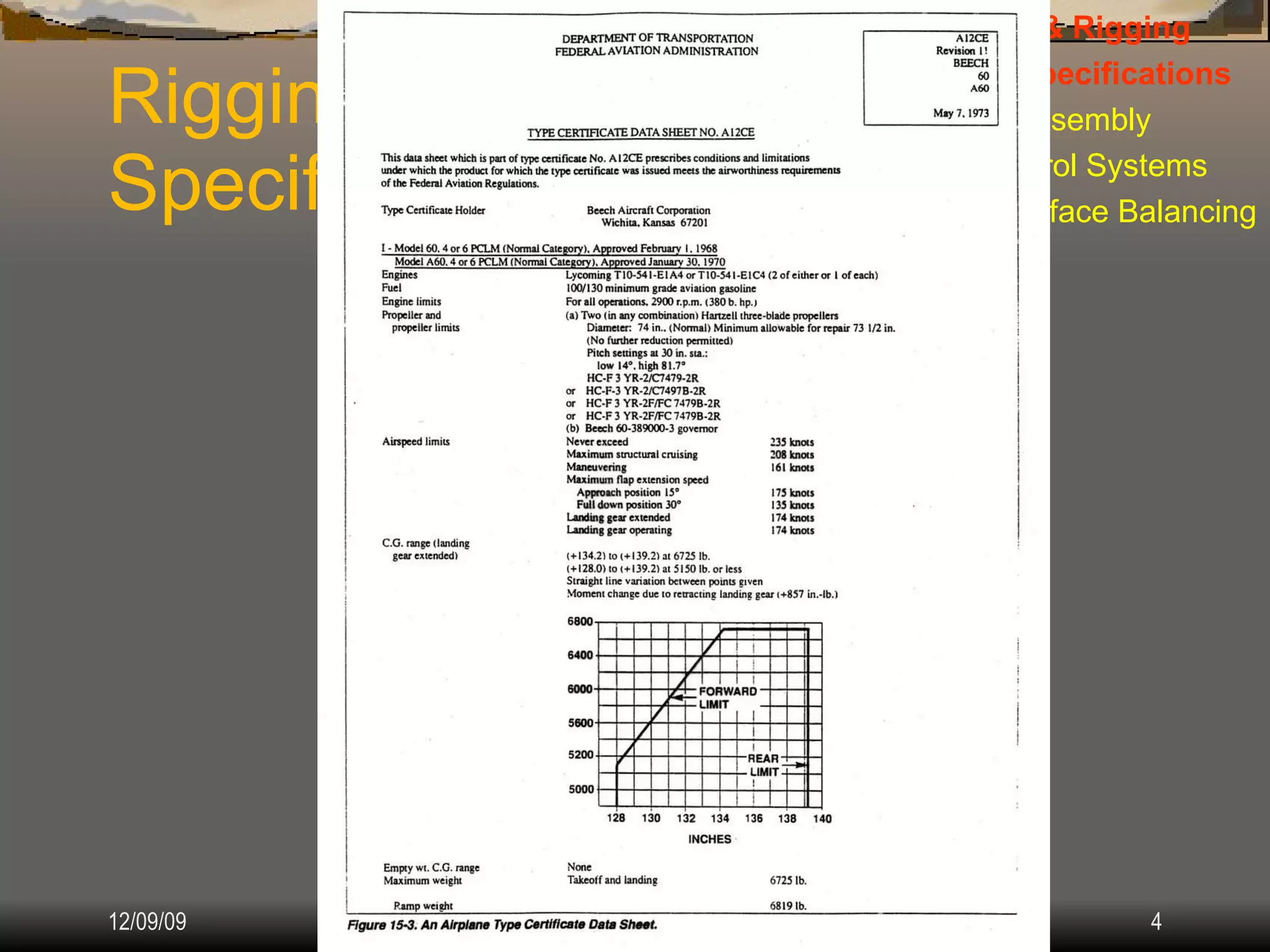
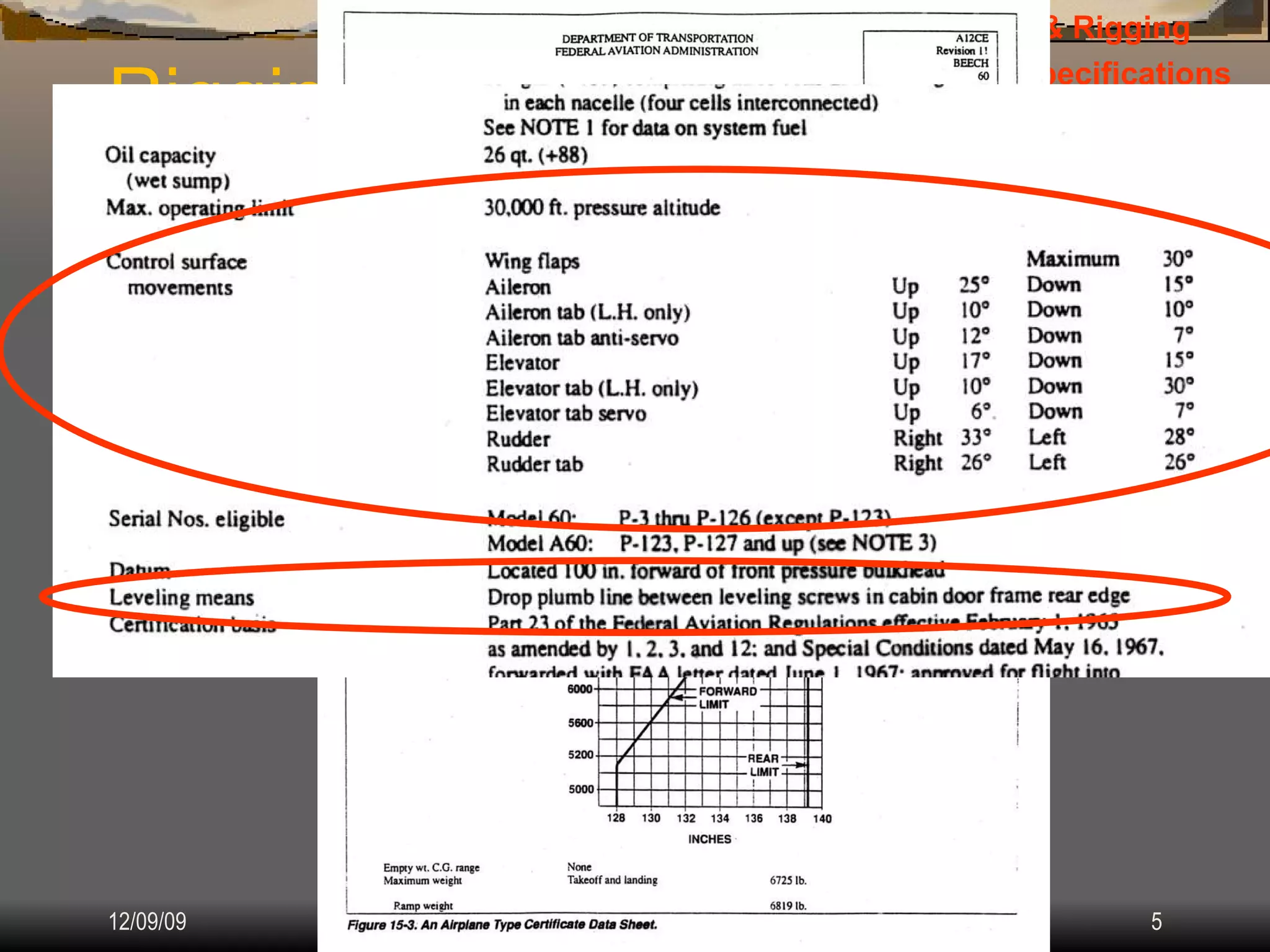
Rigging  Specifications Type Certificate Data Sheets (or Aircraft Specifications) are best source Is most accurate for details Includes: Leveling means Control surface travel Weight and balance information IV.  Assembly & Rigging Rigging Specifications Airplane Assembly Flight Control Systems Control Surface Balancing Biplanes
Rigging  Specifications IV.  Assembly & Rigging Rigging Specifications Airplane Assembly Flight Control Systems Control Surface Balancing Biplanes
Rigging  Specifications Manufacturer’s Manuals Give installation and procedures Don’t believe the details, go to the TCDS MM usually cover more than one model or Ser. No. range = details may not be accurate for your specific aircraft IV.  Assembly & Rigging Rigging Specifications Airplane Assembly Flight Control Systems Control Surface Balancing Biplanes
Airplane Assembly Most airplanes are fully cantilever or with a minimum of external bracing so assembly is pretty straight-forward Follow manufacturer’s instructions IV.  Assembly & Rigging Rigging Specifications Airplane Assembly Flight Control Systems Control Surface Balancing Biplanes
Airplane Assembly General Assembly  procedures: IV.  Assembly & Rigging Rigging Specifications Airplane Assembly Flight Control Systems Control Surface Balancing Biplanes
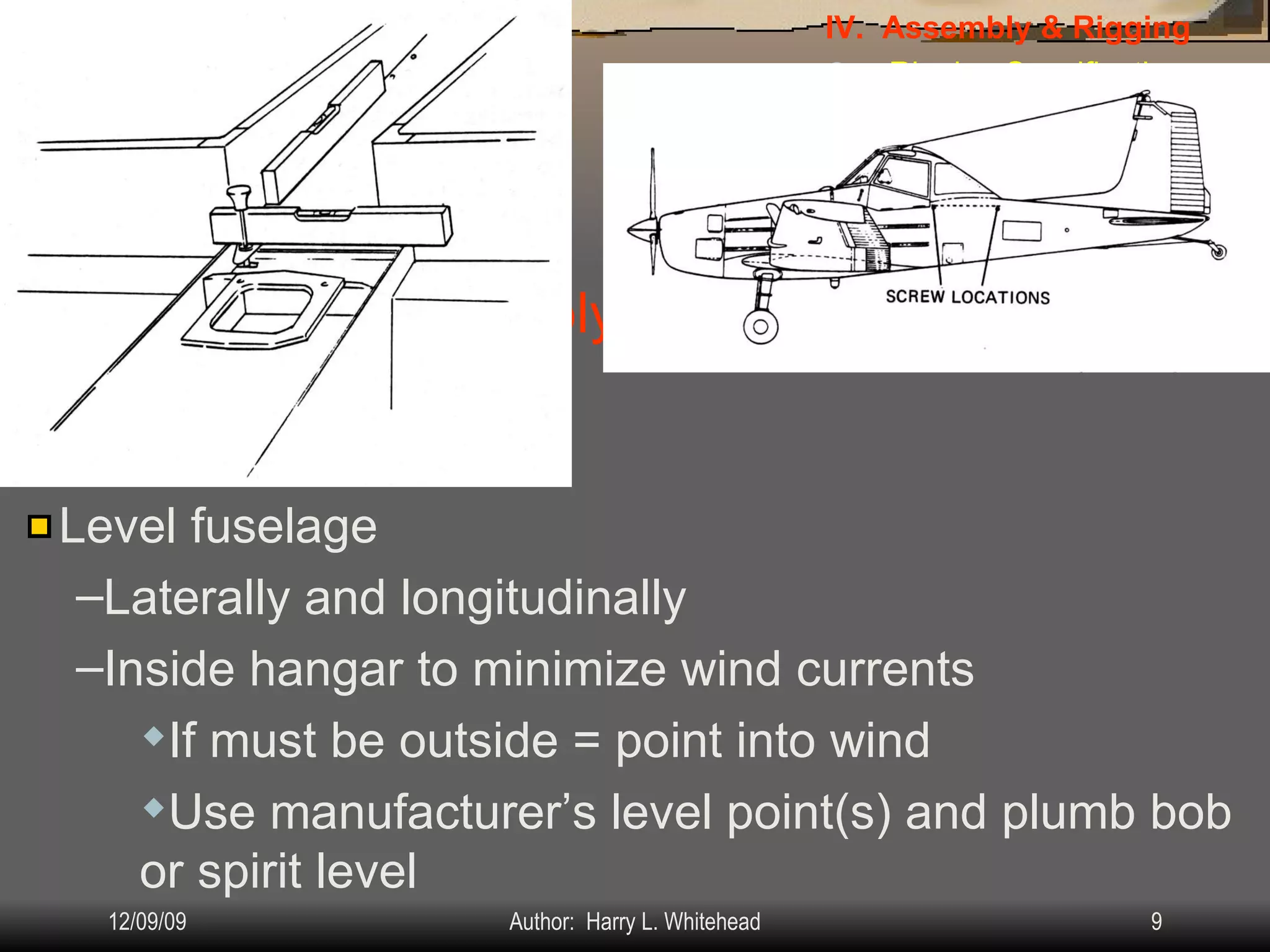
Airplane Assembly General Assembly  procedures: IV.  Assembly & Rigging Rigging Specifications Airplane Assembly Flight Control Systems Control Surface Balancing Biplanes Level fuselage Laterally and longitudinally Inside hangar to minimize wind currents If must be outside = point into wind Use manufacturer’s level point(s) and plumb bob or spirit level
Airplane Assembly General Assembly procedures: IV.  Assembly & Rigging Rigging Specifications Airplane Assembly Flight Control Systems Control Surface Balancing Biplanes Install wings and torque bolts Install Hor. Stab. And Vert. Stab. And torque bolts
Airplane Assembly General Assembly procedures: IV.  Assembly & Rigging Rigging Specifications Airplane Assembly Flight Control Systems Control Surface Balancing Biplanes Perform Alignment Check (next area) Install movable control surfaces Install and rig control systems Test fly to verify control responses and flight stability/attitude
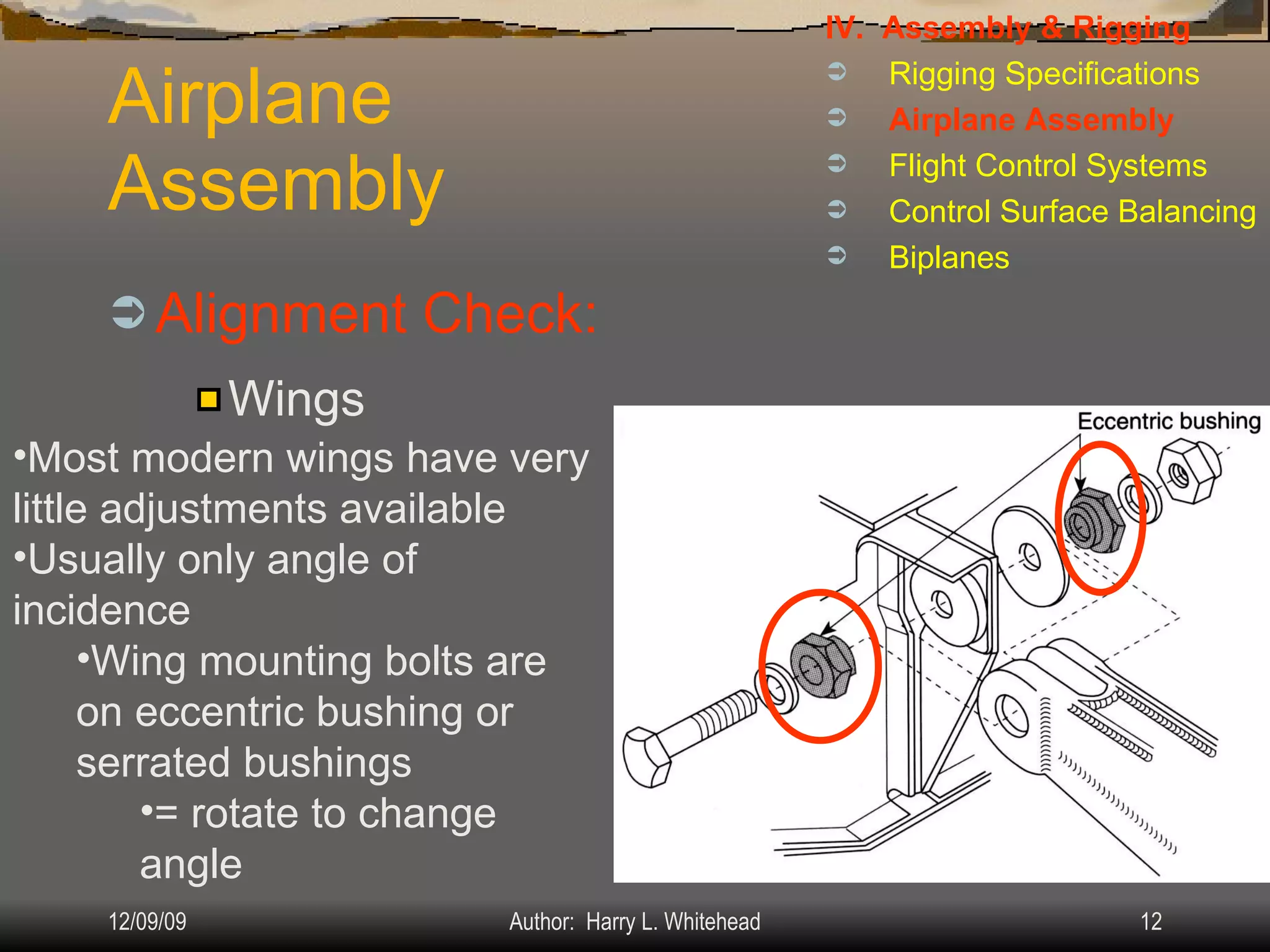
Airplane Assembly Alignment Check: IV.  Assembly & Rigging Rigging Specifications Airplane Assembly Flight Control Systems Control Surface Balancing Biplanes Wings Most modern wings have very little adjustments available Usually only angle of incidence Wing mounting bolts are on eccentric bushing or serrated bushings  = rotate to change angle
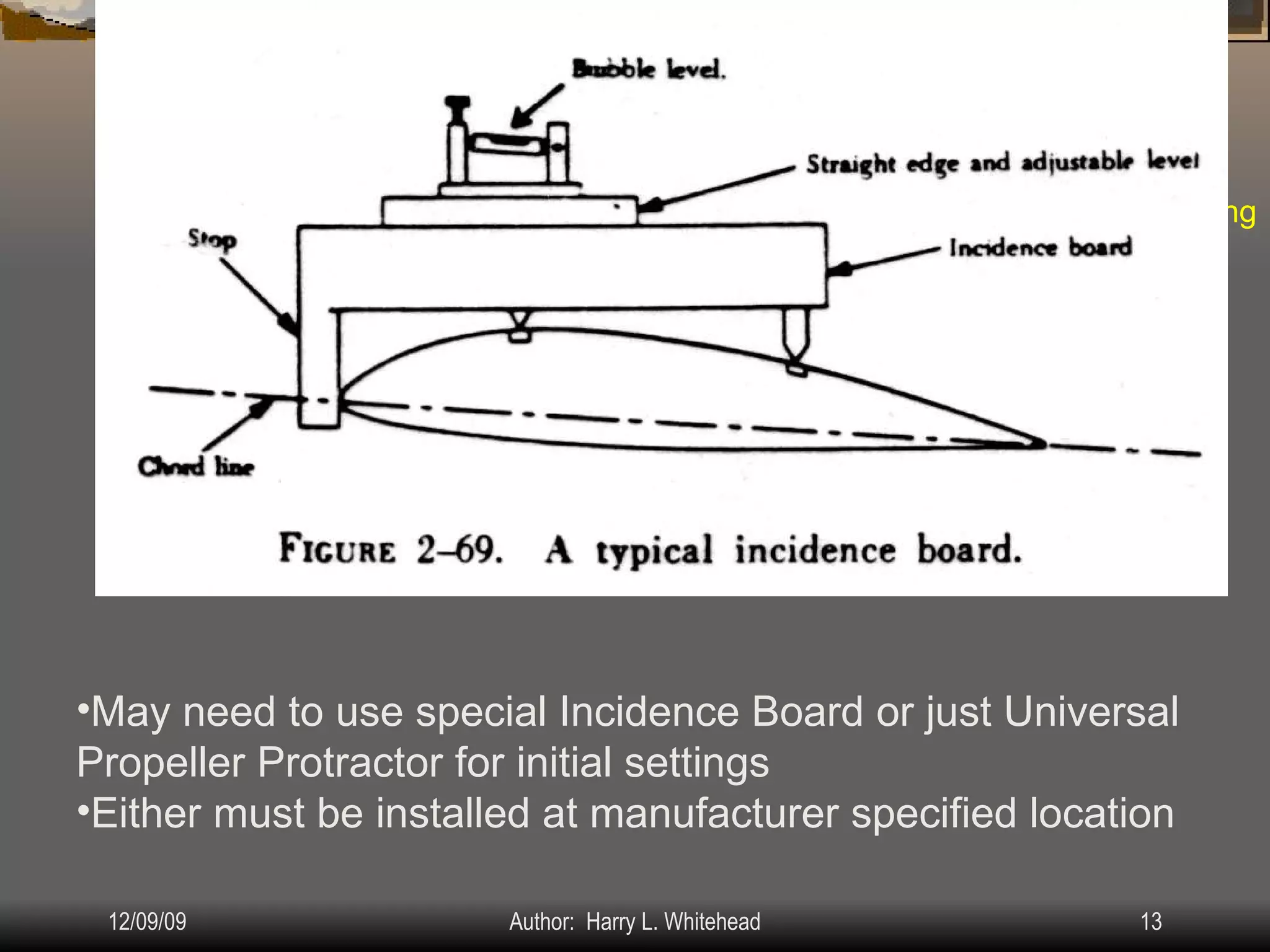
Airplane Assembly Alignment Check: IV.  Assembly & Rigging Rigging Specifications Airplane Assembly Flight Control Systems Control Surface Balancing Biplanes Wings May need to use special Incidence Board or just Universal Propeller Protractor for initial settings Either must be installed at manufacturer specified location
Airplane Assembly Alignment Check: IV.  Assembly & Rigging Rigging Specifications Airplane Assembly Flight Control Systems Control Surface Balancing Biplanes Wings  with V-struts: Piper Tri-Pacer, Piper Cub Can usually adjust Dihedral and Angle of Incidence Procedure Level fuselage laterally & longitudinally Check and adjust Dihedral
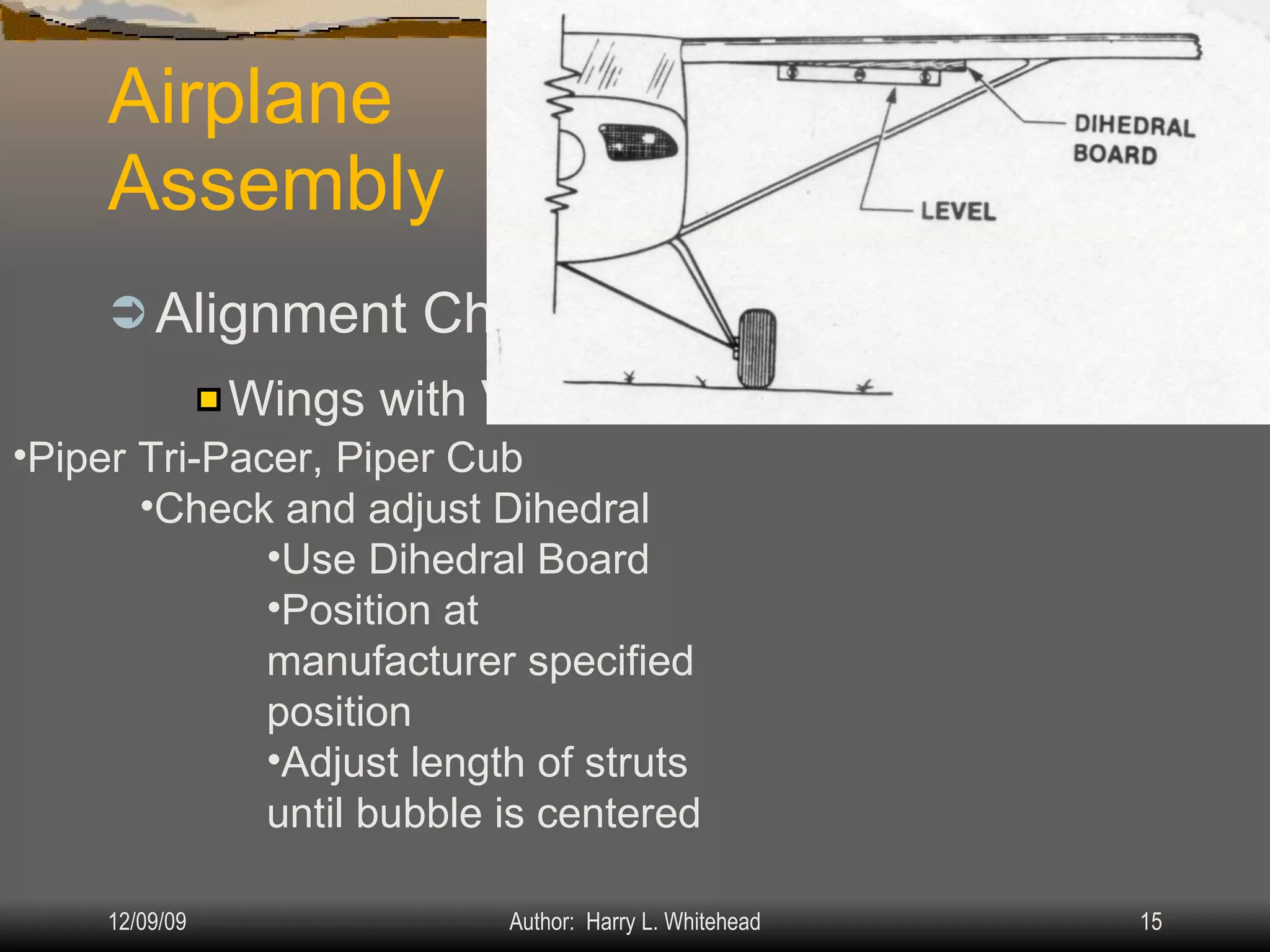
Airplane Assembly Alignment Check: IV.  Assembly & Rigging Rigging Specifications Airplane Assembly Flight Control Systems Control Surface Balancing Biplanes Wings with V-struts: Piper Tri-Pacer, Piper Cub Check and adjust Dihedral Use Dihedral Board Position at manufacturer specified position Adjust length of struts until bubble is centered
Airplane Assembly Alignment Check: IV.  Assembly & Rigging Rigging Specifications Airplane Assembly Flight Control Systems Control Surface Balancing Biplanes Wings with V-struts: Piper Tri-Pacer, Piper Cub Check and adjust Dihedral Some aircraft use string stretched between the wingtips at specified chord location Adjust struts to get specified dimension between string and wing root
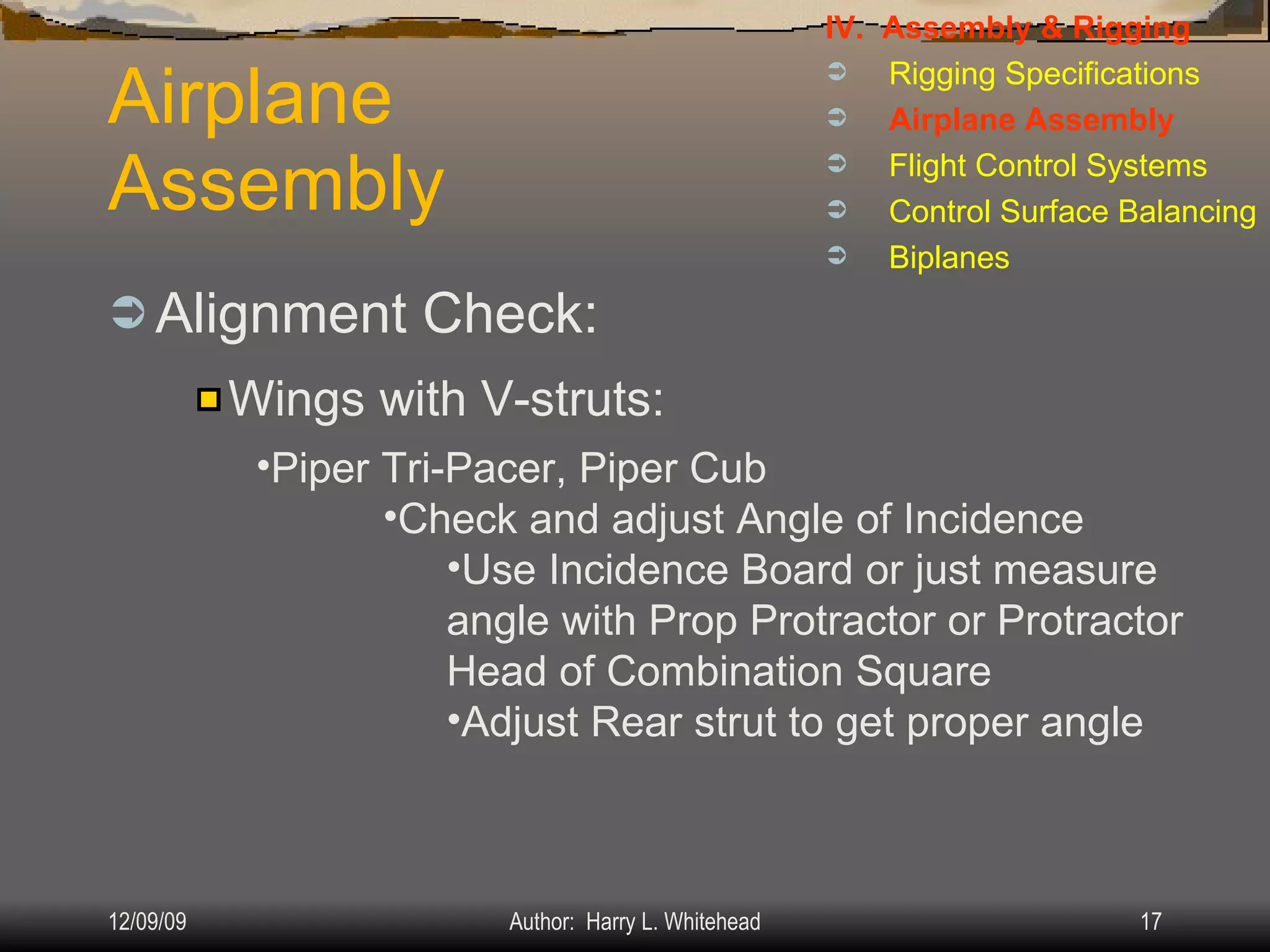
Airplane Assembly Alignment Check: IV.  Assembly & Rigging Rigging Specifications Airplane Assembly Flight Control Systems Control Surface Balancing Biplanes Wings with V-struts: Piper Tri-Pacer, Piper Cub Check and adjust Angle of Incidence Use Incidence Board or just measure angle with Prop Protractor or Protractor Head of Combination Square Adjust Rear strut to get proper angle
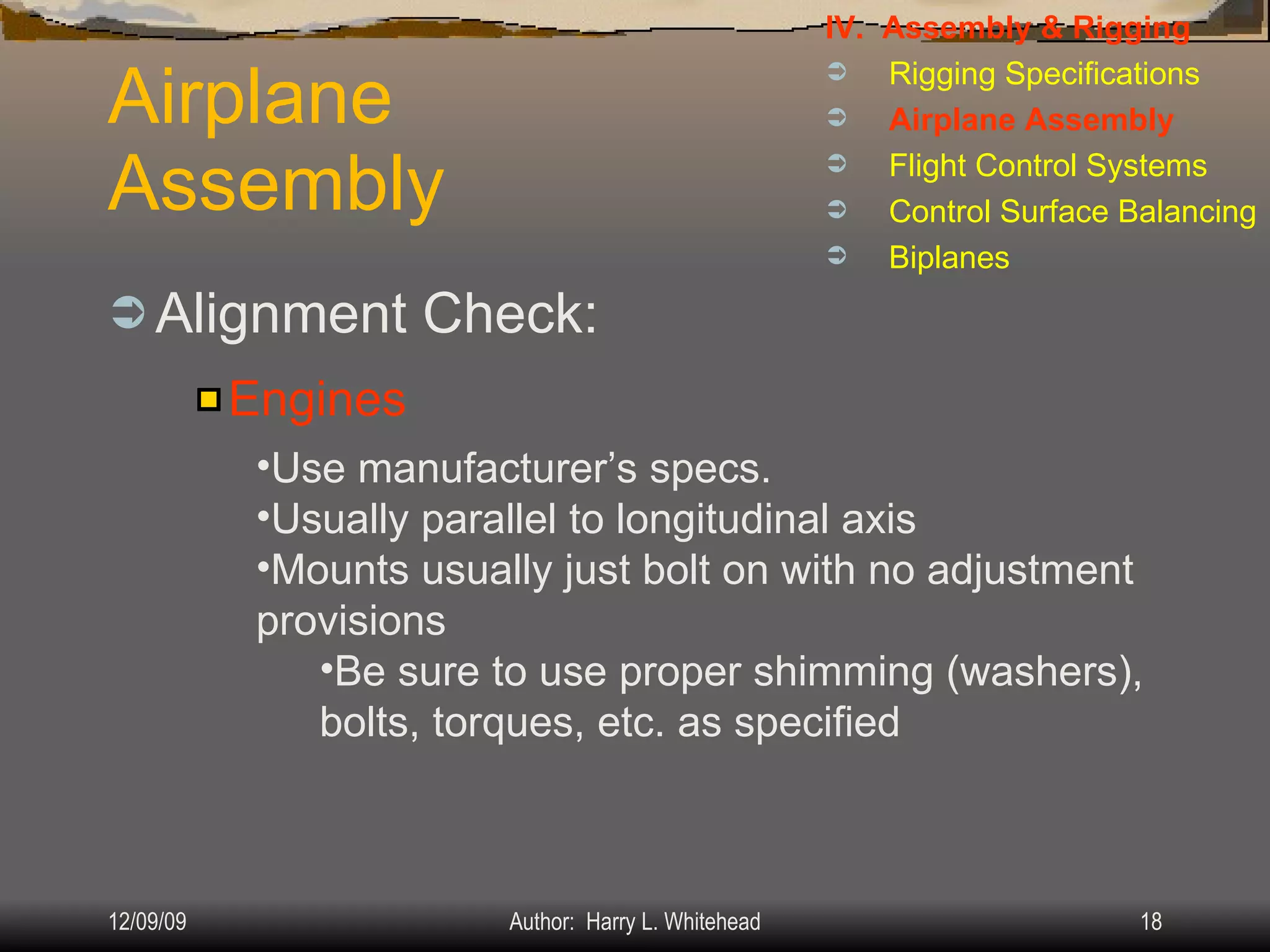
Airplane Assembly Alignment Check: IV.  Assembly & Rigging Rigging Specifications Airplane Assembly Flight Control Systems Control Surface Balancing Biplanes Engines Use manufacturer’s specs. Usually parallel to longitudinal axis Mounts usually just bolt on with no adjustment provisions Be sure to use proper shimming (washers), bolts, torques, etc. as specified
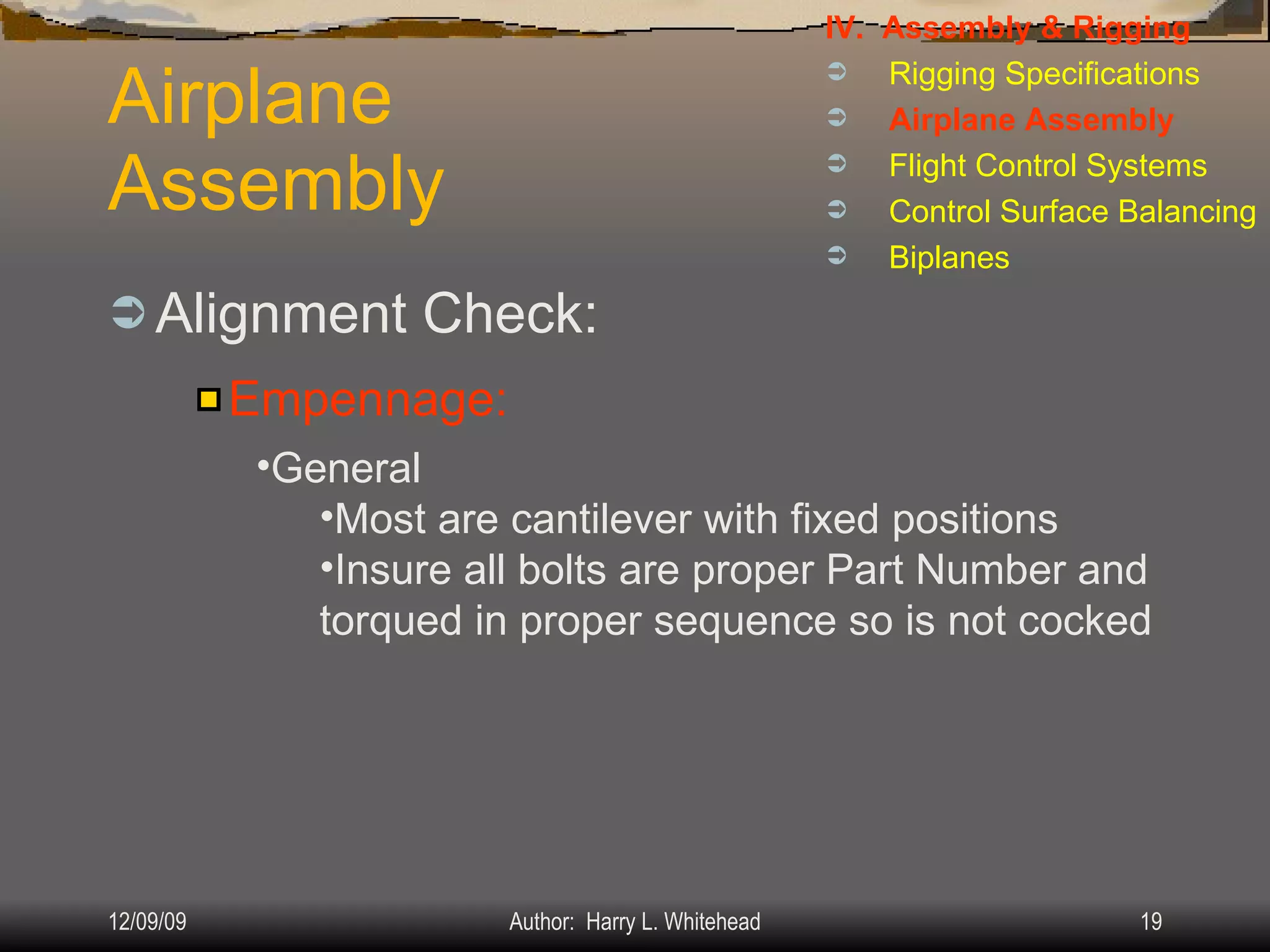
Airplane Assembly Alignment Check: IV.  Assembly & Rigging Rigging Specifications Airplane Assembly Flight Control Systems Control Surface Balancing Biplanes Empennage: General Most are cantilever with fixed positions Insure all bolts are proper Part Number and torqued in proper sequence so is not cocked
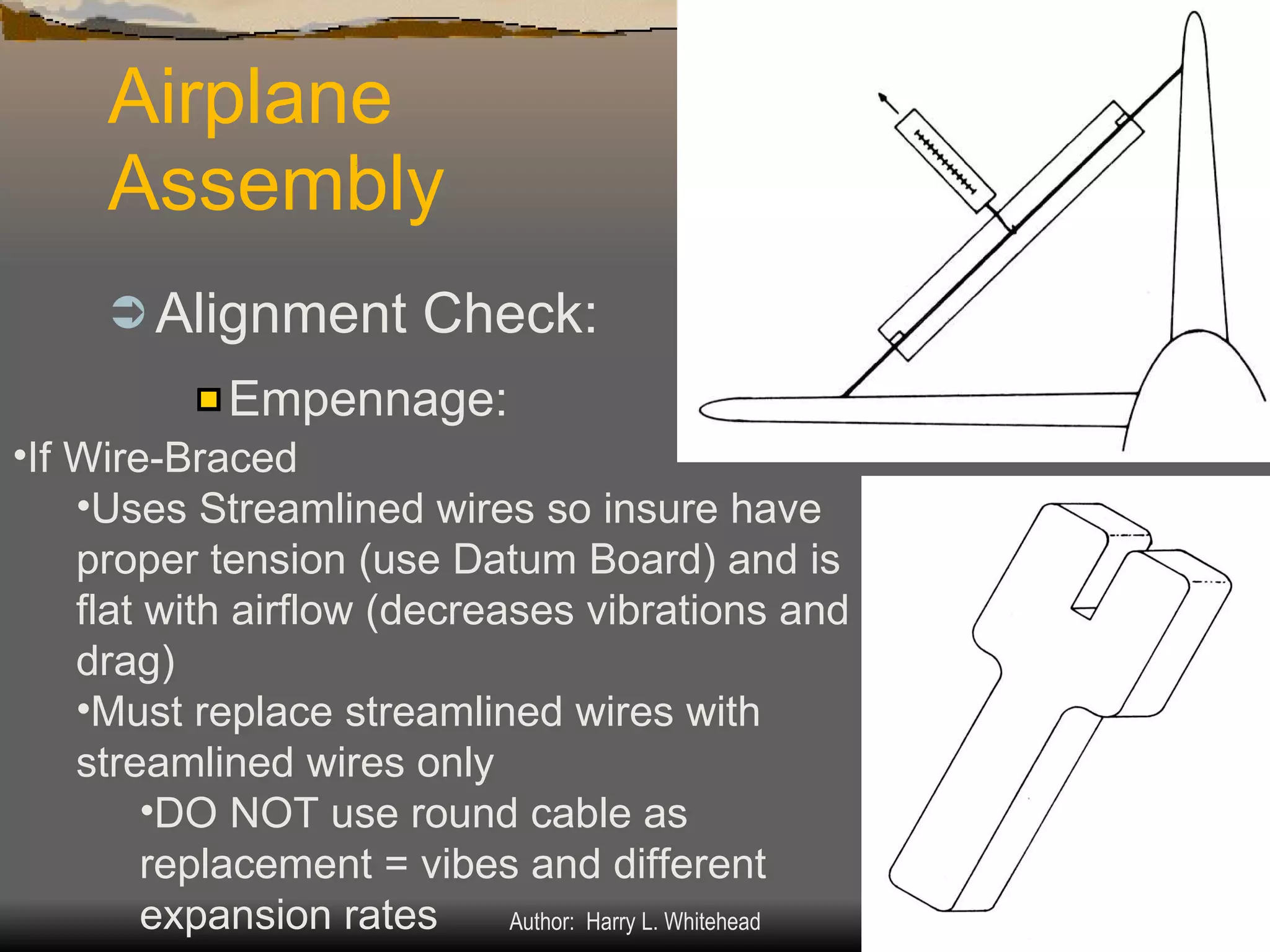
Airplane Assembly Alignment Check: IV.  Assembly & Rigging Rigging Specifications Airplane Assembly Flight Control Systems Control Surface Balancing Biplanes Empennage: If Wire-Braced Uses Streamlined wires so insure have proper tension (use Datum Board) and is flat with airflow (decreases vibrations and drag) Must replace streamlined wires with streamlined wires only  DO NOT use round cable as replacement = vibes and different expansion rates
Airplane Assembly Alignment Check: IV.  Assembly & Rigging Rigging Specifications Airplane Assembly Flight Control Systems Control Surface Balancing Biplanes Empennage: Check Hor. Stab. Dihedral & Angle of Incidence Basically same as wings May or may not be adjustable
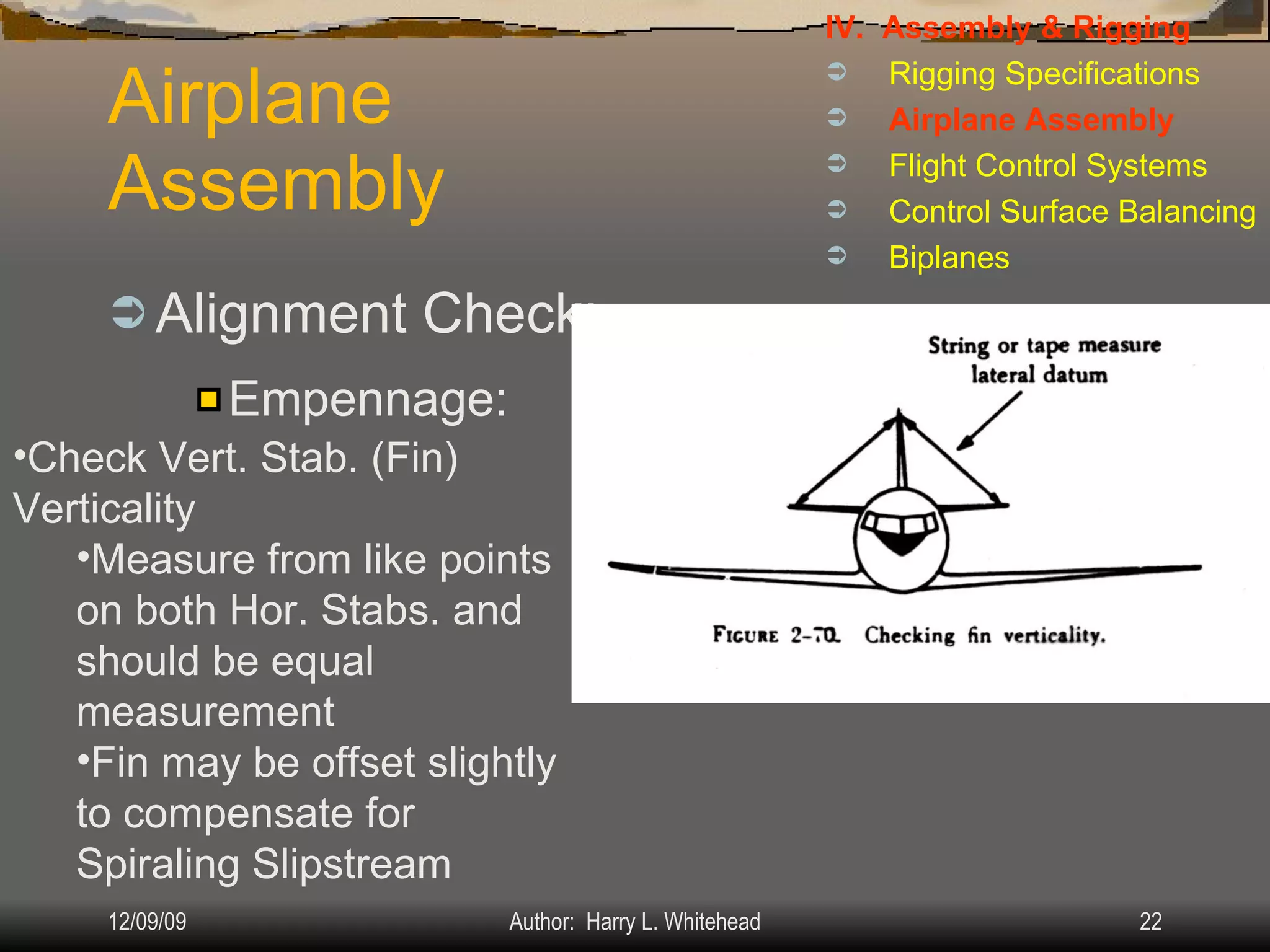
Airplane Assembly Alignment Check: IV.  Assembly & Rigging Rigging Specifications Airplane Assembly Flight Control Systems Control Surface Balancing Biplanes Empennage: Check Vert. Stab. (Fin) Verticality Measure from like points on both Hor. Stabs. and should be equal measurement Fin may be offset slightly to compensate for Spiraling Slipstream
Airplane Assembly Alignment Check: IV.  Assembly & Rigging Rigging Specifications Airplane Assembly Flight Control Systems Control Surface Balancing Biplanes Empennage: If suspicious, run string through control hinges Should be able to be centered in all hinges If not = hinges are misaligned and will bind control movement NOTE:  applies to all control surface hinge lines, not just empennage
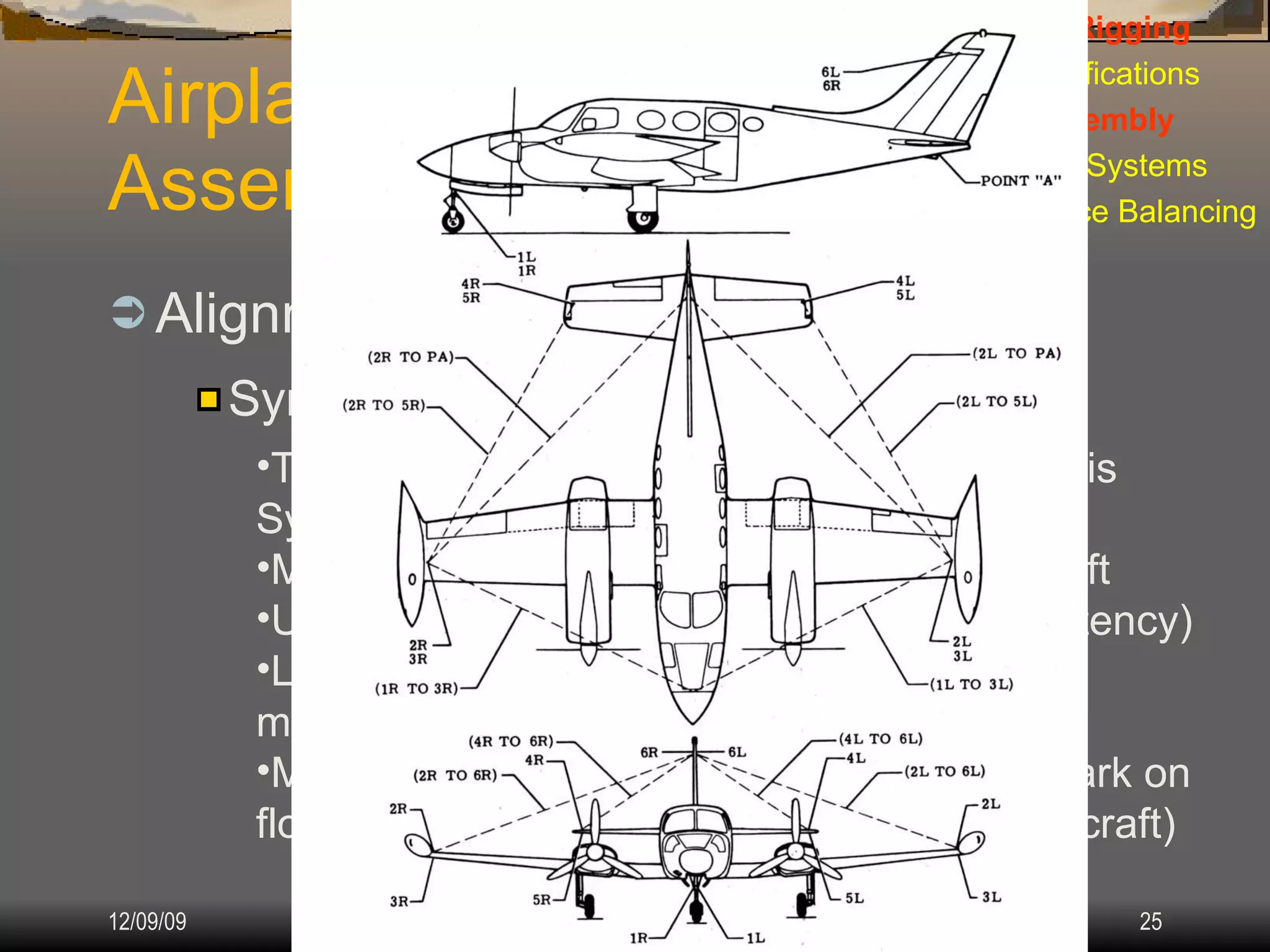
Airplane Assembly Alignment Check: IV.  Assembly & Rigging Rigging Specifications Airplane Assembly Flight Control Systems Control Surface Balancing Biplanes Symmetry Check: To insure entire aircraft is aligned properly (is Symmetrical) Measure between specified points on aircraft Use steel tape with 5 pound pull (for consistency) Like measurements should be equal within manufacturer’s tolerances May need to use plumb bob from points, mark on floor, and then measure (especially large aircraft)
Airplane Assembly Flight Controls Installation & Rigging: IV.  Assembly & Rigging Rigging Specifications Airplane Assembly Flight Control Systems Control Surface Balancing Biplanes Ailerons: Be sure to only use manufacturer’s parts combinations and torque specs to prevent binding Should be free to pivot with no binding and no looseness
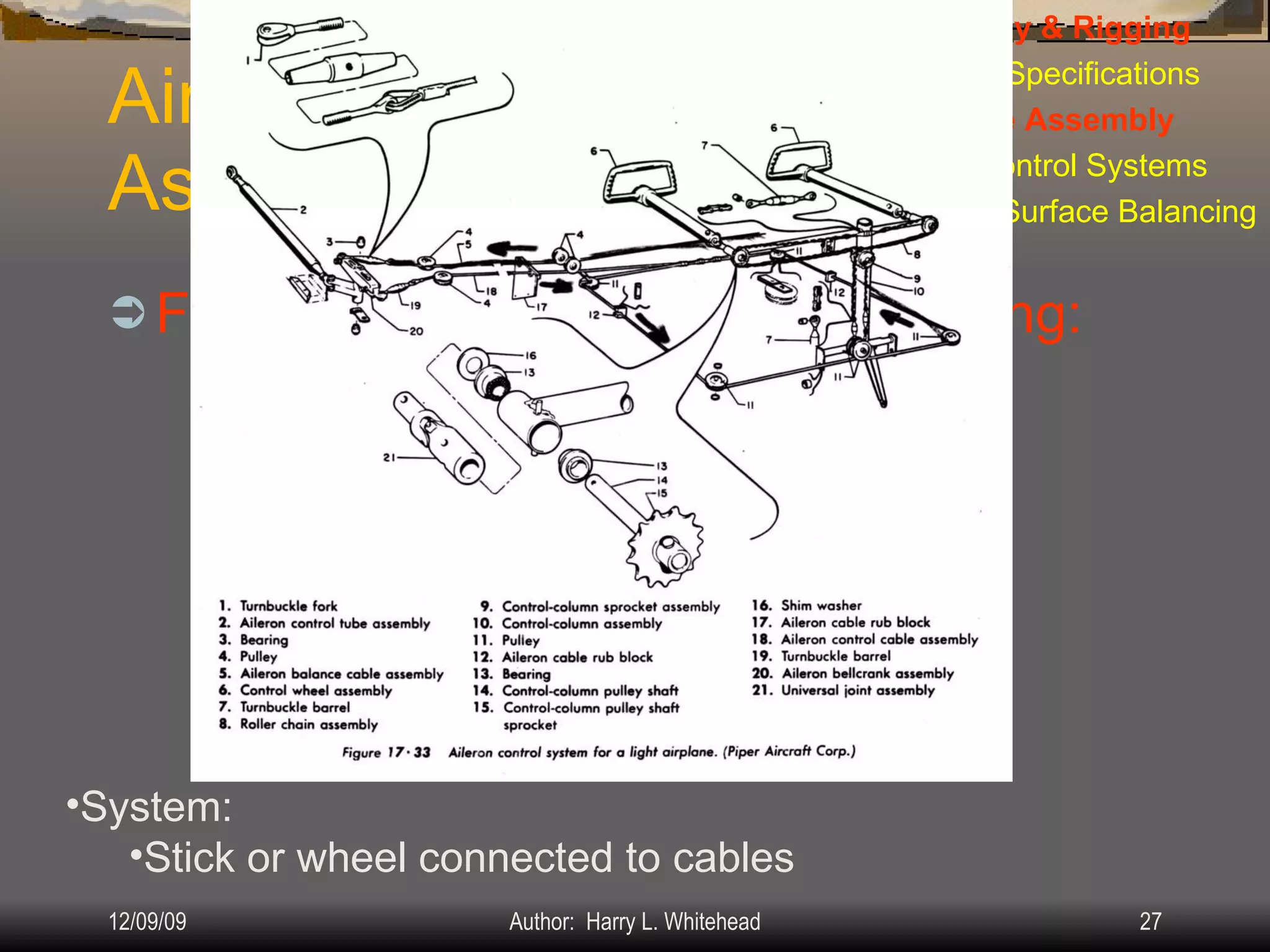
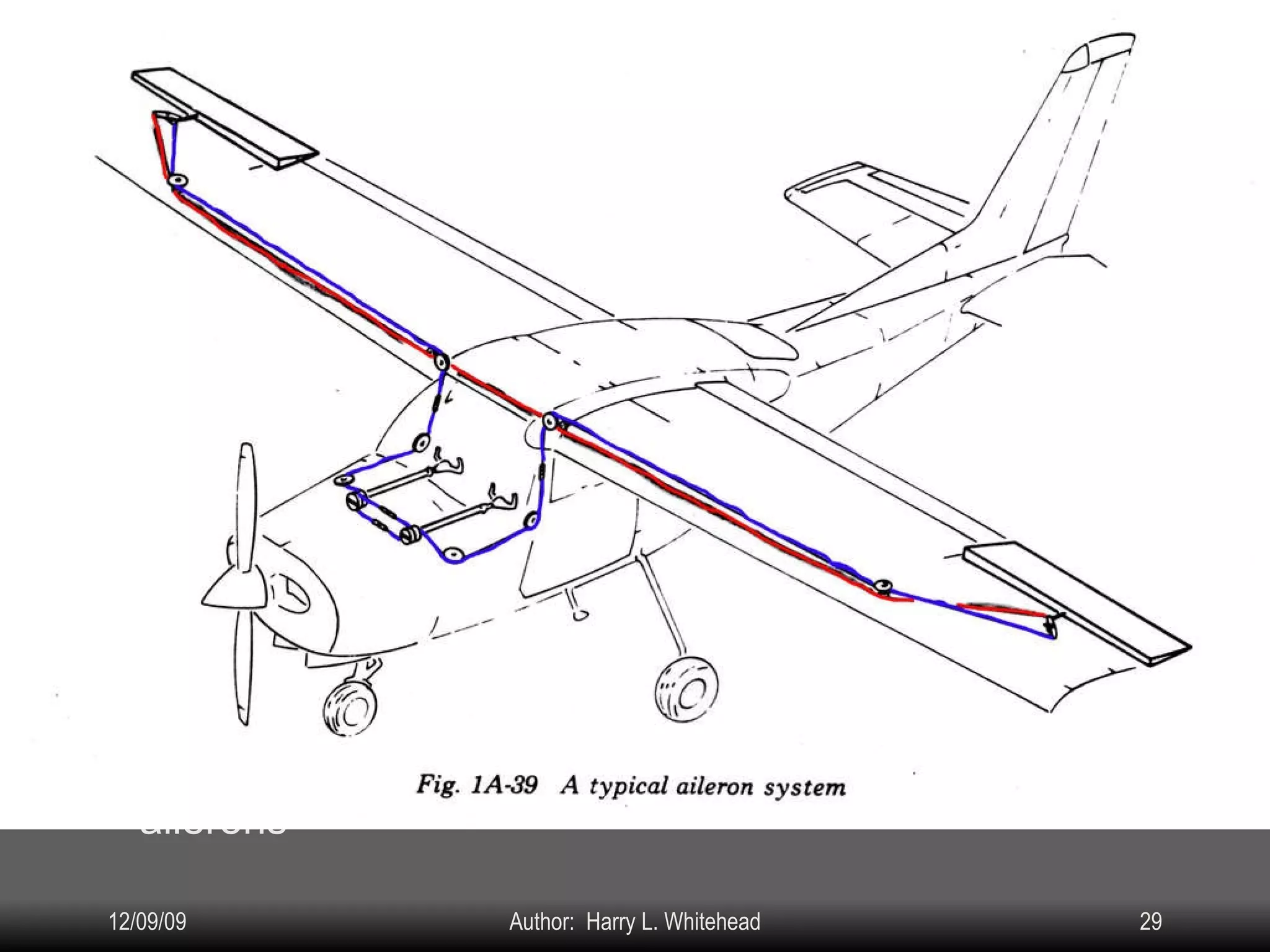
Airplane Assembly Flight Controls Installation & Rigging: IV.  Assembly & Rigging Rigging Specifications Airplane Assembly Flight Control Systems Control Surface Balancing Biplanes Ailerons: System: Stick or wheel connected to cables
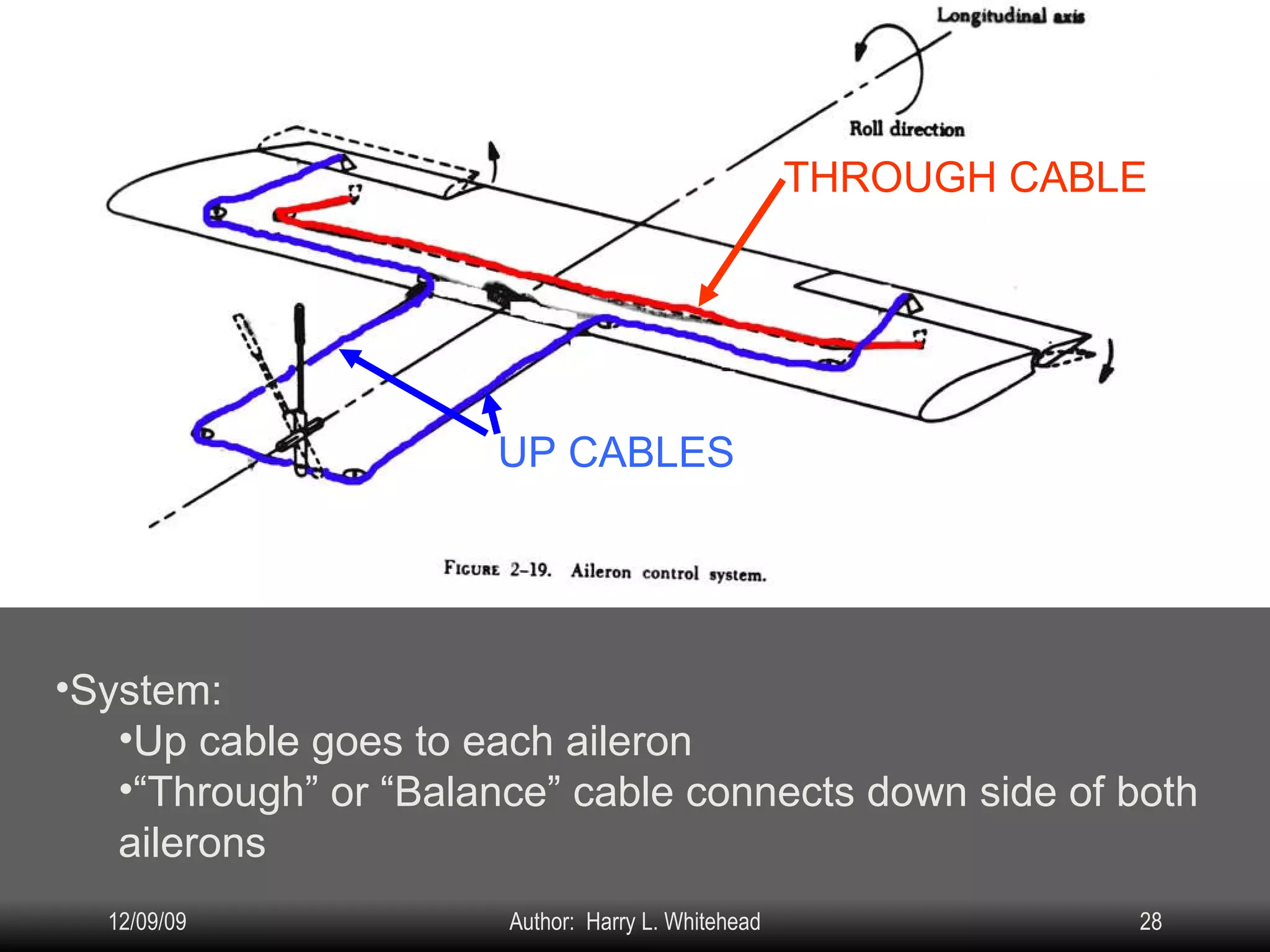
Airplane Assembly Flight Controls Installation & Rigging: IV.  Assembly & Rigging Rigging Specifications Airplane Assembly Flight Control Systems Control Surface Balancing Biplanes Ailerons: System: Up cable goes to each aileron “ Through” or “Balance” cable connects down side of both ailerons THROUGH CABLE UP CABLES
Airplane Assembly Flight Controls Installation & Rigging: IV.  Assembly & Rigging Rigging Specifications Airplane Assembly Flight Control Systems Control Surface Balancing Biplanes Ailerons: System: Stick or wheel connected to cables Up cable goes to each aileron “ Through” or “Balance” cable connects down side of both ailerons
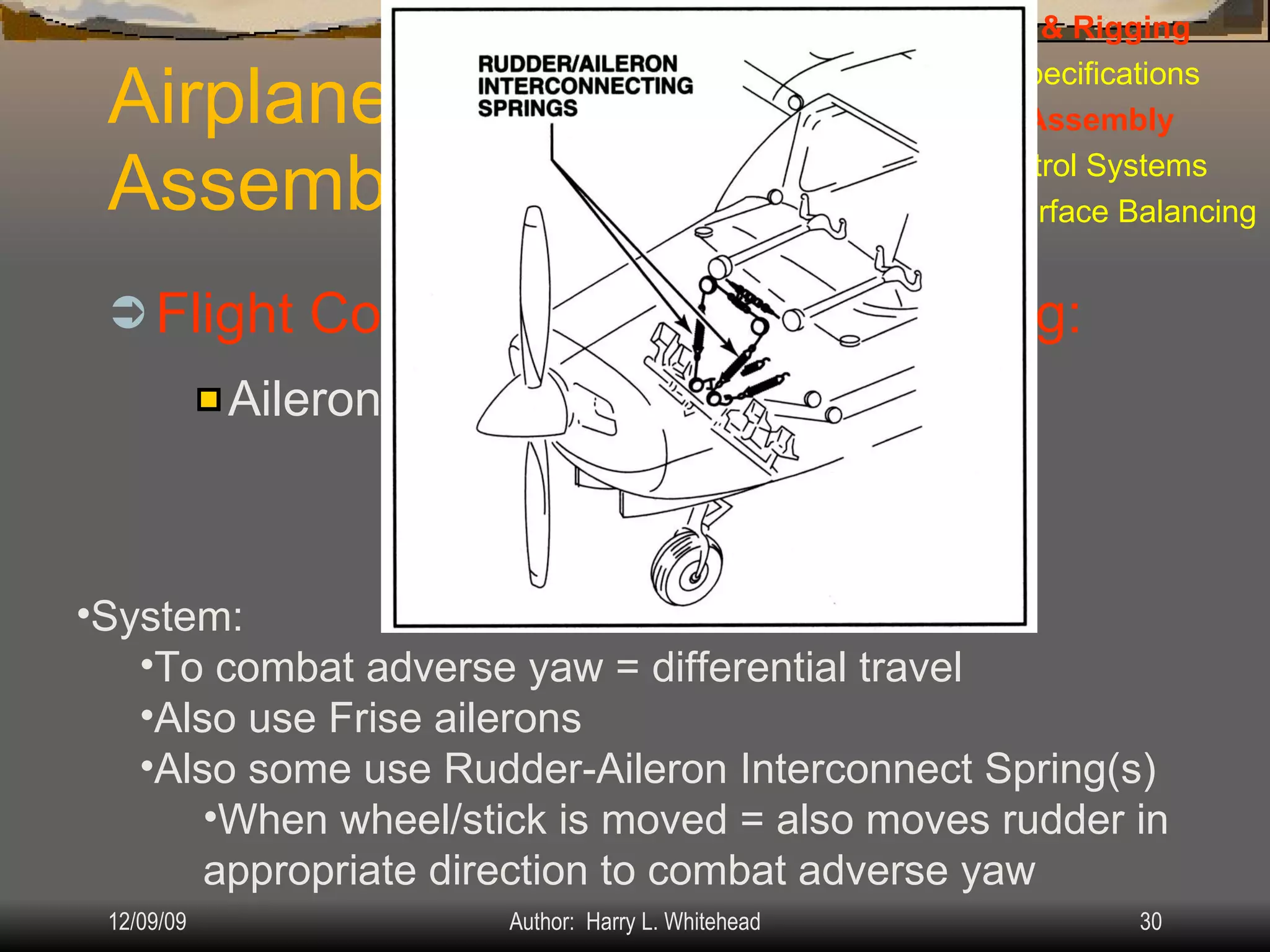
Airplane Assembly Flight Controls Installation & Rigging: IV.  Assembly & Rigging Rigging Specifications Airplane Assembly Flight Control Systems Control Surface Balancing Biplanes Ailerons: System: To combat adverse yaw = differential travel Also use Frise ailerons Also some use Rudder-Aileron Interconnect Spring(s) When wheel/stick is moved = also moves rudder in appropriate direction to combat adverse yaw
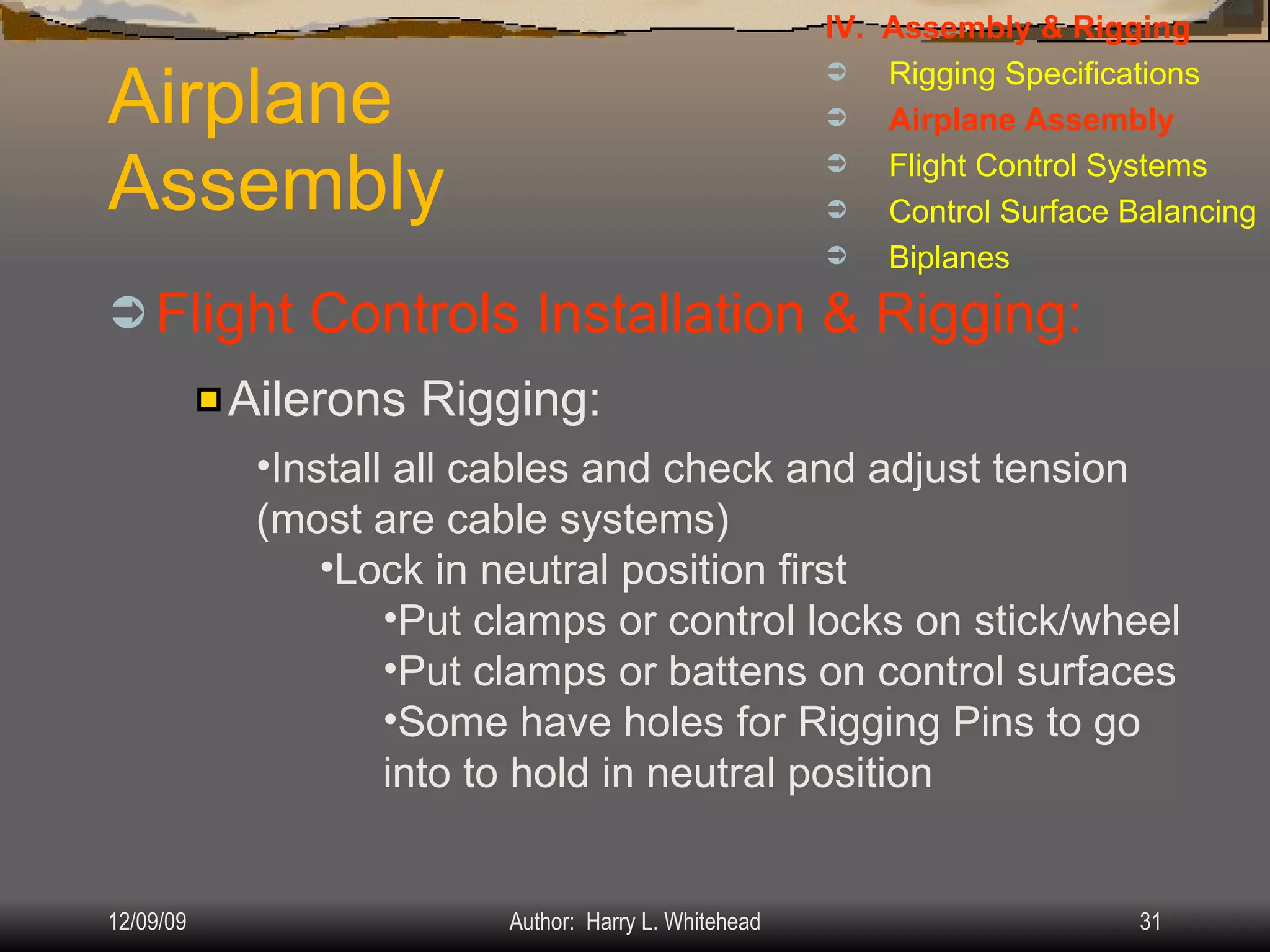
Airplane Assembly Flight Controls Installation & Rigging: IV.  Assembly & Rigging Rigging Specifications Airplane Assembly Flight Control Systems Control Surface Balancing Biplanes Ailerons Rigging: Install all cables and check and adjust tension (most are cable systems) Lock in neutral position first Put clamps or control locks on stick/wheel Put clamps or battens on control surfaces Some have holes for Rigging Pins to go into to hold in neutral position
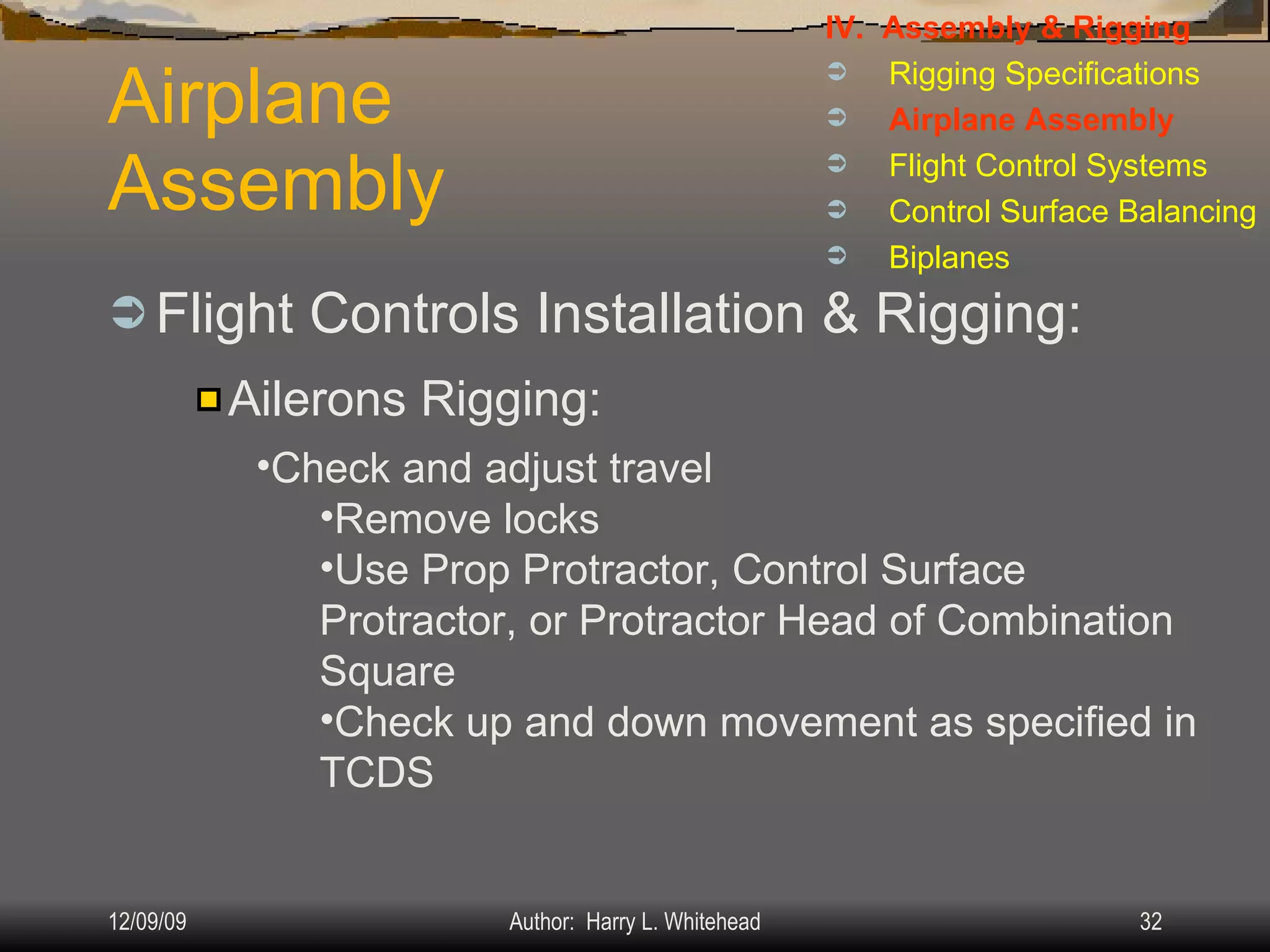
Airplane Assembly Flight Controls Installation & Rigging: IV.  Assembly & Rigging Rigging Specifications Airplane Assembly Flight Control Systems Control Surface Balancing Biplanes Ailerons Rigging: Check and adjust travel Remove locks Use Prop Protractor, Control Surface Protractor, or Protractor Head of Combination Square Check up and down movement as specified in TCDS
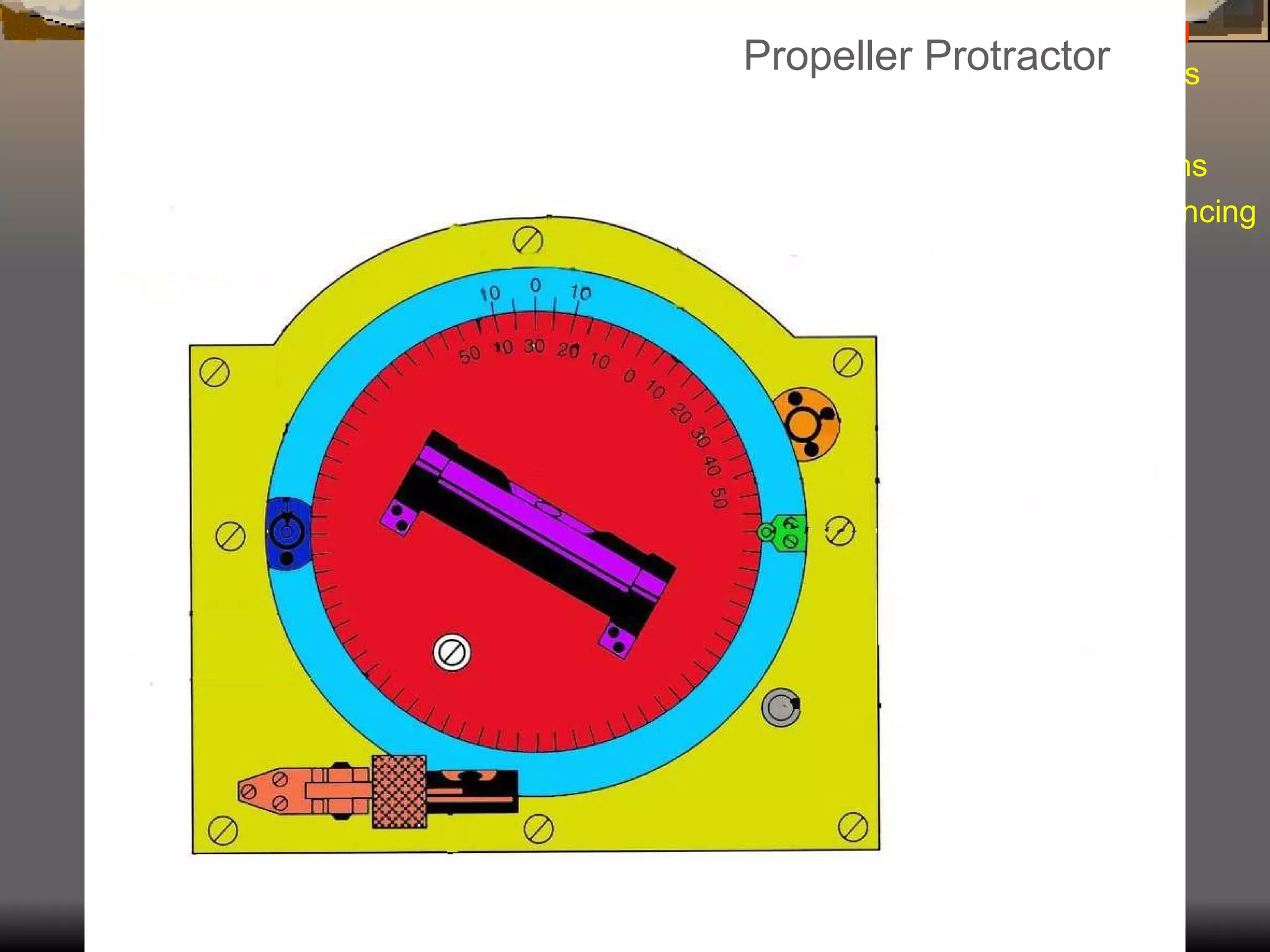
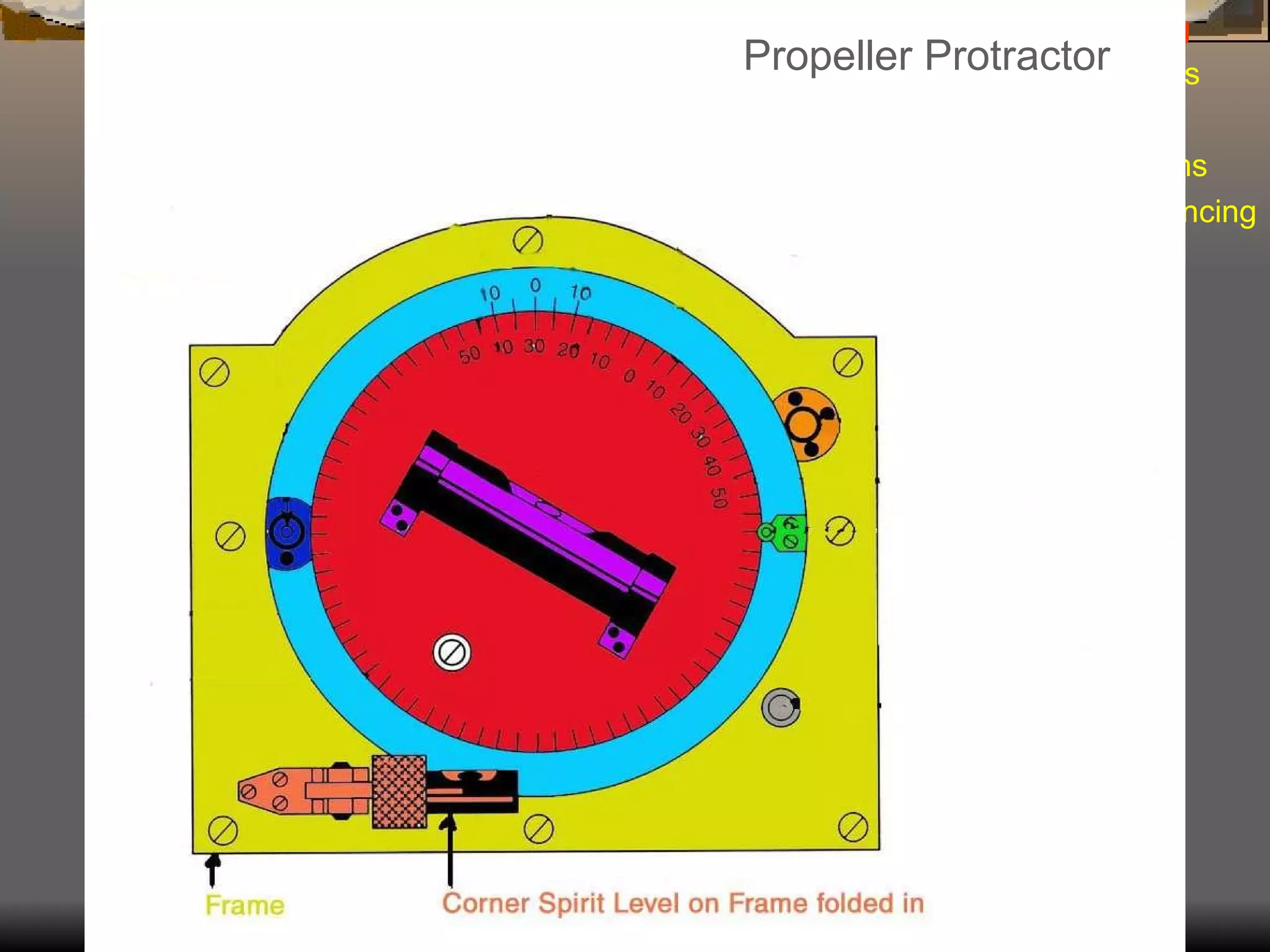
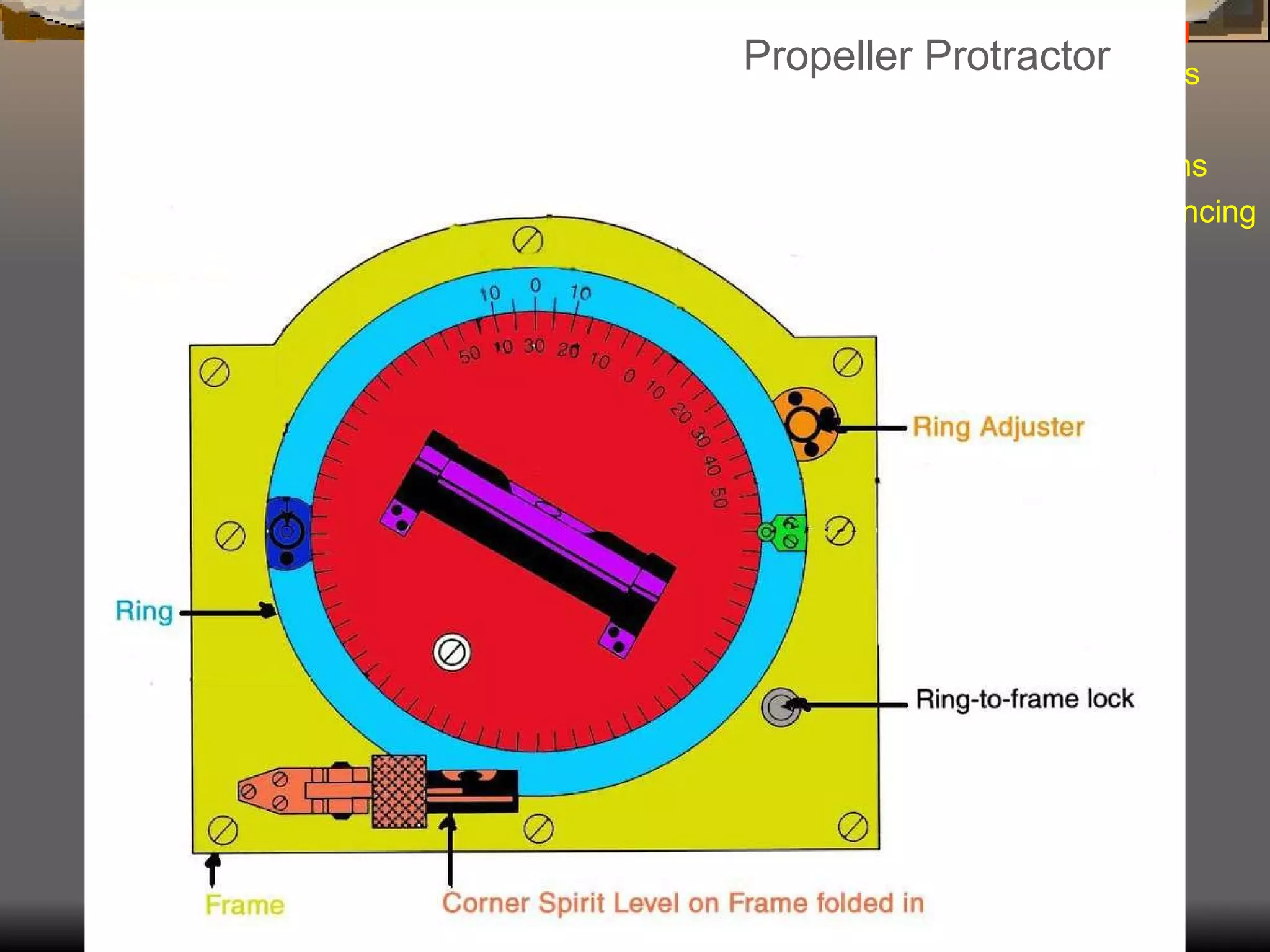
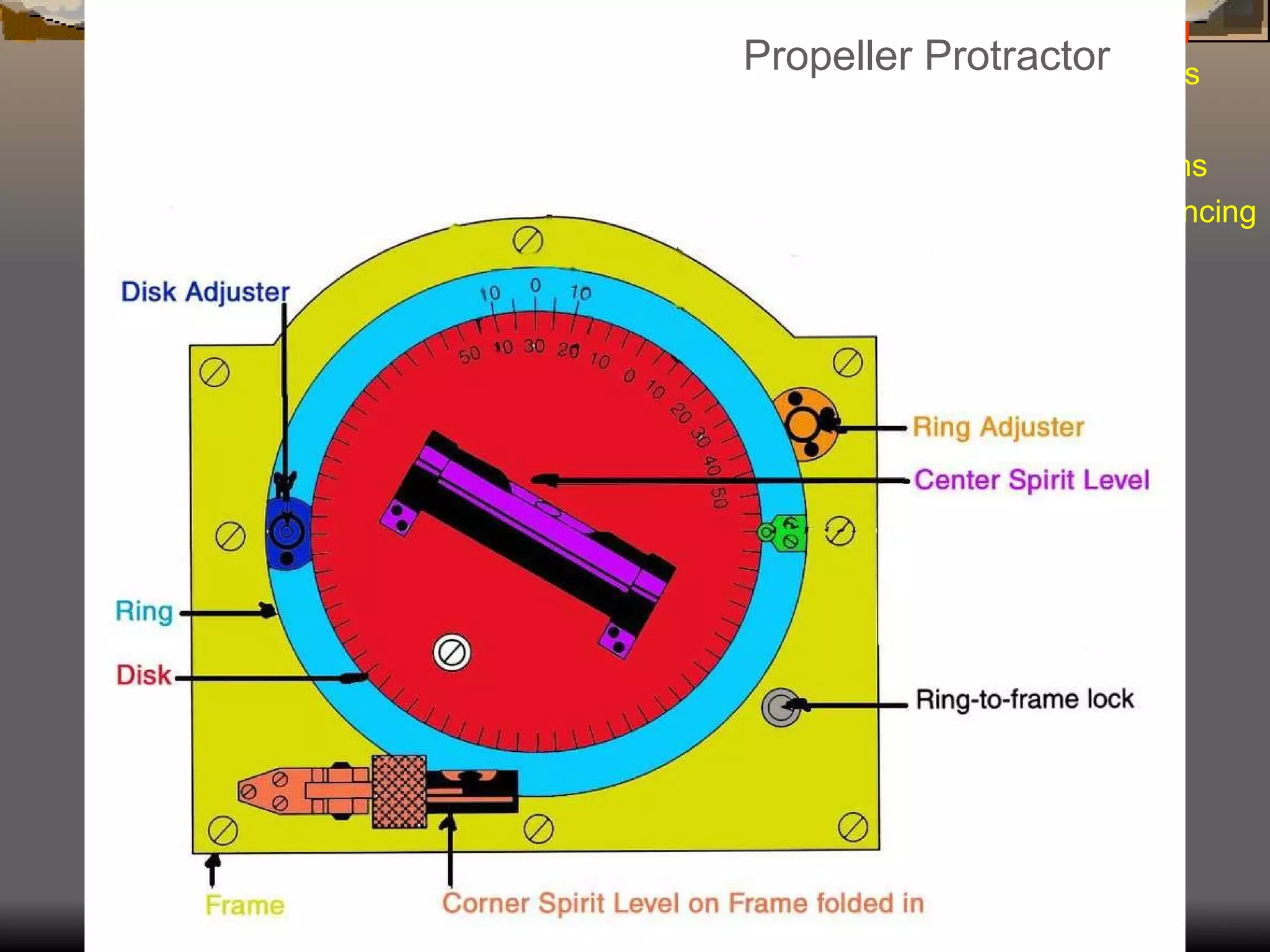
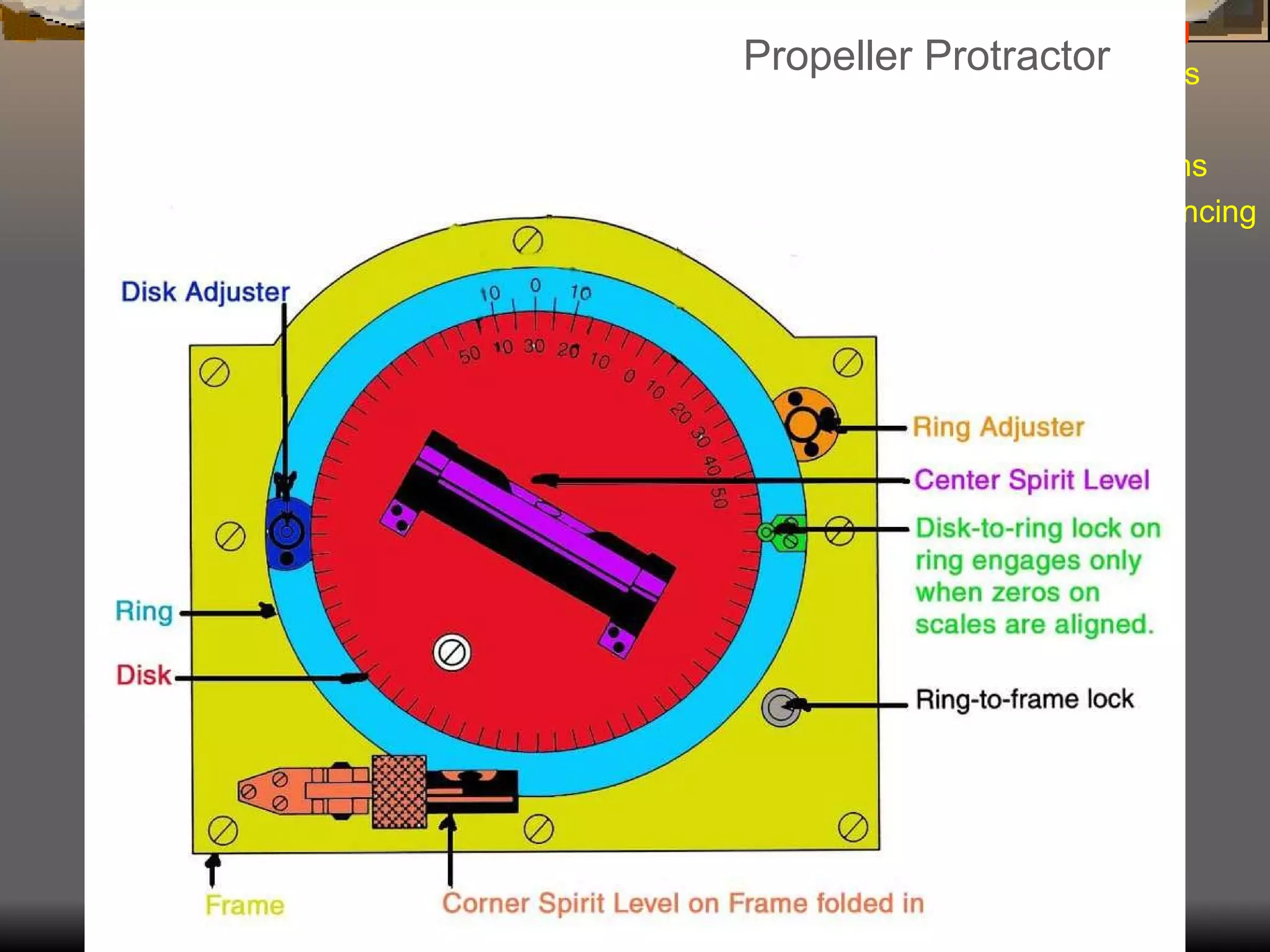
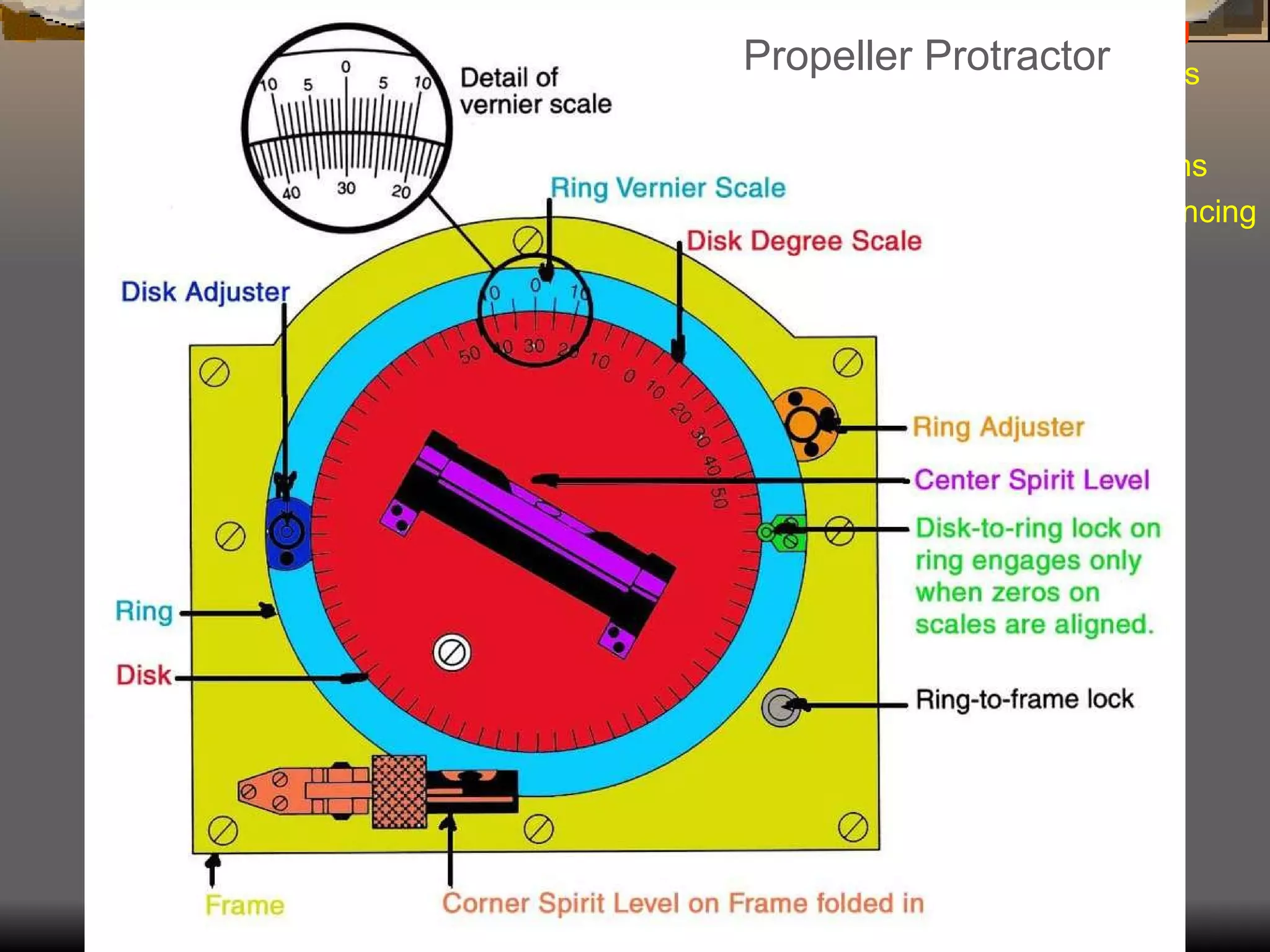
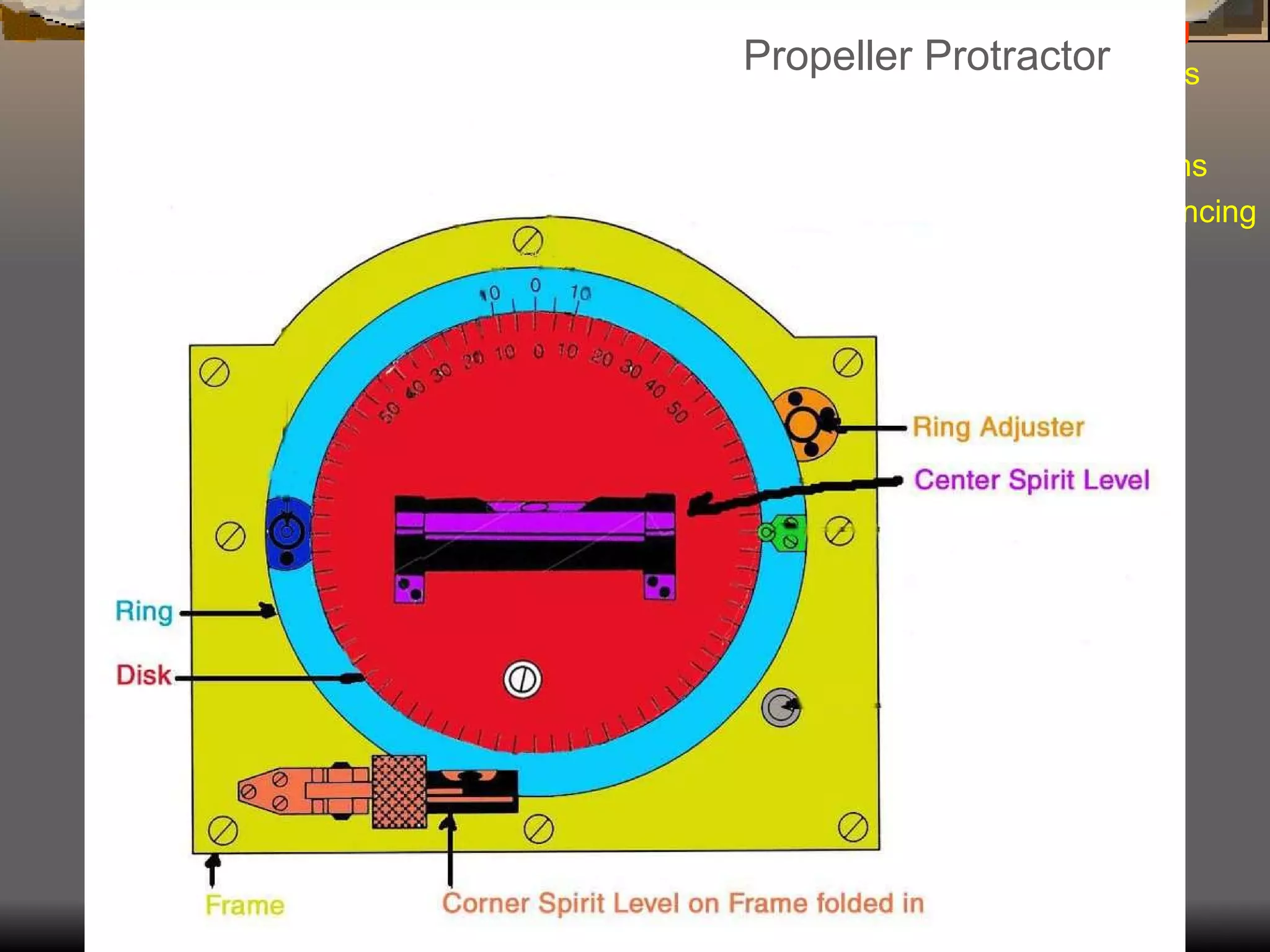
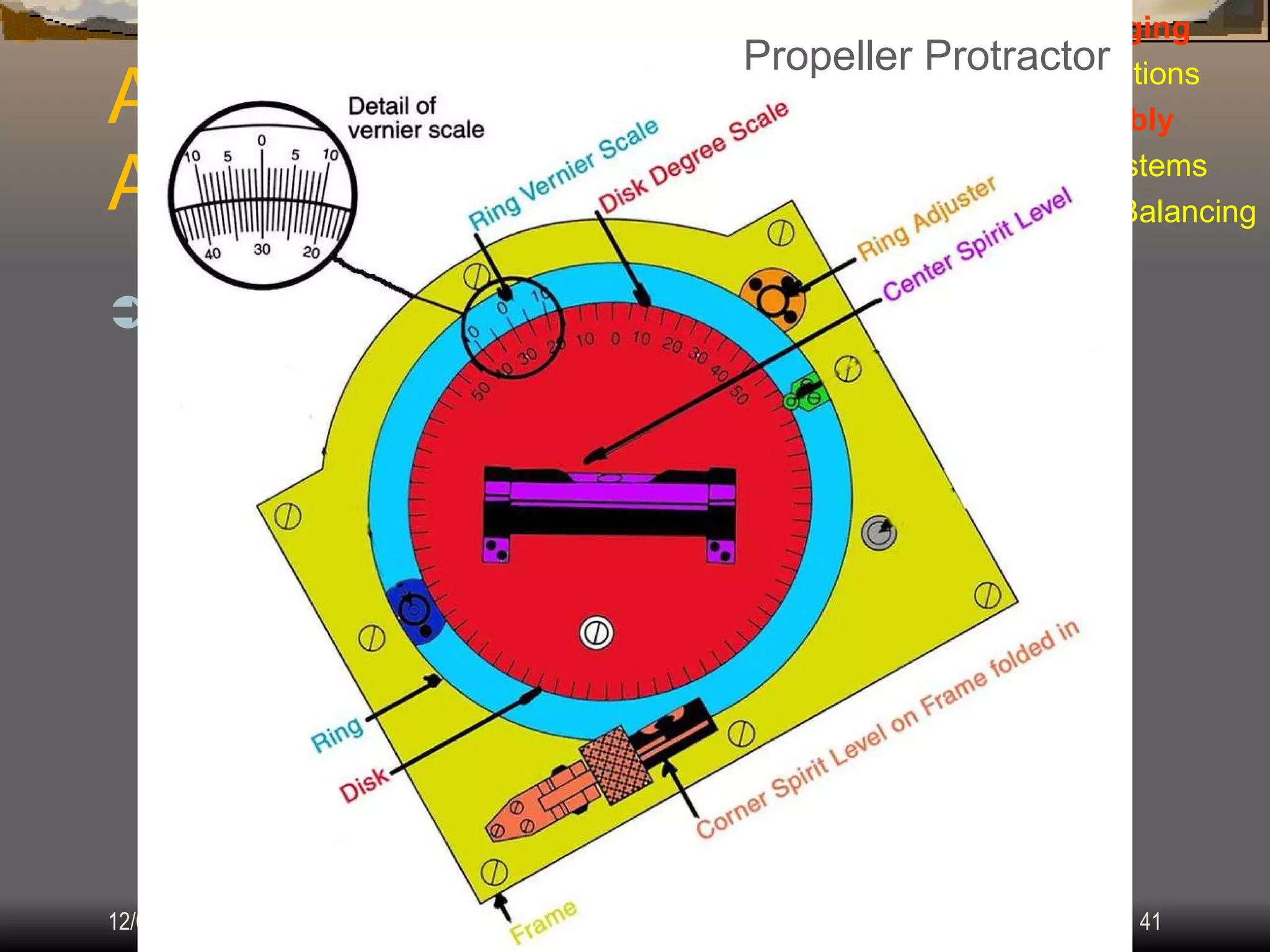
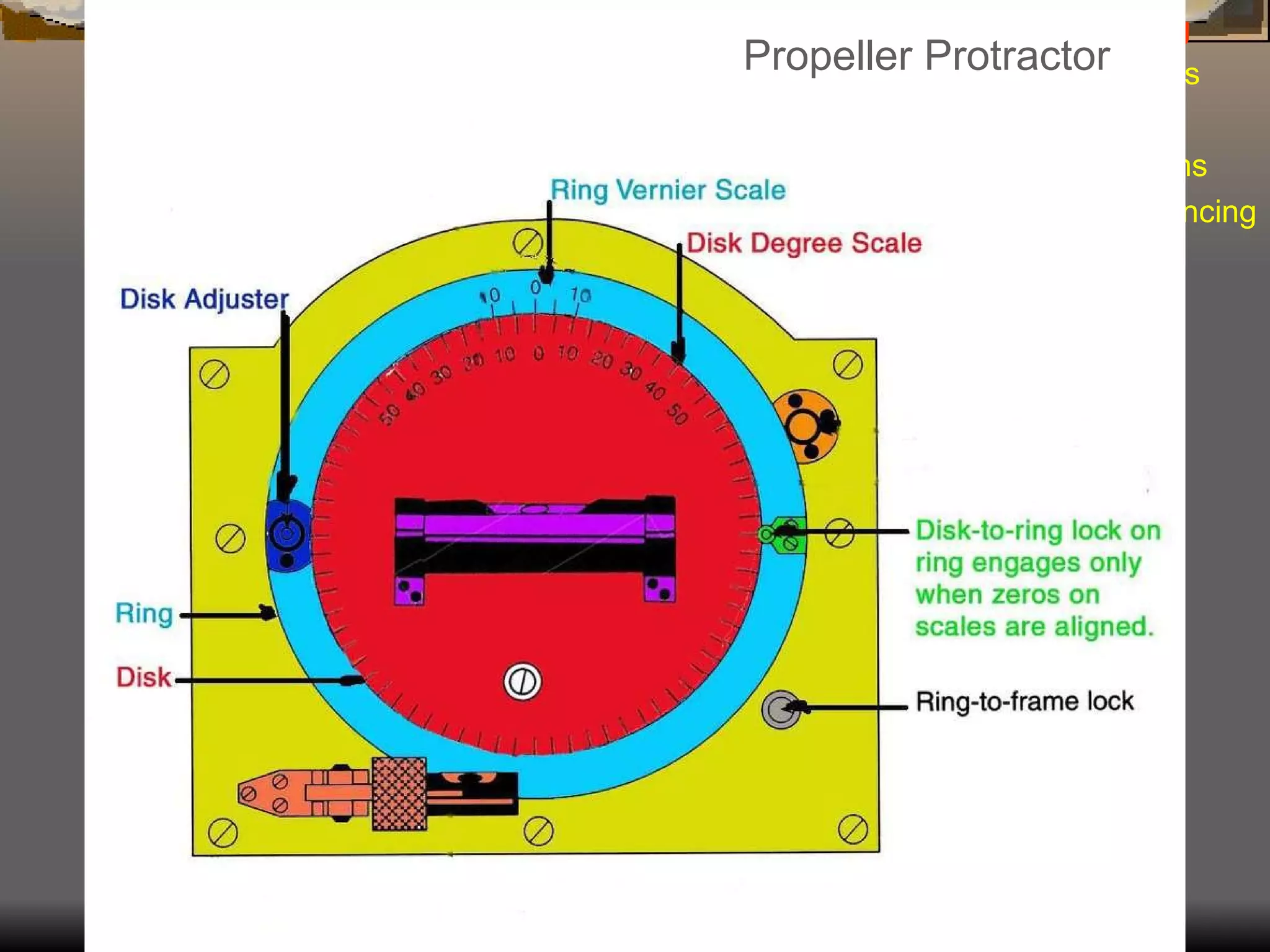
Airplane Assembly Alignment Check: IV.  Assembly & Rigging Rigging Specifications Airplane Assembly Flight Control Systems Control Surface Balancing Biplanes Ailerons Rigging: Prop Protractor Review Propeller Protractor
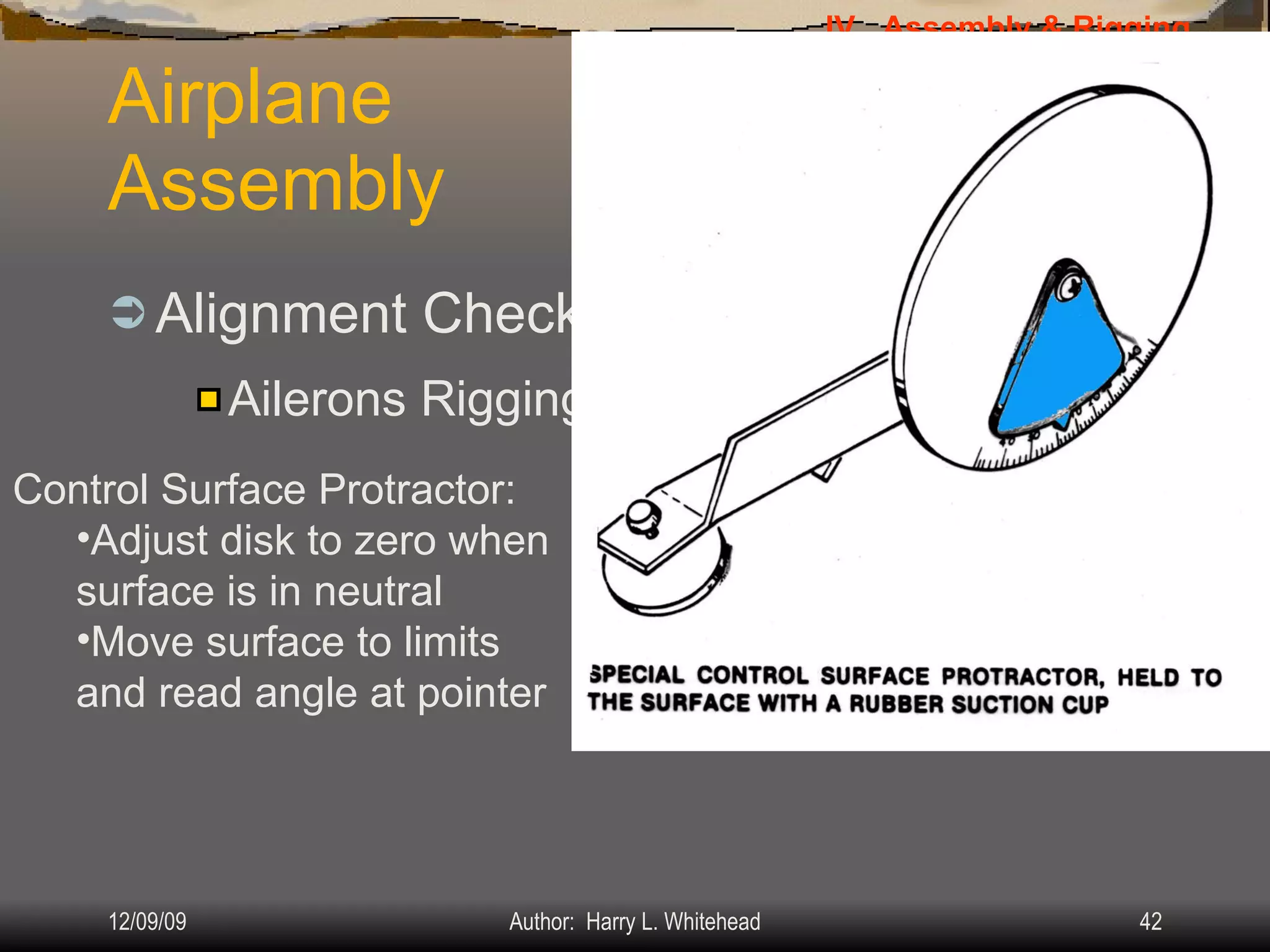
Airplane Assembly Alignment Check: IV.  Assembly & Rigging Rigging Specifications Airplane Assembly Flight Control Systems Control Surface Balancing Biplanes Ailerons Rigging: Control Surface Protractor: Adjust disk to zero when surface is in neutral Move surface to limits and read angle at pointer
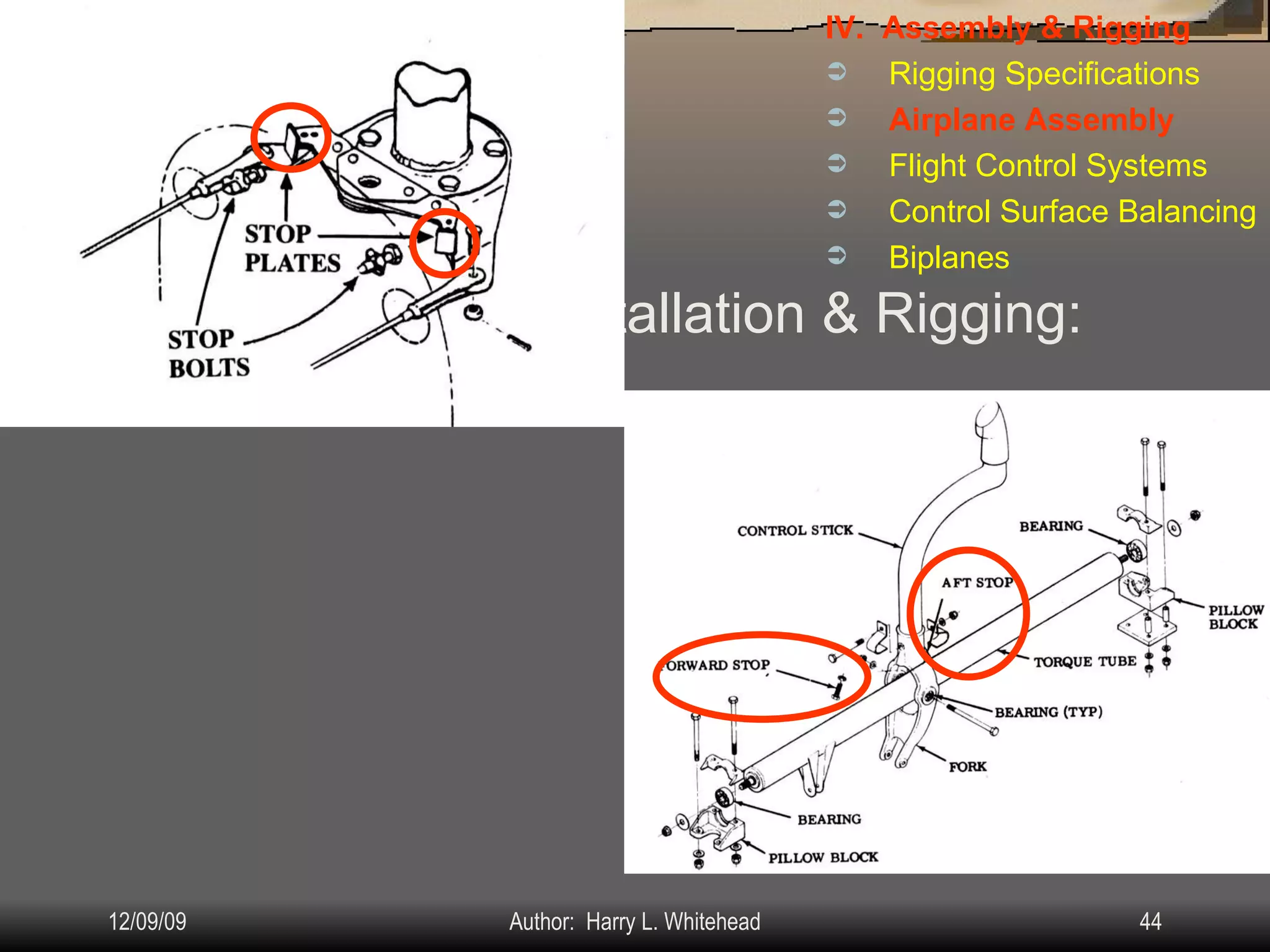
Airplane Assembly Flight Controls Installation & Rigging: IV.  Assembly & Rigging Rigging Specifications Airplane Assembly Flight Control Systems Control Surface Balancing Biplanes Ailerons Rigging: Check and adjust travel Adjust stops at ailerons Make sure they hit the stops at ailerons before running out of stick/wheel movement Should have small amount of movement of stick/wheel left to give pilot “springback” feel or “cushion” so he/she knows they’re at end of travel
Airplane Assembly Flight Controls Installation & Rigging: IV.  Assembly & Rigging Rigging Specifications Airplane Assembly Flight Control Systems Control Surface Balancing Biplanes Ailerons Rigging:
Airplane Assembly Flight Controls Installation & Rigging: IV.  Assembly & Rigging Rigging Specifications Airplane Assembly Flight Control Systems Control Surface Balancing Biplanes Ailerons Rigging: Check and adjust travel Some are “Drooped” When in neutral position = trailing edges are slightly lower than wing  or Flap trailing edges (must be equal droop on each wing) During flight = ailerons are forced to streamlined position to take up any slack or wear in system (mostly cable systems)
Airplane Assembly Flight Controls Installation & Rigging: IV.  Assembly & Rigging Rigging Specifications Airplane Assembly Flight Control Systems Control Surface Balancing Biplanes Ailerons Rigging: After adjustment Move stick/wheel through entire range of movement Check for ease of movement, no binding, hits stops at aileron first, and AILERONS MOVE IN PROPER DIRECTION Check entire system for proper installation (pulleys, cables, bolts, safeties, etc.)
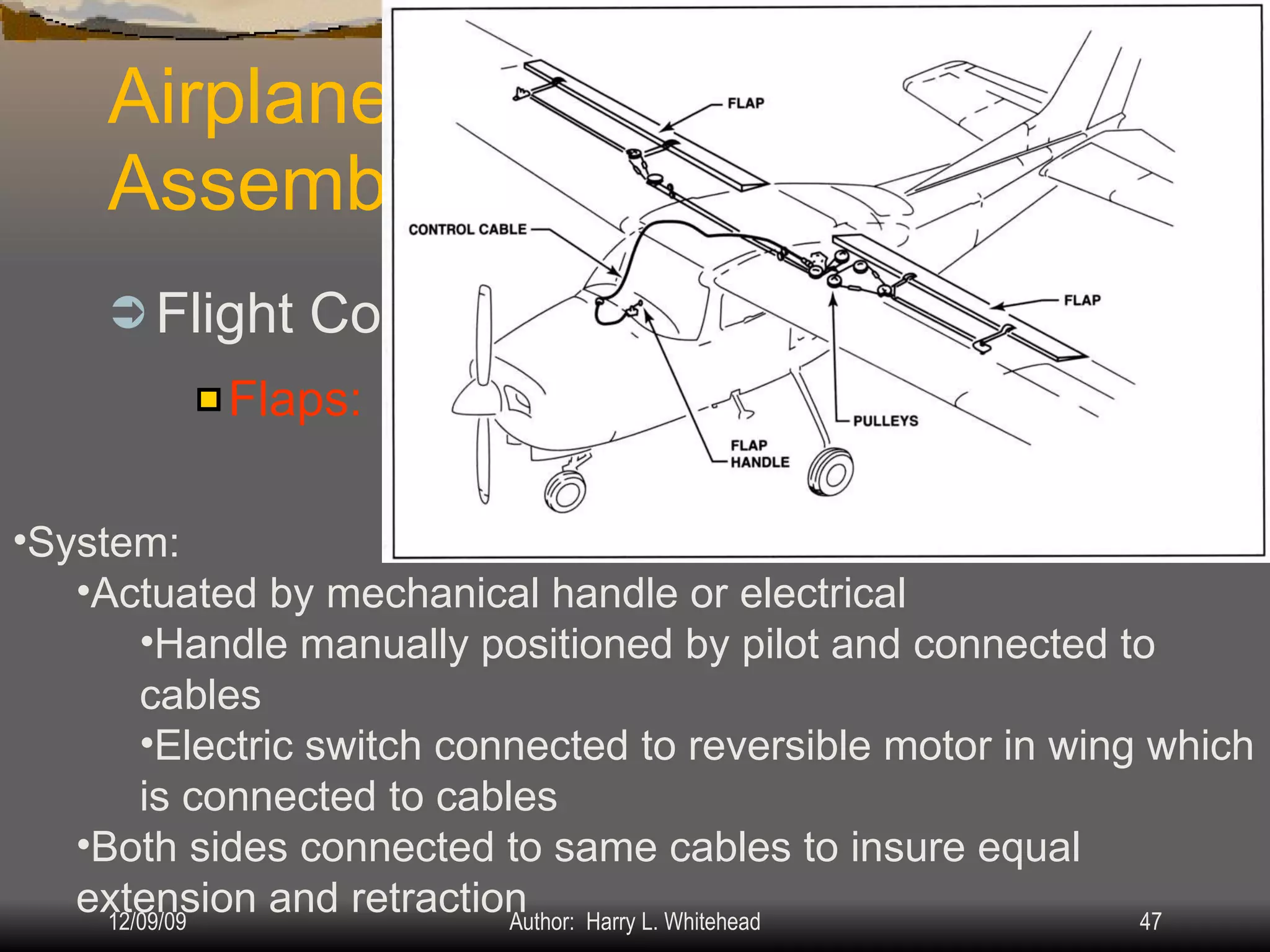
Airplane Assembly Flight Controls Installation & Rigging: IV.  Assembly & Rigging Rigging Specifications Airplane Assembly Flight Control Systems Control Surface Balancing Biplanes Flaps: System: Actuated by mechanical handle or electrical Handle manually positioned by pilot and connected to cables Electric switch connected to reversible motor in wing which is connected to cables Both sides connected to same cables to insure equal extension and retraction
Airplane Assembly Flight Controls Installation & Rigging: IV.  Assembly & Rigging Rigging Specifications Airplane Assembly Flight Control Systems Control Surface Balancing Biplanes Flaps Rigging: Generally same as ailerons Lock in retracted position Adjust cable tension Check and adjust travel as per TCDS Hit stops at flaps first BOTH MUST EXTEND EQUALLY! If different = extreme roll force Check indicator system matches flap movement and positions
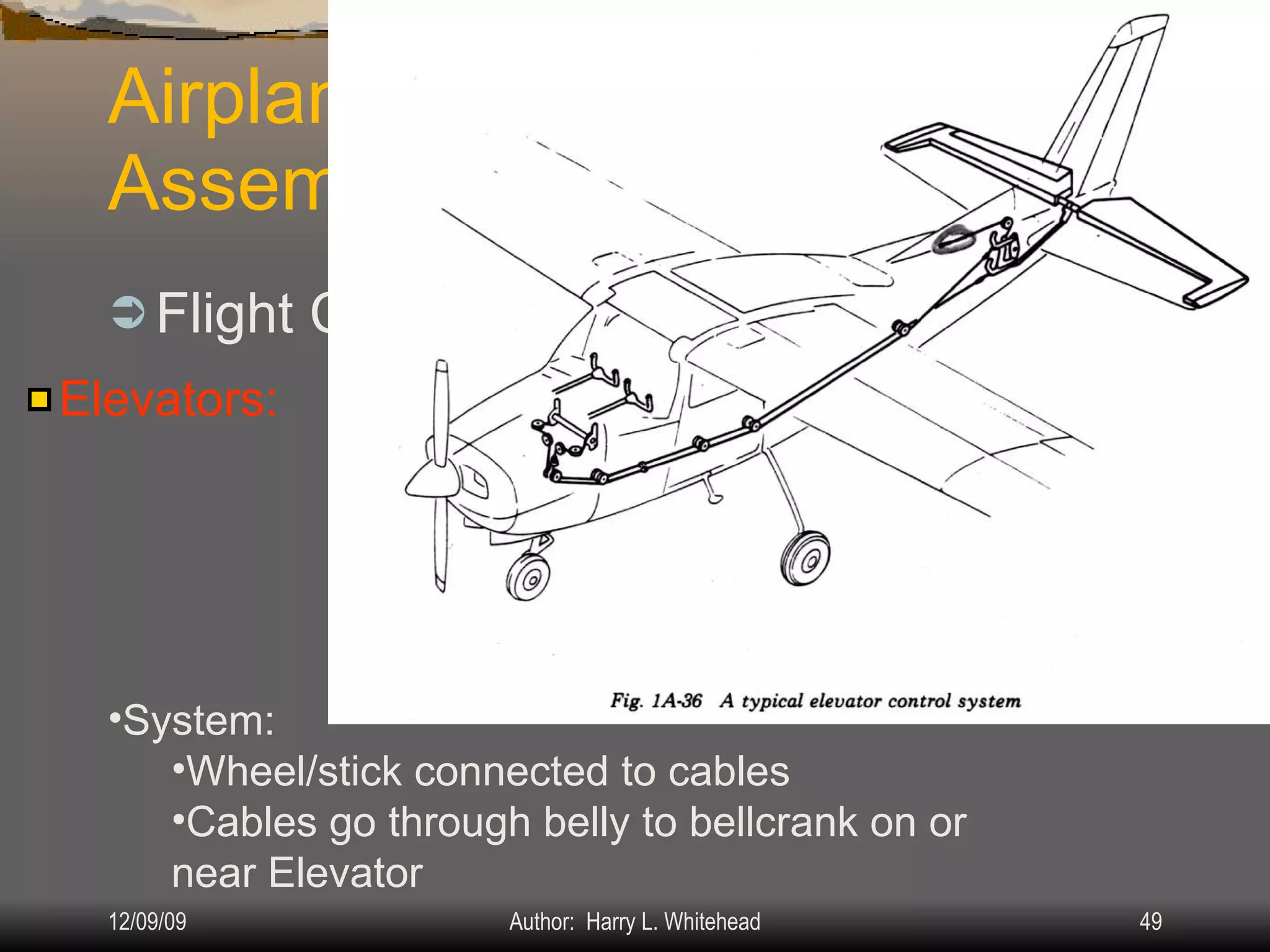
Airplane Assembly Flight Controls Installation & Rigging: IV.  Assembly & Rigging Rigging Specifications Airplane Assembly Flight Control Systems Control Surface Balancing Biplanes Elevators: System: Wheel/stick connected to cables Cables go through belly to bellcrank on or near Elevator
Airplane Assembly Flight Controls Installation & Rigging: IV.  Assembly & Rigging Rigging Specifications Airplane Assembly Flight Control Systems Control Surface Balancing Biplanes Elevators: System: Most modern airplanes can be loaded with CG too far aft Lots of seats, baggage compartments in back, etc. When this airplane is slowed down for landing: Trim tab working hard to keep nose down with Elevators in slightly down position If turbulence = Trim Tab may loose effectiveness = Elevators streamline = nose pitches up and trim tab can’t compensate = possible stall
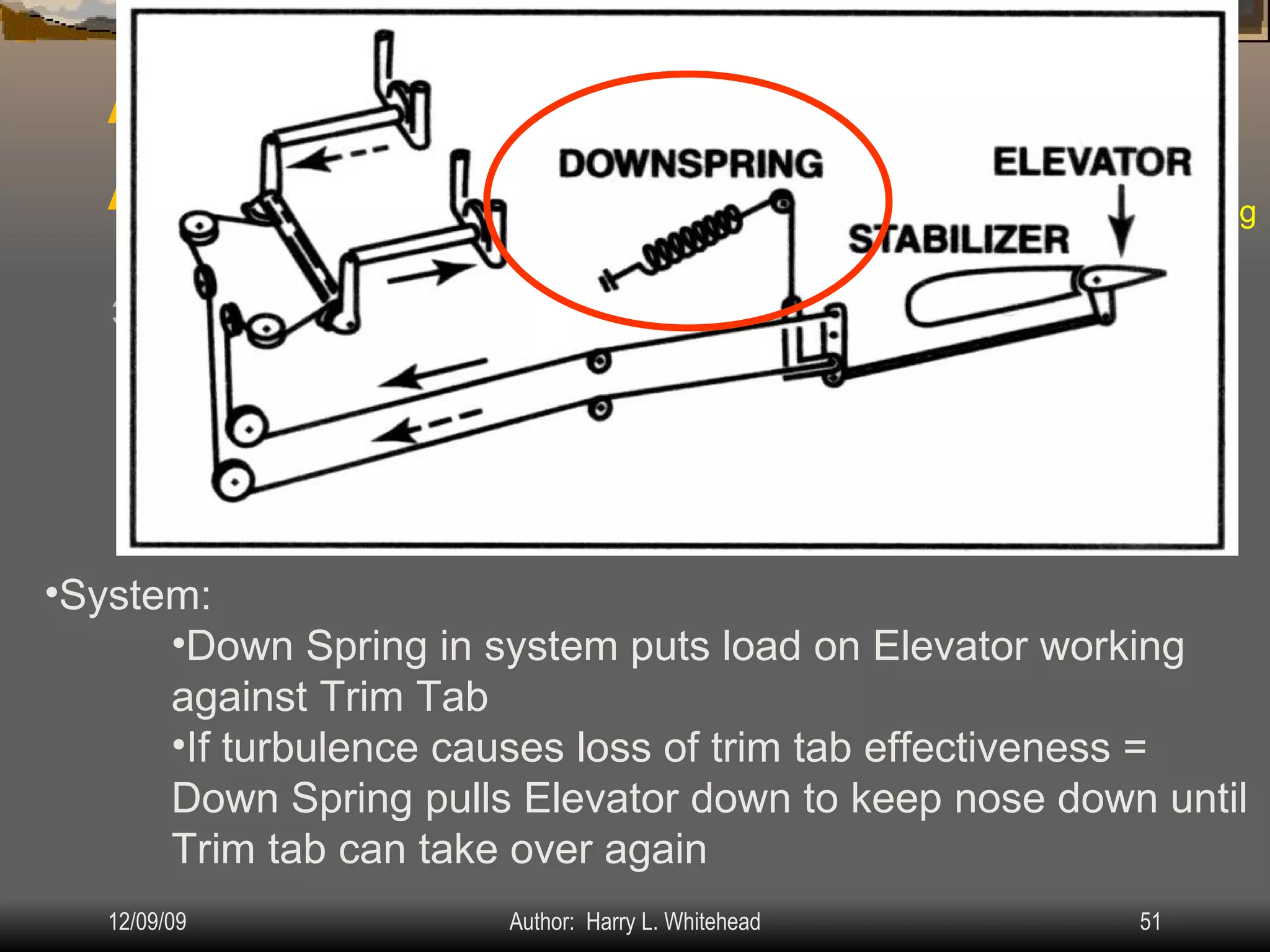
Airplane Assembly Flight Controls Installation & Rigging: IV.  Assembly & Rigging Rigging Specifications Airplane Assembly Flight Control Systems Control Surface Balancing Biplanes Elevators: System: Down Spring in system puts load on Elevator working against Trim Tab If turbulence causes loss of trim tab effectiveness = Down Spring pulls Elevator down to keep nose down until Trim tab can take over again
Airplane Assembly Flight Controls Installation & Rigging: IV.  Assembly & Rigging Rigging Specifications Airplane Assembly Flight Control Systems Control Surface Balancing Biplanes Elevators: Rigging generally same as ailerons Lock in neutral Trailing edge in line with Hor. Stab. trailing edge Clamp wheel/stick and elevator Adjust cable tension Adjust travel Check operations and system for problems
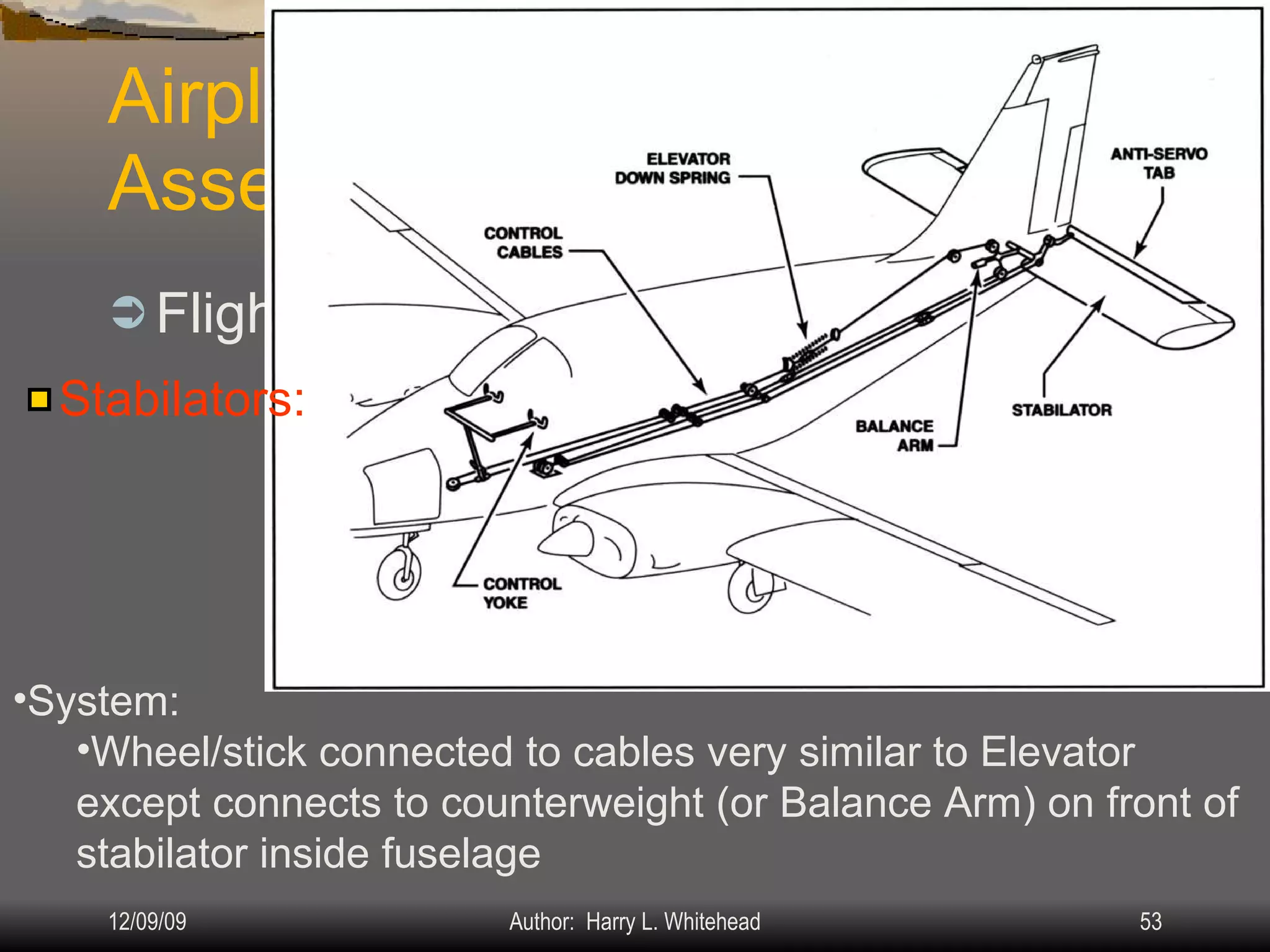
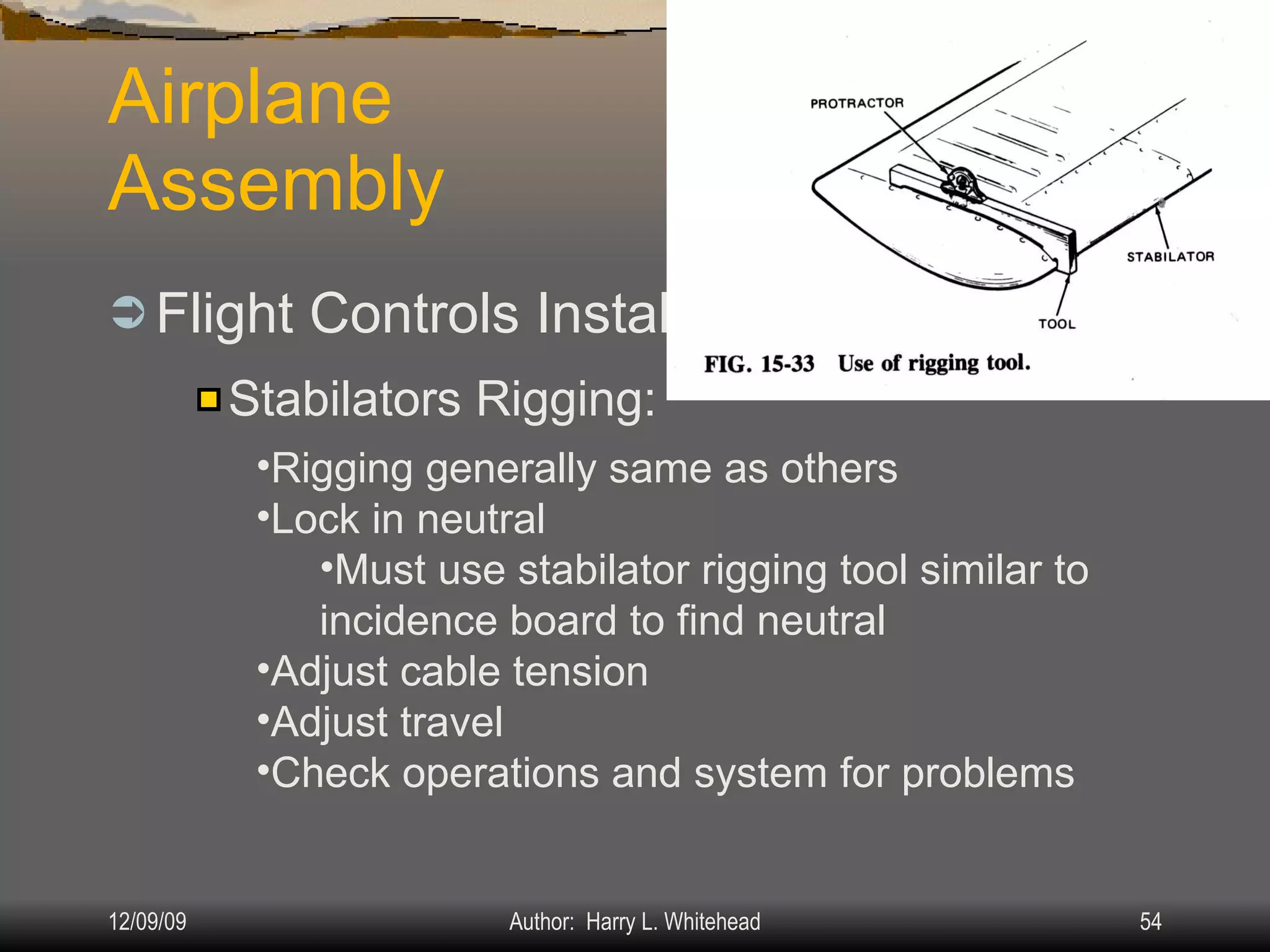
Airplane Assembly Flight Controls Installation & Rigging: IV.  Assembly & Rigging Rigging Specifications Airplane Assembly Flight Control Systems Control Surface Balancing Biplanes Stabilators: System: Wheel/stick connected to cables very similar to Elevator except connects to counterweight (or Balance Arm) on front of stabilator inside fuselage
Airplane Assembly Flight Controls Installation & Rigging: IV.  Assembly & Rigging Rigging Specifications Airplane Assembly Flight Control Systems Control Surface Balancing Biplanes Stabilators Rigging: Rigging generally same as others Lock in neutral Must use stabilator rigging tool similar to incidence board to find neutral Adjust cable tension Adjust travel Check operations and system for problems
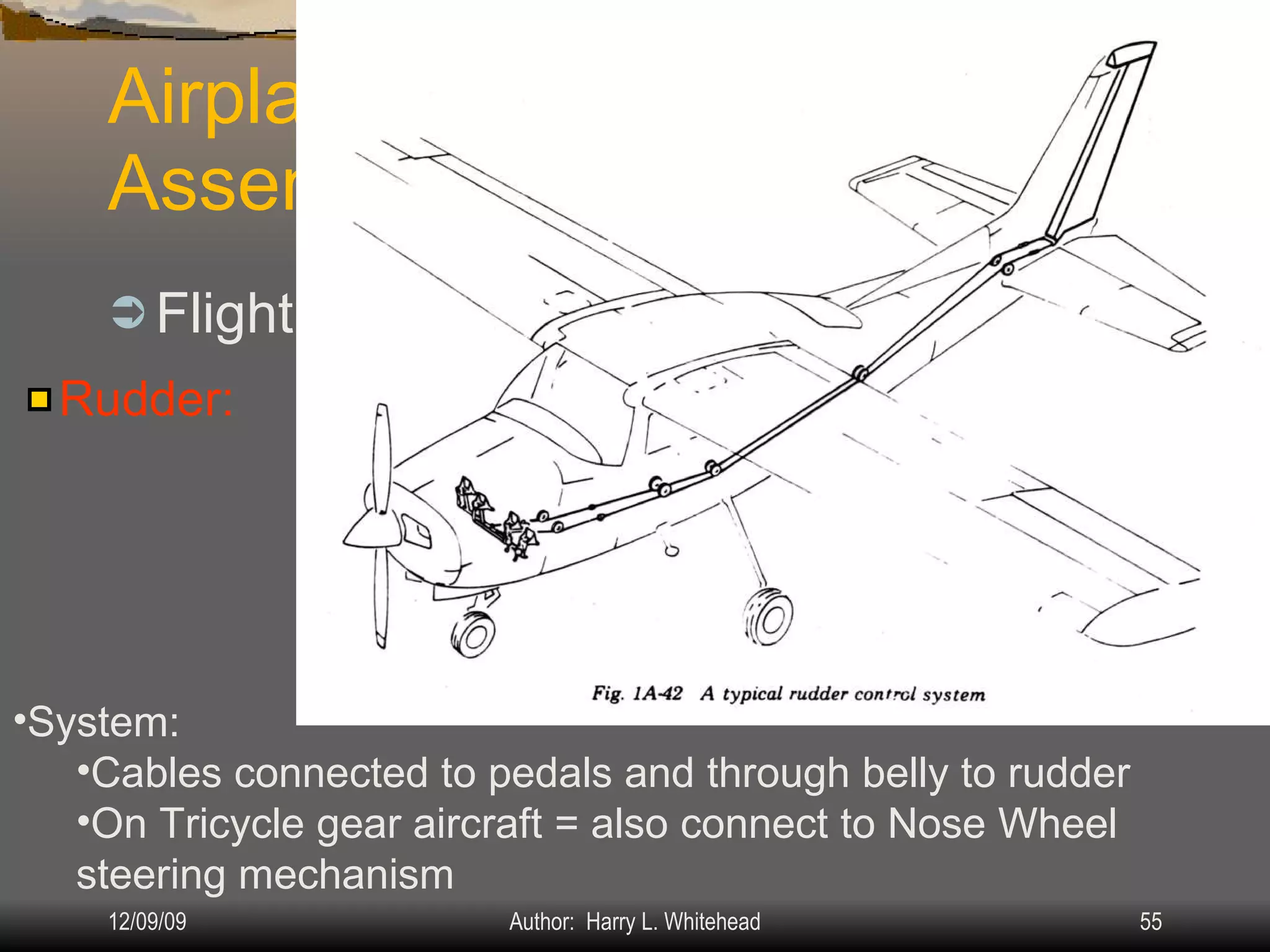
Airplane Assembly Flight Controls Installation & Rigging: IV.  Assembly & Rigging Rigging Specifications Airplane Assembly Flight Control Systems Control Surface Balancing Biplanes Rudder: System: Cables connected to pedals and through belly to rudder  On Tricycle gear aircraft = also connect to Nose Wheel steering mechanism
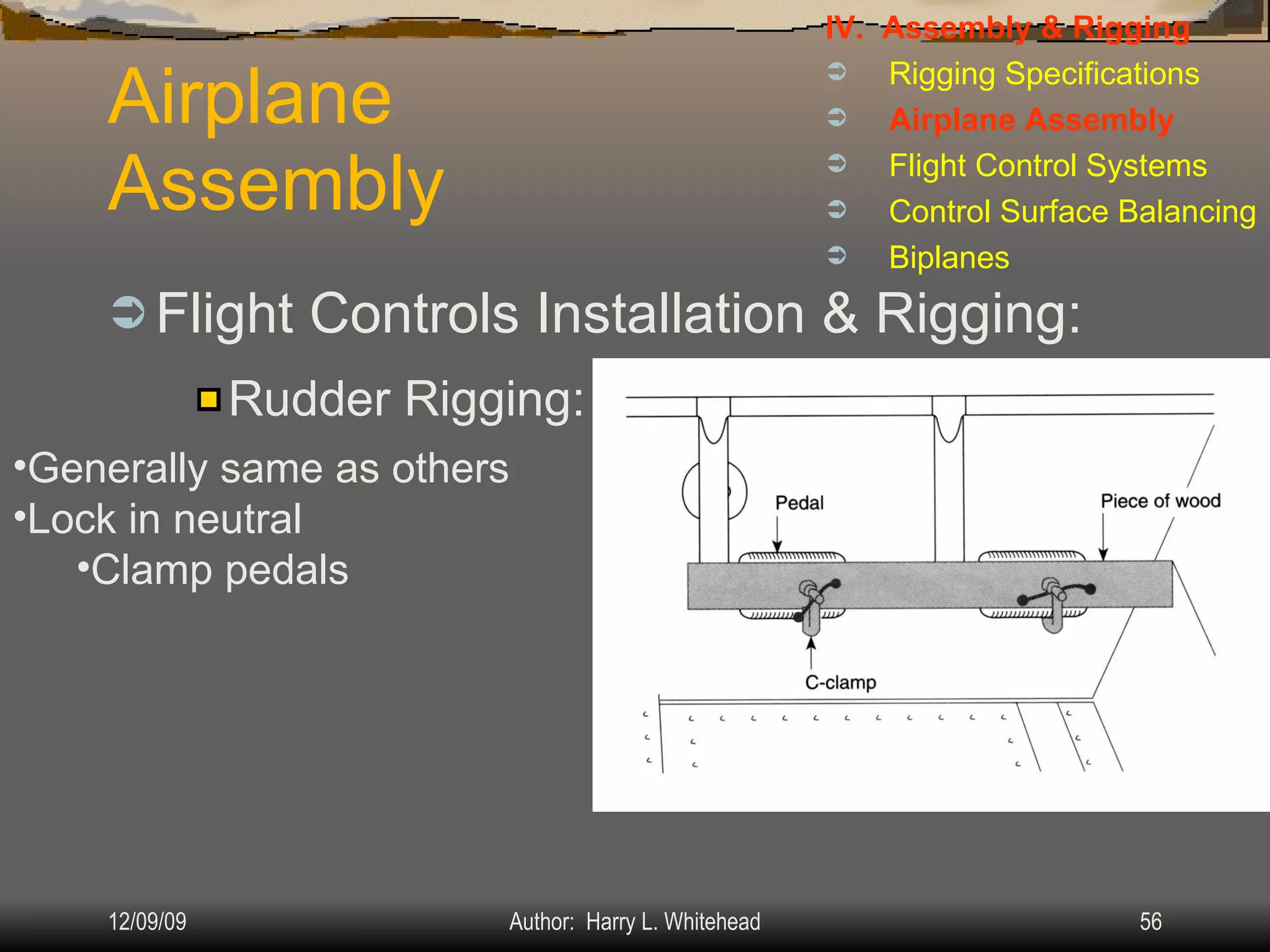
Airplane Assembly Flight Controls Installation & Rigging: IV.  Assembly & Rigging Rigging Specifications Airplane Assembly Flight Control Systems Control Surface Balancing Biplanes Rudder Rigging: Generally same as others Lock in neutral Clamp pedals
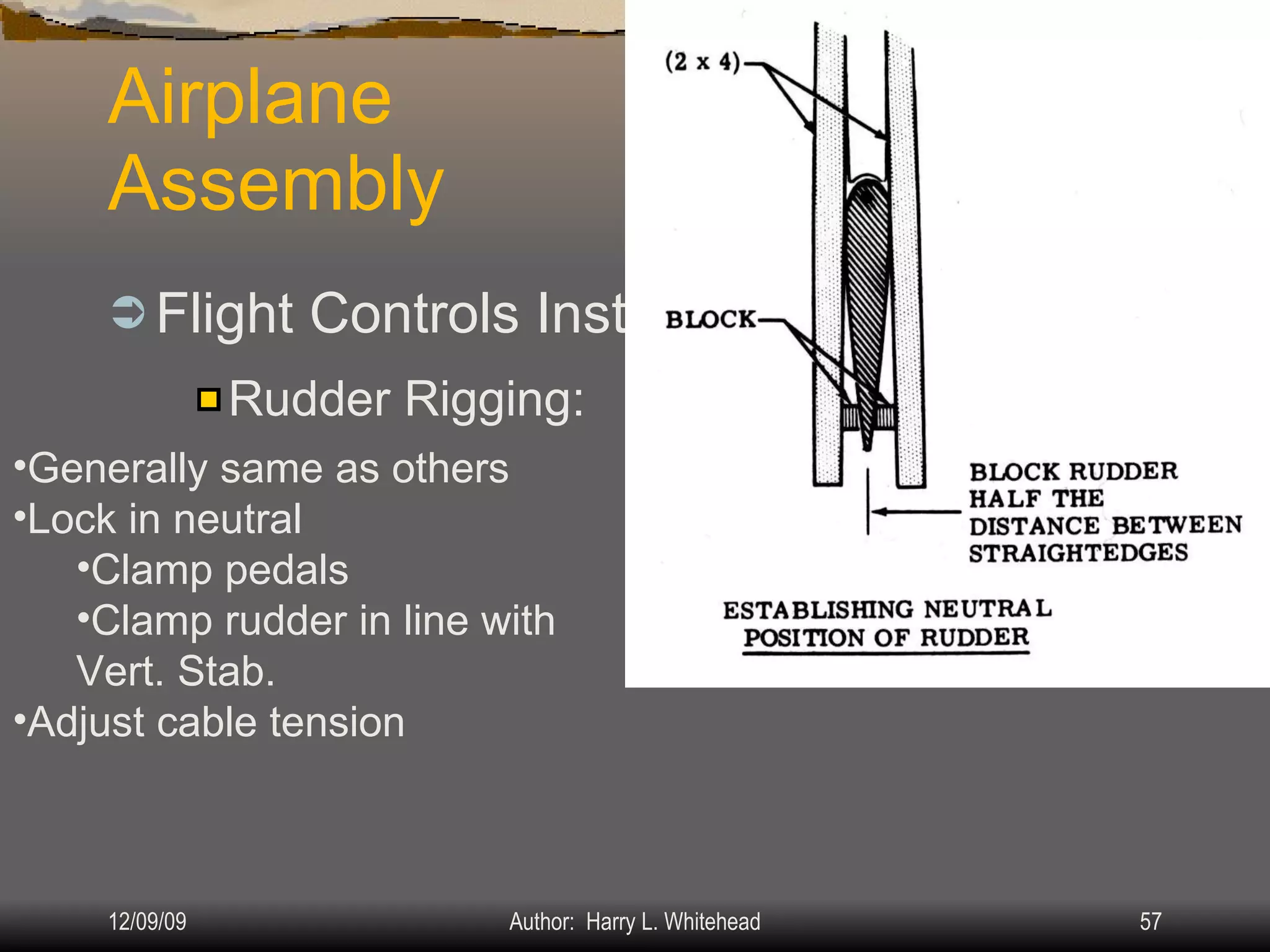
Airplane Assembly Flight Controls Installation & Rigging: IV.  Assembly & Rigging Rigging Specifications Airplane Assembly Flight Control Systems Control Surface Balancing Biplanes Rudder Rigging: Generally same as others Lock in neutral Clamp pedals Clamp rudder in line with Vert. Stab. Adjust cable tension
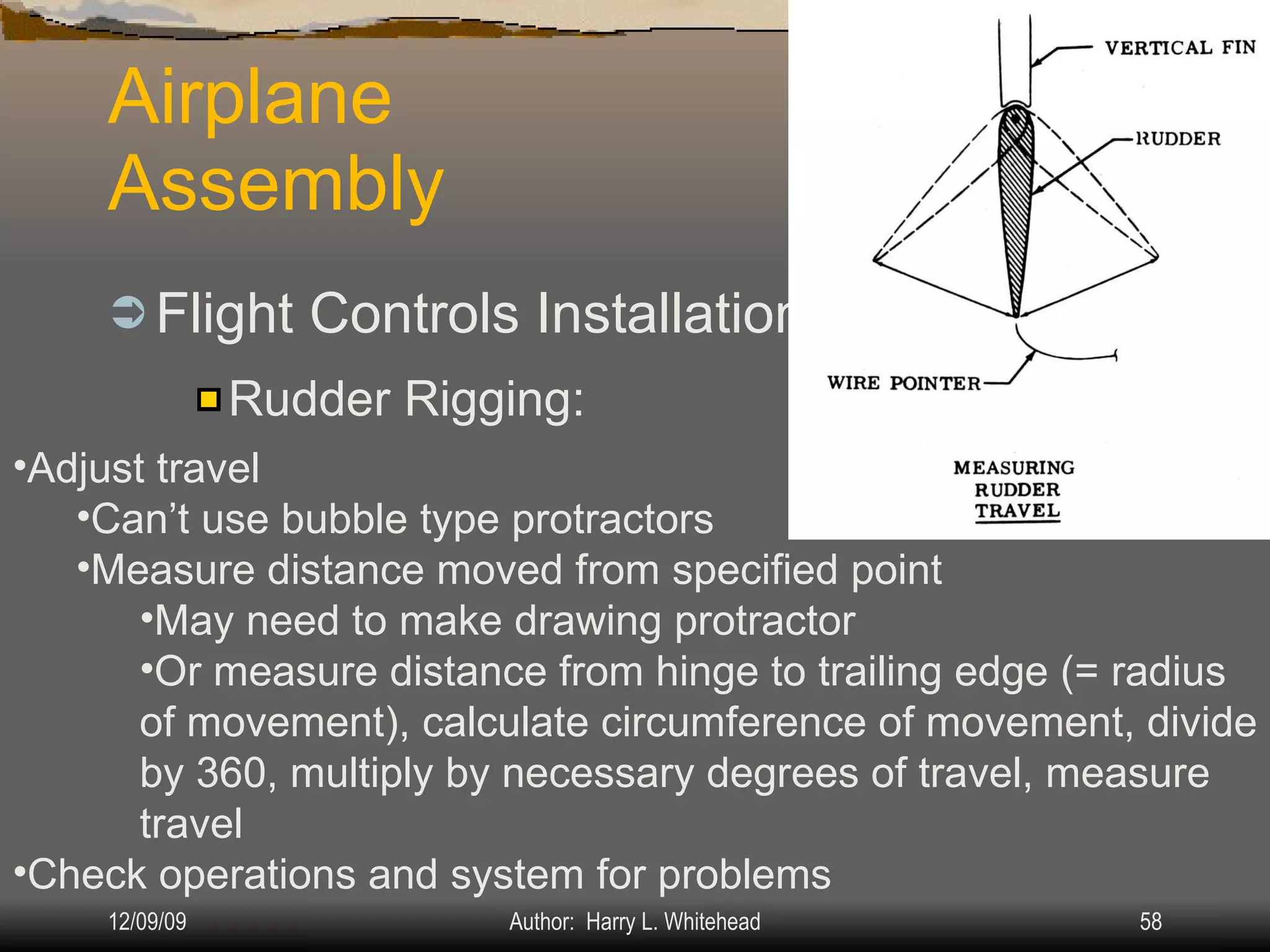
Airplane Assembly Flight Controls Installation & Rigging: IV.  Assembly & Rigging Rigging Specifications Airplane Assembly Flight Control Systems Control Surface Balancing Biplanes Rudder Rigging: Adjust travel Can’t use bubble type protractors Measure distance moved from specified point May need to make drawing protractor Or measure distance from hinge to trailing edge (= radius of movement), calculate circumference of movement, divide by 360, multiply by necessary degrees of travel, measure travel  Check operations and system for problems
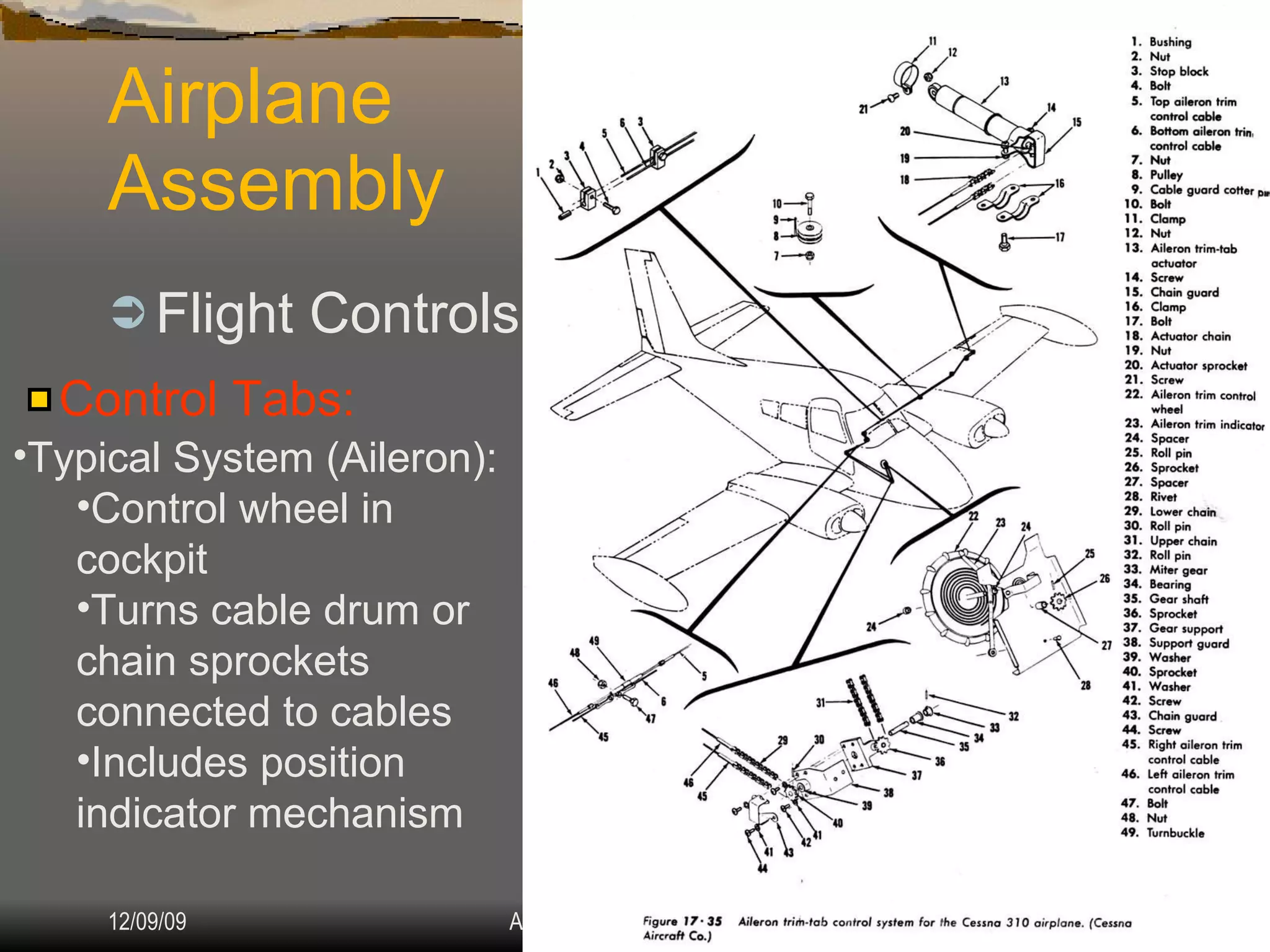
Airplane Assembly Flight Controls Installation & Rigging: IV.  Assembly & Rigging Rigging Specifications Airplane Assembly Flight Control Systems Control Surface Balancing Biplanes Control Tabs: Typical System (Aileron): Control wheel in cockpit Turns cable drum or chain sprockets connected to cables  Includes position indicator mechanism
Airplane Assembly Flight Controls Installation & Rigging: IV.  Assembly & Rigging Rigging Specifications Airplane Assembly Flight Control Systems Control Surface Balancing Biplanes Control Tabs Rigging: Generally same as others Lock in neutral In line with control surface installed on Adjust cable tension Adjust travel Check operations and system for problems Check indicator for proper operation Insure is moving in proper direction
Airplane Assembly Flight Controls Installation & Rigging: IV.  Assembly & Rigging Rigging Specifications Airplane Assembly Flight Control Systems Control Surface Balancing Biplanes Final Check: Test fly and readjust as necessary to fly “hands off” at cruise and most common loading If flying with constant bank (“heavy wing”) Need to adjust angle of incidence of wing(s) Need to “Wash IN” heavy wing by INcreasing angle of incidence on low side Turn rear bolt (if serrated or eccentric) shorten rear strut length Could also Wash Out light (or high) wing
Airplane Assembly Flight Controls Installation & Rigging: IV.  Assembly & Rigging Rigging Specifications Airplane Assembly Flight Control Systems Control Surface Balancing Biplanes Final Check: If in sideslip = rudder  Reset in-flight adjustable trim tab or bend fixed trim tab to compensate If nose low or high = elevator Reset trim tab(s) accordingly All are Trial and Error adjustments so re-test fly to verify and keep trying until it’s right
Airplane Assembly Flight Controls Systems: IV.  Assembly & Rigging Rigging Specifications Airplane Assembly Flight Control Systems Control Surface Balancing Biplanes Cable Systems: Types of Cable CRES or carbon steel Carbon steel cheaper and stronger Preformed Must be at least 1/8 inch diameter for Primary Controls
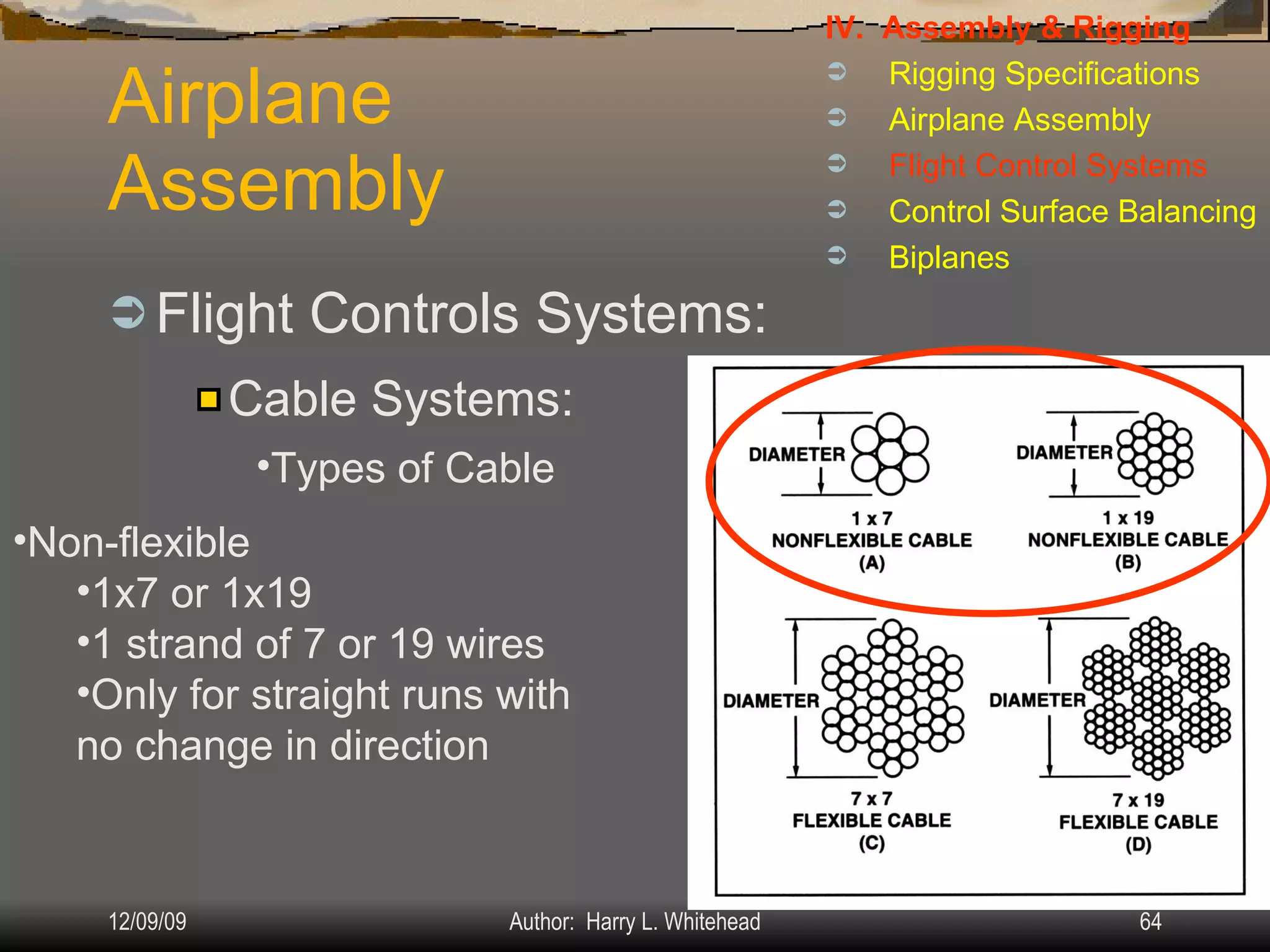
Airplane Assembly Flight Controls Systems: IV.  Assembly & Rigging Rigging Specifications Airplane Assembly Flight Control Systems Control Surface Balancing Biplanes Cable Systems: Types of Cable Non-flexible 1x7 or 1x19 1 strand of 7 or 19 wires Only for straight runs with no change in direction
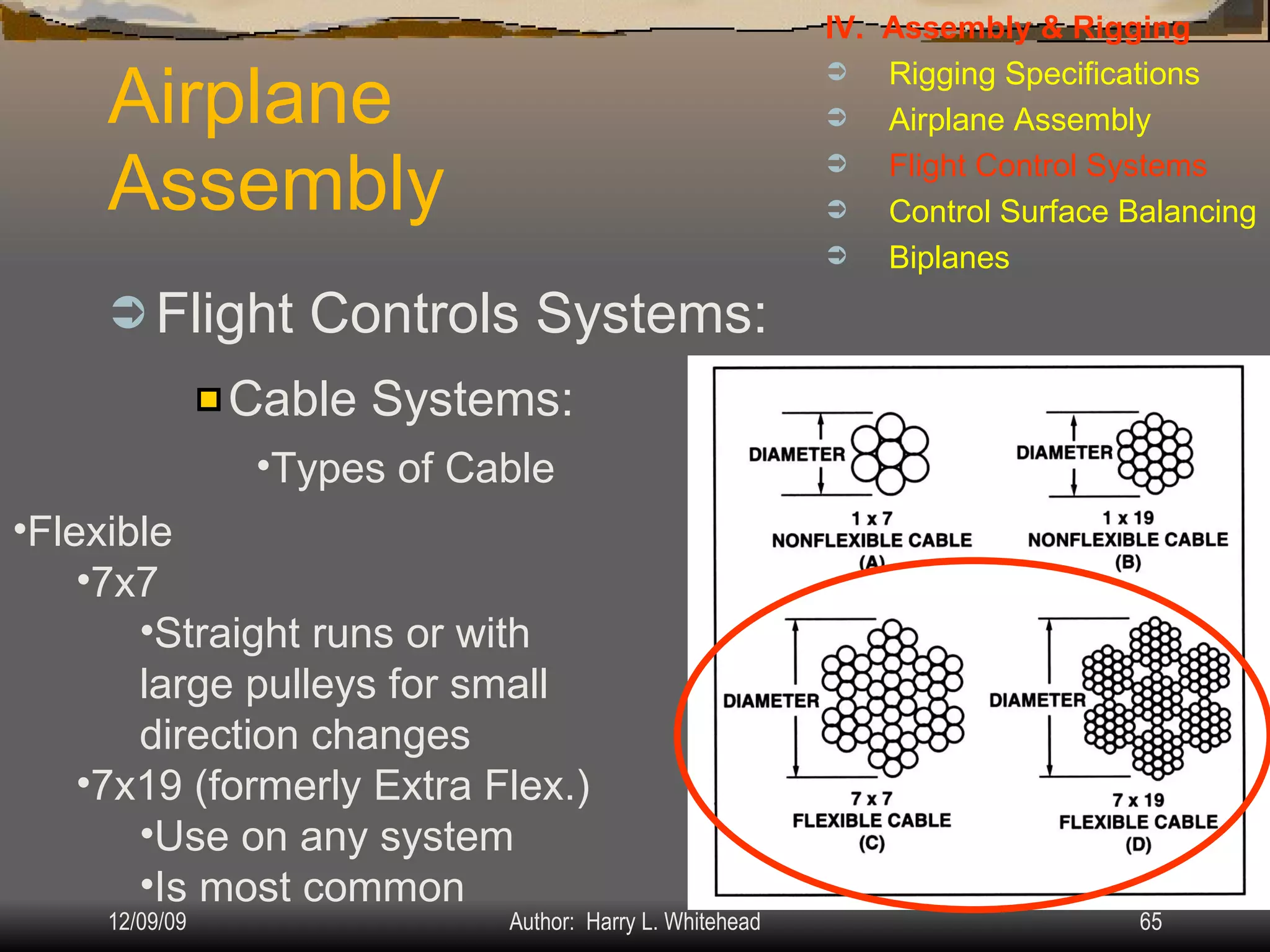
Airplane Assembly Flight Controls Systems: IV.  Assembly & Rigging Rigging Specifications Airplane Assembly Flight Control Systems Control Surface Balancing Biplanes Cable Systems: Types of Cable Flexible 7x7 Straight runs or with large pulleys for small direction changes 7x19 (formerly Extra Flex.) Use on any system Is most common
Airplane Assembly Flight Controls Systems: IV.  Assembly & Rigging Rigging Specifications Airplane Assembly Flight Control Systems Control Surface Balancing Biplanes Cable Systems: Types of Cable Also: 3 x 7 only used on very small cable runs for non-critical applications usually only for control surface position indicators 6 x 19 for larger than 3/8” diameters
Airplane Assembly Flight Controls Systems: IV.  Assembly & Rigging Rigging Specifications Airplane Assembly Flight Control Systems Control Surface Balancing Biplanes Cable Systems: Types of Cable Nylon-coated Made by extruding a nylon coating over CRES cable Increases service life as keeps clean and less vibration (= less work hardening)
Airplane Assembly Flight Controls Systems: IV.  Assembly & Rigging Rigging Specifications Airplane Assembly Flight Control Systems Control Surface Balancing Biplanes Cable Systems: Types of Cable LockClad On some older aircraft for high altitude flight Is regular cable surrounded by Aluminum tube swaged on entire length Temperature affects length less
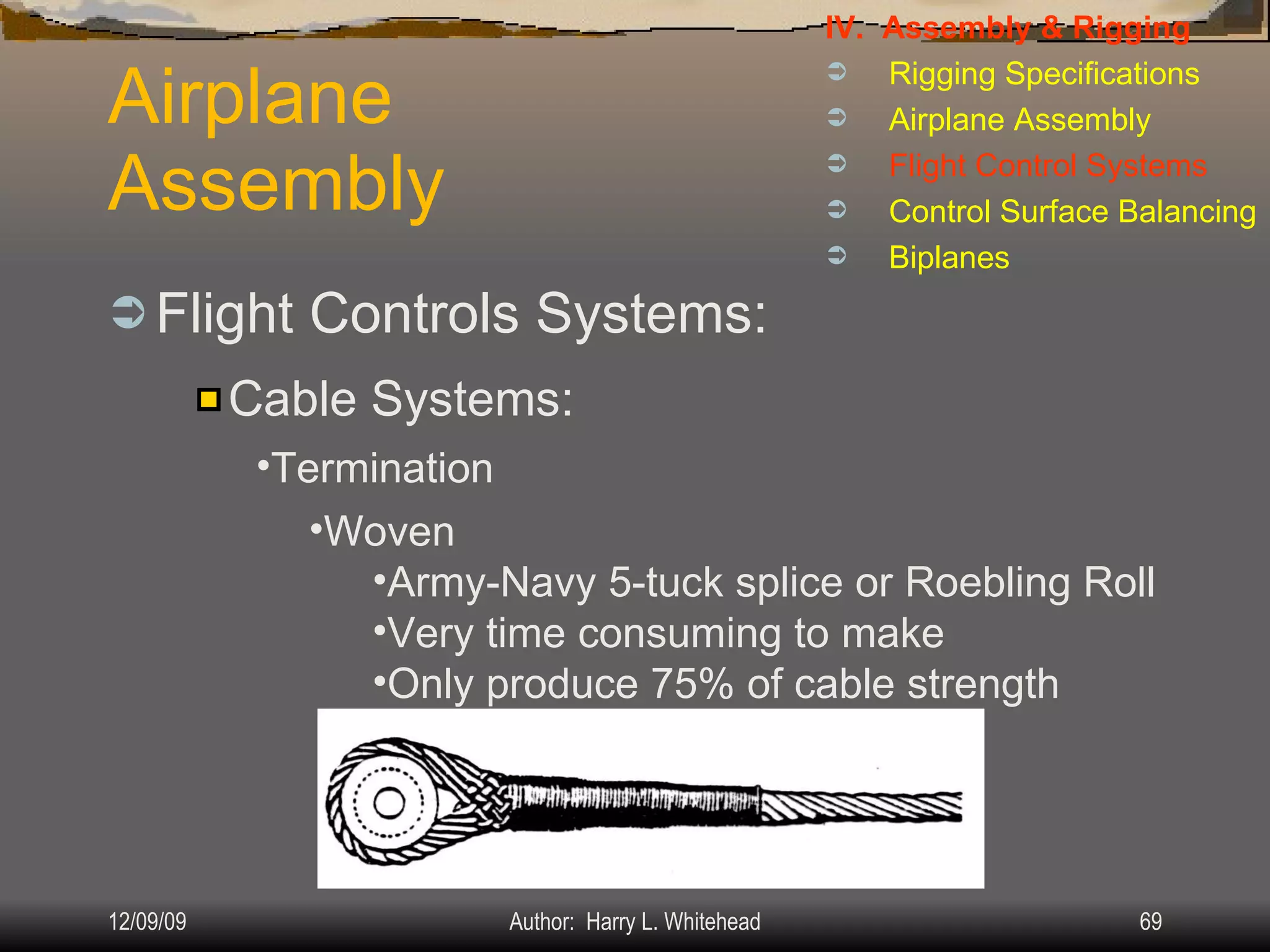
Airplane Assembly Flight Controls Systems: IV.  Assembly & Rigging Rigging Specifications Airplane Assembly Flight Control Systems Control Surface Balancing Biplanes Cable Systems: Termination Woven Army-Navy 5-tuck splice or Roebling Roll Very time consuming to make Only produce 75% of cable strength
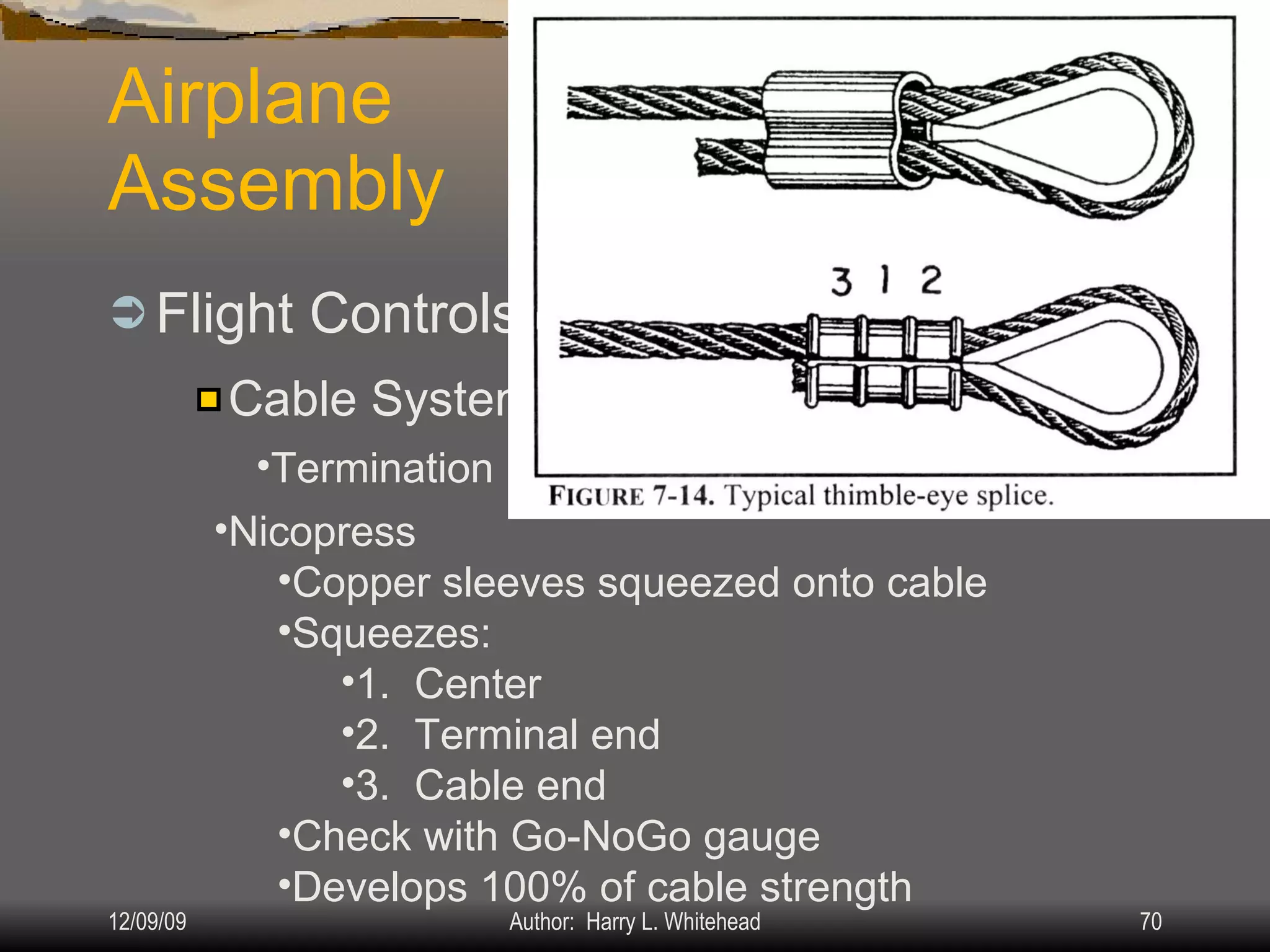
Airplane Assembly Flight Controls Systems: IV.  Assembly & Rigging Rigging Specifications Airplane Assembly Flight Control Systems Control Surface Balancing Biplanes Cable Systems: Termination Nicopress Copper sleeves squeezed onto cable Squeezes:  1.  Center 2.  Terminal end 3.  Cable end Check with Go-NoGo gauge Develops 100% of cable strength
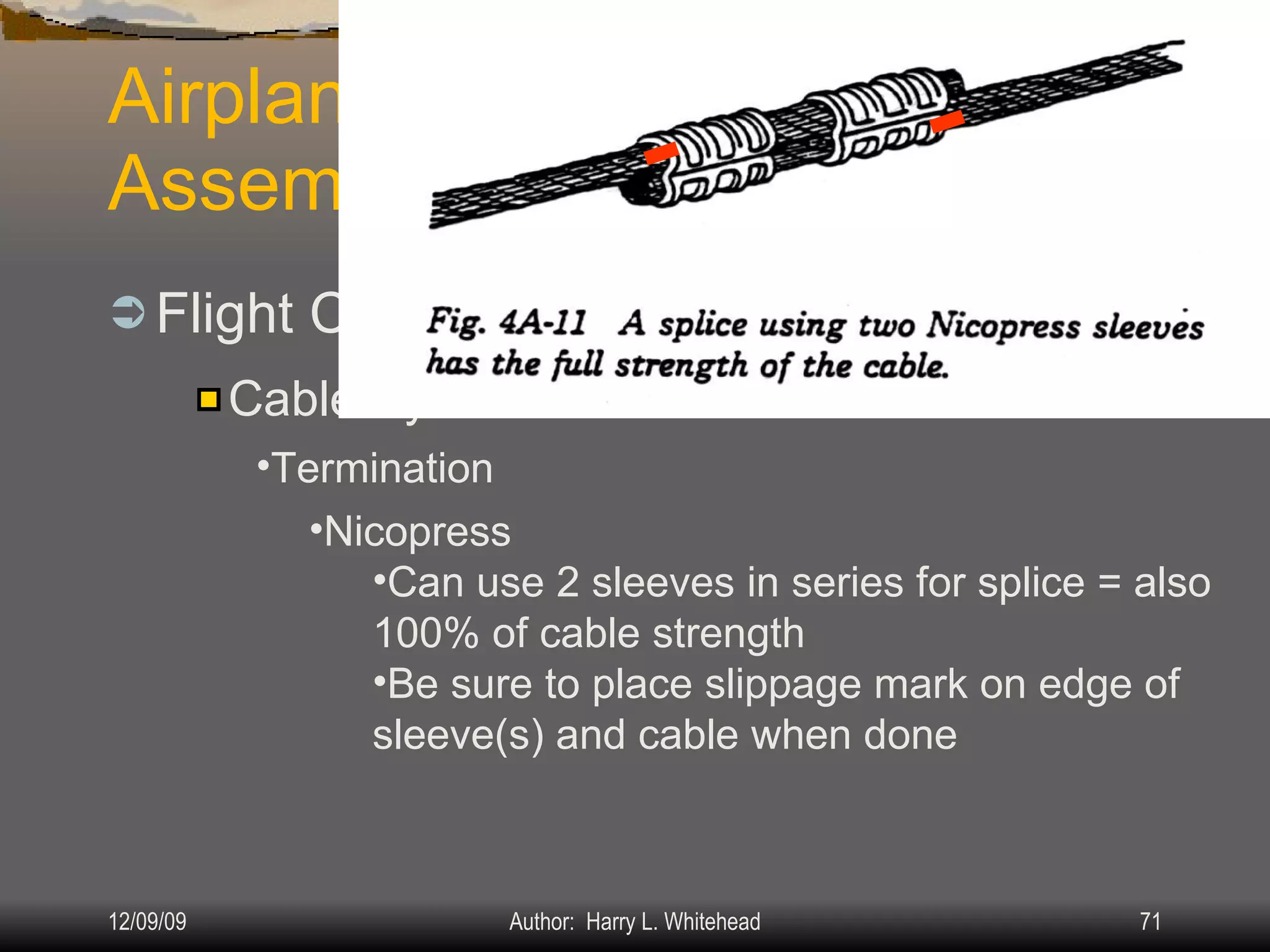
Airplane Assembly Flight Controls Systems: IV.  Assembly & Rigging Rigging Specifications Airplane Assembly Flight Control Systems Control Surface Balancing Biplanes Cable Systems: Termination Nicopress Can use 2 sleeves in series for splice = also 100% of cable strength Be sure to place slippage mark on edge of sleeve(s) and cable when done
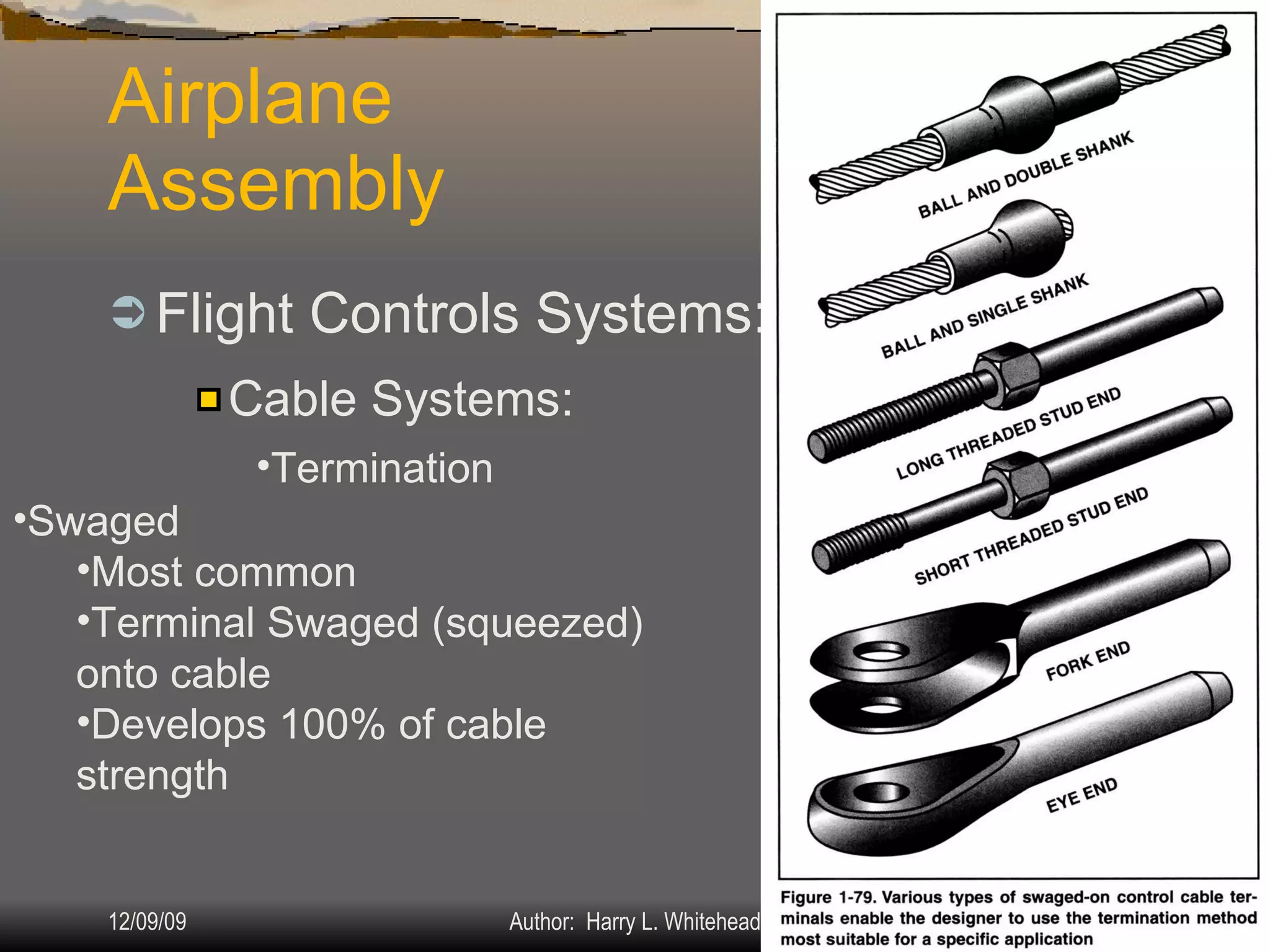
Airplane Assembly Flight Controls Systems: IV.  Assembly & Rigging Rigging Specifications Airplane Assembly Flight Control Systems Control Surface Balancing Biplanes Cable Systems: Termination Swaged Most common Terminal Swaged (squeezed) onto cable Develops 100% of cable strength
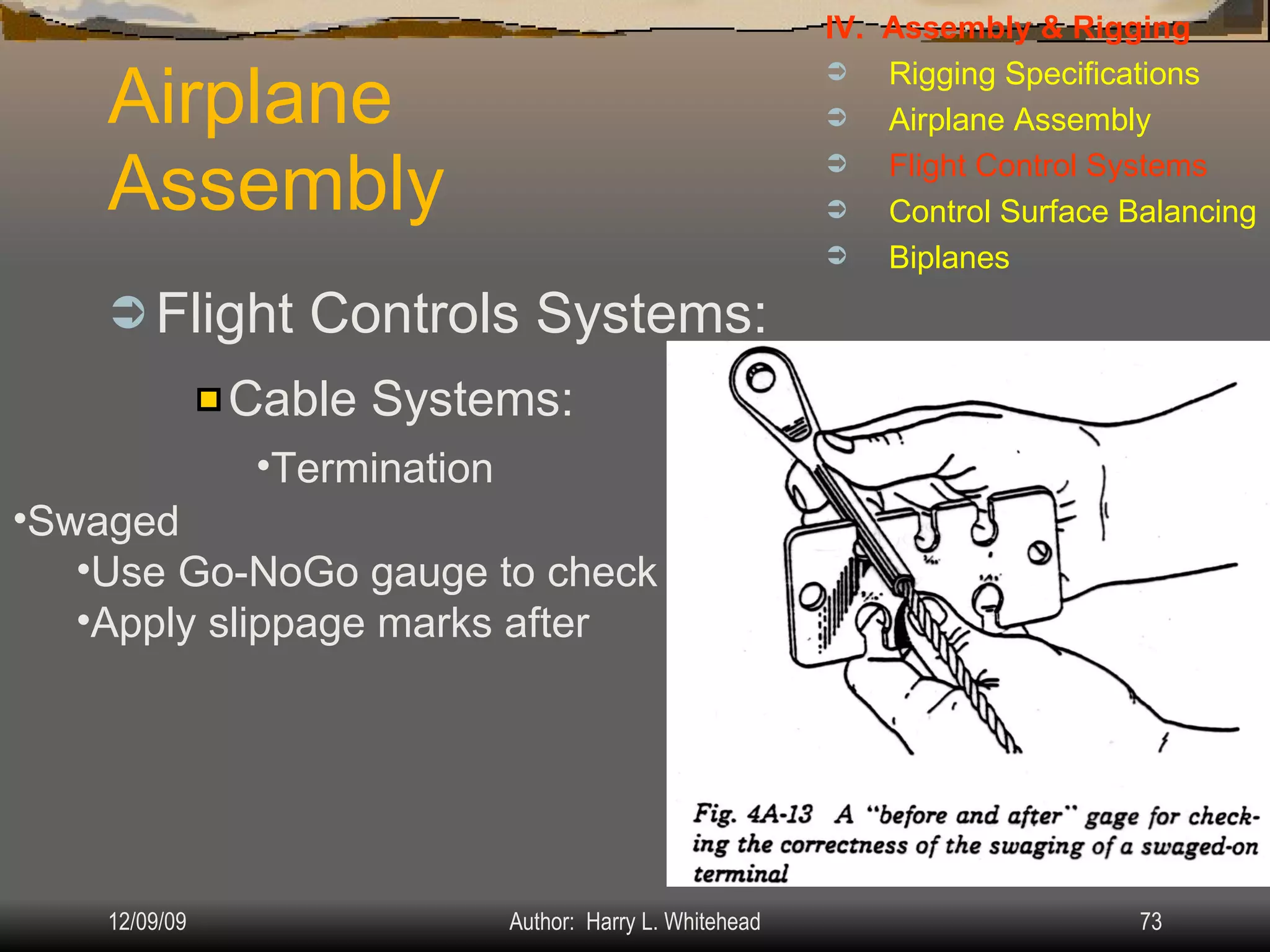
Airplane Assembly Flight Controls Systems: IV.  Assembly & Rigging Rigging Specifications Airplane Assembly Flight Control Systems Control Surface Balancing Biplanes Cable Systems: Termination Swaged Use Go-NoGo gauge to check Apply slippage marks after
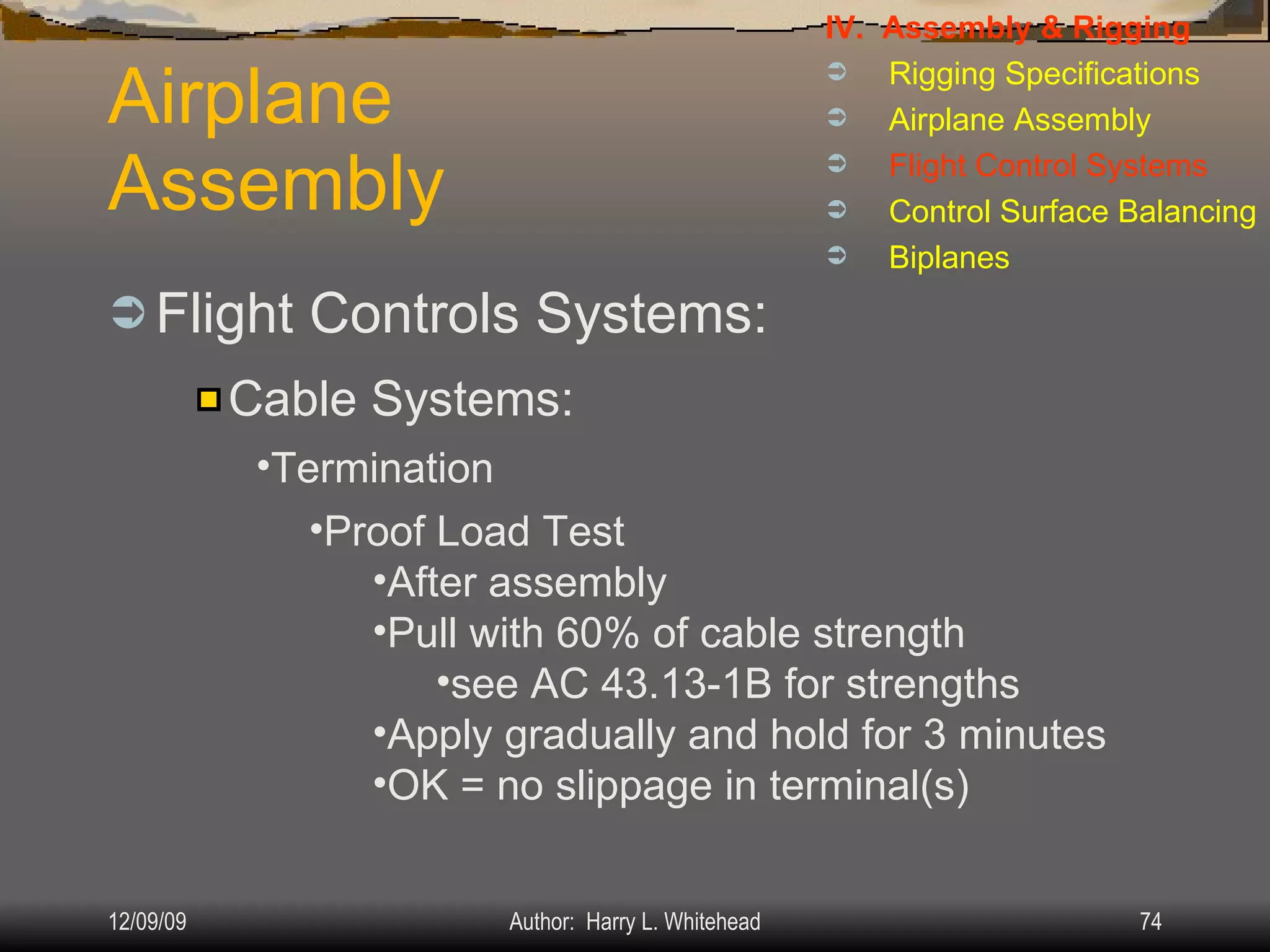
Airplane Assembly Flight Controls Systems: IV.  Assembly & Rigging Rigging Specifications Airplane Assembly Flight Control Systems Control Surface Balancing Biplanes Cable Systems: Termination Proof Load Test After assembly Pull with 60% of cable strength see AC 43.13-1B for strengths Apply gradually and hold for 3 minutes OK = no slippage in terminal(s)
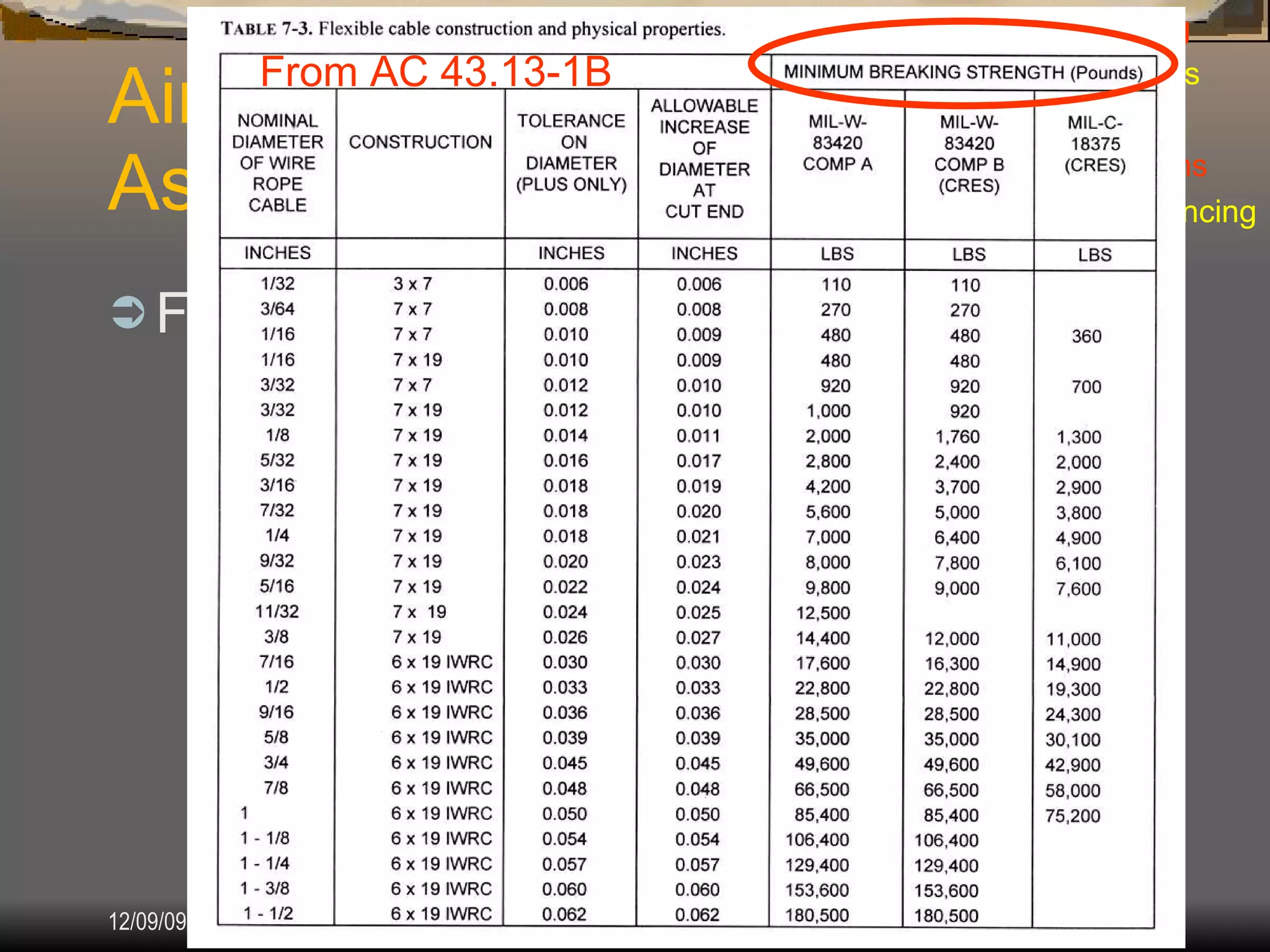
Airplane Assembly Flight Controls Systems: IV.  Assembly & Rigging Rigging Specifications Airplane Assembly Flight Control Systems Control Surface Balancing Biplanes Cable Systems: Termination Proof Load Test After assembly Pull with 60% of cable strength Apply gradually and hold for 3 minutes OK = no slippage in terminal(s) From AC 43.13-1B
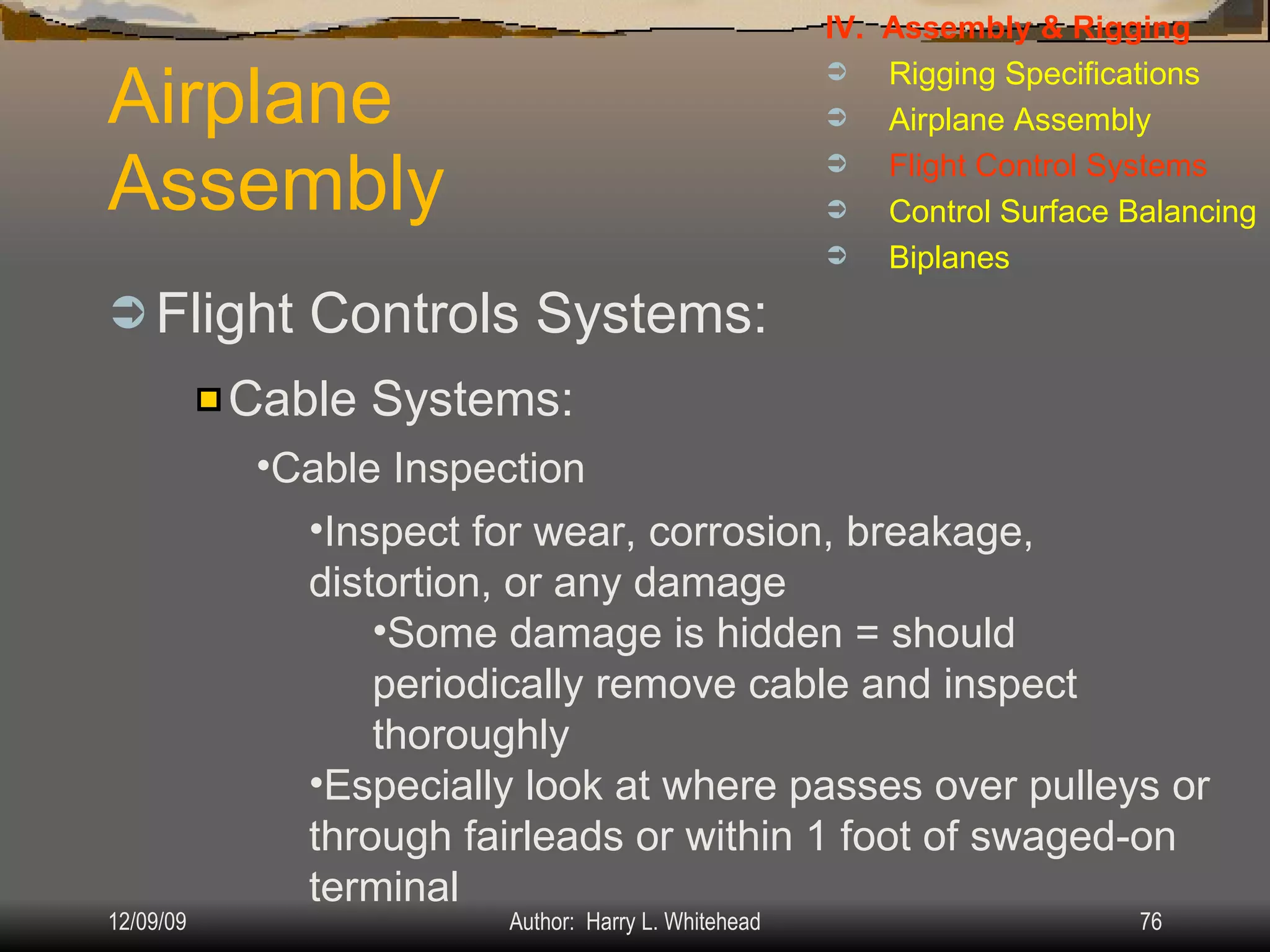
Airplane Assembly Flight Controls Systems: IV.  Assembly & Rigging Rigging Specifications Airplane Assembly Flight Control Systems Control Surface Balancing Biplanes Cable Systems: Cable Inspection Inspect for wear, corrosion, breakage, distortion, or any damage Some damage is hidden = should periodically remove cable and inspect thoroughly Especially look at where passes over pulleys or through fairleads or within 1 foot of swaged-on terminal
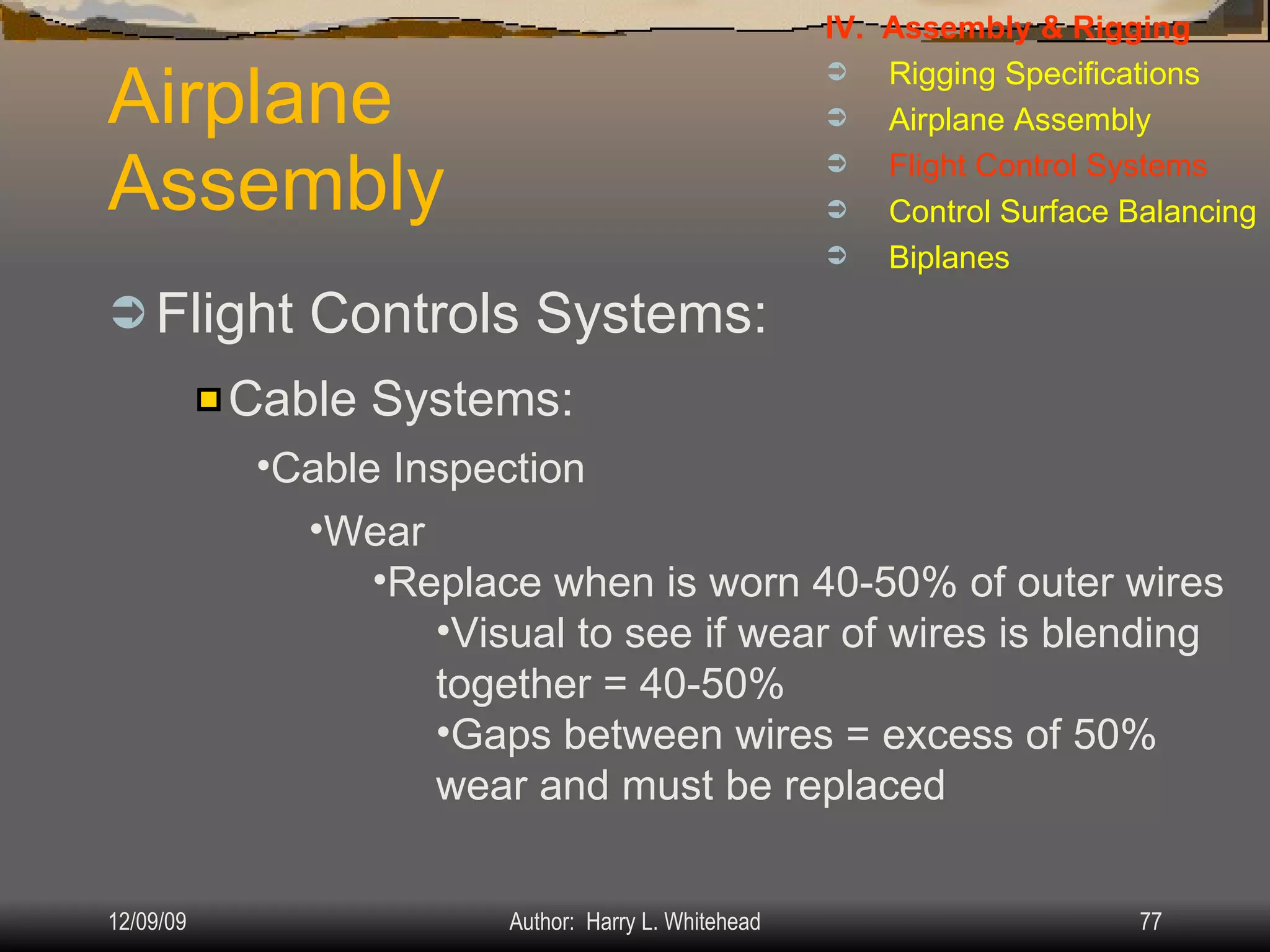
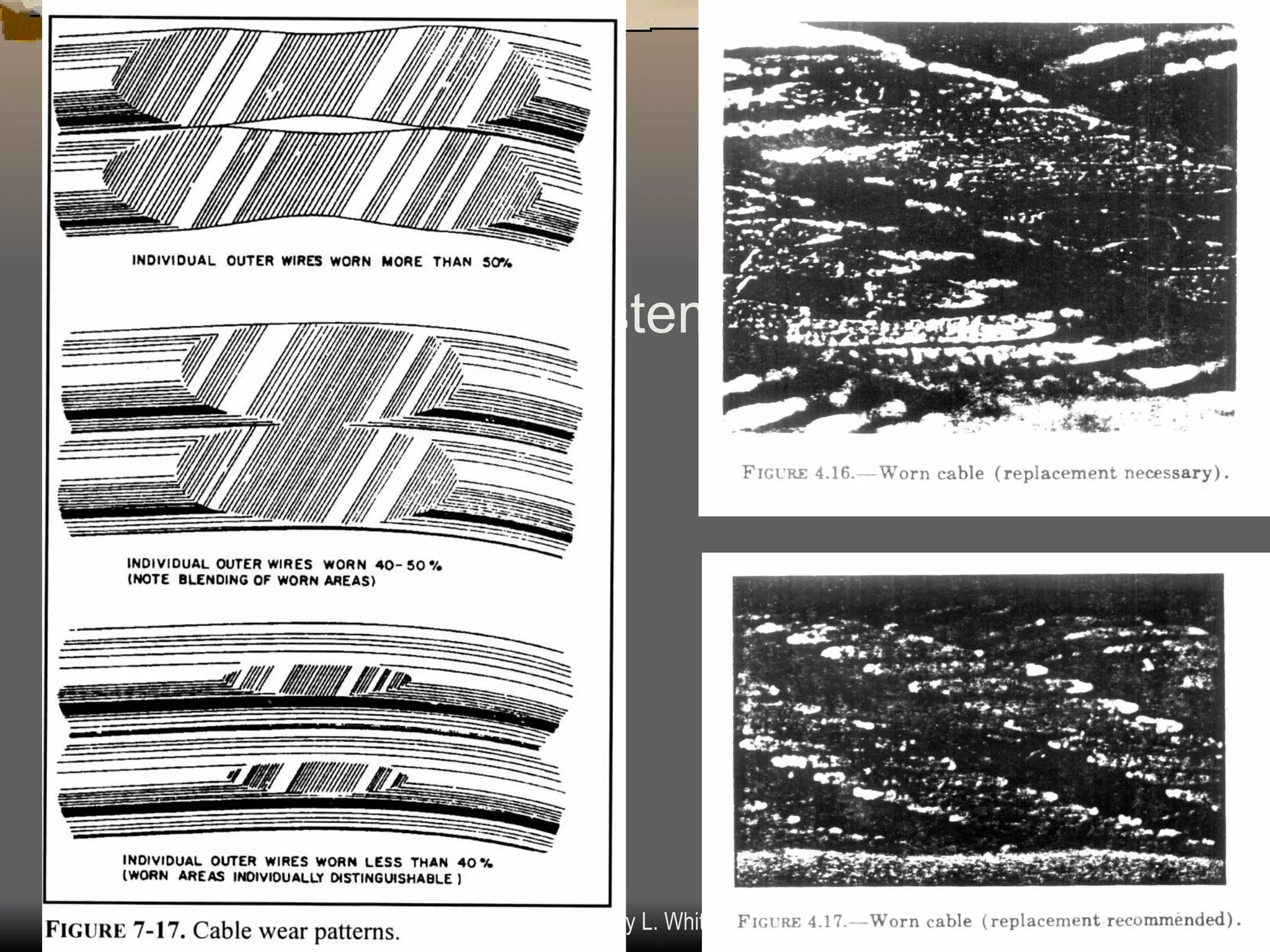
Airplane Assembly Flight Controls Systems: IV.  Assembly & Rigging Rigging Specifications Airplane Assembly Flight Control Systems Control Surface Balancing Biplanes Cable Systems: Cable Inspection Wear Replace when is worn 40-50% of outer wires Visual to see if wear of wires is blending together = 40-50% Gaps between wires = excess of 50% wear and must be replaced
Airplane Assembly Flight Controls Systems: IV.  Assembly & Rigging Rigging Specifications Airplane Assembly Flight Control Systems Control Surface Balancing Biplanes
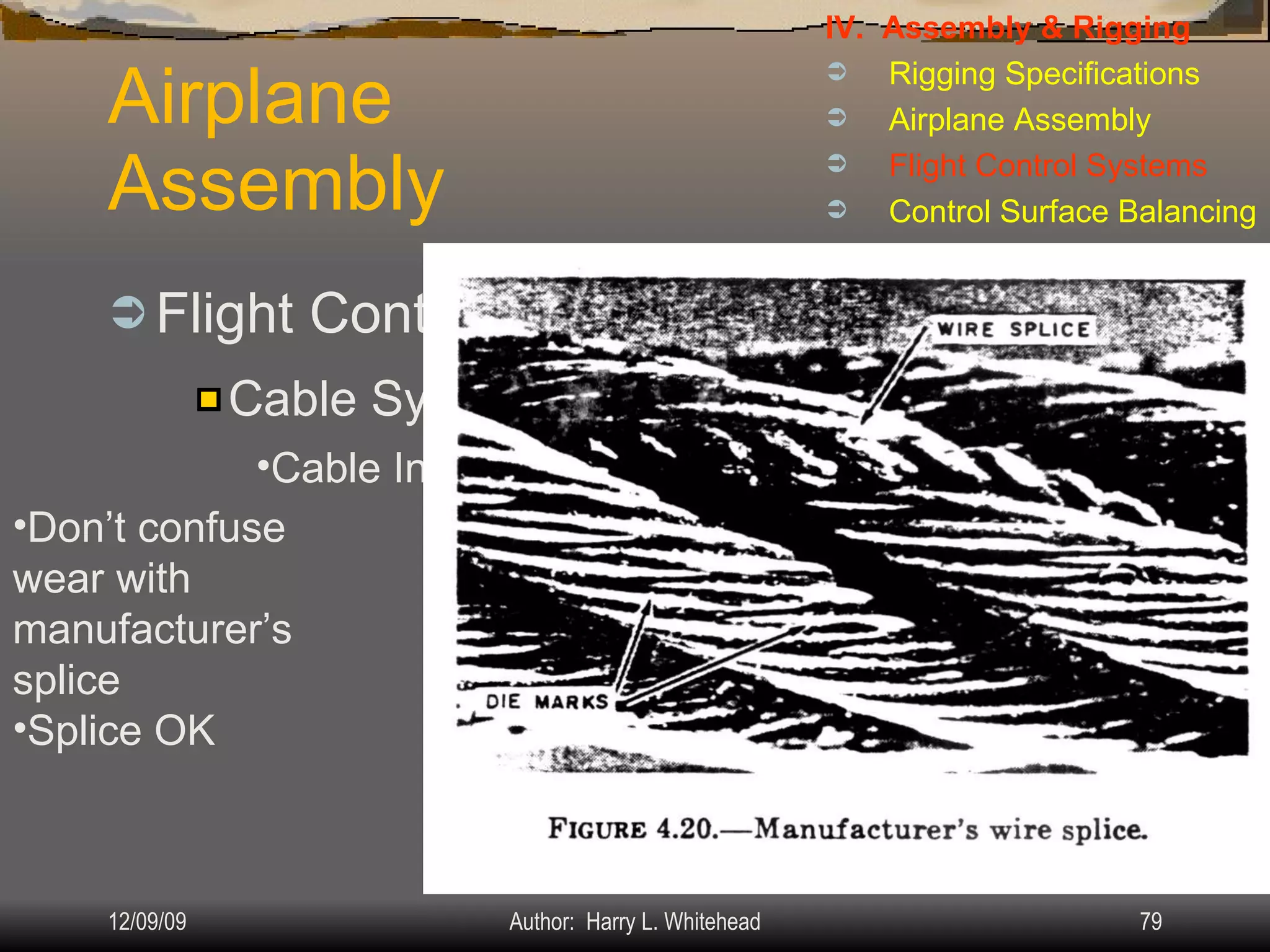
Airplane Assembly Flight Controls Systems: IV.  Assembly & Rigging Rigging Specifications Airplane Assembly Flight Control Systems Control Surface Balancing Biplanes Cable Systems: Cable Inspection Don’t confuse wear with manufacturer’s splice Splice OK
Airplane Assembly Flight Controls Systems: IV.  Assembly & Rigging Rigging Specifications Airplane Assembly Flight Control Systems Control Surface Balancing Biplanes Cable Systems: Cable Inspection Wear If LockClad or Nylon Coated Replace if outer cover is worn through
Airplane Assembly Flight Controls Systems: IV.  Assembly & Rigging Rigging Specifications Airplane Assembly Flight Control Systems Control Surface Balancing Biplanes Cable Systems: Cable Inspection Damage or Corrosion Pass rag over length and will snag on broken wires DON’T USE HAND!
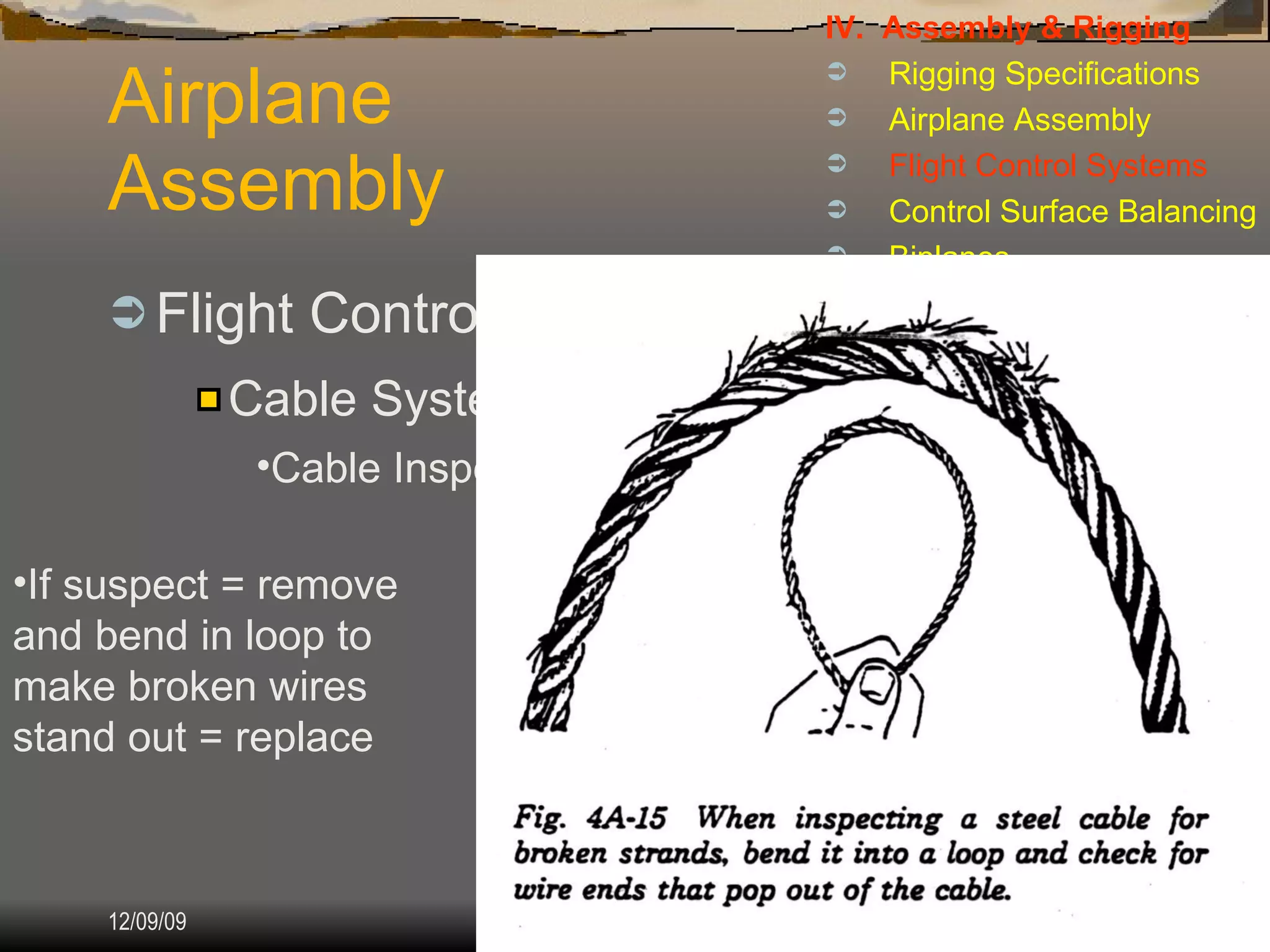
Airplane Assembly Flight Controls Systems: IV.  Assembly & Rigging Rigging Specifications Airplane Assembly Flight Control Systems Control Surface Balancing Biplanes Cable Systems: Cable Inspection If suspect = remove and bend in loop to make broken wires stand out = replace
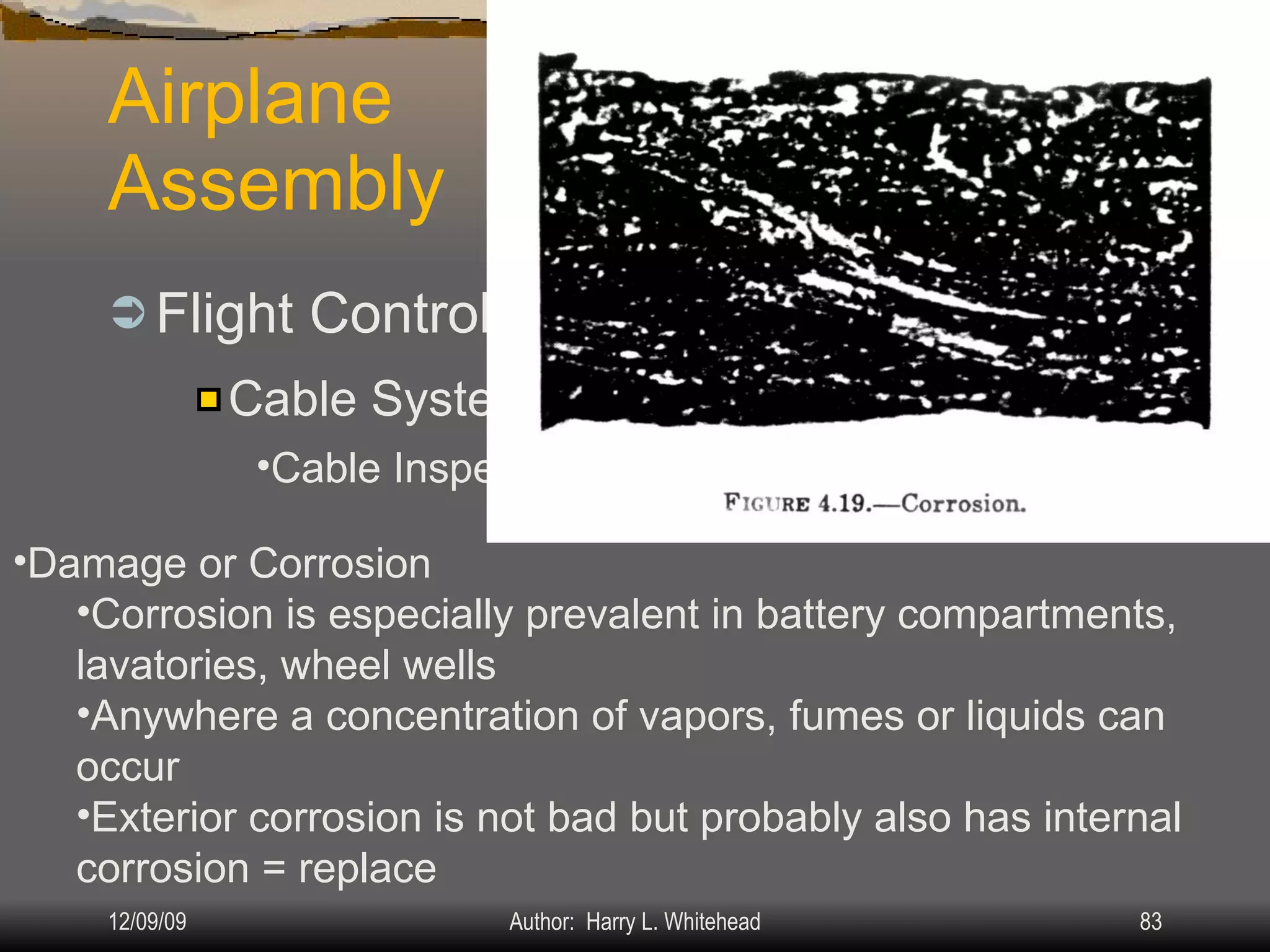
Airplane Assembly Flight Controls Systems: IV.  Assembly & Rigging Rigging Specifications Airplane Assembly Flight Control Systems Control Surface Balancing Biplanes Cable Systems: Cable Inspection Damage or Corrosion Corrosion is especially prevalent in battery compartments, lavatories, wheel wells Anywhere a concentration of vapors, fumes or liquids can occur Exterior corrosion is not bad but probably also has internal corrosion = replace
Airplane Assembly Flight Controls Systems: IV.  Assembly & Rigging Rigging Specifications Airplane Assembly Flight Control Systems Control Surface Balancing Biplanes Cable Systems: Cable Inspection If cable is kinked or twisted wrong Replace as wires/strands will not return to original position and strength is less Make sure no splice is closer than 2 inches to any pulley or fairlead
Airplane Assembly Flight Controls Systems: IV.  Assembly & Rigging Rigging Specifications Airplane Assembly Flight Control Systems Control Surface Balancing Biplanes Cable Systems: Other Components: Pulleys Are phenolic with sealed bearings No lubrication necessary Replace if bearing is rough or dry Use for direction change over 3 o
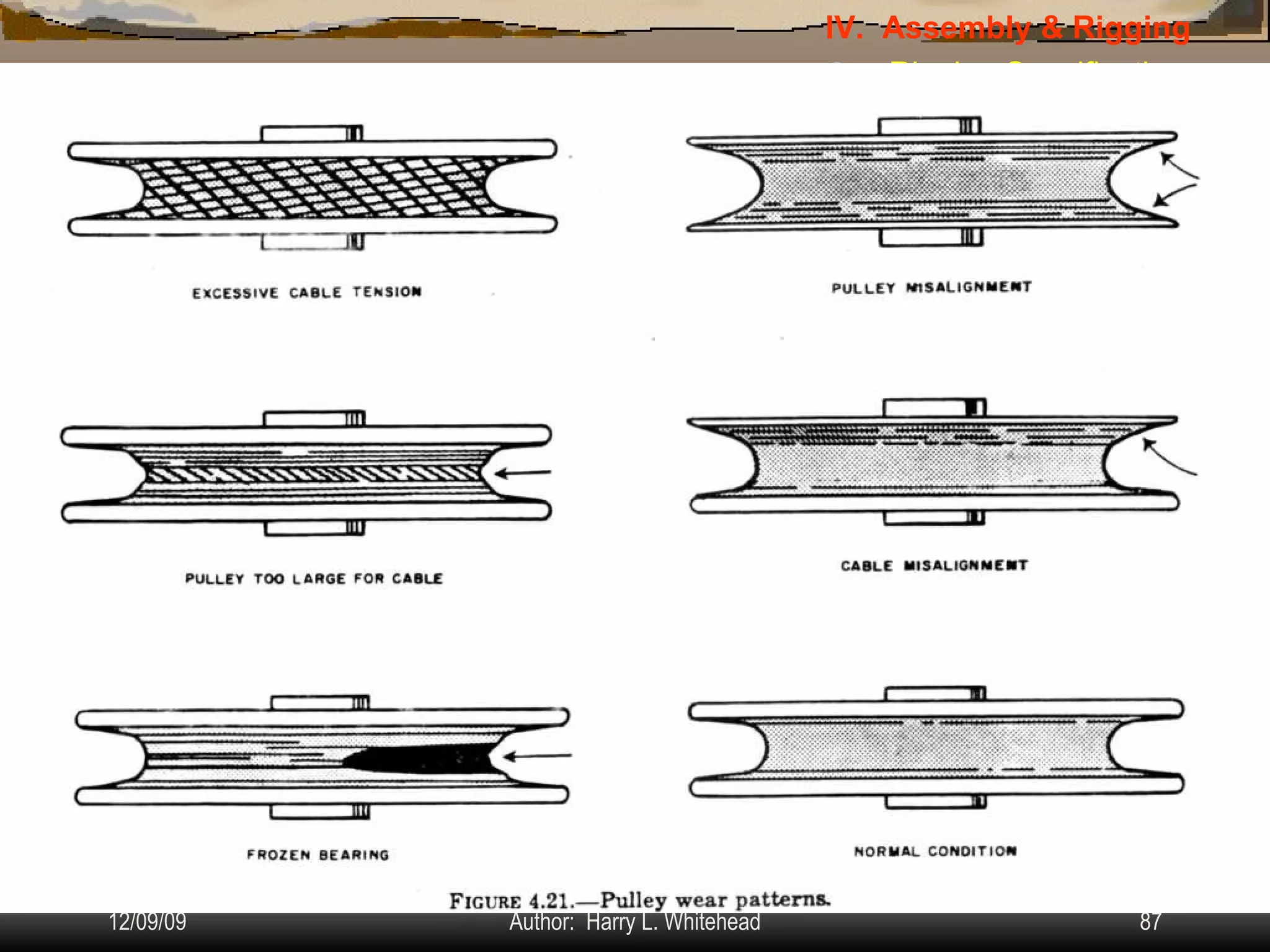
Airplane Assembly Flight Controls Systems: IV.  Assembly & Rigging Rigging Specifications Airplane Assembly Flight Control Systems Control Surface Balancing Biplanes Cable Systems: Other Components: Pulleys Check for wear patterns Periodically rotate any which don’t normally rotate much = loosens and evens wear
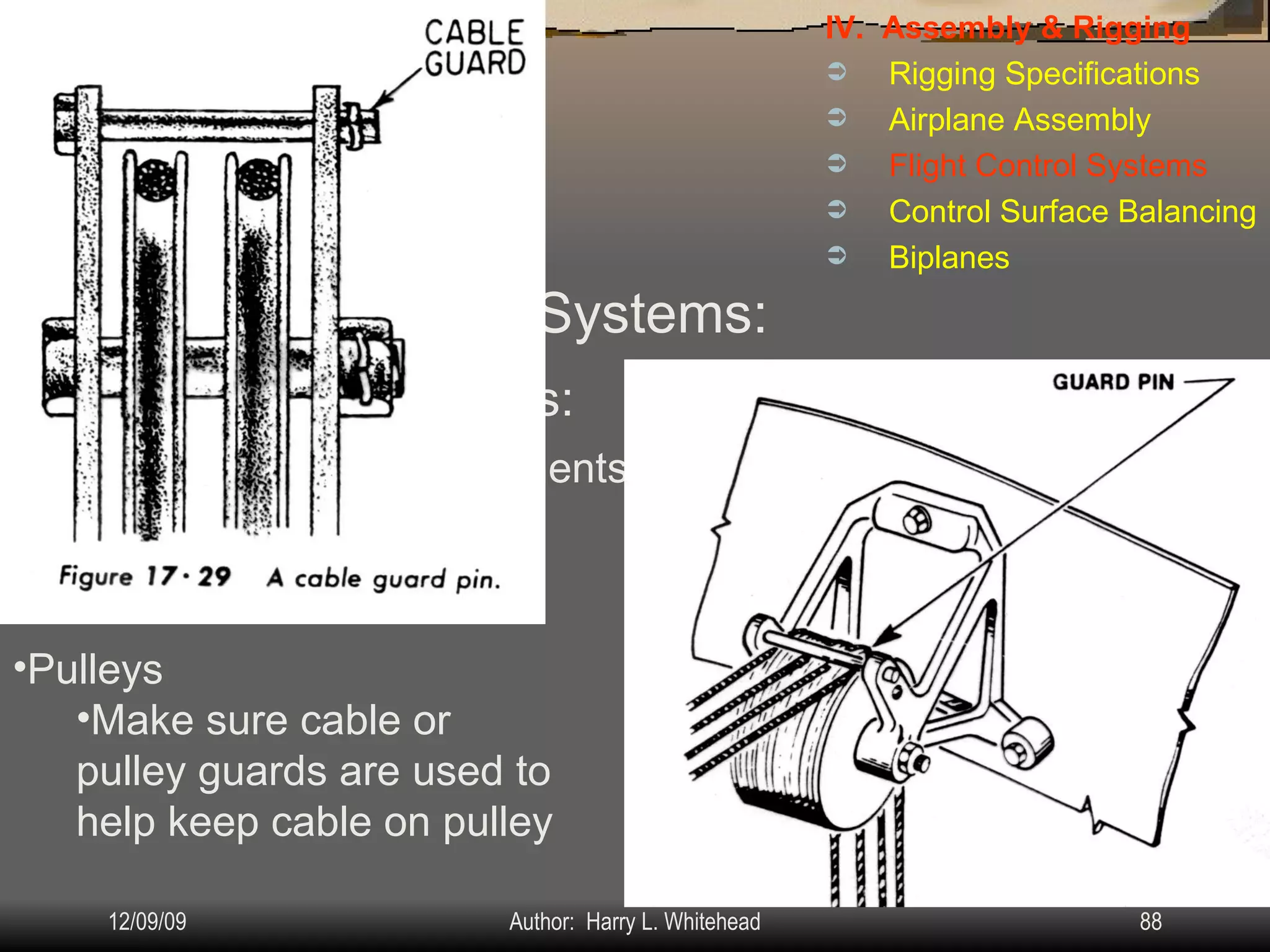
Airplane Assembly Flight Controls Systems: IV.  Assembly & Rigging Rigging Specifications Airplane Assembly Flight Control Systems Control Surface Balancing Biplanes Cable Systems: Other Components: Pulleys Make sure cable or pulley guards are used to help keep cable on pulley
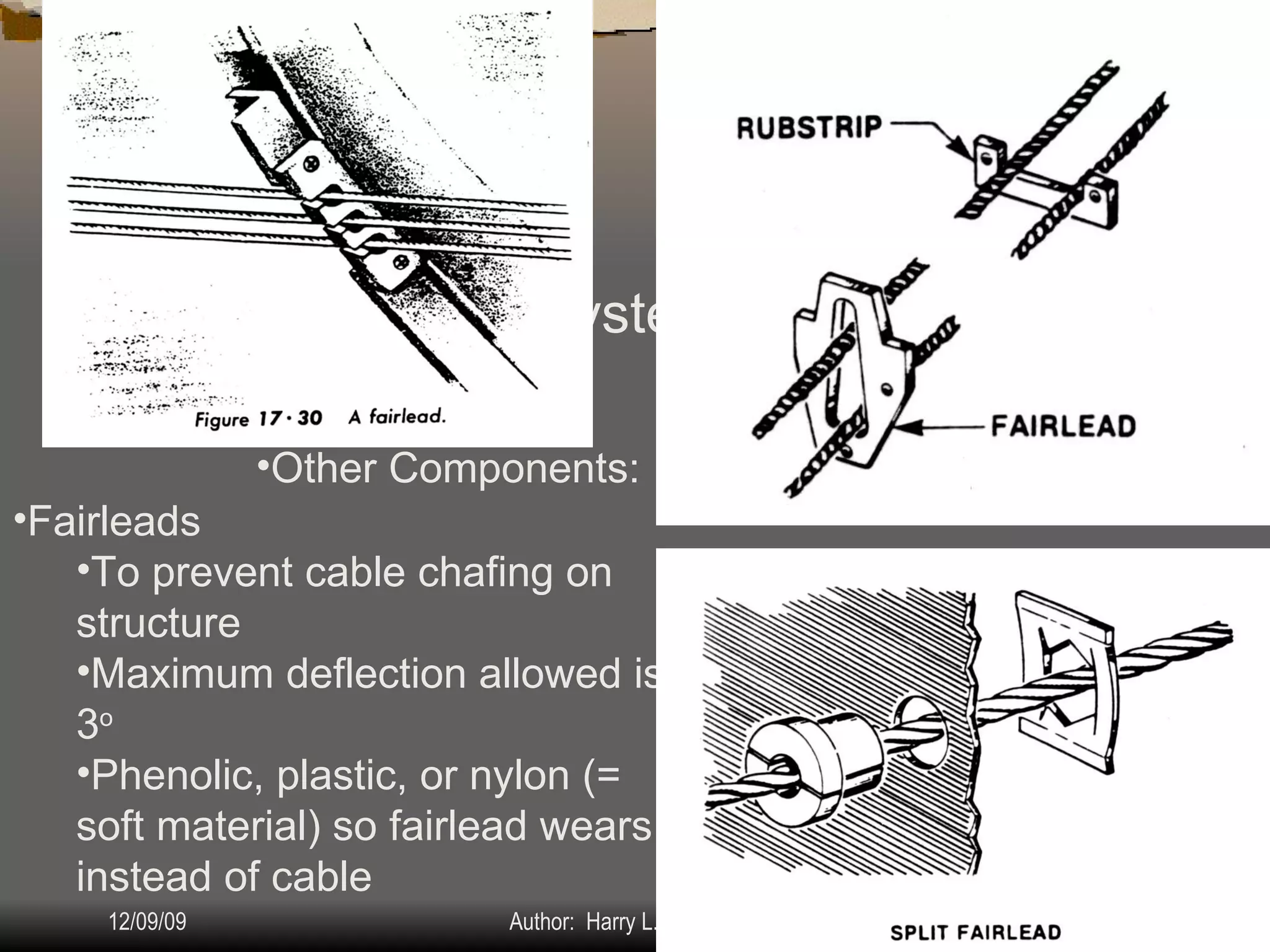
Airplane Assembly Flight Controls Systems: IV.  Assembly & Rigging Rigging Specifications Airplane Assembly Flight Control Systems Control Surface Balancing Biplanes Cable Systems: Other Components: Fairleads To prevent cable chafing on structure Maximum deflection allowed is 3 o Phenolic, plastic, or nylon (= soft material) so fairlead wears instead of cable
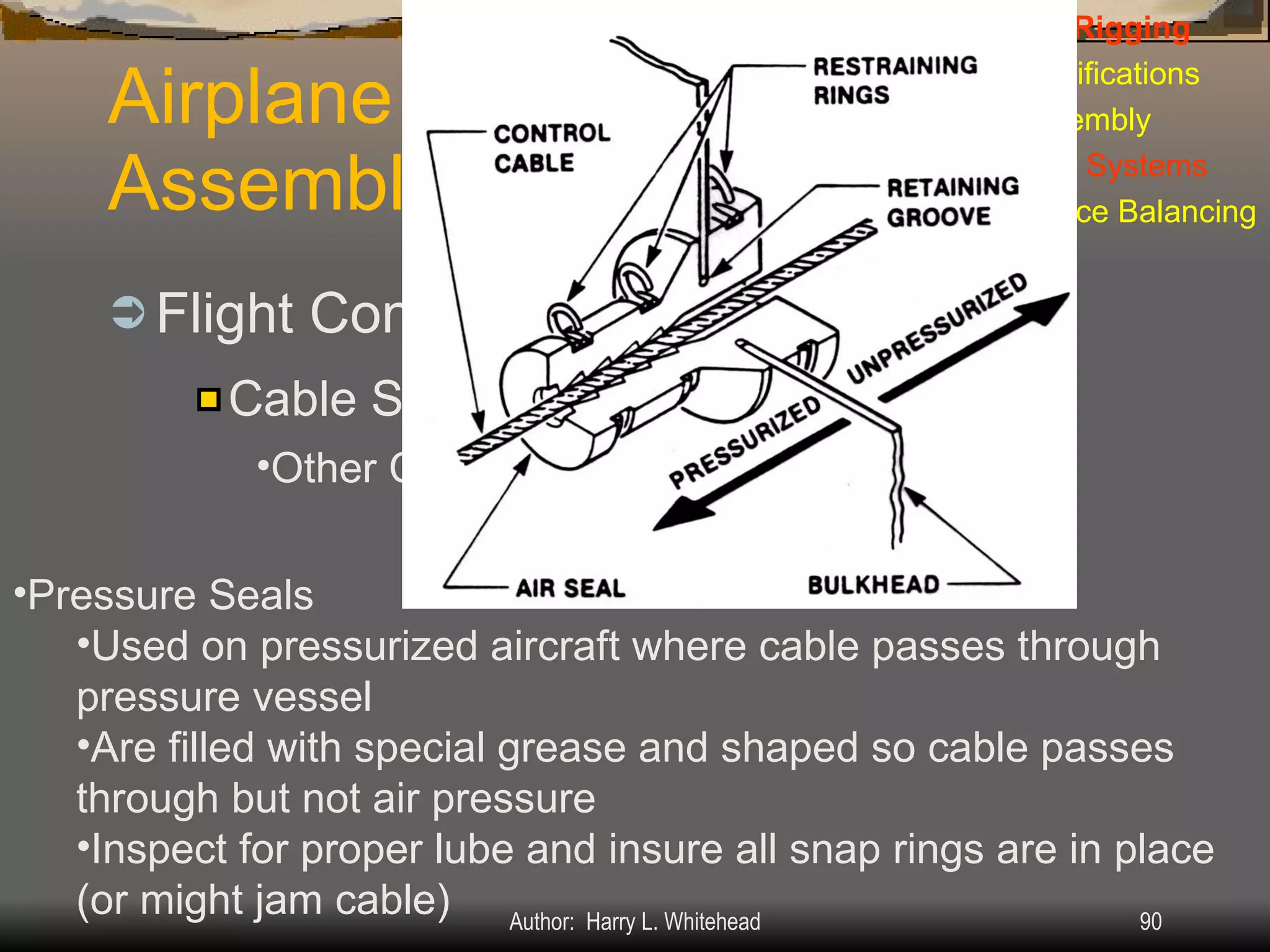
Airplane Assembly Flight Controls Systems: IV.  Assembly & Rigging Rigging Specifications Airplane Assembly Flight Control Systems Control Surface Balancing Biplanes Cable Systems: Other Components: Pressure Seals Used on pressurized aircraft where cable passes through pressure vessel Are filled with special grease and shaped so cable passes through but not air pressure Inspect for proper lube and insure all snap rings are in place (or might jam cable)
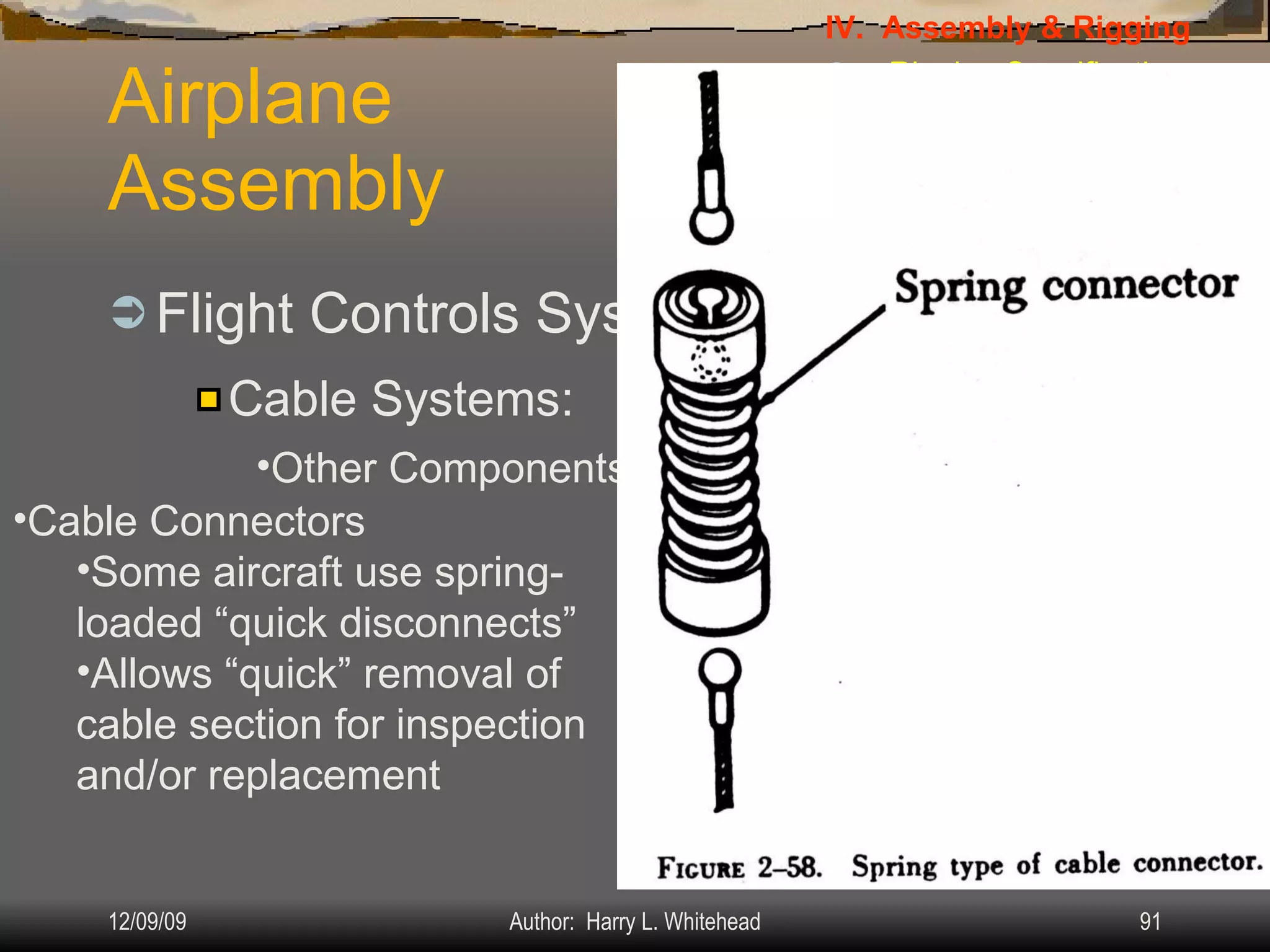
Airplane Assembly Flight Controls Systems: IV.  Assembly & Rigging Rigging Specifications Airplane Assembly Flight Control Systems Control Surface Balancing Biplanes Cable Systems: Other Components: Cable Connectors Some aircraft use spring-loaded “quick disconnects” Allows “quick” removal of cable section for inspection and/or replacement
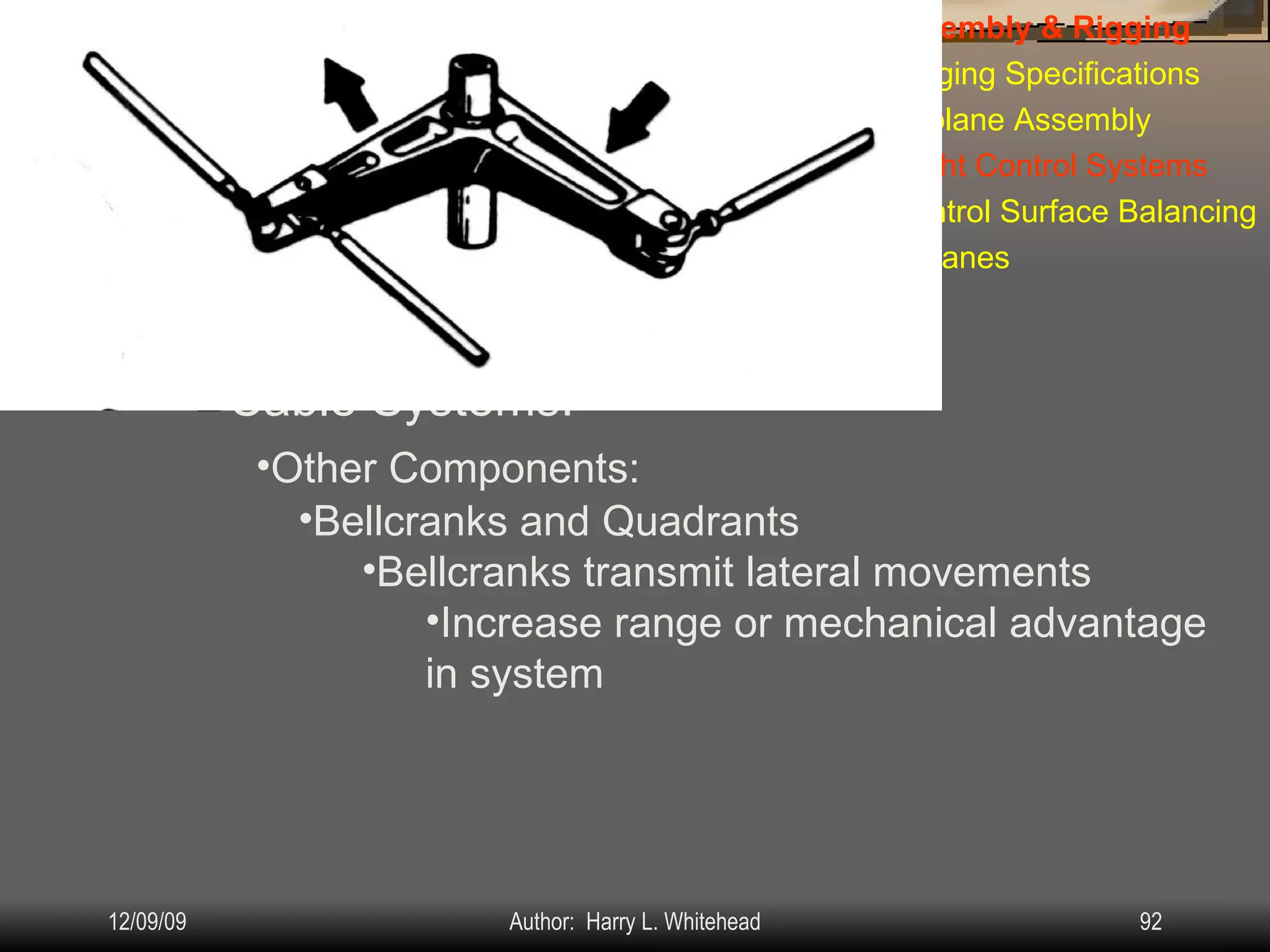
Airplane Assembly Flight Controls Systems: IV.  Assembly & Rigging Rigging Specifications Airplane Assembly Flight Control Systems Control Surface Balancing Biplanes Cable Systems: Other Components: Bellcranks and Quadrants Bellcranks transmit lateral movements Increase range or mechanical advantage in system
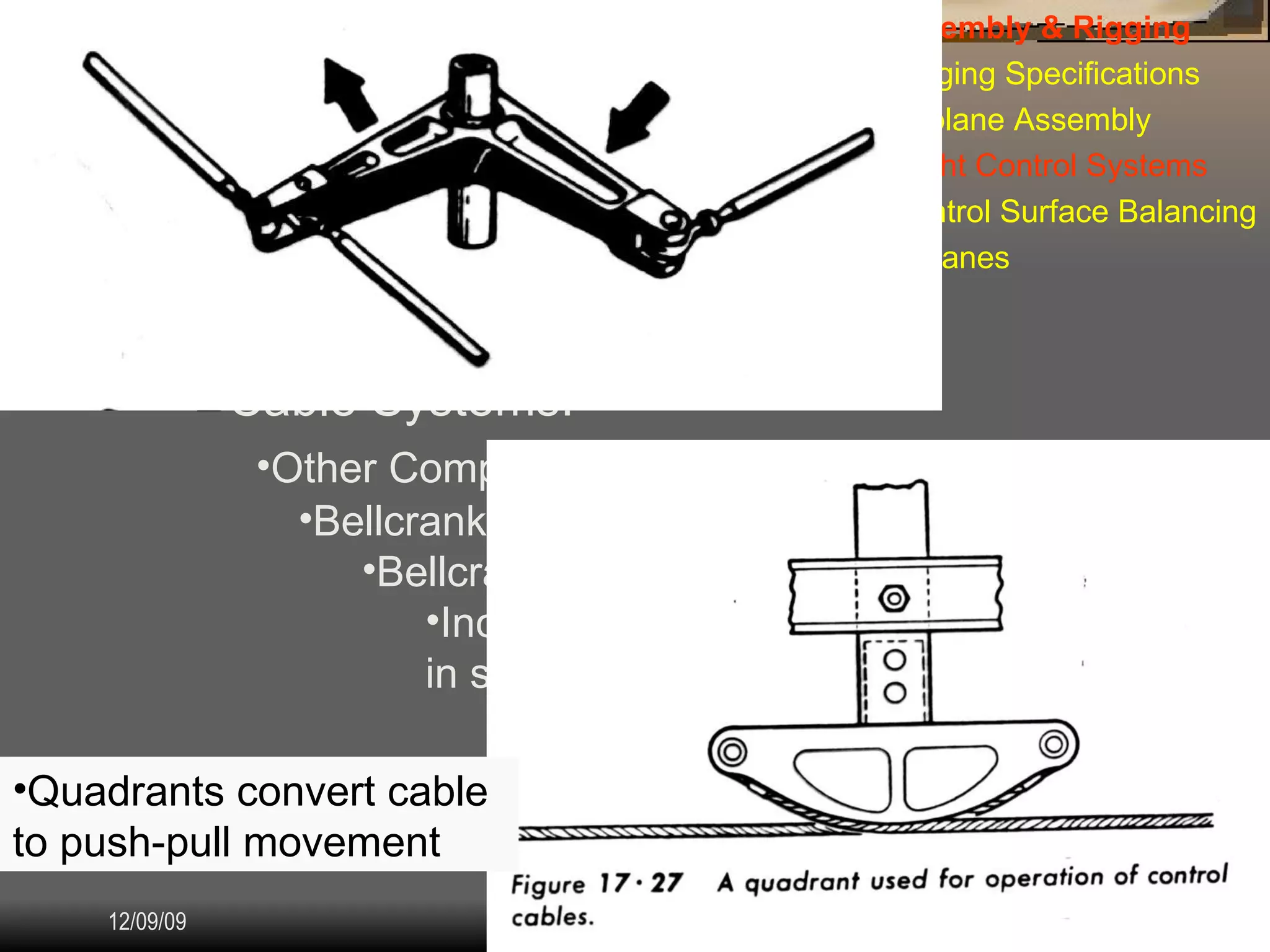
Airplane Assembly Flight Controls Systems: IV.  Assembly & Rigging Rigging Specifications Airplane Assembly Flight Control Systems Control Surface Balancing Biplanes Cable Systems: Other Components: Bellcranks and Quadrants Bellcranks transmit lateral movements Increase range or mechanical advantage in system Quadrants convert cable to push-pull movement
Airplane Assembly Flight Controls Systems: IV.  Assembly & Rigging Rigging Specifications Airplane Assembly Flight Control Systems Control Surface Balancing Biplanes Cable Systems: Travel Adjustment & Tension:
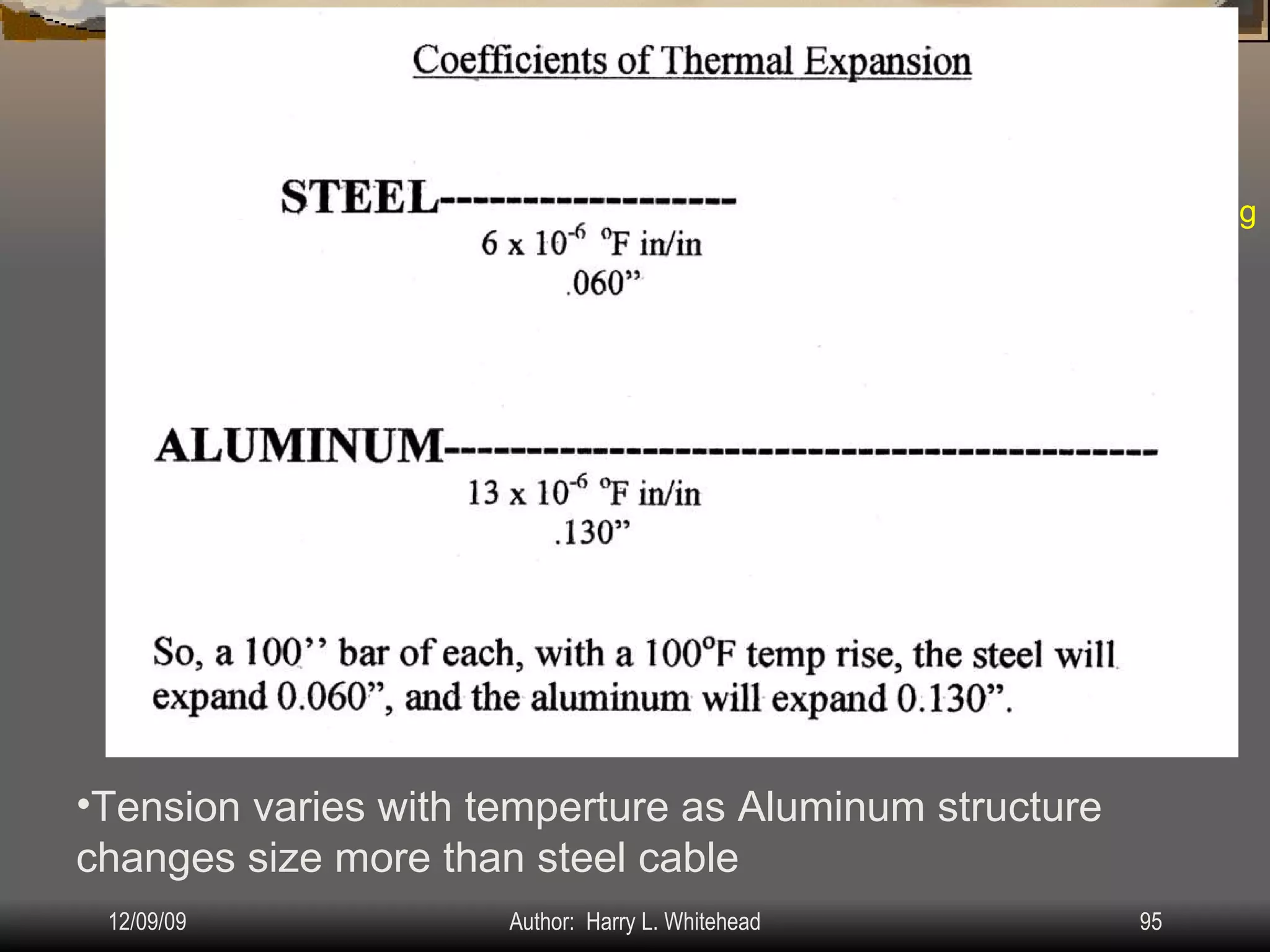
Airplane Assembly Flight Controls Systems: IV.  Assembly & Rigging Rigging Specifications Airplane Assembly Flight Control Systems Control Surface Balancing Biplanes Cable Systems: Travel Adjustment & Tension: Tension varies with temperture as Aluminum structure changes size more than steel cable
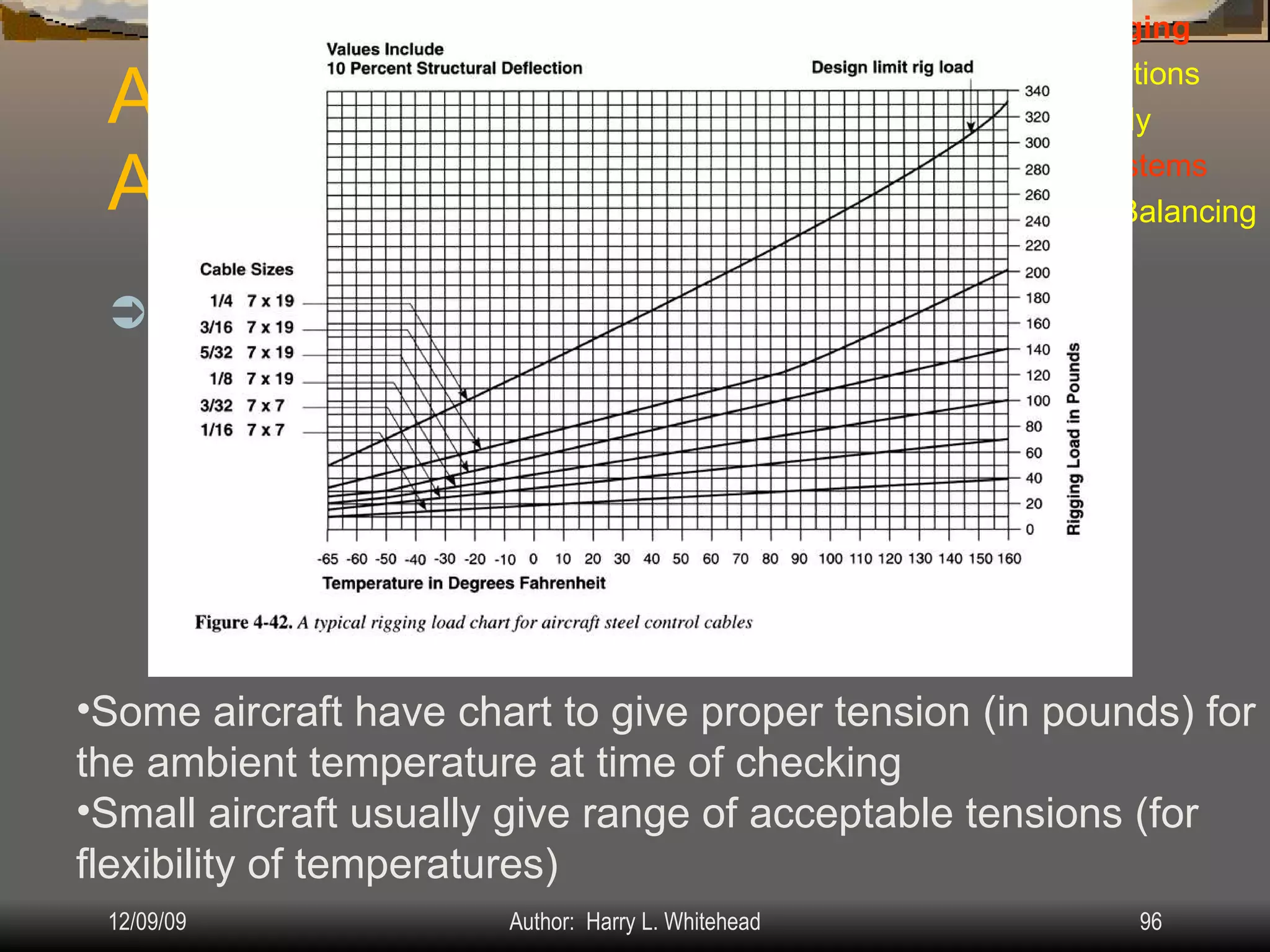
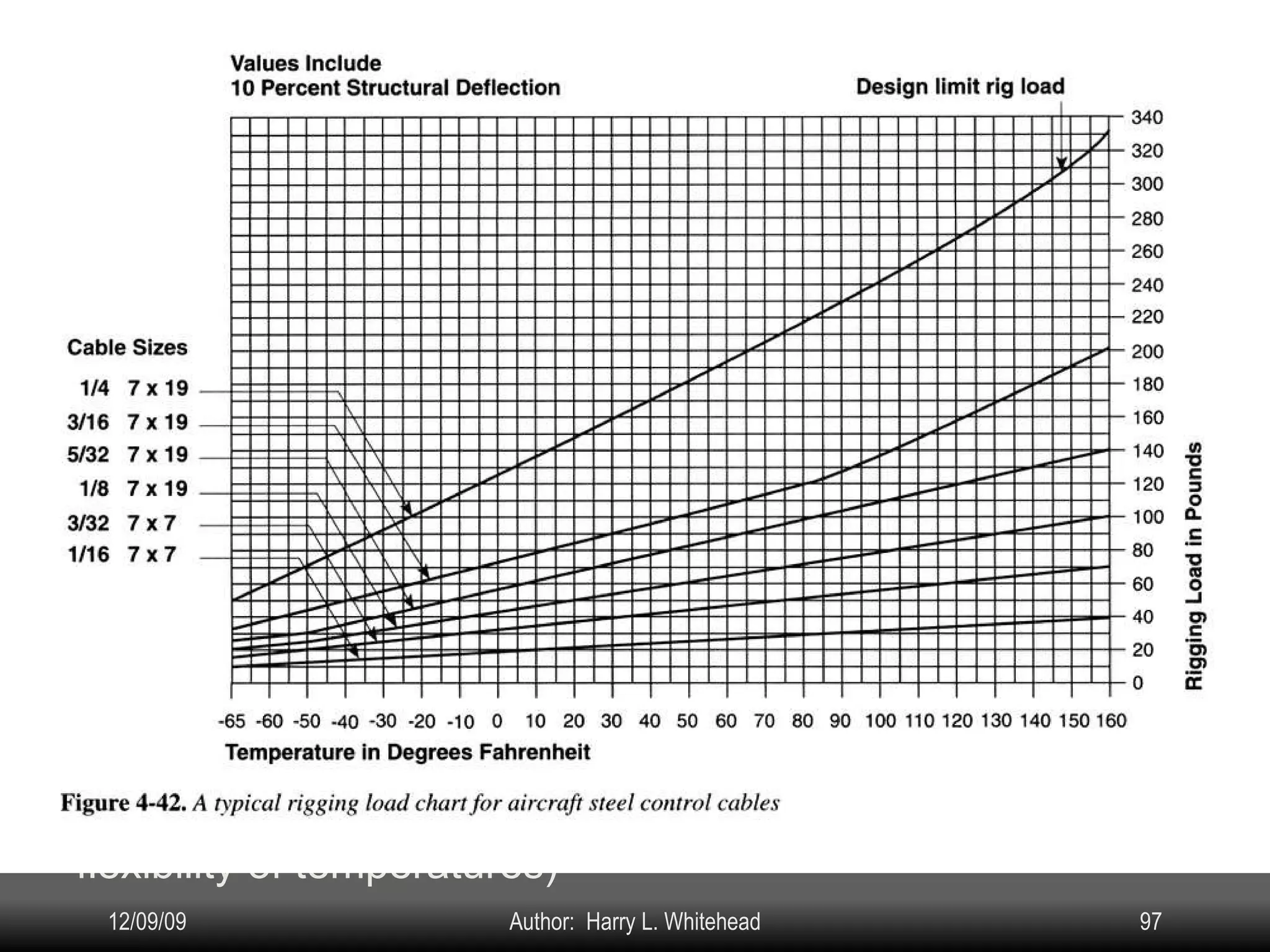
Airplane Assembly Flight Controls Systems: IV.  Assembly & Rigging Rigging Specifications Airplane Assembly Flight Control Systems Control Surface Balancing Biplanes Cable Systems: Travel Adjustment & Tension: Some aircraft have chart to give proper tension (in pounds) for the ambient temperature at time of checking Small aircraft usually give range of acceptable tensions (for flexibility of temperatures)
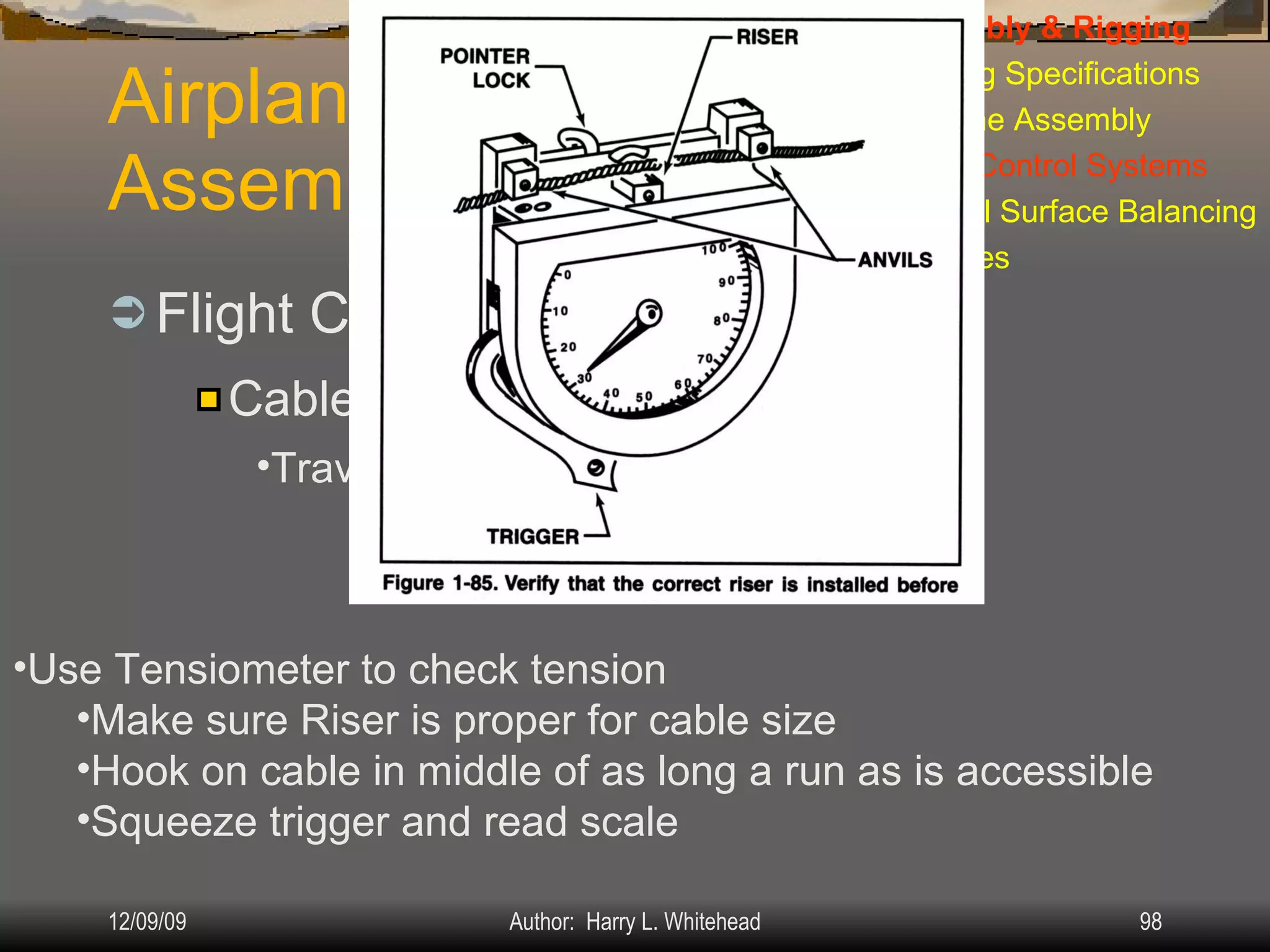
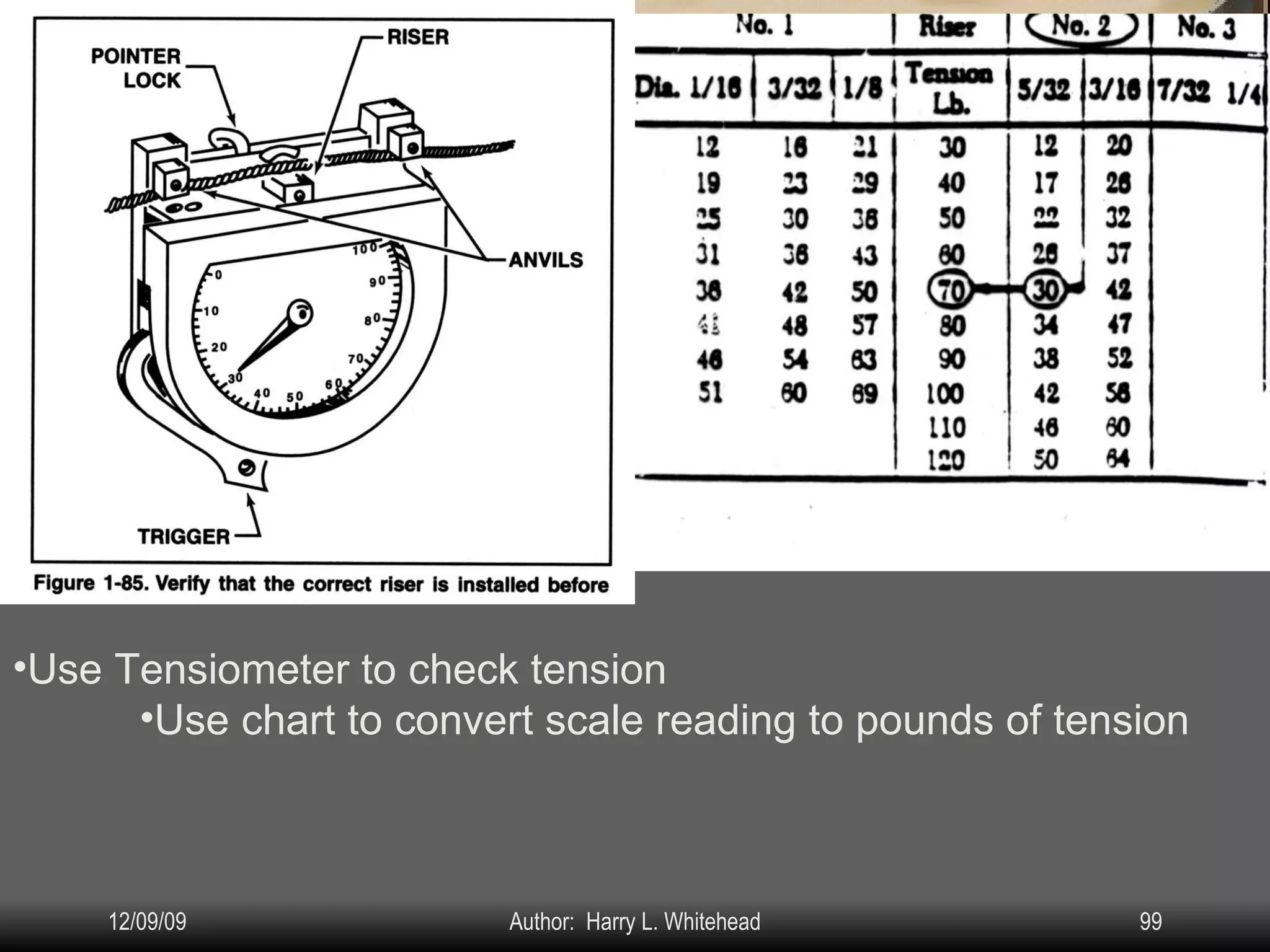
Airplane Assembly Flight Controls Systems: IV.  Assembly & Rigging Rigging Specifications Airplane Assembly Flight Control Systems Control Surface Balancing Biplanes Cable Systems: Travel Adjustment & Tension: Use Tensiometer to check tension Make sure Riser is proper for cable size Hook on cable in middle of as long a run as is accessible Squeeze trigger and read scale
Airplane Assembly Flight Controls Systems: IV.  Assembly & Rigging Rigging Specifications Airplane Assembly Flight Control Systems Control Surface Balancing Biplanes Cable Systems: Travel Adjustment & Tension: Use Tensiometer to check tension Use chart to convert scale reading to pounds of tension
Airplane Assembly Flight Controls Systems: IV.  Assembly & Rigging Rigging Specifications Airplane Assembly Flight Control Systems Control Surface Balancing Biplanes Cable Systems: Travel Adjustment & Tension: Use Tensiometer to check tension Some large aircraft use automatic tension devices Keeps tension constant regardless of temperature
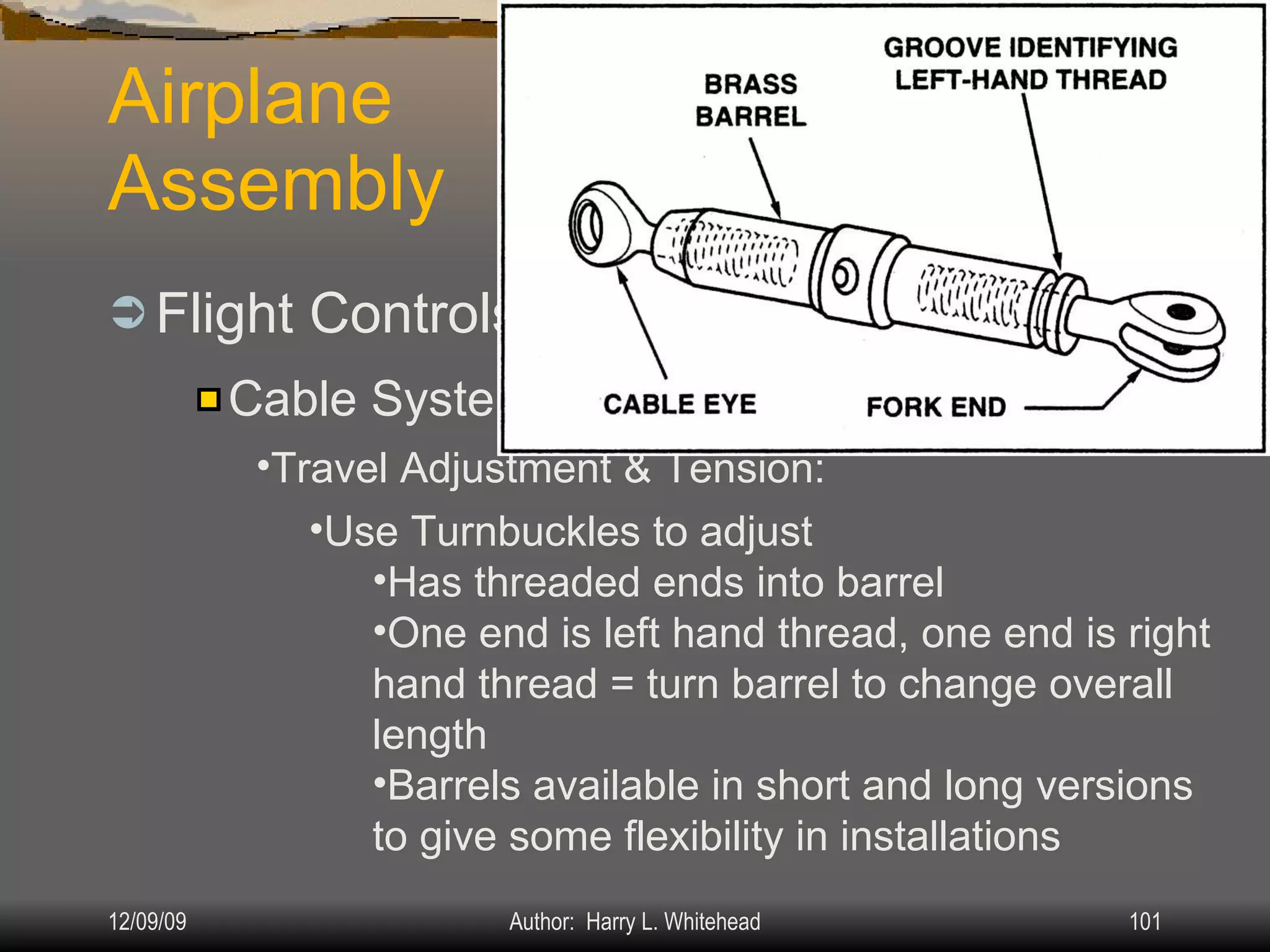
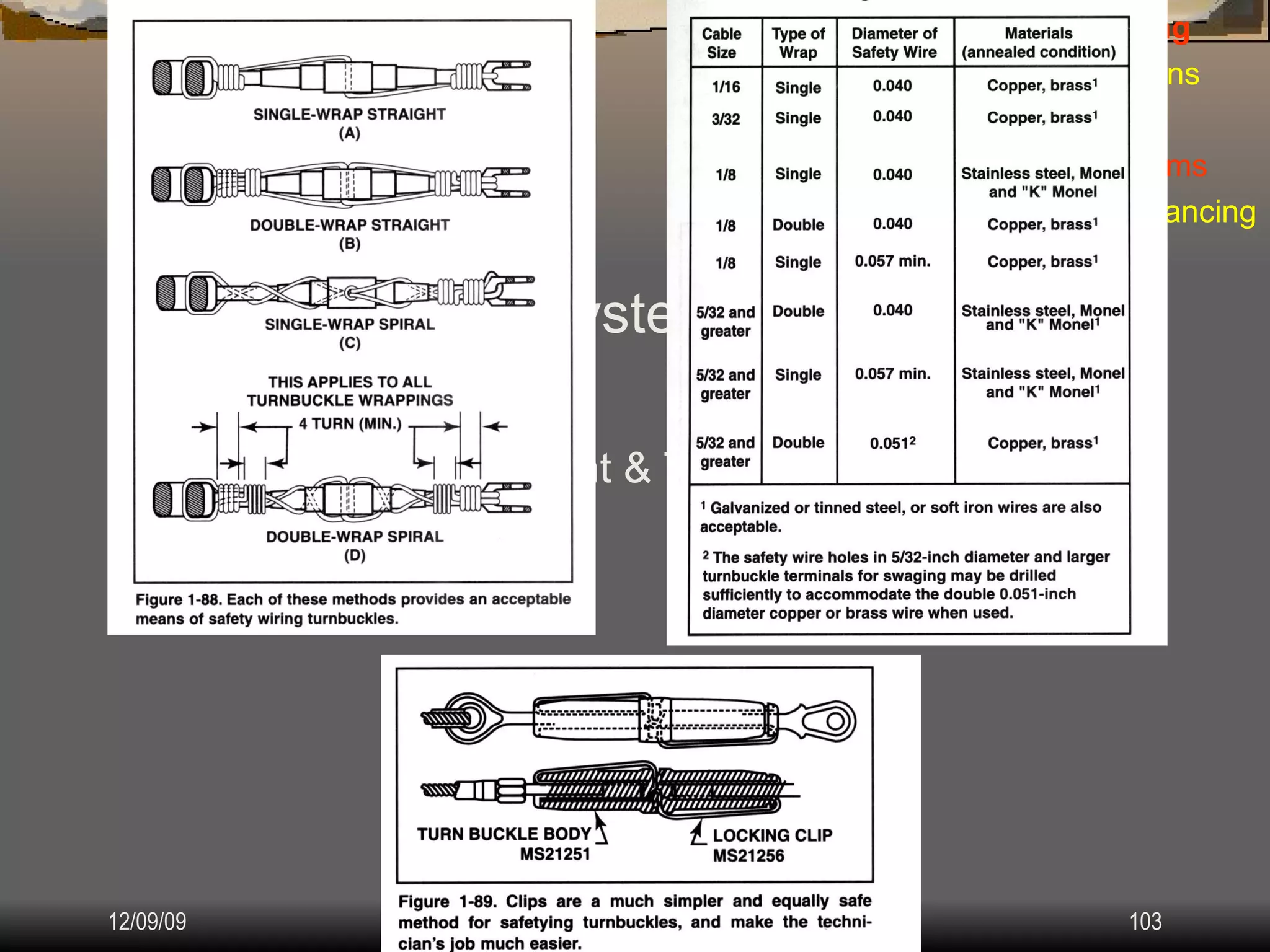
Airplane Assembly Flight Controls Systems: IV.  Assembly & Rigging Rigging Specifications Airplane Assembly Flight Control Systems Control Surface Balancing Biplanes Cable Systems: Travel Adjustment & Tension: Use Turnbuckles to adjust Has threaded ends into barrel One end is left hand thread, one end is right hand thread = turn barrel to change overall length Barrels available in short and long versions to give some flexibility in installations
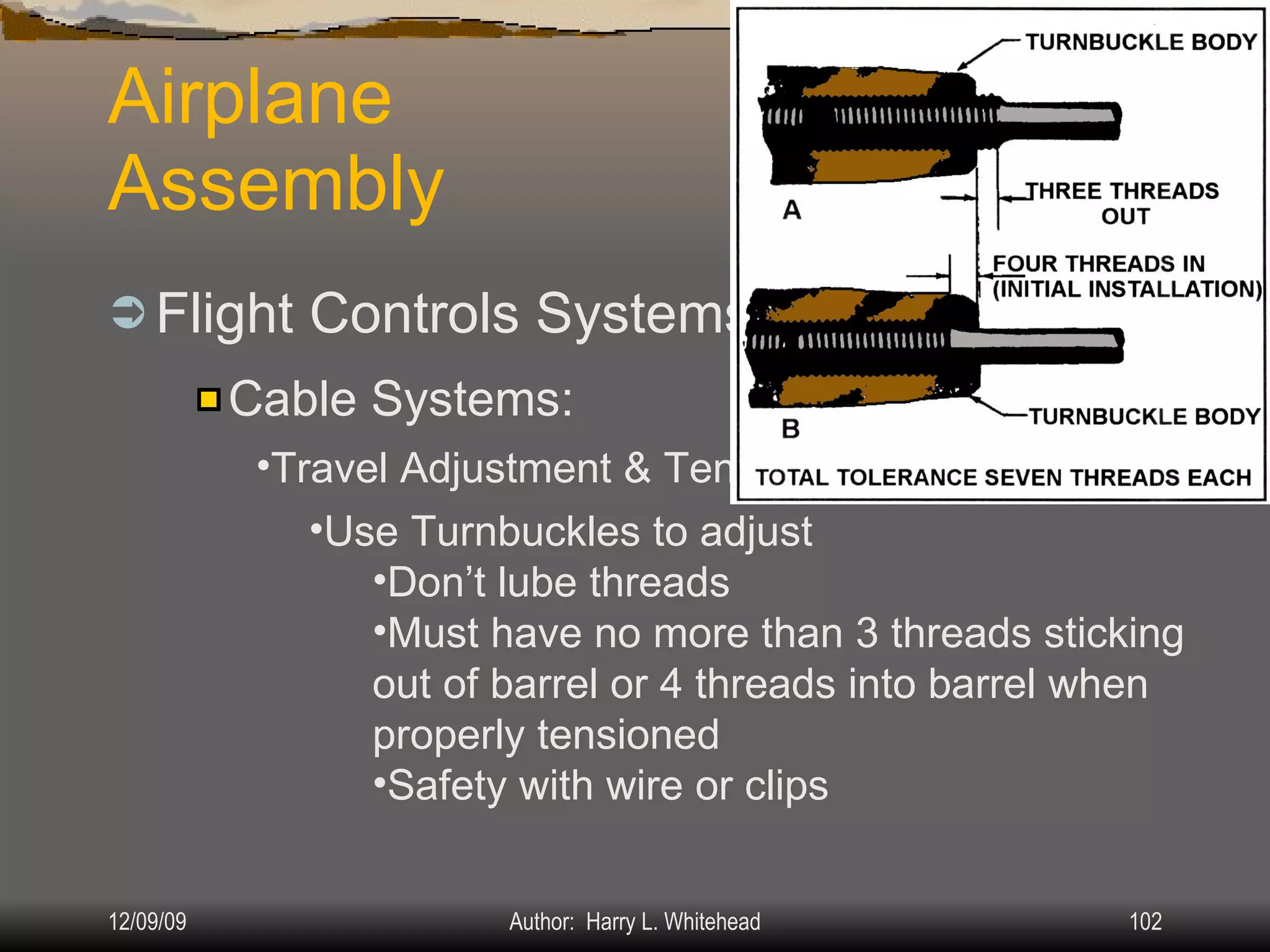
Airplane Assembly Flight Controls Systems: IV.  Assembly & Rigging Rigging Specifications Airplane Assembly Flight Control Systems Control Surface Balancing Biplanes Cable Systems: Travel Adjustment & Tension: Use Turnbuckles to adjust Don’t lube threads Must have no more than 3 threads sticking out of barrel or 4 threads into barrel when properly tensioned Safety with wire or clips
Airplane Assembly Flight Controls Systems: IV.  Assembly & Rigging Rigging Specifications Airplane Assembly Flight Control Systems Control Surface Balancing Biplanes Cable Systems: Travel Adjustment & Tension:
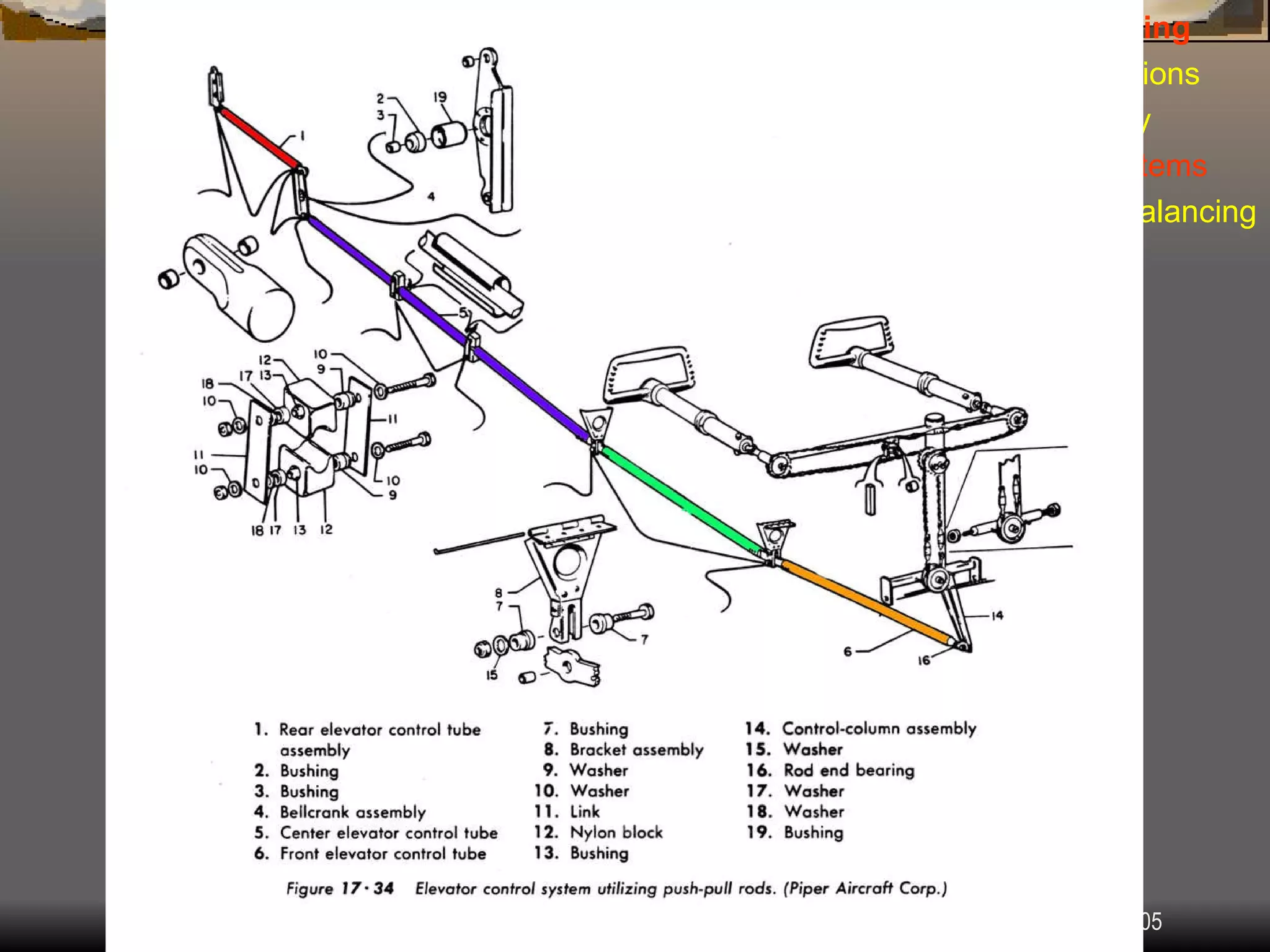
Airplane Assembly Flight Controls Systems: IV.  Assembly & Rigging Rigging Specifications Airplane Assembly Flight Control Systems Control Surface Balancing Biplanes Push-pull Systems: General: Uses all direct mechanical linkages instead of cables Overall has less play or slop in systems than cable
Airplane Assembly Flight Controls Systems: IV.  Assembly & Rigging Rigging Specifications Airplane Assembly Flight Control Systems Control Surface Balancing Biplanes Push-pull Systems:
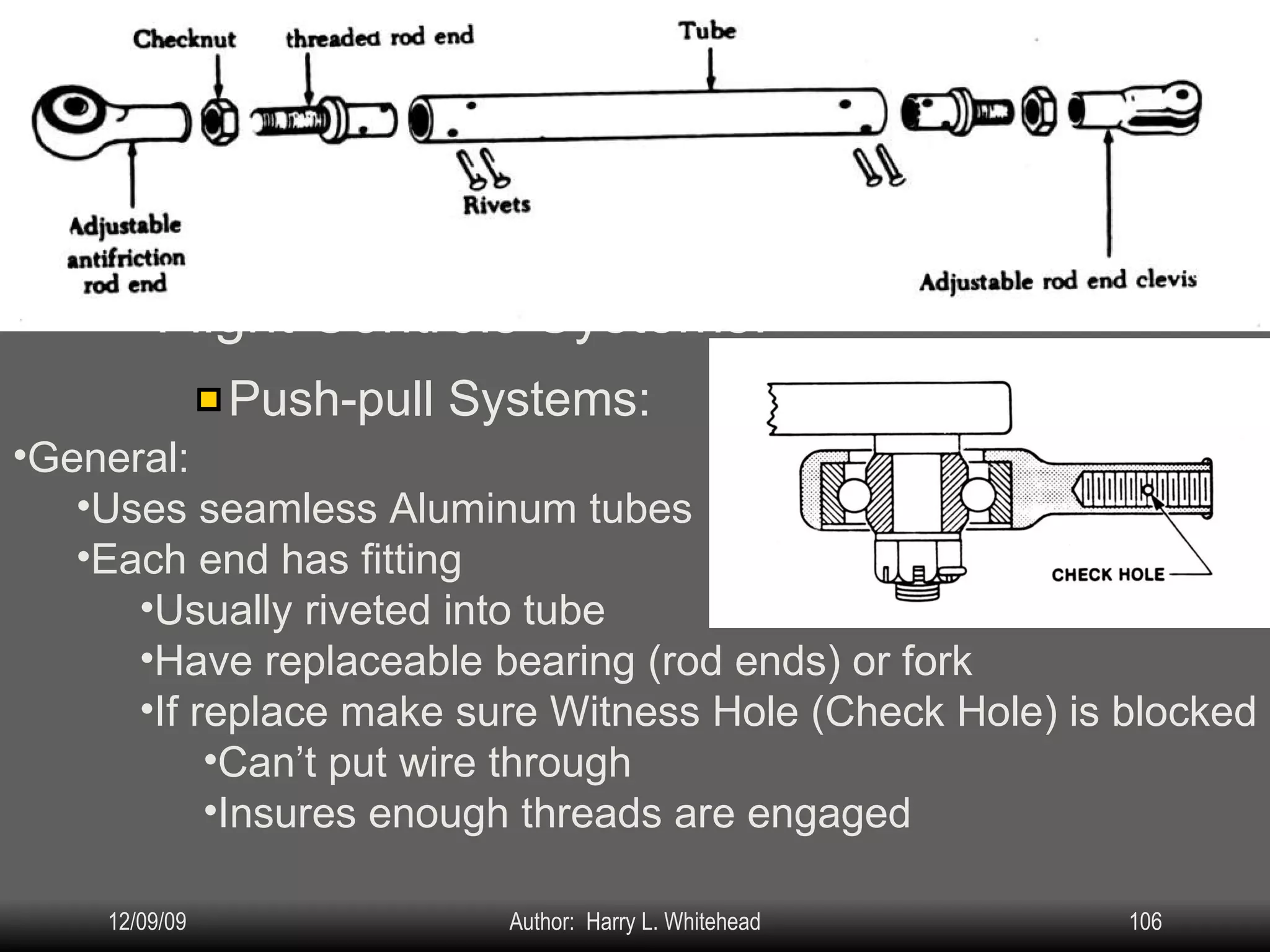
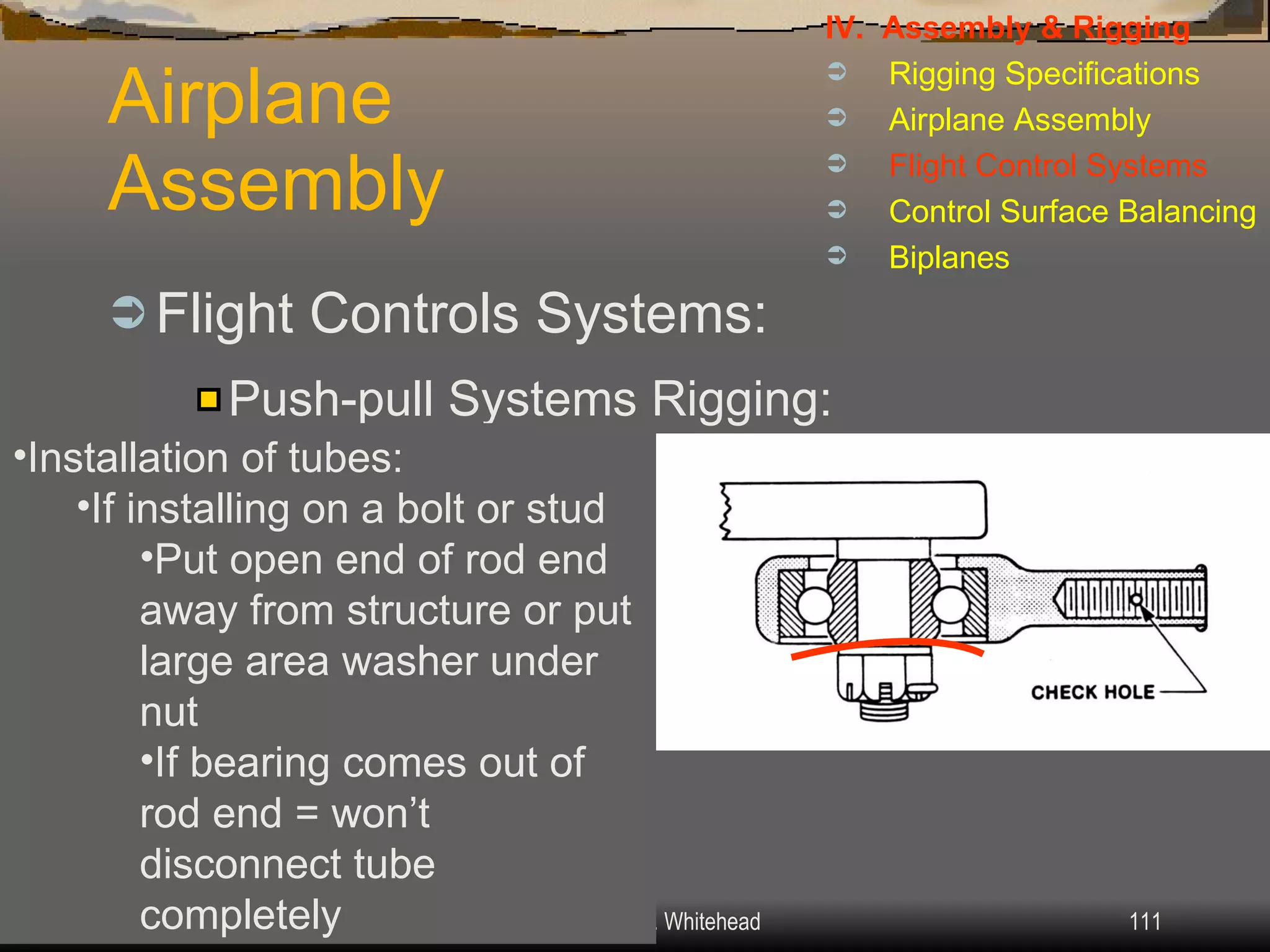
Airplane Assembly Flight Controls Systems: IV.  Assembly & Rigging Rigging Specifications Airplane Assembly Flight Control Systems Control Surface Balancing Biplanes Push-pull Systems: General: Uses seamless Aluminum tubes Each end has fitting Usually riveted into tube Have replaceable bearing (rod ends) or fork If replace make sure Witness Hole (Check Hole) is blocked Can’t put wire through Insures enough threads are engaged
Airplane Assembly Flight Controls Systems: IV.  Assembly & Rigging Rigging Specifications Airplane Assembly Flight Control Systems Control Surface Balancing Biplanes Push-pull Systems: General: Inspect for condition carefully Dents, scratches, gouges, etc. in tube bad as is thin walled and will then crack or fail easily (= monocoque structure) Check bearings/rod ends for wear Small amount in each = large amount in system
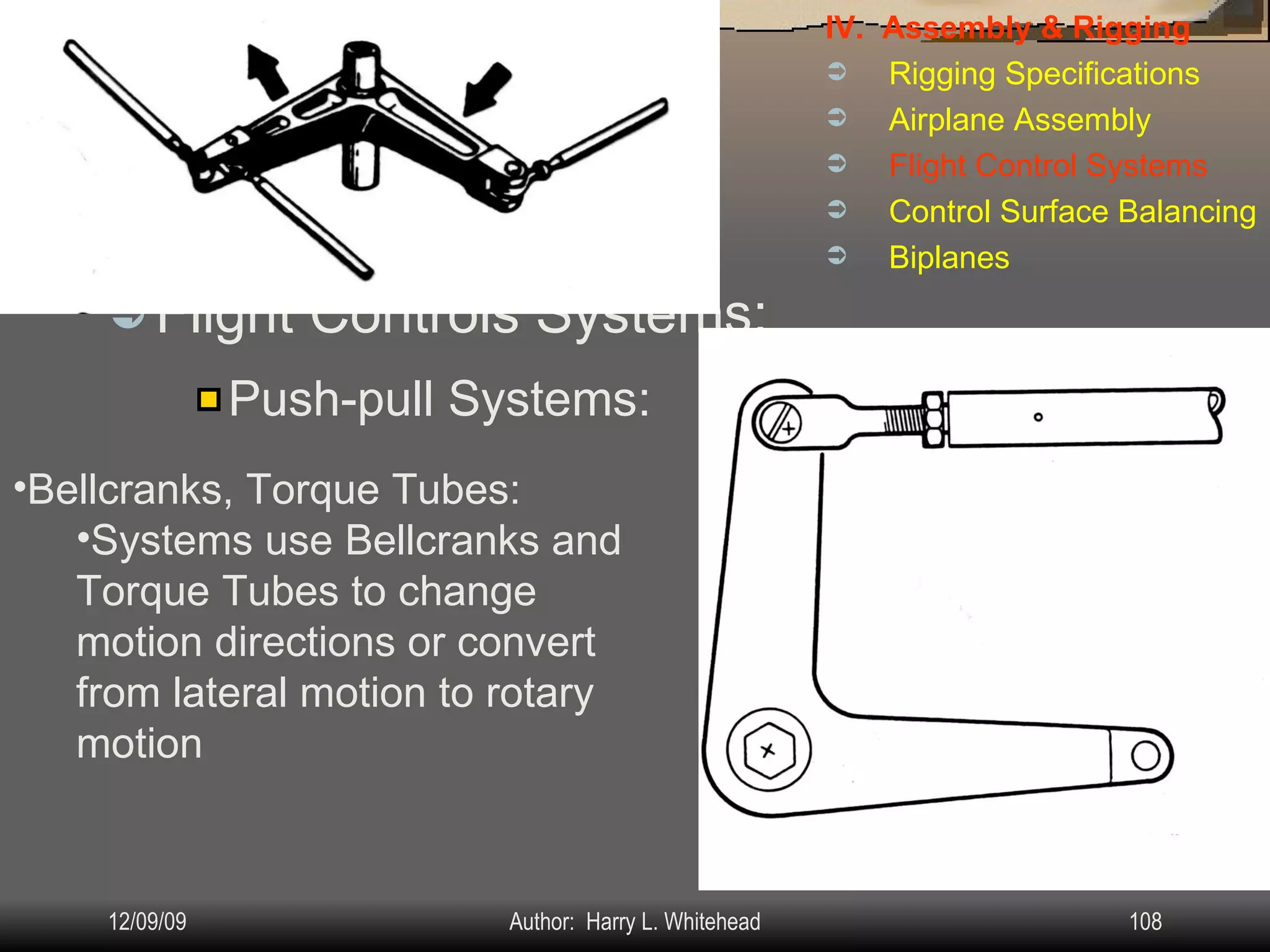
Airplane Assembly Flight Controls Systems: IV.  Assembly & Rigging Rigging Specifications Airplane Assembly Flight Control Systems Control Surface Balancing Biplanes Push-pull Systems: Bellcranks, Torque Tubes: Systems use Bellcranks and Torque Tubes to change motion directions or convert from lateral motion to rotary motion
Airplane Assembly Flight Controls Systems: IV.  Assembly & Rigging Rigging Specifications Airplane Assembly Flight Control Systems Control Surface Balancing Biplanes Push-pull Systems Rigging: Rigging usually accomplished by adjusting the length(s) of various tubes in the system Needs to be checked anytime any tube or rod end is replaced or any control surface is replaced
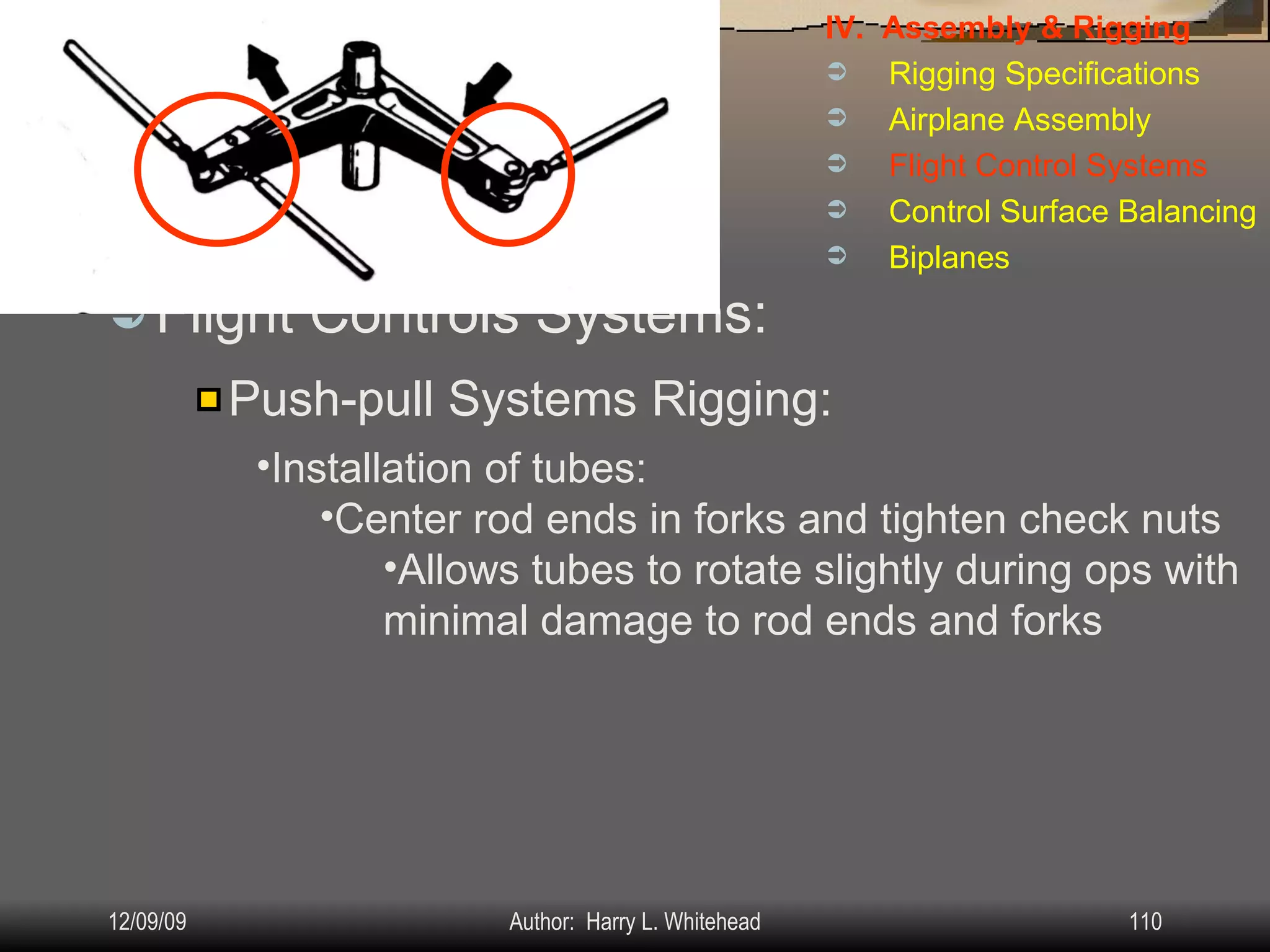
Airplane Assembly Flight Controls Systems: IV.  Assembly & Rigging Rigging Specifications Airplane Assembly Flight Control Systems Control Surface Balancing Biplanes Push-pull Systems Rigging: Installation of tubes: Center rod ends in forks and tighten check nuts Allows tubes to rotate slightly during ops with minimal damage to rod ends and forks
Airplane Assembly Flight Controls Systems: IV.  Assembly & Rigging Rigging Specifications Airplane Assembly Flight Control Systems Control Surface Balancing Biplanes Push-pull Systems Rigging: Installation of tubes: If installing on a bolt or stud Put open end of rod end away from structure or put large area washer under nut If bearing comes out of rod end = won’t disconnect tube completely
Airplane Assembly Control Surface Balancing: IV.  Assembly & Rigging Rigging Specifications Airplane Assembly Flight Control Systems Control Surface Balancing Biplanes General
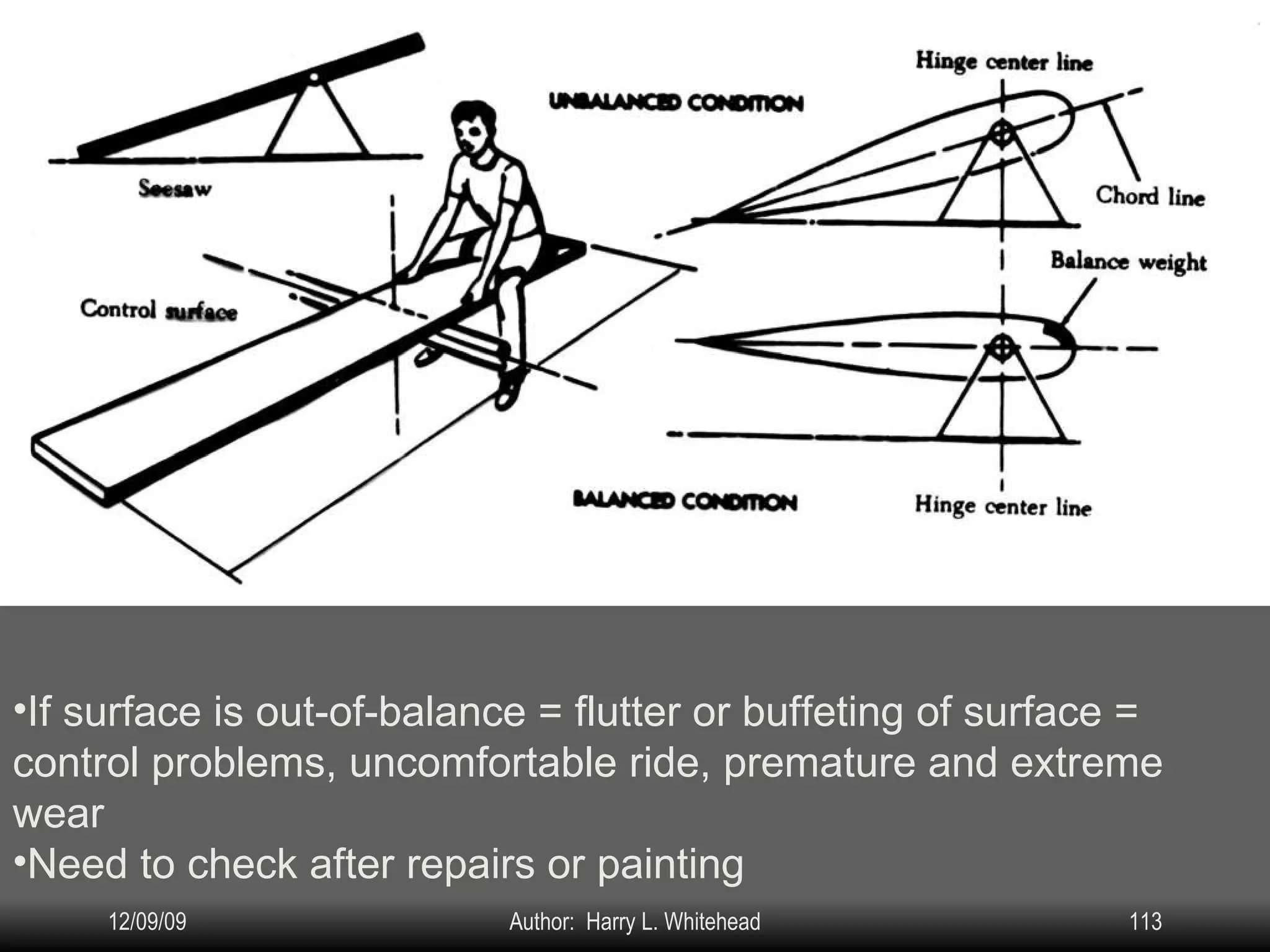
Airplane Assembly Control Surface Balancing: IV.  Assembly & Rigging Rigging Specifications Airplane Assembly Flight Control Systems Control Surface Balancing Biplanes General If surface is out-of-balance = flutter or buffeting of surface = control problems, uncomfortable ride, premature and extreme wear  Need to check after repairs or painting
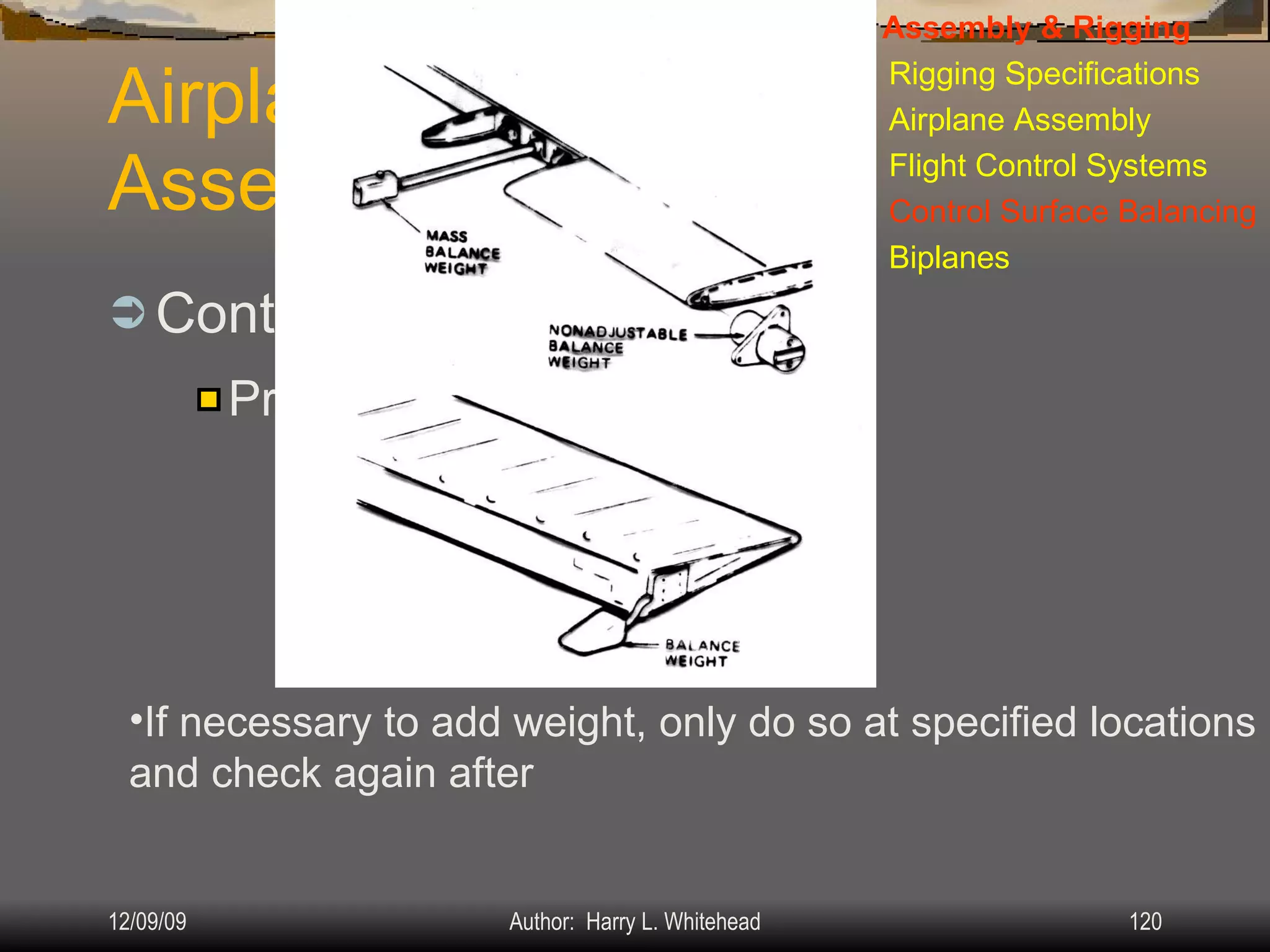
Airplane Assembly Control Surface Balancing: IV.  Assembly & Rigging Rigging Specifications Airplane Assembly Flight Control Systems Control Surface Balancing Biplanes General Basically we want the Moments fore and aft of the surface hinge line to be equal Think Weight and Balance with the hinge line as CG Generally adjusted by adding weight forward of the hinge line as most repairs and paint are aft
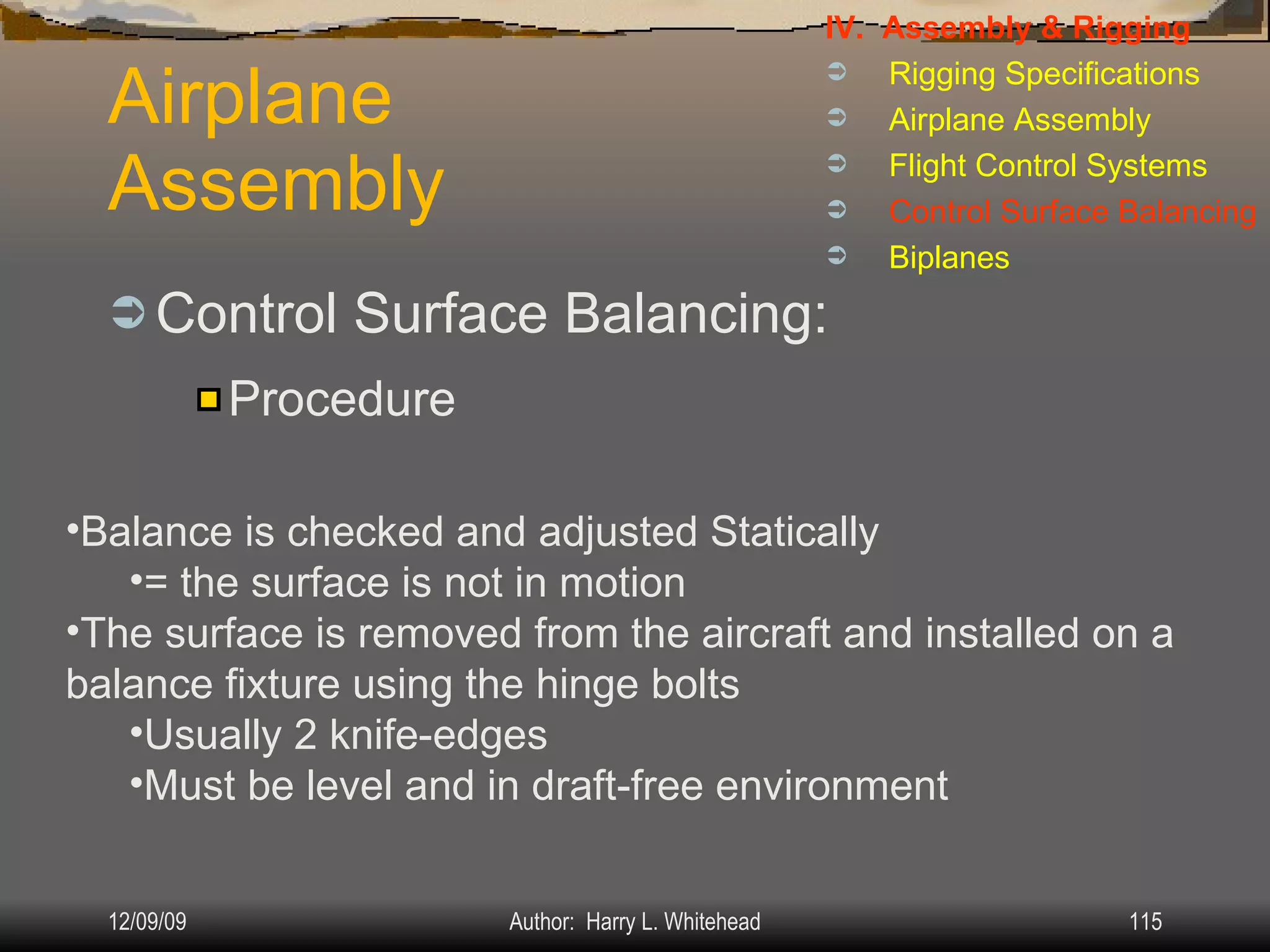
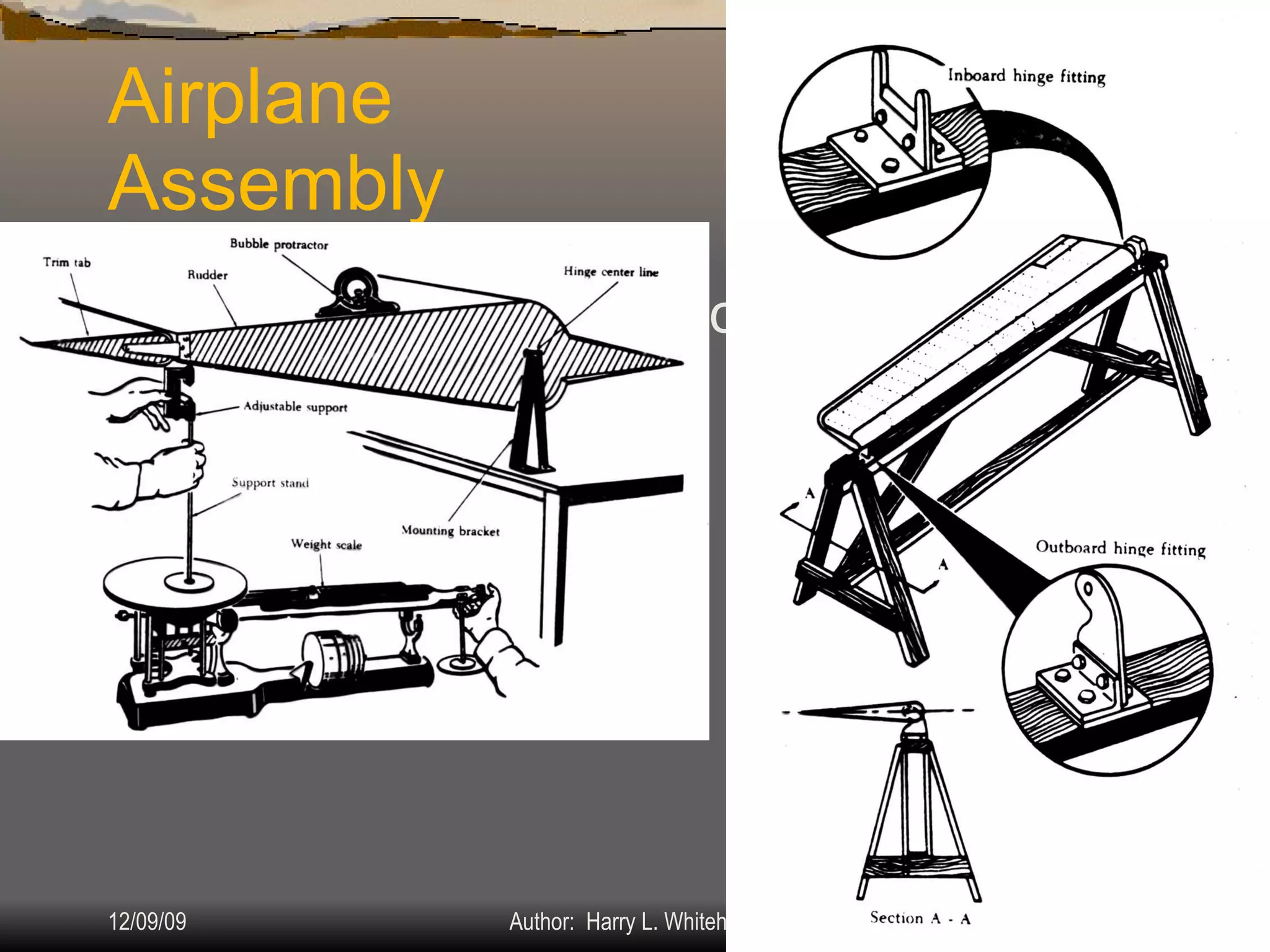
Airplane Assembly Control Surface Balancing: IV.  Assembly & Rigging Rigging Specifications Airplane Assembly Flight Control Systems Control Surface Balancing Biplanes Procedure Balance is checked and adjusted Statically = the surface is not in motion The surface is removed from the aircraft and installed on a balance fixture using the hinge bolts Usually 2 knife-edges  Must be level and in draft-free environment
Airplane Assembly Control Surface Balancing: IV.  Assembly & Rigging Rigging Specifications Airplane Assembly Flight Control Systems Control Surface Balancing Biplanes Procedure
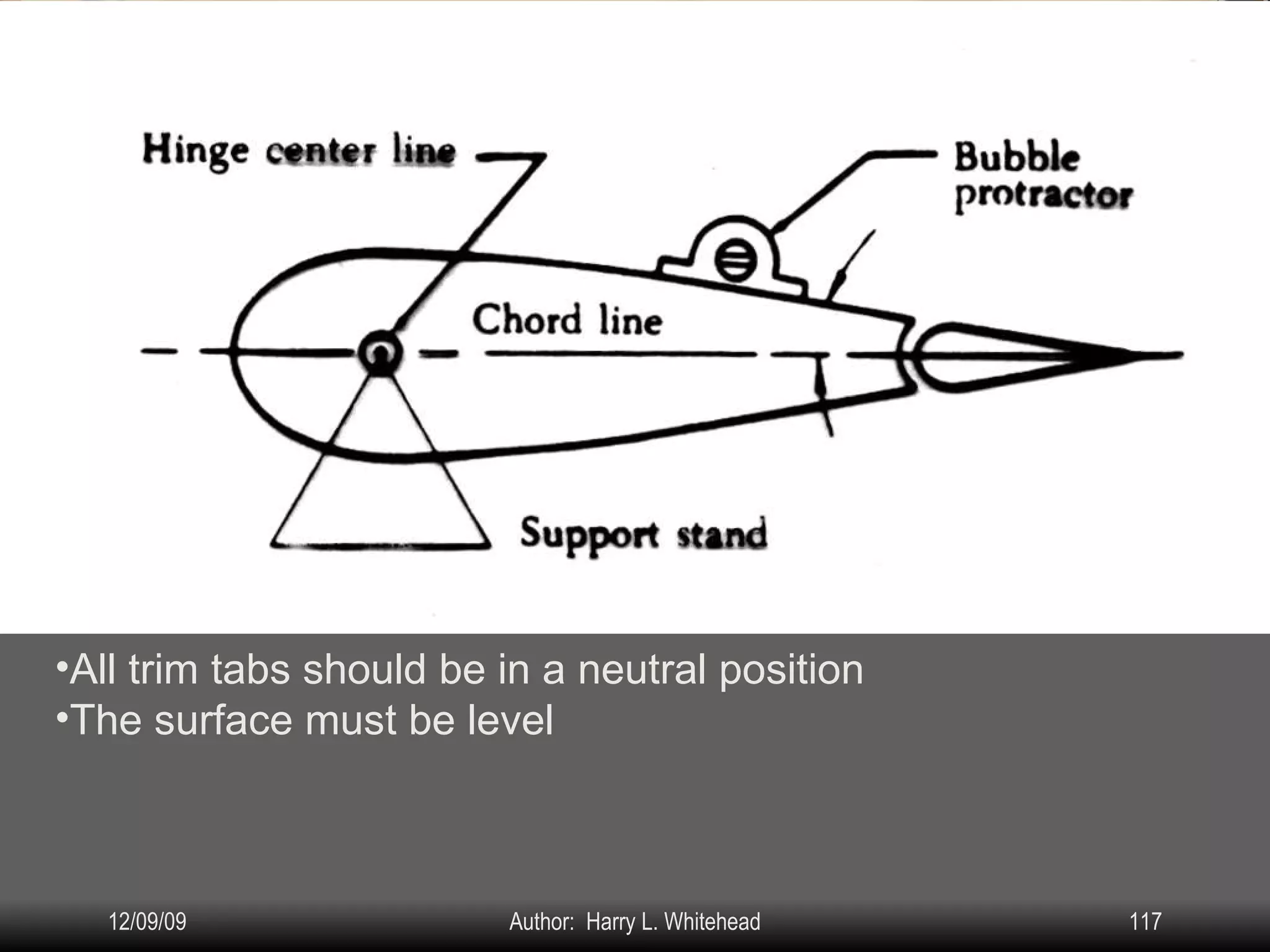
Airplane Assembly Control Surface Balancing: IV.  Assembly & Rigging Rigging Specifications Airplane Assembly Flight Control Systems Control Surface Balancing Biplanes Procedure All trim tabs should be in a neutral position The surface must be level
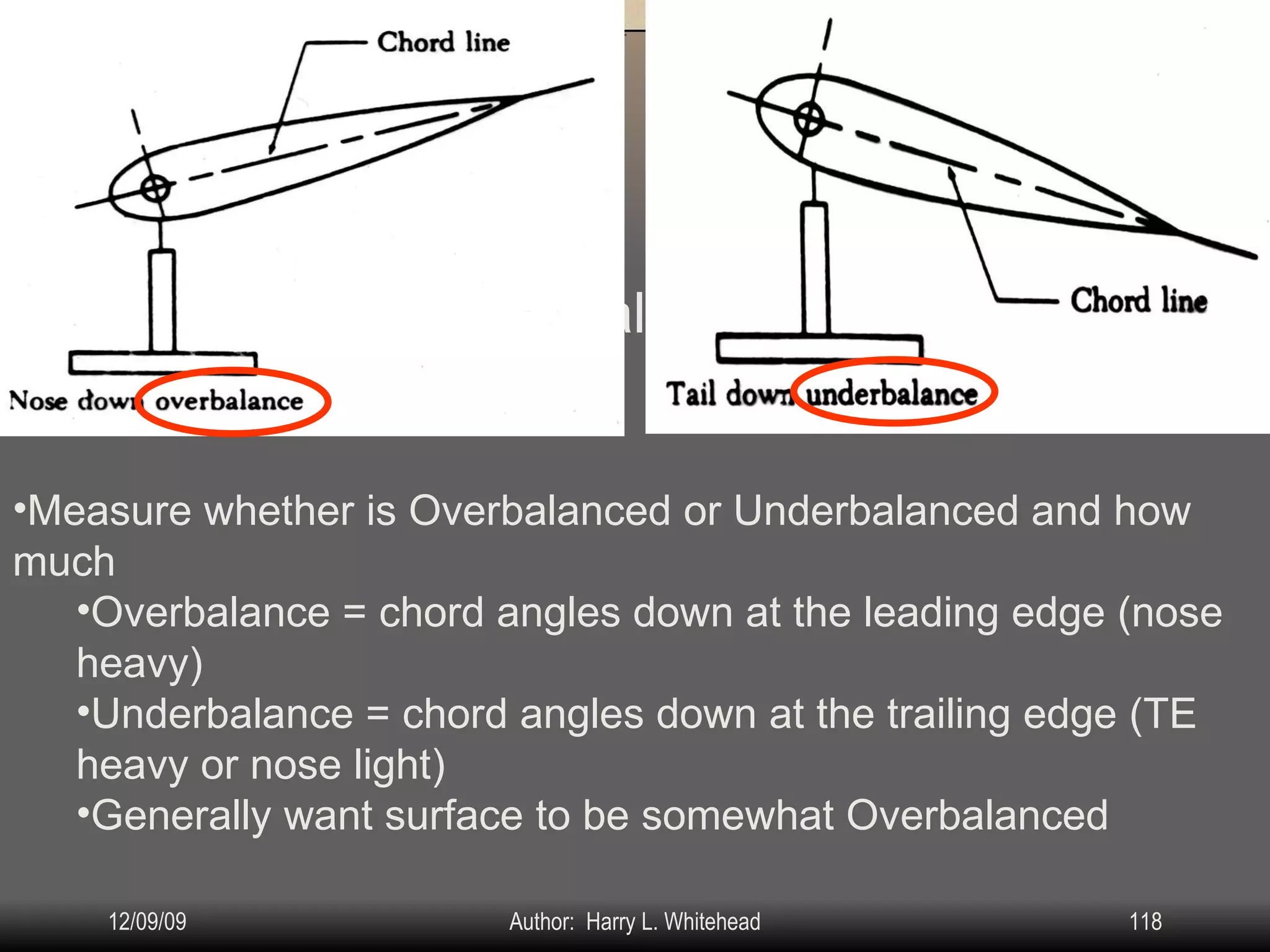
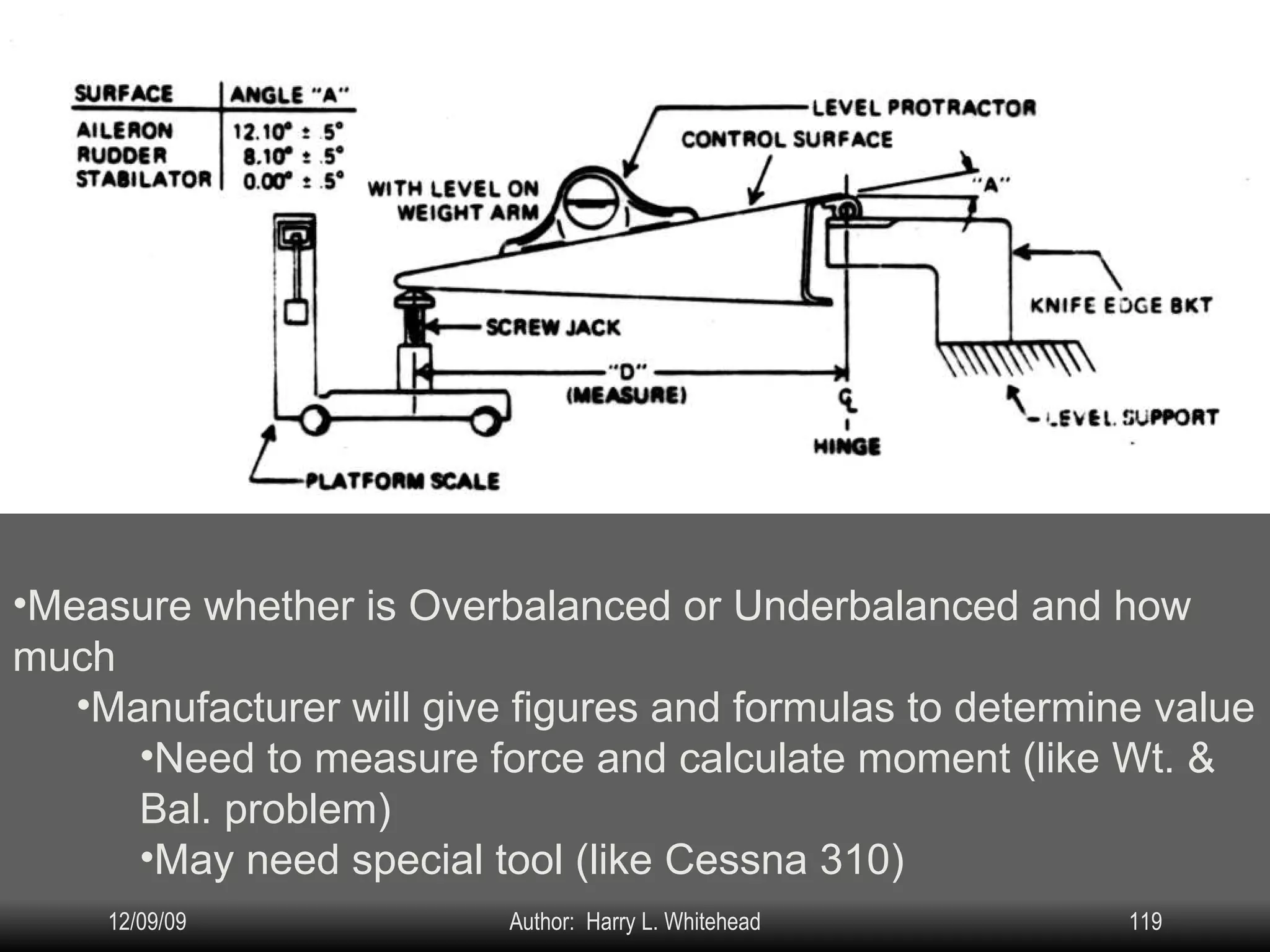
Airplane Assembly Control Surface Balancing: IV.  Assembly & Rigging Rigging Specifications Airplane Assembly Flight Control Systems Control Surface Balancing Biplanes Procedure Measure whether is Overbalanced or Underbalanced and how much Overbalance = chord angles down at the leading edge (nose heavy) Underbalance = chord angles down at the trailing edge (TE heavy or nose light) Generally want surface to be somewhat Overbalanced
Airplane Assembly Control Surface Balancing: IV.  Assembly & Rigging Rigging Specifications Airplane Assembly Flight Control Systems Control Surface Balancing Biplanes Procedure Measure whether is Overbalanced or Underbalanced and how much Manufacturer will give figures and formulas to determine value Need to measure force and calculate moment (like Wt. & Bal. problem) May need special tool (like Cessna 310)
Airplane Assembly Control Surface Balancing: IV.  Assembly & Rigging Rigging Specifications Airplane Assembly Flight Control Systems Control Surface Balancing Biplanes Procedure If necessary to add weight, only do so at specified locations and check again after
 

Assy Rigging

  • 1.
    AVAF 209 -IV. Assembly and Rigging Rigging Specifications Airplane Assembly Flight Control Systems Control Surface Balancing Biplanes
  • 2.
    Rigging SpecificationsShould check “Rigging” during all required inspections and anytime any control or major assembly (I.e. wing) is removed and reinstalled “Rigging” = check systems and control surface travel and adjust as necessary Test fly aircraft after reinstallation and adjust as necessary IV. Assembly & Rigging Rigging Specifications Airplane Assembly Flight Control Systems Control Surface Balancing Biplanes
  • 3.
    Rigging SpecificationsType Certificate Data Sheets (or Aircraft Specifications) are best source Is most accurate for details Includes: Leveling means Control surface travel Weight and balance information IV. Assembly & Rigging Rigging Specifications Airplane Assembly Flight Control Systems Control Surface Balancing Biplanes
  • 4.
    Rigging SpecificationsIV. Assembly & Rigging Rigging Specifications Airplane Assembly Flight Control Systems Control Surface Balancing Biplanes
  • 5.
    Rigging SpecificationsIV. Assembly & Rigging Rigging Specifications Airplane Assembly Flight Control Systems Control Surface Balancing Biplanes
  • 6.
    Rigging SpecificationsManufacturer’s Manuals Give installation and procedures Don’t believe the details, go to the TCDS MM usually cover more than one model or Ser. No. range = details may not be accurate for your specific aircraft IV. Assembly & Rigging Rigging Specifications Airplane Assembly Flight Control Systems Control Surface Balancing Biplanes
  • 7.
    Airplane Assembly Mostairplanes are fully cantilever or with a minimum of external bracing so assembly is pretty straight-forward Follow manufacturer’s instructions IV. Assembly & Rigging Rigging Specifications Airplane Assembly Flight Control Systems Control Surface Balancing Biplanes
  • 8.
    Airplane Assembly GeneralAssembly procedures: IV. Assembly & Rigging Rigging Specifications Airplane Assembly Flight Control Systems Control Surface Balancing Biplanes
  • 9.
    Airplane Assembly GeneralAssembly procedures: IV. Assembly & Rigging Rigging Specifications Airplane Assembly Flight Control Systems Control Surface Balancing Biplanes Level fuselage Laterally and longitudinally Inside hangar to minimize wind currents If must be outside = point into wind Use manufacturer’s level point(s) and plumb bob or spirit level
  • 10.
    Airplane Assembly GeneralAssembly procedures: IV. Assembly & Rigging Rigging Specifications Airplane Assembly Flight Control Systems Control Surface Balancing Biplanes Install wings and torque bolts Install Hor. Stab. And Vert. Stab. And torque bolts
  • 11.
    Airplane Assembly GeneralAssembly procedures: IV. Assembly & Rigging Rigging Specifications Airplane Assembly Flight Control Systems Control Surface Balancing Biplanes Perform Alignment Check (next area) Install movable control surfaces Install and rig control systems Test fly to verify control responses and flight stability/attitude
  • 12.
    Airplane Assembly AlignmentCheck: IV. Assembly & Rigging Rigging Specifications Airplane Assembly Flight Control Systems Control Surface Balancing Biplanes Wings Most modern wings have very little adjustments available Usually only angle of incidence Wing mounting bolts are on eccentric bushing or serrated bushings = rotate to change angle
  • 13.
    Airplane Assembly AlignmentCheck: IV. Assembly & Rigging Rigging Specifications Airplane Assembly Flight Control Systems Control Surface Balancing Biplanes Wings May need to use special Incidence Board or just Universal Propeller Protractor for initial settings Either must be installed at manufacturer specified location
  • 14.
    Airplane Assembly AlignmentCheck: IV. Assembly & Rigging Rigging Specifications Airplane Assembly Flight Control Systems Control Surface Balancing Biplanes Wings with V-struts: Piper Tri-Pacer, Piper Cub Can usually adjust Dihedral and Angle of Incidence Procedure Level fuselage laterally & longitudinally Check and adjust Dihedral
  • 15.
    Airplane Assembly AlignmentCheck: IV. Assembly & Rigging Rigging Specifications Airplane Assembly Flight Control Systems Control Surface Balancing Biplanes Wings with V-struts: Piper Tri-Pacer, Piper Cub Check and adjust Dihedral Use Dihedral Board Position at manufacturer specified position Adjust length of struts until bubble is centered
  • 16.
    Airplane Assembly AlignmentCheck: IV. Assembly & Rigging Rigging Specifications Airplane Assembly Flight Control Systems Control Surface Balancing Biplanes Wings with V-struts: Piper Tri-Pacer, Piper Cub Check and adjust Dihedral Some aircraft use string stretched between the wingtips at specified chord location Adjust struts to get specified dimension between string and wing root
  • 17.
    Airplane Assembly AlignmentCheck: IV. Assembly & Rigging Rigging Specifications Airplane Assembly Flight Control Systems Control Surface Balancing Biplanes Wings with V-struts: Piper Tri-Pacer, Piper Cub Check and adjust Angle of Incidence Use Incidence Board or just measure angle with Prop Protractor or Protractor Head of Combination Square Adjust Rear strut to get proper angle
  • 18.
    Airplane Assembly AlignmentCheck: IV. Assembly & Rigging Rigging Specifications Airplane Assembly Flight Control Systems Control Surface Balancing Biplanes Engines Use manufacturer’s specs. Usually parallel to longitudinal axis Mounts usually just bolt on with no adjustment provisions Be sure to use proper shimming (washers), bolts, torques, etc. as specified
  • 19.
    Airplane Assembly AlignmentCheck: IV. Assembly & Rigging Rigging Specifications Airplane Assembly Flight Control Systems Control Surface Balancing Biplanes Empennage: General Most are cantilever with fixed positions Insure all bolts are proper Part Number and torqued in proper sequence so is not cocked
  • 20.
    Airplane Assembly AlignmentCheck: IV. Assembly & Rigging Rigging Specifications Airplane Assembly Flight Control Systems Control Surface Balancing Biplanes Empennage: If Wire-Braced Uses Streamlined wires so insure have proper tension (use Datum Board) and is flat with airflow (decreases vibrations and drag) Must replace streamlined wires with streamlined wires only DO NOT use round cable as replacement = vibes and different expansion rates
  • 21.
    Airplane Assembly AlignmentCheck: IV. Assembly & Rigging Rigging Specifications Airplane Assembly Flight Control Systems Control Surface Balancing Biplanes Empennage: Check Hor. Stab. Dihedral & Angle of Incidence Basically same as wings May or may not be adjustable
  • 22.
    Airplane Assembly AlignmentCheck: IV. Assembly & Rigging Rigging Specifications Airplane Assembly Flight Control Systems Control Surface Balancing Biplanes Empennage: Check Vert. Stab. (Fin) Verticality Measure from like points on both Hor. Stabs. and should be equal measurement Fin may be offset slightly to compensate for Spiraling Slipstream
  • 23.
    Airplane Assembly AlignmentCheck: IV. Assembly & Rigging Rigging Specifications Airplane Assembly Flight Control Systems Control Surface Balancing Biplanes Empennage: If suspicious, run string through control hinges Should be able to be centered in all hinges If not = hinges are misaligned and will bind control movement NOTE: applies to all control surface hinge lines, not just empennage
  • 24.
    Airplane Assembly AlignmentCheck: IV. Assembly & Rigging Rigging Specifications Airplane Assembly Flight Control Systems Control Surface Balancing Biplanes Symmetry Check: To insure entire aircraft is aligned properly (is Symmetrical) Measure between specified points on aircraft Use steel tape with 5 pound pull (for consistency) Like measurements should be equal within manufacturer’s tolerances May need to use plumb bob from points, mark on floor, and then measure (especially large aircraft)
  • 25.
    Airplane Assembly AlignmentCheck: IV. Assembly & Rigging Rigging Specifications Airplane Assembly Flight Control Systems Control Surface Balancing Biplanes Symmetry Check: To insure entire aircraft is aligned properly (is Symmetrical) Measure between specified points on aircraft Use steel tape with 5 pound pull (for consistency) Like measurements should be equal within manufacturer’s tolerances May need to use plumb bob from points, mark on floor, and then measure (especially large aircraft)
  • 26.
    Airplane Assembly FlightControls Installation & Rigging: IV. Assembly & Rigging Rigging Specifications Airplane Assembly Flight Control Systems Control Surface Balancing Biplanes Ailerons: Be sure to only use manufacturer’s parts combinations and torque specs to prevent binding Should be free to pivot with no binding and no looseness
  • 27.
    Airplane Assembly FlightControls Installation & Rigging: IV. Assembly & Rigging Rigging Specifications Airplane Assembly Flight Control Systems Control Surface Balancing Biplanes Ailerons: System: Stick or wheel connected to cables
  • 28.
    Airplane Assembly FlightControls Installation & Rigging: IV. Assembly & Rigging Rigging Specifications Airplane Assembly Flight Control Systems Control Surface Balancing Biplanes Ailerons: System: Up cable goes to each aileron “ Through” or “Balance” cable connects down side of both ailerons THROUGH CABLE UP CABLES
  • 29.
    Airplane Assembly FlightControls Installation & Rigging: IV. Assembly & Rigging Rigging Specifications Airplane Assembly Flight Control Systems Control Surface Balancing Biplanes Ailerons: System: Stick or wheel connected to cables Up cable goes to each aileron “ Through” or “Balance” cable connects down side of both ailerons
  • 30.
    Airplane Assembly FlightControls Installation & Rigging: IV. Assembly & Rigging Rigging Specifications Airplane Assembly Flight Control Systems Control Surface Balancing Biplanes Ailerons: System: To combat adverse yaw = differential travel Also use Frise ailerons Also some use Rudder-Aileron Interconnect Spring(s) When wheel/stick is moved = also moves rudder in appropriate direction to combat adverse yaw
  • 31.
    Airplane Assembly FlightControls Installation & Rigging: IV. Assembly & Rigging Rigging Specifications Airplane Assembly Flight Control Systems Control Surface Balancing Biplanes Ailerons Rigging: Install all cables and check and adjust tension (most are cable systems) Lock in neutral position first Put clamps or control locks on stick/wheel Put clamps or battens on control surfaces Some have holes for Rigging Pins to go into to hold in neutral position
  • 32.
    Airplane Assembly FlightControls Installation & Rigging: IV. Assembly & Rigging Rigging Specifications Airplane Assembly Flight Control Systems Control Surface Balancing Biplanes Ailerons Rigging: Check and adjust travel Remove locks Use Prop Protractor, Control Surface Protractor, or Protractor Head of Combination Square Check up and down movement as specified in TCDS
  • 33.
    Airplane Assembly AlignmentCheck: IV. Assembly & Rigging Rigging Specifications Airplane Assembly Flight Control Systems Control Surface Balancing Biplanes Ailerons Rigging: Prop Protractor Review Propeller Protractor
  • 34.
    Airplane Assembly AlignmentCheck: IV. Assembly & Rigging Rigging Specifications Airplane Assembly Flight Control Systems Control Surface Balancing Biplanes Ailerons Rigging: Prop Protractor Review Propeller Protractor
  • 35.
    Airplane Assembly AlignmentCheck: IV. Assembly & Rigging Rigging Specifications Airplane Assembly Flight Control Systems Control Surface Balancing Biplanes Ailerons Rigging: Prop Protractor Review Propeller Protractor
  • 36.
    Airplane Assembly AlignmentCheck: IV. Assembly & Rigging Rigging Specifications Airplane Assembly Flight Control Systems Control Surface Balancing Biplanes Ailerons Rigging: Prop Protractor Review Propeller Protractor
  • 37.
    Airplane Assembly AlignmentCheck: IV. Assembly & Rigging Rigging Specifications Airplane Assembly Flight Control Systems Control Surface Balancing Biplanes Ailerons Rigging: Prop Protractor Review Propeller Protractor
  • 38.
    Airplane Assembly AlignmentCheck: IV. Assembly & Rigging Rigging Specifications Airplane Assembly Flight Control Systems Control Surface Balancing Biplanes Ailerons Rigging: Prop Protractor Review Propeller Protractor
  • 39.
    Airplane Assembly AlignmentCheck: IV. Assembly & Rigging Rigging Specifications Airplane Assembly Flight Control Systems Control Surface Balancing Biplanes Ailerons Rigging: Prop Protractor Review Propeller Protractor
  • 40.
    Airplane Assembly AlignmentCheck: IV. Assembly & Rigging Rigging Specifications Airplane Assembly Flight Control Systems Control Surface Balancing Biplanes Ailerons Rigging: Prop Protractor Review Propeller Protractor
  • 41.
    Airplane Assembly AlignmentCheck: IV. Assembly & Rigging Rigging Specifications Airplane Assembly Flight Control Systems Control Surface Balancing Biplanes Ailerons Rigging: Prop Protractor Review Propeller Protractor
  • 42.
    Airplane Assembly AlignmentCheck: IV. Assembly & Rigging Rigging Specifications Airplane Assembly Flight Control Systems Control Surface Balancing Biplanes Ailerons Rigging: Control Surface Protractor: Adjust disk to zero when surface is in neutral Move surface to limits and read angle at pointer
  • 43.
    Airplane Assembly FlightControls Installation & Rigging: IV. Assembly & Rigging Rigging Specifications Airplane Assembly Flight Control Systems Control Surface Balancing Biplanes Ailerons Rigging: Check and adjust travel Adjust stops at ailerons Make sure they hit the stops at ailerons before running out of stick/wheel movement Should have small amount of movement of stick/wheel left to give pilot “springback” feel or “cushion” so he/she knows they’re at end of travel
  • 44.
    Airplane Assembly FlightControls Installation & Rigging: IV. Assembly & Rigging Rigging Specifications Airplane Assembly Flight Control Systems Control Surface Balancing Biplanes Ailerons Rigging:
  • 45.
    Airplane Assembly FlightControls Installation & Rigging: IV. Assembly & Rigging Rigging Specifications Airplane Assembly Flight Control Systems Control Surface Balancing Biplanes Ailerons Rigging: Check and adjust travel Some are “Drooped” When in neutral position = trailing edges are slightly lower than wing or Flap trailing edges (must be equal droop on each wing) During flight = ailerons are forced to streamlined position to take up any slack or wear in system (mostly cable systems)
  • 46.
    Airplane Assembly FlightControls Installation & Rigging: IV. Assembly & Rigging Rigging Specifications Airplane Assembly Flight Control Systems Control Surface Balancing Biplanes Ailerons Rigging: After adjustment Move stick/wheel through entire range of movement Check for ease of movement, no binding, hits stops at aileron first, and AILERONS MOVE IN PROPER DIRECTION Check entire system for proper installation (pulleys, cables, bolts, safeties, etc.)
  • 47.
    Airplane Assembly FlightControls Installation & Rigging: IV. Assembly & Rigging Rigging Specifications Airplane Assembly Flight Control Systems Control Surface Balancing Biplanes Flaps: System: Actuated by mechanical handle or electrical Handle manually positioned by pilot and connected to cables Electric switch connected to reversible motor in wing which is connected to cables Both sides connected to same cables to insure equal extension and retraction
  • 48.
    Airplane Assembly FlightControls Installation & Rigging: IV. Assembly & Rigging Rigging Specifications Airplane Assembly Flight Control Systems Control Surface Balancing Biplanes Flaps Rigging: Generally same as ailerons Lock in retracted position Adjust cable tension Check and adjust travel as per TCDS Hit stops at flaps first BOTH MUST EXTEND EQUALLY! If different = extreme roll force Check indicator system matches flap movement and positions
  • 49.
    Airplane Assembly FlightControls Installation & Rigging: IV. Assembly & Rigging Rigging Specifications Airplane Assembly Flight Control Systems Control Surface Balancing Biplanes Elevators: System: Wheel/stick connected to cables Cables go through belly to bellcrank on or near Elevator
  • 50.
    Airplane Assembly FlightControls Installation & Rigging: IV. Assembly & Rigging Rigging Specifications Airplane Assembly Flight Control Systems Control Surface Balancing Biplanes Elevators: System: Most modern airplanes can be loaded with CG too far aft Lots of seats, baggage compartments in back, etc. When this airplane is slowed down for landing: Trim tab working hard to keep nose down with Elevators in slightly down position If turbulence = Trim Tab may loose effectiveness = Elevators streamline = nose pitches up and trim tab can’t compensate = possible stall
  • 51.
    Airplane Assembly FlightControls Installation & Rigging: IV. Assembly & Rigging Rigging Specifications Airplane Assembly Flight Control Systems Control Surface Balancing Biplanes Elevators: System: Down Spring in system puts load on Elevator working against Trim Tab If turbulence causes loss of trim tab effectiveness = Down Spring pulls Elevator down to keep nose down until Trim tab can take over again
  • 52.
    Airplane Assembly FlightControls Installation & Rigging: IV. Assembly & Rigging Rigging Specifications Airplane Assembly Flight Control Systems Control Surface Balancing Biplanes Elevators: Rigging generally same as ailerons Lock in neutral Trailing edge in line with Hor. Stab. trailing edge Clamp wheel/stick and elevator Adjust cable tension Adjust travel Check operations and system for problems
  • 53.
    Airplane Assembly FlightControls Installation & Rigging: IV. Assembly & Rigging Rigging Specifications Airplane Assembly Flight Control Systems Control Surface Balancing Biplanes Stabilators: System: Wheel/stick connected to cables very similar to Elevator except connects to counterweight (or Balance Arm) on front of stabilator inside fuselage
  • 54.
    Airplane Assembly FlightControls Installation & Rigging: IV. Assembly & Rigging Rigging Specifications Airplane Assembly Flight Control Systems Control Surface Balancing Biplanes Stabilators Rigging: Rigging generally same as others Lock in neutral Must use stabilator rigging tool similar to incidence board to find neutral Adjust cable tension Adjust travel Check operations and system for problems
  • 55.
    Airplane Assembly FlightControls Installation & Rigging: IV. Assembly & Rigging Rigging Specifications Airplane Assembly Flight Control Systems Control Surface Balancing Biplanes Rudder: System: Cables connected to pedals and through belly to rudder On Tricycle gear aircraft = also connect to Nose Wheel steering mechanism
  • 56.
    Airplane Assembly FlightControls Installation & Rigging: IV. Assembly & Rigging Rigging Specifications Airplane Assembly Flight Control Systems Control Surface Balancing Biplanes Rudder Rigging: Generally same as others Lock in neutral Clamp pedals
  • 57.
    Airplane Assembly FlightControls Installation & Rigging: IV. Assembly & Rigging Rigging Specifications Airplane Assembly Flight Control Systems Control Surface Balancing Biplanes Rudder Rigging: Generally same as others Lock in neutral Clamp pedals Clamp rudder in line with Vert. Stab. Adjust cable tension
  • 58.
    Airplane Assembly FlightControls Installation & Rigging: IV. Assembly & Rigging Rigging Specifications Airplane Assembly Flight Control Systems Control Surface Balancing Biplanes Rudder Rigging: Adjust travel Can’t use bubble type protractors Measure distance moved from specified point May need to make drawing protractor Or measure distance from hinge to trailing edge (= radius of movement), calculate circumference of movement, divide by 360, multiply by necessary degrees of travel, measure travel Check operations and system for problems
  • 59.
    Airplane Assembly FlightControls Installation & Rigging: IV. Assembly & Rigging Rigging Specifications Airplane Assembly Flight Control Systems Control Surface Balancing Biplanes Control Tabs: Typical System (Aileron): Control wheel in cockpit Turns cable drum or chain sprockets connected to cables Includes position indicator mechanism
  • 60.
    Airplane Assembly FlightControls Installation & Rigging: IV. Assembly & Rigging Rigging Specifications Airplane Assembly Flight Control Systems Control Surface Balancing Biplanes Control Tabs Rigging: Generally same as others Lock in neutral In line with control surface installed on Adjust cable tension Adjust travel Check operations and system for problems Check indicator for proper operation Insure is moving in proper direction
  • 61.
    Airplane Assembly FlightControls Installation & Rigging: IV. Assembly & Rigging Rigging Specifications Airplane Assembly Flight Control Systems Control Surface Balancing Biplanes Final Check: Test fly and readjust as necessary to fly “hands off” at cruise and most common loading If flying with constant bank (“heavy wing”) Need to adjust angle of incidence of wing(s) Need to “Wash IN” heavy wing by INcreasing angle of incidence on low side Turn rear bolt (if serrated or eccentric) shorten rear strut length Could also Wash Out light (or high) wing
  • 62.
    Airplane Assembly FlightControls Installation & Rigging: IV. Assembly & Rigging Rigging Specifications Airplane Assembly Flight Control Systems Control Surface Balancing Biplanes Final Check: If in sideslip = rudder Reset in-flight adjustable trim tab or bend fixed trim tab to compensate If nose low or high = elevator Reset trim tab(s) accordingly All are Trial and Error adjustments so re-test fly to verify and keep trying until it’s right
  • 63.
    Airplane Assembly FlightControls Systems: IV. Assembly & Rigging Rigging Specifications Airplane Assembly Flight Control Systems Control Surface Balancing Biplanes Cable Systems: Types of Cable CRES or carbon steel Carbon steel cheaper and stronger Preformed Must be at least 1/8 inch diameter for Primary Controls
  • 64.
    Airplane Assembly FlightControls Systems: IV. Assembly & Rigging Rigging Specifications Airplane Assembly Flight Control Systems Control Surface Balancing Biplanes Cable Systems: Types of Cable Non-flexible 1x7 or 1x19 1 strand of 7 or 19 wires Only for straight runs with no change in direction
  • 65.
    Airplane Assembly FlightControls Systems: IV. Assembly & Rigging Rigging Specifications Airplane Assembly Flight Control Systems Control Surface Balancing Biplanes Cable Systems: Types of Cable Flexible 7x7 Straight runs or with large pulleys for small direction changes 7x19 (formerly Extra Flex.) Use on any system Is most common
  • 66.
    Airplane Assembly FlightControls Systems: IV. Assembly & Rigging Rigging Specifications Airplane Assembly Flight Control Systems Control Surface Balancing Biplanes Cable Systems: Types of Cable Also: 3 x 7 only used on very small cable runs for non-critical applications usually only for control surface position indicators 6 x 19 for larger than 3/8” diameters
  • 67.
    Airplane Assembly FlightControls Systems: IV. Assembly & Rigging Rigging Specifications Airplane Assembly Flight Control Systems Control Surface Balancing Biplanes Cable Systems: Types of Cable Nylon-coated Made by extruding a nylon coating over CRES cable Increases service life as keeps clean and less vibration (= less work hardening)
  • 68.
    Airplane Assembly FlightControls Systems: IV. Assembly & Rigging Rigging Specifications Airplane Assembly Flight Control Systems Control Surface Balancing Biplanes Cable Systems: Types of Cable LockClad On some older aircraft for high altitude flight Is regular cable surrounded by Aluminum tube swaged on entire length Temperature affects length less
  • 69.
    Airplane Assembly FlightControls Systems: IV. Assembly & Rigging Rigging Specifications Airplane Assembly Flight Control Systems Control Surface Balancing Biplanes Cable Systems: Termination Woven Army-Navy 5-tuck splice or Roebling Roll Very time consuming to make Only produce 75% of cable strength
  • 70.
    Airplane Assembly FlightControls Systems: IV. Assembly & Rigging Rigging Specifications Airplane Assembly Flight Control Systems Control Surface Balancing Biplanes Cable Systems: Termination Nicopress Copper sleeves squeezed onto cable Squeezes: 1. Center 2. Terminal end 3. Cable end Check with Go-NoGo gauge Develops 100% of cable strength
  • 71.
    Airplane Assembly FlightControls Systems: IV. Assembly & Rigging Rigging Specifications Airplane Assembly Flight Control Systems Control Surface Balancing Biplanes Cable Systems: Termination Nicopress Can use 2 sleeves in series for splice = also 100% of cable strength Be sure to place slippage mark on edge of sleeve(s) and cable when done
  • 72.
    Airplane Assembly FlightControls Systems: IV. Assembly & Rigging Rigging Specifications Airplane Assembly Flight Control Systems Control Surface Balancing Biplanes Cable Systems: Termination Swaged Most common Terminal Swaged (squeezed) onto cable Develops 100% of cable strength
  • 73.
    Airplane Assembly FlightControls Systems: IV. Assembly & Rigging Rigging Specifications Airplane Assembly Flight Control Systems Control Surface Balancing Biplanes Cable Systems: Termination Swaged Use Go-NoGo gauge to check Apply slippage marks after
  • 74.
    Airplane Assembly FlightControls Systems: IV. Assembly & Rigging Rigging Specifications Airplane Assembly Flight Control Systems Control Surface Balancing Biplanes Cable Systems: Termination Proof Load Test After assembly Pull with 60% of cable strength see AC 43.13-1B for strengths Apply gradually and hold for 3 minutes OK = no slippage in terminal(s)
  • 75.
    Airplane Assembly FlightControls Systems: IV. Assembly & Rigging Rigging Specifications Airplane Assembly Flight Control Systems Control Surface Balancing Biplanes Cable Systems: Termination Proof Load Test After assembly Pull with 60% of cable strength Apply gradually and hold for 3 minutes OK = no slippage in terminal(s) From AC 43.13-1B
  • 76.
    Airplane Assembly FlightControls Systems: IV. Assembly & Rigging Rigging Specifications Airplane Assembly Flight Control Systems Control Surface Balancing Biplanes Cable Systems: Cable Inspection Inspect for wear, corrosion, breakage, distortion, or any damage Some damage is hidden = should periodically remove cable and inspect thoroughly Especially look at where passes over pulleys or through fairleads or within 1 foot of swaged-on terminal
  • 77.
    Airplane Assembly FlightControls Systems: IV. Assembly & Rigging Rigging Specifications Airplane Assembly Flight Control Systems Control Surface Balancing Biplanes Cable Systems: Cable Inspection Wear Replace when is worn 40-50% of outer wires Visual to see if wear of wires is blending together = 40-50% Gaps between wires = excess of 50% wear and must be replaced
  • 78.
    Airplane Assembly FlightControls Systems: IV. Assembly & Rigging Rigging Specifications Airplane Assembly Flight Control Systems Control Surface Balancing Biplanes
  • 79.
    Airplane Assembly FlightControls Systems: IV. Assembly & Rigging Rigging Specifications Airplane Assembly Flight Control Systems Control Surface Balancing Biplanes Cable Systems: Cable Inspection Don’t confuse wear with manufacturer’s splice Splice OK
  • 80.
    Airplane Assembly FlightControls Systems: IV. Assembly & Rigging Rigging Specifications Airplane Assembly Flight Control Systems Control Surface Balancing Biplanes Cable Systems: Cable Inspection Wear If LockClad or Nylon Coated Replace if outer cover is worn through
  • 81.
    Airplane Assembly FlightControls Systems: IV. Assembly & Rigging Rigging Specifications Airplane Assembly Flight Control Systems Control Surface Balancing Biplanes Cable Systems: Cable Inspection Damage or Corrosion Pass rag over length and will snag on broken wires DON’T USE HAND!
  • 82.
    Airplane Assembly FlightControls Systems: IV. Assembly & Rigging Rigging Specifications Airplane Assembly Flight Control Systems Control Surface Balancing Biplanes Cable Systems: Cable Inspection If suspect = remove and bend in loop to make broken wires stand out = replace
  • 83.
    Airplane Assembly FlightControls Systems: IV. Assembly & Rigging Rigging Specifications Airplane Assembly Flight Control Systems Control Surface Balancing Biplanes Cable Systems: Cable Inspection Damage or Corrosion Corrosion is especially prevalent in battery compartments, lavatories, wheel wells Anywhere a concentration of vapors, fumes or liquids can occur Exterior corrosion is not bad but probably also has internal corrosion = replace
  • 84.
    Airplane Assembly FlightControls Systems: IV. Assembly & Rigging Rigging Specifications Airplane Assembly Flight Control Systems Control Surface Balancing Biplanes Cable Systems: Cable Inspection If cable is kinked or twisted wrong Replace as wires/strands will not return to original position and strength is less Make sure no splice is closer than 2 inches to any pulley or fairlead
  • 85.
    Airplane Assembly FlightControls Systems: IV. Assembly & Rigging Rigging Specifications Airplane Assembly Flight Control Systems Control Surface Balancing Biplanes Cable Systems: Other Components: Pulleys Are phenolic with sealed bearings No lubrication necessary Replace if bearing is rough or dry Use for direction change over 3 o
  • 86.
    Airplane Assembly FlightControls Systems: IV. Assembly & Rigging Rigging Specifications Airplane Assembly Flight Control Systems Control Surface Balancing Biplanes Cable Systems: Other Components: Pulleys Check for wear patterns Periodically rotate any which don’t normally rotate much = loosens and evens wear
  • 87.
    Airplane Assembly FlightControls Systems: IV. Assembly & Rigging Rigging Specifications Airplane Assembly Flight Control Systems Control Surface Balancing Biplanes Cable Systems: Other Components: Pulleys Check for wear patterns Periodically rotate any which don’t normally rotate much = loosens and evens wear
  • 88.
    Airplane Assembly FlightControls Systems: IV. Assembly & Rigging Rigging Specifications Airplane Assembly Flight Control Systems Control Surface Balancing Biplanes Cable Systems: Other Components: Pulleys Make sure cable or pulley guards are used to help keep cable on pulley
  • 89.
    Airplane Assembly FlightControls Systems: IV. Assembly & Rigging Rigging Specifications Airplane Assembly Flight Control Systems Control Surface Balancing Biplanes Cable Systems: Other Components: Fairleads To prevent cable chafing on structure Maximum deflection allowed is 3 o Phenolic, plastic, or nylon (= soft material) so fairlead wears instead of cable
  • 90.
    Airplane Assembly FlightControls Systems: IV. Assembly & Rigging Rigging Specifications Airplane Assembly Flight Control Systems Control Surface Balancing Biplanes Cable Systems: Other Components: Pressure Seals Used on pressurized aircraft where cable passes through pressure vessel Are filled with special grease and shaped so cable passes through but not air pressure Inspect for proper lube and insure all snap rings are in place (or might jam cable)
  • 91.
    Airplane Assembly FlightControls Systems: IV. Assembly & Rigging Rigging Specifications Airplane Assembly Flight Control Systems Control Surface Balancing Biplanes Cable Systems: Other Components: Cable Connectors Some aircraft use spring-loaded “quick disconnects” Allows “quick” removal of cable section for inspection and/or replacement
  • 92.
    Airplane Assembly FlightControls Systems: IV. Assembly & Rigging Rigging Specifications Airplane Assembly Flight Control Systems Control Surface Balancing Biplanes Cable Systems: Other Components: Bellcranks and Quadrants Bellcranks transmit lateral movements Increase range or mechanical advantage in system
  • 93.
    Airplane Assembly FlightControls Systems: IV. Assembly & Rigging Rigging Specifications Airplane Assembly Flight Control Systems Control Surface Balancing Biplanes Cable Systems: Other Components: Bellcranks and Quadrants Bellcranks transmit lateral movements Increase range or mechanical advantage in system Quadrants convert cable to push-pull movement
  • 94.
    Airplane Assembly FlightControls Systems: IV. Assembly & Rigging Rigging Specifications Airplane Assembly Flight Control Systems Control Surface Balancing Biplanes Cable Systems: Travel Adjustment & Tension:
  • 95.
    Airplane Assembly FlightControls Systems: IV. Assembly & Rigging Rigging Specifications Airplane Assembly Flight Control Systems Control Surface Balancing Biplanes Cable Systems: Travel Adjustment & Tension: Tension varies with temperture as Aluminum structure changes size more than steel cable
  • 96.
    Airplane Assembly FlightControls Systems: IV. Assembly & Rigging Rigging Specifications Airplane Assembly Flight Control Systems Control Surface Balancing Biplanes Cable Systems: Travel Adjustment & Tension: Some aircraft have chart to give proper tension (in pounds) for the ambient temperature at time of checking Small aircraft usually give range of acceptable tensions (for flexibility of temperatures)
  • 97.
    Airplane Assembly FlightControls Systems: IV. Assembly & Rigging Rigging Specifications Airplane Assembly Flight Control Systems Control Surface Balancing Biplanes Cable Systems: Travel Adjustment & Tension: Some aircraft have chart to give proper tension (in pounds) for the ambient temperature at time of checking Small aircraft usually give range of acceptable tensions (for flexibility of temperatures)
  • 98.
    Airplane Assembly FlightControls Systems: IV. Assembly & Rigging Rigging Specifications Airplane Assembly Flight Control Systems Control Surface Balancing Biplanes Cable Systems: Travel Adjustment & Tension: Use Tensiometer to check tension Make sure Riser is proper for cable size Hook on cable in middle of as long a run as is accessible Squeeze trigger and read scale
  • 99.
    Airplane Assembly FlightControls Systems: IV. Assembly & Rigging Rigging Specifications Airplane Assembly Flight Control Systems Control Surface Balancing Biplanes Cable Systems: Travel Adjustment & Tension: Use Tensiometer to check tension Use chart to convert scale reading to pounds of tension
  • 100.
    Airplane Assembly FlightControls Systems: IV. Assembly & Rigging Rigging Specifications Airplane Assembly Flight Control Systems Control Surface Balancing Biplanes Cable Systems: Travel Adjustment & Tension: Use Tensiometer to check tension Some large aircraft use automatic tension devices Keeps tension constant regardless of temperature
  • 101.
    Airplane Assembly FlightControls Systems: IV. Assembly & Rigging Rigging Specifications Airplane Assembly Flight Control Systems Control Surface Balancing Biplanes Cable Systems: Travel Adjustment & Tension: Use Turnbuckles to adjust Has threaded ends into barrel One end is left hand thread, one end is right hand thread = turn barrel to change overall length Barrels available in short and long versions to give some flexibility in installations
  • 102.
    Airplane Assembly FlightControls Systems: IV. Assembly & Rigging Rigging Specifications Airplane Assembly Flight Control Systems Control Surface Balancing Biplanes Cable Systems: Travel Adjustment & Tension: Use Turnbuckles to adjust Don’t lube threads Must have no more than 3 threads sticking out of barrel or 4 threads into barrel when properly tensioned Safety with wire or clips
  • 103.
    Airplane Assembly FlightControls Systems: IV. Assembly & Rigging Rigging Specifications Airplane Assembly Flight Control Systems Control Surface Balancing Biplanes Cable Systems: Travel Adjustment & Tension:
  • 104.
    Airplane Assembly FlightControls Systems: IV. Assembly & Rigging Rigging Specifications Airplane Assembly Flight Control Systems Control Surface Balancing Biplanes Push-pull Systems: General: Uses all direct mechanical linkages instead of cables Overall has less play or slop in systems than cable
  • 105.
    Airplane Assembly FlightControls Systems: IV. Assembly & Rigging Rigging Specifications Airplane Assembly Flight Control Systems Control Surface Balancing Biplanes Push-pull Systems:
  • 106.
    Airplane Assembly FlightControls Systems: IV. Assembly & Rigging Rigging Specifications Airplane Assembly Flight Control Systems Control Surface Balancing Biplanes Push-pull Systems: General: Uses seamless Aluminum tubes Each end has fitting Usually riveted into tube Have replaceable bearing (rod ends) or fork If replace make sure Witness Hole (Check Hole) is blocked Can’t put wire through Insures enough threads are engaged
  • 107.
    Airplane Assembly FlightControls Systems: IV. Assembly & Rigging Rigging Specifications Airplane Assembly Flight Control Systems Control Surface Balancing Biplanes Push-pull Systems: General: Inspect for condition carefully Dents, scratches, gouges, etc. in tube bad as is thin walled and will then crack or fail easily (= monocoque structure) Check bearings/rod ends for wear Small amount in each = large amount in system
  • 108.
    Airplane Assembly FlightControls Systems: IV. Assembly & Rigging Rigging Specifications Airplane Assembly Flight Control Systems Control Surface Balancing Biplanes Push-pull Systems: Bellcranks, Torque Tubes: Systems use Bellcranks and Torque Tubes to change motion directions or convert from lateral motion to rotary motion
  • 109.
    Airplane Assembly FlightControls Systems: IV. Assembly & Rigging Rigging Specifications Airplane Assembly Flight Control Systems Control Surface Balancing Biplanes Push-pull Systems Rigging: Rigging usually accomplished by adjusting the length(s) of various tubes in the system Needs to be checked anytime any tube or rod end is replaced or any control surface is replaced
  • 110.
    Airplane Assembly FlightControls Systems: IV. Assembly & Rigging Rigging Specifications Airplane Assembly Flight Control Systems Control Surface Balancing Biplanes Push-pull Systems Rigging: Installation of tubes: Center rod ends in forks and tighten check nuts Allows tubes to rotate slightly during ops with minimal damage to rod ends and forks
  • 111.
    Airplane Assembly FlightControls Systems: IV. Assembly & Rigging Rigging Specifications Airplane Assembly Flight Control Systems Control Surface Balancing Biplanes Push-pull Systems Rigging: Installation of tubes: If installing on a bolt or stud Put open end of rod end away from structure or put large area washer under nut If bearing comes out of rod end = won’t disconnect tube completely
  • 112.
    Airplane Assembly ControlSurface Balancing: IV. Assembly & Rigging Rigging Specifications Airplane Assembly Flight Control Systems Control Surface Balancing Biplanes General
  • 113.
    Airplane Assembly ControlSurface Balancing: IV. Assembly & Rigging Rigging Specifications Airplane Assembly Flight Control Systems Control Surface Balancing Biplanes General If surface is out-of-balance = flutter or buffeting of surface = control problems, uncomfortable ride, premature and extreme wear Need to check after repairs or painting
  • 114.
    Airplane Assembly ControlSurface Balancing: IV. Assembly & Rigging Rigging Specifications Airplane Assembly Flight Control Systems Control Surface Balancing Biplanes General Basically we want the Moments fore and aft of the surface hinge line to be equal Think Weight and Balance with the hinge line as CG Generally adjusted by adding weight forward of the hinge line as most repairs and paint are aft
  • 115.
    Airplane Assembly ControlSurface Balancing: IV. Assembly & Rigging Rigging Specifications Airplane Assembly Flight Control Systems Control Surface Balancing Biplanes Procedure Balance is checked and adjusted Statically = the surface is not in motion The surface is removed from the aircraft and installed on a balance fixture using the hinge bolts Usually 2 knife-edges Must be level and in draft-free environment
  • 116.
    Airplane Assembly ControlSurface Balancing: IV. Assembly & Rigging Rigging Specifications Airplane Assembly Flight Control Systems Control Surface Balancing Biplanes Procedure
  • 117.
    Airplane Assembly ControlSurface Balancing: IV. Assembly & Rigging Rigging Specifications Airplane Assembly Flight Control Systems Control Surface Balancing Biplanes Procedure All trim tabs should be in a neutral position The surface must be level
  • 118.
    Airplane Assembly ControlSurface Balancing: IV. Assembly & Rigging Rigging Specifications Airplane Assembly Flight Control Systems Control Surface Balancing Biplanes Procedure Measure whether is Overbalanced or Underbalanced and how much Overbalance = chord angles down at the leading edge (nose heavy) Underbalance = chord angles down at the trailing edge (TE heavy or nose light) Generally want surface to be somewhat Overbalanced
  • 119.
    Airplane Assembly ControlSurface Balancing: IV. Assembly & Rigging Rigging Specifications Airplane Assembly Flight Control Systems Control Surface Balancing Biplanes Procedure Measure whether is Overbalanced or Underbalanced and how much Manufacturer will give figures and formulas to determine value Need to measure force and calculate moment (like Wt. & Bal. problem) May need special tool (like Cessna 310)
  • 120.
    Airplane Assembly ControlSurface Balancing: IV. Assembly & Rigging Rigging Specifications Airplane Assembly Flight Control Systems Control Surface Balancing Biplanes Procedure If necessary to add weight, only do so at specified locations and check again after
  • 121.