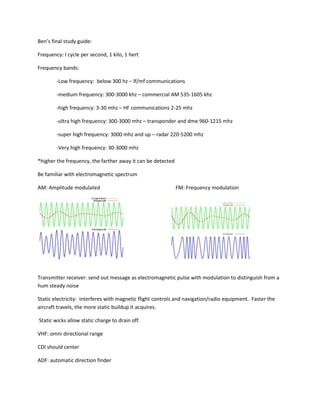
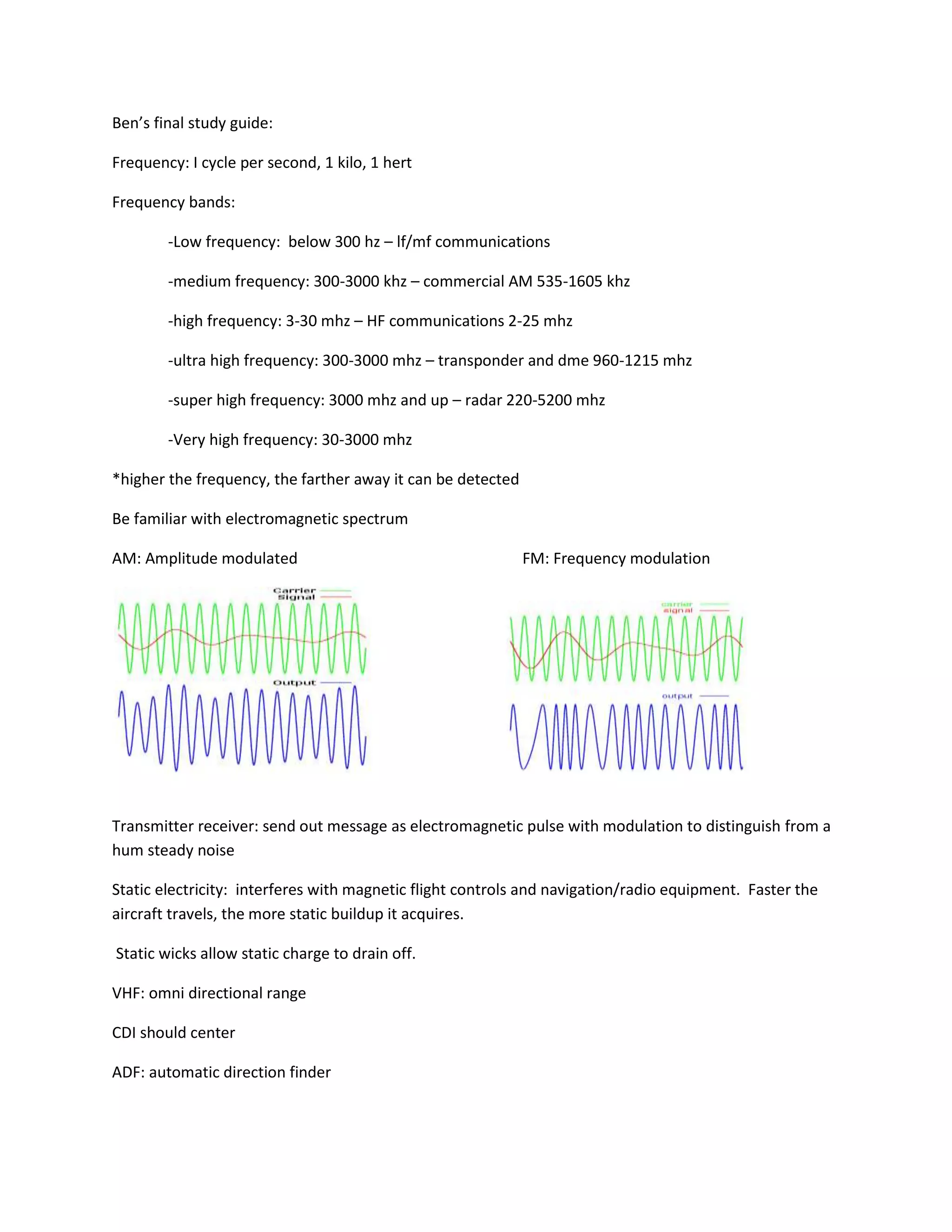
Ben’s final study guide:Frequency: I cycle per second, 1 kilo, 1 hertFrequency bands: -Low frequency:  below 300 hz – lf/mf communications-medium frequency: 300-3000 khz – commercial AM 535-1605 khz-high frequency: 3-30 mhz – HF communications 2-25 mhz-ultra high frequency: 300-3000 mhz – transponder and dme 960-1215 mhz-super high frequency: 3000 mhz and up – radar 220-5200 mhz-Very high frequency: 30-3000 mhz*higher the frequency, the farther away it can be detectedBe familiar with electromagnetic spectrumAM: Amplitude modulated                                                          FM: Frequency modulationTransmitter receiver: send out message as electromagnetic pulse with modulation to distinguish from a hum steady noiseStatic electricity:  interferes with magnetic flight controls and navigation/radio equipment.  Faster the aircraft travels, the more static buildup it acquires. Static wicks allow static charge to drain off.VHF: omni directional rangeCDI should centerADF: automatic direction finderNBD: non directional beacon, low to medium frequencyANT: antenna functionsDirection of needle: direction of stationTail of needle: direction from stationMagnetic bearing + relative bearing= magnetic bearingAdvanced navigation: VORTACLORAN: Long Range Navigation-Low frequency range-follow contours of the earth, long range chain-weather can affect signal-foilage, season, terrain can affect signalGPS:  Global Positioning System, uses triangulation of distance, 3 position satellites to workHSI: Horizontal Situation Indicator, heading and VOR indicating comboFeet/mile: 6000 ft. per nautical mileAC wave: 60 cycles/ secondCommunication radios: 118 mhz to 133 mhz121.5 = emergency signalCarrier wave does not have to take any voice data with itCommunication radios: controlled by FCC2 way radio: transceiver can receive and transmit signals ELT: emergency locater transmitter, transmitted on 121.5 mhz, changed in march 2009.ADF receives signals from 199 to 1799 khzUnits can directly receive from sense antennaLF/MF band is full of atmospheric and manmade noiseCrosswind can cause navigation difficultyILS: instrument landing system, precision approach, most accurate, lowest visibilityI apologize for the terrible organization skills I have.  So other than what’s on here and look over the corresponding avionics chapter in your airframe study book.   Sorry again (fuck, fuck, shit fuck).
Study Guide
Study Guide

Study Guide

  • 1.
    Ben’s final studyguide:Frequency: I cycle per second, 1 kilo, 1 hertFrequency bands: -Low frequency: below 300 hz – lf/mf communications-medium frequency: 300-3000 khz – commercial AM 535-1605 khz-high frequency: 3-30 mhz – HF communications 2-25 mhz-ultra high frequency: 300-3000 mhz – transponder and dme 960-1215 mhz-super high frequency: 3000 mhz and up – radar 220-5200 mhz-Very high frequency: 30-3000 mhz*higher the frequency, the farther away it can be detectedBe familiar with electromagnetic spectrumAM: Amplitude modulated FM: Frequency modulationTransmitter receiver: send out message as electromagnetic pulse with modulation to distinguish from a hum steady noiseStatic electricity: interferes with magnetic flight controls and navigation/radio equipment. Faster the aircraft travels, the more static buildup it acquires. Static wicks allow static charge to drain off.VHF: omni directional rangeCDI should centerADF: automatic direction finderNBD: non directional beacon, low to medium frequencyANT: antenna functionsDirection of needle: direction of stationTail of needle: direction from stationMagnetic bearing + relative bearing= magnetic bearingAdvanced navigation: VORTACLORAN: Long Range Navigation-Low frequency range-follow contours of the earth, long range chain-weather can affect signal-foilage, season, terrain can affect signalGPS: Global Positioning System, uses triangulation of distance, 3 position satellites to workHSI: Horizontal Situation Indicator, heading and VOR indicating comboFeet/mile: 6000 ft. per nautical mileAC wave: 60 cycles/ secondCommunication radios: 118 mhz to 133 mhz121.5 = emergency signalCarrier wave does not have to take any voice data with itCommunication radios: controlled by FCC2 way radio: transceiver can receive and transmit signals ELT: emergency locater transmitter, transmitted on 121.5 mhz, changed in march 2009.ADF receives signals from 199 to 1799 khzUnits can directly receive from sense antennaLF/MF band is full of atmospheric and manmade noiseCrosswind can cause navigation difficultyILS: instrument landing system, precision approach, most accurate, lowest visibilityI apologize for the terrible organization skills I have. So other than what’s on here and look over the corresponding avionics chapter in your airframe study book. Sorry again (fuck, fuck, shit fuck).