AVAF 209 Structures II III.   Basic Aerodynamics  The Atmosphere Physics The Airfoil Lift & Drag Stability Large Aircraft Flight Controls
Basic Aerodynamics III. Basic Aerodynamics   The Atmosphere Physics The Airfoil Lift & Drag Stability Large Aircraft Flight Controls Aerodynamics: The study of objects in motion through the air and the forces that produce or change such motion
Basic Aerodynamics III. Basic Aerodynamics   The Atmosphere Physics The Airfoil Lift & Drag Stability Large Aircraft Flight Controls The Atmosphere In order to fly, we need to create an upward force equal to the weight of the aircraft by using the Atmosphere This force comes from the action of the atmosphere on an airfoil
Basic Aerodynamics III. Basic Aerodynamics   The Atmosphere Physics The Airfoil Lift & Drag Stability Large Aircraft Flight Controls The Atmosphere Is made of a mixture of gases 21% Oxygen 78% Nitrogen Rest is mix of inert gases (Argon, Neon, etc.)
Basic Aerodynamics III. Basic Aerodynamics   The Atmosphere Physics The Airfoil Lift & Drag Stability Large Aircraft Flight Controls The Atmosphere Mixture remains constant regardless of altitude Weight of air changes as altitude changes Less weight above as we go up = less ATMOSPHERIC PRESSURE exerted on objects
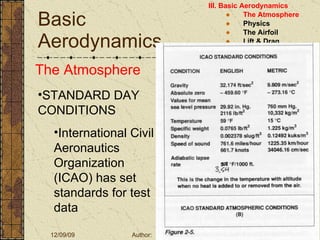
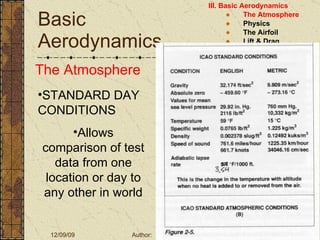
Basic Aerodynamics III. Basic Aerodynamics   The Atmosphere Physics The Airfoil Lift & Drag Stability Large Aircraft Flight Controls The Atmosphere STANDARD DAY CONDITIONS International Civil Aeronautics Organization (ICAO) has set standards for test data
Basic Aerodynamics III. Basic Aerodynamics   The Atmosphere Physics The Airfoil Lift & Drag Stability Large Aircraft Flight Controls The Atmosphere STANDARD DAY CONDITIONS Allows comparison of test data from one location or day to any other in world
Basic Aerodynamics III. Basic Aerodynamics   The Atmosphere Physics The Airfoil Lift & Drag Stability Large Aircraft Flight Controls The Atmosphere STANDARD DAY  Pressure Is a force created by the weight of the atmosphere above an object Is measured in IN-HG, MM-HG, PSI, or MILLIBARS
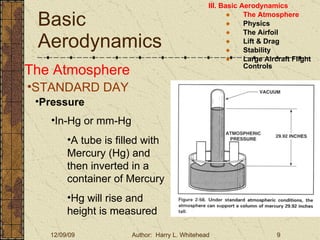
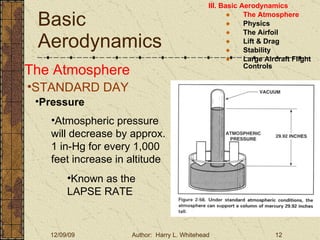
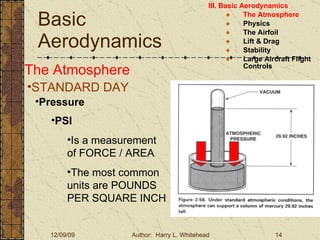
Basic Aerodynamics III. Basic Aerodynamics   The Atmosphere Physics The Airfoil Lift & Drag Stability Large Aircraft Flight Controls The Atmosphere STANDARD DAY   Pressure In-Hg or mm-Hg A tube is filled with Mercury (Hg) and then inverted in a container of Mercury Hg will rise and height is measured
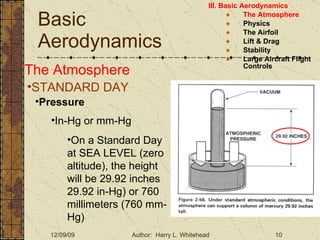
Basic Aerodynamics III. Basic Aerodynamics   The Atmosphere Physics The Airfoil Lift & Drag Stability Large Aircraft Flight Controls The Atmosphere STANDARD DAY   Pressure In-Hg or mm-Hg On a Standard Day at SEA LEVEL (zero altitude), the height will be 29.92 inches 29.92 in-Hg) or 760 millimeters (760 mm-Hg)
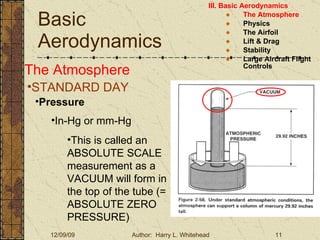
Basic Aerodynamics III. Basic Aerodynamics   The Atmosphere Physics The Airfoil Lift & Drag Stability Large Aircraft Flight Controls The Atmosphere STANDARD DAY   Pressure In-Hg or mm-Hg This is called an ABSOLUTE SCALE measurement as a VACUUM will form in the top of the tube (= ABSOLUTE ZERO PRESSURE)
Basic Aerodynamics III. Basic Aerodynamics   The Atmosphere Physics The Airfoil Lift & Drag Stability Large Aircraft Flight Controls The Atmosphere STANDARD DAY   Pressure Atmospheric pressure will decrease by approx. 1 in-Hg for every 1,000 feet increase in altitude Known as the LAPSE RATE
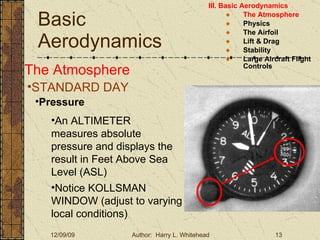
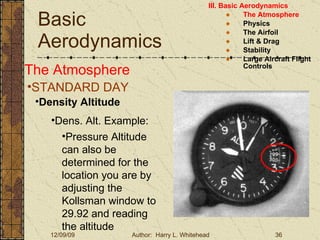
Basic Aerodynamics III. Basic Aerodynamics   The Atmosphere Physics The Airfoil Lift & Drag Stability Large Aircraft Flight Controls The Atmosphere STANDARD DAY   Pressure An ALTIMETER measures absolute pressure and displays the result in Feet Above Sea Level (ASL) Notice KOLLSMAN WINDOW (adjust to varying local conditions)
Basic Aerodynamics III. Basic Aerodynamics   The Atmosphere Physics The Airfoil Lift & Drag Stability Large Aircraft Flight Controls The Atmosphere STANDARD DAY   Pressure PSI Is a measurement of FORCE / AREA The most common units are POUNDS PER SQUARE INCH
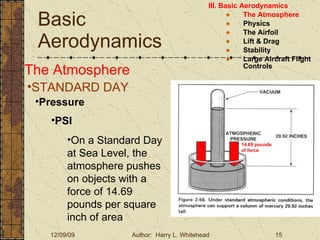
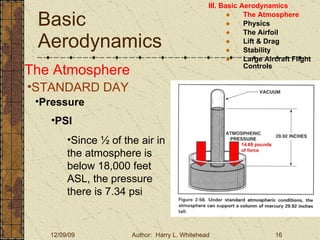
Basic Aerodynamics III. Basic Aerodynamics   The Atmosphere Physics The Airfoil Lift & Drag Stability Large Aircraft Flight Controls The Atmosphere STANDARD DAY  Pressure PSI On a Standard Day at Sea Level, the atmosphere pushes on objects with a force of 14.69 pounds per square inch of area
Basic Aerodynamics III. Basic Aerodynamics   The Atmosphere Physics The Airfoil Lift & Drag Stability Large Aircraft Flight Controls The Atmosphere STANDARD DAY  Pressure PSI Since ½ of the air in the atmosphere is below 18,000 feet ASL, the pressure there is 7.34 psi
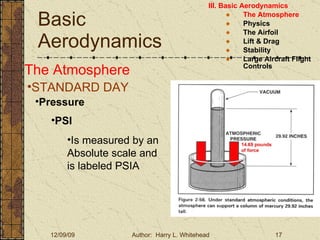
Basic Aerodynamics III. Basic Aerodynamics   The Atmosphere Physics The Airfoil Lift & Drag Stability Large Aircraft Flight Controls The Atmosphere STANDARD DAY  Pressure PSI Is measured by an Absolute scale and is labeled PSIA
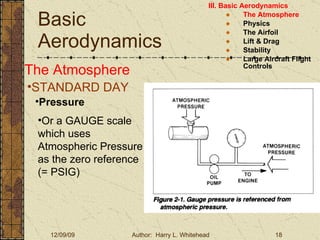
Basic Aerodynamics III. Basic Aerodynamics   The Atmosphere Physics The Airfoil Lift & Drag Stability Large Aircraft Flight Controls The Atmosphere STANDARD DAY  Pressure Or a GAUGE scale which uses Atmospheric Pressure as the zero reference  (= PSIG)
Basic Aerodynamics III. Basic Aerodynamics   The Atmosphere Physics The Airfoil Lift & Drag Stability Large Aircraft Flight Controls The Atmosphere STANDARD DAY  Pressure Millibars Are used by Meteorologists (weather forecasters)  Standard Day at Sea Level is 1013.2 mbs  1 millibar approximately equals .75 in-Hg
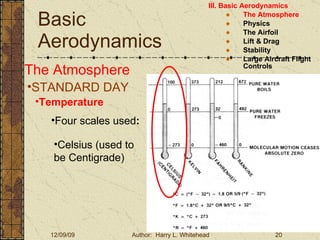
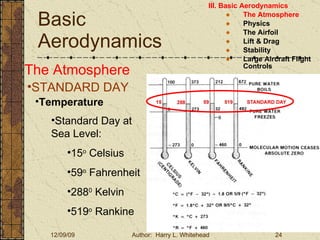
Basic Aerodynamics III. Basic Aerodynamics   The Atmosphere Physics The Airfoil Lift & Drag Stability Large Aircraft Flight Controls The Atmosphere STANDARD DAY  Temperature Four scales used : Celsius (used to be Centigrade)
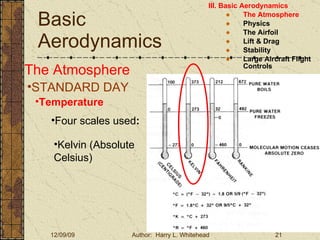
Basic Aerodynamics III. Basic Aerodynamics   The Atmosphere Physics The Airfoil Lift & Drag Stability Large Aircraft Flight Controls The Atmosphere STANDARD DAY  Temperature Four scales used : Kelvin (Absolute Celsius)
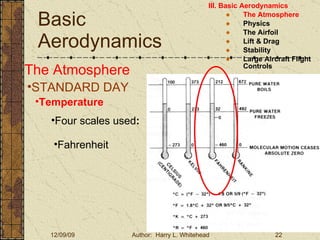
Basic Aerodynamics III. Basic Aerodynamics   The Atmosphere Physics The Airfoil Lift & Drag Stability Large Aircraft Flight Controls The Atmosphere STANDARD DAY  Temperature Four scales used : Fahrenheit
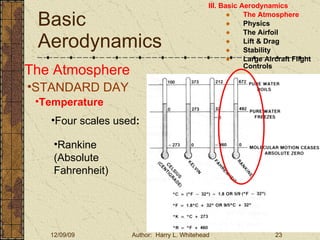
Basic Aerodynamics III. Basic Aerodynamics   The Atmosphere Physics The Airfoil Lift & Drag Stability Large Aircraft Flight Controls The Atmosphere STANDARD DAY  Temperature Four scales used : Rankine (Absolute Fahrenheit)
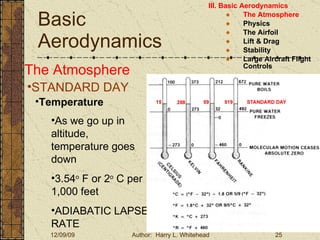
Basic Aerodynamics III. Basic Aerodynamics   The Atmosphere Physics The Airfoil Lift & Drag Stability Large Aircraft Flight Controls The Atmosphere STANDARD DAY  Temperature Standard Day at Sea Level: 15 o  Celsius 59 o  Fahrenheit 288 0  Kelvin 519 o  Rankine
Basic Aerodynamics III. Basic Aerodynamics   The Atmosphere Physics The Airfoil Lift & Drag Stability Large Aircraft Flight Controls The Atmosphere STANDARD DAY  Temperature As we go up in altitude, temperature goes down 3.54 o  F or 2 o  C per 1,000 feet ADIABATIC LAPSE RATE
Basic Aerodynamics III. Basic Aerodynamics   The Atmosphere Physics The Airfoil Lift & Drag Stability Large Aircraft Flight Controls The Atmosphere STANDARD DAY  Humidity Is amount of moisture in air Measured by RELATIVE HUMIDITY Is comparison of moisture present to amount air can hold in percent Maximum amount is directly proportional to temperature (hotter temp. = more moisture at same Relative Humidity %)
Basic Aerodynamics III. Basic Aerodynamics   The Atmosphere Physics The Airfoil Lift & Drag Stability Large Aircraft Flight Controls The Atmosphere STANDARD DAY  Humidity Standard Day is 0% humidity or Dry Air
Basic Aerodynamics III. Basic Aerodynamics   The Atmosphere Physics The Airfoil Lift & Drag Stability Large Aircraft Flight Controls The Atmosphere STANDARD DAY  Density Is measure of Mass per unit Volume Mass is the amount of matter in an object Can think of it as number of molecules Weight is the affect of Gravity on a mass Since we are dealing with objects near the surface of the Earth, Weight and Mass are used interchangeably in Aerodynamics
Basic Aerodynamics III. Basic Aerodynamics   The Atmosphere Physics The Airfoil Lift & Drag Stability Large Aircraft Flight Controls The Atmosphere STANDARD DAY  Density Air density is officially measured in SLUGS PER CUBIC FOOT Standard Day at Sea Level = .002378 slugs/ft 3 Formula symbol is the Greek letter Rho (    ) Is a major factor in developing Lift Varies directly with Atmospheric Pressure and inversely with Temperature
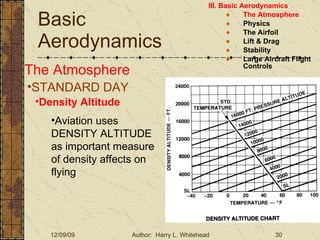
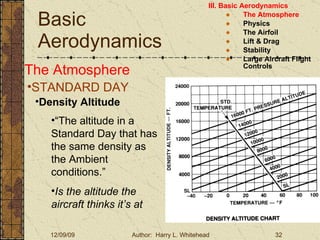
Basic Aerodynamics III. Basic Aerodynamics   The Atmosphere Physics The Airfoil Lift & Drag Stability Large Aircraft Flight Controls The Atmosphere STANDARD DAY  Density Altitude Aviation uses DENSITY ALTITUDE as important measure of density affects on flying
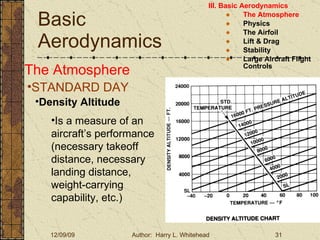
Basic Aerodynamics III. Basic Aerodynamics   The Atmosphere Physics The Airfoil Lift & Drag Stability Large Aircraft Flight Controls The Atmosphere STANDARD DAY  Density Altitude Is a measure of an aircraft’s performance (necessary takeoff distance, necessary landing distance, weight-carrying capability, etc.)
Basic Aerodynamics III. Basic Aerodynamics   The Atmosphere Physics The Airfoil Lift & Drag Stability Large Aircraft Flight Controls The Atmosphere STANDARD DAY  Density Altitude “ The altitude in a Standard Day that has the same density as the Ambient conditions.” Is the altitude the aircraft thinks it’s at
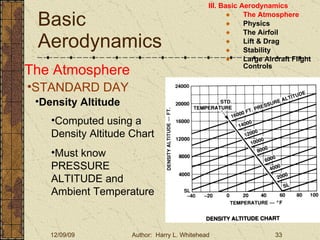
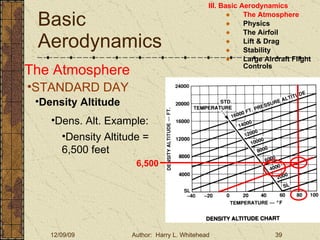
Basic Aerodynamics III. Basic Aerodynamics   The Atmosphere Physics The Airfoil Lift & Drag Stability Large Aircraft Flight Controls The Atmosphere STANDARD DAY  Density Altitude Computed using a Density Altitude Chart Must know PRESSURE ALTITUDE and Ambient Temperature
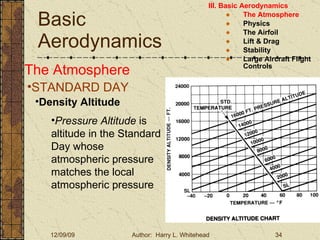
Basic Aerodynamics III. Basic Aerodynamics   The Atmosphere Physics The Airfoil Lift & Drag Stability Large Aircraft Flight Controls The Atmosphere STANDARD DAY  Density Altitude Pressure Altitude  is altitude in the Standard Day whose atmospheric pressure matches the local atmospheric pressure
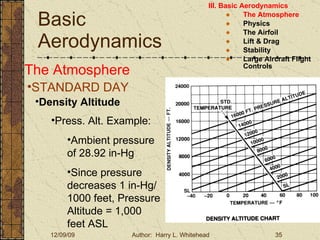
Basic Aerodynamics III. Basic Aerodynamics   The Atmosphere Physics The Airfoil Lift & Drag Stability Large Aircraft Flight Controls The Atmosphere STANDARD DAY  Density Altitude Press. Alt. Example: Ambient pressure of 28.92 in-Hg Since pressure decreases 1 in-Hg/1000 feet, Pressure Altitude = 1,000 feet ASL
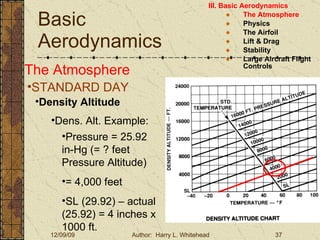
Basic Aerodynamics III. Basic Aerodynamics   The Atmosphere Physics The Airfoil Lift & Drag Stability Large Aircraft Flight Controls The Atmosphere STANDARD DAY  Density Altitude Dens. Alt. Example: Pressure Altitude can also be determined for the location you are by adjusting the Kollsman window to 29.92 and reading the altitude
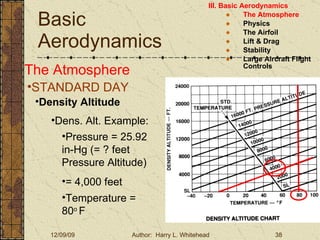
Basic Aerodynamics III. Basic Aerodynamics   The Atmosphere Physics The Airfoil Lift & Drag Stability Large Aircraft Flight Controls The Atmosphere STANDARD DAY  Density Altitude Dens. Alt. Example: Pressure = 25.92 in-Hg (= ? feet  Pressure Altitude) = 4,000 feet SL (29.92) – actual (25.92) = 4 inches x 1000 ft.
Basic Aerodynamics III. Basic Aerodynamics   The Atmosphere Physics The Airfoil Lift & Drag Stability Large Aircraft Flight Controls The Atmosphere STANDARD DAY  Density Altitude Dens. Alt. Example: Pressure = 25.92 in-Hg (= ? feet  Pressure Altitude) = 4,000 feet  Temperature = 80 o   F
Basic Aerodynamics III. Basic Aerodynamics   The Atmosphere Physics The Airfoil Lift & Drag Stability Large Aircraft Flight Controls The Atmosphere STANDARD DAY  Density Altitude Dens. Alt. Example: Density Altitude = 6,500 feet 6,500
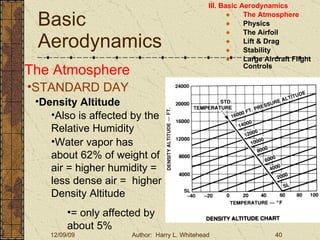
Basic Aerodynamics III. Basic Aerodynamics   The Atmosphere Physics The Airfoil Lift & Drag Stability Large Aircraft Flight Controls The Atmosphere STANDARD DAY  Density Altitude Also is affected by the Relative Humidity Water vapor has about 62% of weight of air = higher humidity = less dense air =  higher Density Altitude = only affected by about 5%
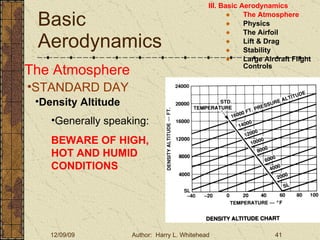
Basic Aerodynamics III. Basic Aerodynamics   The Atmosphere Physics The Airfoil Lift & Drag Stability Large Aircraft Flight Controls The Atmosphere STANDARD DAY  Density Altitude Generally speaking:  BEWARE OF HIGH, HOT AND HUMID CONDITIONS
Basic Aerodynamics III. Basic Aerodynamics   The Atmosphere Physics The Airfoil Lift & Drag Stability Large Aircraft Flight Controls Laws of Physics which affect Aerodynamics Bernoulli's Principle   “ If the total energy of flowing air remains constant, any increase in KINETIC energy creates a decrease in POTENTIAL energy” Since the LAW OF CONSERVATION OF ENERGY applies, the energies in the flow are only changed
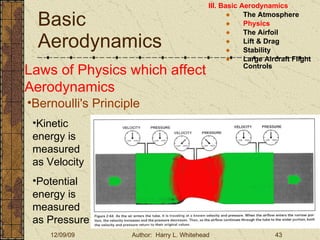
Basic Aerodynamics III. Basic Aerodynamics   The Atmosphere Physics The Airfoil Lift & Drag Stability Large Aircraft Flight Controls Laws of Physics which affect Aerodynamics Bernoulli's Principle Kinetic energy is measured as Velocity Potential energy is measured as Pressure
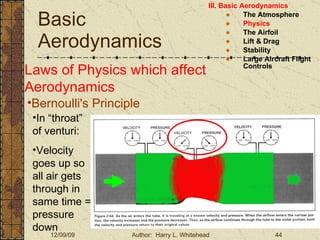
Basic Aerodynamics III. Basic Aerodynamics   The Atmosphere Physics The Airfoil Lift & Drag Stability Large Aircraft Flight Controls Laws of Physics which affect Aerodynamics Bernoulli's Principle In “throat” of venturi: Velocity goes up so all air gets through in same time = pressure down
Basic Aerodynamics III. Basic Aerodynamics   The Atmosphere Physics The Airfoil Lift & Drag Stability Large Aircraft Flight Controls Laws of Physics which affect Aerodynamics Newton’s Laws First Law: Law of Inertia A body at rest tends to remain at rest and a body in motion tends to remain in motion, until acted upon by an outside force.
Basic Aerodynamics III. Basic Aerodynamics   The Atmosphere Physics The Airfoil Lift & Drag Stability Large Aircraft Flight Controls Laws of Physics which affect Aerodynamics Newton’s Laws Second Law: Law of Acceleration Acceleration of a body is directly proportional to the force applied and inversely proportional to the mass of the body or a = F / m  Or more useful to us:  F = ma
Basic Aerodynamics III. Basic Aerodynamics   The Atmosphere Physics The Airfoil Lift & Drag Stability Large Aircraft Flight Controls Laws of Physics which affect Aerodynamics Newton’s Laws Third Law Law of Reaction For every Action there is an Equal and Opposite Reaction
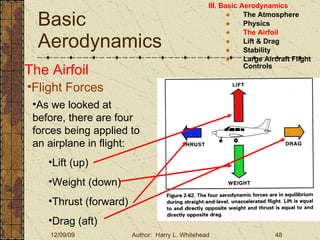
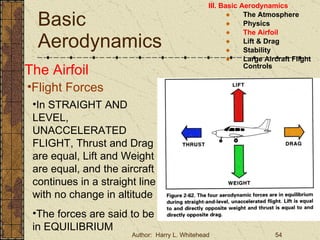
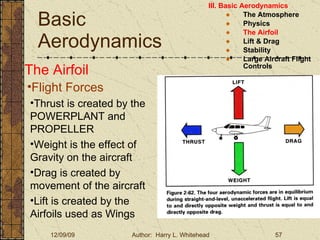
Basic Aerodynamics III. Basic Aerodynamics   The Atmosphere Physics The Airfoil Lift & Drag Stability Large Aircraft Flight Controls The Airfoil Flight Forces As we looked at before, there are four forces being applied to an airplane in flight: Lift (up) Weight (down) Thrust (forward) Drag (aft)
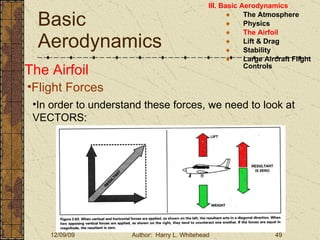
Basic Aerodynamics III. Basic Aerodynamics   The Atmosphere Physics The Airfoil Lift & Drag Stability Large Aircraft Flight Controls The Airfoil Flight Forces In order to understand these forces, we need to look at VECTORS:
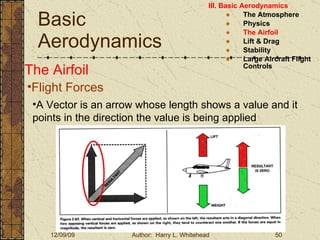
Basic Aerodynamics III. Basic Aerodynamics   The Atmosphere Physics The Airfoil Lift & Drag Stability Large Aircraft Flight Controls The Airfoil Flight Forces A Vector is an arrow whose length shows a value and it points in the direction the value is being applied
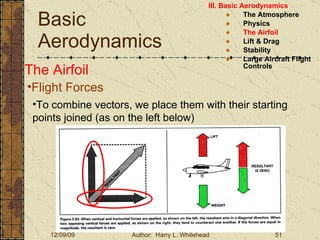
Basic Aerodynamics III. Basic Aerodynamics   The Atmosphere Physics The Airfoil Lift & Drag Stability Large Aircraft Flight Controls The Airfoil Flight Forces To combine vectors, we place them with their starting points joined (as on the left below)
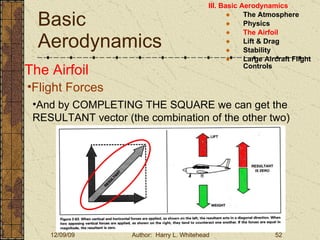
Basic Aerodynamics III. Basic Aerodynamics   The Atmosphere Physics The Airfoil Lift & Drag Stability Large Aircraft Flight Controls The Airfoil Flight Forces And by COMPLETING THE SQUARE we can get the RESULTANT vector (the combination of the other two)
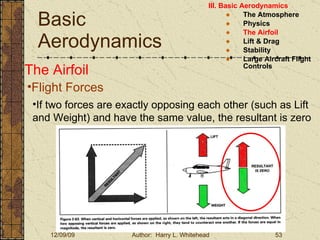
Basic Aerodynamics III. Basic Aerodynamics   The Atmosphere Physics The Airfoil Lift & Drag Stability Large Aircraft Flight Controls The Airfoil Flight Forces If two forces are exactly opposing each other (such as Lift and Weight) and have the same value, the resultant is zero
Basic Aerodynamics III. Basic Aerodynamics   The Atmosphere Physics The Airfoil Lift & Drag Stability Large Aircraft Flight Controls The Airfoil Flight Forces In STRAIGHT AND LEVEL, UNACCELERATED FLIGHT, Thrust and Drag are equal, Lift and Weight are equal, and the aircraft continues in a straight line with no change in altitude The forces are said to be in EQUILIBRIUM
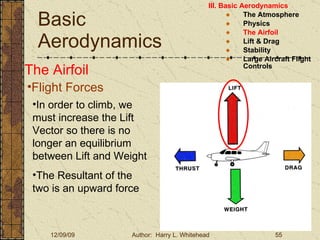
Basic Aerodynamics III. Basic Aerodynamics   The Atmosphere Physics The Airfoil Lift & Drag Stability Large Aircraft Flight Controls The Airfoil Flight Forces In order to climb, we must increase the Lift Vector so there is no longer an equilibrium between Lift and Weight The Resultant of the two is an upward force
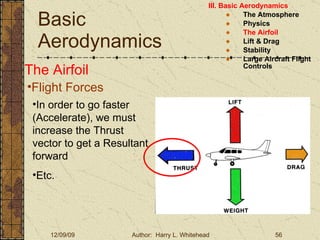
Basic Aerodynamics III. Basic Aerodynamics   The Atmosphere Physics The Airfoil Lift & Drag Stability Large Aircraft Flight Controls The Airfoil Flight Forces In order to go faster (Accelerate), we must increase the Thrust vector to get a Resultant forward Etc.
Basic Aerodynamics III. Basic Aerodynamics   The Atmosphere Physics The Airfoil Lift & Drag Stability Large Aircraft Flight Controls The Airfoil Flight Forces Thrust is created by the POWERPLANT and PROPELLER Weight is the effect of Gravity on the aircraft Drag is created by movement of the aircraft Lift is created by the Airfoils used as Wings
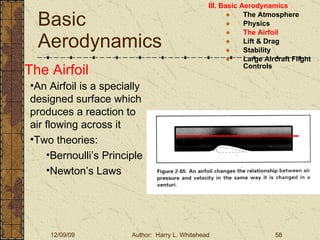
Basic Aerodynamics III. Basic Aerodynamics   The Atmosphere Physics The Airfoil Lift & Drag Stability Large Aircraft Flight Controls The Airfoil An Airfoil is a specially designed surface which produces a reaction to air flowing across it Two theories: Bernoulli’s Principle Newton’s Laws
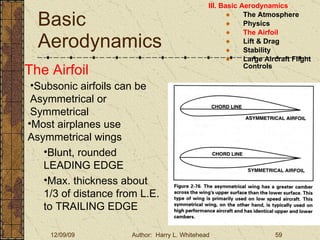
Basic Aerodynamics III. Basic Aerodynamics   The Atmosphere Physics The Airfoil Lift & Drag Stability Large Aircraft Flight Controls The Airfoil Subsonic airfoils can be Asymmetrical or Symmetrical Most airplanes use Asymmetrical wings Blunt, rounded LEADING EDGE Max. thickness about 1/3 of distance from L.E. to TRAILING EDGE
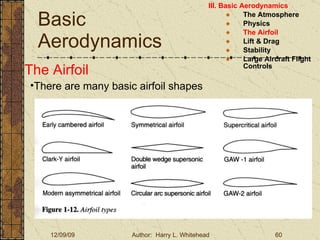
Basic Aerodynamics III. Basic Aerodynamics   The Atmosphere Physics The Airfoil Lift & Drag Stability Large Aircraft Flight Controls The Airfoil There are many basic airfoil shapes
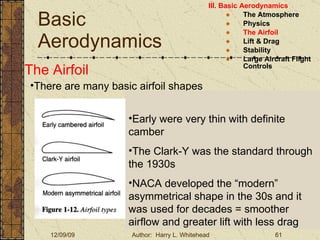
Basic Aerodynamics III. Basic Aerodynamics   The Atmosphere Physics The Airfoil Lift & Drag Stability Large Aircraft Flight Controls The Airfoil Early were very thin with definite camber The Clark-Y was the standard through the 1930s NACA developed the “modern” asymmetrical shape in the 30s and it was used for decades = smoother airflow and greater lift with less drag There are many basic airfoil shapes
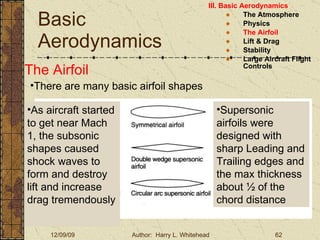
Basic Aerodynamics III. Basic Aerodynamics   The Atmosphere Physics The Airfoil Lift & Drag Stability Large Aircraft Flight Controls The Airfoil There are many basic airfoil shapes As aircraft started to get near Mach 1, the subsonic shapes caused shock waves to form and destroy lift and increase drag tremendously Supersonic airfoils were designed with sharp Leading and Trailing edges and the max thickness about ½ of the chord distance
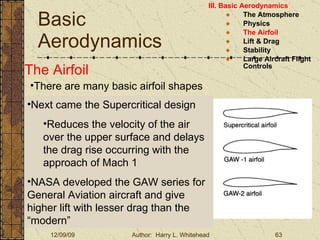
Basic Aerodynamics III. Basic Aerodynamics   The Atmosphere Physics The Airfoil Lift & Drag Stability Large Aircraft Flight Controls The Airfoil There are many basic airfoil shapes Next came the Supercritical design Reduces the velocity of the air over the upper surface and delays the drag rise occurring with the approach of Mach 1 NASA developed the GAW series for General Aviation aircraft and give higher lift with lesser drag than the “modern”
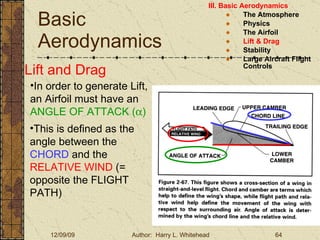
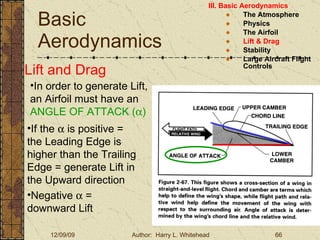
Basic Aerodynamics III. Basic Aerodynamics   The Atmosphere Physics The Airfoil Lift & Drag Stability Large Aircraft Flight Controls Lift and Drag In order to generate Lift, an Airfoil must have an  ANGLE OF ATTACK (  ) This is defined as the angle between the  CHORD  and the  RELATIVE WIND  (= opposite the FLIGHT PATH)
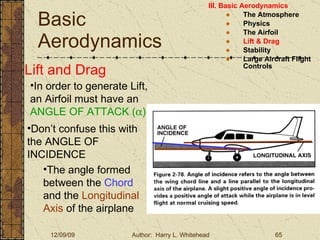
Basic Aerodynamics III. Basic Aerodynamics   The Atmosphere Physics The Airfoil Lift & Drag Stability Large Aircraft Flight Controls Lift and Drag In order to generate Lift, an Airfoil must have an  ANGLE OF ATTACK (  ) Don’t confuse this with the ANGLE OF INCIDENCE The angle formed between the  Chord  and the  Longitudinal Axis  of the airplane
Basic Aerodynamics III. Basic Aerodynamics   The Atmosphere Physics The Airfoil Lift & Drag Stability Large Aircraft Flight Controls Lift and Drag In order to generate Lift, an Airfoil must have an  ANGLE OF ATTACK (  ) If the    is positive = the Leading Edge is higher than the Trailing Edge = generate Lift in the Upward direction  Negative    = downward Lift
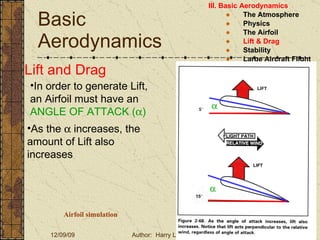
Basic Aerodynamics III. Basic Aerodynamics   The Atmosphere Physics The Airfoil Lift & Drag Stability Large Aircraft Flight Controls Lift and Drag In order to generate Lift, an Airfoil must have an  ANGLE OF ATTACK (  ) As the    increases, the amount of Lift also increases Airfoil simulation
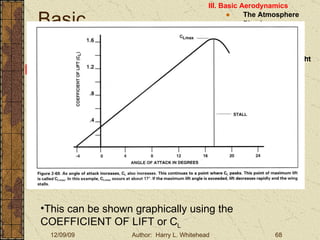
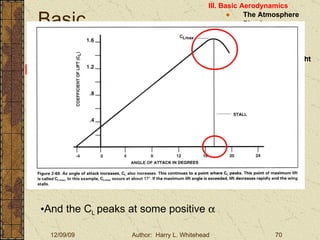
Basic Aerodynamics III. Basic Aerodynamics   The Atmosphere Physics The Airfoil Lift & Drag Stability Large Aircraft Flight Controls Lift and Drag In order to generate Lift, an Airfoil must have an  ANGLE OF ATTACK (  ) This can be shown graphically using the COEFFICIENT OF LIFT or C L
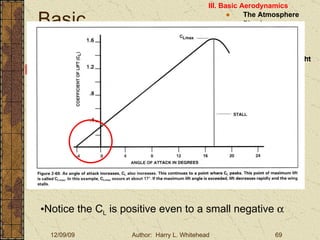
Basic Aerodynamics III. Basic Aerodynamics   The Atmosphere Physics The Airfoil Lift & Drag Stability Large Aircraft Flight Controls Lift and Drag In order to generate Lift, an Airfoil must have an  ANGLE OF ATTACK (  ) Notice the C L  is positive even to a small negative  
Basic Aerodynamics III. Basic Aerodynamics   The Atmosphere Physics The Airfoil Lift & Drag Stability Large Aircraft Flight Controls Lift and Drag In order to generate Lift, an Airfoil must have an  ANGLE OF ATTACK (  ) And the C L  peaks at some positive  
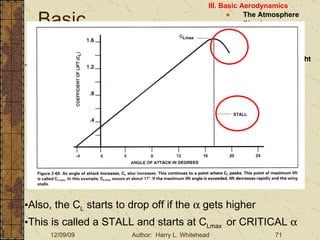
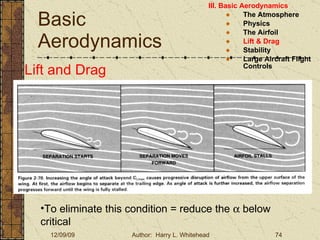
Basic Aerodynamics III. Basic Aerodynamics   The Atmosphere Physics The Airfoil Lift & Drag Stability Large Aircraft Flight Controls The Airfoil In order to generate Lift, an Airfoil must have an  ANGLE OF ATTACK (  ) Also, the C L  starts to drop off if the    gets higher This is called a STALL and starts at C Lmax  or CRITICAL  
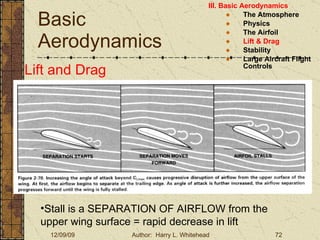
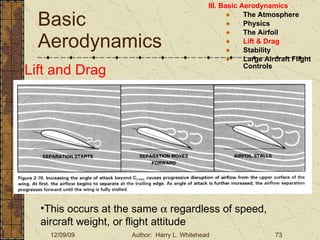
Basic Aerodynamics III. Basic Aerodynamics   The Atmosphere Physics The Airfoil Lift & Drag Stability Large Aircraft Flight Controls Lift and Drag In order to generate Lift, an Airfoil must have an  ANGLE OF ATTACK (  ) Stall is a SEPARATION OF AIRFLOW from the upper wing surface = rapid decrease in lift
Basic Aerodynamics III. Basic Aerodynamics   The Atmosphere Physics The Airfoil Lift & Drag Stability Large Aircraft Flight Controls Lift and Drag In order to generate Lift, an Airfoil must have an  ANGLE OF ATTACK (  ) This occurs at the same    regardless of speed, aircraft weight, or flight attitude
Basic Aerodynamics III. Basic Aerodynamics   The Atmosphere Physics The Airfoil Lift & Drag Stability Large Aircraft Flight Controls Lift and Drag In order to generate Lift, an Airfoil must have an  ANGLE OF ATTACK (  ) To eliminate this condition = reduce the    below critical
Basic Aerodynamics III. Basic Aerodynamics   The Atmosphere Physics The Airfoil Lift & Drag Stability Large Aircraft Flight Controls Lift and Drag Other Factors Affecting Lift: Airspeed Faster = increased Lift Lift is increased as the square of the speed For example: At 200 mph a wing has 4 times the lift of the same airfoil at 100 mph At 50 mph the lift is ¼ as much as at 100 mph Airfoil simulation
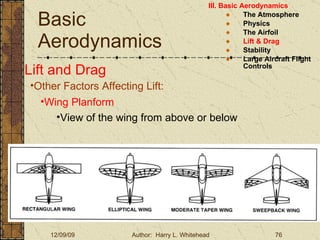
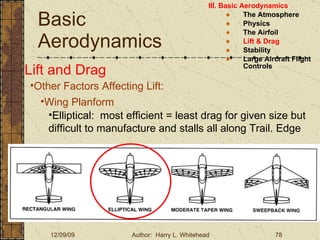
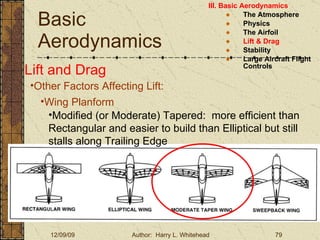
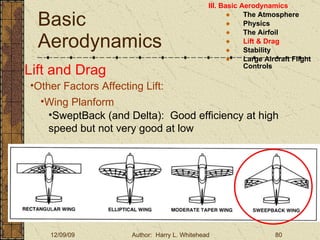
Basic Aerodynamics III. Basic Aerodynamics   The Atmosphere Physics The Airfoil Lift & Drag Stability Large Aircraft Flight Controls Lift and Drag Other Factors Affecting Lift: Wing Planform View of the wing from above or below
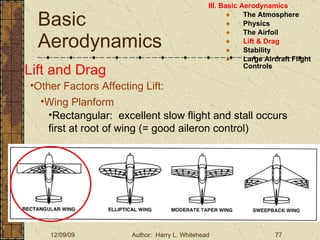
Basic Aerodynamics III. Basic Aerodynamics   The Atmosphere Physics The Airfoil Lift & Drag Stability Large Aircraft Flight Controls Lift and Drag Other Factors Affecting Lift: Wing Planform Rectangular:  excellent slow flight and stall occurs first at root of wing (= good aileron control)
Basic Aerodynamics III. Basic Aerodynamics   The Atmosphere Physics The Airfoil Lift & Drag Stability Large Aircraft Flight Controls Lift and Drag Other Factors Affecting Lift: Wing Planform Elliptical:  most efficient = least drag for given size but difficult to manufacture and stalls all along Trail. Edge
Basic Aerodynamics III. Basic Aerodynamics   The Atmosphere Physics The Airfoil Lift & Drag Stability Large Aircraft Flight Controls Lift and Drag Other Factors Affecting Lift: Wing Planform Modified (or Moderate) Tapered:  more efficient than Rectangular and easier to build than Elliptical but still stalls along Trailing Edge
Basic Aerodynamics III. Basic Aerodynamics   The Atmosphere Physics The Airfoil Lift & Drag Stability Large Aircraft Flight Controls Lift and Drag Other Factors Affecting Lift: Wing Planform SweptBack (and Delta):  Good efficiency at high speed but not very good at low
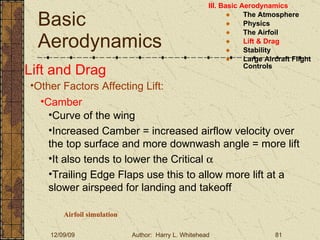
Basic Aerodynamics III. Basic Aerodynamics   The Atmosphere Physics The Airfoil Lift & Drag Stability Large Aircraft Flight Controls Lift and Drag Other Factors Affecting Lift: Camber Curve of the wing Increased Camber = increased airflow velocity over the top surface and more downwash angle = more lift It also tends to lower the Critical   Trailing Edge Flaps use this to allow more lift at a slower airspeed for landing and takeoff Airfoil simulation
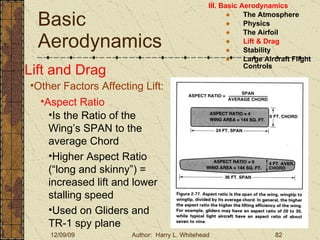
Basic Aerodynamics III. Basic Aerodynamics   The Atmosphere Physics The Airfoil Lift & Drag Stability Large Aircraft Flight Controls Lift and Drag Other Factors Affecting Lift: Aspect Ratio Is the Ratio of the Wing’s SPAN to the average Chord Higher Aspect Ratio (“long and skinny”) = increased lift and lower stalling speed Used on Gliders and TR-1 spy plane
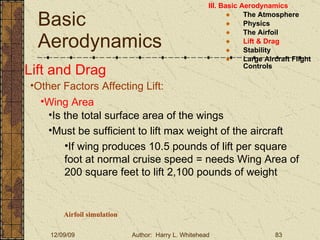
Basic Aerodynamics III. Basic Aerodynamics   The Atmosphere Physics The Airfoil Lift & Drag Stability Large Aircraft Flight Controls Lift and Drag Other Factors Affecting Lift: Wing Area Is the total surface area of the wings Must be sufficient to lift max weight of the aircraft If wing produces 10.5 pounds of lift per square foot at normal cruise speed = needs Wing Area of 200 square feet to lift 2,100 pounds of weight Airfoil simulation
Basic Aerodynamics III. Basic Aerodynamics   The Atmosphere Physics The Airfoil Lift & Drag Stability Large Aircraft Flight Controls Lift and Drag Drag Is the force opposing Thrust Is the force trying to hold the aircraft back as it flies and generally limits the maximum airspeed Is created by any aircraft surface that deflects or interferes with the smooth air flow around the aircraft Drag is classified as two types: Induced  Parasite
Basic Aerodynamics III. Basic Aerodynamics   The Atmosphere Physics The Airfoil Lift & Drag Stability Large Aircraft Flight Controls Lift and Drag Induced Drag The Airfoil shape (type of airfoil and amount of Camber) and Wing Area create a force which comes from the same forces as those which create Lift It is Directly Proportional to the Angle of Attack (  )
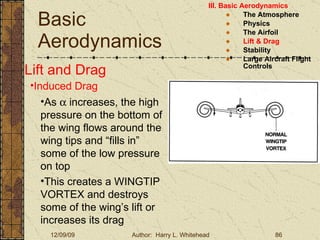
Basic Aerodynamics III. Basic Aerodynamics   The Atmosphere Physics The Airfoil Lift & Drag Stability Large Aircraft Flight Controls Lift and Drag Induced Drag As    increases, the high pressure on the bottom of the wing flows around the wing tips and “fills in” some of the low pressure on top This creates a WINGTIP VORTEX and destroys some of the wing’s lift or increases its drag
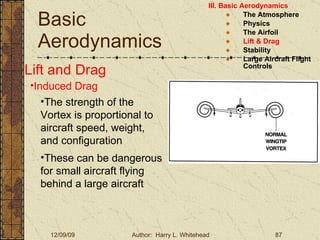
Basic Aerodynamics III. Basic Aerodynamics   The Atmosphere Physics The Airfoil Lift & Drag Stability Large Aircraft Flight Controls Lift and Drag Induced Drag These can be dangerous for small aircraft flying behind a large aircraft The strength of the Vortex is proportional to aircraft speed, weight, and configuration
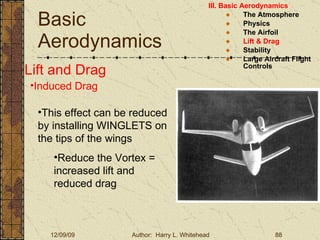
Basic Aerodynamics III. Basic Aerodynamics   The Atmosphere Physics The Airfoil Lift & Drag Stability Large Aircraft Flight Controls Lift and Drag Induced Drag This effect can be reduced by installing WINGLETS on the tips of the wings Reduce the Vortex = increased lift and reduced drag
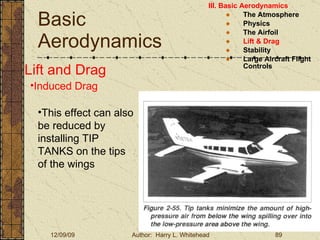
Basic Aerodynamics III. Basic Aerodynamics   The Atmosphere Physics The Airfoil Lift & Drag Stability Large Aircraft Flight Controls Lift and Drag Induced Drag This effect can also be reduced by installing TIP TANKS on the tips of the wings
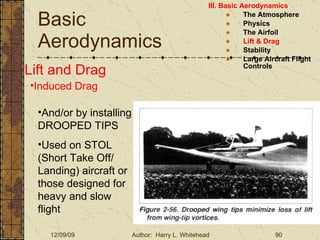
Basic Aerodynamics III. Basic Aerodynamics   The Atmosphere Physics The Airfoil Lift & Drag Stability Large Aircraft Flight Controls Lift and Drag Induced Drag And/or by installing DROOPED TIPS Used on STOL (Short Take Off/ Landing) aircraft or those designed for heavy and slow flight
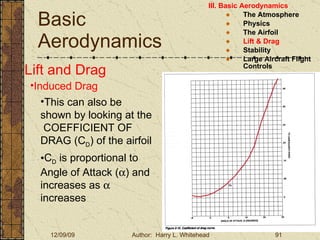
Basic Aerodynamics III. Basic Aerodynamics   The Atmosphere Physics The Airfoil Lift & Drag Stability Large Aircraft Flight Controls Lift and Drag Induced Drag This can also be shown by looking at the  COEFFICIENT OF DRAG (C D ) of the airfoil C D  is proportional to Angle of Attack (  ) and increases as    increases
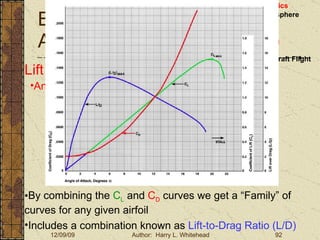
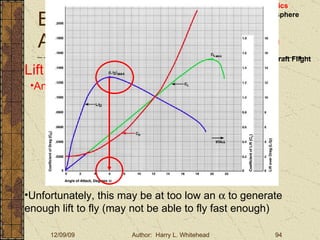
Basic Aerodynamics III. Basic Aerodynamics   The Atmosphere Physics The Airfoil Lift & Drag Stability Large Aircraft Flight Controls Lift and Drag Angle of Attack and Drag By combining the  C L  and  C D  curves we get a “Family” of curves for any given airfoil Includes a combination known as  Lift-to-Drag Ratio (L/D)
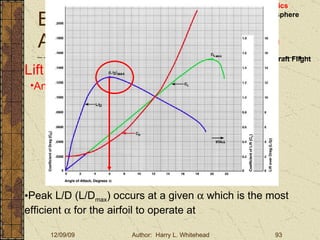
Basic Aerodynamics III. Basic Aerodynamics   The Atmosphere Physics The Airfoil Lift & Drag Stability Large Aircraft Flight Controls Lift and Drag Angle of Attack and Drag Peak L/D (L/D max ) occurs at a given    which is the most efficient    for the airfoil to operate at
Basic Aerodynamics III. Basic Aerodynamics   The Atmosphere Physics The Airfoil Lift & Drag Stability Large Aircraft Flight Controls Lift and Drag Angle of Attack and Drag Unfortunately, this may be at too low an    to generate enough lift to fly (may not be able to fly fast enough)
Basic Aerodynamics III. Basic Aerodynamics   The Atmosphere Physics The Airfoil Lift & Drag Stability Large Aircraft Flight Controls Lift and Drag Parasite Drag Is the drag produced by the aircraft itself and is proportional to Airspeed Is disruption of the airflow around the aircraft 4 types: Form Drag Skin Friction Drag Interference Drag Profile Drag
Basic Aerodynamics III. Basic Aerodynamics   The Atmosphere Physics The Airfoil Lift & Drag Stability Large Aircraft Flight Controls Lift and Drag Parasite Drag Form Drag Created by any structure which extends into the airstream Is directly proportional to the size and shape of the structure Includes struts, antennas, landing gear, etc. Streamlining reduces Form Drag
Basic Aerodynamics III. Basic Aerodynamics   The Atmosphere Physics The Airfoil Lift & Drag Stability Large Aircraft Flight Controls Lift and Drag Parasite Drag Skin Friction Drag Caused by the roughness of the aircraft’s skin Includes paint, rivets, skin seams, etc. Causes small swirls (eddies) of air = drag Improved by flush riveting and cleaning and waxing the skin
Basic Aerodynamics III. Basic Aerodynamics   The Atmosphere Physics The Airfoil Lift & Drag Stability Large Aircraft Flight Controls Lift and Drag Parasite Drag Interference Drag Occurs when various air currents around the aircraft structure intersect and interact with each other Example:  mixing of air where fuselage and wings meet Improved by installing FAIRINGS
Basic Aerodynamics III. Basic Aerodynamics   The Atmosphere Physics The Airfoil Lift & Drag Stability Large Aircraft Flight Controls Lift and Drag Parasite Drag Profile Drag Drag formed by the Frontal Area of the aircraft Can’t be changed or affected by anything except Retractable Landing Gear
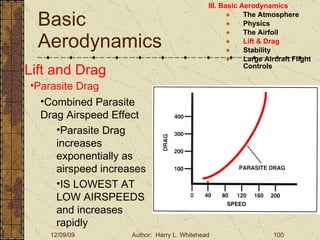
Basic Aerodynamics III. Basic Aerodynamics   The Atmosphere Physics The Airfoil Lift & Drag Stability Large Aircraft Flight Controls Lift and Drag Parasite Drag Combined Parasite Drag Airspeed Effect Parasite Drag increases exponentially as airspeed increases IS LOWEST AT LOW AIRSPEEDS and increases rapidly
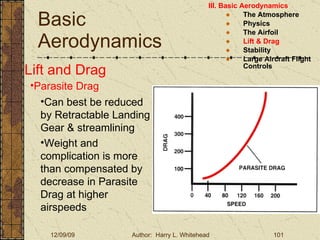
Basic Aerodynamics III. Basic Aerodynamics   The Atmosphere Physics The Airfoil Lift & Drag Stability Large Aircraft Flight Controls Lift and Drag Parasite Drag Can best be reduced by Retractable Landing Gear & streamlining Weight and complication is more than compensated by decrease in Parasite Drag at higher airspeeds
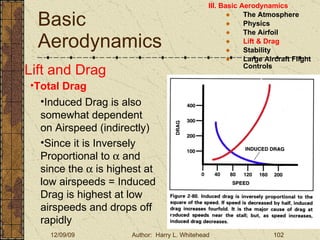
Basic Aerodynamics III. Basic Aerodynamics   The Atmosphere Physics The Airfoil Lift & Drag Stability Large Aircraft Flight Controls Lift and Drag Total Drag Induced Drag is also somewhat dependent on Airspeed (indirectly) Since it is Inversely Proportional to    and since the    is highest at low airspeeds = Induced Drag is highest at low airspeeds and drops off rapidly
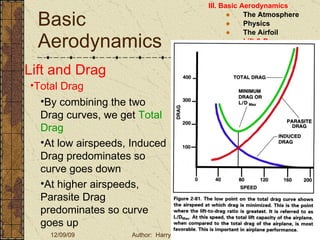
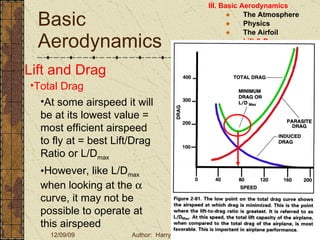
Basic Aerodynamics III. Basic Aerodynamics   The Atmosphere Physics The Airfoil Lift & Drag Stability Large Aircraft Flight Controls Lift and Drag Total Drag By combining the two Drag curves, we get  Total Drag At low airspeeds, Induced Drag predominates so curve goes down At higher airspeeds, Parasite Drag predominates so curve goes up
Basic Aerodynamics III. Basic Aerodynamics   The Atmosphere Physics The Airfoil Lift & Drag Stability Large Aircraft Flight Controls Lift and Drag Total Drag At some airspeed it will be at its lowest value = most efficient airspeed to fly at = best Lift/Drag Ratio or L/D max However, like L/D max  when looking at the    curve, it may not be possible to operate at this airspeed
Basic Aerodynamics III. Basic Aerodynamics   The Atmosphere Physics The Airfoil Lift & Drag Stability Large Aircraft Flight Controls Lift and Drag Other Design Considerations Other factors affect the structure and design of an aircraft while in flight besides just Lift and Drag These are: Load Factor Propeller Factors Engine Torque Gyroscopic Precession Asymmetrical Thrust Spiraling Slipstream
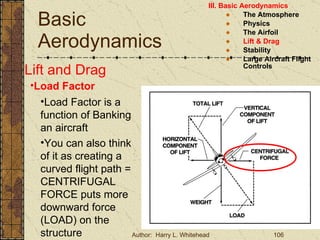
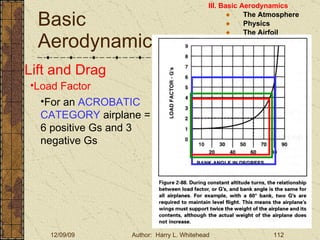
Basic Aerodynamics III. Basic Aerodynamics   The Atmosphere Physics The Airfoil Lift & Drag Stability Large Aircraft Flight Controls Lift and Drag Load Factor Load Factor is a function of Banking an aircraft You can also think of it as creating a curved flight path = CENTRIFUGAL FORCE puts more downward force (LOAD) on the structure
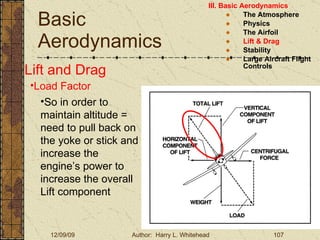
Basic Aerodynamics III. Basic Aerodynamics   The Atmosphere Physics The Airfoil Lift & Drag Stability Large Aircraft Flight Controls Lift and Drag Load Factor So in order to maintain altitude = need to pull back on the yoke or stick and increase the engine’s power to increase the overall Lift component
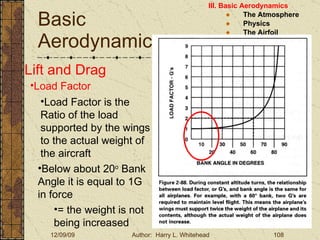
Basic Aerodynamics III. Basic Aerodynamics   The Atmosphere Physics The Airfoil Lift & Drag Stability Large Aircraft Flight Controls Lift and Drag Load Factor Load Factor is the Ratio of the load supported by the wings to the actual weight of the aircraft Below about 20 o  Bank Angle it is equal to 1G in force = the weight is not being increased
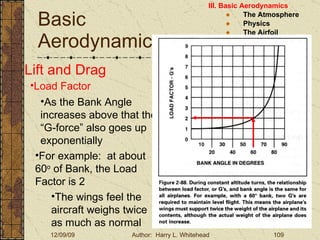
Basic Aerodynamics III. Basic Aerodynamics   The Atmosphere Physics The Airfoil Lift & Drag Stability Large Aircraft Flight Controls Lift and Drag Load Factor As the Bank Angle increases above that the “G-force” also goes up exponentially For example:  at about 60 o  of Bank, the Load Factor is 2 The wings feel the aircraft weighs twice as much as normal
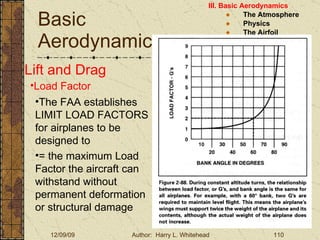
Basic Aerodynamics III. Basic Aerodynamics   The Atmosphere Physics The Airfoil Lift & Drag Stability Large Aircraft Flight Controls Lift and Drag Load Factor The FAA establishes LIMIT LOAD FACTORS for airplanes to be designed to = the maximum Load Factor the aircraft can withstand without permanent deformation or structural damage
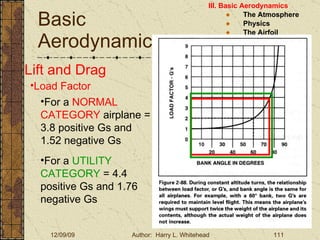
Basic Aerodynamics III. Basic Aerodynamics   The Atmosphere Physics The Airfoil Lift & Drag Stability Large Aircraft Flight Controls Lift and Drag Load Factor For a  NORMAL CATEGORY  airplane = 3.8 positive Gs and 1.52 negative Gs For a  UTILITY CATEGORY  = 4.4 positive Gs and 1.76 negative Gs
Basic Aerodynamics III. Basic Aerodynamics   The Atmosphere Physics The Airfoil Lift & Drag Stability Large Aircraft Flight Controls Lift and Drag Load Factor For an  ACROBATIC CATEGORY  airplane = 6 positive Gs and 3 negative Gs
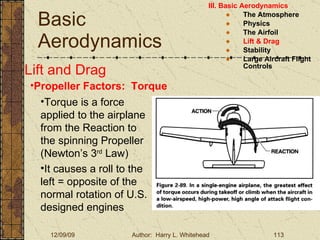
Basic Aerodynamics III. Basic Aerodynamics   The Atmosphere Physics The Airfoil Lift & Drag Stability Large Aircraft Flight Controls Lift and Drag Propeller Factors:  Torque Torque is a force applied to the airplane from the Reaction to the spinning Propeller (Newton’s 3 rd  Law) It causes a roll to the left = opposite of the normal rotation of U.S. designed engines
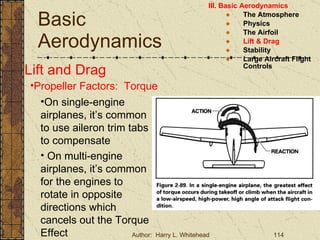
Basic Aerodynamics III. Basic Aerodynamics   The Atmosphere Physics The Airfoil Lift & Drag Stability Large Aircraft Flight Controls Lift and Drag Propeller Factors:  Torque On single-engine airplanes, it’s common to use aileron trim tabs to compensate On multi-engine airplanes, it’s common for the engines to rotate in opposite directions which cancels out the Torque Effect
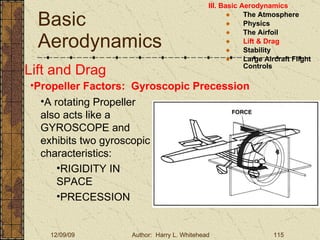
Basic Aerodynamics III. Basic Aerodynamics   The Atmosphere Physics The Airfoil Lift & Drag Stability Large Aircraft Flight Controls Lift and Drag Propeller Factors:  Gyroscopic Precession A rotating Propeller also acts like a GYROSCOPE and exhibits two gyroscopic characteristics: RIGIDITY IN SPACE PRECESSION
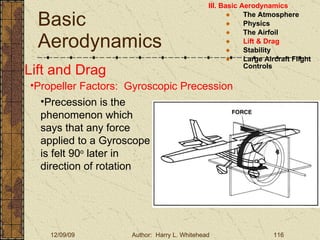
Basic Aerodynamics III. Basic Aerodynamics   The Atmosphere Physics The Airfoil Lift & Drag Stability Large Aircraft Flight Controls Lift and Drag Propeller Factors:  Gyroscopic Precession Precession is the phenomenon which says that any force applied to a Gyroscope is felt 90 o  later in direction of rotation
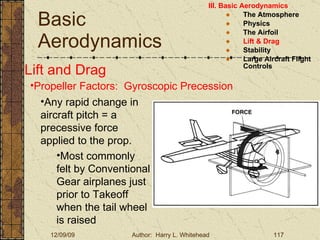
Basic Aerodynamics III. Basic Aerodynamics   The Atmosphere Physics The Airfoil Lift & Drag Stability Large Aircraft Flight Controls Lift and Drag Propeller Factors:  Gyroscopic Precession Any rapid change in aircraft pitch = a precessive force applied to the prop. Most commonly felt by Conventional Gear airplanes just prior to Takeoff when the tail wheel is raised
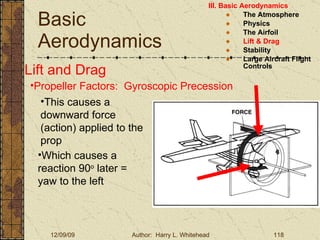
Basic Aerodynamics III. Basic Aerodynamics   The Atmosphere Physics The Airfoil Lift & Drag Stability Large Aircraft Flight Controls Lift and Drag Propeller Factors:  Gyroscopic Precession This causes a downward force (action) applied to the prop Which causes a reaction 90 o  later = yaw to the left
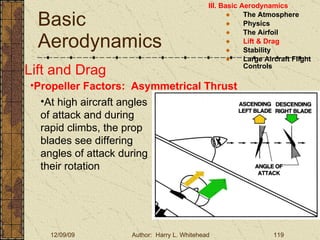
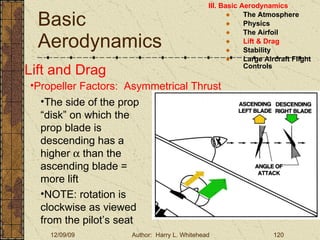
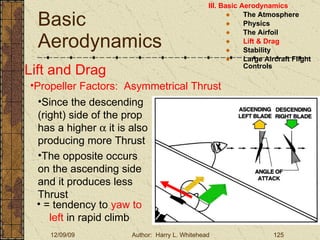
Basic Aerodynamics III. Basic Aerodynamics   The Atmosphere Physics The Airfoil Lift & Drag Stability Large Aircraft Flight Controls Lift and Drag Propeller Factors:  Asymmetrical Thrust At high aircraft angles of attack and during rapid climbs, the prop blades see differing angles of attack during their rotation
Basic Aerodynamics III. Basic Aerodynamics   The Atmosphere Physics The Airfoil Lift & Drag Stability Large Aircraft Flight Controls Lift and Drag Propeller Factors:  Asymmetrical Thrust The side of the prop “disk” on which the prop blade is descending has a higher    than the ascending blade = more lift NOTE: rotation is clockwise as viewed from the pilot’s seat
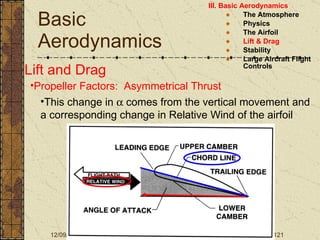
Basic Aerodynamics III. Basic Aerodynamics   The Atmosphere Physics The Airfoil Lift & Drag Stability Large Aircraft Flight Controls Lift and Drag Propeller Factors:  Asymmetrical Thrust This change in    comes from the vertical movement and a corresponding change in Relative Wind of the airfoil
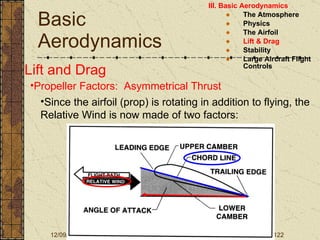
Basic Aerodynamics III. Basic Aerodynamics   The Atmosphere Physics The Airfoil Lift & Drag Stability Large Aircraft Flight Controls Lift and Drag Propeller Factors:  Asymmetrical Thrust Since the airfoil (prop) is rotating in addition to flying, the Relative Wind is now made of two factors:
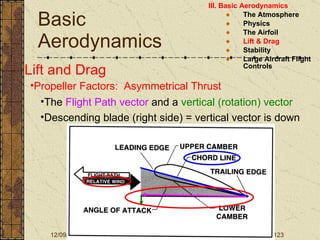
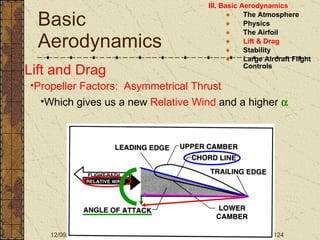
Basic Aerodynamics III. Basic Aerodynamics   The Atmosphere Physics The Airfoil Lift & Drag Stability Large Aircraft Flight Controls Lift and Drag Propeller Factors:  Asymmetrical Thrust The  Flight Path vector  and a  vertical (rotation) vector Descending blade (right side) = vertical vector is down
Basic Aerodynamics III. Basic Aerodynamics   The Atmosphere Physics The Airfoil Lift & Drag Stability Large Aircraft Flight Controls Lift and Drag Propeller Factors:  Asymmetrical Thrust Which gives us a new  Relative Wind  and a higher  
Basic Aerodynamics III. Basic Aerodynamics   The Atmosphere Physics The Airfoil Lift & Drag Stability Large Aircraft Flight Controls Lift and Drag Propeller Factors:  Asymmetrical Thrust Since the descending (right) side of the prop has a higher    it is also producing more Thrust The opposite occurs on the ascending   side and it produces less Thrust = tendency to  yaw to left  in rapid climb
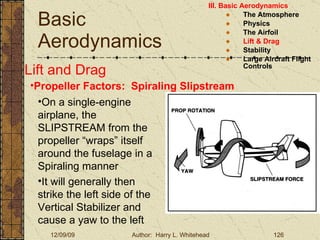
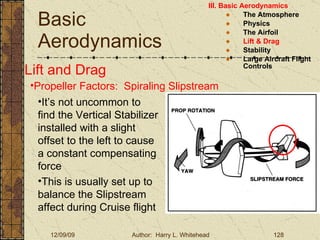
Basic Aerodynamics III. Basic Aerodynamics   The Atmosphere Physics The Airfoil Lift & Drag Stability Large Aircraft Flight Controls Lift and Drag Propeller Factors:  Spiraling Slipstream On a single-engine airplane, the SLIPSTREAM from the propeller “wraps” itself around the fuselage in a Spiraling manner It will generally then strike the left side of the Vertical Stabilizer and cause a yaw to the left
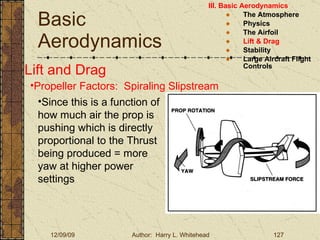
Basic Aerodynamics III. Basic Aerodynamics   The Atmosphere Physics The Airfoil Lift & Drag Stability Large Aircraft Flight Controls Lift and Drag Propeller Factors:  Spiraling Slipstream Since this is a function of how much air the prop is pushing which is directly proportional to the Thrust being produced = more yaw at higher power settings
Basic Aerodynamics III. Basic Aerodynamics   The Atmosphere Physics The Airfoil Lift & Drag Stability Large Aircraft Flight Controls Lift and Drag Propeller Factors:  Spiraling Slipstream It’s not uncommon to find the Vertical Stabilizer installed with a slight offset to the left to cause a constant compensating force This is usually set up to balance the Slipstream affect during Cruise flight
Basic Aerodynamics III. Basic Aerodynamics   The Atmosphere Physics The Airfoil Lift & Drag Stability Large Aircraft Flight Controls

Basic Aerodynamics To Stability

  • 1.
    AVAF 209 StructuresII III. Basic Aerodynamics The Atmosphere Physics The Airfoil Lift & Drag Stability Large Aircraft Flight Controls
  • 2.
    Basic Aerodynamics III.Basic Aerodynamics The Atmosphere Physics The Airfoil Lift & Drag Stability Large Aircraft Flight Controls Aerodynamics: The study of objects in motion through the air and the forces that produce or change such motion
  • 3.
    Basic Aerodynamics III.Basic Aerodynamics The Atmosphere Physics The Airfoil Lift & Drag Stability Large Aircraft Flight Controls The Atmosphere In order to fly, we need to create an upward force equal to the weight of the aircraft by using the Atmosphere This force comes from the action of the atmosphere on an airfoil
  • 4.
    Basic Aerodynamics III.Basic Aerodynamics The Atmosphere Physics The Airfoil Lift & Drag Stability Large Aircraft Flight Controls The Atmosphere Is made of a mixture of gases 21% Oxygen 78% Nitrogen Rest is mix of inert gases (Argon, Neon, etc.)
  • 5.
    Basic Aerodynamics III.Basic Aerodynamics The Atmosphere Physics The Airfoil Lift & Drag Stability Large Aircraft Flight Controls The Atmosphere Mixture remains constant regardless of altitude Weight of air changes as altitude changes Less weight above as we go up = less ATMOSPHERIC PRESSURE exerted on objects
  • 6.
    Basic Aerodynamics III.Basic Aerodynamics The Atmosphere Physics The Airfoil Lift & Drag Stability Large Aircraft Flight Controls The Atmosphere STANDARD DAY CONDITIONS International Civil Aeronautics Organization (ICAO) has set standards for test data
  • 7.
    Basic Aerodynamics III.Basic Aerodynamics The Atmosphere Physics The Airfoil Lift & Drag Stability Large Aircraft Flight Controls The Atmosphere STANDARD DAY CONDITIONS Allows comparison of test data from one location or day to any other in world
  • 8.
    Basic Aerodynamics III.Basic Aerodynamics The Atmosphere Physics The Airfoil Lift & Drag Stability Large Aircraft Flight Controls The Atmosphere STANDARD DAY Pressure Is a force created by the weight of the atmosphere above an object Is measured in IN-HG, MM-HG, PSI, or MILLIBARS
  • 9.
    Basic Aerodynamics III.Basic Aerodynamics The Atmosphere Physics The Airfoil Lift & Drag Stability Large Aircraft Flight Controls The Atmosphere STANDARD DAY Pressure In-Hg or mm-Hg A tube is filled with Mercury (Hg) and then inverted in a container of Mercury Hg will rise and height is measured
  • 10.
    Basic Aerodynamics III.Basic Aerodynamics The Atmosphere Physics The Airfoil Lift & Drag Stability Large Aircraft Flight Controls The Atmosphere STANDARD DAY Pressure In-Hg or mm-Hg On a Standard Day at SEA LEVEL (zero altitude), the height will be 29.92 inches 29.92 in-Hg) or 760 millimeters (760 mm-Hg)
  • 11.
    Basic Aerodynamics III.Basic Aerodynamics The Atmosphere Physics The Airfoil Lift & Drag Stability Large Aircraft Flight Controls The Atmosphere STANDARD DAY Pressure In-Hg or mm-Hg This is called an ABSOLUTE SCALE measurement as a VACUUM will form in the top of the tube (= ABSOLUTE ZERO PRESSURE)
  • 12.
    Basic Aerodynamics III.Basic Aerodynamics The Atmosphere Physics The Airfoil Lift & Drag Stability Large Aircraft Flight Controls The Atmosphere STANDARD DAY Pressure Atmospheric pressure will decrease by approx. 1 in-Hg for every 1,000 feet increase in altitude Known as the LAPSE RATE
  • 13.
    Basic Aerodynamics III.Basic Aerodynamics The Atmosphere Physics The Airfoil Lift & Drag Stability Large Aircraft Flight Controls The Atmosphere STANDARD DAY Pressure An ALTIMETER measures absolute pressure and displays the result in Feet Above Sea Level (ASL) Notice KOLLSMAN WINDOW (adjust to varying local conditions)
  • 14.
    Basic Aerodynamics III.Basic Aerodynamics The Atmosphere Physics The Airfoil Lift & Drag Stability Large Aircraft Flight Controls The Atmosphere STANDARD DAY Pressure PSI Is a measurement of FORCE / AREA The most common units are POUNDS PER SQUARE INCH
  • 15.
    Basic Aerodynamics III.Basic Aerodynamics The Atmosphere Physics The Airfoil Lift & Drag Stability Large Aircraft Flight Controls The Atmosphere STANDARD DAY Pressure PSI On a Standard Day at Sea Level, the atmosphere pushes on objects with a force of 14.69 pounds per square inch of area
  • 16.
    Basic Aerodynamics III.Basic Aerodynamics The Atmosphere Physics The Airfoil Lift & Drag Stability Large Aircraft Flight Controls The Atmosphere STANDARD DAY Pressure PSI Since ½ of the air in the atmosphere is below 18,000 feet ASL, the pressure there is 7.34 psi
  • 17.
    Basic Aerodynamics III.Basic Aerodynamics The Atmosphere Physics The Airfoil Lift & Drag Stability Large Aircraft Flight Controls The Atmosphere STANDARD DAY Pressure PSI Is measured by an Absolute scale and is labeled PSIA
  • 18.
    Basic Aerodynamics III.Basic Aerodynamics The Atmosphere Physics The Airfoil Lift & Drag Stability Large Aircraft Flight Controls The Atmosphere STANDARD DAY Pressure Or a GAUGE scale which uses Atmospheric Pressure as the zero reference (= PSIG)
  • 19.
    Basic Aerodynamics III.Basic Aerodynamics The Atmosphere Physics The Airfoil Lift & Drag Stability Large Aircraft Flight Controls The Atmosphere STANDARD DAY Pressure Millibars Are used by Meteorologists (weather forecasters) Standard Day at Sea Level is 1013.2 mbs 1 millibar approximately equals .75 in-Hg
  • 20.
    Basic Aerodynamics III.Basic Aerodynamics The Atmosphere Physics The Airfoil Lift & Drag Stability Large Aircraft Flight Controls The Atmosphere STANDARD DAY Temperature Four scales used : Celsius (used to be Centigrade)
  • 21.
    Basic Aerodynamics III.Basic Aerodynamics The Atmosphere Physics The Airfoil Lift & Drag Stability Large Aircraft Flight Controls The Atmosphere STANDARD DAY Temperature Four scales used : Kelvin (Absolute Celsius)
  • 22.
    Basic Aerodynamics III.Basic Aerodynamics The Atmosphere Physics The Airfoil Lift & Drag Stability Large Aircraft Flight Controls The Atmosphere STANDARD DAY Temperature Four scales used : Fahrenheit
  • 23.
    Basic Aerodynamics III.Basic Aerodynamics The Atmosphere Physics The Airfoil Lift & Drag Stability Large Aircraft Flight Controls The Atmosphere STANDARD DAY Temperature Four scales used : Rankine (Absolute Fahrenheit)
  • 24.
    Basic Aerodynamics III.Basic Aerodynamics The Atmosphere Physics The Airfoil Lift & Drag Stability Large Aircraft Flight Controls The Atmosphere STANDARD DAY Temperature Standard Day at Sea Level: 15 o Celsius 59 o Fahrenheit 288 0 Kelvin 519 o Rankine
  • 25.
    Basic Aerodynamics III.Basic Aerodynamics The Atmosphere Physics The Airfoil Lift & Drag Stability Large Aircraft Flight Controls The Atmosphere STANDARD DAY Temperature As we go up in altitude, temperature goes down 3.54 o F or 2 o C per 1,000 feet ADIABATIC LAPSE RATE
  • 26.
    Basic Aerodynamics III.Basic Aerodynamics The Atmosphere Physics The Airfoil Lift & Drag Stability Large Aircraft Flight Controls The Atmosphere STANDARD DAY Humidity Is amount of moisture in air Measured by RELATIVE HUMIDITY Is comparison of moisture present to amount air can hold in percent Maximum amount is directly proportional to temperature (hotter temp. = more moisture at same Relative Humidity %)
  • 27.
    Basic Aerodynamics III.Basic Aerodynamics The Atmosphere Physics The Airfoil Lift & Drag Stability Large Aircraft Flight Controls The Atmosphere STANDARD DAY Humidity Standard Day is 0% humidity or Dry Air
  • 28.
    Basic Aerodynamics III.Basic Aerodynamics The Atmosphere Physics The Airfoil Lift & Drag Stability Large Aircraft Flight Controls The Atmosphere STANDARD DAY Density Is measure of Mass per unit Volume Mass is the amount of matter in an object Can think of it as number of molecules Weight is the affect of Gravity on a mass Since we are dealing with objects near the surface of the Earth, Weight and Mass are used interchangeably in Aerodynamics
  • 29.
    Basic Aerodynamics III.Basic Aerodynamics The Atmosphere Physics The Airfoil Lift & Drag Stability Large Aircraft Flight Controls The Atmosphere STANDARD DAY Density Air density is officially measured in SLUGS PER CUBIC FOOT Standard Day at Sea Level = .002378 slugs/ft 3 Formula symbol is the Greek letter Rho (  ) Is a major factor in developing Lift Varies directly with Atmospheric Pressure and inversely with Temperature
  • 30.
    Basic Aerodynamics III.Basic Aerodynamics The Atmosphere Physics The Airfoil Lift & Drag Stability Large Aircraft Flight Controls The Atmosphere STANDARD DAY Density Altitude Aviation uses DENSITY ALTITUDE as important measure of density affects on flying
  • 31.
    Basic Aerodynamics III.Basic Aerodynamics The Atmosphere Physics The Airfoil Lift & Drag Stability Large Aircraft Flight Controls The Atmosphere STANDARD DAY Density Altitude Is a measure of an aircraft’s performance (necessary takeoff distance, necessary landing distance, weight-carrying capability, etc.)
  • 32.
    Basic Aerodynamics III.Basic Aerodynamics The Atmosphere Physics The Airfoil Lift & Drag Stability Large Aircraft Flight Controls The Atmosphere STANDARD DAY Density Altitude “ The altitude in a Standard Day that has the same density as the Ambient conditions.” Is the altitude the aircraft thinks it’s at
  • 33.
    Basic Aerodynamics III.Basic Aerodynamics The Atmosphere Physics The Airfoil Lift & Drag Stability Large Aircraft Flight Controls The Atmosphere STANDARD DAY Density Altitude Computed using a Density Altitude Chart Must know PRESSURE ALTITUDE and Ambient Temperature
  • 34.
    Basic Aerodynamics III.Basic Aerodynamics The Atmosphere Physics The Airfoil Lift & Drag Stability Large Aircraft Flight Controls The Atmosphere STANDARD DAY Density Altitude Pressure Altitude is altitude in the Standard Day whose atmospheric pressure matches the local atmospheric pressure
  • 35.
    Basic Aerodynamics III.Basic Aerodynamics The Atmosphere Physics The Airfoil Lift & Drag Stability Large Aircraft Flight Controls The Atmosphere STANDARD DAY Density Altitude Press. Alt. Example: Ambient pressure of 28.92 in-Hg Since pressure decreases 1 in-Hg/1000 feet, Pressure Altitude = 1,000 feet ASL
  • 36.
    Basic Aerodynamics III.Basic Aerodynamics The Atmosphere Physics The Airfoil Lift & Drag Stability Large Aircraft Flight Controls The Atmosphere STANDARD DAY Density Altitude Dens. Alt. Example: Pressure Altitude can also be determined for the location you are by adjusting the Kollsman window to 29.92 and reading the altitude
  • 37.
    Basic Aerodynamics III.Basic Aerodynamics The Atmosphere Physics The Airfoil Lift & Drag Stability Large Aircraft Flight Controls The Atmosphere STANDARD DAY Density Altitude Dens. Alt. Example: Pressure = 25.92 in-Hg (= ? feet Pressure Altitude) = 4,000 feet SL (29.92) – actual (25.92) = 4 inches x 1000 ft.
  • 38.
    Basic Aerodynamics III.Basic Aerodynamics The Atmosphere Physics The Airfoil Lift & Drag Stability Large Aircraft Flight Controls The Atmosphere STANDARD DAY Density Altitude Dens. Alt. Example: Pressure = 25.92 in-Hg (= ? feet Pressure Altitude) = 4,000 feet Temperature = 80 o F
  • 39.
    Basic Aerodynamics III.Basic Aerodynamics The Atmosphere Physics The Airfoil Lift & Drag Stability Large Aircraft Flight Controls The Atmosphere STANDARD DAY Density Altitude Dens. Alt. Example: Density Altitude = 6,500 feet 6,500
  • 40.
    Basic Aerodynamics III.Basic Aerodynamics The Atmosphere Physics The Airfoil Lift & Drag Stability Large Aircraft Flight Controls The Atmosphere STANDARD DAY Density Altitude Also is affected by the Relative Humidity Water vapor has about 62% of weight of air = higher humidity = less dense air = higher Density Altitude = only affected by about 5%
  • 41.
    Basic Aerodynamics III.Basic Aerodynamics The Atmosphere Physics The Airfoil Lift & Drag Stability Large Aircraft Flight Controls The Atmosphere STANDARD DAY Density Altitude Generally speaking: BEWARE OF HIGH, HOT AND HUMID CONDITIONS
  • 42.
    Basic Aerodynamics III.Basic Aerodynamics The Atmosphere Physics The Airfoil Lift & Drag Stability Large Aircraft Flight Controls Laws of Physics which affect Aerodynamics Bernoulli's Principle “ If the total energy of flowing air remains constant, any increase in KINETIC energy creates a decrease in POTENTIAL energy” Since the LAW OF CONSERVATION OF ENERGY applies, the energies in the flow are only changed
  • 43.
    Basic Aerodynamics III.Basic Aerodynamics The Atmosphere Physics The Airfoil Lift & Drag Stability Large Aircraft Flight Controls Laws of Physics which affect Aerodynamics Bernoulli's Principle Kinetic energy is measured as Velocity Potential energy is measured as Pressure
  • 44.
    Basic Aerodynamics III.Basic Aerodynamics The Atmosphere Physics The Airfoil Lift & Drag Stability Large Aircraft Flight Controls Laws of Physics which affect Aerodynamics Bernoulli's Principle In “throat” of venturi: Velocity goes up so all air gets through in same time = pressure down
  • 45.
    Basic Aerodynamics III.Basic Aerodynamics The Atmosphere Physics The Airfoil Lift & Drag Stability Large Aircraft Flight Controls Laws of Physics which affect Aerodynamics Newton’s Laws First Law: Law of Inertia A body at rest tends to remain at rest and a body in motion tends to remain in motion, until acted upon by an outside force.
  • 46.
    Basic Aerodynamics III.Basic Aerodynamics The Atmosphere Physics The Airfoil Lift & Drag Stability Large Aircraft Flight Controls Laws of Physics which affect Aerodynamics Newton’s Laws Second Law: Law of Acceleration Acceleration of a body is directly proportional to the force applied and inversely proportional to the mass of the body or a = F / m Or more useful to us: F = ma
  • 47.
    Basic Aerodynamics III.Basic Aerodynamics The Atmosphere Physics The Airfoil Lift & Drag Stability Large Aircraft Flight Controls Laws of Physics which affect Aerodynamics Newton’s Laws Third Law Law of Reaction For every Action there is an Equal and Opposite Reaction
  • 48.
    Basic Aerodynamics III.Basic Aerodynamics The Atmosphere Physics The Airfoil Lift & Drag Stability Large Aircraft Flight Controls The Airfoil Flight Forces As we looked at before, there are four forces being applied to an airplane in flight: Lift (up) Weight (down) Thrust (forward) Drag (aft)
  • 49.
    Basic Aerodynamics III.Basic Aerodynamics The Atmosphere Physics The Airfoil Lift & Drag Stability Large Aircraft Flight Controls The Airfoil Flight Forces In order to understand these forces, we need to look at VECTORS:
  • 50.
    Basic Aerodynamics III.Basic Aerodynamics The Atmosphere Physics The Airfoil Lift & Drag Stability Large Aircraft Flight Controls The Airfoil Flight Forces A Vector is an arrow whose length shows a value and it points in the direction the value is being applied
  • 51.
    Basic Aerodynamics III.Basic Aerodynamics The Atmosphere Physics The Airfoil Lift & Drag Stability Large Aircraft Flight Controls The Airfoil Flight Forces To combine vectors, we place them with their starting points joined (as on the left below)
  • 52.
    Basic Aerodynamics III.Basic Aerodynamics The Atmosphere Physics The Airfoil Lift & Drag Stability Large Aircraft Flight Controls The Airfoil Flight Forces And by COMPLETING THE SQUARE we can get the RESULTANT vector (the combination of the other two)
  • 53.
    Basic Aerodynamics III.Basic Aerodynamics The Atmosphere Physics The Airfoil Lift & Drag Stability Large Aircraft Flight Controls The Airfoil Flight Forces If two forces are exactly opposing each other (such as Lift and Weight) and have the same value, the resultant is zero
  • 54.
    Basic Aerodynamics III.Basic Aerodynamics The Atmosphere Physics The Airfoil Lift & Drag Stability Large Aircraft Flight Controls The Airfoil Flight Forces In STRAIGHT AND LEVEL, UNACCELERATED FLIGHT, Thrust and Drag are equal, Lift and Weight are equal, and the aircraft continues in a straight line with no change in altitude The forces are said to be in EQUILIBRIUM
  • 55.
    Basic Aerodynamics III.Basic Aerodynamics The Atmosphere Physics The Airfoil Lift & Drag Stability Large Aircraft Flight Controls The Airfoil Flight Forces In order to climb, we must increase the Lift Vector so there is no longer an equilibrium between Lift and Weight The Resultant of the two is an upward force
  • 56.
    Basic Aerodynamics III.Basic Aerodynamics The Atmosphere Physics The Airfoil Lift & Drag Stability Large Aircraft Flight Controls The Airfoil Flight Forces In order to go faster (Accelerate), we must increase the Thrust vector to get a Resultant forward Etc.
  • 57.
    Basic Aerodynamics III.Basic Aerodynamics The Atmosphere Physics The Airfoil Lift & Drag Stability Large Aircraft Flight Controls The Airfoil Flight Forces Thrust is created by the POWERPLANT and PROPELLER Weight is the effect of Gravity on the aircraft Drag is created by movement of the aircraft Lift is created by the Airfoils used as Wings
  • 58.
    Basic Aerodynamics III.Basic Aerodynamics The Atmosphere Physics The Airfoil Lift & Drag Stability Large Aircraft Flight Controls The Airfoil An Airfoil is a specially designed surface which produces a reaction to air flowing across it Two theories: Bernoulli’s Principle Newton’s Laws
  • 59.
    Basic Aerodynamics III.Basic Aerodynamics The Atmosphere Physics The Airfoil Lift & Drag Stability Large Aircraft Flight Controls The Airfoil Subsonic airfoils can be Asymmetrical or Symmetrical Most airplanes use Asymmetrical wings Blunt, rounded LEADING EDGE Max. thickness about 1/3 of distance from L.E. to TRAILING EDGE
  • 60.
    Basic Aerodynamics III.Basic Aerodynamics The Atmosphere Physics The Airfoil Lift & Drag Stability Large Aircraft Flight Controls The Airfoil There are many basic airfoil shapes
  • 61.
    Basic Aerodynamics III.Basic Aerodynamics The Atmosphere Physics The Airfoil Lift & Drag Stability Large Aircraft Flight Controls The Airfoil Early were very thin with definite camber The Clark-Y was the standard through the 1930s NACA developed the “modern” asymmetrical shape in the 30s and it was used for decades = smoother airflow and greater lift with less drag There are many basic airfoil shapes
  • 62.
    Basic Aerodynamics III.Basic Aerodynamics The Atmosphere Physics The Airfoil Lift & Drag Stability Large Aircraft Flight Controls The Airfoil There are many basic airfoil shapes As aircraft started to get near Mach 1, the subsonic shapes caused shock waves to form and destroy lift and increase drag tremendously Supersonic airfoils were designed with sharp Leading and Trailing edges and the max thickness about ½ of the chord distance
  • 63.
    Basic Aerodynamics III.Basic Aerodynamics The Atmosphere Physics The Airfoil Lift & Drag Stability Large Aircraft Flight Controls The Airfoil There are many basic airfoil shapes Next came the Supercritical design Reduces the velocity of the air over the upper surface and delays the drag rise occurring with the approach of Mach 1 NASA developed the GAW series for General Aviation aircraft and give higher lift with lesser drag than the “modern”
  • 64.
    Basic Aerodynamics III.Basic Aerodynamics The Atmosphere Physics The Airfoil Lift & Drag Stability Large Aircraft Flight Controls Lift and Drag In order to generate Lift, an Airfoil must have an ANGLE OF ATTACK (  ) This is defined as the angle between the CHORD and the RELATIVE WIND (= opposite the FLIGHT PATH)
  • 65.
    Basic Aerodynamics III.Basic Aerodynamics The Atmosphere Physics The Airfoil Lift & Drag Stability Large Aircraft Flight Controls Lift and Drag In order to generate Lift, an Airfoil must have an ANGLE OF ATTACK (  ) Don’t confuse this with the ANGLE OF INCIDENCE The angle formed between the Chord and the Longitudinal Axis of the airplane
  • 66.
    Basic Aerodynamics III.Basic Aerodynamics The Atmosphere Physics The Airfoil Lift & Drag Stability Large Aircraft Flight Controls Lift and Drag In order to generate Lift, an Airfoil must have an ANGLE OF ATTACK (  ) If the  is positive = the Leading Edge is higher than the Trailing Edge = generate Lift in the Upward direction Negative  = downward Lift
  • 67.
    Basic Aerodynamics III.Basic Aerodynamics The Atmosphere Physics The Airfoil Lift & Drag Stability Large Aircraft Flight Controls Lift and Drag In order to generate Lift, an Airfoil must have an ANGLE OF ATTACK (  ) As the  increases, the amount of Lift also increases Airfoil simulation
  • 68.
    Basic Aerodynamics III.Basic Aerodynamics The Atmosphere Physics The Airfoil Lift & Drag Stability Large Aircraft Flight Controls Lift and Drag In order to generate Lift, an Airfoil must have an ANGLE OF ATTACK (  ) This can be shown graphically using the COEFFICIENT OF LIFT or C L
  • 69.
    Basic Aerodynamics III.Basic Aerodynamics The Atmosphere Physics The Airfoil Lift & Drag Stability Large Aircraft Flight Controls Lift and Drag In order to generate Lift, an Airfoil must have an ANGLE OF ATTACK (  ) Notice the C L is positive even to a small negative 
  • 70.
    Basic Aerodynamics III.Basic Aerodynamics The Atmosphere Physics The Airfoil Lift & Drag Stability Large Aircraft Flight Controls Lift and Drag In order to generate Lift, an Airfoil must have an ANGLE OF ATTACK (  ) And the C L peaks at some positive 
  • 71.
    Basic Aerodynamics III.Basic Aerodynamics The Atmosphere Physics The Airfoil Lift & Drag Stability Large Aircraft Flight Controls The Airfoil In order to generate Lift, an Airfoil must have an ANGLE OF ATTACK (  ) Also, the C L starts to drop off if the  gets higher This is called a STALL and starts at C Lmax or CRITICAL 
  • 72.
    Basic Aerodynamics III.Basic Aerodynamics The Atmosphere Physics The Airfoil Lift & Drag Stability Large Aircraft Flight Controls Lift and Drag In order to generate Lift, an Airfoil must have an ANGLE OF ATTACK (  ) Stall is a SEPARATION OF AIRFLOW from the upper wing surface = rapid decrease in lift
  • 73.
    Basic Aerodynamics III.Basic Aerodynamics The Atmosphere Physics The Airfoil Lift & Drag Stability Large Aircraft Flight Controls Lift and Drag In order to generate Lift, an Airfoil must have an ANGLE OF ATTACK (  ) This occurs at the same  regardless of speed, aircraft weight, or flight attitude
  • 74.
    Basic Aerodynamics III.Basic Aerodynamics The Atmosphere Physics The Airfoil Lift & Drag Stability Large Aircraft Flight Controls Lift and Drag In order to generate Lift, an Airfoil must have an ANGLE OF ATTACK (  ) To eliminate this condition = reduce the  below critical
  • 75.
    Basic Aerodynamics III.Basic Aerodynamics The Atmosphere Physics The Airfoil Lift & Drag Stability Large Aircraft Flight Controls Lift and Drag Other Factors Affecting Lift: Airspeed Faster = increased Lift Lift is increased as the square of the speed For example: At 200 mph a wing has 4 times the lift of the same airfoil at 100 mph At 50 mph the lift is ¼ as much as at 100 mph Airfoil simulation
  • 76.
    Basic Aerodynamics III.Basic Aerodynamics The Atmosphere Physics The Airfoil Lift & Drag Stability Large Aircraft Flight Controls Lift and Drag Other Factors Affecting Lift: Wing Planform View of the wing from above or below
  • 77.
    Basic Aerodynamics III.Basic Aerodynamics The Atmosphere Physics The Airfoil Lift & Drag Stability Large Aircraft Flight Controls Lift and Drag Other Factors Affecting Lift: Wing Planform Rectangular: excellent slow flight and stall occurs first at root of wing (= good aileron control)
  • 78.
    Basic Aerodynamics III.Basic Aerodynamics The Atmosphere Physics The Airfoil Lift & Drag Stability Large Aircraft Flight Controls Lift and Drag Other Factors Affecting Lift: Wing Planform Elliptical: most efficient = least drag for given size but difficult to manufacture and stalls all along Trail. Edge
  • 79.
    Basic Aerodynamics III.Basic Aerodynamics The Atmosphere Physics The Airfoil Lift & Drag Stability Large Aircraft Flight Controls Lift and Drag Other Factors Affecting Lift: Wing Planform Modified (or Moderate) Tapered: more efficient than Rectangular and easier to build than Elliptical but still stalls along Trailing Edge
  • 80.
    Basic Aerodynamics III.Basic Aerodynamics The Atmosphere Physics The Airfoil Lift & Drag Stability Large Aircraft Flight Controls Lift and Drag Other Factors Affecting Lift: Wing Planform SweptBack (and Delta): Good efficiency at high speed but not very good at low
  • 81.
    Basic Aerodynamics III.Basic Aerodynamics The Atmosphere Physics The Airfoil Lift & Drag Stability Large Aircraft Flight Controls Lift and Drag Other Factors Affecting Lift: Camber Curve of the wing Increased Camber = increased airflow velocity over the top surface and more downwash angle = more lift It also tends to lower the Critical  Trailing Edge Flaps use this to allow more lift at a slower airspeed for landing and takeoff Airfoil simulation
  • 82.
    Basic Aerodynamics III.Basic Aerodynamics The Atmosphere Physics The Airfoil Lift & Drag Stability Large Aircraft Flight Controls Lift and Drag Other Factors Affecting Lift: Aspect Ratio Is the Ratio of the Wing’s SPAN to the average Chord Higher Aspect Ratio (“long and skinny”) = increased lift and lower stalling speed Used on Gliders and TR-1 spy plane
  • 83.
    Basic Aerodynamics III.Basic Aerodynamics The Atmosphere Physics The Airfoil Lift & Drag Stability Large Aircraft Flight Controls Lift and Drag Other Factors Affecting Lift: Wing Area Is the total surface area of the wings Must be sufficient to lift max weight of the aircraft If wing produces 10.5 pounds of lift per square foot at normal cruise speed = needs Wing Area of 200 square feet to lift 2,100 pounds of weight Airfoil simulation
  • 84.
    Basic Aerodynamics III.Basic Aerodynamics The Atmosphere Physics The Airfoil Lift & Drag Stability Large Aircraft Flight Controls Lift and Drag Drag Is the force opposing Thrust Is the force trying to hold the aircraft back as it flies and generally limits the maximum airspeed Is created by any aircraft surface that deflects or interferes with the smooth air flow around the aircraft Drag is classified as two types: Induced Parasite
  • 85.
    Basic Aerodynamics III.Basic Aerodynamics The Atmosphere Physics The Airfoil Lift & Drag Stability Large Aircraft Flight Controls Lift and Drag Induced Drag The Airfoil shape (type of airfoil and amount of Camber) and Wing Area create a force which comes from the same forces as those which create Lift It is Directly Proportional to the Angle of Attack (  )
  • 86.
    Basic Aerodynamics III.Basic Aerodynamics The Atmosphere Physics The Airfoil Lift & Drag Stability Large Aircraft Flight Controls Lift and Drag Induced Drag As  increases, the high pressure on the bottom of the wing flows around the wing tips and “fills in” some of the low pressure on top This creates a WINGTIP VORTEX and destroys some of the wing’s lift or increases its drag
  • 87.
    Basic Aerodynamics III.Basic Aerodynamics The Atmosphere Physics The Airfoil Lift & Drag Stability Large Aircraft Flight Controls Lift and Drag Induced Drag These can be dangerous for small aircraft flying behind a large aircraft The strength of the Vortex is proportional to aircraft speed, weight, and configuration
  • 88.
    Basic Aerodynamics III.Basic Aerodynamics The Atmosphere Physics The Airfoil Lift & Drag Stability Large Aircraft Flight Controls Lift and Drag Induced Drag This effect can be reduced by installing WINGLETS on the tips of the wings Reduce the Vortex = increased lift and reduced drag
  • 89.
    Basic Aerodynamics III.Basic Aerodynamics The Atmosphere Physics The Airfoil Lift & Drag Stability Large Aircraft Flight Controls Lift and Drag Induced Drag This effect can also be reduced by installing TIP TANKS on the tips of the wings
  • 90.
    Basic Aerodynamics III.Basic Aerodynamics The Atmosphere Physics The Airfoil Lift & Drag Stability Large Aircraft Flight Controls Lift and Drag Induced Drag And/or by installing DROOPED TIPS Used on STOL (Short Take Off/ Landing) aircraft or those designed for heavy and slow flight
  • 91.
    Basic Aerodynamics III.Basic Aerodynamics The Atmosphere Physics The Airfoil Lift & Drag Stability Large Aircraft Flight Controls Lift and Drag Induced Drag This can also be shown by looking at the COEFFICIENT OF DRAG (C D ) of the airfoil C D is proportional to Angle of Attack (  ) and increases as  increases
  • 92.
    Basic Aerodynamics III.Basic Aerodynamics The Atmosphere Physics The Airfoil Lift & Drag Stability Large Aircraft Flight Controls Lift and Drag Angle of Attack and Drag By combining the C L and C D curves we get a “Family” of curves for any given airfoil Includes a combination known as Lift-to-Drag Ratio (L/D)
  • 93.
    Basic Aerodynamics III.Basic Aerodynamics The Atmosphere Physics The Airfoil Lift & Drag Stability Large Aircraft Flight Controls Lift and Drag Angle of Attack and Drag Peak L/D (L/D max ) occurs at a given  which is the most efficient  for the airfoil to operate at
  • 94.
    Basic Aerodynamics III.Basic Aerodynamics The Atmosphere Physics The Airfoil Lift & Drag Stability Large Aircraft Flight Controls Lift and Drag Angle of Attack and Drag Unfortunately, this may be at too low an  to generate enough lift to fly (may not be able to fly fast enough)
  • 95.
    Basic Aerodynamics III.Basic Aerodynamics The Atmosphere Physics The Airfoil Lift & Drag Stability Large Aircraft Flight Controls Lift and Drag Parasite Drag Is the drag produced by the aircraft itself and is proportional to Airspeed Is disruption of the airflow around the aircraft 4 types: Form Drag Skin Friction Drag Interference Drag Profile Drag
  • 96.
    Basic Aerodynamics III.Basic Aerodynamics The Atmosphere Physics The Airfoil Lift & Drag Stability Large Aircraft Flight Controls Lift and Drag Parasite Drag Form Drag Created by any structure which extends into the airstream Is directly proportional to the size and shape of the structure Includes struts, antennas, landing gear, etc. Streamlining reduces Form Drag
  • 97.
    Basic Aerodynamics III.Basic Aerodynamics The Atmosphere Physics The Airfoil Lift & Drag Stability Large Aircraft Flight Controls Lift and Drag Parasite Drag Skin Friction Drag Caused by the roughness of the aircraft’s skin Includes paint, rivets, skin seams, etc. Causes small swirls (eddies) of air = drag Improved by flush riveting and cleaning and waxing the skin
  • 98.
    Basic Aerodynamics III.Basic Aerodynamics The Atmosphere Physics The Airfoil Lift & Drag Stability Large Aircraft Flight Controls Lift and Drag Parasite Drag Interference Drag Occurs when various air currents around the aircraft structure intersect and interact with each other Example: mixing of air where fuselage and wings meet Improved by installing FAIRINGS
  • 99.
    Basic Aerodynamics III.Basic Aerodynamics The Atmosphere Physics The Airfoil Lift & Drag Stability Large Aircraft Flight Controls Lift and Drag Parasite Drag Profile Drag Drag formed by the Frontal Area of the aircraft Can’t be changed or affected by anything except Retractable Landing Gear
  • 100.
    Basic Aerodynamics III.Basic Aerodynamics The Atmosphere Physics The Airfoil Lift & Drag Stability Large Aircraft Flight Controls Lift and Drag Parasite Drag Combined Parasite Drag Airspeed Effect Parasite Drag increases exponentially as airspeed increases IS LOWEST AT LOW AIRSPEEDS and increases rapidly
  • 101.
    Basic Aerodynamics III.Basic Aerodynamics The Atmosphere Physics The Airfoil Lift & Drag Stability Large Aircraft Flight Controls Lift and Drag Parasite Drag Can best be reduced by Retractable Landing Gear & streamlining Weight and complication is more than compensated by decrease in Parasite Drag at higher airspeeds
  • 102.
    Basic Aerodynamics III.Basic Aerodynamics The Atmosphere Physics The Airfoil Lift & Drag Stability Large Aircraft Flight Controls Lift and Drag Total Drag Induced Drag is also somewhat dependent on Airspeed (indirectly) Since it is Inversely Proportional to  and since the  is highest at low airspeeds = Induced Drag is highest at low airspeeds and drops off rapidly
  • 103.
    Basic Aerodynamics III.Basic Aerodynamics The Atmosphere Physics The Airfoil Lift & Drag Stability Large Aircraft Flight Controls Lift and Drag Total Drag By combining the two Drag curves, we get Total Drag At low airspeeds, Induced Drag predominates so curve goes down At higher airspeeds, Parasite Drag predominates so curve goes up
  • 104.
    Basic Aerodynamics III.Basic Aerodynamics The Atmosphere Physics The Airfoil Lift & Drag Stability Large Aircraft Flight Controls Lift and Drag Total Drag At some airspeed it will be at its lowest value = most efficient airspeed to fly at = best Lift/Drag Ratio or L/D max However, like L/D max when looking at the  curve, it may not be possible to operate at this airspeed
  • 105.
    Basic Aerodynamics III.Basic Aerodynamics The Atmosphere Physics The Airfoil Lift & Drag Stability Large Aircraft Flight Controls Lift and Drag Other Design Considerations Other factors affect the structure and design of an aircraft while in flight besides just Lift and Drag These are: Load Factor Propeller Factors Engine Torque Gyroscopic Precession Asymmetrical Thrust Spiraling Slipstream
  • 106.
    Basic Aerodynamics III.Basic Aerodynamics The Atmosphere Physics The Airfoil Lift & Drag Stability Large Aircraft Flight Controls Lift and Drag Load Factor Load Factor is a function of Banking an aircraft You can also think of it as creating a curved flight path = CENTRIFUGAL FORCE puts more downward force (LOAD) on the structure
  • 107.
    Basic Aerodynamics III.Basic Aerodynamics The Atmosphere Physics The Airfoil Lift & Drag Stability Large Aircraft Flight Controls Lift and Drag Load Factor So in order to maintain altitude = need to pull back on the yoke or stick and increase the engine’s power to increase the overall Lift component
  • 108.
    Basic Aerodynamics III.Basic Aerodynamics The Atmosphere Physics The Airfoil Lift & Drag Stability Large Aircraft Flight Controls Lift and Drag Load Factor Load Factor is the Ratio of the load supported by the wings to the actual weight of the aircraft Below about 20 o Bank Angle it is equal to 1G in force = the weight is not being increased
  • 109.
    Basic Aerodynamics III.Basic Aerodynamics The Atmosphere Physics The Airfoil Lift & Drag Stability Large Aircraft Flight Controls Lift and Drag Load Factor As the Bank Angle increases above that the “G-force” also goes up exponentially For example: at about 60 o of Bank, the Load Factor is 2 The wings feel the aircraft weighs twice as much as normal
  • 110.
    Basic Aerodynamics III.Basic Aerodynamics The Atmosphere Physics The Airfoil Lift & Drag Stability Large Aircraft Flight Controls Lift and Drag Load Factor The FAA establishes LIMIT LOAD FACTORS for airplanes to be designed to = the maximum Load Factor the aircraft can withstand without permanent deformation or structural damage
  • 111.
    Basic Aerodynamics III.Basic Aerodynamics The Atmosphere Physics The Airfoil Lift & Drag Stability Large Aircraft Flight Controls Lift and Drag Load Factor For a NORMAL CATEGORY airplane = 3.8 positive Gs and 1.52 negative Gs For a UTILITY CATEGORY = 4.4 positive Gs and 1.76 negative Gs
  • 112.
    Basic Aerodynamics III.Basic Aerodynamics The Atmosphere Physics The Airfoil Lift & Drag Stability Large Aircraft Flight Controls Lift and Drag Load Factor For an ACROBATIC CATEGORY airplane = 6 positive Gs and 3 negative Gs
  • 113.
    Basic Aerodynamics III.Basic Aerodynamics The Atmosphere Physics The Airfoil Lift & Drag Stability Large Aircraft Flight Controls Lift and Drag Propeller Factors: Torque Torque is a force applied to the airplane from the Reaction to the spinning Propeller (Newton’s 3 rd Law) It causes a roll to the left = opposite of the normal rotation of U.S. designed engines
  • 114.
    Basic Aerodynamics III.Basic Aerodynamics The Atmosphere Physics The Airfoil Lift & Drag Stability Large Aircraft Flight Controls Lift and Drag Propeller Factors: Torque On single-engine airplanes, it’s common to use aileron trim tabs to compensate On multi-engine airplanes, it’s common for the engines to rotate in opposite directions which cancels out the Torque Effect
  • 115.
    Basic Aerodynamics III.Basic Aerodynamics The Atmosphere Physics The Airfoil Lift & Drag Stability Large Aircraft Flight Controls Lift and Drag Propeller Factors: Gyroscopic Precession A rotating Propeller also acts like a GYROSCOPE and exhibits two gyroscopic characteristics: RIGIDITY IN SPACE PRECESSION
  • 116.
    Basic Aerodynamics III.Basic Aerodynamics The Atmosphere Physics The Airfoil Lift & Drag Stability Large Aircraft Flight Controls Lift and Drag Propeller Factors: Gyroscopic Precession Precession is the phenomenon which says that any force applied to a Gyroscope is felt 90 o later in direction of rotation
  • 117.
    Basic Aerodynamics III.Basic Aerodynamics The Atmosphere Physics The Airfoil Lift & Drag Stability Large Aircraft Flight Controls Lift and Drag Propeller Factors: Gyroscopic Precession Any rapid change in aircraft pitch = a precessive force applied to the prop. Most commonly felt by Conventional Gear airplanes just prior to Takeoff when the tail wheel is raised
  • 118.
    Basic Aerodynamics III.Basic Aerodynamics The Atmosphere Physics The Airfoil Lift & Drag Stability Large Aircraft Flight Controls Lift and Drag Propeller Factors: Gyroscopic Precession This causes a downward force (action) applied to the prop Which causes a reaction 90 o later = yaw to the left
  • 119.
    Basic Aerodynamics III.Basic Aerodynamics The Atmosphere Physics The Airfoil Lift & Drag Stability Large Aircraft Flight Controls Lift and Drag Propeller Factors: Asymmetrical Thrust At high aircraft angles of attack and during rapid climbs, the prop blades see differing angles of attack during their rotation
  • 120.
    Basic Aerodynamics III.Basic Aerodynamics The Atmosphere Physics The Airfoil Lift & Drag Stability Large Aircraft Flight Controls Lift and Drag Propeller Factors: Asymmetrical Thrust The side of the prop “disk” on which the prop blade is descending has a higher  than the ascending blade = more lift NOTE: rotation is clockwise as viewed from the pilot’s seat
  • 121.
    Basic Aerodynamics III.Basic Aerodynamics The Atmosphere Physics The Airfoil Lift & Drag Stability Large Aircraft Flight Controls Lift and Drag Propeller Factors: Asymmetrical Thrust This change in  comes from the vertical movement and a corresponding change in Relative Wind of the airfoil
  • 122.
    Basic Aerodynamics III.Basic Aerodynamics The Atmosphere Physics The Airfoil Lift & Drag Stability Large Aircraft Flight Controls Lift and Drag Propeller Factors: Asymmetrical Thrust Since the airfoil (prop) is rotating in addition to flying, the Relative Wind is now made of two factors:
  • 123.
    Basic Aerodynamics III.Basic Aerodynamics The Atmosphere Physics The Airfoil Lift & Drag Stability Large Aircraft Flight Controls Lift and Drag Propeller Factors: Asymmetrical Thrust The Flight Path vector and a vertical (rotation) vector Descending blade (right side) = vertical vector is down
  • 124.
    Basic Aerodynamics III.Basic Aerodynamics The Atmosphere Physics The Airfoil Lift & Drag Stability Large Aircraft Flight Controls Lift and Drag Propeller Factors: Asymmetrical Thrust Which gives us a new Relative Wind and a higher 
  • 125.
    Basic Aerodynamics III.Basic Aerodynamics The Atmosphere Physics The Airfoil Lift & Drag Stability Large Aircraft Flight Controls Lift and Drag Propeller Factors: Asymmetrical Thrust Since the descending (right) side of the prop has a higher  it is also producing more Thrust The opposite occurs on the ascending side and it produces less Thrust = tendency to yaw to left in rapid climb
  • 126.
    Basic Aerodynamics III.Basic Aerodynamics The Atmosphere Physics The Airfoil Lift & Drag Stability Large Aircraft Flight Controls Lift and Drag Propeller Factors: Spiraling Slipstream On a single-engine airplane, the SLIPSTREAM from the propeller “wraps” itself around the fuselage in a Spiraling manner It will generally then strike the left side of the Vertical Stabilizer and cause a yaw to the left
  • 127.
    Basic Aerodynamics III.Basic Aerodynamics The Atmosphere Physics The Airfoil Lift & Drag Stability Large Aircraft Flight Controls Lift and Drag Propeller Factors: Spiraling Slipstream Since this is a function of how much air the prop is pushing which is directly proportional to the Thrust being produced = more yaw at higher power settings
  • 128.
    Basic Aerodynamics III.Basic Aerodynamics The Atmosphere Physics The Airfoil Lift & Drag Stability Large Aircraft Flight Controls Lift and Drag Propeller Factors: Spiraling Slipstream It’s not uncommon to find the Vertical Stabilizer installed with a slight offset to the left to cause a constant compensating force This is usually set up to balance the Slipstream affect during Cruise flight
  • 129.
    Basic Aerodynamics III.Basic Aerodynamics The Atmosphere Physics The Airfoil Lift & Drag Stability Large Aircraft Flight Controls