

Most people would agree that
communication between two
individuals should be simple. When
you communicate, you are
successful in getting your point
across to the person you're talking
to.
It's important to remember that there
are differences between talking and
communicating. When we talk, we
tend to erect barriers that hinder our
ability to communicate.
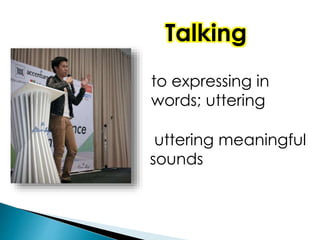
Talking
to expressing in
words; uttering
uttering meaningful
sounds
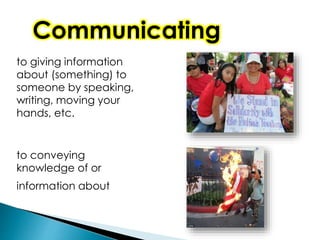
to giving information
about (something) to
someone by speaking,
writing, moving your
hands, etc.
Communicating
to conveying
knowledge of or
information about
Some of the communication barriers during
conversation include:
• The use of jargon. Over-complicated, unfamiliar
and/or technical terms.
• Lack of attention, interest, distractions, or
irrelevance to the receiver.
• Differences in perception and viewpoint.
• Physical disabilities such as hearing problems or
speech difficulties.
• Language differences and the difficulty in
understanding unfamiliar accents.
• People often hear what they expect to hear rather
than what is actually said and jump to incorrect
conclusions.
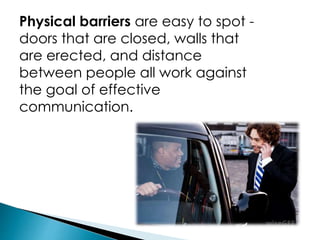
Physical barriers are easy to spot -
doors that are closed, walls that
are erected, and distance
between people all work against
the goal of effective
communication.
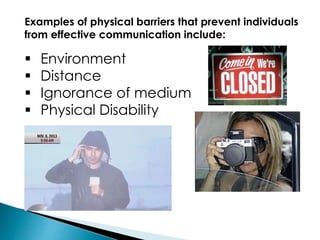
Examples of physical barriers that prevent individuals
from effective communication include:
 Environment
 Distance
 Ignorance of medium
 Physical Disability
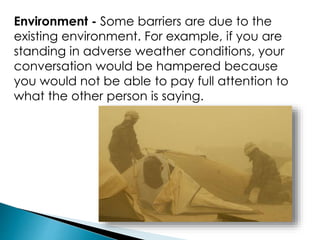
Environment - Some barriers are due to the
existing environment. For example, if you are
standing in adverse weather conditions, your
conversation would be hampered because
you would not be able to pay full attention to
what the other person is saying.
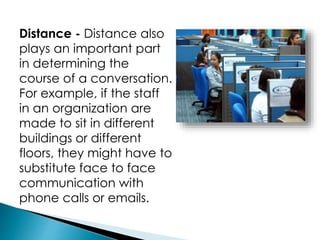
Distance - Distance also
plays an important part
in determining the
course of a conversation.
For example, if the staff
in an organization are
made to sit in different
buildings or different
floors, they might have to
substitute face to face
communication with
phone calls or emails.
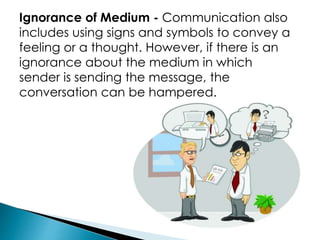
Ignorance of Medium - Communication also
includes using signs and symbols to convey a
feeling or a thought. However, if there is an
ignorance about the medium in which
sender is sending the message, the
conversation can be hampered.
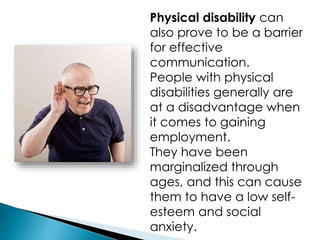
Physical disability can
also prove to be a barrier
for effective
communication.
People with physical
disabilities generally are
at a disadvantage when
it comes to gaining
employment.
They have been
marginalized through
ages, and this can cause
them to have a low self-
esteem and social
anxiety.
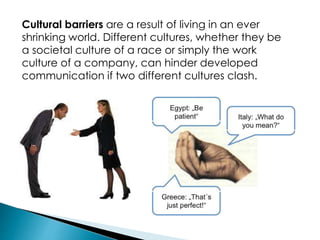
Cultural barriers are a result of living in an ever
shrinking world. Different cultures, whether they be
a societal culture of a race or simply the work
culture of a company, can hinder developed
communication if two different cultures clash.
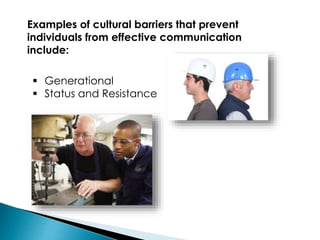
Examples of cultural barriers that prevent
individuals from effective communication
include:
 Generational
 Status and Resistance
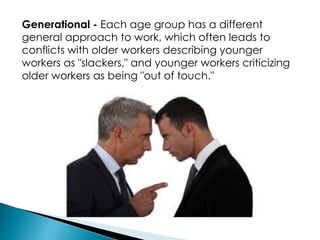
Generational - Each age group has a different
general approach to work, which often leads to
conflicts with older workers describing younger
workers as "slackers," and younger workers criticizing
older workers as being "out of touch."
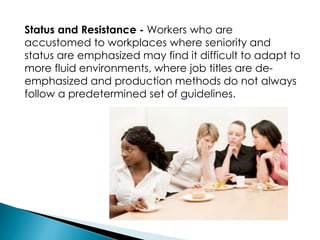
Status and Resistance - Workers who are
accustomed to workplaces where seniority and
status are emphasized may find it difficult to adapt to
more fluid environments, where job titles are de-
emphasized and production methods do not always
follow a predetermined set of guidelines.
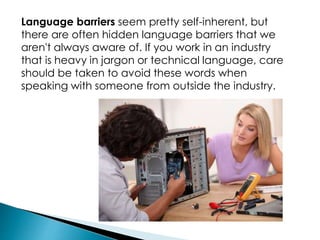
Language barriers seem pretty self-inherent, but
there are often hidden language barriers that we
aren't always aware of. If you work in an industry
that is heavy in jargon or technical language, care
should be taken to avoid these words when
speaking with someone from outside the industry.
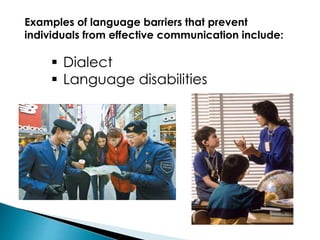
Examples of language barriers that prevent
individuals from effective communication include:
 Dialect
 Language disabilities
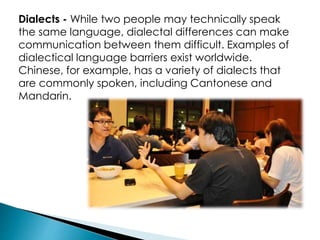
Dialects - While two people may technically speak
the same language, dialectal differences can make
communication between them difficult. Examples of
dialectical language barriers exist worldwide.
Chinese, for example, has a variety of dialects that
are commonly spoken, including Cantonese and
Mandarin.
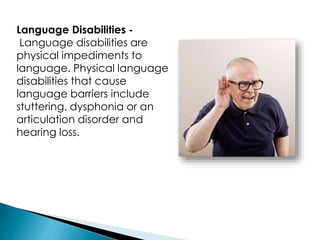
Language Disabilities -
Language disabilities are
physical impediments to
language. Physical language
disabilities that cause
language barriers include
stuttering, dysphonia or an
articulation disorder and
hearing loss.
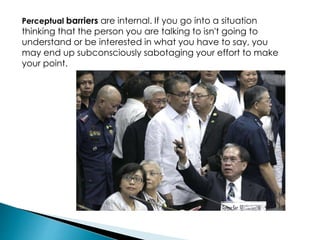
Perceptual barriers are internal. If you go into a situation
thinking that the person you are talking to isn't going to
understand or be interested in what you have to say, you
may end up subconsciously sabotaging your effort to make
your point.
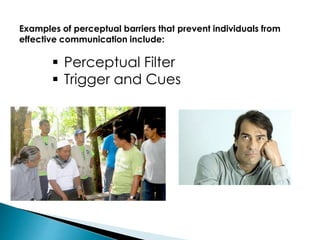
Examples of perceptual barriers that prevent individuals from
effective communication include:
 Perceptual Filter
 Trigger and Cues
Perceptual Filters - We all have our own preferences,
values, attitudes, origins and life experiences that act
as "filters" on our experiences of people, events and
information. Seeing things through the lens of our own
unique life experiences or "conditioning" may lead to
assumptions, stereotyping and misunderstandings of
others whose experiences differ from our own.
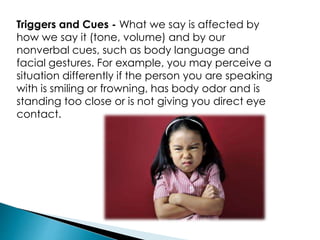
Triggers and Cues - What we say is affected by
how we say it (tone, volume) and by our
nonverbal cues, such as body language and
facial gestures. For example, you may perceive a
situation differently if the person you are speaking
with is smiling or frowning, has body odor and is
standing too close or is not giving you direct eye
contact.
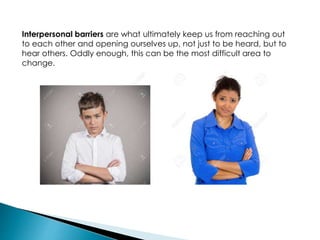
Interpersonal barriers are what ultimately keep us from reaching out
to each other and opening ourselves up, not just to be heard, but to
hear others. Oddly enough, this can be the most difficult area to
change.
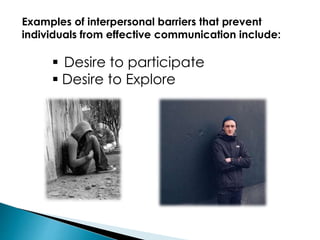
Examples of interpersonal barriers that prevent
individuals from effective communication include:
 Desire to participate
 Desire to Explore
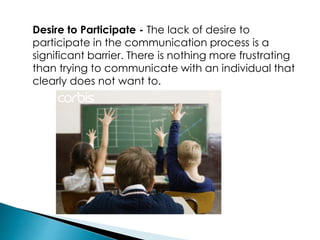
Desire to Participate - The lack of desire to
participate in the communication process is a
significant barrier. There is nothing more frustrating
than trying to communicate with an individual that
clearly does not want to.
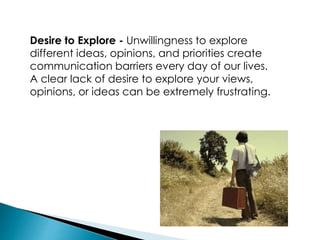
Desire to Explore - Unwillingness to explore
different ideas, opinions, and priorities create
communication barriers every day of our lives.
A clear lack of desire to explore your views,
opinions, or ideas can be extremely frustrating.
Gender barriers have become less of an issue in recent years,
but there is still the possibility for a man to misconstrue the
words of a woman, or vice versa.
To overcome gender barriers within the workplace,
here are some helpful hints:
Educate Team About Gender Bias. Bias is
embedded in stereotypes and organizational
practices that can be hard to detect, but when
people are made aware of it, they see possibilities
for change.
Create Safe "Identity Workspaces". Companies
should encourage women to build communities in
which similarly positioned women can discuss their
feedback, compare notes, and emotionally
support one another's learning.
 Women talk about other people. Men talk about
tangible things like business, sports, food and drinks.
 Women ask questions to gain an understanding. Men
talk to give information rather than asking questions.
 Women are more likely to talk to other women when
a problem or conflict arises. Men are often known for
dealing with problems or issues internally
 Women focus on feelings, senses and meaning. They
rely on their intuition to find answers. Men focus on
facts, reason and logic. They find answers by
analyzing and figuring things out.
 A disagreement between women affects many
aspects of their relationship and may take a long time
to resolve. Men can argue or disagree and then
move on quickly from the conflict.
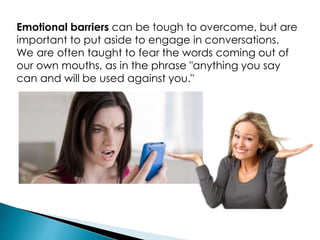
Emotional barriers can be tough to overcome, but are
important to put aside to engage in conversations.
We are often taught to fear the words coming out of
our own mouths, as in the phrase "anything you say
can and will be used against you."
Anger - Anger can affect the way your brain processes
information given to you. For example, angry people have
difficulty processing logical statements, limiting their ability to
accept explanations and solutions offered by others
Pride - The need to be right all the time will not only annoy
others, it can shut down effective communication. For
example, you might focus only on your perspective, or you
might come up with ways to shoot down other people before
you even listen to their points.
Anxiousness - Anxiety has a negative impact on the part of
your brain that manages creativity and communication skills.
For example, your constant worries can hinder your ability to
concentrate on the information you are giving or receiving.
Examples of emotional barriers that prevent individuals
from effective communication include:
Communication is not a one-
way street. To have others
open up to you, you must be
open yourself. By
overcoming the seven
barriers to communication,
you can ensure that the
statement you are making is
not just heard, but also
understood, by the person
you are speaking with. In this
way, you can be confident
that your point has been
expressed.

Barriers in Communication

  • 2.
    Most people wouldagree that communication between two individuals should be simple. When you communicate, you are successful in getting your point across to the person you're talking to. It's important to remember that there are differences between talking and communicating. When we talk, we tend to erect barriers that hinder our ability to communicate.
  • 3.
    Talking to expressing in words;uttering uttering meaningful sounds
  • 4.
    to giving information about(something) to someone by speaking, writing, moving your hands, etc. Communicating to conveying knowledge of or information about
  • 5.
    Some of thecommunication barriers during conversation include: • The use of jargon. Over-complicated, unfamiliar and/or technical terms. • Lack of attention, interest, distractions, or irrelevance to the receiver. • Differences in perception and viewpoint. • Physical disabilities such as hearing problems or speech difficulties. • Language differences and the difficulty in understanding unfamiliar accents. • People often hear what they expect to hear rather than what is actually said and jump to incorrect conclusions.
  • 6.
    Physical barriers areeasy to spot - doors that are closed, walls that are erected, and distance between people all work against the goal of effective communication.
  • 7.
    Examples of physicalbarriers that prevent individuals from effective communication include:  Environment  Distance  Ignorance of medium  Physical Disability
  • 8.
    Environment - Somebarriers are due to the existing environment. For example, if you are standing in adverse weather conditions, your conversation would be hampered because you would not be able to pay full attention to what the other person is saying.
  • 9.
    Distance - Distancealso plays an important part in determining the course of a conversation. For example, if the staff in an organization are made to sit in different buildings or different floors, they might have to substitute face to face communication with phone calls or emails.
  • 10.
    Ignorance of Medium- Communication also includes using signs and symbols to convey a feeling or a thought. However, if there is an ignorance about the medium in which sender is sending the message, the conversation can be hampered.
  • 11.
    Physical disability can alsoprove to be a barrier for effective communication. People with physical disabilities generally are at a disadvantage when it comes to gaining employment. They have been marginalized through ages, and this can cause them to have a low self- esteem and social anxiety.
  • 12.
    Cultural barriers area result of living in an ever shrinking world. Different cultures, whether they be a societal culture of a race or simply the work culture of a company, can hinder developed communication if two different cultures clash.
  • 13.
    Examples of culturalbarriers that prevent individuals from effective communication include:  Generational  Status and Resistance
  • 14.
    Generational - Eachage group has a different general approach to work, which often leads to conflicts with older workers describing younger workers as "slackers," and younger workers criticizing older workers as being "out of touch."
  • 15.
    Status and Resistance- Workers who are accustomed to workplaces where seniority and status are emphasized may find it difficult to adapt to more fluid environments, where job titles are de- emphasized and production methods do not always follow a predetermined set of guidelines.
  • 16.
    Language barriers seempretty self-inherent, but there are often hidden language barriers that we aren't always aware of. If you work in an industry that is heavy in jargon or technical language, care should be taken to avoid these words when speaking with someone from outside the industry.
  • 17.
    Examples of languagebarriers that prevent individuals from effective communication include:  Dialect  Language disabilities
  • 18.
    Dialects - Whiletwo people may technically speak the same language, dialectal differences can make communication between them difficult. Examples of dialectical language barriers exist worldwide. Chinese, for example, has a variety of dialects that are commonly spoken, including Cantonese and Mandarin.
  • 19.
    Language Disabilities - Languagedisabilities are physical impediments to language. Physical language disabilities that cause language barriers include stuttering, dysphonia or an articulation disorder and hearing loss.
  • 20.
    Perceptual barriers areinternal. If you go into a situation thinking that the person you are talking to isn't going to understand or be interested in what you have to say, you may end up subconsciously sabotaging your effort to make your point.
  • 21.
    Examples of perceptualbarriers that prevent individuals from effective communication include:  Perceptual Filter  Trigger and Cues
  • 22.
    Perceptual Filters -We all have our own preferences, values, attitudes, origins and life experiences that act as "filters" on our experiences of people, events and information. Seeing things through the lens of our own unique life experiences or "conditioning" may lead to assumptions, stereotyping and misunderstandings of others whose experiences differ from our own.
  • 23.
    Triggers and Cues- What we say is affected by how we say it (tone, volume) and by our nonverbal cues, such as body language and facial gestures. For example, you may perceive a situation differently if the person you are speaking with is smiling or frowning, has body odor and is standing too close or is not giving you direct eye contact.
  • 24.
    Interpersonal barriers arewhat ultimately keep us from reaching out to each other and opening ourselves up, not just to be heard, but to hear others. Oddly enough, this can be the most difficult area to change.
  • 25.
    Examples of interpersonalbarriers that prevent individuals from effective communication include:  Desire to participate  Desire to Explore
  • 26.
    Desire to Participate- The lack of desire to participate in the communication process is a significant barrier. There is nothing more frustrating than trying to communicate with an individual that clearly does not want to.
  • 27.
    Desire to Explore- Unwillingness to explore different ideas, opinions, and priorities create communication barriers every day of our lives. A clear lack of desire to explore your views, opinions, or ideas can be extremely frustrating.
  • 28.
    Gender barriers havebecome less of an issue in recent years, but there is still the possibility for a man to misconstrue the words of a woman, or vice versa.
  • 29.
    To overcome genderbarriers within the workplace, here are some helpful hints: Educate Team About Gender Bias. Bias is embedded in stereotypes and organizational practices that can be hard to detect, but when people are made aware of it, they see possibilities for change. Create Safe "Identity Workspaces". Companies should encourage women to build communities in which similarly positioned women can discuss their feedback, compare notes, and emotionally support one another's learning.
  • 30.
     Women talkabout other people. Men talk about tangible things like business, sports, food and drinks.  Women ask questions to gain an understanding. Men talk to give information rather than asking questions.  Women are more likely to talk to other women when a problem or conflict arises. Men are often known for dealing with problems or issues internally  Women focus on feelings, senses and meaning. They rely on their intuition to find answers. Men focus on facts, reason and logic. They find answers by analyzing and figuring things out.  A disagreement between women affects many aspects of their relationship and may take a long time to resolve. Men can argue or disagree and then move on quickly from the conflict.
  • 31.
    Emotional barriers canbe tough to overcome, but are important to put aside to engage in conversations. We are often taught to fear the words coming out of our own mouths, as in the phrase "anything you say can and will be used against you."
  • 32.
    Anger - Angercan affect the way your brain processes information given to you. For example, angry people have difficulty processing logical statements, limiting their ability to accept explanations and solutions offered by others Pride - The need to be right all the time will not only annoy others, it can shut down effective communication. For example, you might focus only on your perspective, or you might come up with ways to shoot down other people before you even listen to their points. Anxiousness - Anxiety has a negative impact on the part of your brain that manages creativity and communication skills. For example, your constant worries can hinder your ability to concentrate on the information you are giving or receiving. Examples of emotional barriers that prevent individuals from effective communication include:
  • 33.
    Communication is nota one- way street. To have others open up to you, you must be open yourself. By overcoming the seven barriers to communication, you can ensure that the statement you are making is not just heard, but also understood, by the person you are speaking with. In this way, you can be confident that your point has been expressed.