LESSON 1
NETFLI
X
• What is the role of philosophy in understanding the self?
• What are the different concepts of the self from the
philosophical view?
• What are the various concepts of the self and identify their
similarities?
• How to develop your own philosophy of the self?
what is
philosophy?
PHILOSOPHY IS ABOUT
Finding answers to serious questions about ourselves and about the world we
live in:
What is morally right and wrong? And why?
What is a good life?
Does God exist?
What is the mind? And much, much more
Questioning existing knowledge and intuitions to get closer to the truth.
What will you get out of
philosophy?
The skills are critical thinking skills, argument
skills, communication, reasoning, problem
solving, analysis and much more.
You can justify your opinion and spot a bad
argument what ever the topic is. You can explain
to people why you are right and they are wrong.
Lastly, philosophy basically teaches you to think.
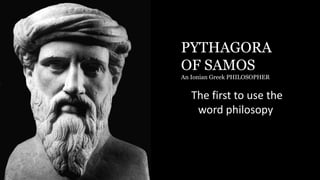
PYTHAGORA
OF SAMOS
An Ionian Greek PHILOSOPHER
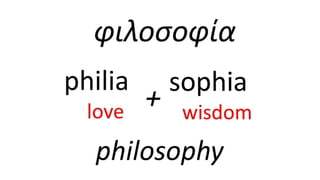
The first to use the
word philosopy
The origin of
philosophy and
logic
The people tend to
search for truth
Search is to look for
something
Search for meaning
Search for answers
Search for importance
Search for significance
Search for value
Search for relevance
Philosophy tends to ask
a lot of questions
PHILOSOPHY
AND THE SELF
HYPATIA OF ALEXANDRIA
Ancient Greek philosopher,
mathematician and astronomer
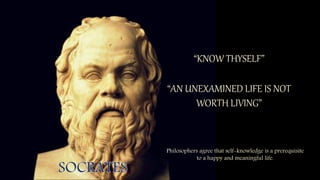
“KNOW THYSELF”
Philosophers agree that self-knowledge is a prerequisite
to a happy and meaningful life.
“AN UNEXAMINED LIFE IS NOT
WORTH LIVING”
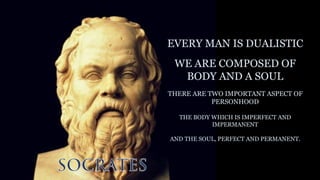
EVERY MAN IS DUALISTIC
WE ARE COMPOSED OF
BODY AND A SOUL
THERE ARE TWO IMPORTANT ASPECT OF
PERSONHOOD
THE BODY WHICH IS IMPERFECT AND
IMPERMANENT
AND THE SOUL, PERFECT AND PERMANENT.
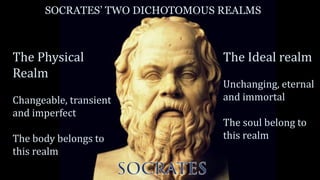
SOCRATES’ TWO DICHOTOMOUS REALMS
The Physical
Realm
Changeable, transient
and imperfect
The body belongs to
this realm
The Ideal realm
Unchanging, eternal
and immortal
The soul belong to
this realm
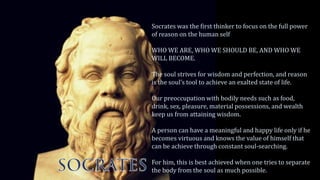
Socrates was the first thinker to focus on the full power
of reason on the human self
WHO WE ARE, WHO WE SHOULD BE, AND WHO WE
WILL BECOME.
The soul strives for wisdom and perfection, and reason
is the soul’s tool to achieve an exalted state of life.
Our preoccupation with bodily needs such as food,
drink, sex, pleasure, material possessions, and wealth
keep us from attaining wisdom.
A person can have a meaningful and happy life only if he
becomes virtuous and knows the value of himself that
can be achieve through constant soul-searching.
For him, this is best achieved when one tries to separate
the body from the soul as much possible.
plato
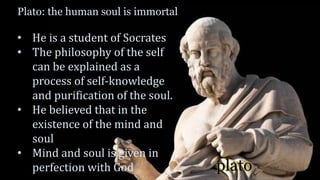
Plato: the human soul is immortal
• He is a student of Socrates
• The philosophy of the self
can be explained as a
process of self-knowledge
and purification of the soul.
• He believed that in the
existence of the mind and
soul
• Mind and soul is given in
perfection with God
plato
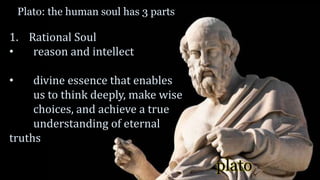
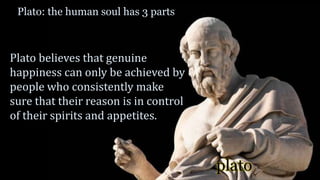
Plato: the human soul has 3 parts
1. Rational Soul
• reason and intellect
• divine essence that enables
us to think deeply, make wise
choices, and achieve a true
understanding of eternal
truths
plato
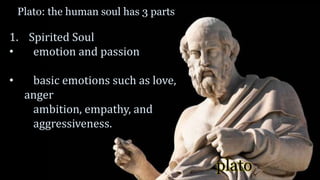
Plato: the human soul has 3 parts
1. Spirited Soul
• emotion and passion
• basic emotions such as love,
anger
ambition, empathy, and
aggressiveness.
plato
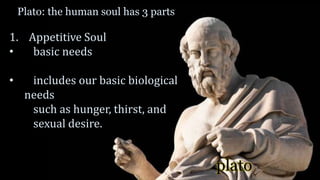
Plato: the human soul has 3 parts
1. Appetitive Soul
• basic needs
• includes our basic biological
needs
such as hunger, thirst, and
sexual desire.
plato
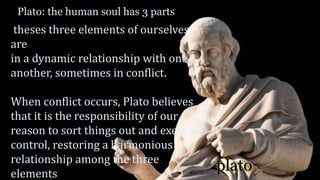
Plato: the human soul has 3 parts
theses three elements of ourselves
are
in a dynamic relationship with one
another, sometimes in conflict.
When conflict occurs, Plato believes
that it is the responsibility of our
reason to sort things out and exert
control, restoring a harmonious
relationship among the three
elements
plato
Plato: the human soul has 3 parts
Plato believes that genuine
happiness can only be achieved by
people who consistently make
sure that their reason is in control
of their spirits and appetites.
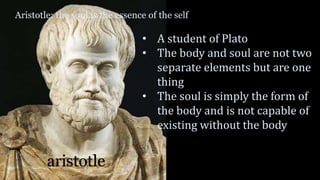
Aristotle: the soul is the essence of the self
aristotle
• A student of Plato
• The body and soul are not two
separate elements but are one
thing
• The soul is simply the form of
the body and is not capable of
existing without the body
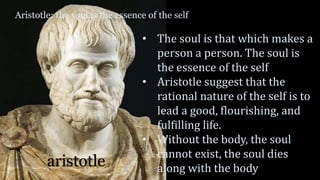
Aristotle: the soul is the essence of the self
aristotle
• The soul is that which makes a
person a person. The soul is
the essence of the self
• Aristotle suggest that the
rational nature of the self is to
lead a good, flourishing, and
fulfilling life.
• Without the body, the soul
cannot exist, the soul dies
along with the body
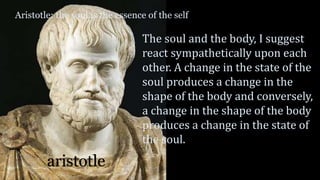
Aristotle: the soul is the essence of the self
aristotle
The soul and the body, I suggest
react sympathetically upon each
other. A change in the state of the
soul produces a change in the
shape of the body and conversely,
a change in the shape of the body
produces a change in the state of
the soul.
Aristotle: the soul is the essence of the self
aristotle
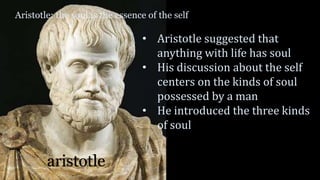
• Aristotle suggested that
anything with life has soul
• His discussion about the self
centers on the kinds of soul
possessed by a man
• He introduced the three kinds
of soul
Aristotle: the three kinds of soul
aristotle
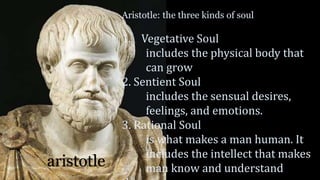
1. Vegetative Soul
includes the physical body that
can grow
2. Sentient Soul
includes the sensual desires,
feelings, and emotions.
3. Rational Soul
is what makes a man human. It
includes the intellect that makes
man know and understand
Aristotle: the three kinds of soul
aristotle
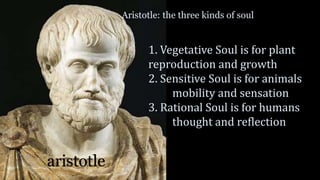
1. Vegetative Soul is for plant
reproduction and growth
2. Sensitive Soul is for animals
mobility and sensation
3. Rational Soul is for humans
thought and reflection
St. Augustine: I am doubting, therefore I am
ST. AUGUSTINE
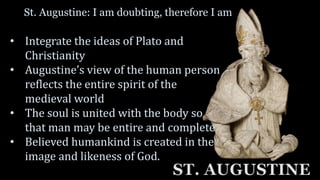
• Integrate the ideas of Plato and
Christianity
• Augustine’s view of the human person
reflects the entire spirit of the
medieval world
• The soul is united with the body so
that man may be entire and complete
• Believed humankind is created in the
image and likeness of God.
St. Augustine: I am doubting, therefore I am
ST. AUGUSTINE
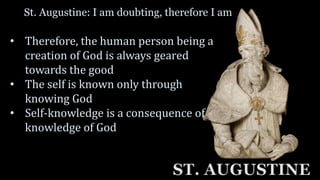
• Therefore, the human person being a
creation of God is always geared
towards the good
• The self is known only through
knowing God
• Self-knowledge is a consequence of
knowledge of God
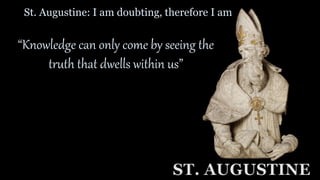
St. Augustine: I am doubting, therefore I am
ST. AUGUSTINE
“Knowledge can only come by seeing the
truth that dwells within us”
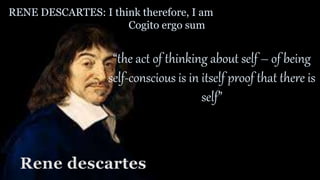
RENE DESCARTES: I think therefore, I am
Cogito ergo sum
“the act of thinking about self – of being
self-conscious is in itself proof that there is
self”
Rene descartes
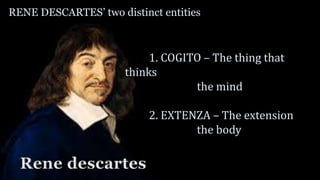
RENE DESCARTES’ two distinct entities
Rene descartes
1. COGITO – The thing that
thinks
the mind
2. EXTENZA – The extension
the body
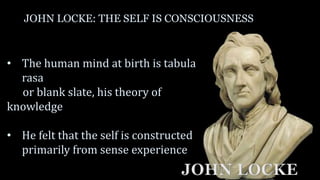
JOHN LOCKE: THE SELF IS CONSCIOUSNESS
• The human mind at birth is tabula
rasa
or blank slate, his theory of
knowledge
• He felt that the self is constructed
primarily from sense experience
JOHN LOCKE
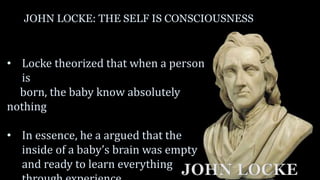
JOHN LOCKE: THE SELF IS CONSCIOUSNESS
• Locke theorized that when a person
is
born, the baby know absolutely
nothing
• In essence, he a argued that the
inside of a baby’s brain was empty
and ready to learn everything
JOHN LOCKE
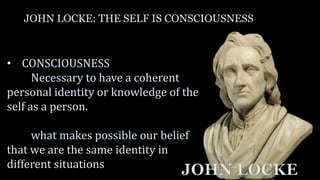
JOHN LOCKE: THE SELF IS CONSCIOUSNESS
• CONSCIOUSNESS
Necessary to have a coherent
personal identity or knowledge of the
self as a person.
what makes possible our belief
that we are the same identity in
different situations
JOHN LOCKE
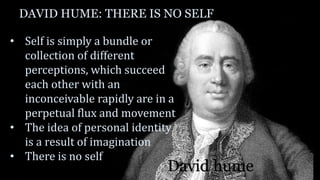
DAVID HUME: THERE IS NO SELF
• Self is simply a bundle or
collection of different
perceptions, which succeed
each other with an
inconceivable rapidly are in a
perpetual flux and movement
• The idea of personal identity
is a result of imagination
• There is no self
David hume
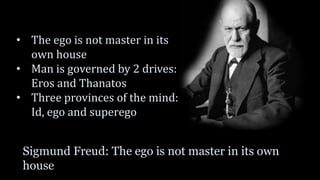
Sigmund Freud: The ego is not master in its own
house
• The ego is not master in its
own house
• Man is governed by 2 drives:
Eros and Thanatos
• Three provinces of the mind:
Id, ego and superego
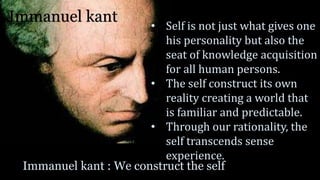
Immanuel kant : We construct the self
Immanuel kant
• Self is not just what gives one
his personality but also the
seat of knowledge acquisition
for all human persons.
• The self construct its own
reality creating a world that
is familiar and predictable.
• Through our rationality, the
self transcends sense
experience.
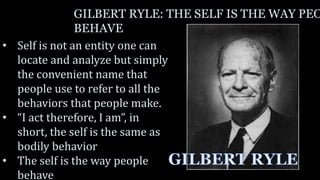
GILBERT RYLE: THE SELF IS THE WAY PEO
BEHAVE
• Self is not an entity one can
locate and analyze but simply
the convenient name that
people use to refer to all the
behaviors that people make.
• “I act therefore, I am”, in
short, the self is the same as
bodily behavior
• The self is the way people
behave
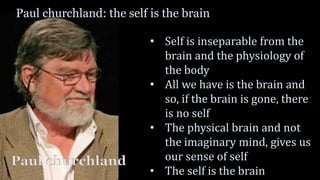
Paul churchland: the self is the brain
• Self is inseparable from the
brain and the physiology of
the body
• All we have is the brain and
so, if the brain is gone, there
is no self
• The physical brain and not
the imaginary mind, gives us
our sense of self
• The self is the brain
Paul churchland
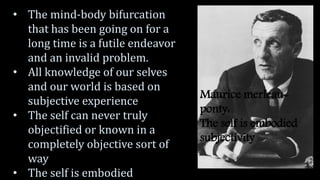
Maurice merleau-
ponty:
The self is embodied
subjectivity
• The mind-body bifurcation
that has been going on for a
long time is a futile endeavor
and an invalid problem.
• All knowledge of our selves
and our world is based on
subjective experience
• The self can never truly
objectified or known in a
completely objective sort of
way
• The self is embodied

Understanding the self in philosophical perspective

  • 2.
    LESSON 1 NETFLI X • Whatis the role of philosophy in understanding the self? • What are the different concepts of the self from the philosophical view? • What are the various concepts of the self and identify their similarities? • How to develop your own philosophy of the self?
  • 3.
    what is philosophy? PHILOSOPHY ISABOUT Finding answers to serious questions about ourselves and about the world we live in: What is morally right and wrong? And why? What is a good life? Does God exist? What is the mind? And much, much more Questioning existing knowledge and intuitions to get closer to the truth.
  • 4.
    What will youget out of philosophy? The skills are critical thinking skills, argument skills, communication, reasoning, problem solving, analysis and much more. You can justify your opinion and spot a bad argument what ever the topic is. You can explain to people why you are right and they are wrong. Lastly, philosophy basically teaches you to think.
  • 6.
    PYTHAGORA OF SAMOS An IonianGreek PHILOSOPHER The first to use the word philosopy
  • 7.
    The origin of philosophyand logic The people tend to search for truth Search is to look for something Search for meaning Search for answers Search for importance Search for significance Search for value Search for relevance Philosophy tends to ask a lot of questions
  • 8.
    PHILOSOPHY AND THE SELF HYPATIAOF ALEXANDRIA Ancient Greek philosopher, mathematician and astronomer
  • 9.
    “KNOW THYSELF” Philosophers agreethat self-knowledge is a prerequisite to a happy and meaningful life. “AN UNEXAMINED LIFE IS NOT WORTH LIVING”
  • 10.
    EVERY MAN ISDUALISTIC WE ARE COMPOSED OF BODY AND A SOUL THERE ARE TWO IMPORTANT ASPECT OF PERSONHOOD THE BODY WHICH IS IMPERFECT AND IMPERMANENT AND THE SOUL, PERFECT AND PERMANENT.
  • 11.
    SOCRATES’ TWO DICHOTOMOUSREALMS The Physical Realm Changeable, transient and imperfect The body belongs to this realm The Ideal realm Unchanging, eternal and immortal The soul belong to this realm
  • 12.
    Socrates was thefirst thinker to focus on the full power of reason on the human self WHO WE ARE, WHO WE SHOULD BE, AND WHO WE WILL BECOME. The soul strives for wisdom and perfection, and reason is the soul’s tool to achieve an exalted state of life. Our preoccupation with bodily needs such as food, drink, sex, pleasure, material possessions, and wealth keep us from attaining wisdom. A person can have a meaningful and happy life only if he becomes virtuous and knows the value of himself that can be achieve through constant soul-searching. For him, this is best achieved when one tries to separate the body from the soul as much possible.
  • 13.
    plato Plato: the humansoul is immortal • He is a student of Socrates • The philosophy of the self can be explained as a process of self-knowledge and purification of the soul. • He believed that in the existence of the mind and soul • Mind and soul is given in perfection with God
  • 14.
    plato Plato: the humansoul has 3 parts 1. Rational Soul • reason and intellect • divine essence that enables us to think deeply, make wise choices, and achieve a true understanding of eternal truths
  • 15.
    plato Plato: the humansoul has 3 parts 1. Spirited Soul • emotion and passion • basic emotions such as love, anger ambition, empathy, and aggressiveness.
  • 16.
    plato Plato: the humansoul has 3 parts 1. Appetitive Soul • basic needs • includes our basic biological needs such as hunger, thirst, and sexual desire.
  • 17.
    plato Plato: the humansoul has 3 parts theses three elements of ourselves are in a dynamic relationship with one another, sometimes in conflict. When conflict occurs, Plato believes that it is the responsibility of our reason to sort things out and exert control, restoring a harmonious relationship among the three elements
  • 18.
    plato Plato: the humansoul has 3 parts Plato believes that genuine happiness can only be achieved by people who consistently make sure that their reason is in control of their spirits and appetites.
  • 19.
    Aristotle: the soulis the essence of the self aristotle • A student of Plato • The body and soul are not two separate elements but are one thing • The soul is simply the form of the body and is not capable of existing without the body
  • 20.
    Aristotle: the soulis the essence of the self aristotle • The soul is that which makes a person a person. The soul is the essence of the self • Aristotle suggest that the rational nature of the self is to lead a good, flourishing, and fulfilling life. • Without the body, the soul cannot exist, the soul dies along with the body
  • 21.
    Aristotle: the soulis the essence of the self aristotle The soul and the body, I suggest react sympathetically upon each other. A change in the state of the soul produces a change in the shape of the body and conversely, a change in the shape of the body produces a change in the state of the soul.
  • 22.
    Aristotle: the soulis the essence of the self aristotle • Aristotle suggested that anything with life has soul • His discussion about the self centers on the kinds of soul possessed by a man • He introduced the three kinds of soul
  • 23.
    Aristotle: the threekinds of soul aristotle 1. Vegetative Soul includes the physical body that can grow 2. Sentient Soul includes the sensual desires, feelings, and emotions. 3. Rational Soul is what makes a man human. It includes the intellect that makes man know and understand
  • 24.
    Aristotle: the threekinds of soul aristotle 1. Vegetative Soul is for plant reproduction and growth 2. Sensitive Soul is for animals mobility and sensation 3. Rational Soul is for humans thought and reflection
  • 25.
    St. Augustine: Iam doubting, therefore I am ST. AUGUSTINE • Integrate the ideas of Plato and Christianity • Augustine’s view of the human person reflects the entire spirit of the medieval world • The soul is united with the body so that man may be entire and complete • Believed humankind is created in the image and likeness of God.
  • 26.
    St. Augustine: Iam doubting, therefore I am ST. AUGUSTINE • Therefore, the human person being a creation of God is always geared towards the good • The self is known only through knowing God • Self-knowledge is a consequence of knowledge of God
  • 27.
    St. Augustine: Iam doubting, therefore I am ST. AUGUSTINE “Knowledge can only come by seeing the truth that dwells within us”
  • 28.
    RENE DESCARTES: Ithink therefore, I am Cogito ergo sum “the act of thinking about self – of being self-conscious is in itself proof that there is self” Rene descartes
  • 29.
    RENE DESCARTES’ twodistinct entities Rene descartes 1. COGITO – The thing that thinks the mind 2. EXTENZA – The extension the body
  • 30.
    JOHN LOCKE: THESELF IS CONSCIOUSNESS • The human mind at birth is tabula rasa or blank slate, his theory of knowledge • He felt that the self is constructed primarily from sense experience JOHN LOCKE
  • 31.
    JOHN LOCKE: THESELF IS CONSCIOUSNESS • Locke theorized that when a person is born, the baby know absolutely nothing • In essence, he a argued that the inside of a baby’s brain was empty and ready to learn everything JOHN LOCKE
  • 32.
    JOHN LOCKE: THESELF IS CONSCIOUSNESS • CONSCIOUSNESS Necessary to have a coherent personal identity or knowledge of the self as a person. what makes possible our belief that we are the same identity in different situations JOHN LOCKE
  • 33.
    DAVID HUME: THEREIS NO SELF • Self is simply a bundle or collection of different perceptions, which succeed each other with an inconceivable rapidly are in a perpetual flux and movement • The idea of personal identity is a result of imagination • There is no self David hume
  • 34.
    Sigmund Freud: Theego is not master in its own house • The ego is not master in its own house • Man is governed by 2 drives: Eros and Thanatos • Three provinces of the mind: Id, ego and superego
  • 35.
    Immanuel kant :We construct the self Immanuel kant • Self is not just what gives one his personality but also the seat of knowledge acquisition for all human persons. • The self construct its own reality creating a world that is familiar and predictable. • Through our rationality, the self transcends sense experience.
  • 36.
    GILBERT RYLE: THESELF IS THE WAY PEO BEHAVE • Self is not an entity one can locate and analyze but simply the convenient name that people use to refer to all the behaviors that people make. • “I act therefore, I am”, in short, the self is the same as bodily behavior • The self is the way people behave
  • 37.
    Paul churchland: theself is the brain • Self is inseparable from the brain and the physiology of the body • All we have is the brain and so, if the brain is gone, there is no self • The physical brain and not the imaginary mind, gives us our sense of self • The self is the brain Paul churchland
  • 38.
    Maurice merleau- ponty: The selfis embodied subjectivity • The mind-body bifurcation that has been going on for a long time is a futile endeavor and an invalid problem. • All knowledge of our selves and our world is based on subjective experience • The self can never truly objectified or known in a completely objective sort of way • The self is embodied