Communication for
work purposes
2
Learning Outcomes
1. Create clear, coherent, and effective materials
2. Present ideas persuasively using appropriate language
registers, tone, facial expressions, and gestures
3. Adopt awareness of audience and context in
presenting ideas
Lesson 7-A outline:
1. Workplace Communication
2. Business Letters
3. Memos
3
a.
workplace
communication
4
Workplace communication
- is a discipline of its own that is unlike academic or
scholastic writing.
- serves specific purposes for particular individuals,
groups, organizations, or departments.
5
3 things to consider in communicating in the
workplace :
1. Purpose
a) Am I writing primarily to create a record, to
request/provide information, or to persuade?
b) What am I trying to say?
6
2. Audience (Searles, 2014)
a) Who will read what I have written?
b) What are their job titles and/or areas of
responsibility?
c) What do they already know about the specific
situation?
d) Why do they need this information?
e) What do I want them to do as a result of
receiving it?
f) What factors might influence their response?
7
Broad categories of workplace communication
a) Upward Communication
- from your position to an audience above you in the job
hierarchy
Example: a response to a letter from your manager
b) Lateral Communication
- between you and an audience within your level of hierarachy
Example: a phone call to/from a co-worker you are collaborating with
8
c) Downward Communication
- from your position to an audience below you in the job
hierarchy
Example: an oral reminder to a trainee
d) Outward Communication
- between you and a company that you do business with or an
audience outside your workplace
Example: a letter of inquiry addressed to a supplier regarding a
delivery to your office
9
3. Tone
- it will set how your target audience will accept what
you are trying to say.
- you do not have to sound tough, demanding, or
condescending in your discourse especially in sensitive
subjects or issues
10
2 kinds of approaches (searles, 2014)
11
Writer-Centered Reader-Centered
I’d be happy to assist you with
your concern.
If you have any concern, I’d be
happy to assist you.
We will send you a copy of your
request…
The copy you requested has
already been sent…
I’m happy to let you know… You will be glad to know that….
12
Negative Positive
I cannot process your request for
a credit in your account unless it
has…
Your request for a credit in your
account will be processed after
it.
been investigated by the fraud
department.
has been investigated.
We are closed after 5:00 PM
daily.
You may visit us daily before
5:00 PM.
Wait for our call regarding your
concern.
Please be advised that you can
expect a call from us regarding
your concern.
Positive and Negative Contents
Workplace communication will fail the ethics test if it is
corrupted by any of the following tactics (Searles, 2014):
1. Suppression of information.
2. Falsification or fabrication.
3. Overstatement of understatement.
4. Selective misquoting.
5. Subjective wording.
6. Conflict of interest.
7. Withholding information.
8. Plagiarism.
13
b.
business letters
14
“Business writing refers to memorandums, reports, proposals, e-mails,
and other forms of writing used in organizations to communicate with
internal and external audiences. Business writing is a type of
professional communication. Also known as business communication
and professional writing (Nordquist, 2017).”
“Writing business correspondence like letters and memos is a skill or
potential that must be developed and possess by a person regardless
by his work, profession, or specialization (Mosura, et al., 199).”
15
Parts of a business letter
1. Heading
- includes the return address and the date on the last line.
Example:
The National Teachers College
Quiapo, Manila
Telephone Number
E-mail
January 1, 2018
16
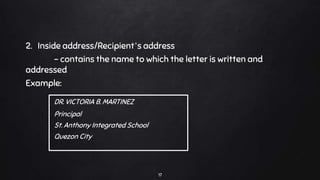
2. Inside address/Recipient’s address
- contains the name to which the letter is written and
addressed
Example:
DR. VICTORIA B. MARTINEZ
Principal
St. Anthony Integrated School
Quezon City
17
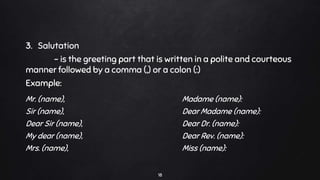
3. Salutation
- is the greeting part that is written in a polite and courteous
manner followed by a comma (,) or a colon (:)
Example:
Mr. (name), Madame (name):
Sir (name), Dear Madame (name):
Dear Sir (name), Dear Dr. (name):
My dear (name), Dear Rev. (name):
Mrs. (name), Miss (name):
18
4. Body of the letter
- contains the main purpose of the letter, the very reason for
writing. It is very important that the body of the letter be written in a
straightforward, simple, and coherent manner.
Example:
“ The undersigned would like to request your good office to grace her an
interview with the one in-charge on the Human Resource Management in your respected
company. This is in line with the expansion that our business is going to have whether we
can consider your business as one of our partners. These all will be depending on the
result of our somehow quick survey and study with your company
The undersigned is fervently hoping for your favorable response.”
19
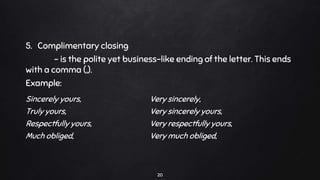
5. Complimentary closing
- is the polite yet business-like ending of the letter. This ends
with a comma (,).
Example:
Sincerely yours, Very sincerely,
Truly yours, Very sincerely yours,
Respectfully yours, Very respectfully yours,
Much obliged, Very much obliged,
20
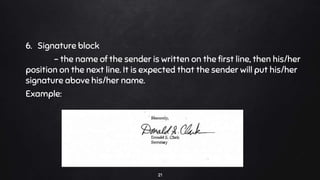
6. Signature block
- the name of the sender is written on the first line, then his/her
position on the next line. It is expected that the sender will put his/her
signature above his/her name.
Example:
21
Formats of a business letter
1. Block.
positions all the parts if the letter to the left, single space, and justified.
2. Modified Block.
all parts of the letter are tabbed on the left, single space, and justified
except the heading and the closing which are tabbed in the center.
3. Semi-block
the paragraphs are indented instead of placing them all on the left.
Heading is on the center , and the date cam be placed in the right side three
spaces after the heading. The recipient’s address is on the left, and the closing
on the right
22
23
Block letter format
24
Modified Block
letter format
25
Semi-block letter
format
Frequently written business letters
1. Letter of Request
26
2. Letter of Inquiry
27
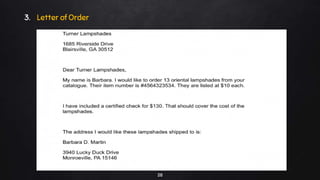
3. Letter of Order
28
4. Letter of Acknowledgement
29
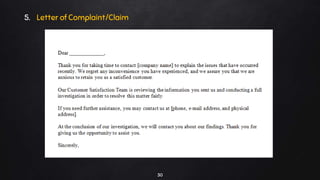
5. Letter of Complaint/Claim
30
6. Letter of Adjustment
31
c.
memos
32
WHAT IS PUBLIC SPEAKING?
- Public speaking is a way of making your ideas
public – of sharing them with other people and of
influencing other people.
33
Three major differences between conversation
and public speaking (lucas, 2015):
1. Public speaking is more highly structured.
2. Public speaking requires more formal language.
3. Public speaking requires a different method of delivery.
34
Several ways of delivering a speech
1. A read speech or reading from a manuscript is the
word-for-word iteration of a written message.
35
Several ways of delivering a speech
2. The memorized speech is the recitation of a written
message that the speaker has memorized.
36
Several ways of delivering a speech
3. An impromptu speech is not rehearsed. This type of
speaking is a presentation of a short message without prior
preparation
37
Several ways of delivering a speech
4. An extemporaneous speech is the presentation of a planned
and rehearsed speech using minimal notes.
38
Guidelines on writing a speech (Lucas, 2015)
1. Focus on your topic.
2. Develop your topic.
3. Organize your speech.
a) Introduction
b) Body
c) Conclusion
39
Elements for a good delivery
1. Volume
2. Pitch
3. Rate
4. Pauses
5. Vocal variety
6. Pronunciation
7. Articulation
8. Movement
9. Gestures
10. Eye contact
40
6 ways to turn nervousness from a negative force
into a positive force (lucas, 2015)
A. Acquire speaking experience
B. Prepare, prepare, prepare.
C. Think positively.
D. Use the power of visualization.
E. Know that most nervousness is not visible.
F. Do not expect perfection.
41
Pieces of advice (Lucas, 2015)
A. Be at your best physically and mentally.
B. As you are waiting to speak, quietly tighten and relax your leg
muscles, or squeeze your hands together and then release them.
C. Take a couple of slow, deep breaths before you start to speak.
D. Work specially hard on your introduction. Once you get through it,
you will be sailing smoothly the rest of the way.
E. Concentrate on communicating with your audience rather than on
worrying about your stage fright.
42
c.
interview
43
WHAT IS AN INTERVIEW?
- An interview is a two-party interaction in which at
least one party has a specific, serious purpose and that
usually involves the asking and answering questions.
44
Characteristics of an interview:
A. Interviews always involve two parties.
B. Interviewing is always purposeful.
C. There is focus on asking and asnwering questions.
45
Planning an interview (adler, 2012)
1. Define the goal.
2. Identify and analyze the other party/respondent.
3. Prepare a list of topics.
4. Choose the best interview structure.
5. Consider possible questions.
6. Arrange the setting.
46
Conducting an interview (adler, et al., 2012)
A. Open with a greeting and an orientation.
B. Perform several tasks during the question-and-answer phase of
the discussion.
C. Close with a satisfactory conclusion.
47
Guidelines for both the interviewer and
interviewee in the conduct of an interview:
A. Formally inform that you will be conducting or attending an
interview.
B. Being punctual is key in making a good impression.
C. Dress to impress.
D. Always start with a strong handshake.
E. Color your words with kindness.
F. Avoid unnecessary stories.
G. Do not lose eye contact during the interview.
H. The magic word is thank you.
48
as smc student,
How will communication for various purposes be
applied to:
1. SMC core values (FAITH, SERVICE, EXCELLENCE)
2. Family, friends, and to the society;
3. Course 49
50
quiz
Communication for
various purposes

Communication for Work Purposes

  • 1.
  • 2.
    2 Learning Outcomes 1. Createclear, coherent, and effective materials 2. Present ideas persuasively using appropriate language registers, tone, facial expressions, and gestures 3. Adopt awareness of audience and context in presenting ideas
  • 3.
    Lesson 7-A outline: 1.Workplace Communication 2. Business Letters 3. Memos 3
  • 4.
  • 5.
    Workplace communication - isa discipline of its own that is unlike academic or scholastic writing. - serves specific purposes for particular individuals, groups, organizations, or departments. 5
  • 6.
    3 things toconsider in communicating in the workplace : 1. Purpose a) Am I writing primarily to create a record, to request/provide information, or to persuade? b) What am I trying to say? 6
  • 7.
    2. Audience (Searles,2014) a) Who will read what I have written? b) What are their job titles and/or areas of responsibility? c) What do they already know about the specific situation? d) Why do they need this information? e) What do I want them to do as a result of receiving it? f) What factors might influence their response? 7
  • 8.
    Broad categories ofworkplace communication a) Upward Communication - from your position to an audience above you in the job hierarchy Example: a response to a letter from your manager b) Lateral Communication - between you and an audience within your level of hierarachy Example: a phone call to/from a co-worker you are collaborating with 8
  • 9.
    c) Downward Communication -from your position to an audience below you in the job hierarchy Example: an oral reminder to a trainee d) Outward Communication - between you and a company that you do business with or an audience outside your workplace Example: a letter of inquiry addressed to a supplier regarding a delivery to your office 9
  • 10.
    3. Tone - itwill set how your target audience will accept what you are trying to say. - you do not have to sound tough, demanding, or condescending in your discourse especially in sensitive subjects or issues 10
  • 11.
    2 kinds ofapproaches (searles, 2014) 11 Writer-Centered Reader-Centered I’d be happy to assist you with your concern. If you have any concern, I’d be happy to assist you. We will send you a copy of your request… The copy you requested has already been sent… I’m happy to let you know… You will be glad to know that….
  • 12.
    12 Negative Positive I cannotprocess your request for a credit in your account unless it has… Your request for a credit in your account will be processed after it. been investigated by the fraud department. has been investigated. We are closed after 5:00 PM daily. You may visit us daily before 5:00 PM. Wait for our call regarding your concern. Please be advised that you can expect a call from us regarding your concern. Positive and Negative Contents
  • 13.
    Workplace communication willfail the ethics test if it is corrupted by any of the following tactics (Searles, 2014): 1. Suppression of information. 2. Falsification or fabrication. 3. Overstatement of understatement. 4. Selective misquoting. 5. Subjective wording. 6. Conflict of interest. 7. Withholding information. 8. Plagiarism. 13
  • 14.
  • 15.
    “Business writing refersto memorandums, reports, proposals, e-mails, and other forms of writing used in organizations to communicate with internal and external audiences. Business writing is a type of professional communication. Also known as business communication and professional writing (Nordquist, 2017).” “Writing business correspondence like letters and memos is a skill or potential that must be developed and possess by a person regardless by his work, profession, or specialization (Mosura, et al., 199).” 15
  • 16.
    Parts of abusiness letter 1. Heading - includes the return address and the date on the last line. Example: The National Teachers College Quiapo, Manila Telephone Number E-mail January 1, 2018 16
  • 17.
    2. Inside address/Recipient’saddress - contains the name to which the letter is written and addressed Example: DR. VICTORIA B. MARTINEZ Principal St. Anthony Integrated School Quezon City 17
  • 18.
    3. Salutation - isthe greeting part that is written in a polite and courteous manner followed by a comma (,) or a colon (:) Example: Mr. (name), Madame (name): Sir (name), Dear Madame (name): Dear Sir (name), Dear Dr. (name): My dear (name), Dear Rev. (name): Mrs. (name), Miss (name): 18
  • 19.
    4. Body ofthe letter - contains the main purpose of the letter, the very reason for writing. It is very important that the body of the letter be written in a straightforward, simple, and coherent manner. Example: “ The undersigned would like to request your good office to grace her an interview with the one in-charge on the Human Resource Management in your respected company. This is in line with the expansion that our business is going to have whether we can consider your business as one of our partners. These all will be depending on the result of our somehow quick survey and study with your company The undersigned is fervently hoping for your favorable response.” 19
  • 20.
    5. Complimentary closing -is the polite yet business-like ending of the letter. This ends with a comma (,). Example: Sincerely yours, Very sincerely, Truly yours, Very sincerely yours, Respectfully yours, Very respectfully yours, Much obliged, Very much obliged, 20
  • 21.
    6. Signature block -the name of the sender is written on the first line, then his/her position on the next line. It is expected that the sender will put his/her signature above his/her name. Example: 21
  • 22.
    Formats of abusiness letter 1. Block. positions all the parts if the letter to the left, single space, and justified. 2. Modified Block. all parts of the letter are tabbed on the left, single space, and justified except the heading and the closing which are tabbed in the center. 3. Semi-block the paragraphs are indented instead of placing them all on the left. Heading is on the center , and the date cam be placed in the right side three spaces after the heading. The recipient’s address is on the left, and the closing on the right 22
  • 23.
  • 24.
  • 25.
  • 26.
    Frequently written businessletters 1. Letter of Request 26
  • 27.
    2. Letter ofInquiry 27
  • 28.
    3. Letter ofOrder 28
  • 29.
    4. Letter ofAcknowledgement 29
  • 30.
    5. Letter ofComplaint/Claim 30
  • 31.
    6. Letter ofAdjustment 31
  • 32.
  • 33.
    WHAT IS PUBLICSPEAKING? - Public speaking is a way of making your ideas public – of sharing them with other people and of influencing other people. 33
  • 34.
    Three major differencesbetween conversation and public speaking (lucas, 2015): 1. Public speaking is more highly structured. 2. Public speaking requires more formal language. 3. Public speaking requires a different method of delivery. 34
  • 35.
    Several ways ofdelivering a speech 1. A read speech or reading from a manuscript is the word-for-word iteration of a written message. 35
  • 36.
    Several ways ofdelivering a speech 2. The memorized speech is the recitation of a written message that the speaker has memorized. 36
  • 37.
    Several ways ofdelivering a speech 3. An impromptu speech is not rehearsed. This type of speaking is a presentation of a short message without prior preparation 37
  • 38.
    Several ways ofdelivering a speech 4. An extemporaneous speech is the presentation of a planned and rehearsed speech using minimal notes. 38
  • 39.
    Guidelines on writinga speech (Lucas, 2015) 1. Focus on your topic. 2. Develop your topic. 3. Organize your speech. a) Introduction b) Body c) Conclusion 39
  • 40.
    Elements for agood delivery 1. Volume 2. Pitch 3. Rate 4. Pauses 5. Vocal variety 6. Pronunciation 7. Articulation 8. Movement 9. Gestures 10. Eye contact 40
  • 41.
    6 ways toturn nervousness from a negative force into a positive force (lucas, 2015) A. Acquire speaking experience B. Prepare, prepare, prepare. C. Think positively. D. Use the power of visualization. E. Know that most nervousness is not visible. F. Do not expect perfection. 41
  • 42.
    Pieces of advice(Lucas, 2015) A. Be at your best physically and mentally. B. As you are waiting to speak, quietly tighten and relax your leg muscles, or squeeze your hands together and then release them. C. Take a couple of slow, deep breaths before you start to speak. D. Work specially hard on your introduction. Once you get through it, you will be sailing smoothly the rest of the way. E. Concentrate on communicating with your audience rather than on worrying about your stage fright. 42
  • 43.
  • 44.
    WHAT IS ANINTERVIEW? - An interview is a two-party interaction in which at least one party has a specific, serious purpose and that usually involves the asking and answering questions. 44
  • 45.
    Characteristics of aninterview: A. Interviews always involve two parties. B. Interviewing is always purposeful. C. There is focus on asking and asnwering questions. 45
  • 46.
    Planning an interview(adler, 2012) 1. Define the goal. 2. Identify and analyze the other party/respondent. 3. Prepare a list of topics. 4. Choose the best interview structure. 5. Consider possible questions. 6. Arrange the setting. 46
  • 47.
    Conducting an interview(adler, et al., 2012) A. Open with a greeting and an orientation. B. Perform several tasks during the question-and-answer phase of the discussion. C. Close with a satisfactory conclusion. 47
  • 48.
    Guidelines for boththe interviewer and interviewee in the conduct of an interview: A. Formally inform that you will be conducting or attending an interview. B. Being punctual is key in making a good impression. C. Dress to impress. D. Always start with a strong handshake. E. Color your words with kindness. F. Avoid unnecessary stories. G. Do not lose eye contact during the interview. H. The magic word is thank you. 48
  • 49.
    as smc student, Howwill communication for various purposes be applied to: 1. SMC core values (FAITH, SERVICE, EXCELLENCE) 2. Family, friends, and to the society; 3. Course 49
  • 50.
  • 51.