

SOCIAL MEDIA
SEMIFINAL PERIOD
ERWIN MARLON SARIO
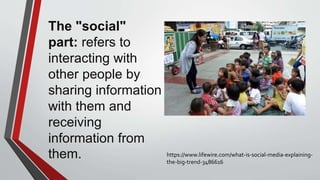
The "social"
part: refers to
interacting with
other people by
sharing information
with them and
receiving
information from
them. https://www.lifewire.com/what-is-social-media-explaining-
the-big-trend-3486616
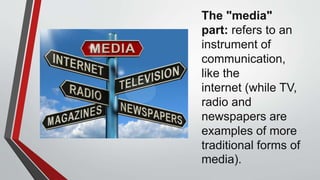
The "media"
part: refers to an
instrument of
communication,
like the
internet (while TV,
radio and
newspapers are
examples of more
traditional forms of
media).
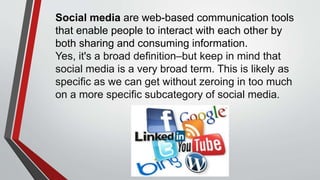
Social media are web-based communication tools
that enable people to interact with each other by
both sharing and consuming information.
Yes, it's a broad definition–but keep in mind that
social media is a very broad term. This is likely as
specific as we can get without zeroing in too much
on a more specific subcategory of social media.
Common Social Media Features
• User Account
• Profile Pages
• Friends, followers, groups,
hashtags and so on
• News feeds
• Personalization
• Notifications
• Information updating, saving or
posting
• Like buttons and comment
sections
• Review, rating or voting systems
The 6 Types of Social Media
https://typesofsocialmedia.com/
1. Social Networks
Services that allow you to connect with other people of
similar interests and background. Usually they consist of a
profile, various ways to interact with other users, ability to
setup groups, etc.The most popular are Facebook and
LinkedIn.
2. Bookmarking Sites
Services that allow you to save, organize and manage links
to various websites and resources around the internet. Most
allow you to "tag" your links to make them easy to search
and share.The most popular are Delicious and
StumbleUpon.
3. Social News
Services that allow people to post
various news items or links to
outside articles and then allows
it's users to "vote" on the items.
The voting is the core social
aspect as the items that get the
most votes are displayed the most
prominently.The community
decides which news items get
seen by more people.The most
popular are Digg and Reddit.
4. Media Sharing
Services that allow you to upload and
share various media such as pictures
and video. Most services have additional
social features such as profiles,
commenting, etc.The most popular are
YouTube and Flickr.
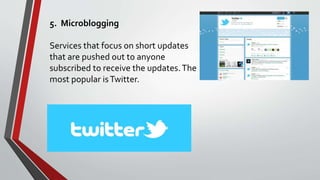
5. Microblogging
Services that focus on short updates
that are pushed out to anyone
subscribed to receive the updates.The
most popular isTwitter.
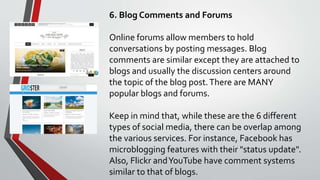
6. Blog Comments and Forums
Online forums allow members to hold
conversations by posting messages. Blog
comments are similar except they are attached to
blogs and usually the discussion centers around
the topic of the blog post.There are MANY
popular blogs and forums.
Keep in mind that, while these are the 6 different
types of social media, there can be overlap among
the various services. For instance, Facebook has
microblogging features with their "status update".
Also, Flickr andYouTube have comment systems
similar to that of blogs.
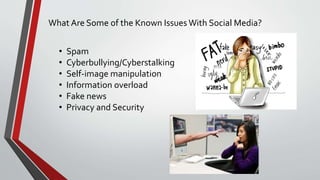
What Are Some of the Known Issues With Social Media?
• Spam
• Cyberbullying/Cyberstalking
• Self-image manipulation
• Information overload
• Fake news
• Privacy and Security
The 10 Best andWorst Ways Social Media Impacts Education
http://www.edudemic.com/social-media-education/
The Negative
1. Many students rely on the accessibility of information
on social media specifically and the web in general to
provide answers.That means a reduced focus on learning
and retaining information.
2. Students who attempt to multi-task, checking social
media sites while studying, show reduced academic
performance.Their ability to concentrate on the task at
hand is significantly reduced by the distractions that are
brought about byYouTube, stumbleupon, Facebook or
Twitter.
3.The more time students spend on social sites, the less time they
spend socializing in person. Because of the lack of body signals and
other nonverbal cues, like tone and inflection, social networking
sites are not an adequate replacement for face-to-face
communication. Students who spend a great deal of time on social
networking are less able to effectively communicate in person.
4.The popularity of social media, and the speed at which
information is published, has created a lax attitude towards proper
spelling and grammar.The reduces a student’s ability to effectively
write without relying on a computer’s spell check feature.
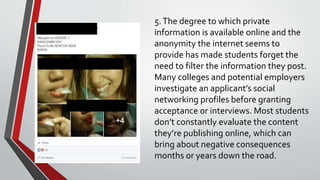
5.The degree to which private
information is available online and the
anonymity the internet seems to
provide has made students forget the
need to filter the information they post.
Many colleges and potential employers
investigate an applicant’s social
networking profiles before granting
acceptance or interviews. Most students
don’t constantly evaluate the content
they’re publishing online, which can
bring about negative consequences
months or years down the road.
The Positive
1. Social networking has increased the rate
and quality of collaboration for students.
They are better able to communicate
meeting times or share information quickly,
which can increase productivity and help
them learn how to work well in groups.
2. Social networking teaches students skills
they’ll need to survive in the business world.
Being able to create and maintain
connections to many people in many
industries is an integral part of developing a
career or building a business.
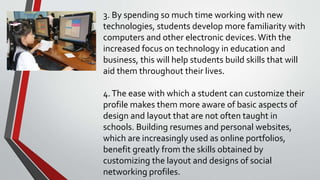
3. By spending so much time working with new
technologies, students develop more familiarity with
computers and other electronic devices.With the
increased focus on technology in education and
business, this will help students build skills that will
aid them throughout their lives.
4.The ease with which a student can customize their
profile makes them more aware of basic aspects of
design and layout that are not often taught in
schools. Building resumes and personal websites,
which are increasingly used as online portfolios,
benefit greatly from the skills obtained by
customizing the layout and designs of social
networking profiles.
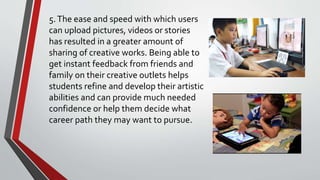
5.The ease and speed with which users
can upload pictures, videos or stories
has resulted in a greater amount of
sharing of creative works. Being able to
get instant feedback from friends and
family on their creative outlets helps
students refine and develop their artistic
abilities and can provide much needed
confidence or help them decide what
career path they may want to pursue.
“The strength of your social
media is determined by the
strength of your content”.

Social media

  • 1.
  • 2.
    The "social" part: refersto interacting with other people by sharing information with them and receiving information from them. https://www.lifewire.com/what-is-social-media-explaining- the-big-trend-3486616
  • 3.
    The "media" part: refersto an instrument of communication, like the internet (while TV, radio and newspapers are examples of more traditional forms of media).
  • 4.
    Social media areweb-based communication tools that enable people to interact with each other by both sharing and consuming information. Yes, it's a broad definition–but keep in mind that social media is a very broad term. This is likely as specific as we can get without zeroing in too much on a more specific subcategory of social media.
  • 5.
    Common Social MediaFeatures • User Account • Profile Pages • Friends, followers, groups, hashtags and so on • News feeds • Personalization • Notifications • Information updating, saving or posting • Like buttons and comment sections • Review, rating or voting systems
  • 6.
    The 6 Typesof Social Media https://typesofsocialmedia.com/ 1. Social Networks Services that allow you to connect with other people of similar interests and background. Usually they consist of a profile, various ways to interact with other users, ability to setup groups, etc.The most popular are Facebook and LinkedIn.
  • 7.
    2. Bookmarking Sites Servicesthat allow you to save, organize and manage links to various websites and resources around the internet. Most allow you to "tag" your links to make them easy to search and share.The most popular are Delicious and StumbleUpon.
  • 8.
    3. Social News Servicesthat allow people to post various news items or links to outside articles and then allows it's users to "vote" on the items. The voting is the core social aspect as the items that get the most votes are displayed the most prominently.The community decides which news items get seen by more people.The most popular are Digg and Reddit.
  • 9.
    4. Media Sharing Servicesthat allow you to upload and share various media such as pictures and video. Most services have additional social features such as profiles, commenting, etc.The most popular are YouTube and Flickr.
  • 10.
    5. Microblogging Services thatfocus on short updates that are pushed out to anyone subscribed to receive the updates.The most popular isTwitter.
  • 11.
    6. Blog Commentsand Forums Online forums allow members to hold conversations by posting messages. Blog comments are similar except they are attached to blogs and usually the discussion centers around the topic of the blog post.There are MANY popular blogs and forums. Keep in mind that, while these are the 6 different types of social media, there can be overlap among the various services. For instance, Facebook has microblogging features with their "status update". Also, Flickr andYouTube have comment systems similar to that of blogs.
  • 12.
    What Are Someof the Known Issues With Social Media? • Spam • Cyberbullying/Cyberstalking • Self-image manipulation • Information overload • Fake news • Privacy and Security
  • 13.
    The 10 BestandWorst Ways Social Media Impacts Education http://www.edudemic.com/social-media-education/ The Negative 1. Many students rely on the accessibility of information on social media specifically and the web in general to provide answers.That means a reduced focus on learning and retaining information. 2. Students who attempt to multi-task, checking social media sites while studying, show reduced academic performance.Their ability to concentrate on the task at hand is significantly reduced by the distractions that are brought about byYouTube, stumbleupon, Facebook or Twitter.
  • 14.
    3.The more timestudents spend on social sites, the less time they spend socializing in person. Because of the lack of body signals and other nonverbal cues, like tone and inflection, social networking sites are not an adequate replacement for face-to-face communication. Students who spend a great deal of time on social networking are less able to effectively communicate in person. 4.The popularity of social media, and the speed at which information is published, has created a lax attitude towards proper spelling and grammar.The reduces a student’s ability to effectively write without relying on a computer’s spell check feature.
  • 15.
    5.The degree towhich private information is available online and the anonymity the internet seems to provide has made students forget the need to filter the information they post. Many colleges and potential employers investigate an applicant’s social networking profiles before granting acceptance or interviews. Most students don’t constantly evaluate the content they’re publishing online, which can bring about negative consequences months or years down the road.
  • 16.
    The Positive 1. Socialnetworking has increased the rate and quality of collaboration for students. They are better able to communicate meeting times or share information quickly, which can increase productivity and help them learn how to work well in groups. 2. Social networking teaches students skills they’ll need to survive in the business world. Being able to create and maintain connections to many people in many industries is an integral part of developing a career or building a business.
  • 17.
    3. By spendingso much time working with new technologies, students develop more familiarity with computers and other electronic devices.With the increased focus on technology in education and business, this will help students build skills that will aid them throughout their lives. 4.The ease with which a student can customize their profile makes them more aware of basic aspects of design and layout that are not often taught in schools. Building resumes and personal websites, which are increasingly used as online portfolios, benefit greatly from the skills obtained by customizing the layout and designs of social networking profiles.
  • 18.
    5.The ease andspeed with which users can upload pictures, videos or stories has resulted in a greater amount of sharing of creative works. Being able to get instant feedback from friends and family on their creative outlets helps students refine and develop their artistic abilities and can provide much needed confidence or help them decide what career path they may want to pursue.
  • 19.
    “The strength ofyour social media is determined by the strength of your content”.