Nutrition
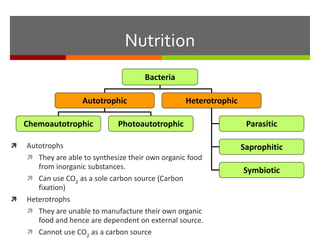
Bacteria
Autotrophic Heterotrophic
Chemoautotrophic Photoautotrophic Parasitic
Saprophitic
Symbiotic
 Autotrophs
 They are able to synthesize their own organic food
from inorganic substances.
 Can use CO2 as a sole carbon source (Carbon
fixation)
 Heterotrophs
 They are unable to manufacture their own organic
food and hence are dependent on external source.
 Cannot use CO2 as a carbon source
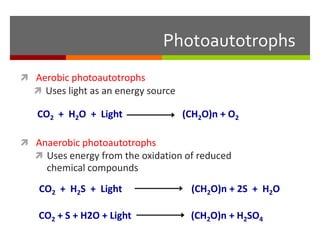
Photoautotrophs
 Aerobic photoautotrophs
 Anaerobic photoautotrophs
CO2 + H2O + Light (CH2O)n + O2
CO2 + H2S + Light (CH2O)n + 2S + H2O
CO2 + S + H2O + Light (CH2O)n + H2SO4
 Uses light as an energy source
 Uses energy from the oxidation of reduced
chemical compounds
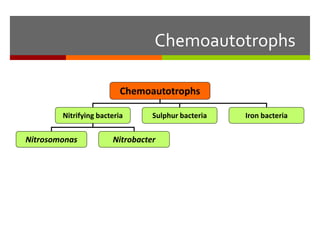
Chemoautotrophs
Chemoautotrophs
Nitrifying bacteria Sulphur bacteria Iron bacteria
Nitrosomonas Nitrobacter
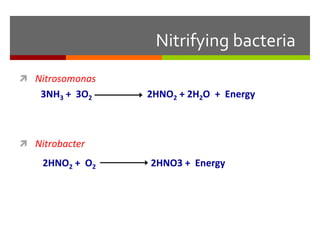
Nitrifying bacteria
 Nitrosomonas
 Nitrobacter
3NH3 + 3O2 2HNO2 + 2H2O + Energy
2HNO2 + O2 2HNO3 + Energy
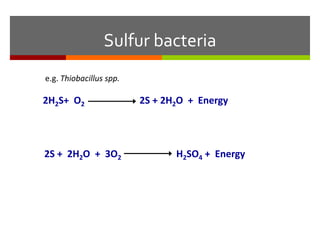
Sulfur bacteria
2H2S+ O2 2S + 2H2O + Energy
2S + 2H2O + 3O2 H2SO4 + Energy
e.g. Thiobacillus spp.
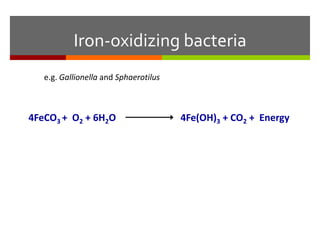
Iron-oxidizing bacteria
4FeCO3 + O2 + 6H2O 4Fe(OH)3 + CO2 + Energy
e.g. Gallionella and Sphaerotilus
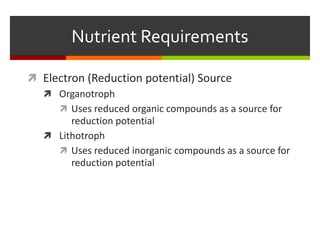
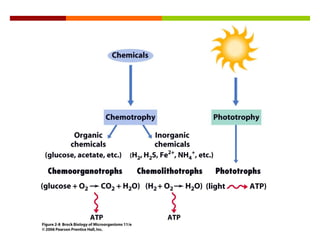
 Electron (Reduction potential) Source
 Organotroph
 Uses reduced organic compounds as a source for
reduction potential
 Lithotroph
 Uses reduced inorganic compounds as a source for
reduction potential
Nutrient Requirements
 Carbon source
 Nitrogen source
 Minerals (phosphorus, sulfur, etc.)
 Growth factors (vitamins, amino acids and
enzymatic cofactors)
Nutrient Requirements
 Prototrophs vs. Auxotrophs
 Prototroph
 A species or genetic strain of microbe capable of
growing on a minimal medium consisting a simple
carbohydrate or CO2 carbon source, with inorganic
sources of all other nutrient requirements
 Auxotroph
 A species or genetic strain requiring one or more
complex organic nutrients (such as amino acids,
nucleotide bases, or enzymatic cofactors) for growth
Microbiological Media
 Liquid (broth) vs. semisolid media
 Liquid medium
 Components are dissolved in water and
sterilized
 Solid medium
 A medium to which has been added a gelling
agent
 Agar (most commonly used)
 Gelatin
Microbiological Media
 Chemically defined vs. complex media
 Chemically defined media
 The exact chemical composition is known
 e.g. minimal media used in bacterial genetics experiments
 Complex media
 Exact chemical composition is not known
 Often consist of plant or animal extracts, such as soybean meal,
milk protein, etc.
 Include most routine laboratory media,
e.g., tryptic soy broth
Microbiological Media
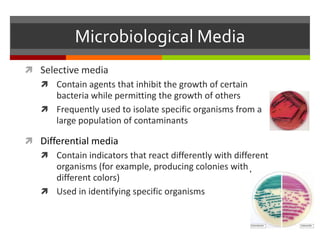
 Selective media
 Contain agents that inhibit the growth of certain
bacteria while permitting the growth of others
 Frequently used to isolate specific organisms from a
large population of contaminants
 Differential media
 Contain indicators that react differently with different
organisms (for example, producing colonies with
different colors)
 Used in identifying specific organisms
Bacterial Growth
Bacterial growth is the division of
one bacterium into two identical
daughter cells during a process
called binary fission. Hence,
doubling of the bacterial
population occurs.
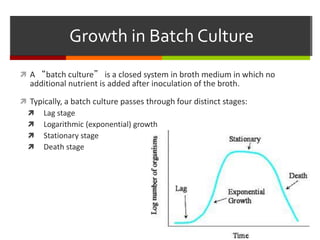
Growth in Batch Culture
 A “batch culture” is a closed system in broth medium in which no
additional nutrient is added after inoculation of the broth.
 Typically, a batch culture passes through four distinct stages:
 Lag stage
 Logarithmic (exponential) growth
 Stationary stage
 Death stage
Measurement of bacterial Growth
1. Microscopic cell counts
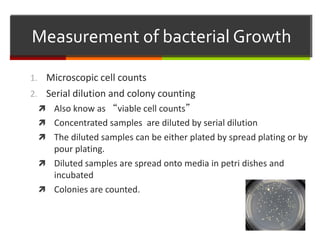
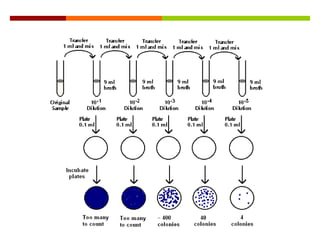
2. Serial dilution and colony counting
 Also know as “viable cell counts”
 Concentrated samples are diluted by serial dilution
 The diluted samples can be either plated by spread plating or by
pour plating.
 Diluted samples are spread onto media in petri dishes and
incubated
 Colonies are counted.
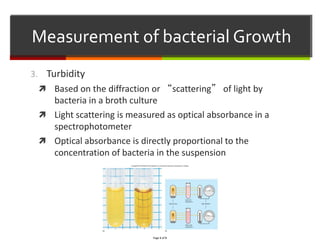
3. Turbidity
 Based on the diffraction or “scattering” of light by
bacteria in a broth culture
 Light scattering is measured as optical absorbance in a
spectrophotometer
 Optical absorbance is directly proportional to the
concentration of bacteria in the suspension
Measurement of bacterial Growth
4. Mass determination
 Cells are removed from a broth culture by centrifugation
and weighed to determine the “wet mass.”
 The cells can be dried out and weighed to determine the
“dry mass.”
5. Measurement of enzymatic activity or other cell
components
Measurement of bacterial Growth
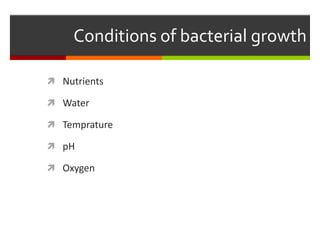
Conditions of bacterial growth
 Nutrients
 Water
 Temprature
 pH
 Oxygen
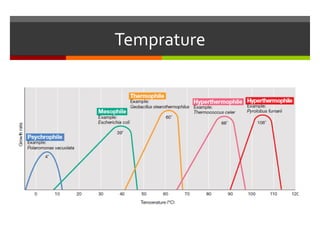
Temprature
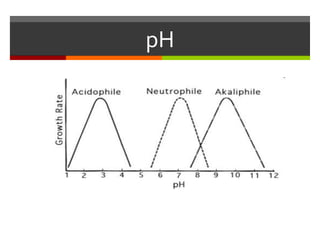
pH
Oxygen
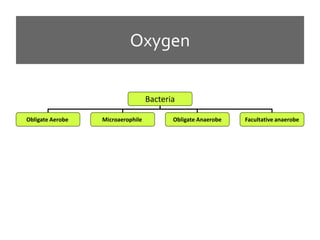
Bacteria
Obligate Aerobe Microaerophile Obligate Anaerobe Facultative anaerobe
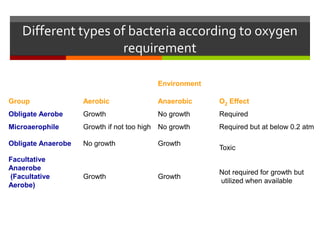
Different types of bacteria according to oxygen
requirement
Environment
Group Aerobic Anaerobic O2 Effect
Obligate Aerobe Growth No growth Required
Microaerophile Growth if not too high No growth Required but at below 0.2 atm
Obligate Anaerobe No growth Growth
Toxic
Facultative
Anaerobe
(Facultative
Aerobe)
Growth Growth
Not required for growth but
utilized when available

Nutrition

  • 1.
    Nutrition Bacteria Autotrophic Heterotrophic Chemoautotrophic PhotoautotrophicParasitic Saprophitic Symbiotic  Autotrophs  They are able to synthesize their own organic food from inorganic substances.  Can use CO2 as a sole carbon source (Carbon fixation)  Heterotrophs  They are unable to manufacture their own organic food and hence are dependent on external source.  Cannot use CO2 as a carbon source
  • 2.
    Photoautotrophs  Aerobic photoautotrophs Anaerobic photoautotrophs CO2 + H2O + Light (CH2O)n + O2 CO2 + H2S + Light (CH2O)n + 2S + H2O CO2 + S + H2O + Light (CH2O)n + H2SO4  Uses light as an energy source  Uses energy from the oxidation of reduced chemical compounds
  • 3.
    Chemoautotrophs Chemoautotrophs Nitrifying bacteria Sulphurbacteria Iron bacteria Nitrosomonas Nitrobacter
  • 4.
    Nitrifying bacteria  Nitrosomonas Nitrobacter 3NH3 + 3O2 2HNO2 + 2H2O + Energy 2HNO2 + O2 2HNO3 + Energy
  • 5.
    Sulfur bacteria 2H2S+ O22S + 2H2O + Energy 2S + 2H2O + 3O2 H2SO4 + Energy e.g. Thiobacillus spp.
  • 6.
    Iron-oxidizing bacteria 4FeCO3 +O2 + 6H2O 4Fe(OH)3 + CO2 + Energy e.g. Gallionella and Sphaerotilus
  • 7.
     Electron (Reductionpotential) Source  Organotroph  Uses reduced organic compounds as a source for reduction potential  Lithotroph  Uses reduced inorganic compounds as a source for reduction potential Nutrient Requirements
  • 9.
    Nutrient Requirements  Carbonsource  Nitrogen source  Minerals (phosphorus, sulfur, etc.)  Growth factors (vitamins, amino acids and enzymatic cofactors)
  • 10.
    Nutrient Requirements  Prototrophsvs. Auxotrophs  Prototroph  A species or genetic strain of microbe capable of growing on a minimal medium consisting a simple carbohydrate or CO2 carbon source, with inorganic sources of all other nutrient requirements  Auxotroph  A species or genetic strain requiring one or more complex organic nutrients (such as amino acids, nucleotide bases, or enzymatic cofactors) for growth
  • 11.
    Microbiological Media  Liquid(broth) vs. semisolid media  Liquid medium  Components are dissolved in water and sterilized  Solid medium  A medium to which has been added a gelling agent  Agar (most commonly used)  Gelatin
  • 12.
    Microbiological Media  Chemicallydefined vs. complex media  Chemically defined media  The exact chemical composition is known  e.g. minimal media used in bacterial genetics experiments  Complex media  Exact chemical composition is not known  Often consist of plant or animal extracts, such as soybean meal, milk protein, etc.  Include most routine laboratory media, e.g., tryptic soy broth
  • 13.
    Microbiological Media  Selectivemedia  Contain agents that inhibit the growth of certain bacteria while permitting the growth of others  Frequently used to isolate specific organisms from a large population of contaminants  Differential media  Contain indicators that react differently with different organisms (for example, producing colonies with different colors)  Used in identifying specific organisms
  • 14.
    Bacterial Growth Bacterial growthis the division of one bacterium into two identical daughter cells during a process called binary fission. Hence, doubling of the bacterial population occurs.
  • 15.
    Growth in BatchCulture  A “batch culture” is a closed system in broth medium in which no additional nutrient is added after inoculation of the broth.  Typically, a batch culture passes through four distinct stages:  Lag stage  Logarithmic (exponential) growth  Stationary stage  Death stage
  • 16.
    Measurement of bacterialGrowth 1. Microscopic cell counts 2. Serial dilution and colony counting  Also know as “viable cell counts”  Concentrated samples are diluted by serial dilution  The diluted samples can be either plated by spread plating or by pour plating.  Diluted samples are spread onto media in petri dishes and incubated  Colonies are counted.
  • 18.
    3. Turbidity  Basedon the diffraction or “scattering” of light by bacteria in a broth culture  Light scattering is measured as optical absorbance in a spectrophotometer  Optical absorbance is directly proportional to the concentration of bacteria in the suspension Measurement of bacterial Growth
  • 19.
    4. Mass determination Cells are removed from a broth culture by centrifugation and weighed to determine the “wet mass.”  The cells can be dried out and weighed to determine the “dry mass.” 5. Measurement of enzymatic activity or other cell components Measurement of bacterial Growth
  • 20.
    Conditions of bacterialgrowth  Nutrients  Water  Temprature  pH  Oxygen
  • 21.
  • 22.
  • 23.
    Oxygen Bacteria Obligate Aerobe MicroaerophileObligate Anaerobe Facultative anaerobe
  • 24.
    Different types ofbacteria according to oxygen requirement Environment Group Aerobic Anaerobic O2 Effect Obligate Aerobe Growth No growth Required Microaerophile Growth if not too high No growth Required but at below 0.2 atm Obligate Anaerobe No growth Growth Toxic Facultative Anaerobe (Facultative Aerobe) Growth Growth Not required for growth but utilized when available