SINGLE CELL
PROTEIN(SCP)
Ankita Behera
M.Sc Microbiology
St. George College of Management & Science
Bengaluru North University
Introduction
• Since,ancient times people near lake chad , Africa and the
lake texoco in Mexico harvested the filamentous BGA (blue
green algar) i.e spirulina from the lake , dried in sin and used
as food.
• But the first industrial production of SCP was during World
war 1 when “Torula Yeast”(Candida utilis) was produced in
Germany and used in soups and sausages.
• The interest in SCP was generate in the wake of protein
deficiency especially in developing countries.
Scp is expected to relive protein
deficiency in 2 ways:-
• It may be used directly as human food supplement.
• It may be used in animal feed to atleast partially replace the
currently used protein –rich soybean meal and fish proteins
and even cereals which can be diverted for human
consumption.
Micro-organisms
• Algae,fungi(filamentous), yeast and bacteria are used for scp
production.
• The micro organisms used for SCP production must be-
1. Non-pathogenic to plants , animals and man.
2. Good nutritional value
3. Easily and cheaply produced on large scale.
4. Toxin free
5. Fast-growing
6. Easy to separate from medium and to dry .
The salient features of different micro-
organisms are:-
ALGAE
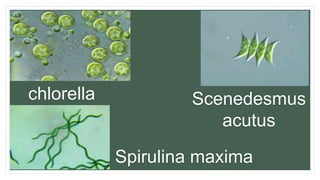
• ALAGE:-members of the genera Chlorella , Scenedesmus and
Spirulina. Are grown in ponds and tanks.
• they use carbondioxie and sunlight as substrate which are without
any cost .
• Algal SCP has about 60% crude protein which is generally good
in amino acids composition except for some deficiency in sulphur
– containing amino acids.
• They are suitable for animal feed as protein rich supplement.
The disadvantages are:-
• Rich chlorophyll content which is not suitable for human use.
• Serious problems when chlorella &Scenedesmus are used in
human diet .
• Low cell density
• Serious risk of contamination .
• Costly recovery methods for unicellular algae.
chlorella Scenedesmus
acutus
Spirulina maxima
Filamentous fungi:-
• It has been used to produce SCP mainly from polysaccharide
hydrolysates. ex:-starch hydrolysates , sulphate liquor from
wood pulp industries.
• These are usually grown as submerged cultures in which
they grow as yeasts like cells in filamentous form .
• They have crude protein content of 50-55% , the protein is
low in sulphur –containing amino acids but otherwise is
excellent in amino acids composition .
• The recovery is easy by filtration .
The problems associated with fungi are:-
• Slower growth rate then bacteria and yeasts but some micro-
fungi may be comparable to yeasts.
• Contamination by yeasts may be frequent if sterility is not
maintained.
• They have nucleic acids content which must be reduce
• The strains have to thoroughly evaluated for mycotoxin
production.
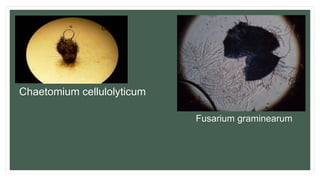
Chaetomium cellulolyticum
Fusarium graminearum
yeasts
• Members of Saccharomyces , Candida & Torulopsis have been
widely studied for SCp production and those of the first 2 genera
are used for commercial processes using various substrates .
• It has 55-60 & crude protein which has good amino acids balance
except for a deficiency in S-containing amino acids.
• Rich in vitamin-b
• Used for both human and animal feed supplement.
• Risk of contamination is low and recovery by continuous
centrifugation is easy.
disadvantages
• Slower growth
• High nucleic acid content
• Methionine supplements may be done to overcome S-
containing amino acids deficiency of its proteins.
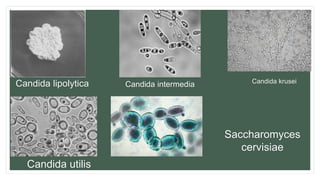
Candida lipolytica Candida krusei
Candida intermedia
Candida utilis
Saccharomyces
cervisiae
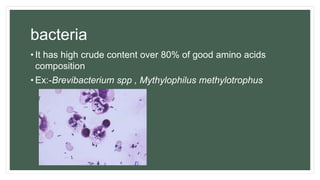
bacteria
• It has high crude content over 80% of good amino acids
composition
• Ex:-Brevibacterium spp , Mythylophilus methylotrophus
disadvantages
• High nucleic acid content especially RNA content must be
reduced
• Sterility must be maintained
• Risk of contamination by pathogenic bacteria is considered
• Recovery of cells is problematic
• Careful evaluation of endotoxin production is essential when
gram negative bacteria are used.
Nucleic acids and their removal:-
• Degradation of nucleic acids produces uric acids which may accumulate to damaging
levels in humans since , they donot posses uricase activity .
• It is therefore necessary that nucleic acids be reduced to acceptably low levels
especially in SCP intended for human use .
• The levels of RNA is reduced using one of the following methods:-
1) Activation of endogenous RNAse by usually a brief treatment heat .
2) Alkaline hydrolysis
3) Chemical extraction
4) Suitable manipulation of growth and physiology of the microbial cells.
Substrates
• A variety of substrates ranging from inorganic carbon through
industrial effluents and low cost organic materials at high cost
materials are used for SCP production.
• These substrates is divided into 2 categories :-
1. fossil carbon sources/non-renewable
2. Renewable carbon sources
but substrates like methanol and ethanol can be produced from
both renewable and non-renewable sources.
FOSSIL CARBON SOURCES
• GASEOUS HYDROCARBONS
• LIQUID HYDROCARBON
• METHANOL
• ETHANOL
Renewable carbon sources :-
• Carbon-di-oxide
• Molasses
• Whey
• Industrial effluents
Production of single cell protein
• Provision of a carbon source it may need physical and/or chemical pretreatment.
• Addition to the carbon source of nitrogen , phosphorus and other nutrients needed to
support optimal growth of selected micro-organisms.
• Prevention of contamination by maintaining sterile or hygenic conditions.the medium
components may be heated or sterilized by filtration and fermentation equipments
may be sterilized.
• the selected micro-organisms is inoculated in a pure state.
• SCP processes are highly aerobic due to which adequate aeration is provided . In
addition cooling is necessary as considerable heat is generated.
• The microbial biomass is recovered from the medium.
• Processing of biomass for enhancing its usefulness and/or storability.
Biomass is carried out in the
continuous mode to maximise yields
and economic returns.
Biomass recovery
• The general approaches for the recovery of biomass are-
I. Bacteria(flocculation and floatation combined with
centrifugation).
II. Yeast(centrifugation)
III. Filamentous fungi (filtration)
• It is important to reduce water as much as possible to reduce
drying costs.
• Sun-drying is cheap but it reduces the quality of SCP.
• Since, recovery processes are not done under sterile
condition so adequate hygine must be maintained and care
should be taken to prevent growth of undesirable micro-
organisms.
• The cell walls must be broken to enhance the nutritional
value of SCP
• The biomass be further processed or even the protein may
be isolated and purified.
Nutritional and safety evaluation
• The SCP chemical composition must be characterises in terms of protein amino acids , nucleic
acids , lipids, vitamins etc.
• Analysis of substrate residues and toxic substances ex- heavy metal , mycotoxin , polycyclic
hydrocarbons etc must be done .
• Physical properties like density , particle size , texture , colour , storage etc properties should be
determined.
• Microbiological description ex- species , strain should be provided and information on
contamination be also given .
• The nutritional value should be evaluated on the target species and other species strain should
be provided and information on contamination be also given .
• The nutritional value should be evaluated on the target species and other species should be
included . The production oh human use will of necessity be evaluated over a long period using
a multi staged process.
• Possible toxic or carcinogenic compunds must be assayed
Advantages of SCP
• It is rich in high quality protein and is poor in fats.
• It can be produced throughout the year and not depend upon climate.
• Microbes used are fast growing and produce large quantites SCP in very
small area of land.
• Use of low cost substrates.
• SCP production helps reduce pollution by usning substrates
• strains having high biomass yields and a desirable amino acids compostion
can be easily selected or produced by genetic engineering .
• They are good source of vitamins , particularly B-group of vitamins.
THANK YOU

Single cell protein(scp)

  • 1.
    SINGLE CELL PROTEIN(SCP) Ankita Behera M.ScMicrobiology St. George College of Management & Science Bengaluru North University
  • 2.
    Introduction • Since,ancient timespeople near lake chad , Africa and the lake texoco in Mexico harvested the filamentous BGA (blue green algar) i.e spirulina from the lake , dried in sin and used as food. • But the first industrial production of SCP was during World war 1 when “Torula Yeast”(Candida utilis) was produced in Germany and used in soups and sausages. • The interest in SCP was generate in the wake of protein deficiency especially in developing countries.
  • 3.
    Scp is expectedto relive protein deficiency in 2 ways:- • It may be used directly as human food supplement. • It may be used in animal feed to atleast partially replace the currently used protein –rich soybean meal and fish proteins and even cereals which can be diverted for human consumption.
  • 4.
    Micro-organisms • Algae,fungi(filamentous), yeastand bacteria are used for scp production. • The micro organisms used for SCP production must be- 1. Non-pathogenic to plants , animals and man. 2. Good nutritional value 3. Easily and cheaply produced on large scale. 4. Toxin free 5. Fast-growing 6. Easy to separate from medium and to dry .
  • 5.
    The salient featuresof different micro- organisms are:-
  • 6.
    ALGAE • ALAGE:-members ofthe genera Chlorella , Scenedesmus and Spirulina. Are grown in ponds and tanks. • they use carbondioxie and sunlight as substrate which are without any cost . • Algal SCP has about 60% crude protein which is generally good in amino acids composition except for some deficiency in sulphur – containing amino acids. • They are suitable for animal feed as protein rich supplement.
  • 7.
    The disadvantages are:- •Rich chlorophyll content which is not suitable for human use. • Serious problems when chlorella &Scenedesmus are used in human diet . • Low cell density • Serious risk of contamination . • Costly recovery methods for unicellular algae.
  • 8.
  • 9.
    Filamentous fungi:- • Ithas been used to produce SCP mainly from polysaccharide hydrolysates. ex:-starch hydrolysates , sulphate liquor from wood pulp industries. • These are usually grown as submerged cultures in which they grow as yeasts like cells in filamentous form . • They have crude protein content of 50-55% , the protein is low in sulphur –containing amino acids but otherwise is excellent in amino acids composition . • The recovery is easy by filtration .
  • 10.
    The problems associatedwith fungi are:- • Slower growth rate then bacteria and yeasts but some micro- fungi may be comparable to yeasts. • Contamination by yeasts may be frequent if sterility is not maintained. • They have nucleic acids content which must be reduce • The strains have to thoroughly evaluated for mycotoxin production.
  • 11.
  • 12.
    yeasts • Members ofSaccharomyces , Candida & Torulopsis have been widely studied for SCp production and those of the first 2 genera are used for commercial processes using various substrates . • It has 55-60 & crude protein which has good amino acids balance except for a deficiency in S-containing amino acids. • Rich in vitamin-b • Used for both human and animal feed supplement. • Risk of contamination is low and recovery by continuous centrifugation is easy.
  • 13.
    disadvantages • Slower growth •High nucleic acid content • Methionine supplements may be done to overcome S- containing amino acids deficiency of its proteins.
  • 14.
    Candida lipolytica Candidakrusei Candida intermedia Candida utilis Saccharomyces cervisiae
  • 15.
    bacteria • It hashigh crude content over 80% of good amino acids composition • Ex:-Brevibacterium spp , Mythylophilus methylotrophus
  • 16.
    disadvantages • High nucleicacid content especially RNA content must be reduced • Sterility must be maintained • Risk of contamination by pathogenic bacteria is considered • Recovery of cells is problematic • Careful evaluation of endotoxin production is essential when gram negative bacteria are used.
  • 17.
    Nucleic acids andtheir removal:- • Degradation of nucleic acids produces uric acids which may accumulate to damaging levels in humans since , they donot posses uricase activity . • It is therefore necessary that nucleic acids be reduced to acceptably low levels especially in SCP intended for human use . • The levels of RNA is reduced using one of the following methods:- 1) Activation of endogenous RNAse by usually a brief treatment heat . 2) Alkaline hydrolysis 3) Chemical extraction 4) Suitable manipulation of growth and physiology of the microbial cells.
  • 18.
    Substrates • A varietyof substrates ranging from inorganic carbon through industrial effluents and low cost organic materials at high cost materials are used for SCP production. • These substrates is divided into 2 categories :- 1. fossil carbon sources/non-renewable 2. Renewable carbon sources but substrates like methanol and ethanol can be produced from both renewable and non-renewable sources.
  • 19.
    FOSSIL CARBON SOURCES •GASEOUS HYDROCARBONS • LIQUID HYDROCARBON • METHANOL • ETHANOL
  • 20.
    Renewable carbon sources:- • Carbon-di-oxide • Molasses • Whey • Industrial effluents
  • 21.
    Production of singlecell protein • Provision of a carbon source it may need physical and/or chemical pretreatment. • Addition to the carbon source of nitrogen , phosphorus and other nutrients needed to support optimal growth of selected micro-organisms. • Prevention of contamination by maintaining sterile or hygenic conditions.the medium components may be heated or sterilized by filtration and fermentation equipments may be sterilized. • the selected micro-organisms is inoculated in a pure state. • SCP processes are highly aerobic due to which adequate aeration is provided . In addition cooling is necessary as considerable heat is generated. • The microbial biomass is recovered from the medium. • Processing of biomass for enhancing its usefulness and/or storability.
  • 22.
    Biomass is carriedout in the continuous mode to maximise yields and economic returns.
  • 23.
    Biomass recovery • Thegeneral approaches for the recovery of biomass are- I. Bacteria(flocculation and floatation combined with centrifugation). II. Yeast(centrifugation) III. Filamentous fungi (filtration)
  • 24.
    • It isimportant to reduce water as much as possible to reduce drying costs. • Sun-drying is cheap but it reduces the quality of SCP. • Since, recovery processes are not done under sterile condition so adequate hygine must be maintained and care should be taken to prevent growth of undesirable micro- organisms. • The cell walls must be broken to enhance the nutritional value of SCP • The biomass be further processed or even the protein may be isolated and purified.
  • 25.
    Nutritional and safetyevaluation • The SCP chemical composition must be characterises in terms of protein amino acids , nucleic acids , lipids, vitamins etc. • Analysis of substrate residues and toxic substances ex- heavy metal , mycotoxin , polycyclic hydrocarbons etc must be done . • Physical properties like density , particle size , texture , colour , storage etc properties should be determined. • Microbiological description ex- species , strain should be provided and information on contamination be also given . • The nutritional value should be evaluated on the target species and other species strain should be provided and information on contamination be also given . • The nutritional value should be evaluated on the target species and other species should be included . The production oh human use will of necessity be evaluated over a long period using a multi staged process. • Possible toxic or carcinogenic compunds must be assayed
  • 26.
    Advantages of SCP •It is rich in high quality protein and is poor in fats. • It can be produced throughout the year and not depend upon climate. • Microbes used are fast growing and produce large quantites SCP in very small area of land. • Use of low cost substrates. • SCP production helps reduce pollution by usning substrates • strains having high biomass yields and a desirable amino acids compostion can be easily selected or produced by genetic engineering . • They are good source of vitamins , particularly B-group of vitamins.
  • 27.