Single Cell Proteins
MUHAMMAD HUSSAIN TAQI
MICROBIOLOGY 7th
PHARMACUEITICAL MICROBIOLOGY
Single Cell Proteins
What Is Single Cell
Proteins?
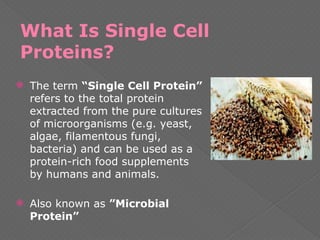
 The term “Single Cell Protein”
refers to the total protein
extracted from the pure cultures
of microorganisms (e.g. yeast,
algae, filamentous fungi,
bacteria) and can be used as a
protein-rich food supplements
by humans and animals.
 Also known as ”Microbial
Protein”
History:
 Used to named as Microbial Proteins.
 1966: M.I.T Professor Carroll L.Wilson renamed it
as “Single Cell Proteins”
 Transportation of food was common in the past but
with the increase in population, energy crisis has
encounter the world.
 So there should an alternate food/protein source to
overcome this energy crisis.
 In 60s’, idea that the dried cells of micro-organisms
can become an ultimate part to solve this problem.
Thus gained research interest among the scientists
& industries (specifically oil industry).
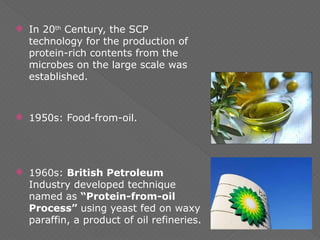
 In 20th
Century, the SCP
technology for the production of
protein-rich contents from the
microbes on the large scale was
established.
 1950s: Food-from-oil.
 1960s: British Petroleum
Industry developed technique
named as “Protein-from-oil
Process” using yeast fed on waxy
paraffin, a product of oil refineries.
Production Of SCP:
Production of SCP involves following steps:
1. Selection of Strain of microbe and Substrate
2. Fermentation
3. Harvesting
4. Post harvest treatment
5. Processing of SCP
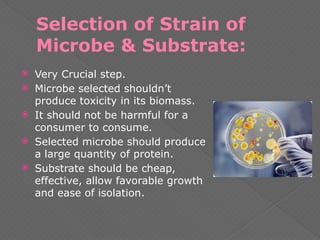
Selection of Strain of
Microbe & Substrate:
 Very Crucial step.
 Microbe selected shouldn’t
produce toxicity in its biomass.
 It should not be harmful for a
consumer to consume.
 Selected microbe should produce
a large quantity of protein.
 Substrate should be cheap,
effective, allow favorable growth
and ease of isolation.
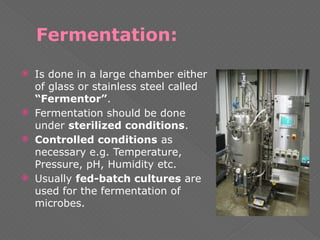
Fermentation:
 Is done in a large chamber either
of glass or stainless steel called
“Fermentor”.
 Fermentation should be done
under sterilized conditions.
 Controlled conditions as
necessary e.g. Temperature,
Pressure, pH, Humidity etc.
 Usually fed-batch cultures are
used for the fermentation of
microbes.
Harvesting:
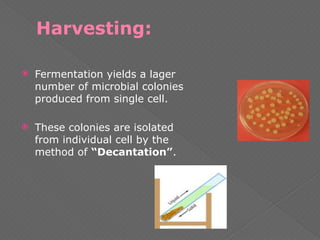
 Fermentation yields a lager
number of microbial colonies
produced from single cell.
 These colonies are isolated
from individual cell by the
method of “Decantation”.
Post-harvesting
Fermentation:
 Isolated microbial colonies are
subjected to various differential
techniques.
 E.g. Centrifugation, Washing,
Drying etc.
Processing of SCPs:
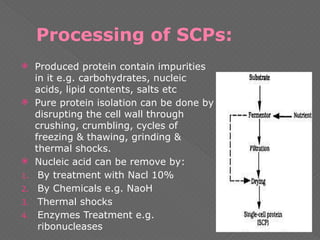
 Produced protein contain impurities
in it e.g. carbohydrates, nucleic
acids, lipid contents, salts etc
 Pure protein isolation can be done by
disrupting the cell wall through
crushing, crumbling, cycles of
freezing & thawing, grinding &
thermal shocks.
 Nucleic acid can be remove by:
1. By treatment with Nacl 10%
2. By Chemicals e.g. NaoH
3. Thermal shocks
4. Enzymes Treatment e.g.
ribonucleases
Advantages of SCPs:
 Some of the advantages of SCPs are as followed:
 Microbes have rapid succession of generation thus
number of generation can be obtained in a very
short interval of time(algae 2-6 hrs, yeast 1-
3hrs, bacteria 0.5-2hrs)
 They can easily be modified genetically for varying
the amino acid composition.
 They contain 43-85% of protein contents in their
dry mass.
 Microbes can use a variety of raw materials as
their source of carbon and thus can cause the
removal of pollutants from the environment.
Continued…
 High yield and good composition SCP
 Can be produce and isolated easily.
 It is beneficial ecologically
Disadvantages of SCPs:
 The disadvantages of SCPs are mentioned below:
 Some microbes are harmful for both humans and
animals and can produce toxins in their biomass which
may cause diseases in humans and animals.
 Microbial biomass may lead to some allergic reactions
and indigestion.
 The higher nucleic acid contents in SCPs may lead to
human kidney stone.
 Production of SCPs is very expensive method and
requires highly sterilized conditions.
 Taste may change & some unacceptable coloration may
produce.
Micro-organisms For
SCPs:
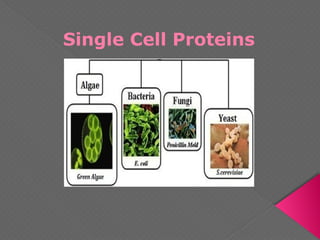
 Micro-organisms that can be used for the
production of SCPs are:
1. Yeast
2. Filamentous Fungi
3. Algae
4. Bacteria
Yeast:
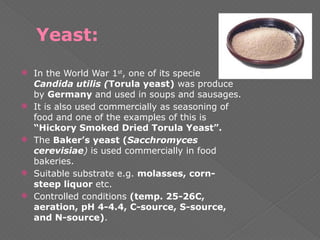
 In the World War 1st
, one of its specie
Candida utilis (Torula yeast) was produce
by Germany and used in soups and sausages.
 It is also used commercially as seasoning of
food and one of the examples of this is
“Hickory Smoked Dried Torula Yeast”.
 The Baker’s yeast (Sacchromyces
cerevisiae) is used commercially in food
bakeries.
 Suitable substrate e.g. molasses, corn-
steep liquor etc.
 Controlled conditions (temp. 25-26C,
aeration, pH 4-4.4, C-source, S-source,
and N-source).
Continued…
 Yeast has some advantages among other SCP
sources e.g.
 The biomass can easily be harvest because of the
larger size of yeast as compare too many bacteria.
 Yeast has long traditional history of its use.
 Biomass produce contain high levels of lysine &
malic acid.
 It can grow at highly acidic pH.
 Whereas, there are some disadvantages too which
includes:
 Yeast has lower growth rate as compare to bacteria.
 Low overall protein contents (45-65%)
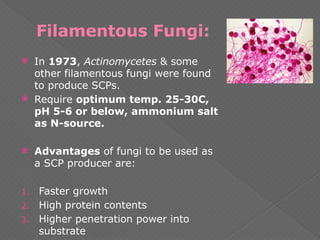
Filamentous Fungi:
 In 1973, Actinomycetes & some
other filamentous fungi were found
to produce SCPs.
 Require optimum temp. 25-30C,
pH 5-6 or below, ammonium salt
as N-source.
 Advantages of fungi to be used as
a SCP producer are:
1. Faster growth
2. High protein contents
3. Higher penetration power into
substrate
Algae:
 Disadvantages include:
1. Some fungi show slower growth
2. Produce mycotoxins
3. Risk of contamination
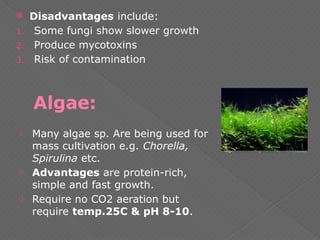
o Many algae sp. Are being used for
mass cultivation e.g. Chorella,
Spirulina etc.
o Advantages are protein-rich,
simple and fast growth.
o Require no CO2 aeration but
require temp.25C & pH 8-10.
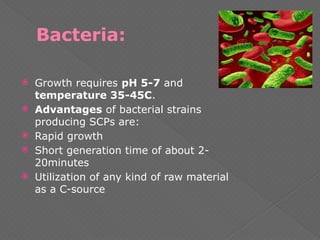
Bacteria:
 Growth requires pH 5-7 and
temperature 35-45C.
 Advantages of bacterial strains
producing SCPs are:
 Rapid growth
 Short generation time of about 2-
20minutes
 Utilization of any kind of raw material
as a C-source
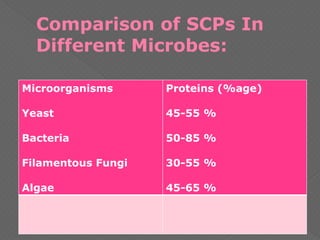
Comparison of SCPs In
Different Microbes:
Microorganisms
Yeast
Bacteria
Filamentous Fungi
Algae
Proteins (%age)
45-55 %
50-85 %
30-55 %
45-65 %
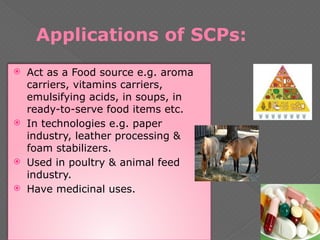
Applications of SCPs:
 Act as a Food source e.g. aroma
carriers, vitamins carriers,
emulsifying acids, in soups, in
ready-to-serve food items etc.
 In technologies e.g. paper
industry, leather processing &
foam stabilizers.
 Used in poultry & animal feed
industry.
 Have medicinal uses.
Conclusion:
 The development of Single Cell Protein is just a
beginning in biotechnology.
 With the improvement in the production of SCPs,
we can solve the malnutritive conditions of the
progressing countries and can also introduce
better quality of food and taste with decreased
chances of occurrence of side effects. Moreover,
genetic modification in microorganisms can lead to
a better future of SCPs in biotechnology,
medicines, agriculture, poultry etc.
singlecellprotein-140416102658-phpapp02.pptx

singlecellprotein-140416102658-phpapp02.pptx

  • 2.
    Single Cell Proteins MUHAMMADHUSSAIN TAQI MICROBIOLOGY 7th PHARMACUEITICAL MICROBIOLOGY
  • 3.
  • 4.
    What Is SingleCell Proteins?  The term “Single Cell Protein” refers to the total protein extracted from the pure cultures of microorganisms (e.g. yeast, algae, filamentous fungi, bacteria) and can be used as a protein-rich food supplements by humans and animals.  Also known as ”Microbial Protein”
  • 5.
    History:  Used tonamed as Microbial Proteins.  1966: M.I.T Professor Carroll L.Wilson renamed it as “Single Cell Proteins”  Transportation of food was common in the past but with the increase in population, energy crisis has encounter the world.  So there should an alternate food/protein source to overcome this energy crisis.  In 60s’, idea that the dried cells of micro-organisms can become an ultimate part to solve this problem. Thus gained research interest among the scientists & industries (specifically oil industry).
  • 6.
     In 20th Century,the SCP technology for the production of protein-rich contents from the microbes on the large scale was established.  1950s: Food-from-oil.  1960s: British Petroleum Industry developed technique named as “Protein-from-oil Process” using yeast fed on waxy paraffin, a product of oil refineries.
  • 7.
    Production Of SCP: Productionof SCP involves following steps: 1. Selection of Strain of microbe and Substrate 2. Fermentation 3. Harvesting 4. Post harvest treatment 5. Processing of SCP
  • 8.
    Selection of Strainof Microbe & Substrate:  Very Crucial step.  Microbe selected shouldn’t produce toxicity in its biomass.  It should not be harmful for a consumer to consume.  Selected microbe should produce a large quantity of protein.  Substrate should be cheap, effective, allow favorable growth and ease of isolation.
  • 9.
    Fermentation:  Is donein a large chamber either of glass or stainless steel called “Fermentor”.  Fermentation should be done under sterilized conditions.  Controlled conditions as necessary e.g. Temperature, Pressure, pH, Humidity etc.  Usually fed-batch cultures are used for the fermentation of microbes.
  • 10.
    Harvesting:  Fermentation yieldsa lager number of microbial colonies produced from single cell.  These colonies are isolated from individual cell by the method of “Decantation”.
  • 11.
    Post-harvesting Fermentation:  Isolated microbialcolonies are subjected to various differential techniques.  E.g. Centrifugation, Washing, Drying etc.
  • 12.
    Processing of SCPs: Produced protein contain impurities in it e.g. carbohydrates, nucleic acids, lipid contents, salts etc  Pure protein isolation can be done by disrupting the cell wall through crushing, crumbling, cycles of freezing & thawing, grinding & thermal shocks.  Nucleic acid can be remove by: 1. By treatment with Nacl 10% 2. By Chemicals e.g. NaoH 3. Thermal shocks 4. Enzymes Treatment e.g. ribonucleases
  • 13.
    Advantages of SCPs: Some of the advantages of SCPs are as followed:  Microbes have rapid succession of generation thus number of generation can be obtained in a very short interval of time(algae 2-6 hrs, yeast 1- 3hrs, bacteria 0.5-2hrs)  They can easily be modified genetically for varying the amino acid composition.  They contain 43-85% of protein contents in their dry mass.  Microbes can use a variety of raw materials as their source of carbon and thus can cause the removal of pollutants from the environment.
  • 14.
    Continued…  High yieldand good composition SCP  Can be produce and isolated easily.  It is beneficial ecologically
  • 15.
    Disadvantages of SCPs: The disadvantages of SCPs are mentioned below:  Some microbes are harmful for both humans and animals and can produce toxins in their biomass which may cause diseases in humans and animals.  Microbial biomass may lead to some allergic reactions and indigestion.  The higher nucleic acid contents in SCPs may lead to human kidney stone.  Production of SCPs is very expensive method and requires highly sterilized conditions.  Taste may change & some unacceptable coloration may produce.
  • 16.
    Micro-organisms For SCPs:  Micro-organismsthat can be used for the production of SCPs are: 1. Yeast 2. Filamentous Fungi 3. Algae 4. Bacteria
  • 17.
    Yeast:  In theWorld War 1st , one of its specie Candida utilis (Torula yeast) was produce by Germany and used in soups and sausages.  It is also used commercially as seasoning of food and one of the examples of this is “Hickory Smoked Dried Torula Yeast”.  The Baker’s yeast (Sacchromyces cerevisiae) is used commercially in food bakeries.  Suitable substrate e.g. molasses, corn- steep liquor etc.  Controlled conditions (temp. 25-26C, aeration, pH 4-4.4, C-source, S-source, and N-source).
  • 18.
    Continued…  Yeast hassome advantages among other SCP sources e.g.  The biomass can easily be harvest because of the larger size of yeast as compare too many bacteria.  Yeast has long traditional history of its use.  Biomass produce contain high levels of lysine & malic acid.  It can grow at highly acidic pH.  Whereas, there are some disadvantages too which includes:  Yeast has lower growth rate as compare to bacteria.  Low overall protein contents (45-65%)
  • 19.
    Filamentous Fungi:  In1973, Actinomycetes & some other filamentous fungi were found to produce SCPs.  Require optimum temp. 25-30C, pH 5-6 or below, ammonium salt as N-source.  Advantages of fungi to be used as a SCP producer are: 1. Faster growth 2. High protein contents 3. Higher penetration power into substrate
  • 20.
    Algae:  Disadvantages include: 1.Some fungi show slower growth 2. Produce mycotoxins 3. Risk of contamination o Many algae sp. Are being used for mass cultivation e.g. Chorella, Spirulina etc. o Advantages are protein-rich, simple and fast growth. o Require no CO2 aeration but require temp.25C & pH 8-10.
  • 21.
    Bacteria:  Growth requirespH 5-7 and temperature 35-45C.  Advantages of bacterial strains producing SCPs are:  Rapid growth  Short generation time of about 2- 20minutes  Utilization of any kind of raw material as a C-source
  • 22.
    Comparison of SCPsIn Different Microbes: Microorganisms Yeast Bacteria Filamentous Fungi Algae Proteins (%age) 45-55 % 50-85 % 30-55 % 45-65 %
  • 23.
    Applications of SCPs: Act as a Food source e.g. aroma carriers, vitamins carriers, emulsifying acids, in soups, in ready-to-serve food items etc.  In technologies e.g. paper industry, leather processing & foam stabilizers.  Used in poultry & animal feed industry.  Have medicinal uses.
  • 24.
    Conclusion:  The developmentof Single Cell Protein is just a beginning in biotechnology.  With the improvement in the production of SCPs, we can solve the malnutritive conditions of the progressing countries and can also introduce better quality of food and taste with decreased chances of occurrence of side effects. Moreover, genetic modification in microorganisms can lead to a better future of SCPs in biotechnology, medicines, agriculture, poultry etc.